

India Menstrual Care Market Research Report: Size, Share, Trends & Forecast (2026-2032)
By Product Type (Sanitary Napkins/Pads, Tampons, Panty Liners, Others), By Material Type (Cotton, Synthetic, Biodegradable Compostable), By Category Type (Reusable, Disposable), By ... Distribution Channel (Supermarket/Hypermarket, Drug Store/Pharmacies, Online Retail Stores, Others), By Top Brands (Whisper, Stayfree, Paree, Sofee, Carefree, Others), and others Read more
- Healthcare
- Feb 2026
- Pages 170
- Report Format: PDF, Excel, PPT
India Menstrual Care Market
Projected 7.82% CAGR from 2026 to 2032
Study Period
2026-2032
Market Size (2026)
USD 1.07 Billion
Market Size (2032)
USD 1.69 Billion
Base Year
2025
Projected CAGR
7.82%
Leading Segments
By Product type: Sanitary Napkins/Pads
India Menstrual Care Market Report Key Takeaways:
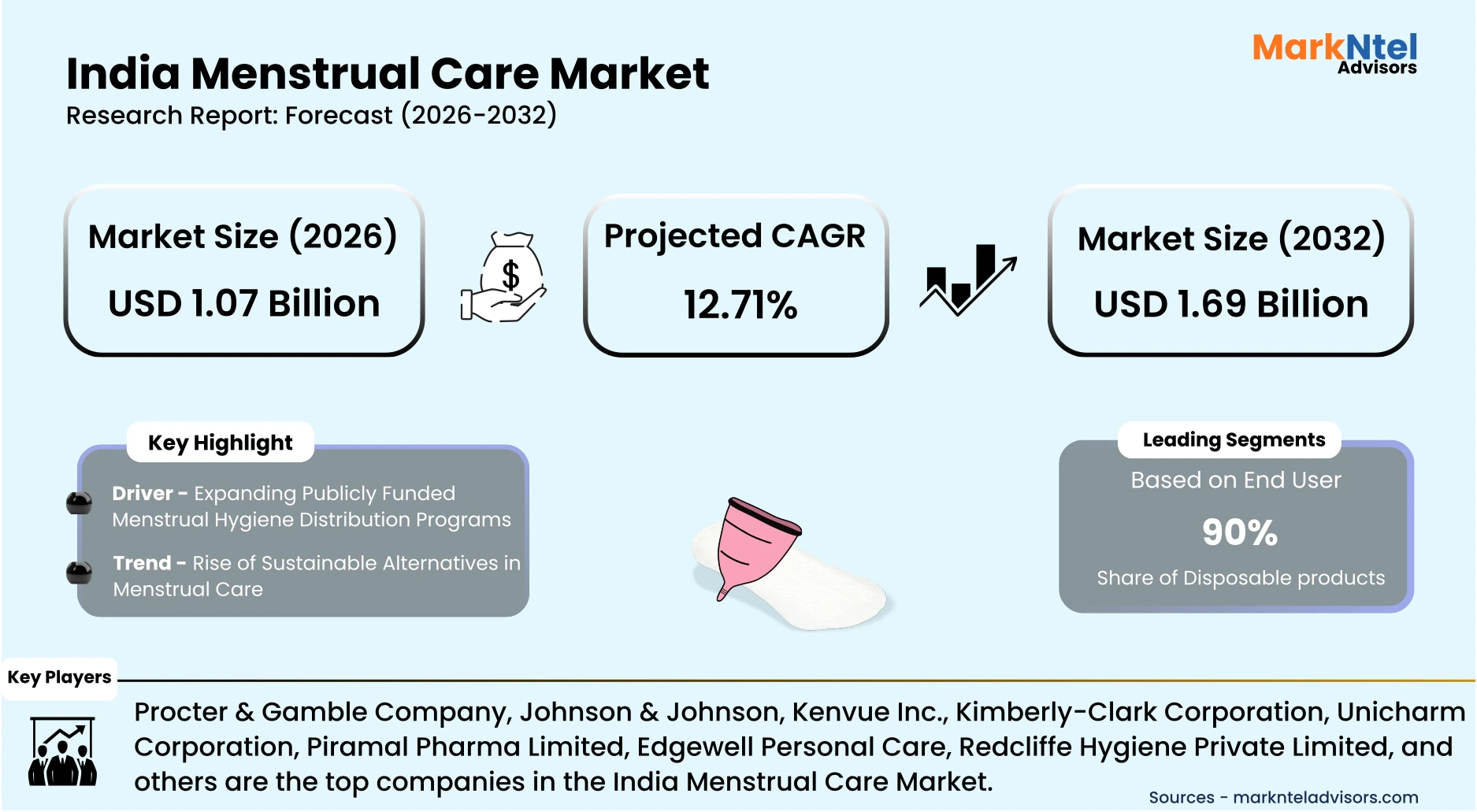
- The India Menstrual Care Market size was valued at USD 0.94 billion in 2025 and is projected to grow from USD 1.07 billion in 2026 to USD 1.69 billion by 2032, exhibiting a CAGR of 7.82% during the forecast period.
- North India is the leading region with a significant share of around 34% in 2026.
- By Product type, the Sanitary napkins segment represented a significant share of about 88% in the Indian Menstrual Care Market in 2026.
- By Category type, the disposable segment presented a significant share of about 90% in the Indian Menstrual Care Market in 2026.
- Leading Menstrual Care Companies in the Indian Market are Procter & Gamble Company, Johnson & Johnson, Kenvue Inc., Kimberly-Clark Corporation, Unicharm Corporation, Piramal Pharma Limited, Edgewell Personal Care, Redcliffe Hygiene Private Limited, Soothe Healthcare Pvt Ltd, Sirona Hygiene Pvt Ltd, Greener Period LLP, and Others.
Market Insights & Analysis: India Menstrual Care Market (2026-32):
The Indian Menstrual Care Market size was valued at USD 0.94 billion in 2025 and is projected to grow from USD 1.07 billion in 2026 to USD 1.69 billion by 2032, exhibiting a CAGR of 7.82% during the forecast period, i.e., 2026-32.
India’s menstrual care market has strengthened alongside demographic expansion and the formalization of hygiene supply chains. The MoHFW’s Scheme for Promotion of Menstrual Hygiene targets adolescent girls aged 10–19 and aims to improve awareness, access to sanitary products, and safe disposal. According to UNICEF 2024 WASH updates, improved sanitation coverage in rural schools has enhanced safe product usage conditions. This institutional integration has historically expanded consumption beyond urban households into structured public distribution systems.
In 2026, the Ministry of Women and Child Development expanded gender budgeting allocations, directing additional funds toward adolescent health and hygiene education under national welfare schemes. Concurrently, the Department for Promotion of Industry and Internal Trade reported fresh manufacturing approvals in hygiene product clusters under Production Linked Incentive–aligned frameworks. These measures have encouraged domestic capacity expansion and supply reliability, positively influencing institutional procurement and retail penetration.
End-user segmentation reveals sustained residential dominance, supported by rising female workforce participation, which the World Bank estimated at over 32% in 2025 . Institutional buyers, including state-run schools and community health centers, increasingly procure standardized hygiene kits through centralized tenders. Commercial channels, particularly organized retail chains in metropolitan areas, have expanded shelf space for branded hygiene portfolios. This multi-channel demand architecture supports volume growth across both urban and semi-urban consumption centers.
Industry-led initiatives further reinforce expansion prospects. In 2025, Procter & Gamble highlighted in its Annual Report that raw material costs remain subject to volatility due to global supply conditions, commodity price fluctuations, and geopolitical factors, and emphasized ongoing supply chain and sourcing strategies to manage input risk Meanwhile, Hindustan Unilever Limited continued strengthening its distribution ecosystem, including enhancements to direct-to-retailer models and last-mile delivery systems to improve reach across rural and semi -urban markets sustainability integration, including biodegradable product pilots introduced by domestic startups, aligns with evolving environmental standards. Collectively, regulatory backing, manufacturing localization, and diversified end-user adoption position the market for sustained forward momentum through 2026 and beyond.
India Menstrual Care Market Recent Developments:
- 2025: Sirona, a leading Indian femtech brand, partnered with M3M India to install menstrual hygiene vending machines across 15 commercial spaces in Delhi‑NCR, offering pads, cups, liners, and wipes in public areas, improving product accessibility and convenience in high-traffic urban spaces.
- 2026: In January 2026, the Supreme Court of India ruled that menstrual health and access to menstrual hygiene products are part of the fundamental right to life and dignity under Article 21 of the Constitution. The court directed pan-India implementation of the Menstrual Hygiene Policy for School‑going Girls, including free provision of biodegradable sanitary products and improved sanitation facilities in all schools.
India Menstrual Care Market Scope:
| Category | Segments |
|---|---|
| By Product Type | (Sanitary Napkins/Pads, Tampons, Panty Liners, Others), |
| By Material Type | (Cotton, Synthetic, Biodegradable Compostable), |
| By Category Type | (Reusable, Disposable), |
| By Distribution Channel | (Supermarket/Hypermarket, Drug Store/Pharmacies, Online Retail Stores, Others), |
| By Top Brands | (Whisper, Stayfree, Paree, Sofee, Carefree, Others), |
India Menstrual Care Market Driver:
Expanding Publicly Funded Menstrual Hygiene Distribution Programs
A structurally transformative driver is the nationwide scale-up of publicly funded menstrual hygiene distribution under school and community health frameworks. National Health Mission (NHM) funding continues as a major public health expenditure line item, indicating government support for adolescent reproductive and menstrual health services being rolled out through states and districts. This expansion has institutionalized recurring procurement of sanitary products, converting public health mandates into predictable bulk demand streams.
The Department of Pharmaceuticals distributes oxo-biodegradable sanitary napkins branded as Suvidha at a subsidized price of USD 0.011 per pad through more than 16,000 Pradhan Mantri Bharatiya Janaushadhi Pariyojana outlets (Jan Aushadhi Kendras ). This large-scale subsidised distribution network enhances product accessibility while generating steady volume requirements for manufacturers.
Collectively, these measures create clearer pricing benchmarks and a structured procurement pipeline, enabling manufacturers to plan production capacity and supply commitments with greater certainty.
State-level implementation reports indicate that free or subsidized product distribution programs have broadened rural access. In Punjab, the state government’s Navi Disha initiative spent USD 6.47 million in 2025 to provide free sanitary pads to over 0.136 million women and girls via local centers and Anganwadis, illustrating government-led distribution that improves access and product uptake. As a result, first-time adoption rates in lower-income districts have measurably increased, expanding overall consumption volume rather than merely shifting brand preferences. By converting menstrual hygiene into a publicly supported essential good, government-led distribution structurally enlarges the addressable user base, reinforcing durable market expansion across geographies.
India Menstrual Care Market Trend:
Rise of Sustainable Alternatives in Menstrual Care
There is a growing preference among Indian consumers for eco-friendly menstrual products, including menstrual cups, reusable cloth pads, and biodegradable sanitary napkins made from materials like bamboo, banana fiber, corn starch, or organic cotton. This trend is driven by environmental awareness, growing concern over plastic waste, and the long-term cost-effectiveness of reusable options.
Government programs and initiatives are actively supporting this movement. For example, several state health departments, like in Kerala, Karnataka , and Odisha, have started integrating biodegradable sanitary pads and reusable menstrual products into school and adolescent health programs to promote sustainable menstrual hygiene. For example, the Kerala State Women’s Development Corporation (KSWDC) extended its She Pad initiative to all government and aided schools and included menstrual cup distribution under the M‑Cup program, reaching more than 10,000 beneficiaries with guidance on safe usage.
Awareness campaigns under the National Health Mission (NHM) and Rashtriya Kishor Swasthya Karyakram (RKSK) educate adolescent girls about safe, eco-friendly menstrual options, increasing adoption in rural and urban areas. The ‘NIRA’ initiative in Uttar Pradesh’s Baghpat district was launched to promote eco-friendly reusable menstrual pads in collaboration with UNICEF and the Indian Red Cross Society, reinforcing local awareness and sustainable product adoption.
The rise of sustainable alternatives is structurally reshaping the menstrual care market in India: demand is shifting from conventional disposable pads to reusable and biodegradable options, encouraging manufacturers to innovate, diversify product lines, and adopt environmentally responsible production practices.
India Menstrual Care Market Opportunity:
Growth of Domestic Sustainable Manufacturing Ecosystems
An exciting prospect is unfolding with the emergence of localised sustainable manufacturing clusters supported by industrial policy. In 2025, the Ministry of Micro, Small, and Medium Enterprises expanded credit guarantees for women-led manufacturing enterprises, improving entry feasibility for smaller hygiene producers. This structural shift reduces capital barriers for biodegradable and reusable product innovators.
Simultaneously, India’s Plastic Waste Management Rules outline producer responsibilities and encourage compliance with waste norms, creating an environment where compostable and plant-based product alternatives are increasingly relevant for manufacturers and plant-based menstrual products. New entrants leveraging alternative raw materials can align with compliance trends while differentiating from conventional synthetic-heavy offerings.
Because large incumbents operate established mass-production lines, agile startups can adapt faster to sustainability-driven procurement preferences in educational institutions and urban eco-conscious segments. Policy-backed financing and regulatory encouragement, therefore, create a timely and scalable entry window for emerging manufacturers.
India Menstrual Care Market Challenge:
Waste Management and Disposal Infrastructure Gaps
A critical structural constraint is inadequate menstrual waste disposal infrastructure. The Swachh Bharat Mission 2025 urban review acknowledged persistent solid waste segregation gaps in multiple municipalities. Limited scientific disposal facilities restrict environmentally compliant handling of absorbent hygiene products.
In 2026, the National Green Tribunal reiterated directives on biomedical and sanitary waste treatment compliance, increasing scrutiny on local authorities. However, implementation disparities across states create uncertainty for manufacturers introducing high-volume disposable formats. This regulatory enforcement environment adds compliance complexity to distribution planning.
In some Karnataka panchayats, menstrual waste was highlighted as a significant daily waste stream, e.g., up to 200 kg per day, showing how local waste systems struggle with classification and handling without effective infrastructure. This structural bottleneck can moderate long-term scalability unless infrastructure investment keeps pace with product penetration.
India Menstrual Care Market (2026-2032) Segmentation Analysis:
The India Menstrual Care Market study of MarkNtel Advisors evaluates and highlights the major trends and influencing factors in each segment. It includes predictions for the period 2026–32 at the country level. Based on the analysis, the market has been further classified as follows:
Based on Product type:
- Sanitary Napkins/Pads
- Tampons
- Panty Liners
- Others
Sanitary napkins dominate India’s menstrual care landscape with a market share of 88% due to entrenched public health distribution frameworks favoring disposable formats. The Indian Council of Medical Research in 2024 highlighted disposable pads as the most commonly adopted product in community-level health interventions. This preference aligns with ease of use and standardized quality control in institutional procurement.
Manufacturing investments further consolidate leadership. Johnson & Johnson has maintained and grown its manufacturing capabilities in India over time to support domestic consumer healthcare demand. Its facility near Kothur in Telangana, one of the company’s largest manufacturing plants, was developed to serve personal hygiene and consumer product lines for the Indian market, demonstrating long-term investment in local production infrastructure that can support rising retail offtake. Disposable pads benefit from economies of scale, enabling competitive pricing across income tiers.
End-user behavior reinforces dominance, as first-time adolescent users typically adopt pads through school distribution or pharmacy channels. Institutional endorsement, mass production efficiency, and widespread retail availability collectively sustain sanitary napkins’ structural leadership in the market.
Based on Category:
- Reusable
- By price range:
- (USD 1.80 – USD 30.10)
- Disposable
- By price range:
- (USD 0.30 – USD 3.00)
Disposable products lead the price-category spectrum with a market share of 90% due to affordability and recurring purchase patterns. Government-supported supply in low-income districts normalizes single-use adoption among price-sensitive consumers. Low entry price points between USD 0.30 and USD 3.00 per pack support broad penetration.
In 2025, an increase in rural consumption expenditure enabled consistent replenishment purchases. Disposable formats align with convenience preferences among working women in urban clusters.
Manufacturers prioritize high-volume, low-margin models supported by extensive distribution networks. Price accessibility, institutional alignment, and behavioral familiarity collectively underpin disposable dominance over reusable alternatives in India’s evolving hygiene economy. The Indian social entrepreneur Arunachalam Muruganantham developed low-cost sanitary pad-making machines that have been installed across multiple states , enabling grassroots and local manufacturing of inexpensive disposable pads. This innovation helps local supply chains prioritize high-volume, low-margin production that can be sold cheaply and widely.
India Menstrual Care Market (2026-2032) Regional Analysis:
North India lead by Delhi-NCR, leads in the menstrual care industry with a market share of 34% due to high per capita income concentration and organized retail density. According to the Government of the National Capital Territory of Delhi's 2025 economic survey, the region maintains one of India’s highest urban consumption indices. This purchasing power translates directly into branded hygiene product demand.
Awareness programmes and NGO activities focused on menstrual health are active in Delhi‑NCR, which supports informed product demand and better market engagement. Initiatives like the YFLO menstrual health awareness drive engaged women across multiple sites in Delhi‑NCR, providing education and access to products as part of empowerment and health outreach.
The region benefits from advanced logistics infrastructure, including proximity to major warehousing corridors in Gurugram and Noida. Policy-driven urban health outreach programs implemented by the Delhi State Health Mission enhance awareness and product accessibility.
Additionally, corporate headquarters and multinational FMCG offices located in NCR drive aggressive marketing and distribution pilots. Concentrated institutional buyers, modern trade penetration, and strong income fundamentals collectively position Delhi-NCR as the most dominant regional market through 2026.
Rajasthan launched the Udaan Scheme to distribute free sanitary pads every month to adolescent girls and menstruating women through schools, Anganwadi centers, and health outreach programs, making the state one of the first in India to offer such widespread free pad distribution. Under the scheme, women and girls up to age ~45 regularly receive sanitary napkins, 6 pads per packet every month. When menstrual products are free and distributed widely, school absenteeism among girls drops, and dignity improves. This kind of public distribution boosts both health outcomes and social norm change.
Gain a Competitive Edge with Our India Menstrual Care Market Report:
- The India Menstrual Care Market Report by MarkNtel Advisors provides a detailed & thorough analysis of market size & share, growth rate, competitive landscape, and key players. This comprehensive analysis helps businesses gain a holistic understanding of the market dynamics & make informed decisions.
- This report also highlights current market trends & future projections, allowing businesses to identify emerging opportunities & potential challenges. By understanding market forecasts, companies can align their strategies & stay ahead of the competition.
- The India Menstrual Care Market Report aids in assessing & mitigating risks associated with entering or operating in the market. By understanding market dynamics, regulatory frameworks, and potential challenges, businesses can develop strategies to minimize risks & optimize their operations.
*Reports Delivery Format - Market research studies from MarkNtel Advisors are offered in PDF, Excel and PowerPoint formats. Within 24 hours of the payment being successfully received, the report will be sent to your email address.
Frequently Asked Questions
- Market Segmentation
- Introduction
- Product Definition
- Research Process
- Assumptions
- Executive Summary
- India Menstrual Care Market Policies, Regulations, and Product Standards
- India Menstrual Care Market Trends & Developments
- India Menstrual Care Market Dynamics
- Growth Factors
- Challenges
- India Menstrual Care Market Hotspot & Opportunities
- India Menstrual Care Market Outlook, 2022-2032F
- Market Size & Outlook
- By Revenues (USD Million)
- Market Share & Outlook
- By Product Type- Market Size & Forecast 2022-2032, USD Million
- Sanitary Napkins/Pads
- Tampons
- Panty Liners
- Others
- By Material Type- Market Size & Forecast 2022-2032, USD Million
- Cotton
- Synthetic
- Biodegradable Compostable
- By Category Type- Market Size & Forecast 2022-2032, USD Million
- Reusable
- USD1-USD10
- USD10-USD20
- USD20-USD30
- Disposable
- USD 0.30-USD 1.00
- USD 1.00- USD 2.00
- USD 2.00- USD 3.00
- Reusable
- By Distribution Channel- Market Size & Forecast 2022-2032, USD Million
- Supermarket/Hypermarket
- Drug Store/Pharmacies
- Online Retail Stores
- Others
- By Top Brands- Market Size & Forecast 2022-2032, USD Million
- Whisper
- Stayfree
- Paree
- Sofee
- Carefree
- Others
- By Region- Market Size & Forecast 2022-2032, USD Million
- North
- National Capital Region (Delhi NCR)
- Uttar Pradesh
- Punjab
- Rajasthan
- South
- Karnataka
- Tamil Nadu
- Kerala
- East
- West Bengal
- Odisha
- West
- Maharashtra
- Gujarat
- Madhya Pradesh
- North
- By Company
- Competition Characteristics
- Market Share & Analysis
- By Product Type- Market Size & Forecast 2022-2032, USD Million
- Market Size & Outlook
- India Sanitary Napkins/Pads Market Outlook, 2022-2032
- Market Size & Outlook
- By Revenues (USD Million)
- Market Share & Outlook
- By Material Type- Market Size & Forecast 2022-2032, USD Million
- By Category Type- Market Size & Forecast 2022-2032, USD Million
- By Distribution Channel- Market Size & Forecast 2022-2032, USD Million
- By Top Brands- Market Size & Forecast 2022-2032, USD Million
- By Region- Market Size & Forecast 2022-2032, USD Million
- Market Size & Outlook
- India Tampons Market Outlook, 2022-2032
- Market Size & Outlook
- By Revenues (USD Million)
- Market Share & Outlook
- By Material Type- Market Size & Forecast 2022-2032, USD Million
- By Category Type- Market Size & Forecast 2022-2032, USD Million
- By Distribution Channel- Market Size & Forecast 2022-2032, USD Million
- By Top Brands- Market Size & Forecast 2022-2032, USD Million
- By Region- Market Size & Forecast 2022-2032, USD Million
- Market Size & Outlook
- India Panty Liners Market Outlook, 2022-2032
- Market Size & Outlook
- By Revenues (USD Million)
- Market Share & Outlook
- By Material Type- Market Size & Forecast 2022-2032, USD Million
- By Category Type- Market Size & Forecast 2022-2032, USD Million
- By Distribution Channel- Market Size & Forecast 2022-2032, USD Million
- By Top Brands- Market Size & Forecast 2022-2032, USD Million
- By Region- Market Size & Forecast 2022-2032, USD Million
- Market Size & Outlook
- India Menstrual Care Market Key Strategic Imperatives for Success & Growth
- Competitive Outlook
- Company Profiles
- Procter and Gamble Company
- Business Description
- Product Portfolio
- Collaborations & Alliances
- Recent Developments
- Financial Details
- Others
- Kenvue Inc.
- Business Description
- Product Portfolio
- Collaborations & Alliances
- Recent Developments
- Financial Details
- Others
- Kimberly-Clark Corporation
- Business Description
- Product Portfolio
- Collaborations & Alliances
- Recent Developments
- Financial Details
- Others
- Unicharm Corporation
- Business Description
- Product Portfolio
- Collaborations & Alliances
- Recent Developments
- Financial Details
- Others
- Piramal Pharma Limited (i-Activ)
- Business Description
- Product Portfolio
- Collaborations & Alliances
- Recent Developments
- Financial Details
- Others
- Edgewell Personal Care
- Business Description
- Product Portfolio
- Collaborations & Alliances
- Recent Developments
- Financial Details
- Others
- Redcliffe Hygiene Private Limited
- Business Description
- Product Portfolio
- Collaborations & Alliances
- Recent Developments
- Financial Details
- Others
- Soothe Healthcare Pvt Ltd (Paree)
- Business Description
- Product Portfolio
- Collaborations & Alliances
- Recent Developments
- Financial Details
- Others
- Sirona Hygiene Pvt Ltd
- Business Description
- Product Portfolio
- Collaborations & Alliances
- Recent Developments
- Financial Details
- Others
- Greener Period LLP (Soch Green)
- Business Description
- Product Portfolio
- Collaborations & Alliances
- Recent Developments
- Financial Details
- Others
- Procter and Gamble Company
- Company Profiles
- Disclaimer
MarkNtel Advisors follows a robust and iterative research methodology designed to ensure maximum accuracy and minimize deviation in market estimates and forecasts. Our approach combines both bottom-up and top-down techniques to effectively segment and quantify various aspects of the market. A consistent feature across all our research reports is data triangulation, which examines the market from three distinct perspectives to validate findings. Key components of our research process include:
1. Scope & Research Design At the outset, MarkNtel Advisors define the research objectives and formulate pertinent questions. This phase involves determining the type of research—qualitative or quantitative—and designing a methodology that outlines data collection methods, target demographics, and analytical tools. They also establish timelines and budgets to ensure the research aligns with client goals.
2. Sample Selection and Data Collection In this stage, the firm identifies the target audience and determines the appropriate sample size to ensure representativeness. They employ various sampling methods, such as random or stratified sampling, based on the research objectives. Data collection is carried out using tools like surveys, interviews, and observations, ensuring the gathered data is reliable and relevant.
3. Data Analysis and Validation Once data is collected, MarkNtel Advisors undertake a rigorous analysis process. This includes cleaning the data to remove inconsistencies, employing statistical software for quantitative analysis, and thematic analysis for qualitative data. Validation steps are taken to ensure the accuracy and reliability of the findings, minimizing biases and errors.

4. Data Forecast and FinalizationThe final phase involves forecasting future market trends based on the analyzed data. MarkNtel Advisors utilize predictive modeling and time series analysis to anticipate market behaviors. The insights are then compiled into comprehensive reports, featuring visual aids like charts and graphs, and include strategic recommendations to inform client decision-making
We offer flexible licensing options to cater to varying organizational needs. Choose the pricing pack that best suits your requirements:
Buy Now Inquire Before Buying
 Request Customization
 Talk to our Consultant







