

India Electric Vehicle Motor Market Research Report Forecast: (2026-2032)
By Motor Type (DC Series Motor, Brushless DC Motor, Permanent Magnet Synchronous Motor (PMSM), Three-Phase AC Induction Motors, Switched Reluctance Motors (SRM)), By Vehicle Type ( ... Electric Passenger Cars (Sedan, Hatchback, SUV), Electric Commercial Vehicles (Light Commercial Vehicles (Minivans, Light Trucks & Buses), Medium & Heavy Commercial Vehicles (Trucks, Buses)), Electric Two Wheelers (Scooters, Motorcycles), Electric Three Wheelers), By Power Rating (Up to 50 kW, 51 kW to 150 kW, Above 150 kW), and others Read more
- Automotive
- Jun 2026
- Pages 240
- Report Format: PDF, Excel, PPT
India Electric Vehicle Motor Market
Projected 14.8% CAGR from 2026 to 2032
Study Period
2026-2032
Market Size (2026)
USD 0.62 Billion
Market Size (2032)
USD 1.432 Billion
Base Year
2025
Projected CAGR
14.8%
Leading Segments
By Vehicle Type: Two Wheeler
India Electric Vehicle Motor Market Key Takeaways
- The India Electric Vehicle Motor Market was valued at USD 0.62 billion in 2026 and is projected to reach USD 1.432 billion by 2032, growing at a CAGR of approximately 14.8% during 2026–2032.
- By motor type, Permanent Magnet Synchronous Motor systems are dominating with approximately 80% market share.
- By vehicle type, two-wheeler market is maturing rapidly, accounting for nearly 60% of all EV volumes in the country
- The India Electric Vehicle Motor Market remains moderately consolidated, with the top five players collectively accounting for approximately 36% of the total market share.
India Electric Vehicle Motor Market Size & Outlook
The India Electric Vehicle Motor Market was valued at USD 0.54 billion in 2025 and is projected to grow from USD 0.62 billion in 2026 to USD 1.432 billion by 2032, registering a CAGR of approximately 14.8% during 2026–2032. Market growth is being driven by rising electric vehicle penetration, localization of drivetrain components, charging infrastructure expansion, and increasing deployment of high-power propulsion systems across commercial and passenger EV segments.
India’s EV industry is witnessing rapid expansion across all vehicle categories, with EV sales reaching approximately 2.45 million units in FY26 and EV penetration crossing 11% of total automotive sales during May 2026. While electric two-wheelers and three-wheelers dominate unit volumes, passenger EVs also saw a sale surge of 83.6%, reaching 1,99,923 units.
Charging infrastructure expansion is strengthening long-term motor demand visibility. Public EV charging stations reached approximately 29,151 units by December 2025, growing at nearly 78% CAGR since FY22, while government estimates indicate India will require nearly 1.32 million charging stations by 2030. The PM E-DRIVE Scheme, with an outlay of USD 1.14 billion, additionally allocates funding toward public charging infrastructure deployment to improve EV viability across passenger and fleet applications.
Government policy is also accelerating domestic EV drivetrain manufacturing. The PM E-DRIVE Scheme supports electric two-wheelers, three-wheelers, ambulances, trucks, and buses, directly supporting traction motor deployment across vehicle categories. Simultaneously, the PLI-Auto Scheme, with an approved outlay of USD 2.72 billion, had attracted cumulative investments exceeding USD 3.73 billion by December 2025, accelerating domestic manufacturing across EV motors, controllers, stators, rotors, and integrated drive systems.
The PLI Scheme for Advanced Chemistry Cell (ACC) Battery Storage further targets establishment of 50 GWh domestic battery manufacturing capacity, strengthening India’s broader EV drivetrain ecosystem. Fiscal measures including reduction of GST on EVs and charging infrastructure to 5% are also improving EV affordability and supporting downstream motor demand growth.
As a result, market value growth is increasingly being supported not only by rising EV volumes, but also by higher motor power intensity, drivetrain integration, and increasing motor realization across passenger and commercial EV platforms.
India Electric Vehicle Motor Market Key Indicators
- Delhi’s Draft EV Policy 2.0 mandates that from April 1, 2028, only electric two-wheelers will be eligible for new registrations, structurally accelerating long-term demand for low-power BLDC traction motors across India’s largest urban mobility market.
- India targets 30% EV penetration in total vehicle sales by 2030, with motorised two- and three-wheelers identified by NITI Aayog as priority electrification segments due to their dominant share in India’s overall vehicle fleet.
- The PM-eBus Sewa Scheme targets deployment of 10,000 electric buses under a PPP framework, structurally accelerating demand for high-power traction motor systems within India’s commercial EV ecosystem.
- India’s EV policy ecosystem now spans more than a dozen schemes with cumulative allocations exceeding ₹1.6 lakh crore, reflecting a strategic transition from pure EV adoption incentives toward long-term domestic manufacturing and drivetrain ecosystem development.
- Electric three-wheelers accounted for approximately 61% of India’s total three-wheeler market in FY26, highlighting accelerating commercial electrification and sustained demand growth for medium-power traction motor systems.
India Electric Vehicle Motor Market Scope
| Category | Segments |
|---|---|
| By Motor Type | DC Series Motor, Brushless DC Motor, Permanent Magnet Synchronous Motor (PMSM), Three-Phase AC Induction Motors, Switched Reluctance Motors (SRM |
| By Vehicle Type | Electric Passenger Cars (Sedan, Hatchback, SUV), Electric Commercial Vehicles (Light Commercial Vehicles (Minivans, Light Trucks & Buses), Medium & Heavy Commercial Vehicles (Trucks, Buses)), Electric Two Wheelers (Scooters, Motorcycles), Electric Three Wheelers |
| By Power Rating | Up to 50 kW, 51 kW to 150 kW, Above 150 kW |
India Electric Vehicle Motor Market Growth Driver
Accelerating Commercial Fleet Electrification Driving High-Power Motor Demand
Commercial fleet electrification is emerging as one of the strongest revenue drivers for India’s EV motor market. While electric two-wheelers dominate motor volumes, electric buses, light commercial vehicles, and medium-duty electric trucks utilize significantly higher-capacity traction motors, resulting in materially higher motor realization per vehicle.
Government-backed electric bus procurement and rapid electrification of logistics fleets are accelerating deployment of motors in the 100–350 kW range, increasing demand for advanced PMSM and induction motor systems optimized for continuous-duty operations and thermal efficiency. Under the PM e-Bus Sewa Scheme, the government aims to deploy 10,000 electric buses across 169 cities, significantly strengthening demand for high-power commercial EV drivetrains.
Simultaneously, commercial EV sales surged 121% year-on-year to 19,454 units as logistics and e-commerce operators accelerated fleet electrification. This is driving rising demand for medium-power integrated e-drive systems combining motors, controllers, and inverters to improve drivetrain efficiency and reduce operational costs.
As institutional procurement and fleet replacement cycles accelerate, high-power motor deployment is expected to become a major contributor to overall market value growth during the forecast period.
India Electric Vehicle Motor Market Trend
India’s EV motor ecosystem is gradually transitioning toward integrated e-drive and e-axle architectures combining motors, inverters, reduction gears, cooling systems, and control electronics into compact propulsion units. The shift is becoming increasingly visible across passenger EVs, electric buses, and commercial electric vehicles, where OEMs are prioritizing drivetrain efficiency, packaging optimization, and weight reduction.
Unlike conventional standalone motor systems, integrated e-axles significantly influence how traction motors are designed, packaged, cooled, and electronically controlled. The integration of motors with transmission and inverter systems increases thermal density within propulsion units, driving demand for advanced cooling systems, optimized winding designs, compact high-power-density motors, and improved insulation capabilities. Consequently, Permanent Magnet Synchronous Motors (PMSMs) are witnessing accelerated penetration due to their superior efficiency, compact architecture, and higher torque density.
Global suppliers are increasingly commercializing modular integrated propulsion platforms to improve efficiency and simplify vehicle integration. Bosch’s modular eAxle platform integrates electric motors, transmission systems, and power electronics within compact units supporting outputs from 50 kW to 300 kW. Similarly, AVL has developed integrated e-axle systems for commercial vehicles combining motors, transmission, differential systems, lubrication, and cooling architectures into compact assemblies to improve efficiency and reduce packaging complexity.
India’s domestic ecosystem is also strengthening integrated drivetrain capabilities. ARAI has expanded testing infrastructure supporting integrated e-axles, e-motors, inverter systems, and regenerative powertrain validation for passenger and commercial EV applications.
This evolving technology landscape is gradually shifting the market from standalone motor supply toward integrated, software-enabled, high-efficiency propulsion systems with higher drivetrain value addition and stronger OEM-supplier integration.
India Electric Vehicle Motor Market Challenges
Reducing Rare-Earth Import Dependency Through Supply Chain Localization and Integrated Drivetrain Manufacturing
India’s EV motor ecosystem remains significantly dependent on imported rare-earth permanent magnets used extensively in PMSM-based propulsion systems across passenger EVs, electric buses, and commercial electric vehicles. India imported approximately 53,748 metric tonnes of rare-earth permanent magnets during FY25, with a substantial share sourced from China, exposing the domestic drivetrain ecosystem to supply-chain concentration and pricing volatility.
As penetration of passenger EVs and high-power commercial electric vehicles accelerates, demand for NdFeB magnets, advanced power electronics, and high-efficiency motor systems is expected to increase further. Simultaneously, limited domestic processing capability for critical minerals and dependence on imported semiconductor-linked power electronics continue constraining full localization of integrated motor-controller architectures and advanced propulsion systems.
However, this supply-chain dependence is simultaneously creating substantial long-term localization opportunities across India’s EV drivetrain ecosystem. Rising investments in stators, rotors, controllers, copper winding systems, integrated e-drive units, and localized e-axle assembly are strengthening domestic value addition across PMSM and high-efficiency propulsion architectures. In parallel, increasing industry focus on ferrite-based and rare-earth-free motor technologies is supporting development of alternative propulsion platforms with lower import dependence.
Government-backed industrial initiatives are further accelerating ecosystem development. The government is evaluating a proposed INR 5,000 Crore support package for the rare-earth ecosystem alongside development of “Rare Earth Corridors” to strengthen domestic processing of lithium, cobalt, nickel, and rare-earth materials. Simultaneously, the PLI framework is increasingly expanding toward battery materials, advanced EV components, and power electronics manufacturing, while growing investments in battery recycling, second-life battery applications, and sodium-ion technologies are expected to strengthen India’s long-term competitiveness in integrated EV propulsion systems.
Segmentation Insights
Electric Two-Wheelers Sustaining Volume Leadership Across the EV Motor Ecosystem
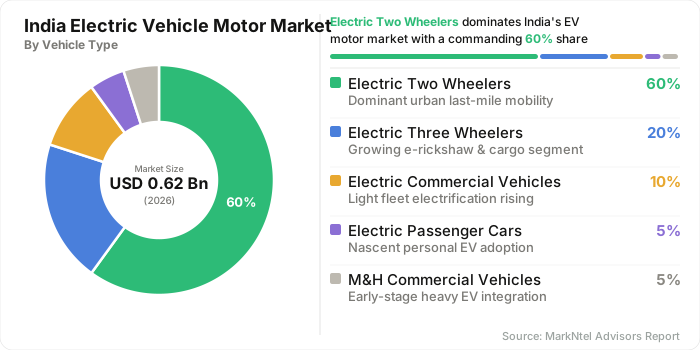
Electric two-wheelers continue to dominate India’s EV motor demand, accounting for nearly 60% of total EV volumes in the country. Their leadership is supported by India’s extensive two-wheeler ownership base, growing urban commuting requirements, and increasing adoption of electric scooters among cost-conscious consumers. Favorable government incentives, improving battery economics, and expanding charging and battery-swapping networks are further accelerating penetration across major metropolitan and Tier-II cities.
The segment remains a key driver of overall EV motor installations, with manufacturers continuously expanding product portfolios to address rising demand. For instance, TVS Motor Company Limited launched the Orbiter electric scooter in August 2025 with a claimed range of 158 km, highlighting intensifying competition within India’s urban electric mobility landscape. While two-wheelers are expected to maintain volume leadership, passenger and commercial EVs are projected to contribute a larger share of market value due to higher motor power requirements and drivetrain realization The market is further bifurcated into the following sub-segments:
- Electric Passenger Cars
- Electric Commercial Vehicles
- Medium & Heavy Commercial Vehicles
- Electric Two Wheelers
- Electric Three Wheelers
Permanent Magnet Synchronous Motors Dominating Demand Amid Rising EV Performance Requirements
Permanent Magnet Synchronous Motors have emerged as the dominant motor technology in India’s EV motor market, accounting for approximately 80% of the total market share. Their superior efficiency, higher torque density, compact design, and ability to deliver extended driving range have made them the preferred choice across passenger electric vehicles and increasingly advanced electric mobility platforms. Growing consumer demand for performance-oriented EVs continues to reinforce PMSM adoption across the industry.
Automakers are increasingly integrating PMSM-based propulsion systems to enhance vehicle efficiency and support long-range electric mobility applications. The technology’s compatibility with integrated e-drive architectures and high-performance powertrains further strengthens its market position. As passenger EV adoption accelerates and OEMs expand premium electric vehicle offerings, PMSM systems are expected to retain their leadership while benefiting from continued advancements in power electronics, motor control systems, and vehicle electrification strategies. The market is further bifurcated into the following sub-segments:
- DC Series Motor
- Brushless DC Motor
- Permanent Magnet Synchronous Motor (PMSM)
- Three Phase AC Induction Motors
- Switched Reluctance Motors (SRM)
India Electric Vehicle Motor Market Competitive Analysis
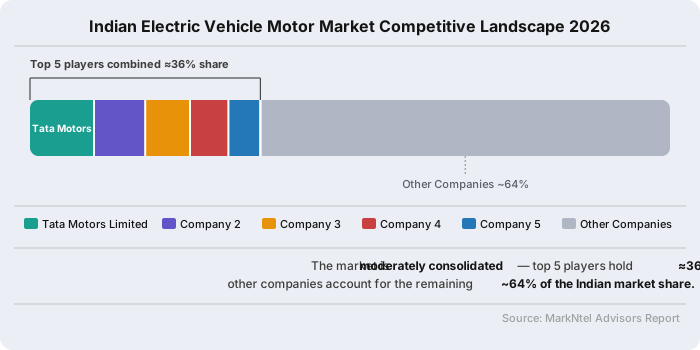
The India Electric Vehicle Motor Market remains moderately consolidated, with competition increasingly centred on integrated drivetrain capabilities, localization strategies, and OEM supply partnerships. Major players include ABB India Limited, Tata Motors Limited, Kirloskar Electric Company Limited, Nidec India Private Limited, and Bharat Heavy Electricals Limited, with the top five companies collectively accounting for approximately 36% of the total market share.
Key Companies in India Electric Vehicle Motor Market
- ABB India Limited
- Tata Motors Limited
- Kirloskar Electric Company Limited
- Nidec India Private Limited
- Bharat Heavy Electricals Limited
- Bonfiglioli Transmissions Private Limited
- Laxmi Hydraulics Private Limited
- Bosch Limited
- CG Power and Industrial Solutions Limited
- WEG Industries (India) Private Limited
India Electric Vehicle Motor Market Industry News & Recent Developments
2025: ABB India Limited Expands Integrated Electric Bus Powertrain Capabilities
ABB India Limited introduced an integrated electric bus powertrain package combining a high-torque-density traction motor with advanced inverter architecture optimized for commercial fleet applications. The solution is designed to improve drivetrain efficiency, thermal management performance, and operational reliability across electric bus deployments operating under continuous-duty urban transit conditions.
The integrated architecture combines motor and inverter systems into a compact propulsion platform aimed at reducing drivetrain complexity, improving energy utilization, and enhancing vehicle range efficiency. The development aligns with accelerating electric bus deployment across India under institutional fleet electrification initiatives and growing procurement of high-power traction systems for public transportation modernization.
Impact Analysis: The development is expected to strengthen competition within India’s high-power commercial EV drivetrain ecosystem, where efficiency optimization, thermal durability, and lifecycle reliability are becoming key procurement parameters. The launch reflects the market’s transition from standalone motor supply toward integrated propulsion architectures with higher system-level value addition. It may also accelerate localization opportunities across commercial EV drivetrain manufacturing, inverter integration, and power electronics development while supporting wider adoption of high-efficiency PMSM-based commercial propulsion systems.
2025: Nidec India Private Limited Strengthens Integrated E-Drive Deployment Across Commercial EV Platforms
Nidec India Private Limited expanded collaboration activities within India’s commercial EV ecosystem to strengthen deployment of integrated motor-controller systems across electric commercial vehicle platforms. The company is increasingly focusing on compact e-drive architectures combining traction motors, controllers, and power electronics into integrated propulsion systems optimized for logistics fleets, light commercial vehicles, and medium-duty transport applications. The initiative reflects growing OEM demand for drivetrain systems capable of improving torque delivery, packaging efficiency, and energy optimization while supporting localization requirements within India’s evolving EV manufacturing ecosystem.
Impact Analysis: The collaboration highlights the accelerating shift toward integrated e-drive partnerships between OEMs and drivetrain suppliers across India’s commercial EV market. As fleet electrification expands within logistics and institutional mobility segments, OEMs are increasingly prioritizing integrated propulsion systems that reduce drivetrain complexity and improve operational efficiency. The development is also expected to strengthen localization of advanced motor-controller assemblies, support domestic e-drive manufacturing expansion, and accelerate adoption of high-efficiency PMSM architectures across India’s commercial electric mobility ecosystem.
Frequently Asked Questions
- Market Segmentation
- Introduction
- Product Definition
- Research Process
- Assumptions
- Executive Summary
- India Electric Vehicle Motor Market Policies, Regulations, and Product Standards
- India Electric Vehicle Motor Market Trends & Developments
- India Electric Vehicle Motor Market Dynamics
- Growth Factors
- Challenges
- India Electric Vehicle Motor Market Hotspot & Opportunities
- India Electric Vehicle Motor Market Supply Chain Analysis
- India Electric Vehicle Motor Market Outlook, 2022-2032F
- Market Size & Outlook
- By Revenues (USD Million)
- By Units Sold (Thousand)
- Market Share & Outlook
- By Motor Type- Market Size & Forecast 2022-2032, USD Million & Thousand Units
- DC Series Motor
- Brushless DC Motor
- Permanent Magnet Synchronous Motor (PMSM)
- Three-Phase AC Induction Motors
- Switched Reluctance Motors (SRM)
- By Vehicle Type- Market Size & Forecast 2022-2032, USD Million & Thousand Units
- Electric Passenger Cars
- Sedan
- Hatchback
- SUV
- Electric Commercial Vehicles
- Light Commercial Vehicles
- Minivans
- Light Trucks & Buses
- Medium & Heavy Commercial Vehicles
- Trucks
- Buses
- Light Commercial Vehicles
- Electric Two Wheelers
- Scooters
- Motorcycles
- Electric Three Wheelers
- Electric Passenger Cars
- By Power Rating- Market Size & Forecast 2022-2032, USD Million & Thousand Units
- Up to 50 kW
- 51 kW to 150 kW
- Above 150 kW
- By Region- Market Size & Forecast 2022-2032, USD Million & Thousand Units
- North
- South
- East
- West
- By Company
- Competition Characteristics
- Market Share & Analysis
- By Motor Type- Market Size & Forecast 2022-2032, USD Million & Thousand Units
- Market Size & Outlook
- India DC Series Motor Market Outlook, 2022-2032
- Market Size & Outlook
- By Revenues (USD Million)
- Market Share & Outlook
- By Type- Market Size & Forecast 2022-2032, USD Million & Thousand Units
- By Motor Type- Market Size & Forecast 2022-2032, USD Million & Thousand Units
- By Component- Market Size & Forecast 2022-2032, USD Million & Thousand Units
- By Power Rating- Market Size & Forecast 2022-2032, USD Million & Thousand Units
- By Region- Market Size & Forecast 2022-2032, USD Million & Thousand Units
- Market Size & Outlook
- India Brushless DC Motor Market Outlook, 2022-2032
- Market Size & Outlook
- By Revenues (USD Million)
- Market Share & Outlook
- By Type- Market Size & Forecast 2022-2032, USD Million & Thousand Units
- By Motor Type- Market Size & Forecast 2022-2032, USD Million & Thousand Units
- By Component- Market Size & Forecast 2022-2032, USD Million & Thousand Units
- By Power Rating- Market Size & Forecast 2022-2032, USD Million & Thousand Units
- By Region- Market Size & Forecast 2022-2032, USD Million & Thousand Units
- Market Size & Outlook
- India Permanent Magnet Synchronous Motor Market Outlook, 2022-2032
- Market Size & Outlook
- By Revenues (USD Million)
- Market Share & Outlook
- By Type- Market Size & Forecast 2022-2032, USD Million & Thousand Units
- By Motor Type- Market Size & Forecast 2022-2032, USD Million & Thousand Units
- By Component- Market Size & Forecast 2022-2032, USD Million & Thousand Units
- By Power Rating- Market Size & Forecast 2022-2032, USD Million & Thousand Units
- By Region- Market Size & Forecast 2022-2032, USD Million & Thousand Units
- Market Size & Outlook
- India Three-Phase AC Induction Motors Market Outlook, 2022-2032
- Market Size & Outlook
- By Revenues (USD Million)
- Market Share & Outlook
- By Type- Market Size & Forecast 2022-2032, USD Million & Thousand Units
- By Motor Type- Market Size & Forecast 2022-2032, USD Million & Thousand Units
- By Component- Market Size & Forecast 2022-2032, USD Million & Thousand Units
- By Power Rating- Market Size & Forecast 2022-2032, USD Million & Thousand Units
- By Region- Market Size & Forecast 2022-2032, USD Million & Thousand Units
- Market Size & Outlook
- India Switched Reluctance Motors Market Outlook, 2022-2032
- Market Size & Outlook
- By Revenues (USD Million)
- Market Share & Outlook
- By Type- Market Size & Forecast 2022-2032, USD Million & Thousand Units
- By Motor Type- Market Size & Forecast 2022-2032, USD Million & Thousand Units
- By Component- Market Size & Forecast 2022-2032, USD Million & Thousand Units
- By Power Rating- Market Size & Forecast 2022-2032, USD Million & Thousand Units
- By Region- Market Size & Forecast 2022-2032, USD Million & Thousand Units
- Market Size & Outlook
- India Electric Vehicle Motor Market Key Strategic Imperatives for Success & Growth
- Competitive Outlook
- Company Profiles
- ABB India Limited
- Business Description
- Product Portfolio
- Collaborations & Alliances
- Recent Developments
- Financial Details
- Others
- Tata Motors Limited
- Business Description
- Product Portfolio
- Collaborations & Alliances
- Recent Developments
- Financial Details
- Others
- Kirloskar Electric Company Limited
- Business Description
- Product Portfolio
- Collaborations & Alliances
- Recent Developments
- Financial Details
- Others
- Nidec India Pvt Ltd.
- Business Description
- Product Portfolio
- Collaborations & Alliances
- Recent Developments
- Financial Details
- Others
- Bosch Ltd.
- Business Description
- Product Portfolio
- Collaborations & Alliances
- Recent Developments
- Financial Details
- Others
- Bharat Heavy Electricals Limited
- Business Description
- Product Portfolio
- Collaborations & Alliances
- Recent Developments
- Financial Details
- Others
- Laxmi Hydraulics Pvt Ltd.
- Business Description
- Product Portfolio
- Collaborations & Alliances
- Recent Developments
- Financial Details
- Others
- Bonfiglioli Transmissions Private Limited
- Business Description
- Product Portfolio
- Collaborations & Alliances
- Recent Developments
- Financial Details
- Others
- CG Power & Industrial Solutions Ltd.
- Business Description
- Product Portfolio
- Collaborations & Alliances
- Recent Developments
- Financial Details
- Others
- WEG Industries (India) Private Limited
- Business Description
- Product Portfolio
- Collaborations & Alliances
- Recent Developments
- Financial Details
- Others
- ABB India Limited
- Company Profiles
- Disclaimer
MarkNtel Advisors follows a robust and iterative research methodology designed to ensure maximum accuracy and minimize deviation in market estimates and forecasts. Our approach combines both bottom-up and top-down techniques to effectively segment and quantify various aspects of the market. A consistent feature across all our research reports is data triangulation, which examines the market from three distinct perspectives to validate findings. Key components of our research process include:
1. Scope & Research Design At the outset, MarkNtel Advisors define the research objectives and formulate pertinent questions. This phase involves determining the type of research—qualitative or quantitative—and designing a methodology that outlines data collection methods, target demographics, and analytical tools. They also establish timelines and budgets to ensure the research aligns with client goals.
2. Sample Selection and Data Collection In this stage, the firm identifies the target audience and determines the appropriate sample size to ensure representativeness. They employ various sampling methods, such as random or stratified sampling, based on the research objectives. Data collection is carried out using tools like surveys, interviews, and observations, ensuring the gathered data is reliable and relevant.
3. Data Analysis and Validation Once data is collected, MarkNtel Advisors undertake a rigorous analysis process. This includes cleaning the data to remove inconsistencies, employing statistical software for quantitative analysis, and thematic analysis for qualitative data. Validation steps are taken to ensure the accuracy and reliability of the findings, minimizing biases and errors.

4. Data Forecast and FinalizationThe final phase involves forecasting future market trends based on the analyzed data. MarkNtel Advisors utilize predictive modeling and time series analysis to anticipate market behaviors. The insights are then compiled into comprehensive reports, featuring visual aids like charts and graphs, and include strategic recommendations to inform client decision-making
We offer flexible licensing options to cater to varying organizational needs. Choose the pricing pack that best suits your requirements:
Buy Now Inquire Before Buying
 Request Customization
 Talk to our Consultant







