

Thailand Ice Cream Market Research Report: Growth Drivers & Forecast (2026-2032)
By Type (Impulse Ice Cream, Artisanal / Dine-in Scoops, Take-Home & Bulk Ice Cream), By Flavour (Vanilla, Chocolate, Strawberry, Coconut, Thai Tea, Durian, Matcha, Others), By Form ... at (Cup, Stick/ Bar, Cone, Tub/ Brick, Others (Sandwich, Tub, etc.)), By Composition (Dairy-based Ice Cream, Plant-based Ice Cream), By Positioning (Mass Market Ice Cream, Premium Ice Cream), By Sales Channel (Convenience Stores, Hypermarkets/Supermarkets, Street Vendors, Carts, Foodservice/Parlors, Online/Delivery), and others Read more
- Food & Beverages
- Jul 2026
- Pages 140
- Report Format: PDF, Excel, PPT
Thailand Ice Cream Market
Projected 2.69% CAGR from 2026,2032 to
Study Period
2026,2032
Market Size (2026)
USD 0.40 Billion
Market Size (2032)
USD 0.46 Billion
Base Year
2025
Projected CAGR
2.69%
Leading Segments
By Type: Impulse Ice Cream
Thailand Ice Cream Market Key Takeaways
- The Thailand ice cream market size was valued at USD 0.39 billion in 2025 and is projected to grow from USD 0.40 billion in 2026 to USD 0.46 billion by 2032.
- The market is projected to register a CAGR of 2.69% during 2026–2032.
- By type, the impulse ice cream segment represented a significant share of about 70% in the market in 2026.
- By flavour, the chocolate segment seized a significant share of about 32% in the market in 2026.
- The market is consolidated, with the leading ice cream companies having a 65% market share in 2026.
Thailand Ice Cream Market Size and Outlook
The ice cream industry in Thailand was valued at USD 0.39 billion in 2025 and is currently standing at USD 0.40 billion in 2026. The industry is projected to grow to USD 0.46 billion by 2032, showcasing a CAGR of around 2.69% during the forecast period, i.e., 2026–32. The market benefits from the country's hot tropical climate, supporting year-round consumption rather than seasonal demand. The category is evolving towards premium, indulgent, and differentiated offerings as consumers increasingly seek higher quality products and localized flavours.
Thailand is also strengthening its position as a regional ice cream production and export hub. According to Thailand's trade policy and strategy office, the country became Asia's largest ice cream exporter and the 11th largest globally in 2025, supported by abundant agricultural resources and increasing international demand for Thai-inspired flavors such as durian, coconut, and Thai tea. This expanding export competitiveness is encouraging manufacturers to diversify product portfolios, enhance production capabilities, and strengthen Thailand's role in supplying premium and localized frozen desserts across regional and international markets
Corporate investments are reinforcing Thailand's transition toward a more innovation-driven and premium-focused ice cream market. In December 2025, Unilever completed the global demerger of its ice cream business into the Magnum ice cream company, which increased emphasis on portfolio development is expected to strengthen premium offerings across Thailand alongside continued investments by multinational and domestic manufacturers. Although international visitor arrivals moderated to approximately 32.97 million in 2025, tourism continues to support demand for impulse and premium frozen desserts across major cities, shopping destinations, and resort destinations.
Government policies are also shaping the long-term innovation landscape of the industry. The final phase of Thailand's sugar excise tax became effective in April 2025, reinforcing the country's broader agenda of promoting healthier food and beverage consumption. The measure is encouraging frozen dessert manufacturers to accelerate investments in reduced sugar formulations, functional dairy ingredients, and better-for-you product offerings to align with evolving consumer preferences and regulatory direction. This shift is expected to strengthen product innovation, portfolio diversification, and the long-term competitiveness of Thailand's ice cream market
Thailand Ice Cream Market Key Indicators
- Thailand's private consumption expenditure grew 3.2% year on year in Q1 2026, accelerating from prior quarters and supporting discretionary food spending capacity.
- Thailand's economy expanded 2.4% for full-year 2025, with household consumption growing 3.3% in Q4 2025, both beating official expectations and supporting the 2026 growth outlook.
- Thailand's headline CPI rose 2.42% year on year in June 2026, the third straight month of inflation after a year-long deflationary run, driven partly by rising prepared food prices.
- Thailand's dairy sector comprises approximately 550,000 dairy cows producing over one million tonnes of raw milk annually, an average of roughly 2,818 tonnes per day, forming the domestic input base for dairy-based ice cream manufacturing.
- Thailand's foreign tourist receipts to rise to USD 49.16 billion in 2026, up from USD 43.80 billion in 2025, indicating a rebound in footfall-driven retail and foodservice demand.
Thailand Ice Cream Market Scope
| Category | Segments |
|---|---|
| By Type | Impulse Ice Cream, Artisanal / Dine-in Scoops, Take-Home & Bulk Ice Cream |
| By Flavour | Vanilla, Chocolate, Strawberry, Coconut, Thai Tea, Durian, Matcha, Others |
| By Format | Cup, Stick/ Bar, Cone, Tub/ Brick, Others (Sandwich, Tub, etc. |
| By Composition | Dairy-based Ice Cream, Plant-based Ice Cream |
| By Positioning | Mass Market Ice Cream, Premium Ice Cream |
| By Sales Channel | Convenience Stores, Hypermarkets/Supermarkets, Street Vendors, Carts, Foodservice/Parlors, Online/Delivery |
Thailand Ice Cream Market Growth Drivers
Expansion of Convenience Retail Networks Driving High Frequency Ice Cream Consumption
Thailand's expanding convenience retail network is significantly increasing the accessibility and frequency of ice cream purchases by bringing frozen products closer to consumers' daily routines. CP ALL operated 15,430 7-Eleven stores across the country as of May 2025, collectively serving around 14 million customers each day, creating an extensive neighborhood retail footprint for impulse frozen dessert sales. The widespread availability of in store freezer infrastructure has strengthened product visibility, improved cold chain reach, and enabled manufacturers to expand distribution beyond traditional supermarkets into high-traffic convenience locations.
The continued development of organized food retail is further reinforcing this consumption pattern. In 2025, CP Axtra reported that its Makro and Lotus's soft serve counters, developed in partnership with CP Meiji, surpassed 1 million cones sold since their late 2024 introduction and expanded to more than 50 outlets nationwide. The rollout of these neighborhood foodservice touchpoints has increased consumer access to freshly prepared frozen desserts while strengthening organized retail as an important channel for high-frequency ice cream consumption, supporting sustained volume growth across Thailand's ice cream market.
Recent Trends
Flavour Localization and Health-Oriented Innovation Transforming Thailand's Ice Cream Innovation Pipeline
Thailand's ice cream manufacturers are increasingly differentiating their portfolios through localized flavours and health-oriented product innovation to address evolving consumer preferences. In September 2025, Nestlé Thailand launched kitkat matcha ice cream, developed using authentic shizuoka matcha through its Singapore research and development centre, reflecting growing demand for internationally inspired premium flavours. Localized innovation is also accelerating across domestic offerings, with dairy queen Thailand introducing durian black sticky rice blizzard and nam dok mai mango soft serve, while makro expanded its seasonal range with coconut milk soft serve, incorporating familiar Thai ingredients into modern frozen dessert formats.
The innovation pipeline is also expanding beyond flavour development toward functional formulations and collaborative product launches. In 2025, CP Meiji and lotus's introduced natural and mixed berry greek yogurt ice cream, reflecting increasing emphasis on products combining indulgence with added nutritional appeal. At the same time, Chomthana continued strengthening its portfolio with commercially produced Thai tea, durian, coconut, and mango ice cream formulations, supporting broader flavour diversification across retail and foodservice channels. The combination of localized ingredients, functional dairy formulations, and continuous product launches is reshaping innovation strategies across Thailand's ice cream industry.
Thailand Ice Cream Market Challenges and Opportunities
Rising Cold Chain Costs Accelerating Organized Retail Distribution Partnerships
Thailand's ice cream market is becoming increasingly exposed to rising operating costs due to its heavy dependence on temperature-controlled storage, transportation, and retail display infrastructure. The energy regulatory commission increased electricity tariffs for the May to August 2026 billing period and proposed a further increase for September to December 2026 to recover accumulated subsidy debt. As frozen dessert manufacturers rely on extensive refrigerated logistics and in-store freezer networks, successive tariff adjustments are raising distribution expenses across the value chain.
These cost pressures are particularly significant for regional and smaller manufacturers, which often have limited financial capacity to absorb higher energy and cold chain costs. Maintaining competitive pricing while sustaining nationwide product availability becomes increasingly difficult as higher energy expenses continue to increase the cost of operating refrigerated distribution networks.
As manufacturers seek to offset these rising costs, organized retail partnerships are emerging as an effective strategy to expand nationwide distribution without substantial investment in proprietary retail infrastructure. Established retail chains provide existing cold storage facilities, nationwide store networks, and high consumer footfall, allowing brands to strengthen product availability while reducing capital requirements and improving operational efficiency.
Reflecting this shift, CP Meiji and Lotus introduced natural and mixed berry greek yogurt ice cream in 2025, while CP Axtra continued expanding branded soft serve counters across Makro outlets. These collaborations enable manufacturers to leverage established retail ecosystems, improve product visibility, and accelerate geographic expansion, creating a scalable pathway for long-term market penetration despite rising distribution and logistics costs.
Segmentation Insights
Widespread Convenience Retail and Year-Round Consumption Sustain Impulse Ice Cream Leadership
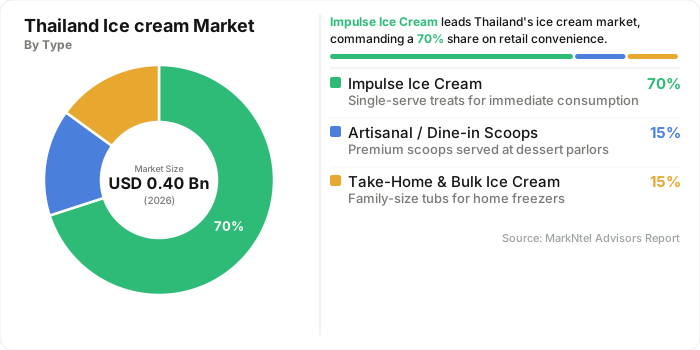
Impulse Ice Cream dominates the market with approximately 70% share, driven by strong convenience store penetration and consumer behavior favoring immediate consumption. The dominance is reinforced by Thailand’s climate, which supports frequent consumption of single-serve products throughout the year. Retail infrastructure, particularly convenience stores, ensures high visibility and accessibility of impulse products. This enables consistent demand generation across urban and semi-urban areas.
Manufacturers prioritize impulse formats due to faster inventory turnover and higher volume throughput. Product innovation is heavily concentrated in this segment, including cones, sticks, and novelty items. Promotional strategies and price-point optimization further enhance demand within this category. This makes impulse ice cream the core revenue driver in the market.
Additionally, impulse products require lower consumer commitment compared to take-home formats. This aligns with changing consumption patterns driven by mobility and convenience. The segment benefits from strong alignment with retail infrastructure and lifestyle trends. As a result, it is expected to maintain its leadership position over the forecast period. Based on type, the market is furher bifurcated into:
- Impulse Ice Cream
- Artisanal / Dine-in Scoops
- Take-Home & Bulk Ice Cream
Efficient Cocoa Supply Chains and Product Versatility Strengthen Chocolate Flavour Leadership
Chocolate leads the Thailand ice cream market with a 32% share, supported not only by consumer preference but by structural supply dynamics. Thailand has limited domestic cocoa production, concentrated in southern provinces such as Chumphon and Nakhon Si Thammarat. The scalability of chocolate flavor is further supported by its processing compatibility and cost standardization. Unlike fruit-based flavors that depend on seasonal supply and cold-chain handling, cocoa derivatives like powder and butter are shelf-stable and globally traded commodities, reducing volatility in manufacturing.
Local manufacturers and multinational players leverage imported cocoa to produce value-added variants such as chocolate-coated bars, filled cones, and layered desserts. Export-oriented production, particularly within ASEAN, benefits from Thailand’s food processing infrastructure and trade agreements. The combination of secure import channels, processing efficiency, and product versatility strengthens chocolate’s role as the most commercially viable flavor. This integrated supply-demand alignment ensures continued leadership, as chocolate remains the easiest flavor to scale, innovate, and distribute across Thailand’s ice cream ecosystem. Based on flavour, the market is further segmented into:
- Vanilla
- Chocolate
- Strawberry
- Coconut
- Thai Tea
- Durian
- Matcha
- Others
Thailand Ice Cream Market Competitive Analysis
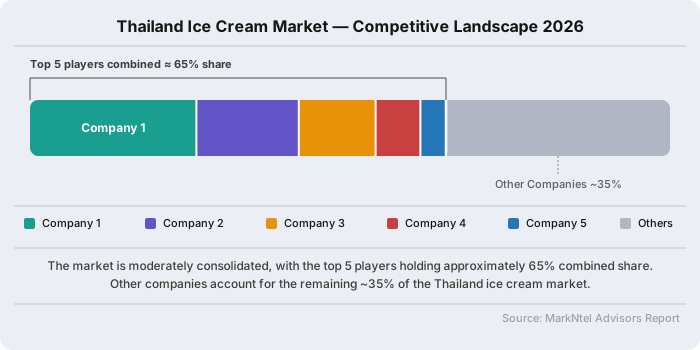
The market is consolidated, with competition shared among multinational ice cream manufacturers, regional dairy companies, domestic frozen dessert producers, and foodservice ice cream chains. Major participants include Magnum Ice Cream Company B.V., Nestlé S.A., Chomthana Co., Ltd. (Yili Group, China), F&N Dairies (Thailand) Ltd., and CP-Meiji Co., Ltd. The top five players collectively account for approximately 65% of the Thailand ice cream market.
Key Companies in the Thailand Ice Cream Market
- Magnum Ice Cream Company B.V.
- Nestlé S.A.
- Chomthana Co., Ltd. (Yili Group, China)
- F&N Dairies (Thailand) Ltd.
- CP-Meiji Co., Ltd.
- Dairy Queen (Thailand)
- Tipco Foods Public Company Limited
Thailand Ice Cream Industry News and Recent Developments
2026: Nestlé Launches Extreme Pop Hot Mala Ice Cream in Thailand to Expand Experimental Flavor Portfolio
Nestlé launched Extreme Pop Hot Mala Ice Cream in Thailand in 2026, introducing an unconventional combination of spicy Sichuan mala seasoning, vanilla ice cream, and a chocolate coating. The launch reflects the company's strategy of expanding its impulse ice cream portfolio through bold, limited edition flavor innovations designed to attract younger consumers seeking novel taste experiences and differentiated frozen dessert offerings.
Impact Analysis: The product launch highlights the growing emphasis on experimental flavor innovation within the Thailand ice cream market as manufacturers increasingly target Gen Z and younger millennials through unique sensory experiences. The introduction of unconventional flavors is expected to intensify product innovation, encourage greater investment in limited edition and localized offerings, and strengthen competition within the impulse ice cream segment, prompting manufacturers to diversify portfolios beyond traditional flavors to enhance consumer engagement and brand differentiation.
Frequently Asked Questions
- Market Segmentation
- Introduction
- Product Definition
- Research Process
- Assumptions
- Executive Summary
- Thailand Ice Cream Market Pricing Analysis
- SKU Wise Price Points
- Average Increase/Decrease in Price Per ML
- Thailand Ice Cream Market Policies, Regulations, and Product Standards
- Thailand Ice Cream Market Trends & Developments
- Thailand Ice Cream Market Dynamics
- Growth Factors
- Challenges
- Thailand Ice Cream Market Hotspot & Opportunities
- Thailand Ice Cream Market Outlook, 2022-2032
- Market Size & Outlook
- By Revenues (USD Million)
- By Quantity Sold (Million Litres)
- Market Segmentation & Outlook
- By Type- Market Size & Forecast 2022-2032, USD Million & Million Litres
- Impulse Ice Cream
- Artisanal / Dine-in Scoops
- Take-Home & Bulk Ice Cream
- By Flavour- Market Size & Forecast 2022-2032, USD Million & Million Litres
- Vanilla
- Chocolate
- Strawberry
- Coconut
- Thai Tea
- Durian
- Matcha
- Others
- By Format- Market Size & Forecast 2022-2032, USD Million & Million Litres
- Cup
- Stick/ Bar
- Cone
- Tub/ Brick
- Others (Sandwich, Tub, etc.)
- By Composition- Market Size & Forecast 2022-2032, USD Million & Million Litres
- Dairy-based Ice Cream
- Plant-based Ice Cream
- By Positioning- Market Size & Forecast 2022-2032, USD Million & Million Litres
- Mass Market Ice Cream
- Premium Ice Cream
- By Sales Channel- Market Size & Forecast 2022-2032, USD Million & Million Litres
- Convenience Stores
- Hypermarkets/Supermarkets
- Street Vendors, Carts
- Foodservice/Parlors
- Online/Delivery
- By Region- Market Size & Forecast 2022-2032, USD Million & Million Litres
- East
- North
- West
- South
- Central
- By Company
- Competition Characteristics
- Market Share & Analysis
- By Type- Market Size & Forecast 2022-2032, USD Million & Million Litres
- Market Size & Outlook
- Thailand Impulse Ice Cream Market Outlook, 2022-2032
- Market Size & Outlook
- By Revenues (USD Million)
- By Quantity Sold (Million Litres)
- Market Segmentation & Outlook
- By Flavour- Market Size & Forecast 2022-2032, USD Million & Million Litres
- By Format- Market Size & Forecast 2022-2032, USD Million & Million Litres
- By Composition- Market Size & Forecast 2022-2032, USD Million & Million Litres
- By Positioning- Market Size & Forecast 2022-2032, USD Million & Million Litres
- By Sales Channel- Market Size & Forecast 2022-2032, USD Million & Million Litres
- By Region- Market Size & Forecast 2022-2032, USD Million & Million Litres
- Market Size & Outlook
- Thailand Artisanal / Dine-in Scoops Market Outlook, 2022-2032
- Market Size & Outlook
- By Revenues (USD Million)
- By Quantity Sold (Million Litres)
- Market Segmentation & Outlook
- By Flavour- Market Size & Forecast 2022-2032, USD Million & Million Litres
- By Format- Market Size & Forecast 2022-2032, USD Million & Million Litres
- By Composition- Market Size & Forecast 2022-2032, USD Million & Million Litres
- By Positioning- Market Size & Forecast 2022-2032, USD Million & Million Litres
- By Sales Channel- Market Size & Forecast 2022-2032, USD Million & Million Litres
- By Region- Market Size & Forecast 2022-2032, USD Million & Million Litres
- Market Size & Outlook
- Thailand Take-Home & Bulk Ice Cream Market Outlook, 2022-2032
- Market Size & Outlook
- By Revenues (USD Million)
- By Quantity Sold (Million Litres)
- Market Segmentation & Outlook
- By Flavour- Market Size & Forecast 2022-2032, USD Million & Million Litres
- By Format- Market Size & Forecast 2022-2032, USD Million & Million Litres
- By Composition- Market Size & Forecast 2022-2032, USD Million & Million Litres
- By Positioning- Market Size & Forecast 2022-2032, USD Million & Million Litres
- By Sales Channel- Market Size & Forecast 2022-2032, USD Million & Million Litres
- By Region- Market Size & Forecast 2022-2032, USD Million & Million Litres
- Market Size & Outlook
- Thailand Ice Cream Market Key Strategic Imperatives for Success & Growth
- Competitive Outlook
- Company Profiles
- Magnum Ice Cream Company B.V.
- Business Description
- Product Portfolio
- Collaborations & Alliances
- Recent Developments
- Financial Details
- Others
- Nestlé S.A.
- Business Description
- Product Portfolio
- Collaborations & Alliances
- Recent Developments
- Financial Details
- Others
- Chomthana Co., Ltd. (Yili Group, China)
- Business Description
- Product Portfolio
- Collaborations & Alliances
- Recent Developments
- Financial Details
- Others
- F&N Dairies (Thailand) Ltd.
- Business Description
- Product Portfolio
- Collaborations & Alliances
- Recent Developments
- Financial Details
- Others
- CP-Meiji Co., Ltd.
- Business Description
- Product Portfolio
- Collaborations & Alliances
- Recent Developments
- Financial Details
- Others
- Dairy Queen (Thailand)
- Business Description
- Product Portfolio
- Collaborations & Alliances
- Recent Developments
- Financial Details
- Others
- Tipco Foods Public Company Limited
- Business Description
- Product Portfolio
- Collaborations & Alliances
- Recent Developments
- Financial Details
- Others
- Magnum Ice Cream Company B.V.
- Company Profiles
- Disclaimer
MarkNtel Advisors follows a robust and iterative research methodology designed to ensure maximum accuracy and minimize deviation in market estimates and forecasts. Our approach combines both bottom-up and top-down techniques to effectively segment and quantify various aspects of the market. A consistent feature across all our research reports is data triangulation, which examines the market from three distinct perspectives to validate findings. Key components of our research process include:
1. Scope & Research Design At the outset, MarkNtel Advisors define the research objectives and formulate pertinent questions. This phase involves determining the type of research—qualitative or quantitative—and designing a methodology that outlines data collection methods, target demographics, and analytical tools. They also establish timelines and budgets to ensure the research aligns with client goals.
2. Sample Selection and Data Collection In this stage, the firm identifies the target audience and determines the appropriate sample size to ensure representativeness. They employ various sampling methods, such as random or stratified sampling, based on the research objectives. Data collection is carried out using tools like surveys, interviews, and observations, ensuring the gathered data is reliable and relevant.
3. Data Analysis and Validation Once data is collected, MarkNtel Advisors undertake a rigorous analysis process. This includes cleaning the data to remove inconsistencies, employing statistical software for quantitative analysis, and thematic analysis for qualitative data. Validation steps are taken to ensure the accuracy and reliability of the findings, minimizing biases and errors.

4. Data Forecast and FinalizationThe final phase involves forecasting future market trends based on the analyzed data. MarkNtel Advisors utilize predictive modeling and time series analysis to anticipate market behaviors. The insights are then compiled into comprehensive reports, featuring visual aids like charts and graphs, and include strategic recommendations to inform client decision-making
We offer flexible licensing options to cater to varying organizational needs. Choose the pricing pack that best suits your requirements:
Buy Now Inquire Before Buying
 Request Customization
 Talk to our Consultant







