

Malaysia Home Laundry Appliances Market Research Report: Forecast (2026-2032)
Malaysia Home Laundry Appliances Market - By Product Type (Freestanding Home Laundry Appliances, Automatic Dryers, Automatic Washer Dryers, Automatic Washing Machines, Semi-Automat ... ic Washing Machines), By Distribution Channel (Online Retail, Specialty Stores, Departmental Stores, Direct Sales, Others), By Operation (Non-Smart, Smart), By Price (Premium, Mid-Range, Budget), and others Read more
- FMCG
- Feb 2026
- Pages 135
- Report Format: PDF, Excel, PPT
Malaysia Home Laundry Appliances Market
Projected 4.19% CAGR from 2026 to 2032
Study Period
2026-2032
Market Size (2025)
USD 310 Million
Market Size (2032)
USD 411 Million
Base Year
2025
Projected CAGR
4.19%
Leading Segments
By Operation: Non-Smart
Malaysia Home Laundry Appliances Market Report Key Takeaways:
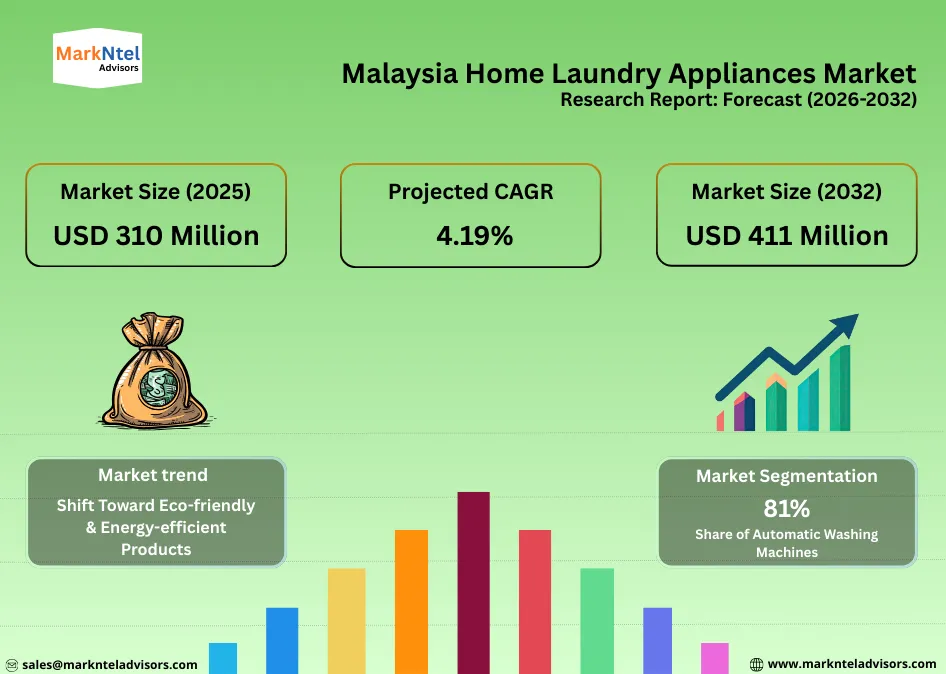
- The Malaysia Home Laundry Appliances Market size was valued at around USD 310 million in 2025 and is projected to reach USD 411 million by 2032. The estimated CAGR from 2026 to 2032 is around 4.19%, indicating strong growth.
- The number of units sold in the Malaysia Home Laundry Appliances Market is projected to grow at a 3.28% CAGR during 2026-32.
- By Product Type, the automatic washing machines hold around 81% share of the Malaysia Home Laundry Appliances Market size in 2025.
- By Operation, the Non-Smart segment represented 98% of the Malaysia Home Laundry Appliances Market size in 2025, while Smart segment is expected to grow at a 5.55% CAGR during 2026-32.
- The leading home laundry appliances companies in Malaysia are Midea, Pensonic Holdings Berhad, Electrolux, Samsung Electronics, LG Electronics, Panasonic, Bosch, Beko, Elba, Haier, Toshiba, Sharp, BSH, Hitachi, and others.
Market Insights & Analysis: Malaysia Home Laundry Appliances Market (2026-2032):
The Malaysia Home Laundry Appliances Market size was valued at around USD 310 million in 2025 and is projected to reach USD 411 million by 2032. Along with this, the market is estimated to grow at a CAGR of around 4.19% during the forecast period, i.e., 2026-32. The Malaysia Home Laundry Appliances Market is set for steady expansion, supported by rising urban living, lifestyle modernization, and continuous product innovation. Malaysia has one of the highest urbanization levels in Southeast Asia, with nearly four-fifths of its population residing in cities. This shift has reshaped household routines, increasing reliance on automated appliances that reduce time spent on daily chores. Near-universal access to electricity and piped water further enables widespread adoption of washing machines and washer-dryer units across urban and semi-urban homes.
Product innovation is playing a central role in shaping market momentum. In 2025, Elba expanded its Malaysian home appliance portfolio with new laundry machine offerings, strengthening product variety and intensifying competition in the local major appliances segment .
Similarly, global brands are aligning product designs with urban housing constraints. For example, Xiaomi launched the Mijia Front Load Washer Dryer 10.5 kg in Malaysia, combining washing and drying functions with Wi-Fi connectivity, addressing space limitations common in high-density residential developments .
Technological upgrades are also accelerating replacement demand. Haier Malaysia introduced its X Series washing machines (X5, X7, X9), featuring AI Wash and Essence Wash technologies aimed at improving efficiency, fabric care, and energy savings.
Overall, continued urban housing development, growing preference for fully automatic machines, and the integration of smart features are expected to sustain demand, positioning the Malaysia home laundry appliances market for long-term, technology-driven growth.
Malaysia Home Laundry Appliances Market Recent Developments:
- August 2025: Samsung unveils its latest AI‑powered laundry innovations, including the A‑65% energy‑efficient Bespoke AI Washer and second‑generation Bespoke AI Laundry Combo, featuring enhanced features such as AI Wash+ and AI Dry+ for better energy savings and fabric care at the international tech show IFA 2025.
- May 2025: Haier Malaysia introduced its L+ Washing Machine, featuring AI Smart Wash and heat‑pump drying, plus advanced hygiene functions. This flagship washer‑dryer aims at premium household adoption, driving innovation and consumer demand for intelligent laundry care solutions.
Malaysia Home Laundry Appliances Market Scope:
| Category | Segments |
|---|---|
| Product Type | Freestanding Home Laundry Appliances, Automatic Dryers, Automatic Washer Dryers, Automatic Washing Machines, Semi-Automatic Washing Machines |
| Distribution Channel | Online Retail, Specialty Stores, Departmental Stores, Direct Sales, Others |
| Operation | Non-Smart, Smart |
| Price | Premium, Mid-Range, Budget |
| Region | North, East, South, Central, Sarawak, Sabah |
Malaysia Home Laundry Appliances Market Drivers:
Increasing Urbanization & Changing Lifestyle
Malaysia’s rapid urbanization is a fundamental driver accelerating demand for home laundry appliances. According to the Department of Statistics Malaysia (DOSM), the country’s urban population reached approximately 79% in 2024, reflecting a steady shift toward city-based living. Urban areas such as Kuala Lumpur, Selangor, and Johor Bahru exhibit higher household incomes, dense housing formats, and faster-paced lifestyles, all of which increase reliance on automated household appliances. Crucially, urban infrastructure supports this adoption, 99.3% of urban households have access to piped water, and 99.9% have electricity, creating ideal conditions for washing machine and dryer usage.
Urbanization also brings lifestyle changes. The rise of dual-income households, longer working hours, and smaller family sizes reduces the time available for manual household chores. As a result, households increasingly prefer automatic and space-efficient laundry appliances that save time and physical effort. Government household expenditure surveys consistently show higher spending on durable household goods among urban residents compared to rural populations.
Manufacturers are actively responding to these shifts. In 2025, Samsung Malaysia officially introduced its Bespoke AI Laundry Combo, a washer-dryer unit designed for compact urban homes, integrating energy-efficient and automation features . Such product launches demonstrate how companies are aligning with urban consumer needs through innovation rather than capacity expansion.
Furthermore, Malaysia’s urbanization rate is projected to exceed 85% by 2040, supported by ongoing urban housing and smart-city initiatives under national development plans. This expansion will continue to increase household formation in cities, sustaining long-term demand for advanced laundry appliances.
Malaysia Home Laundry Appliances Market Trends:
Shift Toward Eco-friendly & Energy-efficient Products
The shift toward eco-friendly and energy-efficient home laundry appliances in Malaysia has accelerated due to rising electricity tariffs, climate policy commitments, and heightened consumer cost awareness. Malaysia’s National Energy Transition Roadmap and the target to achieve net-zero emissions by 2050 have reinforced demand for low-energy household appliances. In 2024, the Energy Commission strengthened Minimum Energy Performance Standards and expanded the mandatory Energy Efficiency Star Labeling program for washing machines. These measures, combined with steady growth in urban middle-income households, have made energy efficiency a key purchase criterion rather than a premium feature.
Structurally, this trend is reshaping product design, sourcing, and retail strategies across the value chain. Manufacturers are increasing the use of inverter motors, water-efficient wash technologies, and recyclable materials to comply with regulatory thresholds and labeling requirements. Retailers are prioritizing high-star-rated models as electricity cost transparency improves among consumers, particularly in urban residential segments. End users, including multi-unit housing developers and institutional housing providers, are increasingly specifying energy-rated appliances to align with sustainability benchmarks and operational cost controls.
The trend is expected to persist due to durable regulatory alignment, rising utility cost pressures, and long-term national sustainability objectives. Malaysia’s gradual removal of blanket electricity subsidies since 2025 has strengthened consumer sensitivity to appliance-level energy consumption. Leading brands such as Panasonic and Samsung have publicly expanded their energy-efficient appliance portfolios and localized production to meet compliance and pricing expectations. These combined policy, cost, and industry factors ensure energy efficiency remains a central driver of market evolution rather than a short-term adoption cycle.
Malaysia Home Laundry Appliances Market Challenges:
High Upfront Costs Limiting Wider Adoption
A significant challenge in the Malaysia home laundry appliances industry is the high upfront cost of modern washing machines and dryers, which constrains adoption, especially among price-sensitive households. Although official inflation has remained relatively moderate, 1.8% overall in 2024, the Consumer Price Index for household appliances and related equipment has steadily increased, reflecting rising purchase costs for durable goods such as washing machines. The Department of Statistics Malaysia (DOSM) reported that the CPI sub-index for household appliances (including cleaning equipment) reached an index of 113.6 in March 2025, up from lower levels in previous months, indicating that appliance prices have climbed relative to the base period.
Household expenditure patterns further illustrate the cost burden. The mean monthly consumption expenditure among Malaysian households reached USD 1,325 in 2024, with the ‘Furnishings, Household Equipment & Routine Maintenance’ group accounting for part of the overall spending. High-end automatic washing machines and washer-dryer combos can range from several hundred to over USD 800–1,500 per unit, making the initial purchase a notable portion of disposable income .
This upfront cost challenge is compounded for lower-income segments, where essential needs such as food and utilities occupy a larger share of budgets. While appliance prices are influenced by import costs and exchange rates, the relatively higher cost relative to average household spending slows penetration of advanced laundry technologies. As a result, many consumers defer purchasing automatic units or continue using semi-automatic models, stalling broader market growth.
Furthermore, high initial purchase costs remain a barrier to the rapid adoption of modern laundry appliances in Malaysia, particularly for lower and middle-income households, tempering overall market expansion.
As China implements more stringent water quality standards and advanced treatment technologies, capital-intensive upgrades and recurring operational costs will remain a barrier. Strengthening cost recovery, dynamic pricing, and fiscal support mechanisms is crucial to ensure sustainable expansion and modernization of wastewater infrastructure nationwide.
Malaysia Home Laundry Appliances Market (2026-32) Segmentation Analysis:
The Malaysia Home Laundry Appliances Market Report and Forecast 2026-2032 offers a detailed analysis of the market based on the following segments:
Based on Product Type:
- Freestanding Home Laundry Appliances
- Automatic Dryers
- Automatic Washer Dryers
- Automatic Washing Machines
- Semi-Automatic Washing Machines
The automatic washing machine leads the Malaysia home laundry appliances industry, with 81% market share. This dominance is driven by urban consumers’ preference for convenience, efficiency, and water-saving features. Front-load and top-load automatic washers provide better fabric care, multiple wash cycles, and energy efficiency compared to semi-automatic models. The high adoption rate is also supported by rising disposable incomes, growing nuclear households, and increased awareness of smart and energy-efficient appliances. Urban high-rise residences and middle-to-premium households increasingly favor these machines, as they reduce manual effort and provide faster, more hygienic laundry solutions.
Additionally, appliance retailers and e-commerce platforms heavily promote automatic models due to strong demand, ensuring widespread availability. The result is a market heavily skewed towards automatic washing machines, reflecting both consumer preference and technological advancement in Malaysia’s home laundry sector.
Based on Operation:
- Non-Smart
- Smart
Despite the growth of smart appliances, non-smart units dominate with a 98% market share. Most Malaysian households still prioritize affordability and essential functionality over connectivity or app-based controls. Non-smart washers and dryers provide reliable, easy-to-use performance with minimal maintenance, appealing to price-sensitive consumers and mid-market households. The limited penetration of smart appliances is due to higher upfront costs and the moderate level of digital adoption among average households. Additionally, non-smart units are widely stocked across specialty stores, departmental stores, and online platforms, ensuring accessibility in both urban and semi-urban regions.
This dominance indicates that functionality and cost-effectiveness remain primary decision drivers in Malaysia’s laundry appliance market, even as smart appliances gradually gain awareness among tech-savvy urban buyers.
Gain a Competitive Edge with Our Malaysia Home Laundry Appliances Market Report:
- Malaysia Home Laundry Appliances Market Report by MarkNtel Advisors provides a detailed & thorough analysis of market size & share, growth rate, competitive landscape, and key players. This comprehensive analysis helps businesses gain a holistic understanding of the market dynamics & make informed decisions.
- This report also highlights current market trends & future projections, allowing businesses to identify emerging opportunities & potential challenges. By understanding market forecasts, companies can align their strategies & stay ahead of the competition.
- Malaysia Home Laundry Appliances Market Report aids in assessing & mitigating risks associated with entering or operating in the market. By understanding market dynamics, regulatory frameworks, and potential challenges, businesses can develop strategies to minimize risks & optimize their operations.
*Reports Delivery Format - Market research studies from MarkNtel Advisors are offered in PDF, Excel and PowerPoint formats. Within 24 hours of the payment being successfully received, the report will be sent to your email address.
Frequently Asked Questions
- Market Segmentation
- Introduction
- Product Definition
- Research Process
- Assumptions
- Executive Summary
- Malaysia Home Laundry Appliances Market Policies, Regulations, and Product Standards
- Malaysia Home Laundry Appliances Market Supply Chain Analysis
- Malaysia Home Laundry Appliances Market Trends & Developments
- Malaysia Home Laundry Appliances Market Dynamics
- Growth Drivers
- Challenges
- Malaysia Home Laundry Appliances Market Hotspot & Opportunities
- Malaysia Home Laundry Appliances Market Outlook, 2022-2032
- Market Size & Outlook
- By Revenues (USD Million)
- By Units Sold (Thousand Units)
- Market Share & Outlook
- By Product Type- Market Size & Forecast 2022-2032F, USD Million & Thousand Units & Thousand Units
- Freestanding Home Laundry Appliances
- Automatic Dryers
- Automatic Washer Dryers
- Automatic Washing Machines
- Semi-Automatic Washing Machines
- By Distribution Channel- Market Size & Forecast 2022-2032F, USD Million & Thousand Units & Thousand Units
- Online Retail
- Specialty Stores
- Departmental Stores
- Direct Sales
- Others
- By Operation- Market Size & Forecast 2022-2032F, USD Million & Thousand Units & Thousand Units
- Non-Smart
- Smart
- By Price- Market Size & Forecast 2022-2032F, USD Million & Thousand Units & Thousand Units
- Premium
- Mid-Range
- Budget
- By Region
- North
- East
- South
- Central
- Sarawak
- Sabah
- By Company
- Company Revenue Shares
- Competitor Characteristics
- By Product Type- Market Size & Forecast 2022-2032F, USD Million & Thousand Units & Thousand Units
- Market Size & Outlook
- Malaysia Freestanding Home Laundry Appliances Market Outlook, 2022-2032
- Market Size & Analysis
- Market Revenues (USD Million)
- By Units Sold (Thousand Units)
- Market Share & Analysis
- By Technology- Market Size & Forecast 2022-2032, USD Million & Thousand Units
- By Distribution Channel- Market Size & Forecast 2022-2032, USD Million & Thousand Units
- By Operation- Market Size & Forecast 2022-2032, USD Million & Thousand Units
- By Price- Market Size & Forecast 2022-2032, USD Million & Thousand Units
- Market Size & Analysis
- Malaysia Automatic Dryers Home Laundry Appliances Market Outlook, 2022-2032
- Market Size & Analysis
- Market Revenues (USD Million)
- By Units Sold (Thousand Units)
- Market Share & Analysis
- By Technology- Market Size & Forecast 2022-2032, USD Million & Thousand Units
- By Distribution Channel- Market Size & Forecast 2022-2032, USD Million & Thousand Units
- By Operation- Market Size & Forecast 2022-2032, USD Million & Thousand Units
- By Price- Market Size & Forecast 2022-2032, USD Million & Thousand Units
- Market Size & Analysis
- Malaysia Automatic Washer Dryers Home Laundry Appliances Market Outlook, 2022-2032
- Market Size & Analysis
- Market Revenues (USD Million)
- By Units Sold (Thousand Units)
- Market Share & Analysis
- By Technology- Market Size & Forecast 2022-2032, USD Million & Thousand Units
- By Distribution Channel- Market Size & Forecast 2022-2032, USD Million & Thousand Units
- By Operation- Market Size & Forecast 2022-2032, USD Million & Thousand Units
- By Price- Market Size & Forecast 2022-2032, USD Million & Thousand Units
- Market Size & Analysis
- Malaysia Automatic Washing Machines Home Laundry Appliances Market Outlook, 2022-2032
- Market Size & Analysis
- Market Revenues (USD Million)
- By Units Sold (Thousand Units)
- Market Share & Analysis
- By Technology- Market Size & Forecast 2022-2032, USD Million & Thousand Units
- By Distribution Channel- Market Size & Forecast 2022-2032, USD Million & Thousand Units
- By Operation- Market Size & Forecast 2022-2032, USD Million & Thousand Units
- By Price- Market Size & Forecast 2022-2032, USD Million & Thousand Units
- Market Size & Analysis
- Malaysia Semi-Automatic Washing Machines Home Laundry Appliances Market Outlook, 2022-2032
- Market Size & Analysis
- Market Revenues (USD Million)
- By Units Sold (Thousand Units)
- Market Share & Analysis
- By Technology- Market Size & Forecast 2022-2032, USD Million & Thousand Units
- By Distribution Channel- Market Size & Forecast 2022-2032, USD Million & Thousand Units
- By Operation- Market Size & Forecast 2022-2032, USD Million & Thousand Units
- By Price- Market Size & Forecast 2022-2032, USD Million & Thousand Units
- Market Size & Analysis
- Malaysia Home Laundry Appliances Market Key Strategic Imperatives for Success & Growth
- Competition Outlook
- Company Profiles
- Midea
- Business Description
- Product Portfolio
- Strategic Alliances or Partnerships
- Recent Developments
- Financial Details
- Others
- Pensonic Holdings Berhad
- Business Description
- Product Portfolio
- Strategic Alliances or Partnerships
- Recent Developments
- Financial Details
- Others
- Electrolux
- Business Description
- Product Portfolio
- Strategic Alliances or Partnerships
- Recent Developments
- Financial Details
- Others
- Samsung Electronics
- Business Description
- Product Portfolio
- Strategic Alliances or Partnerships
- Recent Developments
- Financial Details
- Others
- LG Electronics
- Business Description
- Product Portfolio
- Strategic Alliances or Partnerships
- Recent Developments
- Financial Details
- Others
- Panasonic
- Business Description
- Product Portfolio
- Strategic Alliances or Partnerships
- Recent Developments
- Financial Details
- Others
- Bosch
- Business Description
- Product Portfolio
- Strategic Alliances or Partnerships
- Recent Developments
- Financial Details
- Others
- Beko
- Business Description
- Product Portfolio
- Strategic Alliances or Partnerships
- Recent Developments
- Financial Details
- Others
- Elba
- Business Description
- Product Portfolio
- Strategic Alliances or Partnerships
- Recent Developments
- Financial Details
- Others
- Haier
- Business Description
- Product Portfolio
- Strategic Alliances or Partnerships
- Recent Developments
- Financial Details
- Others
- Toshiba
- Business Description
- Product Portfolio
- Strategic Alliances or Partnerships
- Recent Developments
- Financial Details
- Others
- Sharp
- Business Description
- Product Portfolio
- Strategic Alliances or Partnerships
- Recent Developments
- Financial Details
- Others
- BSH
- Business Description
- Product Portfolio
- Strategic Alliances or Partnerships
- Recent Developments
- Financial Details
- Others
- Hitachi
- Business Description
- Product Portfolio
- Strategic Alliances or Partnerships
- Recent Developments
- Financial Details
- Others
- Others
- Midea
- Company Profiles
- Disclaimer
MarkNtel Advisors follows a robust and iterative research methodology designed to ensure maximum accuracy and minimize deviation in market estimates and forecasts. Our approach combines both bottom-up and top-down techniques to effectively segment and quantify various aspects of the market. A consistent feature across all our research reports is data triangulation, which examines the market from three distinct perspectives to validate findings. Key components of our research process include:
1. Scope & Research Design At the outset, MarkNtel Advisors define the research objectives and formulate pertinent questions. This phase involves determining the type of research—qualitative or quantitative—and designing a methodology that outlines data collection methods, target demographics, and analytical tools. They also establish timelines and budgets to ensure the research aligns with client goals.
2. Sample Selection and Data Collection In this stage, the firm identifies the target audience and determines the appropriate sample size to ensure representativeness. They employ various sampling methods, such as random or stratified sampling, based on the research objectives. Data collection is carried out using tools like surveys, interviews, and observations, ensuring the gathered data is reliable and relevant.
3. Data Analysis and Validation Once data is collected, MarkNtel Advisors undertake a rigorous analysis process. This includes cleaning the data to remove inconsistencies, employing statistical software for quantitative analysis, and thematic analysis for qualitative data. Validation steps are taken to ensure the accuracy and reliability of the findings, minimizing biases and errors.

4. Data Forecast and FinalizationThe final phase involves forecasting future market trends based on the analyzed data. MarkNtel Advisors utilize predictive modeling and time series analysis to anticipate market behaviors. The insights are then compiled into comprehensive reports, featuring visual aids like charts and graphs, and include strategic recommendations to inform client decision-making
We offer flexible licensing options to cater to varying organizational needs. Choose the pricing pack that best suits your requirements:
Buy Now Inquire Before Buying
 Request Customization
 Talk to our Consultant







