

India Home Coffee Machine Market Research Report: Forecast (2026-2032)
India Home Coffee Machine Market - By Product Type (Drip/Filter Coffee Machines, Pod/Capsule Coffee Machines, Espresso Coffee Machines, Bean-to-Cup Coffee Machines, Others), By Mod ... e of Operation (Semi-automatic, Fully automatic, Manual), By Distribution Channel (Multi-Branded Stores, Online Retail, Specialty Stores, Other Channels), By Price Range (Economy / Low‑cost Segment, Mid‑range Segment, Premium / High‑end Segment), By Material Type (Plastic, Metal), and others Read more
- FMCG
- Jan 2026
- Pages 135
- Report Format: PDF, Excel, PPT
India Home Coffee Machine Market
Projected 18.43% CAGR from 2026 to 2032
Study Period
2026-2032
Market Size (2025)
USD 33.71 Million
Market Size (2032)
USD 110.12 Million
Base Year
2025
Projected CAGR
18.43%
Leading Segments
By Mode of Operation:
India Home Coffee Machine Market Report Key Takeaways:
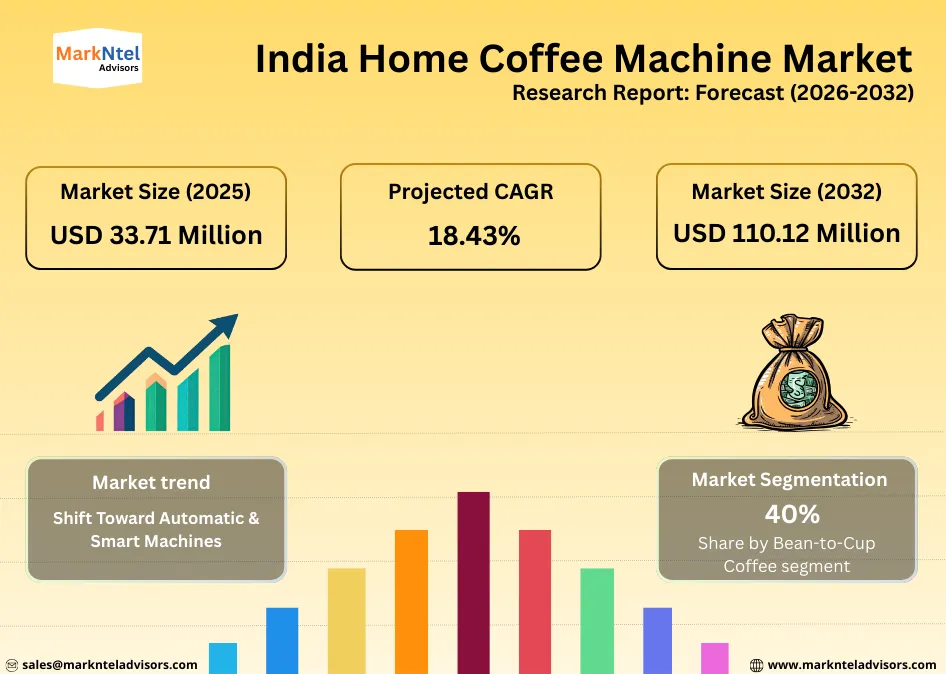
- The India Home Coffee Machine Market size was valued at around USD 33.71 million in 2025 and is projected to reach USD 110.12 million by 2032. The estimated CAGR from 2026 to 2032 is around 18.43%, indicating strong growth.
- By product type, the bean-to-cup coffee machines represented 40% in the overall revenue, while the drip coffee machine holds 46% share in the number of units sold.
- By mode of operation, the fully automatic machines seized around 42% share of the India Home Coffee Machine Market in 2025.
- Delhi NCR leads the India Home Coffee Machine Market with a 26% market share in 2025.
- The leading home coffee machine companies are Philips, Nespresso, Breville / Sage, Preethi, Hamilton Beach, De’Longhi, Black+Decker, Agaro, Havells India, Tecnora Appliances, Bajaj Electricals, and others.
Market Insights & Analysis: India Home Coffee Machine Market (2026- 2032):
The India Home Coffee Machine Market size was valued at around USD 33.71 million in 2025 and is projected to reach USD 110.12 million by 2032. Along with this, the market is estimated to grow at a CAGR of around 18.43% during the forecast period, i.e., 2026-32. The India Home Coffee Machine Market is poised for robust growth, fueled by rising urban coffee consumption and evolving lifestyle preferences. For example, India’s coffee output is forecast at approximately 403,000 tonnes in 2025–26, up 11 % year-on-year, and the domestic supply is strong enough to support growing at-home consumption.
Simultaneously, India’s coffee export earnings reached USD 1.8 billion in FY 2023–24, a 125 % increase over 11 years, reflecting both production efficiency and enhanced domestic availability, indirectly boosting consumer exposure to premium coffee varieties.
Urban households increasingly embrace convenience and café-style experiences, evidenced by initiatives like Nespresso opening its first brand boutique in New Delhi, giving consumers direct access to premium pod coffee machines and accessories.
The trend toward automation is further reinforced by technological adoption. The government has allocated USD 145 million under the Digital India and Smart Cities Mission to integrate AI and smart home technology, supporting connected, energy-efficient appliances, including advanced coffee machines.
This digital readiness is mirrored in product innovation. For example, JURA’s Z10 launch in June 2025, offering programmable features and up to 40 hot and cold beverage options, illustrates rising consumer demand for smart, automatic coffee solutions.
These developments suggest a convergence of factors strong domestic coffee supply, increasing urban demand, technological integration, and premium appliance launches that collectively create a favorable environment for sustained market growth. As awareness and adoption of automatic and smart coffee machines rise, India is likely to witness a significant expansion of the home coffee machine segment through 2032, transforming at-home coffee brewing into a mainstream lifestyle choice.
India Home Coffee Machine Market Recent Developments:
- June 2025: Singapore-based Costar Cosmos entered India’s coffee gadget market with a barista-grade automatic coffee machine priced under USD 400–430, aiming to make café-style brewing more accessible to home users and support broader market expansion.
- September 2025: DIT’O introduced India’s first self-cleaning filter coffee machine, combining IoT controls and hygiene-focused design initially for hospitality, with strong implications for future home-oriented filter coffee automation.
India Home Coffee Machine Market Scope:
| Category | Segments |
|---|---|
| Product Type | Drip/Filter Coffee Machines, Pod/Capsule Coffee Machines, Espresso Coffee Machines, Bean-to-Cup Coffee Machines, Others |
| Mode of Operation | Semi-automatic, Fully automatic, Manual |
| Distribution Channel | Multi-Branded Stores, Online Retail, Specialty Stores, Other Channels |
| Price Range | Economy / Low‑cost Segment, Mid‑range Segment, Premium / High‑end Segment |
| Material Type | Plastic, Metal |
India Home Coffee Machine Market Drivers:
Rising Urban Coffee Consumption & At-Home Brewing Preference
India’s coffee consumption patterns are shifting markedly, especially in urban areas where brewed coffee is increasingly preferred over traditional beverages. According to Coffee Board of India data, urban consumers account for about 70% of total coffee consumption, with per-capita consumption at 140 g annually versus rural levels near 31 g, and 85–90 % of urban consumption occurring at home rather than outside the home.
Domestic coffee consumption has steadily increased over the past decade, rising from 84,000 tonnes in 2012 to 91,000 tonnes in 2023, a clear indication of growing habitual consumption. Such trends are underpinned by lifestyle changes in urban centers, where younger professionals and dual-income households increasingly treat coffee as a daily ritual rather than an occasional indulgence, a shift supported by rising café culture and greater exposure to specialty coffee varieties.
This urban demand has begun to influence broader consumption behavior: households that once relied primarily on instant coffee are now experimenting with espresso, filter, and specialty brews, increasing interest in home brewing solutions and premium coffee equipment. Government-linked initiatives, such as the Coffee Board’s expansion plans to open 100 new franchise outlets, aim to further nurture domestic coffee demand beyond urban cafés and into community hubs, indirectly reinforcing at-home drinking culture beyond 2025.
Overall, as urban consumers increasingly adopt coffee drinking as part of their everyday lifestyle and prioritize at-home preparation, demand for home coffee machines will rise significantly, creating sustained market growth well into the late 2020s.
India Home Coffee Machine Market Trends:
Shift Toward Automatic & Smart Machines
The adoption of automatic and smart coffee machines in India reflects a broader, technology-led transformation in household appliances. Urban consumers increasingly seek connected, intuitive devices that offer convenience, automation, and remote control. Official government-linked data shows that India’s smart kitchen appliances sector, valued at about USD 1.06 billion in 2022, is projected to reach USD 4.9 billion by 2030, driven by rising incomes and urban technology uptake, indicating growing acceptance of advanced home appliances. The overall appliance market in India was around USD 30.8 billion in 2024 and is expected to reach USD 46.4 billion by 2030, with smart kitchen technology being one of the fastest-growing segments.
This trend is supported by India’s rapid adoption of IoT-connected devices, where usage of IoT-enabled systems has grown about 30%, driven by a young, tech-savvy population embracing home automation. Smart coffee machines, programmable via Wi-Fi and integrated with voice assistants or mobile apps, align with this broader shift toward intelligent appliances that simplify daily routines.
Government initiatives such as Digital India and infrastructure expansion further facilitate this transition by enhancing connectivity and digital access across urban and semi-urban areas. As connected homes become more common, automatic and smart coffee machines offering features like app-based controls, scheduling, and customization are poised to become mainstream components of modern Indian kitchens, especially beyond 2025.
This tech-centric behavior supports a lasting trend where smart, automatic coffee machines help redefine daily brewing experiences and expand overall market penetration.
India Home Coffee Machine Market Challenges:
High Cost Limiting Wider Adoption
One of the foremost challenges facing the India Home Coffee Machine Market is the high initial cost sensitivity among Indian consumers, particularly outside affluent segments. Even though home coffee machine prices vary widely, fully automatic machines that deliver convenience and café‑style quality often start at around USD 730–USD 1,100 for premium models, and imported specialty units can cost upwards of USD 1,580 after duties and logistics, making them luxurious purchases for most households. High prices have kept yearly premium sales relatively limited, with only around 20,000 imported high‑end machines sold locally despite growing interest in coffee culture.
For many Indian buyers, coffee machines are still perceived as non‑essential appliances, meaning discretionary spending on them competes with priorities like food, housing, and education. While entry and mid‑segment machines (e.g., in the USD 110–USD 436 range) are more accessible, advanced machines with features like bean‑to‑cup or automatic brewing remain costly compared to average household appliance spending. Price sensitivity is also reinforced by broader consumer behavior in India, where affordability remains a key determinant of purchase decisions across electronics and household appliances, especially in semi‑urban and rural regions.
Additionally, import duties and taxes, including basic customs duty (often around 10 %), IGST, and surcharges further inflate retail prices of imported coffee machine components and finished units, constraining mass adoption.
These high upfront costs mean many potential buyers delay or forego purchasing quality home coffee machines, presenting a persistent barrier to widespread market growth.
India Home Coffee Machine Market (2026-32) Segmentation Analysis:
The India Home Coffee Machine Market Report and Forecast 2026-2032 offers a detailed analysis of the market based on the following segments:
Based on Product Type:
- Drip/Filter Coffee Machines
- Pod/Capsule Coffee Machines
- Espresso Coffee Machines
- Bean-to-Cup Coffee Machines
- Others
In the India Home Coffee Machine Market, the Bean-to-Cup Coffee segment leads in market value, accounting for around 40% of total revenue, driven by growing urban demand for convenience, freshness, and café-style coffee at home. These machines automate grinding, dosing, and brewing in one device, appealing to consumers who value consistent quality and minimal effort.
On the other hand, Drip/Filter Coffee Machines dominate the market in terms of the number of units sold, with a market share of around 46%, as they are more affordable, simpler to operate, and widely accessible across urban and semi-urban households. This divergence highlights how premium, high-value machines capture revenue share, while economy and mid-range options drive penetration across broader consumer segments.
Based on Mode of Operation:
- Semi-automatic
- Fully automatic
- Manual
The Fully Automatic coffee machine holds a dominant position in the India Home Coffee Machine Market, holding around 42% market share. This preference reflects a growing consumer inclination toward convenience, consistency, and café-style coffee at home. Fully automatic machines handle the entire brewing process from grinding beans to extracting coffee and frothing milk, requiring minimal manual effort. This automation appeals especially to urban professionals and tech-savvy households, who value efficiency and the ability to prepare multiple beverages quickly.
Price points for these machines are higher, often ranging from USD 730–1,100 for mid-to-premium models, but Indian consumers are increasingly willing to invest in quality and convenience, particularly in metro and tier-1 cities. Technological integration, such as programmable settings, IoT-enabled controls, and maintenance alerts, further enhances adoption. The segment’s growth is also supported by rising urban coffee consumption and increasing awareness of specialty coffee culture, ensuring that fully automatic machines remain the preferred choice for premium home brewing in India.
India Home Coffee Machine Market (2026-32): Regional Projection
The market for home coffee machines in India is dominated by Delhi-NCR, holding around 26% market share. This region leads due to a combination of high disposable incomes, rapid urbanization, and a strong presence of tech-savvy and lifestyle-conscious consumers who are more likely to invest in premium and automated coffee appliances. Delhi-NCR also hosts a wide variety of multi-brand retail outlets, specialty stores, and online marketplaces, making home coffee machines easily accessible.
Additionally, the region’s busy urban lifestyle and growing café culture have increased the preference for at-home brewing solutions that offer convenience without compromising quality. The presence of professionals, expatriates, and students with exposure to international coffee trends further drives adoption. Cities such as Gurgaon, Noida, and Faridabad, with modern housing developments and affluent households, serve as key consumption hubs, ensuring that Delhi-NCR continues to dominate India’s home coffee machine market.
Gain a Competitive Edge with Our India Home Coffee Machine Market Report:
India Home Coffee Machine Market Report by MarkNtel Advisors provides a detailed & thorough analysis of market size & share, growth rate, competitive landscape, and key players. This comprehensive analysis helps businesses gain a holistic understanding of the market dynamics & make informed decisions.
This report also highlights current market trends & future projections, allowing businesses to identify emerging opportunities & potential challenges. By understanding market forecasts, companies can align their strategies & stay ahead of the competition.
India Home Coffee Machine Market Report aids in assessing & mitigating risks associated with entering or operating in the market. By understanding market dynamics, regulatory frameworks, and potential challenges, businesses can develop strategies to minimize risks & optimize their operations.
*Reports Delivery Format - Market research studies from MarkNtel Advisors are offered in PDF, Excel and PowerPoint formats. Within 24 hours of the payment being successfully received, the report will be sent to your email address.
Frequently Asked Questions
- Market Segmentation
- Introduction
- Product Definition
- Research Process
- Assumptions
- Executive Summary
- India Home Coffee Machine Market Policies, Regulations, and Product Standards
- India Home Coffee Machine Market Supply Chain Analysis
- India Home Coffee Machine Market Trends & Developments
- India Home Coffee Machine Market Dynamics
- Growth Drivers
- Challenges
- India Home Coffee Machine Market Hotspot & Opportunities
- India Home Coffee Machine Market Outlook, 2022-2032
- Market Size & Outlook
- By Revenues (USD Million)
- Market Share & Outlook
- By Product Type- Market Size & Forecast 2022-2032F, USD Million
- Drip/Filter Coffee Machines
- Pod/Capsule Coffee Machines
- Espresso Coffee Machines
- Bean-to-Cup Coffee Machines
- Others
- By Mode of Operation- Market Size & Forecast 2022-2032F, USD Million
- Semi-automatic
- Fully automatic
- Manual
- By Distribution Channel- Market Size & Forecast 2022-2032F, USD Million
- Multi-Branded Stores
- Online Retail
- Specialty Stores
- Other Channels
- By Price Range- Market Size & Forecast 2022-2032F, USD Million
- Economy / Low‑cost Segment
- Mid‑range Segment
- Premium / High‑end Segment
- By Material Type- Market Size & Forecast 2022-2032F, USD Million
- Plastic
- Metal
- By Region
- Delhi NCR
- Mumbai
- Chennai
- Bengaluru
- Hyderabad
- Rest of Other Cities
- By Company
- Company Revenue Shares
- Competitor Characteristics
- By Product Type- Market Size & Forecast 2022-2032F, USD Million
- Market Size & Outlook
- India Drip/Filter Coffee Machines Market Outlook, 2022-2032
- Market Size & Analysis
- Market Share & Analysis
- By Mode of Operation- Market Size & Forecast 2022-2032, USD Million
- By Distribution Channel- Market Size & Forecast 2022-2032, USD Million
- By Price Range- Market Size & Forecast 2022-2032, USD Million
- By Material Type- Market Size & Forecast 2022-2032, USD Million
- India Pod/Capsule Coffee Machines Market Outlook, 2022-2032
- Market Size & Analysis
- Market Revenues (USD Million)
- Market Share & Analysis
- By Mode of Operation- Market Size & Forecast 2022-2032, USD Million
- By Distribution Channel- Market Size & Forecast 2022-2032, USD Million
- By Price Range- Market Size & Forecast 2022-2032, USD Million
- By Material Type- Market Size & Forecast 2022-2032, USD Million
- Market Size & Analysis
- India Espresso Coffee Machines Market Outlook, 2022-2032
- Market Size & Analysis
- Market Revenues (USD Million)
- Market Share & Analysis
- By Mode of Operation- Market Size & Forecast 2022-2032, USD Million
- By Distribution Channel- Market Size & Forecast 2022-2032, USD Million
- By Price Range- Market Size & Forecast 2022-2032, USD Million
- By Material Type- Market Size & Forecast 2022-2032, USD Million
- Market Size & Analysis
- India Bean-to-Cup Coffee Machines Market Outlook, 2022-2032
- Market Size & Analysis
- Market Revenues (USD Million)
- Market Share & Analysis
- By Mode of Operation- Market Size & Forecast 2022-2032, USD Million
- By Distribution Channel- Market Size & Forecast 2022-2032, USD Million
- By Price Range- Market Size & Forecast 2022-2032, USD Million
- By Material Type- Market Size & Forecast 2022-2032, USD Million
- Market Size & Analysis
- India Home Coffee Machine Market Key Strategic Imperatives for Success & Growth
- Competition Outlook
- Company Profiles
- Philips
- Business Description
- Product Portfolio
- Strategic Alliances or Partnerships
- Recent Developments
- Financial Details
- Others
- Nespresso
- Business Description
- Product Portfolio
- Strategic Alliances or Partnerships
- Recent Developments
- Financial Details
- Others
- Breville / Sage
- Business Description
- Product Portfolio
- Strategic Alliances or Partnerships
- Recent Developments
- Financial Details
- Others
- Preethi
- Business Description
- Product Portfolio
- Strategic Alliances or Partnerships
- Recent Developments
- Financial Details
- Others
- Hamilton Beach
- Business Description
- Product Portfolio
- Strategic Alliances or Partnerships
- Recent Developments
- Financial Details
- Others
- De’Longhi
- Business Description
- Product Portfolio
- Strategic Alliances or Partnerships
- Recent Developments
- Financial Details
- Others
- Black+Decker
- Business Description
- Product Portfolio
- Strategic Alliances or Partnerships
- Recent Developments
- Financial Details
- Others
- Agaro
- Business Description
- Product Portfolio
- Strategic Alliances or Partnerships
- Recent Developments
- Financial Details
- Others
- Havells India
- Business Description
- Product Portfolio
- Strategic Alliances or Partnerships
- Recent Developments
- Financial Details
- Others
- Tecnora Appliances
- Business Description
- Product Portfolio
- Strategic Alliances or Partnerships
- Recent Developments
- Financial Details
- Others
- Bajaj Electricals
- Business Description
- Product Portfolio
- Strategic Alliances or Partnerships
- Recent Developments
- Financial Details
- Others
- Others
- Philips
- Company Profiles
- Disclaimer
MarkNtel Advisors follows a robust and iterative research methodology designed to ensure maximum accuracy and minimize deviation in market estimates and forecasts. Our approach combines both bottom-up and top-down techniques to effectively segment and quantify various aspects of the market. A consistent feature across all our research reports is data triangulation, which examines the market from three distinct perspectives to validate findings. Key components of our research process include:
1. Scope & Research Design At the outset, MarkNtel Advisors define the research objectives and formulate pertinent questions. This phase involves determining the type of research—qualitative or quantitative—and designing a methodology that outlines data collection methods, target demographics, and analytical tools. They also establish timelines and budgets to ensure the research aligns with client goals.
2. Sample Selection and Data Collection In this stage, the firm identifies the target audience and determines the appropriate sample size to ensure representativeness. They employ various sampling methods, such as random or stratified sampling, based on the research objectives. Data collection is carried out using tools like surveys, interviews, and observations, ensuring the gathered data is reliable and relevant.
3. Data Analysis and Validation Once data is collected, MarkNtel Advisors undertake a rigorous analysis process. This includes cleaning the data to remove inconsistencies, employing statistical software for quantitative analysis, and thematic analysis for qualitative data. Validation steps are taken to ensure the accuracy and reliability of the findings, minimizing biases and errors.

4. Data Forecast and FinalizationThe final phase involves forecasting future market trends based on the analyzed data. MarkNtel Advisors utilize predictive modeling and time series analysis to anticipate market behaviors. The insights are then compiled into comprehensive reports, featuring visual aids like charts and graphs, and include strategic recommendations to inform client decision-making
We offer flexible licensing options to cater to varying organizational needs. Choose the pricing pack that best suits your requirements:
Buy Now Inquire Before Buying
 Request Customization
 Talk to our Consultant







