

Europe Dermocosmetics Market Research Report: Forecast (2026-2032)
Europe Dermocosmetics Market - By Type Skin Care, (Anti-Aging, Skin Whitening, Sun Protection, Acne Treatment, Others), Hair Care, (Anti-Hairfall, Anti-Dandruff, Others), By Distri ... bution Channel (Pharmacy & Drug Stores, Online Retail, Supermarkets & Hypermarkets, Specialty Stores, Others), By Gender (Female, Male), By End-User (Hospitals & Clinics, Medical Spas & Salons, Individuals (Home Use), Others), and others Read more
- FMCG
- Feb 2026
- Pages 165
- Report Format: PDF, Excel, PPT
Europe Dermocosmetics Market
Projected 9.7% CAGR from 2026 to 2032
Study Period
2026-2032
Market Size (2025)
USD 10.23 Billion
Market Size (2032)
USD 17.19 Billion
Base Year
2025
Projected CAGR
9.7%
Leading Segments
By Distribution Channel: Pharmacy & Drug Stores
Europe Dermocosmetics Market Report Key Takeaways:
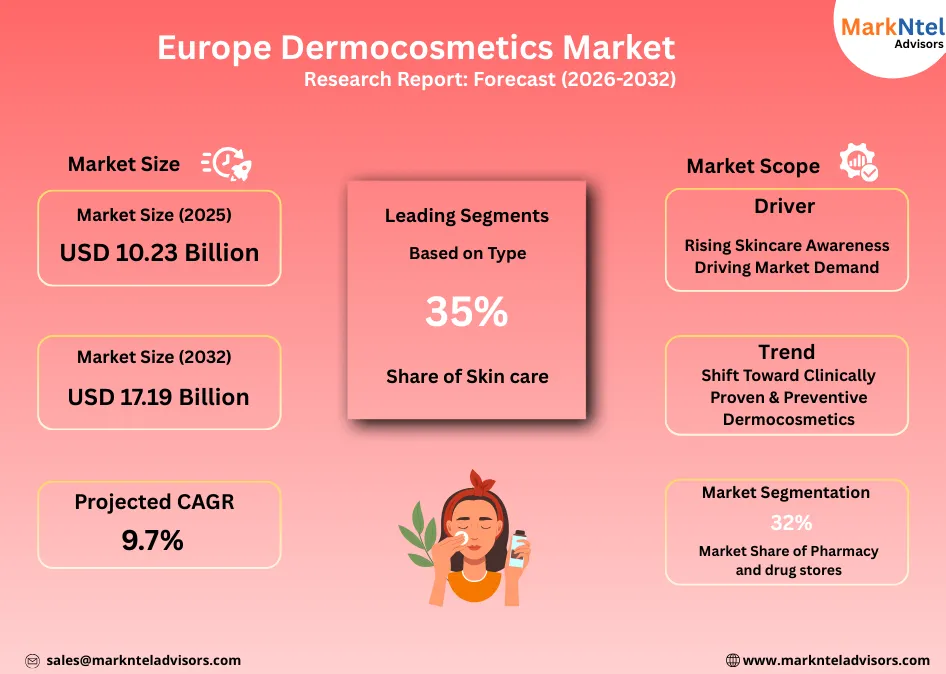
- The Europe Dermocosmetics Market size was valued at around USD 10.23 billion in 2025 and is projected to reach USD 17.19 billion by 2032. The estimated CAGR from 2026 to 2032 is around 9.7%, indicating strong growth.
- By Type, the skin care represented 35% of the Europe Dermocosmetics Market size in 2025.
- By Distribution Channel, the pharmacy & drug stores hold around 32% of the Europe Dermocosmetics Market size in 2025.
- By Country, France leads the Europe Dermocosmetics Market with a 19.12% market share in 2025
- The leading dermocosmetics companies in Europe are L’Oréal S.A., Beiersdorf AG, Pierre Fabre Group, Coty, Unilever PLC, Bioderma, Galderma S.A., Dermalogica, NUXE, Uriage, Sebapharma (Sebamed), ISDIN, Bioskin, PUIG, and others.
Market Insights & Analysis: Europe Dermocosmetics Market (2026- 2032):
The Europe Dermocosmetics Market size was valued at around USD 10.23 billion in 2025 and is projected to reach USD 17.19 billion by 2032. Along with this, the market is estimated to grow at a CAGR of around 9.7% during the forecast period, i.e., 2026-32. The Europe Dermocosmetics Market is entering a phase of sustained growth, supported by rising dermatological awareness, preventive healthcare practices, and a strong preference for clinically validated skincare solutions. Across the region, consumers are increasingly informed about skin health risks and early intervention. In France, a national survey reported that 92% of adults were aware of sun-related skin risks, while 60% understood the ABCDE rule for early melanoma detection, reflecting heightened public understanding of skin cancer prevention and the need for high-protection dermocosmetic products.
This awareness is translating into proactive medical engagement. A Europe-wide dermatology survey found that 42% to 78% of adults consulted a dermatologist within the past 24 months, depending on the country, highlighting growing reliance on professional skin assessments and medically endorsed skincare regimes. Such behavior directly supports demand for dermocosmetics positioned at the intersection of cosmetics and dermatology.
The market is also shaped by industry-level strategic moves toward science-led portfolios. In 2025, L’Oréal Group acquired a majority stake in Medik8, a UK-based brand recognized for clinically validated formulations, reinforcing long-term investment in evidence-based and preventive dermocosmetics across Europe.
Overall, continued public health education, dermatologist engagement, and corporate focus on validated efficacy are expected to strengthen consumer trust and expand adoption. As preventive skincare becomes a routine component of personal health management, dermocosmetics are positioned to remain a core growth pillar within Europe’s broader healthcare-oriented beauty ecosystem.
Europe Dermocosmetics Market Recent Developments:
- April 2025: Unilever launched the Dove Regenerative facial range in 2025, aiming at the fast-growing science-led dermocosmetics segment. With global dermocosmetics worth an estimated USD 8.5 billion, the move supports premium science-backed skincare adoption.
- June 2025: European Academy of Dermatology and Venereology (EADV) 2025, Vichy unveiled Neovadiol Longevity Revolumizing Cream (boosts skin volume & youthful tissue) and Dercos Aminexil Clinical REGEN Booster (clinically shown to add hair growth). Both leverage 20+ years of research and biotech breakthroughs for mature skin and scalp concerns.
Europe Dermocosmetics Market Scope:
| Category | Segments |
|---|---|
| By Type | Skin Care, (Anti-Aging, Skin Whitening, Sun Protection, Acne Treatment, Others), Hair Care, (Anti-Hairfall, Anti-Dandruff, Others |
| By Distribution Channel | Pharmacy & Drug Stores, Online Retail, Supermarkets & Hypermarkets, Specialty Stores, Others |
| By Gender | Female, Male |
| By End-User | Hospitals & Clinics, Medical Spas & Salons, Individuals (Home Use), Others), and others |
Europe Dermocosmetics Market Drivers:
Rising Skincare Awareness Driving Market Demand
In Europe, rising skincare awareness has emerged as a fundamental driver for the dermocosmetics market, anchored in both public health realities and consumer behavior supported by government / institutional data. A population-based study across 27 European countries found that over 43% of adults reported having at least one dermatological condition annually, equating to roughly 185 million individuals, including discomfort such as dryness, itching, acne, eczema, and infections. This high prevalence underlines the need for effective skin health solutions and fuels demand for dermocosmetic products that provide both therapeutic and cosmetic benefits.
Europeans also trust dermatologists as primary caregivers for skin health, with the majority across Western, Eastern, Northern, and Southern Europe consulting dermatologists regularly for both clinical and cosmetic advice, according to a large EADV public perception survey. Such clinical endorsement strengthens consumer confidence in scientifically backed dermocosmetics.
Cosmetics Europe reports that skin care and toiletries accounted for USD 32.2 billion of European cosmetics retail sales in 2024, reflecting widespread routine use of skin health products, far exceeding decorative categories. Consumers use multiple products daily for protection, hydration, and preventive care, showing that skincare is increasingly regarded as essential to daily health and well-being.
Furthermore, investment in dermatological education, preventive health campaigns, and integration of teledermatology/AI diagnostics is anticipated to accelerate awareness further. EU health initiatives, such as upcoming Horizon Europe health projects, are expected to fund skin health research, prevention strategies, and consumer education programmes, driving continued uptake of advanced dermocosmetics.
Overall, rising skincare awareness, buttressed by high disease prevalence and strong clinical trust, is propelling demand for dermocosmetics. Continued public health investments and preventive initiatives will sustain this driver, expanding the market through 2030 and beyond.
Europe Dermocosmetics Market Trends:
Shift Toward Clinically Proven & Preventive Dermocosmetics
A leading trend in Europe’s dermocosmetics market is the move toward clinically proven and preventive skincare, where scientifically validated products that protect and maintain skin health take precedence over purely cosmetic solutions. Europe’s regulatory framework, especially EU Regulation 1223/2009, requires dermocosmetic products to demonstrate safety and substantiated performance before they can be marketed. This ensures that consumers are increasingly choosing products with verifiable clinical evidence and dermatologist validation rather than superficial aesthetic claims.
A clear example of this trend is Vichy’s 2025 product launches at the European Academy of Dermatology and Venereology (EADV) Congress, where the brand debuted two science-backed innovations. The Neovadiol Longevity Revolumizing Cream, designed to increase youthful skin tissue by +31% and restore up to +42% of skin volume, and the Dercos Aminexil Clinical REGEN Booster, a scalp treatment clinically shown to add more than 14,000 hairs in 12 weeks. Both products are underpinned by over 20 years of research and more than 100 scientific studies, highlighting the market’s emphasis on preventive, evidence-based solutions rather than cosmetic enhancement alone.
This preventive focus is reinforced by public health guidance on broad-spectrum sun protection (SPF 30+), which is promoted to limit ultraviolet (UV) radiation exposure and reduce skin cancer risk; such campaigns encourage consumers to adopt dermocosmetics that are both clinically effective and protective.
Overall, the growing emphasis on clinical validation and preventive efficacy positions dermocosmetics as essential skin health tools in Europe, driving product innovation, regulatory compliance, and consumer trust that will continue to propel market growth.
Europe Dermocosmetics Market Challenges:
High Cost & R&D Barriers Impeding Market Growth
A significant challenge for the Europe dermocosmetics market stems from the high cost and research-and-development (R&D) barriers imposed by regulatory and safety requirements. Under EU Regulation (EC) No 1223/2009, every cosmetic product, including dermocosmetics, must undergo an exhaustive safety and scientific assessment before being placed on the EU market, ensuring a high level of consumer health protection. These obligations include detailed safety testing, creation of a cosmetic product safety report, and maintenance of a Product Information File (PIF) that documents quality and safety for up to ten years after launch. Compliance with such requirements often involves expert toxicological reviews and specialized laboratory analyses.
Quantifiable compliance costs reveal the financial strain on product developers. For a single dermocosmetic formulation, safety assessments alone can cost from roughly USD 760–2,930, with additional stability tests costing USD 760–2,170 and chemical analyses, such as heavy metals, costing USD 240–575, adding thousands of euros per product. For many small and medium-sized enterprises (SMEs), these fixed expenditures, particularly when multiplied across multiple products, can exceed manufacturing costs, creating a barrier to innovation and market entry.
Furthermore, the complexity of ongoing safety surveillance and re-assessment further raises long-term R&D commitments, especially as scientific and regulatory expectations evolve. Collectively, these factors increase the time and money required to bring new dermocosmetic innovations to European consumers, potentially delaying launches and favouring large multinationals with deeper R&D resources.
Overall, high compliance, testing, and safety evaluation costs under rigorous EU standards create significant R&D barriers. These financial burdens can slow innovation, restrict smaller brands, and challenge growth momentum in the European dermocosmetics industry.
Europe Dermocosmetics Market (2026-32) Segmentation Analysis:
The Europe Dermocosmetics Market Report and Forecast 2026-2032 offers a detailed analysis of the market based on the following segments:
Based on Type:
- Skin Care
- Anti-Aging
- Skin Whitening
- Sun Protection
- Acne Treatment
- Others
- Hair Care
- Anti-Hairfall
- Anti-Dandruff
- Others
Skin care holds the leading share, around 35% in the Europe dermocosmetics industry due to its strong alignment with preventive dermatology and daily health-oriented routines. European consumers increasingly view skin care as an extension of medical care rather than cosmetic indulgence, particularly for conditions such as photoaging, acne, rosacea, pigmentation, and barrier repair. High awareness of sun damage, skin cancer prevention, and premature aging has driven sustained demand for anti-aging, sun protection, and acne treatment products, which are frequently recommended by dermatologists.
Additionally, Europe’s aging population has increased reliance on clinically validated formulations that support long-term skin health. Regulatory emphasis on safety, ingredient transparency, and substantiated claims further strengthens consumer trust in dermocosmetic skin care products. The segment’s dominance is also supported by frequent product innovation, prescription-adjacent positioning, and repeat usage patterns, making skin care the most essential and consistently purchased category within the European dermocosmetics landscape.
Based on Distribution Channel:
- Pharmacy & Drug Stores
- Online Retail
- Supermarkets & Hypermarkets
- Specialty Stores
- Others
Pharmacy and drug stores account for nearly 32% of the European dermocosmetics industry, making them the most dominant distribution channel. This leadership is driven by Europe’s strong culture of pharmacist-led skincare guidance and medical endorsement. Consumers often prefer purchasing dermocosmetics from pharmacies due to the perceived credibility, product authenticity, and access to professional advice. Many dermocosmetic brands are specifically formulated for pharmacy distribution, reinforcing trust and compliance with medical standards. In several European countries, pharmacists play a semi-clinical role, influencing purchasing decisions for conditions such as sensitive skin, acne, eczema, and hair loss.
Additionally, strict cosmetic regulations encourage controlled retail environments, favoring pharmacies over informal channels. The channel also benefits from strong repeat purchases, insurance-linked recommendations in some regions, and integration with dermatology clinics. As a result, pharmacy and drug stores remain the primary gateway for consumers seeking evidence-based, preventive dermocosmetic solutions across Europe.
Europe Dermocosmetics Market (2026-32): Regional Projection
The Europe Dermocosmetics Market is dominated by France, holding around 19.12% market share. France’s leadership is primarily driven by its strong dermatology culture, well-established pharmaceutical retail network, and the presence of globally recognized dermocosmetic brands. The country has a high density of dermatologists and pharmacy-led skincare recommendations, which significantly influence consumer purchasing behavior. French consumers also exhibit high awareness of preventive skincare, sun protection, anti-aging, and clinically proven formulations, supporting consistent demand.
Moreover, France serves as the headquarters or innovation hub for several leading dermocosmetic companies, encouraging early adoption of advanced products. Strict regulatory compliance and scientific validation further enhance consumer trust in domestically developed dermocosmetics. Additionally, frequent dermatology congresses, research institutions, and collaborations between healthcare professionals and brands strengthen product credibility. These factors collectively position France as the dominant regional contributor to Europe’s dermocosmetics market, sustaining its leadership through strong clinical alignment, innovation, and consumer confidence.
Gain a Competitive Edge with Our Europe Dermocosmetics Market Report:
- Europe Dermocosmetics Market Report by MarkNtel Advisors provides a detailed & thorough analysis of market size & share, growth rate, competitive landscape, and key players. This comprehensive analysis helps businesses gain a holistic understanding of the market dynamics & make informed decisions.
- This report also highlights current market trends & future projections, allowing businesses to identify emerging opportunities & potential challenges. By understanding market forecasts, companies can align their strategies & stay ahead of the competition.
- Europe Dermocosmetics Market Report aids in assessing & mitigating risks associated with entering or operating in the market. By understanding market dynamics, regulatory frameworks, and potential challenges, businesses can develop strategies to minimize risks & optimize their operations.
*Reports Delivery Format - Market research studies from MarkNtel Advisors are offered in PDF, Excel and PowerPoint formats. Within 24 hours of the payment being successfully received, the report will be sent to your email address.
Frequently Asked Questions
- Market Segmentation
- Introduction
- Product Definition
- Research Process
- Assumptions
- Executive Summary
- Europe Dermocosmetics Market Policies, Regulations, and Product Standards
- Europe Dermocosmetics Market Supply Chain Analysis
- Europe Dermocosmetics Market Trends & Developments
- Europe Dermocosmetics Market Dynamics
- Growth Drivers
- Challenges
- Europe Dermocosmetics Market Hotspot & Opportunities
- Europe Dermocosmetics Market Outlook, 2022-2032
- Market Size & Outlook
- By Revenues (USD Million)
- Market Share & Outlook
- By Type- Market Size & Forecast 2022-2032F, USD Million
- Skin Care
- Anti-Aging
- Skin Whitening
- Sun Protection
- Acne Treatment
- Others
- Hair Care
- Anti-Hairfall
- Anti-Dandruff
- Others
- Skin Care
- By Distribution Channel- Market Size & Forecast 2022-2032F, USD Million
- Pharmacy & Drug Stores
- Online Retail
- Supermarkets & Hypermarkets
- Specialty Stores
- Others
- By Gender- Market Size & Forecast 2022-2032F, USD Million
- Female
- Male
- By End-User- Market Size & Forecast 2022-2032F, USD Million
- Hospitals & Clinics
- Medical Spas & Salons
- Individuals (Home Use)
- Others
- By Country
- UK
- Germany
- France
- Italy
- Spain
- Russia
- BENELUX
- Rest of Europe
- By Company
- Company Revenue Shares
- Competitor Characteristics
- By Type- Market Size & Forecast 2022-2032F, USD Million
- Market Size & Outlook
- UK Dermocosmetics Market Outlook, 2022-2032
- Market Size & Analysis
- Market Share & Analysis
- By Type- Market Size & Forecast 2022-2032, USD Million
- By Distribution Channel- Market Size & Forecast 2022-2032, USD Million
- By Gender- Market Size & Forecast 2022-2032, USD Million
- By End-User- Market Size & Forecast 2022-2032, USD Million
- Germany Dermocosmetics Market Outlook, 2022-2032
- Market Size & Analysis
- Market Revenues (USD Million)
- Market Share & Analysis
- By Type- Market Size & Forecast 2022-2032, USD Million
- By Distribution Channel- Market Size & Forecast 2022-2032, USD Million
- By Gender- Market Size & Forecast 2022-2032, USD Million
- By End-User- Market Size & Forecast 2022-2032, USD Million
- Market Size & Analysis
- France Dermocosmetics Market Outlook, 2022-2032
- Market Size & Analysis
- Market Revenues (USD Million)
- Market Share & Analysis
- By Type- Market Size & Forecast 2022-2032, USD Million
- By Distribution Channel- Market Size & Forecast 2022-2032, USD Million
- By Gender- Market Size & Forecast 2022-2032, USD Million
- By End-User- Market Size & Forecast 2022-2032, USD Million
- Market Size & Analysis
- Italy Dermocosmetics Market Outlook, 2022-2032
- Market Size & Analysis
- Market Revenues (USD Million)
- Market Share & Analysis
- By Type- Market Size & Forecast 2022-2032, USD Million
- By Distribution Channel- Market Size & Forecast 2022-2032, USD Million
- By Gender- Market Size & Forecast 2022-2032, USD Million
- By End-User- Market Size & Forecast 2022-2032, USD Million
- Market Size & Analysis
- Spain Dermocosmetics Market Outlook, 2022-2032
- Market Size & Analysis
- Market Revenues (USD Million)
- Market Share & Analysis
- By Type- Market Size & Forecast 2022-2032, USD Million
- By Distribution Channel- Market Size & Forecast 2022-2032, USD Million
- By Gender- Market Size & Forecast 2022-2032, USD Million
- By End-User- Market Size & Forecast 2022-2032, USD Million
- Market Size & Analysis
- Russia Dermocosmetics Market Outlook, 2022-2032
- Market Size & Analysis
- Market Revenues (USD Million)
- Market Share & Analysis
- By Type- Market Size & Forecast 2022-2032, USD Million
- By Distribution Channel- Market Size & Forecast 2022-2032, USD Million
- By Gender- Market Size & Forecast 2022-2032, USD Million
- By End-User- Market Size & Forecast 2022-2032, USD Million
- Market Size & Analysis
- BENELUX Dermocosmetics Market Outlook, 2022-2032
- Market Size & Analysis
- Market Revenues (USD Million)
- Market Share & Analysis
- By Type- Market Size & Forecast 2022-2032, USD Million
- By Distribution Channel- Market Size & Forecast 2022-2032, USD Million
- By Gender- Market Size & Forecast 2022-2032, USD Million
- By End-User- Market Size & Forecast 2022-2032, USD Million
- Market Size & Analysis
- Europe Dermocosmetics Market Key Strategic Imperatives for Success & Growth
- Competition Outlook
- Company Profiles
- L’Oréal S.A.
- Business Description
- Product Portfolio
- Strategic Alliances or Partnerships
- Recent Developments
- Financial Details
- Others
- Beiersdorf AG
- Business Description
- Product Portfolio
- Strategic Alliances or Partnerships
- Recent Developments
- Financial Details
- Others
- Pierre Fabre Group
- Business Description
- Product Portfolio
- Strategic Alliances or Partnerships
- Recent Developments
- Financial Details
- Others
- Coty
- Business Description
- Product Portfolio
- Strategic Alliances or Partnerships
- Recent Developments
- Financial Details
- Others
- Unilever PLC
- Business Description
- Product Portfolio
- Strategic Alliances or Partnerships
- Recent Developments
- Financial Details
- Others
- Bioderma
- Business Description
- Product Portfolio
- Strategic Alliances or Partnerships
- Recent Developments
- Financial Details
- Others
- Galderma S.A.
- Business Description
- Product Portfolio
- Strategic Alliances or Partnerships
- Recent Developments
- Financial Details
- Others
- Dermalogica
- Business Description
- Product Portfolio
- Strategic Alliances or Partnerships
- Recent Developments
- Financial Details
- Others
- NUXE
- Business Description
- Product Portfolio
- Strategic Alliances or Partnerships
- Recent Developments
- Financial Details
- Others
- Uriage
- Business Description
- Product Portfolio
- Strategic Alliances or Partnerships
- Recent Developments
- Financial Details
- Others
- Sebapharma / Sebamed
- Business Description
- Product Portfolio
- Strategic Alliances or Partnerships
- Recent Developments
- Financial Details
- Others
- ISDIN
- Business Description
- Product Portfolio
- Strategic Alliances or Partnerships
- Recent Developments
- Financial Details
- Others
- Bioskin
- Business Description
- Product Portfolio
- Strategic Alliances or Partnerships
- Recent Developments
- Financial Details
- Others
- PUIG
- Business Description
- Product Portfolio
- Strategic Alliances or Partnerships
- Recent Developments
- Financial Details
- Others
- Others
- L’Oréal S.A.
- Company Profiles
- Disclaimer
MarkNtel Advisors follows a robust and iterative research methodology designed to ensure maximum accuracy and minimize deviation in market estimates and forecasts. Our approach combines both bottom-up and top-down techniques to effectively segment and quantify various aspects of the market. A consistent feature across all our research reports is data triangulation, which examines the market from three distinct perspectives to validate findings. Key components of our research process include:
1. Scope & Research Design At the outset, MarkNtel Advisors define the research objectives and formulate pertinent questions. This phase involves determining the type of research—qualitative or quantitative—and designing a methodology that outlines data collection methods, target demographics, and analytical tools. They also establish timelines and budgets to ensure the research aligns with client goals.
2. Sample Selection and Data Collection In this stage, the firm identifies the target audience and determines the appropriate sample size to ensure representativeness. They employ various sampling methods, such as random or stratified sampling, based on the research objectives. Data collection is carried out using tools like surveys, interviews, and observations, ensuring the gathered data is reliable and relevant.
3. Data Analysis and Validation Once data is collected, MarkNtel Advisors undertake a rigorous analysis process. This includes cleaning the data to remove inconsistencies, employing statistical software for quantitative analysis, and thematic analysis for qualitative data. Validation steps are taken to ensure the accuracy and reliability of the findings, minimizing biases and errors.

4. Data Forecast and FinalizationThe final phase involves forecasting future market trends based on the analyzed data. MarkNtel Advisors utilize predictive modeling and time series analysis to anticipate market behaviors. The insights are then compiled into comprehensive reports, featuring visual aids like charts and graphs, and include strategic recommendations to inform client decision-making
We offer flexible licensing options to cater to varying organizational needs. Choose the pricing pack that best suits your requirements:
Buy Now Inquire Before Buying
 Request Customization
 Talk to our Consultant







