

France Greenhouse Horticulture Market Research Report: Growth Drivers & Forecast (2026-2032)
By Crop Type (Fruits & Vegetables, Nursery Crops, Flowers & Ornamentals, Others), By Material Type (Glass, Plastic), By Technology (Heating System, Cooling System, Others), By End- ... Use (Commercial growers, Residential, Research & educational institutes), and others Read more
- Environment
- Mar 2026
- Pages 135
- Report Format: PDF, Excel, PPT
France Greenhouse Horticulture Market
Projected 6.15% CAGR from 2026 to 2032
Study Period
2026-2032
Market Size (2026)
USD 1.23 Billion
Market Size (2032)
USD 1.76 Billion
Base Year
2025
Projected CAGR
6.15%
Leading Segments
By Material Type: Glass
France Greenhouse Horticulture Market Report Key Takeaways:
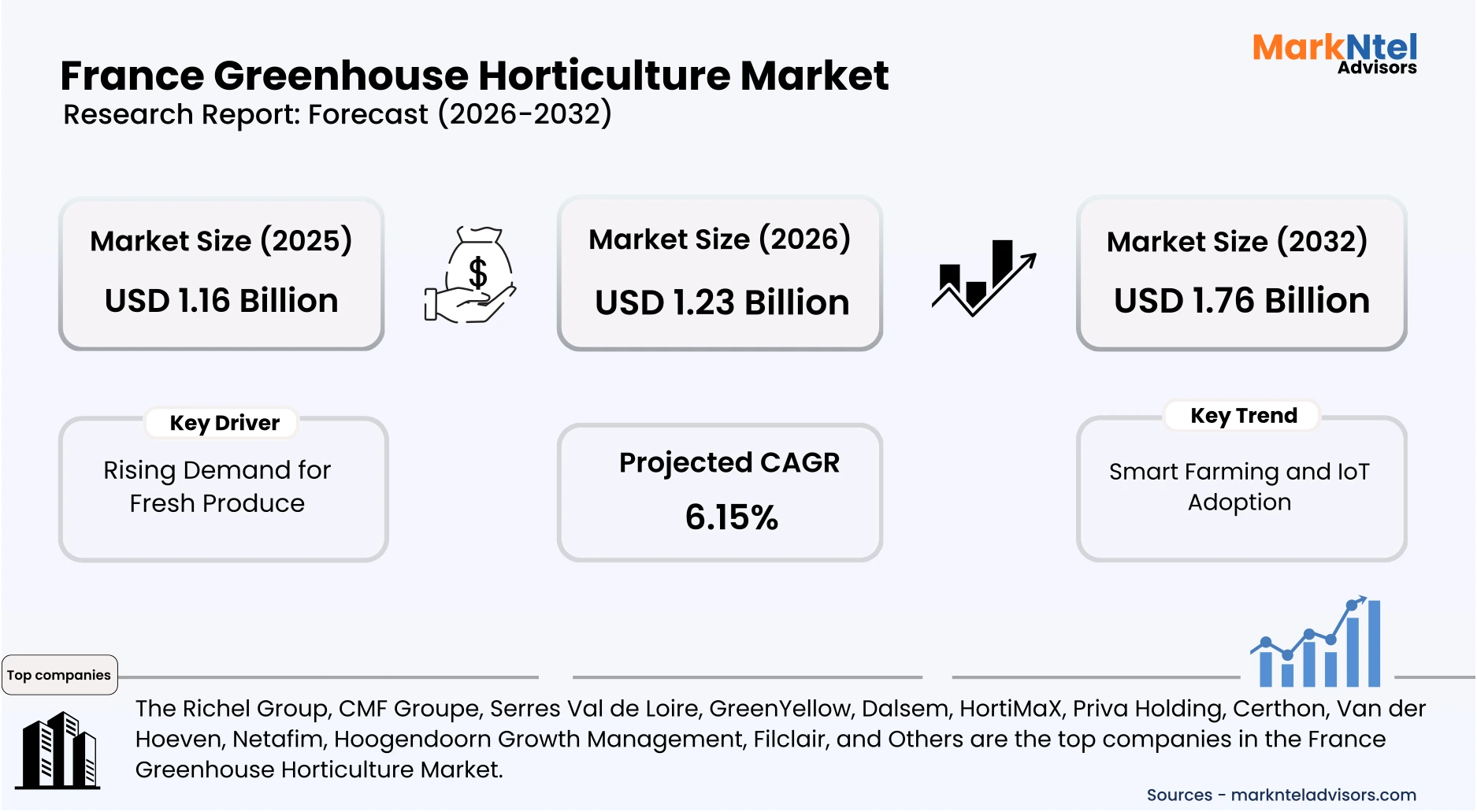
- The France Greenhouse Horticulture market size was valued at USD 1.16 billion in 2025 and is projected to grow from USD 1.23 billion in 2026 to USD 1.76 billion by 2032, exhibiting a CAGR of 6.15% during the forecast period.
- By Crop Type, the Fruits & Vegetables seized a significant share of about 54% in the France Greenhouse Horticulture Market in 2026.
- By Material Type, the glass segment holds the largest share of about 57% in the France Greenhouse Horticulture Market in 2026.
- Leading Greenhouse Horticulture companies in France are Richel Group, CMF Groupe, Serres Val de Loire, GreenYellow, Dalsem, HortiMaX, Priva Holding, Certhon, Van der Hoeven, Netafim, Hoogendoorn Growth Management, Filclair, and Others.
Market Insights & Analysis: France Greenhouse Horticulture Market (2026-32):
The France Greenhouse Horticulture Market size was valued at around USD 1.16 billion in 2025 and is projected to grow from USD 1.23 billion in 2026 to USD 1.76 billion by 2032. Along with this, the market is estimated to grow at a CAGR of around 6.15% during the forecast period, i.e., 2026-32.
The France greenhouse horticulture market is witnessing steady development as the country strengthens its focus on controlled-environment agriculture to ensure stable food production and supply. One of the major factors supporting market growth is the rising demand for fresh, high-quality fruits and vegetables among French consumers. Increasing health awareness and the preference for locally produced food have encouraged growers to adopt greenhouse systems that allow year-round cultivation while maintaining consistent quality and yield.
Demand for greenhouse cultivation is particularly visible in Central France, especially the Centre-Val de Loire region, where horticulture and market gardening are deeply rooted in the local agricultural economy. The region produces large volumes of vegetables such as onions, beets, lettuce, and cucumbers. Notably, greenhouse cucumber cultivation in this region accounts for nearly 90% of national production, highlighting the importance of controlled-environment farming in meeting domestic demand and supporting supply chains across France .
Similarly, the Southeast region has become a significant center for greenhouse horticulture due to favorable climatic conditions and strong agricultural infrastructure. Areas such as the Rhône Valley and Provence-Alpes-Côte d’Azur (PACA) benefit from mild weather conditions that support the production of tomatoes, peppers, raspberries, and apricots . The presence of extensive sheltered cultivation systems in these regions allows growers to maintain stable production levels while responding to the increasing demand for fresh and locally grown produce.
Technological advancement is another factor shaping the evolution of greenhouse horticulture in France. Growers are gradually adopting smart farming technologies and IoT-based monitoring systems to improve crop management and resource efficiency. For example, a research project titled “Precision AgriVoltaics for Carbon Neutrality Enhanced Production,” funded by the French National Research Agency (ANR), is developing an AI- and IoT-enabled greenhouse system equipped with sensors, cameras, and photovoltaic panels. This system continuously monitors environmental factors such as CO₂ levels, temperature, soil moisture, and light intensity. The collected data allows automated adjustments in irrigation, fertilization, and lighting, enabling growers to optimize crop productivity while improving energy efficiency.
In addition to technological adoption, government support is also contributing to the modernization of greenhouse infrastructure. Under the France 2030 agricultural strategy, the national agency FranceAgriMer launched funding programs aimed at supporting investments in innovative greenhouse technologies, including climate-control systems, automation, and sustainable cultivation practices. This initiative will remain active until July 2026, encouraging growers to adopt modern greenhouse solutions and enhance productivity across the horticulture sector .
Overall, the France greenhouse horticulture market is expected to expand as demand for fresh produce continues to rise and advanced cultivation technologies become more accessible. The combination of strong domestic demand, technological innovation, and supportive government initiatives is likely to strengthen the country’s greenhouse horticulture industry in the coming years.
France Greenhouse Horticulture Market Recent Developments:
- 2025: Astredhor Méditerranée inaugurated a new 600 m² experimental greenhouse in November‑December 2025 to support practical trials and innovation in crop production methods and varieties, boosting research capabilities for ornamental and vegetable horticulture in southern France .
- 2025: The Volta Group and Richel Group commissioned two photovoltaic greenhouses covering 5 hectares in the Drôme (France) for kiwi production. These greenhouses generate about 7.3 GWh/year of solar power while protecting crops and saving water, combining renewable energy with horticulture.
France Greenhouse Horticulture Market Scope:
| Category | Segments |
|---|---|
| By Crop Type | (Fruits & Vegetables, Nursery Crops, Flowers & Ornamentals, Others), |
| By Material Type | (Glass, Plastic), |
| By Technology | (Heating System, Cooling System, Others), |
| By End-Use | (Commercial growers, Residential, Research & educational institutes), |
France Greenhouse Horticulture Market Driver:
Rising Demand for Fresh Produce
The demand for fresh fruits and vegetables in France is a structurally significant driver of greenhouse horticulture, shaped by national policy and long‑term agricultural strategy. France currently produces approximately 2.48 million tonnes of fruit and 13.2 million tonnes of vegetables annually, yet domestic production has declined over recent decades, leading to about half of all fresh produce consumed in the country being imported as of the early 2020s . To counter this and strengthen food sovereignty, the French government launched a sovereign fund of USD 214 million to support fruit and vegetable production, including investments in modern cultivation technologies such as climate‑controlled greenhouses, automation, and water‑efficient equipment.
France’s National Food, Nutrition, and Climate Strategy also emphasizes increased consumption of locally grown fruits and vegetables through 2030, linking healthy diets with sustainable agriculture . Growing health awareness and environmental concerns are prompting consumers to prefer fresh, pesticide‑reduced, locally sourced produce year‑round, fuelling greenhouse cultivation that overcomes seasonal limitations.
Looking ahead, beyond 2025, continued public investment under France 2030 and related policies will further encourage greenhouse expansion and technology adoption, including precision agriculture and improved logistics infrastructure to reduce dependence on imports and shorten farm‑to‑table supply chains.
Overall, with declining self‑sufficiency, strategic government initiatives, and rising consumer demand for fresh, local produce, this driver will increasingly propel greenhouse horticulture growth in France.
France Greenhouse Horticulture Market Trend:
Smart Farming and IoT Adoption
The adoption of smart farming technologies and IoT-based monitoring systems is emerging as a key trend in the France greenhouse horticulture market, as growers increasingly rely on real-time environmental data to optimize crop production and resource efficiency. Advanced sensor networks are being integrated into agricultural operations to monitor parameters such as temperature, soil moisture, humidity, and water availability, enabling more precise crop management. For instance, at the INRAE experimental farm in Montoldre (Auvergne-Rhône-Alpes, France), researchers deployed LoRaWAN-connected sensors that continuously track environmental conditions and transmit the data to a gateway for real-time monitoring. This system enables data-driven management of irrigation and crop conditions, helping farmers improve productivity while minimizing resource use .
For example, Provence in southern France, where researchers tested wireless sensor networks and IoT-based irrigation monitoring systems to enhance water management in agriculture. The sensors collect real-time data on soil moisture levels and crop water demand, allowing farmers to apply irrigation more precisely and reduce water wastage. The study demonstrated that low-cost IoT sensor networks can significantly improve irrigation decision-making and water efficiency in Mediterranean agricultural systems .
Overall, the integration of IoT sensors, digital monitoring platforms, and automated climate-control systems reflects the broader transition of greenhouse horticulture in France toward data-driven and precision-based cultivation. As greenhouse crops require tightly controlled environmental conditions, smart farming technologies are increasingly essential for improving yields, conserving resources, and enhancing operational efficiency.
France Greenhouse Horticulture Market Opportunity:
Innovation in Crop Varieties
Continuous innovation in crop varieties and plant breeding technologies presents a major opportunity for the France greenhouse horticulture market. Research institutions and seed developers in France are increasingly developing new fruit and vegetable varieties that offer higher yields, disease resistance, and adaptability to controlled greenhouse environments. These innovations enable growers to improve productivity while reducing chemical inputs and resource consumption.
A notable example is the “GEOPOLIS” winter wheat variety developed by the French research institute INRAE and its subsidiary Agri Obtentions. This variety was officially introduced for cultivation in France starting in the autumn of 2025, after nearly 10 years of research and breeding trials. Field tests showed that GEOPOLIS achieved 110.7% of the control yield under treated conditions and 125% under non-fungicide conditions, demonstrating strong resistance to major diseases and improved nitrogen-use efficiency. The innovation is expected to be cultivated on around 30,000 hectares beginning with the 2026 harvest, highlighting the scale at which new crop genetics can influence agricultural productivity .
Similarly, seed companies are launching new horticultural varieties designed specifically for greenhouse production. For example, HM. Clause introduced a new Marmande-type tomato variety for the European market, designed for high flavor quality and adaptability to both heated and cold greenhouse systems. Such varietal innovation helps growers differentiate products and meet consumer demand for premium tomatoes in France, where average tomato consumption reached 13.5 kg per capita according to FranceAgriMer .
Overall, the development of high-yielding, climate-resilient, and greenhouse-optimized crop varieties offers significant opportunities for France’s horticulture sector. These innovations support higher productivity, improved crop quality, and better resilience to climate variability, enabling greenhouse producers to expand production and strengthen domestic fruit and vegetable supply.
France Greenhouse Horticulture Market Challenge:
High Capital Expenditure Impeding Market Growth
High capital expenditure is one of the major challenges limiting the expansion of the France greenhouse horticulture market, particularly for small and medium-scale growers. Modern greenhouse systems require significant upfront investment for construction, climate-control technology, irrigation systems, and energy infrastructure. For instance, installing a high-tech glass greenhouse with automated climate control, fertigation, and monitoring systems can cost between approximately USD 2.7 million and USD 6.7 million, depending on the design and technology level .
Even medium-scale hydroponic greenhouse facilities require substantial capital. Agricultural investment estimates indicate that greenhouse farms covering 1,000–3,000 m² require investments of around USD 325,000–USD 865,000 for infrastructure, irrigation equipment, and environmental control systems . These high initial costs create financial barriers for new entrants and limit technology adoption among smaller producers.
In addition to construction expenses, greenhouse operations involve high ongoing costs for energy, labor, and maintenance. Heating and climate control alone can require per hectare annually USD 22,000–USD 65,000, especially in winter production systems . Rising energy price volatility further increases financial risk for greenhouse farmers.
As a result, although modern greenhouses improve productivity and enable year-round cultivation, the substantial capital requirements and financing constraints remain a major obstacle to widespread adoption of advanced greenhouse technologies across France’s horticulture sector.
France Greenhouse Horticulture Market (2026-32) Segmentation Analysis:
The France Greenhouse Horticulture Market study of MarkNtel Advisors evaluates & highlights the major trends and influencing factors in each segment. It includes predictions for the period 2026–32 at the country level. Based on the analysis, the market has been further classified as;
Based on Crop Type:
-
- Fruits & Vegetables
- Nursery Crops
- Flowers & Ornamentals
- Others
Fruits and vegetables are the dominant crop type in the France greenhouse horticulture market, accounting for 54% of the total market. This segment’s prominence is driven by growing domestic consumption and the demand for year-round availability of high-quality produce. Controlled greenhouse environments allow farmers to manage temperature, humidity, and light conditions, reducing crop losses caused by unpredictable weather and pests. High-value crops such as tomatoes, cucumbers, strawberries, and peppers benefit particularly from these optimized conditions.
Moreover, France’s export-oriented horticulture sector relies heavily on greenhouse cultivation to meet international quality standards. Innovations in hydroponics, vertical farming, and automated irrigation further enhance productivity and sustainability. The combination of consistent yield, better crop quality, and the ability to supply off-season fruits and vegetables reinforces the leading position of this segment. Commercial growers increasingly prioritize this crop type to maximize profitability and meet both domestic and global market demands.
Based on Material Type:
- Glass
- Plastic
Glass is the leading material type in the French market, capturing 57% of market size. This preference stems from glass’s superior light transmission, durability, and long-term investment value. Unlike plastic, glass allows uniform sunlight penetration, which enhances photosynthesis and promotes better crop quality. The material also supports advanced climate control technologies, enabling precise management of temperature, humidity, and ventilation for sensitive crops.
Additionally, glass greenhouses are more compatible with sustainable energy solutions, such as solar panels, and provide higher insulation efficiency, reducing heating costs during colder months. Their durability ensures longevity, minimizing replacement and maintenance expenses over time. As a result, commercial and export-oriented growers prefer glass over other materials, particularly for high-value fruits, vegetables, and ornamental crops. This combination of efficiency, productivity, and sustainability underlines the leading market share of glass greenhouses in France.
France Greenhouse Horticulture Market (2026-32): Regional Projection
The France Greenhouse Horticulture Market is largely dominated by the Southeast region, particularly Provence-Alpes-Côte d’Azur and Auvergne-Rhône-Alpes. These regions host a large concentration of commercial greenhouse farms due to their favorable climate, strong agricultural infrastructure, and proximity to major fruit and vegetable production zones. The Mediterranean climate in southern France offers higher solar radiation and milder winters, which help reduce heating requirements and improve crop productivity in greenhouse cultivation.
The Southeast is a major center for greenhouse vegetable production, especially tomatoes, cucumbers, and leafy greens. According to agricultural data from the French Ministry of Agriculture and FranceAgriMer, Provence-Alpes-Côte d’Azur is one of the leading regions for protected vegetable cultivation in France. The region benefits from well-developed irrigation networks, advanced horticultural cooperatives, and access to large domestic and export markets.
In addition, several greenhouse technology providers and research institutions supporting controlled-environment agriculture are located in southern France. This strong ecosystem of growers, suppliers, and research facilities reinforces the Southeast region’s leadership in greenhouse horticulture production across the country.
Gain a Competitive Edge with Our France Greenhouse Horticulture Market Report:
- France Greenhouse Horticulture Market Report by MarkNtel Advisors provides a detailed & thorough analysis of market size & share, growth rate, competitive landscape, and key players. This comprehensive analysis helps businesses gain a holistic understanding of the market dynamics & make informed decisions.
- This report also highlights current market trends & future projections, allowing businesses to identify emerging opportunities & potential challenges. By understanding market forecasts, companies can align their strategies & stay ahead of the competition.
- France Greenhouse Horticulture Market Report aids in assessing & mitigating risks associated with entering or operating in the market. By understanding market dynamics, regulatory frameworks, and potential challenges, businesses can develop strategies to minimize risks & optimize their operations.
*Reports Delivery Format - Market research studies from MarkNtel Advisors are offered in PDF, Excel and PowerPoint formats. Within 24 hours of the payment being successfully received, the report will be sent to your email address.
Frequently Asked Questions
- Market Segmentation
- Introduction
- Product Definition
- Research Process
- Assumptions
- Executive Summary
- France Greenhouse Horticulture Market Policies, Regulations, and Product Standards
- France Greenhouse Horticulture Market Trends & Developments
- France Greenhouse Horticulture Market Dynamics
- Growth Factors
- Challenges
- France Greenhouse Horticulture Market Hotspot & Opportunities
- France Greenhouse Horticulture Market Outlook, 2022-2032F
- Market Size & Outlook
- By Revenues (USD Million)
- Market Share & Outlook
- By Crop Type- Market Size & Forecast 2022-2032, USD Million
- Fruits & Vegetables
- Nursery Crops
- Flowers & Ornamentals
- Others
- By Material Type- Market Size & Forecast 2022-2032, USD Million
- Glass
- Plastic
- By Technology- Market Size & Forecast 2022-2032, USD Million
- Heating System
- Cooling System
- Others
- By End-Use- Market Size & Forecast 2022-2032, USD Million
- Commercial growers
- Residential
- Research & educational institutes
- By Region- Market Size & Forecast 2022-2032, USD Million
- Northeast
- Southeast
- West
- Central
- By Company
- Competition Characteristics
- Market Share & Analysis
- By Crop Type- Market Size & Forecast 2022-2032, USD Million
- Market Size & Outlook
- France Fruits & Vegetables Greenhouse Market Outlook, 2022-2032
- Market Size & Outlook
- By Revenues (USD Million)
- Market Share & Outlook
- By Material Type- Market Size & Forecast 2022-2032, USD Million
- By Technology- Market Size & Forecast 2022-2032, USD Million
- By End-Use- Market Size & Forecast 2022-2032, USD Million
- By Region- Market Size & Forecast 2022-2032, USD Million
- Market Size & Outlook
- France Nursery Crops Greenhouse Market Outlook, 2022-2032
- Market Size & Outlook
- By Revenues (USD Million)
- Market Share & Outlook
- By Material Type- Market Size & Forecast 2022-2032, USD Million
- By Technology- Market Size & Forecast 2022-2032, USD Million
- By End-Use- Market Size & Forecast 2022-2032, USD Million
- By Region- Market Size & Forecast 2022-2032, USD Million
- Market Size & Outlook
- France Flowers & Ornamentals Greenhouse Market Outlook, 2022-2032
- Market Size & Outlook
- By Revenues (USD Million)
- Market Share & Outlook
- By Material Type- Market Size & Forecast 2022-2032, USD Million
- By Technology- Market Size & Forecast 2022-2032, USD Million
- By End-Use- Market Size & Forecast 2022-2032, USD Million
- By Region- Market Size & Forecast 2022-2032, USD Million
- Market Size & Outlook
- France Greenhouse Horticulture Market Key Strategic Imperatives for Success & Growth
- Competitive Outlook
- Company Profiles
- Richel Group
- Business Description
- Product Portfolio
- Collaborations & Alliances
- Recent Developments
- Financial Details
- Others
- CMF Groupe
- Business Description
- Product Portfolio
- Collaborations & Alliances
- Recent Developments
- Financial Details
- Others
- Serres Val de Loire
- Business Description
- Product Portfolio
- Collaborations & Alliances
- Recent Developments
- Financial Details
- Others
- GreenYellow
- Business Description
- Product Portfolio
- Collaborations & Alliances
- Recent Developments
- Financial Details
- Others
- Dalsem
- Business Description
- Product Portfolio
- Collaborations & Alliances
- Recent Developments
- Financial Details
- Others
- HortiMaX
- Business Description
- Product Portfolio
- Collaborations & Alliances
- Recent Developments
- Financial Details
- Others
- Priva Holding
- Business Description
- Product Portfolio
- Collaborations & Alliances
- Recent Developments
- Financial Details
- Others
- Certhon
- Business Description
- Product Portfolio
- Collaborations & Alliances
- Recent Developments
- Financial Details
- Others
- Van der Hoeven
- Business Description
- Product Portfolio
- Collaborations & Alliances
- Recent Developments
- Financial Details
- Others
- Netafim
- Business Description
- Product Portfolio
- Collaborations & Alliances
- Recent Developments
- Financial Details
- Others
- Hoogendoorn Growth Management
- Business Description
- Product Portfolio
- Collaborations & Alliances
- Recent Developments
- Financial Details
- Others
- Filclair
- Business Description
- Product Portfolio
- Collaborations & Alliances
- Recent Developments
- Financial Details
- Others
- Richel Group
- Company Profiles
- Disclaimer
MarkNtel Advisors follows a robust and iterative research methodology designed to ensure maximum accuracy and minimize deviation in market estimates and forecasts. Our approach combines both bottom-up and top-down techniques to effectively segment and quantify various aspects of the market. A consistent feature across all our research reports is data triangulation, which examines the market from three distinct perspectives to validate findings. Key components of our research process include:
1. Scope & Research Design At the outset, MarkNtel Advisors define the research objectives and formulate pertinent questions. This phase involves determining the type of research—qualitative or quantitative—and designing a methodology that outlines data collection methods, target demographics, and analytical tools. They also establish timelines and budgets to ensure the research aligns with client goals.
2. Sample Selection and Data Collection In this stage, the firm identifies the target audience and determines the appropriate sample size to ensure representativeness. They employ various sampling methods, such as random or stratified sampling, based on the research objectives. Data collection is carried out using tools like surveys, interviews, and observations, ensuring the gathered data is reliable and relevant.
3. Data Analysis and Validation Once data is collected, MarkNtel Advisors undertake a rigorous analysis process. This includes cleaning the data to remove inconsistencies, employing statistical software for quantitative analysis, and thematic analysis for qualitative data. Validation steps are taken to ensure the accuracy and reliability of the findings, minimizing biases and errors.

4. Data Forecast and FinalizationThe final phase involves forecasting future market trends based on the analyzed data. MarkNtel Advisors utilize predictive modeling and time series analysis to anticipate market behaviors. The insights are then compiled into comprehensive reports, featuring visual aids like charts and graphs, and include strategic recommendations to inform client decision-making
We offer flexible licensing options to cater to varying organizational needs. Choose the pricing pack that best suits your requirements:
Buy Now Inquire Before Buying
 Request Customization
 Talk to our Consultant







