Europe Welding Equipment Market Research Report: Growth Drivers & Forecast (2026-2032)
By Product Type (Arc Welding Equipment, Resistance Welding Equipment, Plasma Welding Equipment, Laser Welding Equipment, Oxy-Fuel Welding Equipment), By Distribution Channel (Direc ... t Sales (B2B), Distributors, Online Retail, Specialty Stores, Industrial Equipment Retailers), By Automation Level (Manual Welding Equipment, Semi-Automatic Welding Equipment, Automatic/Robotic Welding Equipment), By End User (Automotive & Transportation, Construction & Infrastructure, Shipbuilding & Offshore, Aerospace & Defense, Manufacturing, Electronics & Electricals, Energy & Utilities, Oil & Gas, Others), and others Read more
- Buildings, Construction, Metals & Mining
- Feb 2026
- Pages 165
- Report Format: PDF, Excel, PPT
Europe Welding Equipment Market
Projected 4.65% CAGR from 2026 to 2032
Study Period
2026-2032
Market Size (2025)
USD 3.56 Billion
Market Size (2032)
USD 4.89 Billion
Base Year
2025
Projected CAGR
4.65%
Leading Segments
By End Users: Automotive & Transportation
Europe Welding Equipment Market Report Key Takeaways:
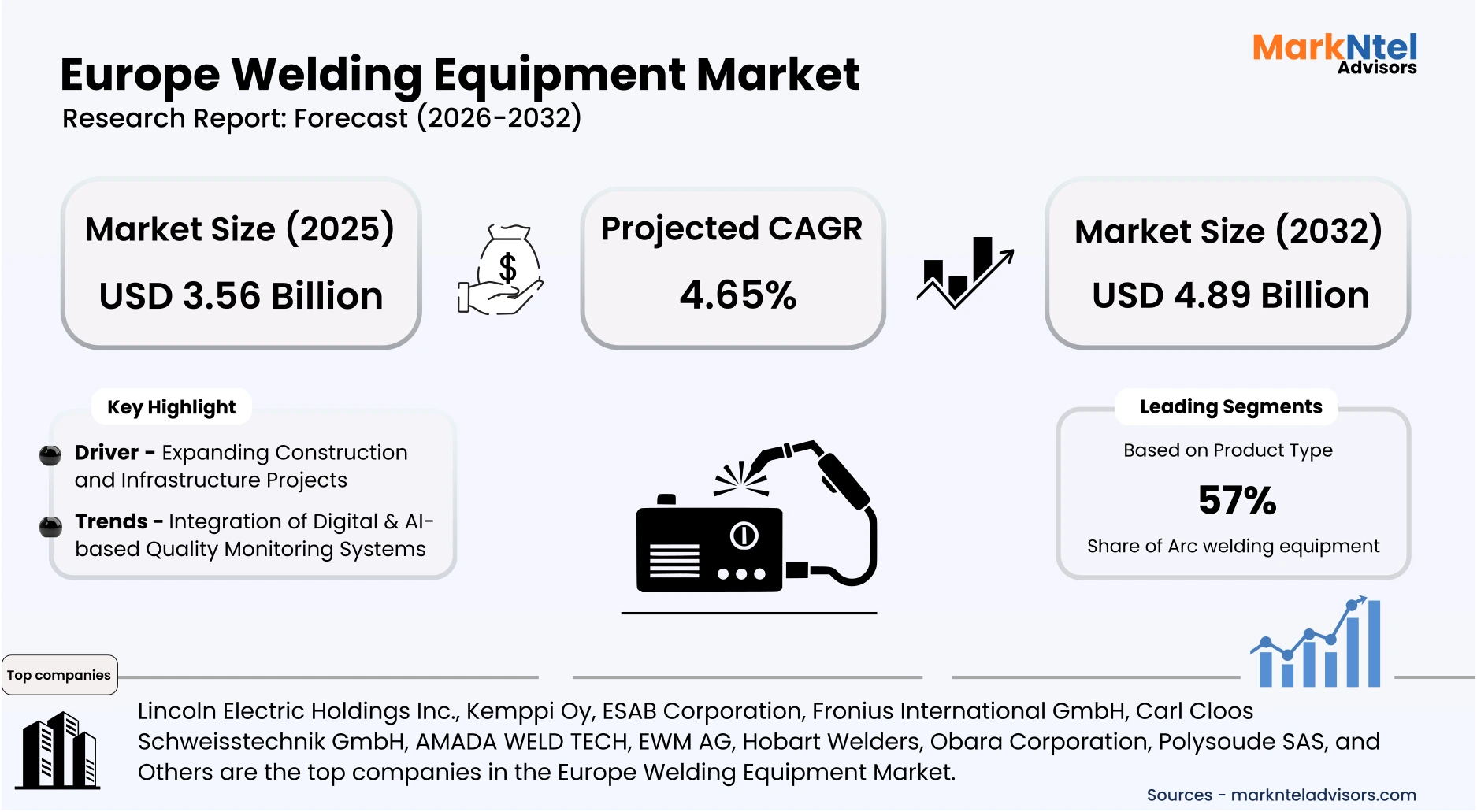
- Market size was valued at around USD3.56 billion in 2025 and is projected to reach USD4.89 billion by 2032. The estimated CAGR from 2026 to 2032 is around 4.65%, indicating strong growth.
- Germany holds the largest market share of about 22% in the Europe Welding Equipment Market in 2025.
- By Product Type, the Arc Welding Equipment segment represented a significant share of about 57% in the Europe Welding Equipment Market in 2025.
- By End-Use Industry, the Automotive and Transportation segment presented a significant share of about 29% in the Europe Welding Equipment Market in 2025.
- Leading Welding Equipment Companies in the Europe Market are Lincoln Electric Holdings Inc., Kemppi Oy, ESAB Corporation, Fronius International GmbH, Carl Cloos Schweisstechnik GmbH, AMADA WELD TECH, EWM AG, Hobart Welders, Denyo Co. Ltd., W.W. Grainger Inc., Obara Corporation, Polysoude SAS, and Others.
Market Insights & Analysis: Europe Welding Equipment Market (2026-32):
The Europe Welding Equipment Market size was valued at around USD3.56 billion in 2025 and is projected to reach USD4.89 billion by 2032. Along with this, the market is estimated to grow at a CAGR of around 4.65% during the forecast period, i.e., 2026-32.
The Europe Welding Equipment Market is experiencing steady growth as industries across the region focus on modernization, automation, and energy efficiency. The market is primarily driven by construction, automotive, shipbuilding, and manufacturing sectors that continue to adopt advanced welding technologies to improve precision, productivity, and sustainability. Increasing demand for lightweight materials and stronger welds in automotive and aerospace applications is further enhancing the need for high-performance welding systems such as laser, MIG, TIG, and robotic welding.
Additionally, the region’s emphasis on automation and digital transformation is pushing manufacturers to upgrade to smart and inverter-based welding solutions. Companies are investing in automation lines, robotic welding cells, and cloud-integrated monitoring systems to reduce production costs and improve operational safety. The European Union’s focus on industrial sustainability, energy-efficient manufacturing, and local production under the Green Deal is also creating favorable conditions for adopting cleaner and more efficient welding equipment.
Moreover, the presence of established players, continuous technological innovation, and increased collaboration between welding equipment manufacturers and industrial automation providers are shaping the market’s evolution. While supply chain challenges and labor shortages persist, the ongoing transition toward automation and electric-powered equipment is expected to offset these issues. Overall, the Europe welding equipment market is moving toward a phase of quality-driven growth. The increasing integration of digital controls, automation, and energy-efficient systems will continue to redefine production standards, ensuring that Europe remains one of the leading regions for advanced and sustainable welding solutions.
Europe Welding Equipment Market Recent Developments:
- 2025 : Carl Cloos Schweisstechnik GmbH launched a new production hall at its Haiger (Germany) headquarters, creating a dedicated line for advanced welding solutions and automation systems for the European Market.
Europe Welding Equipment Market Scope:
| Category | Segments |
|---|---|
| By Product Type | (Arc Welding Equipment, Resistance Welding Equipment, Plasma Welding Equipment, Laser Welding Equipment, Oxy-Fuel Welding Equipment), |
| By Distribution Channel | (Direct Sales (B2B), Distributors, Online Retail, Specialty Stores, Industrial Equipment Retailers), |
| By Automation Level | (Manual Welding Equipment, Semi-Automatic Welding Equipment, Automatic/Robotic Welding Equipment), |
| By End User | (Automotive & Transportation, Construction & Infrastructure, Shipbuilding & Offshore, Aerospace & Defense, Manufacturing, Electronics & Electricals, Energy & Utilities, Oil & Gas, Others), |
Europe Welding Equipment Market Driver:
Expanding Construction and Infrastructure Projects
The expansion of construction and infrastructure projects across Europe is a major driver of this market, directly increasing the demand for arc, MIG/MAG, and plasma welding systems. For reference, the European Investment Bank (EIB) allocated over USD95.9 billion in 2023 to infrastructure projects, particularly in Germany, France, and Italy.
This surge in construction activities has led to higher consumption of portable, inverter-based, and automated welding machines for structural and pipeline fabrication. Consequently, manufacturers such as Carl Cloos Schweisstechnik GmbH and Fronius International GmbH have scaled up production to meet the rising regional demand. The growing need for durable, high-efficiency welding solutions across infrastructure projects is therefore propelling steady market growth in Europe.
Growing Automotive & Transportation Sector Driving Market Demand
The automotive and transportation sector is a major growth driver for Europe’s welding equipment industry, supported by strong investments in electric mobility and sustainable transport manufacturing. For instance, Volkswagen Group announced around a USD196 billion investment during 2023–2027 to expand EV and battery production across Germany and Central Europe, increasing the need for robotic MIG and laser welding systems in chassis and battery assembly.
Additionally, BMW Group is investing over USD2 billion in its Debrecen, Hungary, plant to build battery assembly for vehicles, increasing the demand for advanced welding solutions. Likewise, Stellantis is upgrading its Italian facilities to produce hybrid and electric cars, boosting demand for automated welding technologies.
Europe Welding Equipment Market Trend:
Integration of Digital & AI-based Quality Monitoring Systems
In Europe’s Welding Equipment Market, advanced digital and AI-based quality monitoring systems are reshaping operations. For instance, at the Fraunhofer Institute for Digital Media Technology (IDMT) in Germany, in 2024, a system was developed in which AI analyzes welding current, voltage, and acoustic signals to detect irregularities in real time, enabling corrective action on the fly.
These innovations mean that welding systems in automotive and transport manufacturing can reduce defects, rework, and scrap. In effect, manufacturers integrate sensors, data analytics, and intelligent feedback loops, aligning with the broader shift toward smart manufacturing in Europe. As manufacturers in sectors such as EV-body assembly adopt such systems, the demand for welding equipment with built-in digital/AI capability grows significantly.
Robotic & Automated Welding Systems Gaining Traction
Robotic and automated welding systems are rapidly reshaping the European welding equipment industry, particularly across automotive, heavy machinery, and metal fabrication industries. For instance, Volkswagen-Emden plant uses robots in its body shop and executes “up to 7 million spot welds every day, ensuring high structural integrity and consistency.
Similarly, BMW’s Dingolfing plant integrates robotic arc and laser welding systems for EV frame assembly, reducing manual welding operations . European manufacturers such as KUKA (Germany) and ABB (Switzerland) are developing AI-guided robotic welding arms with real-time path correction and adaptive heat control. Consequently, the widespread automation of welding tasks is significantly improving productivity, quality, and worker safety across Europe’s industrial landscape.
Europe Welding Equipment Market Challenge:
Shortage of Skilled Workforce & Rising Operational Costs
The European Welding Equipment Market is under pressure from a dual challenge of labor shortages and escalating operational costs. According to the European Welding Federation (EWF), Europe faces a deficit of over 300,000 certified welders, a gap that continues to widen as older workers retire and fewer young professionals enter the trade. This shortage causes project delays, reduced productivity, and increased labor costs across construction, automotive, and energy sectors.
Simultaneously, industrial gas and electricity costs remain 2–4 times higher than in the EU’s main trading partners, according to the European Commission. This sustained cost pressure threatens the competitiveness of energy-intensive sectors such as metal fabrication and welding, where electricity and gas are vital inputs for production and thermal processing operations, intensifying the financial burden on manufacturers and fabrication workshops, hindering market growth & expansion.
Europe Welding Equipment Market (2026-32) Segmentation Analysis:
The Europe Welding Equipment Market Report and Forecast 2026-2032 offers a detailed analysis of the market based on the following segments:
Based on Product Type
- Arc Welding Equipment
- MIG/MAG Welding Equipment
- TIG Welding Equipment
- Resistance Welding Equipment
- Plasma Welding Equipment
- Laser Welding Equipment
- Oxy-Fuel Welding Equipment
- Others
Arc welding equipment holds the leading position in this market owing to its broad industrial applicability, efficiency, and adaptability. More than 57% of Europe’s metal fabrication and maintenance work relies on arc-based technologies, including MIG/MAG, TIG, and shielded metal arc welding. These systems are extensively used in construction, heavy machinery, energy infrastructure, and shipbuilding due to their ability to deliver strong, precise, and durable welds.
The European Committee for Welding (EWF) emphasizes that arc welding remains the preferred process for structural steel and pipeline assembly because of its cost-effectiveness and compatibility with both manual and automated setups. Moreover, advancements in inverter-based arc systems and automated arc robots are further improving productivity and energy efficiency. As a result, arc welding continues to dominate Europe’s welding landscape, underpinning the region’s industrial and infrastructure growth.
Based on End Users
- Automotive & Transportation
- Construction & Infrastructure
- Shipbuilding & Offshore
- Aerospace & Defense
- Manufacturing
- Electronics & Electricals
- Energy & Utilities
- Oil & Gas
- Others
The automotive and transportation sector holds the dominant share in Europe’s Welding Equipment Industry, with a market share of about 29% driven by its massive manufacturing output, automation intensity, and precision requirements. As reported by the European Parliament, the region produced around 14.8 million vehicles in 2023, increasing the market growth. Each vehicle involves hundreds of welds during body assembly and chassis fabrication, making welding equipment essential to the industry’s operations.
The International Federation of Robotics (IFR) noted that over 23,000 industrial robots were installed in Europe’s automotive facilities in 2024 , most used for automated welding. Furthermore, the European Welding Federation (EWF) highlights that a majority of certified welders and robotic operators in Europe work in automotive manufacturing. Backed by continuous R&D and electrification initiatives, the automotive sector remains the key driver of welding innovation, productivity, and demand across Europe.
Europe Welding Equipment (2026-32): Regional Projection
Germany leads the European Welding Equipment Industry with a market share of about 22% through its advanced manufacturing capacity, automation leadership, and strong engineering expertise. The country’s automotive industry produced around 4.1 million passenger cars in 2024 , driving high demand for robotic and precision welding. Data from Eurostat and the German Federal Statistical Office (Destatis) confirm that machinery and metal product manufacturing remain key contributors to industrial output, reinforcing Germany’s position as Europe’s largest metalworking hub. For instance, Germany accounted for about 26% of the EU’s total production value , the highest share in the region, increasing the demand for welding equipment in Germany.
Major domestic players such as EWM AG and Carl Cloos Schweisstechnik GmbH, along with regional bases of Fronius International GmbH, continue to innovate in inverter-based and automated welding systems. Supported by initiatives from Germany Trade & Invest (GTAI) and Industry 4.0 programs under the Federal Ministry for Economic Affairs and Climate Action (BMWK), Germany sets the benchmark for welding automation, productivity, and sustainability across the European market.
Gain a Competitive Edge with Our Europe Welding Equipment Market Report
- Europe Welding Equipment Market Report by MarkNtel Advisors provides a detailed & thorough analysis of market size & share, growth rate, competitive landscape, and key players. This comprehensive analysis helps businesses gain a holistic understanding of the market dynamics & make informed decisions.
- This report also highlights current market trends & future projections, allowing businesses to identify emerging opportunities & potential challenges. By understanding market forecasts, companies can align their strategies & stay ahead of the competition.
- Europe Welding Equipment Market Report aids in assessing & mitigating risks associated with entering or operating in the market. By understanding market dynamics, regulatory frameworks, and potential challenges, businesses can develop strategies to minimize risks & optimize their operations.
*Reports Delivery Format - Market research studies from MarkNtel Advisors are offered in PDF, Excel and PowerPoint formats. Within 24 hours of the payment being successfully received, the report will be sent to your email address.
Frequently Asked Questions
- Market Segmentation
- Introduction
- Product Definition
- Research Process
- Assumptions
- Executive Summary
- Europe Welding Equipment Market Regulations, Policies & Standards
- Europe Welding Equipment Market Trends & Developments
- Europe Welding Equipment Market Dynamics
- Growth Drivers
- Challenges
- Europe Welding Equipment Market Hotspots & Opportunities
- Europe Welding Equipment Market Strategic Insights
- Europe Welding Equipment Market Pricing Analysis
- Europe Welding Equipment Market Value Chain Analysis
- Europe Welding Equipment Market Outlook, 2022- 2032F
- Market Size & Analysis
- Market Revenues (USD Million)
- Market Share & Analysis
- By Product Type
- Arc Welding Equipment- Market Size & Forecast 2022-2032, USD Million
- MIG/MAG Welding Equipment- Market Size & Forecast 2022-2032, USD Million
- TIG Welding Equipment- Market Size & Forecast 2022-2032, USD Million
- Resistance Welding Equipment- Market Size & Forecast 2022-2032, USD Million
- Plasma Welding Equipment- Market Size & Forecast 2022-2032, USD Million
- Laser Welding Equipment- Market Size & Forecast 2022-2032, USD Million
- Oxy-Fuel Welding Equipment- Market Size & Forecast 2022-2032, USD Million
- Others (Soldering, Brazing, Forge Welding, etc.)- Market Size & Forecast 2022-2032, USD Million
- Arc Welding Equipment- Market Size & Forecast 2022-2032, USD Million
- By Distribution Channel
- Direct Sales (B2B)- Market Size & Forecast 2022-2032, USD Million
- Distributors- Market Size & Forecast 2022-2032, USD Million
- Online Retail- Market Size & Forecast 2022-2032, USD Million
- Specialty Stores- Market Size & Forecast 2022-2032, USD Million
- Industrial Equipment Retailers- Market Size & Forecast 2022-2032, USD Million
- By Automation Level
- Manual Welding Equipment- Market Size & Forecast 2022-2032, USD Million
- Semi-Automatic Welding Equipment- Market Size & Forecast 2022-2032, USD Million
- Automatic/Robotic Welding Equipment- Market Size & Forecast 2022-2032, USD Million
- By End User
- Automotive & Transportation- Market Size & Forecast 2022-2032, USD Million
- Construction & Infrastructure- Market Size & Forecast 2022-2032, USD Million
- Shipbuilding & Offshore- Market Size & Forecast 2022-2032, USD Million
- Aerospace & Defense- Market Size & Forecast 2022-2032, USD Million
- Manufacturing- Market Size & Forecast 2022-2032, USD Million
- Electronics & Electricals- Market Size & Forecast 2022-2032, USD Million
- Energy & Utilities- Market Size & Forecast 2022-2032, USD Million
- Oil & Gas- Market Size & Forecast 2022-2032, USD Million
- Others- Market Size & Forecast 2022-2032, USD Million
- By Region
- Germany
- France
- United Kingdom
- Italy
- Spain
- Rest of Europe (Nordic, Benelux, CEE, etc.)
- By Competitors
- Competition Characteristics
- Market Share & Analysis
- By Product Type
- Market Size & Analysis
- Germany Welding Equipment Market Outlook, 2022- 2032F
- Market Size & Analysis
- Market Revenues (USD Million)
- Market Share & Analysis
- By Product Type- Market Size & Forecast 2022-2032, USD Million
- By Distribution Channel- Market Size & Forecast 2022-2032, USD Million
- By Automation Level- Market Size & Forecast 2022-2032, USD Million
- By End User- Market Size & Forecast 2022-2032, USD Million
- Market Size & Analysis
- France Welding Equipment Market Outlook, 2022- 2032F
- Market Size & Analysis
- Market Revenues (USD Million)
- Market Share & Analysis
- By Product Type- Market Size & Forecast 2022-2032, USD Million
- By Distribution Channel- Market Size & Forecast 2022-2032, USD Million
- By Automation Level- Market Size & Forecast 2022-2032, USD Million
- By End User- Market Size & Forecast 2022-2032, USD Million
- Market Size & Analysis
- United Kingdom Welding Equipment Market Outlook, 2022- 2032F
- Market Size & Analysis
- Market Revenues (USD Million)
- Market Share & Analysis
- By Product Type- Market Size & Forecast 2022-2032, USD Million
- By Distribution Channel- Market Size & Forecast 2022-2032, USD Million
- By Automation Level- Market Size & Forecast 2022-2032, USD Million
- By End User- Market Size & Forecast 2022-2032, USD Million
- Market Size & Analysis
- Italy Welding Equipment Market Outlook, 2022- 2032F
- Market Size & Analysis
- Market Revenues (USD Million)
- Market Share & Analysis
- By Product Type- Market Size & Forecast 2022-2032, USD Million
- By Distribution Channel- Market Size & Forecast 2022-2032, USD Million
- By Automation Level- Market Size & Forecast 2022-2032, USD Million
- By End User- Market Size & Forecast 2022-2032, USD Million
- Market Size & Analysis
- Spain Welding Equipment Market Outlook, 2022- 2032F
- Market Size & Analysis
- Market Revenues (USD Million)
- Market Share & Analysis
- By Product Type- Market Size & Forecast 2022-2032, USD Million
- By Distribution Channel- Market Size & Forecast 2022-2032, USD Million
- By Automation Level- Market Size & Forecast 2022-2032, USD Million
- By End User- Market Size & Forecast 2022-2032, USD Million
- Market Size & Analysis
- Europe Welding Equipment Market Key Strategic Imperatives for Growth & Success
- Competitive Outlook
- Company Profiles
- Lincoln Electric Holdings Inc.
- Business Description
- Product Portfolio
- Strategic Alliances or Partnerships
- Recent Developments
- Financial Details
- Others
- Kemppi Oy
- Business Description
- Product Portfolio
- Strategic Alliances or Partnerships
- Recent Developments
- Financial Details
- Others
- ESAB Corp.
- Business Description
- Product Portfolio
- Strategic Alliances or Partnerships
- Recent Developments
- Financial Details
- Others
- Fronius International GmbH
- Business Description
- Product Portfolio
- Strategic Alliances or Partnerships
- Recent Developments
- Financial Details
- Others
- Carl Cloos Schweisstechnik GmbH
- Business Description
- Product Portfolio
- Strategic Alliances or Partnerships
- Recent Developments
- Financial Details
- Others
- AMADA WELD TECH
- Business Description
- Product Portfolio
- Strategic Alliances or Partnerships
- Recent Developments
- Financial Details
- Others
- EWM AG
- Business Description
- Product Portfolio
- Strategic Alliances or Partnerships
- Recent Developments
- Financial Details
- Others
- Hobart Welders
- Business Description
- Product Portfolio
- Strategic Alliances or Partnerships
- Recent Developments
- Financial Details
- Others
- Denyo Co. Ltd
- Business Description
- Product Portfolio
- Strategic Alliances or Partnerships
- Recent Developments
- Financial Details
- Others
- W.W. Grainger Inc.
- Business Description
- Product Portfolio
- Strategic Alliances or Partnerships
- Recent Developments
- Financial Details
- Others
- Obara Corporation
- Business Description
- Product Portfolio
- Strategic Alliances or Partnerships
- Recent Developments
- Financial Details
- Others
- Polysoude SAS
- Business Description
- Product Portfolio
- Strategic Alliances or Partnerships
- Recent Developments
- Financial Details
- Others
- Others
- Lincoln Electric Holdings Inc.
- Company Profiles
- Disclaimer
MarkNtel Advisors follows a robust and iterative research methodology designed to ensure maximum accuracy and minimize deviation in market estimates and forecasts. Our approach combines both bottom-up and top-down techniques to effectively segment and quantify various aspects of the market. A consistent feature across all our research reports is data triangulation, which examines the market from three distinct perspectives to validate findings. Key components of our research process include:
1. Scope & Research Design At the outset, MarkNtel Advisors define the research objectives and formulate pertinent questions. This phase involves determining the type of research—qualitative or quantitative—and designing a methodology that outlines data collection methods, target demographics, and analytical tools. They also establish timelines and budgets to ensure the research aligns with client goals.
2. Sample Selection and Data Collection In this stage, the firm identifies the target audience and determines the appropriate sample size to ensure representativeness. They employ various sampling methods, such as random or stratified sampling, based on the research objectives. Data collection is carried out using tools like surveys, interviews, and observations, ensuring the gathered data is reliable and relevant.
3. Data Analysis and Validation Once data is collected, MarkNtel Advisors undertake a rigorous analysis process. This includes cleaning the data to remove inconsistencies, employing statistical software for quantitative analysis, and thematic analysis for qualitative data. Validation steps are taken to ensure the accuracy and reliability of the findings, minimizing biases and errors.

4. Data Forecast and FinalizationThe final phase involves forecasting future market trends based on the analyzed data. MarkNtel Advisors utilize predictive modeling and time series analysis to anticipate market behaviors. The insights are then compiled into comprehensive reports, featuring visual aids like charts and graphs, and include strategic recommendations to inform client decision-making
We offer flexible licensing options to cater to varying organizational needs. Choose the pricing pack that best suits your requirements:
Buy Now Inquire Before Buying
 Request Customization
 Talk to our Consultant