

Southeast Asia Aluminum Wire Rod Market Research Report: Trends, Forecast & Opportunities (2026-2032)
By Application (Electrical & Electronics, Automotive, Construction, Industrial Machinery, Aerospace & Defense), By Alloy Type (Pure Aluminum, Aluminum–Magnesium (Al Mg), Aluminum–S ... ilicon (Al Si), Aluminum–Copper (Al Cu), Aluminum–Zinc (Al Zn), Other Alloy Types), By Manufacturing Process (Hot Rolling, Cold Rolling, Extrusion, Continuous Casting, Annealing & Heat Treatment), and others Read more
- Buildings, Construction, Metals & Mining
- Mar 2026
- Pages 155
- Report Format: PDF, Excel, PPT
Southeast Asia Aluminum Wire Rod Market
Projected 6.73% CAGR from 2026 to 2032
Study Period
2026-2032
Market Size (2026)
USD 2.03 billion
Market Size (2032)
USD 3 Billion
Base Year
2025
Projected CAGR
6.73%
Leading Segments
By Application: Electrical & Electronics
Southeast Asia Aluminum Wire Rod Market Report Key Takeaways:
- The Southeast Asia Aluminum Wire Rod Market size was valued at USD 1.85 billion in 2025 and is projected to grow from USD 2.03 billion in 2026 to USD 3 billion by 2032, exhibiting a CAGR of 6.73% during the forecast period.
- Indonesia is the leading country with a significant share of 35% in 2026.
- By Application type, the Electrical and Electronics segment represented a significant share of about 65% in the Southeast Asia Aluminum Wire Rod Market in 2026.
- By Alloy type, the pure Aluminum segment presented a significant share of about 60% in the Southeast Asia Aluminum Wire Rod Market in 2026.
Market Insights & Analysis: Southeast Asia Aluminum Wire Rod Market (2026-32):
The Southeast Asia Aluminum Wire Rod market size was valued at USD 1.85 billion in 2025 and is projected to grow from USD 2.03 billion in 2026 to USD 3 billion by 2032, exhibiting a CAGR of 6.73% during the forecast period. i.e., 2026-32.
Southeast Asia’s Aluminum wire rod market has experienced a notable upward trajectory supported by regional primary Aluminum production growth, with ASEAN output expected to expand to approximately 2.7 million tonnes by 2026 as new smelter capacities are brought online in Indonesia and Vietnam, helping to secure upstream supply for downstream rod manufacturing. This capacity adds resilience to the supply chain for Aluminum rod conversion into wire products, even as export demand remains robust. Such growth reflects broader industrial expansion in the region, where increasing electrification and manufacturing of electrical components bolster baseline demand for conductors and related products. The augmentation of output in key producing nations signals sustained industrial momentum and strengthens regional self‑sufficiency in semi‑finished inputs foundational to wire rod markets.
A significant regulatory enabler of this trend is the ASEAN Plan of Action for Energy Cooperation (2026–2030), under which member states approved targets to raise the share of renewable electricity to 45% by 2030 and reduce energy intensity by 40% relative to 2005 levels, encouraging grid enhancements and more electrified end‑use sectors. The shift toward renewables and energy efficiency is prompting utilities and grid operators to modernize and expand networks, thereby increasing procurement of Aluminum‑based electrical components.
Regional cooperation initiatives such as the ASEAN Power Grid (APG) are creating a collaborative framework for interconnecting national grids to improve reliability, integrate diverse power sources, and support cross‑border electricity trade. The IEA notes that incremental progress on APG projects has already enabled thousands of gigawatt‑hours of cross‑border power exchanges, demonstrating early operationalization of transnational grid links that depend on robust conductor supply chains. The expansion of such interconnected systems drives long‑term planning for components that originate from Aluminum wire rod production.
End‑user sector dynamics also bolster the market, particularly in industrial and utility segments where electrification of manufacturing, data infrastructure, and urban services is intensifying. The region’s industrial clusters are rapidly adapting to support low‑carbon and energy‑efficient growth, increasing reliance on electrical equipment and materials that use Aluminum for conductivity and weight advantages. This shift is reinforced by broader economic diversification strategies that prioritize resilient, electrified infrastructure, creating a forward‑looking outlook in which Aluminum wire rod demand is closely aligned with Southeast Asia’s energy transition and network upgrades.
Southeast Asia Aluminum Wire Rod Market Scope:
| Category | Segments |
|---|---|
| By Application | (Electrical & Electronics, Automotive, Construction, Industrial Machinery, Aerospace & Defense), |
| By Alloy Type | (Pure Aluminum, Aluminum–Magnesium (Al Mg), Aluminum–Silicon (Al Si), Aluminum–Copper (Al Cu), Aluminum–Zinc (Al Zn), Other Alloy Types), |
| By Manufacturing Process | (Hot Rolling, Cold Rolling, Extrusion, Continuous Casting, Annealing & Heat Treatment), |
Southeast Asia Aluminum Wire Rod Market Driver:
Expansion of Renewable Power Infrastructure Driving Aluminum Wire Rod Demand
The expansion of renewable power infrastructure in Southeast Asia serves as a structural driver for Aluminum wire rod demand, as solar and wind projects require durable, high-conductivity materials for transmission and distribution. Rapid electricity demand growth across the region, driven by industrialization, urbanization, and digitalization, is increasing the need for grid-connected renewable capacity. According to the International Energy Agency (IEA), Southeast Asia’s electricity demand is expected to continue rising sharply, necessitating large-scale infrastructure expansion to ensure a reliable supply.
This driver has intensified as ASEAN nations implement national renewable energy plans and grid integration frameworks, such as the ASEAN Power Grid (APG), which coordinates cross-border transmission projects to enable electricity trade and reliability improvements. The region possesses substantial untapped renewable potential, the IEA estimates around 20 TW of technical solar and wind resources, far exceeding current installed capacity. The scale and longevity of these infrastructure projects create sustained procurement of Aluminum wire rod for overhead lines, substations, and cabling, producing measurable increases in material demand across multiple geographies.
The driver materially expands market volume because renewable infrastructure deployment requires long-lived, high-conductivity materials, with procurement based on multi-year capital projects rather than short-term adoption. Grid-connected renewable projects provide structured, recurring demand for Aluminum wire rod, linking directly to power transmission and distribution networks. As Southeast Asian nations advance renewable integration under APG and national plans, the structural need for Aluminum wire rod will continue to grow steadily, underpinning the region’s market expansion well into the next decade.
Southeast Asia Aluminum Wire Rod Market Trend:
Adoption of Sustainable Manufacturing and Recycled Aluminum
A major structural trend in the Southeast Asia Aluminum wire rod market is the shift toward sustainable manufacturing, driven by regulatory pressures, corporate ESG commitments, and growing awareness of climate impact. Governments across the region are incentivizing low-carbon production, including energy-efficient smelting and recycling initiatives. For example, Singapore’s 2025 National Environment Agency guidelines promote industrial recycling and emissions reduction, encouraging manufacturers to adopt recycled Aluminum to meet both environmental and performance standards.
This trend is reshaping industry operations and the value chain, as companies invest in energy-efficient production lines, closed-loop recycling systems, and eco-certifications. Recycled Aluminum reduces energy consumption by up to 95% compared with primary Aluminum production, directly lowering carbon footprints and operational costs. Adoption of these practices affects procurement, production planning, and product design, with downstream users, such as utilities and industrial manufacturers, increasingly preferring materials that comply with green standards.
Sustainable manufacturing adoption is expected to persist, as ASEAN countries tighten emissions regulations and align with global climate goals under the Paris Agreement and regional decarbonization strategies. Long-term commitments to carbon neutrality , combined with corporate sustainability programs, ensure that demand for recycled and eco-friendly Aluminum wire rod will remain structurally significant. The trend drives enduring market transformation, influencing investment in green technologies, operational practices, and supply chain alignment toward environmentally responsible production.
Southeast Asia Aluminum Wire Rod Market Opportunity:
Strategic Infrastructure‑Driven Expansion in Southeast Asia’s Power Transmission Network
A structural opportunity for new entrants in the Southeast Asia Aluminum wire rod market lies in supplying the expanding regional power transmission and electrification infrastructure enabled by the ASEAN Power Grid (APG) initiative, supported by recent multilateral financing commitments. In 2025–26, major development banks, including the Asian Development Bank and World Bank, launched a financing programme to integrate national grids across ASEAN, mobilizing billions in investment for cross‑border transmission and renewable energy connectivity projects. The APG aims to expand capacity, build new interconnections, and support distributed renewable generation through sustained public‑private financing frameworks that are expected to require hundreds of billions of USD in grid infrastructure investment by 2045.
This structural shift translates into tangible demand for Aluminum wire rod, which is a core input in high‑voltage conductors, distribution wiring, and renewable connection cabling due to its cost‑effective conductivity and lighter weight compared to copper. The Asian Development Bank (ADB) and the World Bank launched the ASEAN Power Grid Financing Initiative, announcing combined financial backing of approximately USD 12.5 billion to support regional grid interconnection and related infrastructure projects across Southeast Asia. For new or smaller producers, this opportunity is advantageous because regional power projects prioritise diversified supply chains and localised sourcing, reducing incumbent advantage and lowering entry barriers. Smaller players can compete through flexible capacity, specialized alloy offerings, and alignment with emerging sustainability criteria rather than scale‑based dominance, especially where incumbents are focused on legacy commodity streams.
Southeast Asia Aluminum Wire Rod Market Challenge:
Energy & Carbon Cost Burden as a Structural Barrier in Southeast Asia’s Aluminum Market
Aluminum production is inherently energy‑intensive, relying on the Hall–Héroult electrolytic process that consumes large amounts of electricity, and thus drives up operating costs for smelters. In Southeast Asia, as elsewhere, producers must secure continuous, high‑volume power to sustain operations, with reliability and baseload access materially affecting feasibility and unit costs. This reliance on energy infrastructure, often at volatile prices, creates an uneven cost basis for producers compared to regions with abundant, low‑cost renewable power.
Simultaneously, tightening environmental policy frameworks abroad are creating additional cost burdens for exporters. The European Union’s Carbon Border Adjustment Mechanism (CBAM) entered its definitive regime in 2026, requiring importers to account for and cover the embedded emissions in Aluminum and other carbon‑intensive goods . This effectively imposes a financial levy based on associated emissions during production, raising compliance costs for exporters without carbon pricing mechanisms at home.
These structural pressures materially restrict growth by increasing production and export compliance costs for Southeast Asian producers, particularly smaller or emerging players lacking scale advantages or existing decarbonization investments. Established larger firms with integrated power contracts and emissions reporting systems can better absorb these burdens, whereas newcomers face higher entry and operating risks, limiting competitiveness and slowing broader market expansion.
Southeast Asia Aluminum Wire Rod Market (2026-32) Segmentation Analysis:
The Southeast Asia Aluminum Wire Rod Market study of MarkNtel Advisors evaluates & highlights the major trends and influencing factors in each segment. It includes predictions for the period 2026–32 at the regional level. Based on the analysis, the market has been further classified as;
Based on Application:
- Electrical & Electronics
- Wires & cables
- Conductors for power distribution
- Electrical components
- Automotive
- Vehicle wiring harnesses
- Structural components
- Battery connectors
- Construction
- Reinforcement bars
- Structural supports
- Building wiring
- Industrial Machinery
- Machine wiring
- Control cables
- Metal parts
- Aerospace & Defense
- Lightweight wiring
- Aircraft components
- Ground support equipment
The Electrical & Electronics segment leads the Southeast Asia Aluminum wire rod market with a market share of 65% due to the rapid expansion of transmission and distribution infrastructure across economies such as Indonesia, Vietnam, and the Philippines. The core cause is rising electricity demand, which the International Energy Agency notes is growing steadily in emerging Asia due to urbanization and industrial activity. Aluminum wire rods are preferred for conductors because they offer a lower-cost alternative to copper while maintaining adequate conductivity. This cost-performance advantage structurally anchors their use in large-scale grid expansion projects.
A clear industry example is Indonesia’s state utility PLN, which continues to expand transmission lines to improve electrification coverage, with 48,000 km of new transmission lines to support renewable energy and rising demand. These projects directly translate into bulk procurement of Aluminum wire rods for cables and overhead conductors.
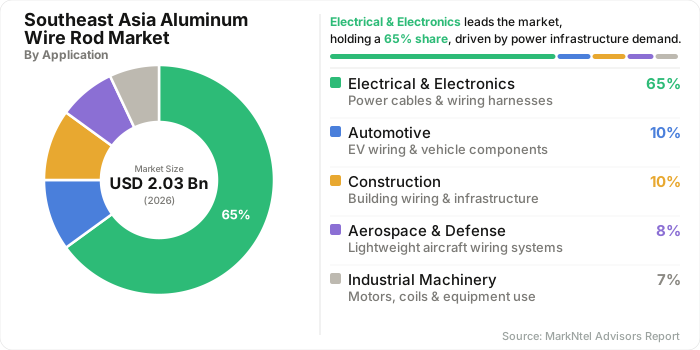
The market impact is significant, as this segment benefits from long-term, policy-backed demand that ensures volume stability and reduces cyclicality. Unlike automotive or aerospace applications, utility-driven procurement follows planned capital expenditure cycles, supporting consistent offtake for manufacturers. This enhances production planning and capacity utilization for suppliers while attracting new entrants targeting standardized, high-volume conductor-grade products. Consequently, the Electrical & Electronics segment sustains its dominance by combining policy support, infrastructure investment, and predictable end-user demand.
Based on Alloy Type:
- Pure Aluminum
- Aluminum–Magnesium (Al‑Mg)
- Aluminum–Silicon (Al‑Si)
- Aluminum–Copper (Al‑Cu)
- Aluminum–Zinc (Al‑Zn)
- Other Alloy Types
Pure Aluminum continues to dominate the alloy segment with a market share of 60% due to its unmatched suitability for high-voltage transmission and distribution applications, where conductivity and cost efficiency are critical. The primary cause is the region’s accelerating rural electrification and urban grid expansion programs, particularly in countries like the Philippines and Thailand.
Another strong industry example is the National Grid Corporation of the Philippines, which is actively expanding grid infrastructure, with over 100 transmission projects worth more than USD 10 billion planned or under implementation . These include high-voltage lines (230 kV–500 kV) and substations to meet rising electricity demand and improve grid reliability. These projects require Aluminum Conductor Steel Reinforced (ACSR) and All-Aluminum Alloy Conductors (AAAC), both of which rely heavily on high-purity Aluminum wire rods. Such utility-led projects consistently prioritize pure Aluminum inputs due to standardization and proven efficiency in tropical operating conditions.
The market impact is evident in sustained bulk procurement cycles and reduced demand volatility compared to specialized alloys. Pure Aluminum enables manufacturers to scale production efficiently while meeting standardized utility specifications, supporting stable revenues and operational predictability. This also lowers technical barriers for new entrants, as production processes are less complex than alloyed alternatives. Consequently, the segment maintains leadership through consistent infrastructure-driven demand and strong policy-backed investment flows across Southeast Asia.
Southeast Asia Aluminum Wire Rod Market (2026-32) Regional Analysis:
Indonesia leads the Southeast Asia Aluminum wire rod market with a market share of 35% due to its strong structural foundation in energy infrastructure expansion and industrial growth. As the region’s largest economy, Indonesia is witnessing rapid electricity demand growth driven by urbanization and manufacturing activity. According to the World Bank, Indonesia continues to invest heavily in grid modernization through programs such as the USD 500 million Electricity Network Transformation initiative (2025–2032). This large -scale infrastructure push directly drives demand for Aluminum wire rods used in transmission and distribution systems.
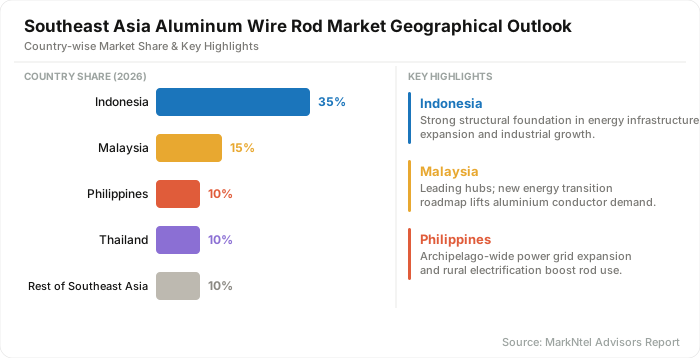
Policy support further strengthens Indonesia’s dominance, particularly through national electrification and energy transition strategies. The government’s RUPTL 2025–2034 plan, implemented by Perusahaan Listrik Negara, includes the addition of approximately 48,000 km of transmission lines and significant renewable energy integration targets. These policies are designed to expand grid coverage and improve reliability across the archipelago, requiring extensive deployment of Aluminum conductors. Additionally, Indonesia’s focus on local manufacturing and downstream metal industries supports domestic production and consumption of Aluminum-based inputs.
End-user demand is highly concentrated in Indonesia due to its large population base and expanding industrial zones. State utility PLN remains the dominant buyer, alongside growing demand from construction, automotive, and industrial sectors. Major infrastructure and electrification projects ensure consistent procurement cycles, supporting high-volume consumption of Aluminum wire rods. This combination of policy-backed investment, large-scale utility demand, and industrial expansion firmly establishes Indonesia as the leading regional market.
Southeast Asia Aluminum Wire Rod Market Competitive Landscape
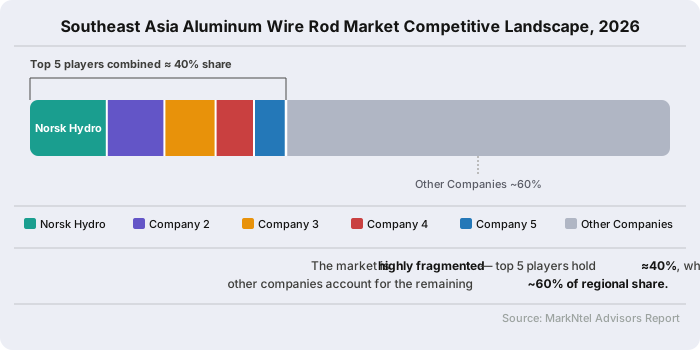
The Southeast Asia aluminum wire rod market is highly fragmented, with the presence of numerous regional and international manufacturers competing across diverse end-use industries. Collectively, the top five players account for approximately 40% of the total market share, indicating a competitive landscape.
Key Aluminium Rod Producing Players in Southeast Asia
- Norsk Hydro
- Southern Cable
- PT. KMI Wire and Cable
- LS Vina Cable & System
- Vedanta Limited
- Hindalco Industries
- UC RUSAL
- UACJ Corporation
- Southwire Company
- Emirates Global Aluminum (EGA)
- Others
Gain a Competitive Edge with Our Southeast Asia Aluminum Wire Rod Market Report:
- The Southeast Asia Aluminum Wire Rod Market Report by MarkNtel Advisors provides a detailed & thorough analysis of market size & share, growth rate, competitive landscape, and key players. This comprehensive analysis helps businesses gain a holistic understanding of the market dynamics & make informed decisions.
- This report also highlights current market trends & future projections, allowing businesses to identify emerging opportunities & potential challenges. By understanding market forecasts, companies can align their strategies & stay ahead of the competition.
- The Southeast Asia Aluminum Wire Rod Market Report aids in assessing & mitigating risks associated with entering or operating in the market. By understanding market dynamics, regulatory frameworks, and potential challenges, businesses can develop strategies to minimize risks & optimize their operations.
*Reports Delivery Format - Market research studies from MarkNtel Advisors are offered in PDF, Excel and PowerPoint formats. Within 24 hours of the payment being successfully received, the report will be sent to your email address.
Frequently Asked Questions
- Market Segmentation
- Introduction
- Product Definition
- Research Process
- Assumptions
- Executive Summary
- Southeast Asia Aluminum Wire Rod Market Policies, Regulations, and Product Standards
- Southeast Asia Aluminum Wire Rod Market Trends & Developments
- Southeast Asia Aluminum Wire Rod Market Dynamics
- Growth Factors
- Challenges
- Southeast Asia Aluminum Wire Rod Market Hotspot & Opportunities
- Southeast Asia Aluminum Wire Rod Market Outlook, 2022-2032F
- Market Size & Outlook
- By Revenues (USD Million)
- Market Share & Analysis
- By Application- Market Size & Forecast 2022-2032, USD Million
- Electrical & Electronics
- Wires & cables
- Conductors for power distribution
- Electrical components
- Automotive
- Vehicle wiring harnesses
- Structural components
- Battery connectors
- Construction
- Reinforcement bars
- Structural supports
- Building wiring
- Industrial Machinery
- Machine wiring
- Control cables
- Metal parts
- Aerospace & Defense
- Lightweight wiring
- Aircraft components
- Ground support equipment
- Electrical & Electronics
- By Alloy Type- Market Size & Forecast 2022-2032, USD Million
- Pure Aluminum
- Aluminum–Magnesium (Al Mg)
- Aluminum–Silicon (Al Si)
- Aluminum–Copper (Al Cu)
- Aluminum–Zinc (Al Zn)
- Other Alloy Types
- By Manufacturing Process- Market Size & Forecast 2022-2032, USD Million
- Hot Rolling
- Cold Rolling
- Extrusion
- Continuous Casting
- Annealing & Heat Treatment
- By Country
- Indonesia
- Malaysia
- Philippines
- Thailand
- Vietnam
- Rest of Southeast Asia
- By Company
- Competition Characteristics
- Market Share & Analysis
- By Application- Market Size & Forecast 2022-2032, USD Million
- Market Size & Outlook
- Indonesia Aluminum Wire Rod Market Outlook, 2022-2032F
- Market Size & Outlook
- By Revenues (USD Million)
- Market Share & Analysis
- By Application- Market Size & Forecast 2022-2032, USD Million
- By Alloy Type- Market Size & Forecast 2022-2032, USD Million
- By Manufacturing Process- Market Size & Forecast 2022-2032, USD Million
- Market Size & Outlook
- Malaysia Aluminum Wire Rod Market Outlook, 2022-2032F
- Market Size & Outlook
- By Revenues (USD Million)
- Market Share & Analysis
- By Application- Market Size & Forecast 2022-2032, USD Million
- By Alloy Type- Market Size & Forecast 2022-2032, USD Million
- By Manufacturing Process- Market Size & Forecast 2022-2032, USD Million
- Market Size & Outlook
- Philippines Aluminum Wire Rod Market Outlook, 2022-2032F
- Market Size & Outlook
- By Revenues (USD Million)
- Market Share & Analysis
- By Application- Market Size & Forecast 2022-2032, USD Million
- By Alloy Type- Market Size & Forecast 2022-2032, USD Million
- By Manufacturing Process- Market Size & Forecast 2022-2032, USD Million
- Market Size & Outlook
- Thailand Aluminum Wire Rod Market Outlook, 2022-2032F
- Market Size & Outlook
- By Revenues (USD Million)
- Market Share & Analysis
- By Application- Market Size & Forecast 2022-2032, USD Million
- By Alloy Type- Market Size & Forecast 2022-2032, USD Million
- By Manufacturing Process- Market Size & Forecast 2022-2032, USD Million
- Market Size & Outlook
- Vietnam Aluminum Wire Rod Market Outlook, 2022-2032F
- Market Size & Outlook
- By Revenues (USD Million)
- Market Share & Analysis
- By Application- Market Size & Forecast 2022-2032, USD Million
- By Alloy Type- Market Size & Forecast 2022-2032, USD Million
- By Manufacturing Process- Market Size & Forecast 2022-2032, USD Million
- Market Size & Outlook
- Southeast Asia Aluminum Wire Rod Market Key Strategic Imperatives for Success & Growth
- Competitive Outlook
- Company Profiles
- Norsk Hydro
- Business Description
- Product Portfolio
- Collaborations & Alliances
- Recent Developments
- Financial Details
- Others
- Southern Cable
- Business Description
- Product Portfolio
- Collaborations & Alliances
- Recent Developments
- Financial Details
- Others
- PT. KMI Wire and Cable
- Business Description
- Product Portfolio
- Collaborations & Alliances
- Recent Developments
- Financial Details
- Others
- LS Vina Cable & System
- Business Description
- Product Portfolio
- Collaborations & Alliances
- Recent Developments
- Financial Details
- Others
- Vedanta Limited
- Business Description
- Product Portfolio
- Collaborations & Alliances
- Recent Developments
- Financial Details
- Others
- Hindalco Industries
- Business Description
- Product Portfolio
- Collaborations & Alliances
- Recent Developments
- Financial Details
- Others
- UC RUSAL
- Business Description
- Product Portfolio
- Collaborations & Alliances
- Recent Developments
- Financial Details
- Others
- UACJ Corporation
- Business Description
- Product Portfolio
- Collaborations & Alliances
- Recent Developments
- Financial Details
- Others
- Southwire Company
- Business Description
- Product Portfolio
- Collaborations & Alliances
- Recent Developments
- Financial Details
- Others
- Emirates Global Aluminium (EGA)
- Business Description
- Product Portfolio
- Collaborations & Alliances
- Recent Developments
- Financial Details
- Others
- Norsk Hydro
- Company Profiles
- Disclaimer
MarkNtel Advisors follows a robust and iterative research methodology designed to ensure maximum accuracy and minimize deviation in market estimates and forecasts. Our approach combines both bottom-up and top-down techniques to effectively segment and quantify various aspects of the market. A consistent feature across all our research reports is data triangulation, which examines the market from three distinct perspectives to validate findings. Key components of our research process include:
1. Scope & Research Design At the outset, MarkNtel Advisors define the research objectives and formulate pertinent questions. This phase involves determining the type of research—qualitative or quantitative—and designing a methodology that outlines data collection methods, target demographics, and analytical tools. They also establish timelines and budgets to ensure the research aligns with client goals.
2. Sample Selection and Data Collection In this stage, the firm identifies the target audience and determines the appropriate sample size to ensure representativeness. They employ various sampling methods, such as random or stratified sampling, based on the research objectives. Data collection is carried out using tools like surveys, interviews, and observations, ensuring the gathered data is reliable and relevant.
3. Data Analysis and Validation Once data is collected, MarkNtel Advisors undertake a rigorous analysis process. This includes cleaning the data to remove inconsistencies, employing statistical software for quantitative analysis, and thematic analysis for qualitative data. Validation steps are taken to ensure the accuracy and reliability of the findings, minimizing biases and errors.

4. Data Forecast and FinalizationThe final phase involves forecasting future market trends based on the analyzed data. MarkNtel Advisors utilize predictive modeling and time series analysis to anticipate market behaviors. The insights are then compiled into comprehensive reports, featuring visual aids like charts and graphs, and include strategic recommendations to inform client decision-making
We offer flexible licensing options to cater to varying organizational needs. Choose the pricing pack that best suits your requirements:
Buy Now Inquire Before Buying
 Request Customization
 Talk to our Consultant







