

Europe Crane Rental Market Research Report: Trends & Forecast (2026-2032)
By Crane Type (Mobile Cranes, All-Terrain Cranes, Truck-Mounted Cranes, Rough Terrain Cranes, Crawler Cranes, Tower Cranes, Fixed Cranes, Others), By Weightlifting Capacity (Low (< ... 50 tons), Low to Medium (51–150 tons), Heavy (151–500 tons), Extremely Heavy (>500 tons)), By Duration of Rental (Short-Term (up to 6 Months), Mid-Term (7 to 12 months), Long-Term (more than 12 months)), By End-User (Building & Construction, Infrastructure, Utilities, Manufacturing, Oil & Gas, Transportation, Mining, Others), and others Read more
- Buildings, Construction, Metals & Mining
- Mar 2026
- Pages 225
- Report Format: PDF, Excel, PPT
Europe Crane Rental Market
Projected 4.2% CAGR from 2026 to 2032
Study Period
2026-2032
Market Size (2026)
USD 14.48 Billion
Market Size (2032)
USD 18.53 Billion
Base Year
2025
Projected CAGR
4.2%
Leading Segments
By Crane Type: Mobile Cranes
Europe Crane Rental Market Report Key Takeaways:
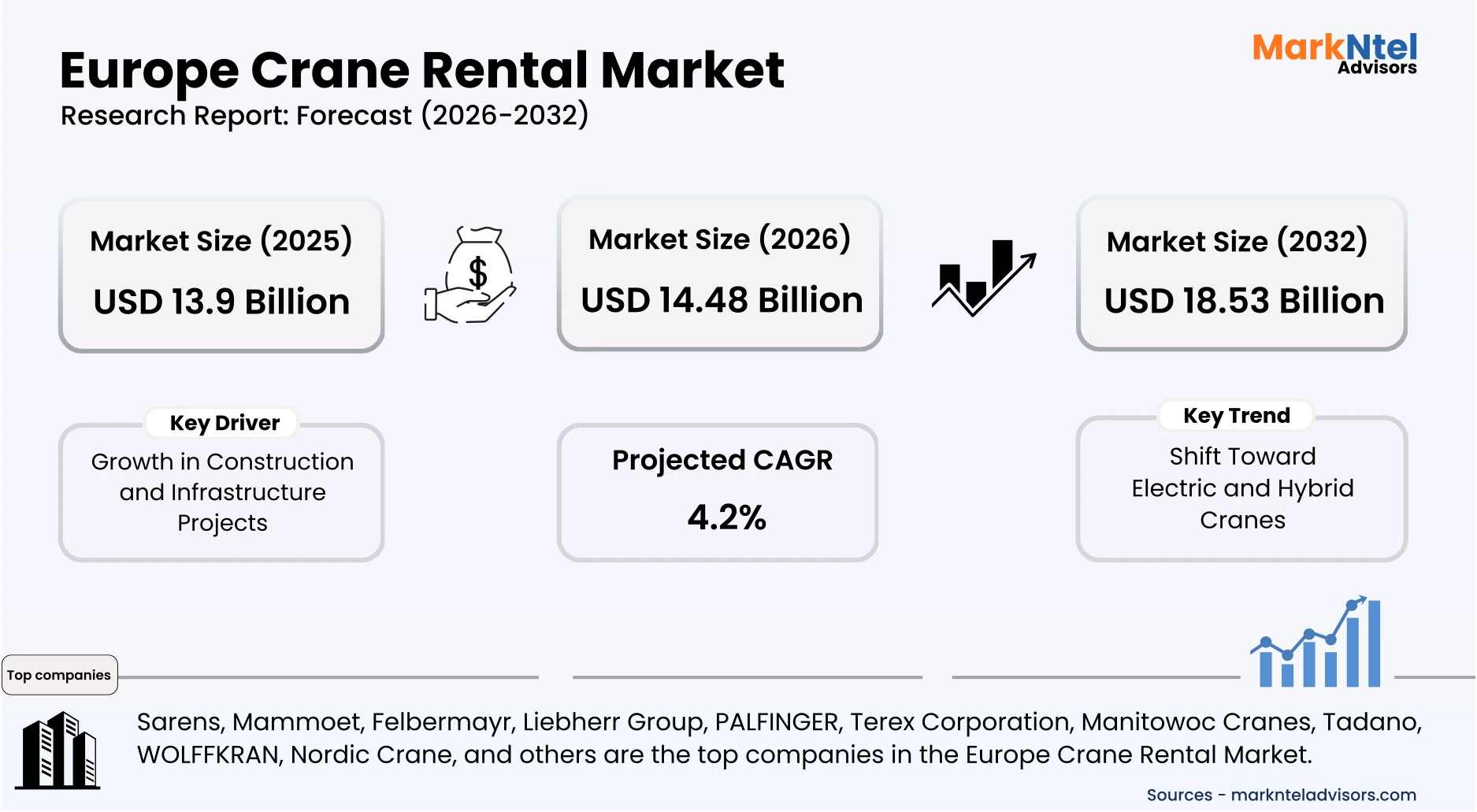
- The Europe Crane Rental Market size was valued at around USD 13.9 billion in 2025 and is projected grow from USD 14.48 billion in 2026 to USD 18.53 billion by 2032, exhibiting a CAGR of 4.2% during 2026-32.
- Germany holds the largest market share of about 24.25% in the Europe Crane Rental Market in 2026.
- By Crane Type, the Mobile Cranes segment represented a significant share of about 32% in the Europe Crane Rental Market in 2026.
- By End User, the Building & Construction sector seized a significant share of about 37% in the Europe Crane Rental Market in 2026.
- Leading companies in the market are Sarens, Mammoet, Felbermayr, Liebherr Group, PALFINGER, Terex Corporation, Manitowoc Cranes, Tadano, WOLFFKRAN, Nordic Crane, and Others.
Market Insights & Analysis: Europe Crane Rental Market (2026-32):
The Europe Crane Rental Market size was valued at around USD 13.9 billion in 2025 and is projected grow from USD 14.48 billion in 2026 to USD 18.53 billion by 2032, exhibiting a CAGR of 4.2% during the forecast period, i.e., 2026-32.
The Europe crane rental market has demonstrated steady expansion, supported by sustained infrastructure investment, urbanization, and industrial development across major economies. Growth has historically been driven by large-scale public works and cross-border connectivity projects, encouraging contractors to shift toward rental models to optimize capital efficiency. According to Invest Europe, infrastructure funds raised approximately USD 287 billion between 2020 and H1 2025, with USD 181 billion invested across more than 1,000 projects, highlighting strong private capital participation . This consistent investment pipeline has reinforced construction activity and supported long-term utilization of crane rental fleets across the region.
Current market conditions remain favorable, driven by robust demand across residential, commercial, and industrial end-user segments. Residential construction continues to expand due to urban population growth and housing demand, while commercial activity is supported by logistics and warehouse developments linked to e-commerce growth. Industrial demand is also strengthening, driven by manufacturing upgrades and energy infrastructure expansion across Europe. Holcim has indicated stable growth expectations of 3–5% in 2026, reflecting sustained public investment and a strong pipeline of projects requiring lifting and installation services .
Government policies and regulatory frameworks are playing a central role in sustaining market momentum and shaping technology adoption. National infrastructure funding programs, particularly in Germany, have supported sector recovery, with construction output reaching approximately USD 196 billion in 2025. In addition, Italy approved the USD 15.5 billion Strait of Messina bridge project in August 2025, reinforcing long-term investment in transport connectivity and construction activity. Spain’s renewable energy expansion, supported by approximately USD 384 million in government subsidies under the RENOVAL 2 program, is further accelerating installation activity and increasing demand for specialized crane rental solutions.
Industry participants are actively responding through innovation, localization strategies, and sustainability-focused investments to strengthen market positioning. Leading manufacturers are introducing hybrid and energy-efficient crane models, while rental companies are expanding localized fleets and implementing digital fleet management systems to enhance operational efficiency. European construction-related equities rose by approximately 21% in 2025, reflecting strong investor confidence driven by infrastructure investment expectations and sector recovery. Looking ahead, continued infrastructure development, renewable energy expansion, and urban redevelopment are expected to sustain demand, ensuring stable and resilient growth prospects for the Europe crane rental market.
Europe Crane Rental Market Recent Developments:
- 2025 : Belgium-based heavy-lifting specialist Sarens introduced the SGC-170, a next-generation super heavy-lift crane designed for large infrastructure and energy projects. The fully electric crane supports zero-emission operations and is engineered for high-capacity lifting in complex construction environments, reinforcing Sarens’ sustainable fleet strategy across European crane rental operations.
- 2025 : Belgian crane rental giant Sarens expanded its heavy transport capabilities by acquiring over 100 Self-Propelled Modular Transporter (SPMT) axle lines from Cometto. The investment enhances Sarens’ capacity to support complex lifting and transportation projects for infrastructure, industrial facilities, and energy developments across Europe.
Europe Crane Rental Market Scope:
| Category | Segments |
|---|---|
| By Crane Type | (Mobile Cranes, All-Terrain Cranes, Truck-Mounted Cranes, Rough Terrain Cranes, Crawler Cranes, Tower Cranes, Fixed Cranes, Others), |
| By Weightlifting Capacity | (Low (<50 tons), Low to Medium (51–150 tons), Heavy (151–500 tons), Extremely Heavy (>500 tons)), |
| By Duration of Rental | (Short-Term (up to 6 Months), Mid-Term (7 to 12 months), Long-Term (more than 12 months)), |
| By End-User | (Building & Construction, Infrastructure, Utilities, Manufacturing, Oil & Gas, Transportation, Mining, Others), |
Europe Crane Rental Market Driver:
Growth in Construction and Infrastructure Projects
The expansion of construction and infrastructure development across Europe has emerged as the most influential driver accelerating demand for crane rental services. Over the past few years, governments have significantly increased capital spending to modernize transport networks, housing, and energy infrastructure. The European Commission’s Recovery and Resilience Facility (RRF), valued at approximately USD 780 billion, has allocated large funding portions to construction-intensive sectors such as rail, bridges, renewable power plants, and urban infrastructure. According to the European Commission, more than 40% of funded projects involve construction or civil engineering activities, directly stimulating demand for heavy lifting equipment, including mobile, tower, and crawler cranes used across large project sites.
The measurable impact of this funding is visible across transportation and civil engineering projects throughout Europe. For instance, according to the International Energy Agency (IEA), Lithuania allocated approximately USD 56 million in 2025 toward railway electrification projects through 2026 under the RRF. Such projects involve the installation of overhead lines, substations, and structural components, all of which require mobile and crawler cranes during execution. Similarly, broader EU-backed transport initiatives such as rail upgrades and corridor expansions are generating continuous demand for lifting equipment across multiple geographies and construction phases.
Unlike short-term industrial demand cycles, infrastructure-led construction creates sustained and volume-driven equipment requirements over extended timelines. According to the European Investment Bank, infrastructure investment in Europe exceeds USD 460 billion annually, with a substantial portion directed toward construction-intensive sectors including transport, energy, and urban development . Since contractors typically prefer renting cranes rather than investing in high-cost equipment for project-specific needs, this sustained pipeline of infrastructure projects directly translates into increased crane rental volumes, fleet utilization, and long-term market expansion across Europe.
Europe Crane Rental Market Trend:
Shift Toward Electric and Hybrid Cranes
The transition toward electric and hybrid cranes has accelerated across Europe due to tightening emission regulations and sustainability targets in the construction sector. The European Union’s climate policies, including decarbonization goals under the Green Deal, are compelling contractors to adopt low-emission equipment. This shift has intensified as urban construction projects increasingly face restrictions on noise and emissions, making electric cranes a preferred solution for compliant and efficient operations.
This trend is driving structural changes across the crane rental value chain by reshaping fleet investment strategies and operational models. Rental companies are expanding portfolios with electric and hybrid cranes to meet evolving sustainability requirements. For instance, in 2026, Netherlands-based Ecranes added the 50-tonne Tadano V470RXX electric crane to its fleet . Similarly, in 2025, Tadano launched hybrid cranes such as the AC 4.070HL-1 and AC 5.120H-1, capable of reducing CO₂ emissions by around 60% while enabling electric on-site operations.
The trend is expected to persist as sustainability becomes a core requirement in infrastructure and industrial projects across Europe. The International Energy Agency highlights continued growth in clean energy and low-emission infrastructure, reinforcing demand for compliant equipment. Additionally, improvements in battery efficiency and hybrid systems are enhancing crane performance, ensuring that electric and hybrid crane adoption remains a long-term structural shift in the Europe crane rental market.
Europe Crane Rental Market Opportunity:
Expansion of Offshore Wind Energy Projects
The rapid expansion of offshore wind energy across Europe presents a compelling opportunity for new entrants in the crane rental market. This growth is driven by strong regulatory and policy support under the European Union’s climate targets. According to the International Energy Agency, Europe is accelerating offshore wind deployment through auctions and funding mechanisms introduced in 2025. These initiatives are creating a sustained pipeline of offshore projects requiring specialized heavy-lift and installation equipment.
This opportunity translates into tangible demand due to the technical complexity of offshore wind construction. Installation of turbine components such as towers, nacelles, and blades requires high-capacity cranes and lifting solutions. The European Commission highlights offshore wind as a key pillar of energy transition, with major projects across Germany, the Netherlands, and the United Kingdom. For instance, BMS Heavy Cranes deployed multiple Liebherr crawler cranes in Denmark to assemble 106 offshore wind turbine towers . Additionally, in 2026, the Netherlands advanced a hybrid offshore wind–solar project at Hollandse Kust Noord, reflecting the growth of integrated offshore energy zones.
The segment is advantageous for new players due to its specialized and evolving nature, creating entry points for niche operators. Offshore projects require project-specific equipment, enabling smaller firms to compete effectively. Government-backed tenders further support market participation. In 2026, nine European countries adopted the Hamburg Declaration, targeting 100 GW of offshore wind capacity with over USD 1 trillion in planned investment, strengthening long-term project visibility and growth potential .
Europe Crane Rental Market Challenge:
High Operational and Maintenance Costs
High equipment maintenance and operational costs remain a critical structural challenge in the Europe crane rental market, driven by rising input costs and regulatory pressures. Inflation across the European Union has increased expenses related to spare parts, fuel, and skilled labor. According to Eurostat, industrial cost pressures remained elevated through 2024–2025, directly affecting heavy equipment servicing. Additionally, strict EU safety and emission regulations require regular inspections and upgrades, increasing the overall lifecycle cost of crane fleets.
This cost burden is significantly impacting crane rental companies by increasing operating expenses and compressing margins. Compliance with EU machinery and emission standards requires continuous investment in maintenance and cleaner technologies. Transitioning to hybrid or low-emission cranes involves higher upfront and servicing costs compared to traditional equipment. Smaller rental firms are particularly affected, as maintaining modern fleets while ensuring compliance creates financial strain and limits competitiveness.
These challenges restrict market expansion by discouraging new entrants and slowing fleet modernization. High maintenance costs reduce the feasibility of scaling operations, especially in price-sensitive construction markets. Increased operational expenses are often passed on to customers, potentially affecting demand. As a result, elevated cost pressures limit investment capacity and create barriers to entry in the Europe crane rental market.
Europe Crane Rental Market (2026-32) Segmentation Analysis:
The Europe Crane Rental market study of MarkNtel Advisors evaluates & highlights the major trends and influencing factors in each segment. It includes predictions for the period 2026–32 at the regional level. Based on the analysis, the market has been further classified as;
Based on Crane Type:
- Mobile Cranes
- All-Terrain Cranes
- Truck-Mounted Cranes
- Rough Terrain Cranes
- Crawler Cranes
- Tower Cranes
- Fixed Cranes
- Others
The mobile crane segment dominates the Europe crane rental market, accounting for approximately 32% of total demand, primarily due to its high operational flexibility and multi-industry applicability. Mobile cranes are widely used across construction, logistics, industrial maintenance, and energy projects because they can be quickly transported and deployed without complex installation. According to the European Commission, ongoing investments in infrastructure modernization and transport networks are increasing demand for versatile lifting solutions that can operate across multiple project sites.
Operational advantages further strengthen this dominance, as mobile cranes require minimal setup time compared to tower or crawler cranes, enabling faster project execution. This makes them particularly suitable for urban construction, road development, and maintenance activities where space and time constraints are critical. Additionally, infrastructure initiatives such as the Trans-European Transport Network (TEN-T) are driving dispersed project execution across regions, increasing reliance on mobile cranes that can be easily relocated between sites.
Cost efficiency and fleet utilization also play a key role in segment leadership. Mobile cranes offer lower transportation, assembly, and labor costs, making them more economical for short- to medium-duration projects. Rental companies benefit from higher utilization rates as these cranes can serve multiple projects sequentially. For instance, Liebherr introduced the LTM 1400-6.1 mobile crane with 400-tonne lifting capacity and rapid setup capabilities, highlighting ongoing advancements in mobile crane efficiency and versatility . This combination of flexibility, cost efficiency, and technological advancement continues to position mobile cranes as the leading crane type in the Europe crane rental market.
Based on End User:
- Building & Construction
- Infrastructure
- Utilities
- Manufacturing
- Oil & Gas
- Transportation
- Mining
- Others
The building and construction segment dominates the Europe crane rental market, accounting for approximately 37% of total demand, primarily due to the scale and continuity of construction activity across residential, commercial, and infrastructure projects. Governments across Europe are actively increasing investments in housing and urban development to address supply shortages and support economic growth. For instance, in 2025, the UK government committed approximately USD 2.58 billion to build up to 18,000 affordable homes, significantly boosting construction activity and demand for heavy lifting equipment across project sites .
The dominance is further reinforced by the rising construction of commercial and industrial infrastructure across the region. Large-scale developments such as logistics hubs, manufacturing facilities, and data centers require cranes for structural assembly, prefabrication, and equipment installation. Additionally, urban redevelopment and renovation of aging infrastructure across major European cities are increasing the frequency and complexity of construction projects. These projects require cranes across multiple stages, including foundation work, steel erection, and installation, ensuring sustained utilization of rental fleets.
Moreover, the project-based nature of construction strongly favors rental models over ownership. Contractors prefer renting cranes to avoid high capital expenditure and maintenance costs while maintaining flexibility across geographically dispersed sites. The need for different crane types at various construction phases further strengthens reliance on rental providers. This combination of high construction volume, strong government-backed housing initiatives, and cost-efficient procurement practices continues to position the building and construction segment as the leading end-user in the Europe crane rental market.
Europe Crane Rental Market (2026-32): Regional Projection
Germany dominates the Europe crane rental market, accounting for approximately 24.25% of total regional demand, primarily due to its position as the largest construction and industrial economy in Europe. The country has a strong base of infrastructure development, manufacturing activity, and urban construction projects, all of which require extensive lifting operations. According to the European Commission, Germany continues to lead in infrastructure modernization and industrial output within the European Union, supporting consistent demand for crane rental services across multiple sectors.
This dominance is further reinforced by Germany’s large-scale industrial and energy infrastructure. The country hosts extensive manufacturing facilities, logistics hubs, and renewable energy projects that require cranes for installation and maintenance activities. For instance, in 2025, Germany’s renewable capacity approached 210 GW, with onshore wind tenders receiving over 8 GW of bids against 3.5 GW auctioned, indicating strong project activity requiring extensive crane deployment. Additionally, in 2026, Google signed a 15-year agreement to procure 100 MW of power from EnBW’s 960 MW offshore wind project in Germany, highlighting rising infrastructure demand driven by digital and energy sector investments. These developments ensure the continuous utilization of crane rental fleets, strengthening Germany’s leadership compared to other European countries.
Germany also benefits from a well-established ecosystem of crane manufacturers and rental service providers, including global players such as Liebherr, which enhances equipment availability and technological advancement. The country’s advanced logistics networks and central geographic location enable efficient equipment deployment across regions. Additionally, contractors increasingly prefer rental solutions to manage costs and maintain flexibility. This combination of strong construction activity, industrial depth, and energy project expansion positions Germany as the leading country in the Europe crane rental market.
Gain a Competitive Edge with Our Europe Crane Rental Market Report:
- Europe Crane Rental Market Report by MarkNtel Advisors provides a detailed & thorough analysis of market size & share, growth rate, competitive landscape, and key players. This comprehensive analysis helps businesses gain a holistic understanding of the market dynamics & make informed decisions.
- This report also highlights current market trends & future projections, allowing businesses to identify emerging opportunities & potential challenges. By understanding market forecasts, companies can align their strategies & stay ahead of the competition.
- Europe Crane Rental Market Report aids in assessing & mitigating risks associated with entering or operating in the market. By understanding market dynamics, regulatory frameworks, and potential challenges, businesses can develop strategies to minimize risks & optimize their operations.
*Reports Delivery Format - Market research studies from MarkNtel Advisors are offered in PDF, Excel and PowerPoint formats. Within 24 hours of the payment being successfully received, the report will be sent to your email address.
Frequently Asked Questions
- Market Segmentation
- Introduction
- Product Definition
- Research Process
- Assumptions
- Executive Summary
- Europe Crane Rental Market Policies, Regulations, and Product Standards
- Europe Crane Rental Market Trends & Developments
- Europe Crane Rental Market Dynamics
- Growth Factors
- Challenges
- Europe Crane Rental Market Hotspot & Opportunities
- Europe Crane Rental Market Outlook, 2022-2032F
- Market Size & Outlook
- By Revenues (USD Million)
- Market Share & Analysis
- By Crane Type- Market Size & Forecast 2022-2032, USD Million
- Mobile Cranes
- All-Terrain Cranes
- Truck-Mounted Cranes
- Rough Terrain Cranes
- Crawler Cranes
- Tower Cranes
- Fixed Cranes
- Others
- By Weightlifting Capacity- Market Size & Forecast 2022-2032, USD Million
- Low (<50 tons)
- Low to Medium (51–150 tons)
- Heavy (151–500 tons)
- Extremely Heavy (>500 tons)
- By Duration of Rental- Market Size & Forecast 2022-2032, USD Million
- Short-Term (up to 6 Months)
- Mid-Term (7 to 12 months)
- Long-Term (more than 12 months)
- By End-User- Market Size & Forecast 2022-2032, USD Million
- Building & Construction
- Infrastructure
- Utilities
- Manufacturing
- Oil & Gas
- Transportation
- Mining
- Others
- By Country
- Germany
- The UK
- Italy
- France
- Spain
- The Netherlands
- Poland
- Belgium
- Sweden
- Finland
- Norway
- Rest of Europe
- By Company
- Competition Characteristics
- Market Share & Analysis
- By Crane Type- Market Size & Forecast 2022-2032, USD Million
- Market Size & Outlook
- Germany Crane Rental Market Outlook, 2022-2032F
- Market Size & Outlook
- By Revenues (USD Million)
- Market Share & Analysis
- By Crane Type- Market Size & Forecast 2022-2032, USD Million
- By Weightlifting Capacity- Market Size & Forecast 2022-2032, USD Million
- By Duration of Rental- Market Size & Forecast 2022-2032, USD Million
- By End-User- Market Size & Forecast 2022-2032, USD Million
- Market Size & Outlook
- The UK Crane Rental Market Outlook, 2022-2032F
- Market Size & Outlook
- By Revenues (USD Million)
- Market Share & Analysis
- By Crane Type- Market Size & Forecast 2022-2032, USD Million
- By Weightlifting Capacity- Market Size & Forecast 2022-2032, USD Million
- By Duration of Rental- Market Size & Forecast 2022-2032, USD Million
- By End-User- Market Size & Forecast 2022-2032, USD Million
- Market Size & Outlook
- Italy Crane Rental Market Outlook, 2022-2032F
- Market Size & Outlook
- By Revenues (USD Million)
- Market Share & Analysis
- By Crane Type- Market Size & Forecast 2022-2032, USD Million
- By Weightlifting Capacity- Market Size & Forecast 2022-2032, USD Million
- By Duration of Rental- Market Size & Forecast 2022-2032, USD Million
- By End-User- Market Size & Forecast 2022-2032, USD Million
- Market Size & Outlook
- France Crane Rental Market Outlook, 2022-2032F
- Market Size & Outlook
- By Revenues (USD Million)
- Market Share & Analysis
- By Crane Type- Market Size & Forecast 2022-2032, USD Million
- By Weightlifting Capacity- Market Size & Forecast 2022-2032, USD Million
- By Duration of Rental- Market Size & Forecast 2022-2032, USD Million
- By End-User- Market Size & Forecast 2022-2032, USD Million
- Market Size & Outlook
- Spain Crane Rental Market Outlook, 2022-2032F
- Market Size & Outlook
- By Revenues (USD Million)
- Market Share & Analysis
- By Crane Type- Market Size & Forecast 2022-2032, USD Million
- By Weightlifting Capacity- Market Size & Forecast 2022-2032, USD Million
- By Duration of Rental- Market Size & Forecast 2022-2032, USD Million
- By End-User- Market Size & Forecast 2022-2032, USD Million
- Market Size & Outlook
- The Netherlands Crane Rental Market Outlook, 2022-2032F
- Market Size & Outlook
- By Revenues (USD Million)
- Market Share & Analysis
- By Crane Type- Market Size & Forecast 2022-2032, USD Million
- By Weightlifting Capacity- Market Size & Forecast 2022-2032, USD Million
- By Duration of Rental- Market Size & Forecast 2022-2032, USD Million
- By End-User- Market Size & Forecast 2022-2032, USD Million
- Market Size & Outlook
- Poland Crane Rental Market Outlook, 2022-2032F
- Market Size & Outlook
- By Revenues (USD Million)
- Market Share & Analysis
- By Crane Type- Market Size & Forecast 2022-2032, USD Million
- By Weightlifting Capacity- Market Size & Forecast 2022-2032, USD Million
- By Duration of Rental- Market Size & Forecast 2022-2032, USD Million
- By End-User- Market Size & Forecast 2022-2032, USD Million
- Market Size & Outlook
- Belgium Crane Rental Market Outlook, 2022-2032F
- Market Size & Outlook
- By Revenues (USD Million)
- Market Share & Analysis
- By Crane Type- Market Size & Forecast 2022-2032, USD Million
- By Weightlifting Capacity- Market Size & Forecast 2022-2032, USD Million
- By Duration of Rental- Market Size & Forecast 2022-2032, USD Million
- By End-User- Market Size & Forecast 2022-2032, USD Million
- Market Size & Outlook
- Sweden Crane Rental Market Outlook, 2022-2032F
- Market Size & Outlook
- By Revenues (USD Million)
- Market Share & Analysis
- By Crane Type- Market Size & Forecast 2022-2032, USD Million
- By Weightlifting Capacity- Market Size & Forecast 2022-2032, USD Million
- By Duration of Rental- Market Size & Forecast 2022-2032, USD Million
- By End-User- Market Size & Forecast 2022-2032, USD Million
- Market Size & Outlook
- Finland Crane Rental Market Outlook, 2022-2032F
- Market Size & Outlook
- By Revenues (USD Million)
- Market Share & Analysis
- By Crane Type- Market Size & Forecast 2022-2032, USD Million
- By Weightlifting Capacity- Market Size & Forecast 2022-2032, USD Million
- By Duration of Rental- Market Size & Forecast 2022-2032, USD Million
- By End-User- Market Size & Forecast 2022-2032, USD Million
- Market Size & Outlook
- Norway Crane Rental Market Outlook, 2022-2032F
- Market Size & Outlook
- By Revenues (USD Million)
- Market Share & Analysis
- By Crane Type- Market Size & Forecast 2022-2032, USD Million
- By Weightlifting Capacity- Market Size & Forecast 2022-2032, USD Million
- By Duration of Rental- Market Size & Forecast 2022-2032, USD Million
- By End-User- Market Size & Forecast 2022-2032, USD Million
- Market Size & Outlook
- Europe Crane Rental Market Key Strategic Imperatives for Success & Growth
- Competitive Outlook
- Company Profiles
- Sarens
- Business Description
- Product Portfolio
- Collaborations & Alliances
- Recent Developments
- Financial Details
- Others
- Mammoet
- Business Description
- Product Portfolio
- Collaborations & Alliances
- Recent Developments
- Financial Details
- Others
- Felbermayr
- Business Description
- Product Portfolio
- Collaborations & Alliances
- Recent Developments
- Financial Details
- Others
- Liebherr Group
- Business Description
- Product Portfolio
- Collaborations & Alliances
- Recent Developments
- Financial Details
- Others
- PALFINGER
- Business Description
- Product Portfolio
- Collaborations & Alliances
- Recent Developments
- Financial Details
- Others
- Terex Corporation
- Business Description
- Product Portfolio
- Collaborations & Alliances
- Recent Developments
- Financial Details
- Others
- Manitowoc Cranes
- Business Description
- Product Portfolio
- Collaborations & Alliances
- Recent Developments
- Financial Details
- Others
- Tadano
- Business Description
- Product Portfolio
- Collaborations & Alliances
- Recent Developments
- Financial Details
- Others
- WOLFFKRAN
- Business Description
- Product Portfolio
- Collaborations & Alliances
- Recent Developments
- Financial Details
- Others
- Nordic Crane
- Business Description
- Product Portfolio
- Collaborations & Alliances
- Recent Developments
- Financial Details
- Others
- Sarens
- Company Profiles
- Disclaimer
MarkNtel Advisors follows a robust and iterative research methodology designed to ensure maximum accuracy and minimize deviation in market estimates and forecasts. Our approach combines both bottom-up and top-down techniques to effectively segment and quantify various aspects of the market. A consistent feature across all our research reports is data triangulation, which examines the market from three distinct perspectives to validate findings. Key components of our research process include:
1. Scope & Research Design At the outset, MarkNtel Advisors define the research objectives and formulate pertinent questions. This phase involves determining the type of research—qualitative or quantitative—and designing a methodology that outlines data collection methods, target demographics, and analytical tools. They also establish timelines and budgets to ensure the research aligns with client goals.
2. Sample Selection and Data Collection In this stage, the firm identifies the target audience and determines the appropriate sample size to ensure representativeness. They employ various sampling methods, such as random or stratified sampling, based on the research objectives. Data collection is carried out using tools like surveys, interviews, and observations, ensuring the gathered data is reliable and relevant.
3. Data Analysis and Validation Once data is collected, MarkNtel Advisors undertake a rigorous analysis process. This includes cleaning the data to remove inconsistencies, employing statistical software for quantitative analysis, and thematic analysis for qualitative data. Validation steps are taken to ensure the accuracy and reliability of the findings, minimizing biases and errors.

4. Data Forecast and FinalizationThe final phase involves forecasting future market trends based on the analyzed data. MarkNtel Advisors utilize predictive modeling and time series analysis to anticipate market behaviors. The insights are then compiled into comprehensive reports, featuring visual aids like charts and graphs, and include strategic recommendations to inform client decision-making
We offer flexible licensing options to cater to varying organizational needs. Choose the pricing pack that best suits your requirements:
Buy Now Inquire Before Buying
 Request Customization
 Talk to our Consultant







