

Indonesia Construction Equipment Rental Market Research Report: Forecast (2026-2032)
By Type (Earthmoving Equipment (Excavator, Loaders, Bulldozers, Dump trucks, Others (Trenchers, Motor Grades)), Material Handling Equipment (Tipper, Forklifts, Cranes, Others), Con ... crete Equipment, Others (Road Roller, etc.)), By Rental Duration (Short-term (Less than 6 months), Medium-term (6 to 12 months), Long-term (Over 12 months)), By Rated Power (Below 100 HP, 100-300 HP, 300-500 HP, Above 500 HP), By Application (Residential Construction, Commercial Construction, Industrial Construction, Road Construction, Mining & Quarrying, Others (Oil & gas, events, maintenance)), By Distribution Channel (Direct, Online, OEM Dealer, Contractor), and others Read more
- Buildings, Construction, Metals & Mining
- May 2026
- Pages 122
- Report Format: PDF, Excel, PPT
Indonesia Construction Equipment Rental Market
Projected 7.51% CAGR from 2026 to 2032
Study Period
2026-2032
Market Size (2026)
USD 450 Million
Market Size (2032)
USD 695 Million
Base Year
2025
Projected CAGR
7.51%
Leading Segments
By Distribution Channel: Direct Rental
Indonesia Construction Equipment Rental Market Key Takeaways
- The Indonesia Construction Equipment Rental Market was valued at USD 418 million in 2025 and is projected to grow from USD 450 million in 2026 to USD 695 million by 2032, registering a CAGR of 7.51% during 2026–2032.
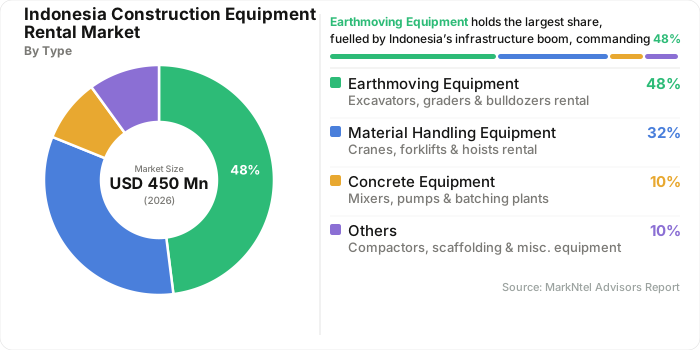
- By equipment type, earthmoving equipment holds a dominant position, accounting for approximately 48% of the total market share.
- Based on distribution channel, the direct rental segment captured a significant share of around 65% in 2026.
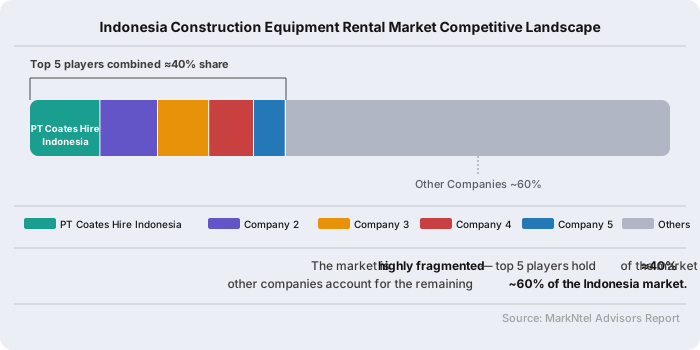
- The market remains highly fragmented, with the top five players collectively accounting for nearly 40% of the total market share.
Indonesia Construction Equipment Rental Market Size and Outlook
The Indonesia Construction Equipment Rental Market is projected to grow at a CAGR of approximately 7.51% during 2026–2032. This growth is primarily supported by sustained government investment in large-scale infrastructure projects, including roads, ports, and urban development initiatives, which continue to drive demand for cost-efficient equipment rental solutions. Additionally, increasing construction activity across residential, commercial, and industrial sectors is encouraging contractors to opt for rentals over ownership to reduce capital expenditure and maintenance costs.
Another key foundation of this growth is the structural importance of the construction sector, which contributed 10.43% to Indonesia’s GDP in Q4 2024, making it the fourth-largest economic sector in the country. This highlights the scale of ongoing construction activity and directly reinforces the underlying demand base for construction machinery and rental services.
Moreover, Indonesia continues to prioritize large-scale infrastructure expansion through structured public-private partnerships. The government has approved a PPP infrastructure program for 2026, covering 19 toll road projects along with ports, water systems, and clean energy infrastructure. These projects are designed to attract private capital and ensure continuous infrastructure development beyond 2025. As these projects are executed in phases across multiple regions, demand for flexible and short-term equipment deployment is expected to rise significantly, strengthening the role of rental operators in the construction value chain.
Alongside infrastructure growth, the market is also being reshaped by technological advancement. The increasing adoption of IoT-enabled telematics and fleet management systems is enabling real-time tracking of equipment, predictive maintenance, and data-driven optimization of fleet utilization. This transition is improving operational efficiency, reducing downtime, and enhancing cost control for rental operators.
Overall, the market outlook remains positive, with projected growth from USD 450 million in 2026 to USD 695 million by 2032, supported by strong contributions from the construction sector to GDP, sustained infrastructure expansion driven by long-term PPP initiatives, and the rapid adoption of telematics-based fleet optimization. Collectively, these factors are expected to enhance equipment utilization efficiency and accelerate the shift toward rental-based construction equipment deployment across Indonesia.
Indonesia Construction Equipment Rental Market Key Indicators
- Indonesia’s urban population reached 59.2% of the total population (around 168 million people) in 2024, reflecting a strong concentration of people in cities. This ongoing urban migration is increasing the need for residential complexes, commercial buildings, and supporting infrastructure, which directly accelerates construction activity and strengthens demand for rented cranes, earthmoving machinery, and access equipment across urban project sites.
- According to long-term projections by the World Bank and United Nations Population Division, over 70% of Indonesia’s population, around 220 million people, is expected to live in urban areas by 2045. This sustained urbanization trajectory will generate continuous demand for residential, commercial, and municipal construction projects, reinforcing long-term reliance on rental equipment providers across all major island regions.
Indonesia Construction Equipment Rental Market Scope
| Category | Segments |
|---|---|
| By Type | Earthmoving Equipment (Excavator, Loaders, Bulldozers, Dump trucks, Others (Trenchers, Motor Grades)), Material Handling Equipment (Tipper, Forklifts, Cranes, Others), Concrete Equipment, Others (Road Roller, etc. |
| By Rental Duration | Short-term (Less than 6 months), Medium-term (6 to 12 months), Long-term (Over 12 months |
| By Rated Power | Below 100 HP, 100-300 HP, 300-500 HP, Above 500 HP |
| By Application | Residential Construction, Commercial Construction, Industrial Construction, Road Construction, Mining & Quarrying, Others (Oil & gas, events, maintenance |
| By Distribution Channel | Direct, Online, OEM Dealer, Contractor |
Indonesia Construction Equipment Rental Market Growth Drivers
Increasing Need for Flexible & Cost-Efficient Project Execution
Indonesia construction and infrastructure landscape is increasingly shaped by phased development models and capital-sharing frameworks, which are directly accelerating the preference for equipment rental over ownership. Large-scale projects are no longer executed as single, continuous investments; instead, they are divided into stages, compelling contractors to align equipment usage with short-term requirements rather than long-term asset holding.
For example, the development of Nusantara Capital City, where total investment is estimated at around USD 32 billion, with nearly 80% expected from private and PPP participation. This financing structure necessitates strict cost control and phased deployment, encouraging contractors to rely on rented machinery to avoid heavy upfront capital commitments. Supporting this, the project had already attracted over USD 4 billion in private investment commitments by 2025, indicating ongoing multi-stage construction activity.
Similarly, Indonesia’s toll road expansion program, driven by the Ministry of Public Works and Housing Indonesia, targets approximately 4,480 km of operational toll roads by 2030, requiring investments exceeding USD 44 billion. These projects are typically tendered in multiple packages across contractors, reinforcing the need for flexible, short-duration equipment access rather than ownership.
Looking ahead, Indonesia’s infrastructure roadmap continues to emphasize PPP-led execution and private capital mobilization through institutions such as the Indonesia Investment Authority, which is actively channeling funds into transport and logistics assets. This ensures a steady pipeline of modular, capital-sensitive projects beyond 2025.
Recent Trends
Integration of Telematics and Fleet Management Systems
The Indonesia construction equipment rental market is increasingly transitioning toward data-driven fleet operations, with telematics and IoT-enabled systems becoming central to equipment management. This shift is driven by the need to improve operational efficiency, reduce downtime, and optimize asset utilization across geographically dispersed project sites.
A strong industry example is the deployment of telematics solutions by TransTRACK at Mining Indonesia 2025. The company showcased IoT-based fleet and heavy equipment tracking systems capable of real-time monitoring of machine location, fuel consumption, and operational performance. These systems enable contractors to track equipment usage, manage preventive maintenance, and improve safety through centralized monitoring platforms.
In addition, the integration of data analytics and communication platforms allows real-time coordination between control centers and field operators, supporting faster decision-making and reducing operational bottlenecks. The technology also supports route optimization, predictive maintenance, and cost control, helping companies significantly reduce fuel consumption and idle time while improving productivity.
Beyond individual deployments, telematics platforms in Indonesia are already delivering measurable efficiency gains, including 20–40% improvement in fleet utilization and up to 30% reduction in operating costs, highlighting their growing commercial viability.
As construction and mining projects scale in complexity, real-time equipment visibility and data-driven decision-making are becoming essential. The rising integration of telematics will continue to enhance fleet efficiency, positioning it as a key technological driver shaping the evolution of Indonesia’s equipment rental market.
Indonesia Construction Equipment Rental Market Opportunities and Challenges
High Maintenance Costs Driving Organized Rental Service Models
The Indonesia construction equipment rental market experiences a significant challenge from high maintenance and operational costs, largely driven by the continuous use of heavy machinery in demanding environments such as mining areas, infrastructure corridors, and tropical construction sites. These conditions accelerate equipment wear, increase repair frequency, and lead to higher downtime, which ultimately impacts operational efficiency and raises the overall cost burden for rental providers. In addition, maintaining large and diverse fleets requires regular servicing, availability of spare parts, and skilled technical manpower, further increasing financial pressure on operators.
At the same time, this challenge is creating opportunities in the form of improved fleet management practices and more structured rental service offerings. Rental companies are increasingly focusing on ensuring better equipment availability and reliability through disciplined maintenance scheduling and organized fleet operations. For example, PT Madhani Talatah Nusantara’s rental service model, which provides a managed fleet of heavy equipment supported by operational readiness and maintenance coordination, ensures consistent equipment availability for project requirements.
This approach highlights the opportunity for rental providers to strengthen their service reliability and reduce inefficiencies associated with equipment downtime. It also encourages better asset utilization planning and more stable operational performance across projects.
Although high maintenance and operational costs remain a key challenge in the Indonesia construction equipment rental market, they are driving improvements in fleet organization, service reliability, and operational discipline, supporting more stable and efficient rental operations across construction and mining activities.
Segmentation Insights
Earthmoving Equipment Segment Holds a Dominant Share of the Market
Earthmoving equipment holds the dominant share in Indonesia’s construction equipment rental market, accounting for nearly 48% of total demand. This leadership is closely tied to the country’s project execution pattern, where most construction activity begins with large-scale land preparation. Equipment such as excavators, loaders, and bulldozers is essential during the initial phases of infrastructure, mining, and industrial development, making their utilization both intensive and time-bound. Since these machines involve high acquisition costs and ongoing maintenance expenses, contractors, especially mid-sized firms, prefer rental over ownership to maintain financial flexibility.
Another defining factor is the overlap between infrastructure and mining operations. In Indonesia, coal and nickel extraction projects require continuous earthmoving activity, often across remote regions like Kalimantan. Renting allows operators to scale fleets quickly based on project cycles without locking capital into depreciating assets. In addition, the government’s push for large infrastructure programs, including toll roads and the new capital city, has sustained consistent demand for excavation and grading work. This combination of high frequency use, capital intensity, and cross-sector application ensures that earthmoving equipment remains the backbone of the rental market. Based on type, the scope has been segmented into
- Earthmoving Equipment
- Excavator
- Loaders
- Bulldozers
- Dump trucks
- Others (Trenchers, Motor Grades)
- Material Handling Equipment
- Tipper
- Forklifts
- Cranes
- Others
- Concrete Equipment
- Others (Road Roller, etc.)
Road Construction Emerges as the Leading Application Segment
Road construction stands as the leading application segment in Indonesia’s construction equipment rental market, accounting for approximately 40% of overall demand. This dominance is primarily driven by the government’s sustained focus on expanding national connectivity through large-scale infrastructure programs, including toll roads, inter-regional highways, and urban transport corridors. These projects require continuous and large-scale deployment of equipment across multiple phases, particularly for excavation, grading, and compaction, making rental solutions operationally efficient.
Unlike residential or commercial construction, road projects are highly equipment-intensive and follow a linear execution model, where machinery is required consistently across different project segments. This creates a steady demand for rental fleets, as contractors prefer to avoid long-term capital commitments and instead align equipment usage with project timelines. Furthermore, the geographic spread of infrastructure development beyond core regions such as Java into emerging areas like Sumatra and Kalimantan necessitates flexible equipment access, which rental providers are better positioned to deliver. The combination of high utilization intensity, project-based demand cycles, and government-led investment pipelines underpins the segment’s leading position in the market. The key applications mapped in the study involve:
- Residential Construction
- Commercial Construction
- Industrial Construction
- Road Construction
- Mining & Quarrying
- Others (Oil & gas, events, maintenance)
Indonesia Construction Equipment Rental Market Competitive Analysis
The Indonesia construction equipment rental market is highly fragmented, with a large number of domestic and international rental companies operating across infrastructure, mining, and industrial construction segments. The market is characterized by project-based demand and regional equipment deployment across diverse geographic locations. The top five companies, including PT Coates Hire Indonesia, PT Madhani Talatah Nusantara, PT AKTIO Equipment Indonesia, PT Royal Krane Perkasa, and PT Rental Crane Indonesia, collectively account for approximately 40% of the total market share, reflecting a competitive landscape marked by strong regional presence and equipment specialization across cranes, earthmoving, and heavy lifting categories.
Major Construction Equipment Rental Companies in Indonesia
- PT Coates Hire Indonesia
- PT Madhani Talatah Nusantara
- PT AKTIO Equipment Indonesia
- PT Cakra Indo Pratama Group
- PT Royal Krane Perkasa
- PT Rental Crane Indonesia
- PT Sarana Rintasindah
- PT Marga Maju Mapan
- PT Tanjungsari Prima Sentosa (RIMASA)
- Others
Global Construction Equipment Rental Industry News and Recent Developments
September 2025: PT Superkrane Expands Rental Fleet with 230-Ton Liebherr LTM 1230-5.1 Crane to Support Indonesia’s Infrastructure Projects
Liebherr Group delivered a 230-ton LTM 1230-5.1 mobile crane to PT Superkrane Mitra Utama Tbk. The crane, featuring a 75-meter telescopic boom, is being added to support large-scale infrastructure, mining, and energy projects planned for 2026.
Impact Analysis: This fleet expansion highlights rising investment in high-capacity rental equipment to meet Indonesia’s growing infrastructure and industrial demand. The deployment of advanced cranes for long-term projects across oil & gas, mining, and infrastructure indicates strong pipeline visibility. It also reflects a shift toward technology-driven fleet upgrades, enhancing operational efficiency and strengthening the role of rental companies in executing large-scale national projects.
Frequently Asked Questions
- Market Segmentation
- Introduction
- Product Definition
- Research Process
- Assumptions
- Executive Summary
- Indonesia Construction Equipment Rental Market Policies, Regulations, and Product Standards
- Indonesia Construction Equipment Rental Market Trends & Developments
- Indonesia Construction Equipment Rental Market Dynamics
- Growth Drivers
- Challenges
- Indonesia Construction Equipment Rental Market Hotspot & Opportunities
- Indonesia Construction Equipment Rental Market Outlook, 2022-2032
- Market Size & Outlook
- By Revenues (USD Million)
- Market Share & Outlook
- By Type – Market Size & Forecast 2022-2032, USD Million
- Earthmoving Equipment
- Excavator
- Loaders
- Bulldozers
- Dump trucks
- Others (Trenchers, Motor Grades)
- Material Handling Equipment
- Tipper
- Forklifts
- Cranes
- Others
- Concrete Equipment
- Others (Road Roller, etc.)
- Earthmoving Equipment
- By Rental Duration – Market Size & Forecast 2022-2032, USD Million
- Short-term (Less than 6 months)
- Medium-term (6 to 12 months)
- Long-term (Over 12 months)
- By Rated Power– Market Size & Forecast 2022-2032, USD Million
- Below 100 HP
- 100-300 HP
- 300-500 HP
- Above 500 HP
- By Application– Market Size & Forecast 2022-2032, USD Million
- Residential Construction
- Commercial Construction
- Industrial Construction
- Road Construction
- Mining & Quarrying
- Others (Oil & gas, events, maintenance)
- By Distribution Channel – Market Size & Forecast 2022-2032, USD Million
- Direct
- Online
- OEM Dealer
- Contractor
- By Region
- Java
- Sumatra
- Kalimantan
- Sulawesi
- Others
- By Company
- Company Revenue Shares
- Competitor Characteristics
- By Type – Market Size & Forecast 2022-2032, USD Million
- Market Size & Outlook
- Indonesia Earthmoving Equipment Market Outlook, 2022-2032
- Market Size & Outlook
- By Revenues (USD Million)
- Market Share & Outlook
- By Rental Duration – Market Size & Forecast 2022-2032, USD Million
- By Rated Power – Market Size & Forecast 2022-2032, USD Million
- By Application– Market Size & Forecast 2022-2032, USD Million
- By Distribution Channel – Market Size & Forecast 2022-2032, USD Million
- By Region
- Market Size & Outlook
- Indonesia Material Handling Equipment Market Outlook, 2022-2032
- Market Size & Outlook
- By Revenues (USD Million)
- Market Share & Outlook
- By Rental Duration – Market Size & Forecast 2022-2032, USD Million
- By Rated Power – Market Size & Forecast 2022-2032, USD Million
- By Application– Market Size & Forecast 2022-2032, USD Million
- By Distribution Channel – Market Size & Forecast 2022-2032, USD Million
- By Region
- Market Size & Outlook
- Indonesia Construction Equipment Rental Market Key Strategic Imperatives for Success & Growth
- Competition Outlook
- Company Profiles
- PT Coates Hire Indonesia
- Business Description
- Product Portfolio
- Strategic Alliances or Partnerships
- Recent Developments
- Financial Details
- Others
- PT Madhani Talatah Nusantara
- Business Description
- Product Portfolio
- Strategic Alliances or Partnerships
- Recent Developments
- Financial Details
- Others
- PT AKTIO Equipment Indonesia
- Business Description
- Product Portfolio
- Strategic Alliances or Partnerships
- Recent Developments
- Financial Details
- Others
- PT Cakra Indo Pratama Group
- Business Description
- Product Portfolio
- Strategic Alliances or Partnerships
- Recent Developments
- Financial Details
- Others
- PT Royal Krane Perkasa
- Business Description
- Product Portfolio
- Strategic Alliances or Partnerships
- Recent Developments
- Financial Details
- Others
- PT Rental Crane Indonesia
- Business Description
- Product Portfolio
- Strategic Alliances or Partnerships
- Recent Developments
- Financial Details
- Others
- PT Sarana Rintasindah
- Business Description
- Product Portfolio
- Strategic Alliances or Partnerships
- Recent Developments
- Financial Details
- Others
- PT Marga Maju Mapan
- Business Description
- Product Portfolio
- Strategic Alliances or Partnerships
- Recent Developments
- Financial Details
- Others
- PT Tanjungsari Prima Sentosa (RIMASA)
- Business Description
- Product Portfolio
- Strategic Alliances or Partnerships
- Recent Developments
- Financial Details
- Others
- Others
- PT Coates Hire Indonesia
- Company Profiles
- Disclaimer
MarkNtel Advisors follows a robust and iterative research methodology designed to ensure maximum accuracy and minimize deviation in market estimates and forecasts. Our approach combines both bottom-up and top-down techniques to effectively segment and quantify various aspects of the market. A consistent feature across all our research reports is data triangulation, which examines the market from three distinct perspectives to validate findings. Key components of our research process include:
1. Scope & Research Design At the outset, MarkNtel Advisors define the research objectives and formulate pertinent questions. This phase involves determining the type of research—qualitative or quantitative—and designing a methodology that outlines data collection methods, target demographics, and analytical tools. They also establish timelines and budgets to ensure the research aligns with client goals.
2. Sample Selection and Data Collection In this stage, the firm identifies the target audience and determines the appropriate sample size to ensure representativeness. They employ various sampling methods, such as random or stratified sampling, based on the research objectives. Data collection is carried out using tools like surveys, interviews, and observations, ensuring the gathered data is reliable and relevant.
3. Data Analysis and Validation Once data is collected, MarkNtel Advisors undertake a rigorous analysis process. This includes cleaning the data to remove inconsistencies, employing statistical software for quantitative analysis, and thematic analysis for qualitative data. Validation steps are taken to ensure the accuracy and reliability of the findings, minimizing biases and errors.

4. Data Forecast and FinalizationThe final phase involves forecasting future market trends based on the analyzed data. MarkNtel Advisors utilize predictive modeling and time series analysis to anticipate market behaviors. The insights are then compiled into comprehensive reports, featuring visual aids like charts and graphs, and include strategic recommendations to inform client decision-making
We offer flexible licensing options to cater to varying organizational needs. Choose the pricing pack that best suits your requirements:
Buy Now Inquire Before Buying
 Request Customization
 Talk to our Consultant







