

US Energy Management Systems Market Research Report: Forecast (2026-2032)
US Energy Management Systems Market - By System Type (Industrial energy management systems (IEMS), Building energy management systems (BEMS), Home energy management systems (HEMS), ... By Component (Hardware, Smart Meters, Sensors & IoT Devices, Controllers & Actuators, Energy Storage Systems, Power Quality Equipment, Building Automation System (BAS) Controllers, Others), Software (Energy Analytics & Reporting, Load Forecasting, Demand Response Platforms, Utility Customer Energy Management Software, Others), Services (Consulting & Auditing, Energy Audits, Compliance & Sustainability Consulting, Installation & Integration, Managed Services (Outsourced EMS), Maintenance & Support, Performance Contracting / ESCO Services, Others), By Deployment (On-premises, Cloud-Based, Hybrid), By End-User (Residential & Commercial, Energy & Utilities, Manufacturing, Telecom & IT, Data Centers, Others), By Customer Size (Large Enterprises, Mid-Size Enterprises, Small Enterprises), By Business Model (Direct Purchase, SaaS (Subscription-Based), Energy Performance Contracts, Others (Leasing, Utility Incentives, etc), By Buyer Priority (Energy Cost Reduction, Sustainability / Carbon Reduction, Regulatory Compliance, Reliability & Resilience), and others Read more
- Energy
- Dec 2025
- Pages 138
- Report Format: PDF, Excel, PPT
US Energy Management Systems Market
Projected 9.62% CAGR from 2026 to 2032
Study Period
2026-2032
Market Size (2025)
USD 14.18 Billion
Market Size (2032)
USD 26.98 Billion
Base Year
2025
Projected CAGR
9.62%
Leading Segments
By Component: Hardware
US Energy Management Systems Market Report Key Takeaways:
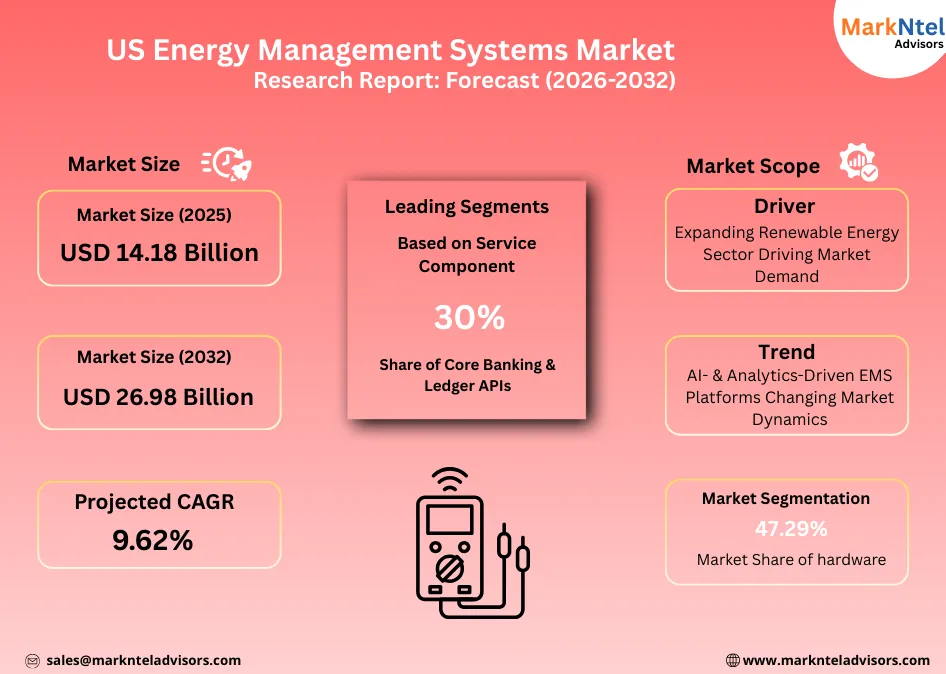
- The US Energy Management Systems Market size is valued at around USD 14.18 billion in 2025 and is projected to reach USD 26.98 billion by 2032. The estimated CAGR from 2026 to 2032 is around 9.62%, indicating strong growth.
- By System Type, the industrial energy management systems (IEMS) segment represents 37% of the US Energy Management Systems Market size in 2025. Meanwhile, the Building Energy Management Systems (BEMS) segment is anticipated to grow at a 12.19% CAGR during 2026-2032.
- By Component, hardware holds around 47.29% share of the Energy Management Systems Industry in 2025.
- The leading companies in the US Energy Management Systems Market are Schneider Electric, Siemens, Honeywell, ABB, Emerson, Johnson Controls, C3 AI, GridPoint, EnergyCAP, Lucid, Trane Technologies, Carrier, Delta Control, AutoGrid, Opus One Solutions, GE Vernova, Oracle, Bloom Energy, Enchanted Rock, Scale Microgrids, Itron, Landis+Gyr, Sensus, Xylem, Rockwell Automation, Advantech, Cisco, Belimo, Enel X, EnergyHub, Voltus, CPower, OhmConnect, Leap, Ameresco, ENGIE, and others.
Market Insights & Analysis: US Energy Management Systems Market (2026- 2032):
The US Energy Management Systems Market size is valued at around USD 14.18 billion in 2025 and is projected to reach USD 26.98 billion by 2032. Along with this, the market is estimated to grow at a CAGR of around 9.62% during the forecast period, i.e., 2026-32. The US Energy Management Systems Market is primarily driven by rising energy costs that increase the need for efficiency and cost optimization, along with stringent government regulations and sustainability mandates promoting energy efficiency and emission reduction. These pressures are reshaping how utilities, industries, and commercial users monitor, control, and optimize energy consumption across increasingly complex power networks.
The growing share of renewable energy, including solar, wind, and battery storage, has introduced higher variability into grid operations, strengthening the role of EMS platforms in real-time monitoring, forecasting, and system optimization. To support this transition, federal initiatives are accelerating digital grid readiness. For example, in September 2025, the U.S. Department of Energy (DOE) launched the Speed to Power Initiative, aimed at accelerating multi-gigawatt grid projects and modernizing infrastructure to meet rising electricity demand.
Moreover, Regional infrastructure investments further reinforce EMS adoption. For example, in December 2025, the Electric Reliability Council of Texas (ERCOT) approved a USD 9.4 billion transmission expansion plan to accommodate rapid load growth from electrification and data centers, increasing the need for advanced energy management and grid optimization tools.
Furthermore, technological innovation is also shaping market momentum. For example, in 2025, Stem, Inc. launched its PowerTrack™ EMS platform, enabling real-time control of standalone and hybrid energy storage systems, highlighting the growing role of software-driven energy management in utility and commercial operations.
US Energy Management Systems Market Recent Developments:
- December 2025: Fluence Energy gained investor attention as U.S. grid modernization and renewable integration boosted demand for its integrated energy storage and management solutions. Utilities and large customers increasingly relied on Fluence’s EMS capabilities to improve energy optimization, reliability, and system efficiency amid rising electricity consumption.
- December 2025: NextEra Energy expanded its partnership with Google Cloud, securing over 2.5 GW of clean energy and storage contracts in the U.S. The collaboration includes an AI-driven platform to enhance grid efficiency, forecast equipment needs, and optimize energy flows, highlighting the growing role of AI-enabled energy management systems.
US Energy Management Systems Market Scope:
| Category | Segments |
|---|---|
| By System Type | Industrial energy management systems (IEMS), Building energy management systems (BEMS), Home energy management systems (HEMS), |
| By Component | Hardware, Smart Meters, Sensors & IoT Devices, Controllers & Actuators, Energy Storage Systems, Power Quality Equipment, Building Automation System (BAS) Controllers, Others), Software (Energy Analytics & Reporting, Load Forecasting, Demand Response Platforms, Utility Customer Energy Management Software, Others), Services (Consulting & Auditing, Energy Audits, Compliance & Sustainability Consulting, Installation & Integration, Managed Services (Outsourced EMS), Maintenance & Support, Performance Contracting / ESCO Services, Others), |
| By Deployment | On-premises,Cloud-Based,Hybrid), |
| By End-User | Residential & Commercial, Energy & Utilities, Manufacturing, Telecom & IT, Data Centers, Others), |
| By Customer Size | Large Enterprises, Mid-Size Enterprises, Small Enterprises), |
| By Business Model | Direct Purchase, SaaS (Subscription-Based), Energy Performance Contracts, Others (Leasing, Utility Incentives, etc), |
| By Buyer Priority | Energy Cost Reduction, Sustainability / Carbon Reduction, Regulatory Compliance, Reliability & Resilience), and others |
US Energy Management Systems Market Drivers:
Expanding Renewable Energy Sector Driving Market Demand
The growth of the Renewable Energy sector is a major driver for the U.S. Energy Management Systems (EMS) Market because increasing penetration of renewables such as solar and wind transforms how electricity is produced, distributed, and consumed, requiring advanced EMS for stability, reliability, and optimization.
According to the U.S. Energy Information Administration (EIA), renewable energy sources (wind, solar, hydropower, biomass, geothermal) supplied nearly 28% of U.S. electricity generation in the first half of 2025, with solar alone contributing around 9% and wind 11.6% of total generation. This marked growth reflects a close shift toward cleaner energy domination of the grid.
In 2025, a record estimated 64 GW of new electric capacity is expected to be added to the U.S. grid, with 33.3 GW from solar, 18.3 GW from battery storage, and 7.8 GW from wind, showcasing renewable leadership in capacity growth. Furthermore, a U.S. Department of Energy (DOE) study highlights that federal lands could technically support over 7,700 GW of renewable capacity, with 51–84 GW deployed by 2035, significantly expanding solar, wind, and geothermal infrastructure.
As renewables expand, grid operators and utilities increasingly rely on EMS to balance variable generation, integrate energy storage, and maintain grid reliability and forecast accuracy. Future federal and state policies aiming to decarbonize electricity systems through 2035 and beyond, including targets for 60–70 GW of new renewables annually to achieve 90% carbon-free electricity, will further heighten EMS demand.
Overall, the rapid integration and planned expansion of renewable energy resources require sophisticated EMS to manage intermittency, optimize energy flows, and support grid resilience, thereby significantly accelerating market growth.
US Energy Management Systems Market Trends:
AI- & Analytics-Driven EMS Platforms Changing Market Dynamics
AI and advanced analytics are rapidly transforming Energy Management Systems (EMS) in the U.S., playing a pivotal role in optimizing grid operations amid rising demand and renewable integration. The U.S. Department of Energy (DOE) has explicitly recognized AI as a critical tool for modernizing the electric grid, using machine learning to improve load forecasting, anticipate disruptions, and enhance operational reliability and efficiency across power systems. AI helps utilities better manage variable renewable generation and distributed energy resources, which are increasingly complex under current grid conditions.
To support this transition, DOE invested USD 7.5 million in 2024 for projects that use advanced data analytics and sensor technologies to strengthen grid resilience and reliability. These funds accelerate the use of AI-enabled predictive analytics that can detect grid anomalies and support real-time decision-making.
Federal reports and expert analyses also show that U.S. data centers, major drivers of electricity demand as they support AI workloads, are expected to account for up to 12 % of total U.S. electricity use by 2028, up from about 4.4 % in 2023, intensifying the need for AI-driven EMS to balance loads and forecast energy use.
After 2025, wider adoption of emission-reduction policies, rebate and equipment-exchange programmes, and municipal moves toward zero-emission landscaping fleets will further accelerate this transition.
Overall, tightening regulations and expanding DIY engagement are driving a long-term shift toward electric gardening tools, significantly increasing demand for battery-powered mowers, trimmers, blowers, and related accessories.
US Energy Management Systems Market Challenges:
High Initial Implementation Costs to Impede Quick Market Expansion
High initial implementation costs continue to restrain the growth of the U.S. Energy Management Systems (EMS) Market, particularly among small utilities and mid-sized commercial and industrial users. Deploying EMS involves substantial upfront expenditure on digital monitoring equipment, control systems, communication networks, software integration, cybersecurity upgrades, and skilled workforce training. These investments are typically required well before operational savings can be realized, increasing financial risk for adopters.
The U.S. Government Accountability Office (GAO) has highlighted that grid modernization projects, including advanced monitoring, automation, and energy management technologies, require significant upfront capital expenditures, creating financial strain for utilities with limited rate flexibility and constrained budgets. These high upfront expenditures increase financial risk, extend payback periods, and slow EMS adoption across budget-constrained segments of the U.S. energy market.
US Energy Management Systems Market (2026-32) Segmentation Analysis:
US Energy Management Systems Market Report and Forecast 2026-2032 offers a detailed analysis of the market based on the following segments:
Based on System Type
- Industrial energy management systems (IEMS)
- Building energy management systems (BEMS)
- Home energy management systems (HEMS)
The IEMS segment, with 37% market share, leads the market. Market leadership is driven by energy-intensive operations in manufacturing, chemicals, and large commercial facilities requiring real-time monitoring, process optimization, and cost management. EMS platforms enable industrial users to integrate distributed generation, minimize energy wastage, and maintain operational efficiency. Supporting this growth, utilities are securing long-term power agreements to meet surging electricity demand from industrial users and data centers, highlighting the critical role of IEMS in managing high-load environments.
Rising electricity costs, regulatory compliance, and industrial electrification trends further drive adoption, making IEMS a primary revenue-generating segment in the U.S. EMS market.
Moreover, the Building Energy Management Systems (BEMS) segment is the fastest-growing in the U.S. EMS market, with a CAGR of 12.19%, driven by increasing adoption in commercial and institutional buildings, smart-building initiatives, and stringent energy-efficiency regulations promoting cost and carbon reduction.
Overall, the strong adoption of IEMS underscores its importance in helping industrial users control energy costs, optimize operations, and manage increasingly complex energy loads. As electricity demand from industrial facilities and data centers continues to rise, IEMS will remain critical for maintaining reliability and efficiency. This positions the segment as a sustained revenue driver in the U.S. EMS market.
Based on Component
- Hardware
- Smart Meters
- Sensors & IoT Devices
- Controllers & Actuators
- Energy Storage Systems
- Power Quality Equipment
- Building Automation System (BAS) Controllers
- Others
- Software
- Energy Analytics & Reporting
- Load Forecasting
- Demand Response Platforms
- Utility Customer Energy Management Software
- Others
- Services
- Consulting & Auditing
- Energy Audits
- Compliance & Sustainability Consulting
- Installation & Integration
- Managed Services (Outsourced EMS)
- Maintenance & Support
- Performance Contracting / ESCO Services
- Consulting & Auditing
- Others
The hardware segment dominates the U.S. EMS Market with a 47.29% share, as devices like smart meters, sensors, controllers, energy storage systems, and power-quality equipment form the foundation of energy management solutions. Hardware enables real-time monitoring, accurate measurement, and automated control of energy across industrial, commercial, and utility-scale systems. Recent developments highlight this dominance. U.S. microgrid capacity combining onsite generation, energy storage, and load management is projected to reach 10 GW by 2025, up from 4.4 GW.
These installations heavily rely on hardware to manage distributed generation, optimize energy use, and ensure grid reliability. The need for continuous equipment upgrades, compliance with energy-efficiency standards, and integration of IoT-enabled devices further sustains the segment’s leadership, making hardware an indispensable component of the U.S. EMS ecosystem.
US Energy Management Systems Market (2026-32): Regional Projection
The U.S. Energy Management Systems market is dominated by the Western and Southern regions, particularly California and Texas, due to their high electricity demand, advanced grid infrastructure, and strong policy support for energy efficiency. These regions host a dense concentration of industrial facilities, data centers, commercial buildings, and renewable energy projects, driving large-scale EMS adoption. California leads due to strict energy efficiency mandates, aggressive decarbonization targets, and widespread deployment of smart buildings and distributed energy resources. Texas also plays a critical role because of its large industrial base and complex power network, requiring advanced energy monitoring and load management. For instance, the Electric Reliability Council of Texas approved a USD 9.4 billion transmission expansion in 2025 to support rising demand from data centers and electrification, increasing the need for advanced energy management solutions.
Overall, energy consumption, regulatory pressure, renewable integration, and grid modernization initiatives position California and Texas.
Gain a Competitive Edge with Our US Energy Management Systems Market Report
- US Energy Management Systems Market Report by MarkNtel Advisors provides a detailed & thorough analysis of market size & share, growth rate, competitive landscape, and key players. This comprehensive analysis helps businesses gain a holistic understanding of the market dynamics & make informed decisions.
- This report also highlights current market trends & future projections, allowing businesses to identify emerging opportunities & potential challenges. By understanding market forecasts, companies can align their strategies & stay ahead of the competition.
- US Energy Management Systems Market Report aids in assessing & mitigating risks associated with entering or operating in the market. By understanding market dynamics, regulatory frameworks, and potential challenges, businesses can develop strategies to minimize risks & optimize their operations.
*Reports Delivery Format - Market research studies from MarkNtel Advisors are offered in PDF, Excel and PowerPoint formats. Within 24 hours of the payment being successfully received, the report will be sent to your email address.
Frequently Asked Questions
- Market Segmentation
- Introduction
- Product Definition
- Research Process
- Assumptions
- Executive Summary
- The US Energy Sector Macroeconomic Outlook, 2022-2032
- YoY Electricity Generation in Million TW
- By Source of Energy
- Natural Gas
- Coal
- Nuclear
- Conventional hydropower
- Wind
- Solar
- Others
- YoY Electricity Consumption, By End Users
- Homes
- Commercial Buildings
- Industries
- Electricity Pricing Analysis
- Demand & Supply Gap Analysis
- By Source of Energy
- YoY Electricity Generation in Million TW
- US Energy Management Systems Market Policies, Regulations, and Product Standards
- US Energy Management Systems Market Supply Chain Analysis
- US Energy Management Systems Market Trends & Developments
- US Energy Management Systems Market Dynamics
- Growth Drivers
- Challenges
- US Energy Management Systems Market Hotspot & Opportunities
- US Energy Management Systems Market Outlook, 2022-2032
- Market Size & Outlook
- By Revenues (USD Million)
- Market Share & Outlook
- By System Type- Market Size & Forecast 2022-2032F, USD Million
- Industrial energy management systems (IEMS)
- Building energy management systems (BEMS)
- Home energy management systems (HEMS)
- By Component- Market Size & Forecast 2022-2032F, USD Million
- Hardware
- Smart Meters
- Sensors & IoT Devices
- Controllers & Actuators
- Energy Storage Systems
- Power Quality Equipment
- Building Automation System (BAS) Controllers
- Others
- Software
- Energy Analytics & Reporting
- Load Forecasting
- Demand Response Platforms
- Utility Customer Energy Management Software
- Others
- Services
- Consulting & Auditing
- Energy Audits
- Compliance & Sustainability Consulting
- Installation & Integration
- Managed Services (Outsourced EMS)
- Maintenance & Support
- Performance Contracting / ESCO Services
- Others
- Consulting & Auditing
- Hardware
- By Deployment- Market Size & Forecast 2022-2032F, USD Million
- On-premises
- Cloud-Based
- Hybrid
- By End-User- Market Size & Forecast 2022-2032F, USD Million
- Residential & Commercial
- Energy & Utilities
- Manufacturing
- Telecom & IT
- Data Centers
- Others
- By Customer Size- Market Size & Forecast 2022-2032F, USD Million
- Large Enterprises
- Mid-Size Enterprises
- Small Enterprises
- By Business Model- Market Size & Forecast 2022-2032F, USD Million
- Direct Purchase
- SaaS (Subscription-Based)
- Energy Performance Contracts
- Others (Leasing, Utility Incentives, etc)
- By Buyer Priority- Market Size & Forecast 2022-2032F, USD Million
- Energy Cost Reduction
- Sustainability / Carbon Reduction
- Regulatory Compliance
- Reliability & Resilience
- By Region
- Northeast
- South
- Midwest
- West
- By Company
- Company Revenue Shares
- Competitor Characteristics
- By System Type- Market Size & Forecast 2022-2032F, USD Million
- Market Size & Outlook
- US Industrial Energy Management Systems (IEMS) Market Outlook, 2022-2032
- Market Size & Analysis
- Market Share & Analysis
- By Component - Market Size & Forecast 2022-2032, USD Million
- By Deployment - Market Size & Forecast 2022-2032, USD Million
- By End-User- Market Size & Forecast 2022-2032, USD Million
- By Customer Size- Market Size & Forecast 2022-2032, USD Million
- By Business Model- Market Size & Forecast 2022-2032, USD Million
- By Buyer Priority- Market Size & Forecast 2022-2032, USD Million
- US Building Energy Management Systems (BEMS) Market Outlook, 2022-2032
- Market Size & Analysis
- Market Revenues (The USD Million)
- Market Share & Analysis
- By Component - Market Size & Forecast 2022-2032, USD Million
- By Deployment - Market Size & Forecast 2022-2032, USD Million
- By End-User- Market Size & Forecast 2022-2032, USD Million
- By Customer Size- Market Size & Forecast 2022-2032, USD Million
- By Business Model- Market Size & Forecast 2022-2032, USD Million
- By Buyer Priority- Market Size & Forecast 2022-2032, USD Million
- Market Size & Analysis
- The US Home Energy Management Systems (HEMS) Market Outlook, 2022-2032
- Market Size & Analysis
- Market Revenues (The USD Million)
- Market Share & Analysis
- By Component - Market Size & Forecast 2022-2032, USD Million
- By Deployment - Market Size & Forecast 2022-2032, USD Million
- By End-User- Market Size & Forecast 2022-2032, USD Million
- By Customer Size- Market Size & Forecast 2022-2032, USD Million
- By Business Model- Market Size & Forecast 2022-2032, USD Million
- By Buyer Priority- Market Size & Forecast 2022-2032, USD Million
- Market Size & Analysis
- US Energy Management Systems Market Key Strategic Imperatives for Success & Growth
- Competition Outlook
- Company Profiles
- Energy Management Platform Providers
- Schneider Electric (EcoStruxure)
- Siemens (Desigo, Navigator)
- Honeywell (Forge Energy Optimization)
- ABB (Ability Energy Management)
- Emerson
- Others
- SaaS-First EMS
- Johnson Controls (OpenBlue)
- C3 AI (Energy & Utilities suite)
- GridPoint
- EnergyCAP
- Lucid
- Others
- Building Automation & Controls Specialists
- Johnson Controls
- Siemens
- Schneider Electric
- Trane Technologies
- Carrier
- Delta Control
- Others
- Distributed Energy Resource & Grid-Oriented Platforms
- AutoGrid
- Opus One Solutions
- GE Vernova
- Oracle Utilities
- Schneider Electric
- Bloom Energy
- Enchanted Rock
- Scale Microgrids
- Others
- IoT, Metering & Edge Infrastructure Providers
- Itron
- Landis+Gyr
- Sensus (Xylem)
- Rockwell Automation
- Advantech
- Cisco (IoT gateways)
- Belimo
- Others
- Utility Programs, Demand Response & Aggregators
- Enel X
- EnergyHub
- Voltus
- CPower
- OhmConnect
- Leap
- Others
- Energy Services Companies (ESCOs) & Integrators
- Ameresco
- ENGIE North America
- Honeywell Building Solutions
- Schneider Electric Energy & Sustainability Services
- Johnson Controls Performance Infrastructure
- Others
- Energy Management Platform Providers
- Company Profiles
- Disclaimer
MarkNtel Advisors follows a robust and iterative research methodology designed to ensure maximum accuracy and minimize deviation in market estimates and forecasts. Our approach combines both bottom-up and top-down techniques to effectively segment and quantify various aspects of the market. A consistent feature across all our research reports is data triangulation, which examines the market from three distinct perspectives to validate findings. Key components of our research process include:
1. Scope & Research Design At the outset, MarkNtel Advisors define the research objectives and formulate pertinent questions. This phase involves determining the type of research—qualitative or quantitative—and designing a methodology that outlines data collection methods, target demographics, and analytical tools. They also establish timelines and budgets to ensure the research aligns with client goals.
2. Sample Selection and Data Collection In this stage, the firm identifies the target audience and determines the appropriate sample size to ensure representativeness. They employ various sampling methods, such as random or stratified sampling, based on the research objectives. Data collection is carried out using tools like surveys, interviews, and observations, ensuring the gathered data is reliable and relevant.
3. Data Analysis and Validation Once data is collected, MarkNtel Advisors undertake a rigorous analysis process. This includes cleaning the data to remove inconsistencies, employing statistical software for quantitative analysis, and thematic analysis for qualitative data. Validation steps are taken to ensure the accuracy and reliability of the findings, minimizing biases and errors.

4. Data Forecast and FinalizationThe final phase involves forecasting future market trends based on the analyzed data. MarkNtel Advisors utilize predictive modeling and time series analysis to anticipate market behaviors. The insights are then compiled into comprehensive reports, featuring visual aids like charts and graphs, and include strategic recommendations to inform client decision-making
We offer flexible licensing options to cater to varying organizational needs. Choose the pricing pack that best suits your requirements:
Buy Now Inquire Before Buying
 Request Customization
 Talk to our Consultant







