

Global Electrolyzer Market Research Report Forecast (2026-2032)
Electrolyzer Market - By Product Type (Alkaline Electrolyzer, Proton Exchange Membrane Electrolyzer, Solid Oxide (SOE) Electrolyzer, Anion Exchange Membrane (AEM) Electrolyzer), ... By Application (Power Generation, Transportation, Industry Energy, Industry Feedstock, Building Heat and Power, Others), By Capacity (Less than 500 kW, 500 kW to 2 MW, Above 2 MW), Read more
- Energy
- Mar 2026
- Pages 192
- Report Format: PDF, Excel, PPT
Global Electrolyzer Market
Projected 24.4% CAGR from 2026 to 2032
Study Period
2026-2032
Market Size (2026)
USD 2.75 Billion
Market Size (2032)
USD 10.19 Billion
Largest Region
Asia-Pacific
Projected CAGR
24.4%
Leading Segments
By Product Type: Alkaline Electrolyzers
Global Electrolyzer Market Report Key Takeaways:
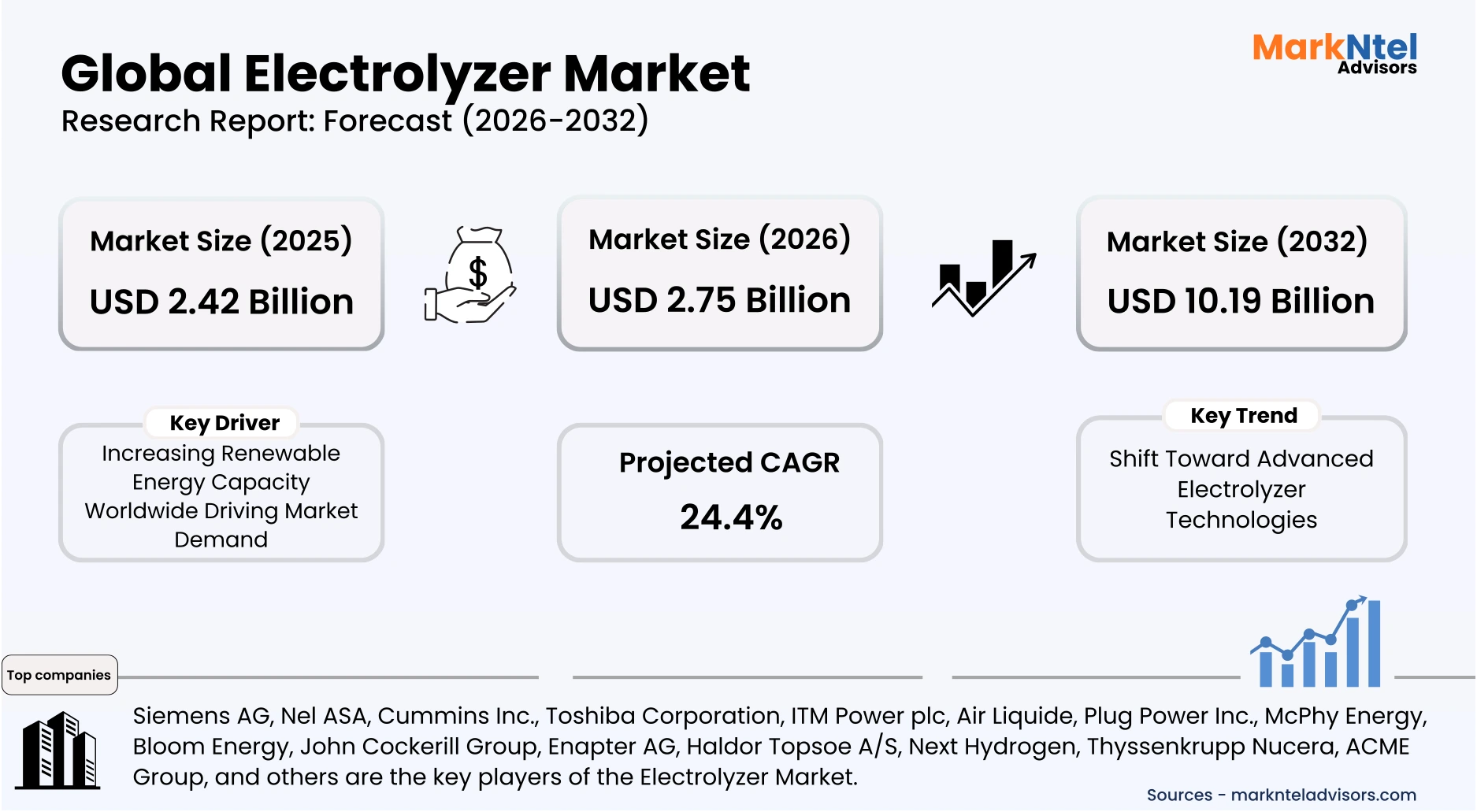
- The Global Electrolyzer Market size was valued at around USD 2.42 billion in 2025 and is projected to grow from USD 2.75 billion in 2026 to USD 10.19 billion by 2032. The estimated CAGR from 2026 to 2032 is around 24.4%, indicating strong growth.
- By Product Type, Alkaline Electrolyzer seized the largest market share, around 75% in 2026.
- By Capacity, the 500 kW to 2 MW segment holds 56% share of the Global Electrolyzer Market size in 2026.
- By Region, Asia Pacific is the leading region with a market share of 49% in 2026.
- The leading Electrolyzer companies in the global market are Siemens AG, Nel ASA, Cummins Inc., Toshiba Corporation, ITM Power plc, Air Liquide, Plug Power Inc., McPhy Energy, Bloom Energy, John Cockerill Group, Enapter AG, Haldor Topsoe A/S, Next Hydrogen, Thyssenkrupp Nucera, ACME Group, and others.
Market Insights & Analysis: Global Electrolyzer Market (2026-2032):
The Global Electrolyzer Market size was valued at around USD 2.42 billion in 2025 and is projected to grow from USD 2.75 billion in 2026 to USD 10.19 billion by 2032. Along with this, the market is estimated to grow at a CAGR of around 24.4% during the forecast period, i.e., 2026-32. The Global Electrolyzer Market is primarily driven by rapid expansion in renewable energy capacity and accelerating adoption of advanced hydrogen production technologies. Governments worldwide are scaling clean energy infrastructure to support energy security and decarbonization, directly strengthening the case for green hydrogen produced through electrolyzers. For example, in 2024 alone, global renewable power capacity increased by 585 GW, the highest annual addition on record, pushing total installed capacity to around 4,448 GW, according to the International Renewable Energy Agency (IRENA). This surge in solar and wind generation provides the low-carbon electricity essential for cost-effective electrolyzer operations.
India exemplifies this momentum. In 2025, the country added nearly 50 GW of renewable capacity with investments of approximately USD 24 billion, while reaffirming its long-term target of 500 GW of non-fossil fuel capacity by 2030. At the state level, Gujarat’s Integrated Renewable Energy Policy 2025 aims to exceed 100 GW by 2030, explicitly supporting hybrid projects and energy storage key enablers for round-the-clock green hydrogen production.
Furthermore, the market is witnessing a clear shift toward advanced electrolyzer technologies. Companies are scaling PEM and high-efficiency alkaline systems to improve flexibility and integration with variable renewables. In Europe, Plug Power’s solar-integrated 5 MW PEM electrolyzer project in the Netherlands and Andritz’s 1 GW annual-capacity electrolyzer gigafactory in Germany signal growing industrial confidence.
Focusing on future investments, the market is witnessing significant capital inflows to scale large electrolyzer projects and accelerate green hydrogen adoption. In 2025, Air Liquide and TotalEnergies committed over USD 1.05 billion to develop large-scale projects in the Netherlands, including 200 MW and 250 MW electrolyzer facilities expected to begin operations by 2027, reinforcing long-term investment momentum.
Global Electrolyzer Market Recent Developments:
- October 2025: Plug Power delivered the first 10 MW GenEco electrolyzer module for a 100 MW green hydrogen project at Galp’s Sines Refinery, Portugal. This large-scale deployment supports industrial decarbonization and reflects rising confidence in electrolyzer-based green hydrogen solutions across Europe.
- February 2025: The International Energy Agency (IEA) reported that despite delays and cancellations affecting some low-emissions hydrogen and electrolyzer projects, the global project pipeline remains strong. Rising hydrogen demand and decarbonization targets support future growth, though deployment is slower due to financing, permitting, and supply-chain challenges.
Global Electrolyzer Market Scope:
| Category | Segments |
|---|---|
| By Product Type | Alkaline Electrolyzer, Proton Exchange Membrane Electrolyzer, Solid Oxide (SOE) Electrolyzer, Anion Exchange Membrane (AEM) Electrolyzer |
| By Application | Power Generation, Transportation, Industry Energy, Industry Feedstock, Building Heat and Power, Others), |
| By Capacity | Less than 500 kW, 500 kW to 2 MW, Above 2 MW), |
Global Electrolyzer Market Drivers:
Increasing Renewable Energy Capacity Worldwide Driving Market Demand
The expansion of global renewable energy capacity is a fundamental driver for the electrolyzer market because green hydrogen production depends directly on renewable electricity availability. According to the International Energy Agency (IEA), global renewable power capacity is expected to grow by over 4,600 GW by 2030, equivalent to adding the combined power generation capacity of China, the EU, and Japan, with solar PV accounting for 80% of this increase due to lower costs and faster permitting processes.
In 2024, global installed renewable capacity reached approximately 4,443 GW, with solar PV (452.1 GW) and wind (114.3 GW) leading additions, a nearly 20% increase over 2023, according to the International Renewable Energy Agency (IRENA). This surge ensures abundant low-cost renewable electricity, enabling cleaner, cost-competitive green hydrogen via electrolyzers.
Governments are formalizing long-term energy plans beyond 2025. For instance, several countries pledge to triple renewable energy capacity by 2030, a commitment reflected in national strategies that emphasize solar, wind, and grid integration, creating clear pathways for electrolyzer expansion.
Moreover, dedicated renewable capacity to hydrogen production projected to reach around 50 GW by 2027 highlights how renewable build-out is increasingly aligned with hydrogen needs, particularly in China, the U.S., Chile, and Australia.
Overall, as renewable electricity capacities scale sharply through 2030 and beyond, they reduce green hydrogen production costs and expand green power availability. This strengthens the business case for electrolyzers, positioning them as essential infrastructure in decarbonized energy systems.
Global Electrolyzer Market Trends:
Shift Toward Advanced Electrolyzer Technologies
The global electrolyzer industry is increasingly shifting toward advanced technologies, especially Proton Exchange Membrane (PEM) and Solid Oxide Electrolyzers (SOEC), driven by efficiency improvements, government policy support, and industrial decarbonization needs. According to the International Energy Agency (IEA), countries are investing heavily in next-generation electrolyzers to enhance performance and integrate with variable renewable power sources. China leads in global installed capacity, with about 0.8 GW cumulatively operational by 2023 and over 9 GW under construction or FID, showing how advanced designs are scaling beyond pilot stages.
Moreover, PEM electrolyzers are gaining favor due to their faster response times and ability to work with intermittent renewables like wind and solar, which improves green hydrogen production economics. These systems can achieve electrical efficiencies of around 80% and are being prioritized in industrial hydrogen strategies. Meanwhile, SOEC technology, which operates at high temperatures, delivers even higher efficiencies (over 85%) when integrated with industrial heat streams, making it attractive for future large-scale hydrogen production.
Overall, the trend toward advanced electrolyzer technologies with greater efficiency, flexibility, and industrial relevance is strengthening the global electrolyzer market by reducing production costs and improving integration with renewable energy, positioning green hydrogen as a scalable clean energy vector.
Global Electrolyzer Market Challenges:
High Installation & Operational Costs Impacting Market Growth
A key challenge for the Global Electrolyzer Market is the high capital expenditure (CapEx) and operating costs associated with electrolyzer systems, which significantly hinder widespread deployment. The current installed cost for electrolyzer systems, including the electrolyzer stack, balance of plant (BoP), and installation, remains elevated. According to peer‑reviewed data, total installed capital costs for electrolyzers range from approximately USD 1,666/kW to USD 1,970/kW, with CapEx alone contributing around 27–40% of the overall levelized cost of hydrogen production. This cost structure is a major factor keeping the levelized cost of green hydrogen between USD 5 and 10 per kg of hydrogen produced.
The International Energy Agency (IEA) also notes that capital costs for electrolysis systems have recently climbed due to inflation in materials, labor, and interest rates. Systems of non‑Chinese origin reached about USD 2,000/kW for alkaline units and USD 2,450/kW for PEM systems, about 20% higher than the previous year. Such high expenditures increase the cost barrier for investors and project developers, particularly where financing costs are elevated.
Operating expenses are influenced by electricity rates, maintenance, and periodic stack replacements, all of which contribute to elevated operational expenditure. Collectively, the combination of high CapEx and OpEx restricts the rapid deployment of electrolyzer projects, underscoring the need for technological innovation, manufacturing scale-up, and supportive policies to reduce costs and enable broader market adoption.
Global Electrolyzer Market (2026-32) Segmentation Analysis:
The Global Electrolyzer Market Report and Forecast 2026-2032 offers a detailed analysis of the market based on the following segments:
Based on Product Type:
- Alkaline Electrolyzer
- Proton Exchange Membrane Electrolyzer
- Solid Oxide (SOE) Electrolyzer
- Anion Exchange Membrane (AEM) Electrolyzer
Alkaline electrolyzers dominate the global market with a 75% share, primarily due to their mature technology, cost-effectiveness, and scalability. They have been commercially deployed for decades, offering robust performance and long operational life in industrial and large-scale green hydrogen production. Alkaline systems can operate efficiently with variable renewable energy sources and tolerate impurities in water feed, reducing pre-treatment costs.
Governments and industries favor alkaline electrolyzers for utility-scale and grid-connected applications, as they require lower capital expenditure compared to PEM and SOE alternatives. For instance, Europe’s hydrogen initiatives often utilize alkaline systems in large industrial plants due to reliability and proven performance. Their high efficiency in moderate temperature and pressure operations also contributes to lower operating costs, making them attractive for countries seeking large-scale hydrogen generation to meet decarbonization and renewable integration goals.
Based on Capacity:
- Less than 500 kW
- 500 kW to 2 MW
- Above 2 MW
The 500 kW to 2 MW capacity segment leads the market with a 56% share, reflecting a balance between scalability and cost-efficiency. This range is suitable for mid-scale industrial projects, commercial applications, and pilot deployments where flexibility and manageable capital expenditure are critical. Smaller units (<500 kW) are often too limited for industrial feedstock or power applications, while larger units (>2 MW) involve higher CapEx, longer commissioning times, and complex integration challenges.
Mid-range electrolyzers provide sufficient hydrogen output for power generation, transport, and industrial energy applications without requiring excessive infrastructure or investment. Countries and companies expanding green hydrogen adoption prefer this range to test and scale renewable integration while ensuring economic viability. The segment’s popularity also reflects growing confidence in deploying electrolyzers in modular, decentralized setups, supporting gradual expansion toward larger capacities over time.
Global Electrolyzer Market (2026-32): Regional Projection
The Asia Pacific region dominates the Global Electrolyzer Market, accounting for approximately 49% share of the entire market value. This dominance is driven by rapid industrialization, strong government support for renewable energy, and aggressive policies promoting green hydrogen adoption. Countries in the region are expanding their renewable energy capacity at a fast pace, providing a reliable and low-cost electricity supply that is essential for cost-effective electrolyzer operations.
Additionally, the region benefits from well-established manufacturing infrastructure, lower production costs, and growing technological expertise, which together facilitate large-scale electrolyzer production and deployment. Asia Pacific’s focus on integrating electrolyzers into industrial processes, power generation, and transportation further strengthens market adoption. The combination of favorable policies, supportive industrial ecosystems, and abundant renewable resources ensures that the Asia Pacific remains the leading region in both electrolyzer manufacturing and consumption, outpacing other regions in market share and growth potential.
Gain a Competitive Edge with Our Global Electrolyzer Market Report
- Global Electrolyzer Market Report by MarkNtel Advisors provides a detailed & thorough analysis of market size & share, growth rate, competitive landscape, and key players. This comprehensive analysis helps businesses gain a holistic understanding of the market dynamics & make informed decisions.
- This report also highlights current market trends & future projections, allowing businesses to identify emerging opportunities & potential challenges. By understanding market forecasts, companies can align their strategies & stay ahead of the competition.
- Global Electrolyzer Market Report aids in assessing & mitigating risks associated with entering or operating in the market. By understanding market dynamics, regulatory frameworks, and potential challenges, businesses can develop strategies to minimize risks & optimize their operations.
*Reports Delivery Format - Market research studies from MarkNtel Advisors are offered in PDF, Excel and PowerPoint formats. Within 24 hours of the payment being successfully received, the report will be sent to your email address.
Frequently Asked Questions
- Market Segmentation
- Introduction
- Product Definition
- Research Process
- Assumptions
- Executive Summary
- Global Electrolyzer Market Policies, Regulations, Product Standards
- Global Electrolyzer Market Trends & Development
- Global Electrolyzer Market Dynamics
- Growth Drivers
- Challenges
- Global Electrolyzer Market Hotspot & Opportunities
- Global Electrolyzer Market Outlook, 2022-2032F
- Market Size & Analysis
- By Revenue (USD Billion)
- Market Share & Analysis
- By Product Type- (USD Billion)
- Alkaline Electrolyzer
- Proton Exchange Membrane Electrolyzer
- Solid Oxide (SOE) Electrolyzer
- Anion Exchange Membrane (AEM) Electrolyzer
- By Application- (USD Billion)
- Power Generation
- Transportation
- Industry Energy
- Industry Feedstock
- Building Heat and Power
- Others
- By Capacity- (USD Billion)
- Less than 500 kW
- 500 kW to 2 MW
- Above 2 MW
- By Region
- North America
- South America
- Europe
- Middle East & Africa
- Asia-Pacific
- By Company
- Competition Characteristics
- Market Share & Analysis
- By Product Type- (USD Billion)
- Market Size & Analysis
- North America Electrolyzer Market Outlook, 2022-2032F
- Market Size & Analysis
- By Revenue (USD Billion)
- Market Share & Analysis
- By Product- (USD Billion)
- By Application- (USD Billion)
- By Capacity- (USD Billion)
- By Country
- The US
- Canada
- Mexico
- The US Electrolyzer Market Outlook, 2022-2032F
- Market Size & Analysis
- By Revenue (USD Billion)
- Market Share & Analysis
- By Product- (USD Billion)
- By Application- (USD Billion)
- By Capacity- (USD Billion)
- Market Size & Analysis
- Canada Electrolyzer Market Outlook, 2022-2032F
- Market Size & Analysis
- By Revenue (USD Billion)
- Market Share & Analysis
- By Product- (USD Billion)
- By Application- (USD Billion)
- By Capacity- (USD Billion)
- Market Size & Analysis
- Mexico Electrolyzer Market Outlook, 2022-2032F
- Market Size & Analysis
- By Revenue (USD Billion)
- Market Share & Analysis
- By Product- (USD Billion)
- By Application- (USD Billion)
- By Capacity- (USD Billion)
- Market Size & Analysis
- Market Size & Analysis
- South America Electrolyzer Market Outlook, 2022-2032F
- Market Size & Analysis
- By Revenue (USD Billion)
- Market Share & Analysis
- By Product- (USD Billion)
- By Application- (USD Billion)
- By Capacity- (USD Billion)
- By Country
- Brazil
- Argentina
- Rest of South America
- Brazil Electrolyzer Market Outlook, 2022-2032F
- Market Size & Analysis
- By Revenue (USD Billion)
- Market Share & Analysis
- By Product- (USD Billion)
- By Application- (USD Billion)
- By Capacity- (USD Billion)
- Market Size & Analysis
- Argentina Electrolyzer Market Outlook, 2022-2032F
- Market Size & Analysis
- By Revenue (USD Billion)
- Market Share & Analysis
- By Product- (USD Billion)
- By Application- (USD Billion)
- By Capacity- (USD Billion)
- Market Size & Analysis
- Market Size & Analysis
- Europe Electrolyzer Market Outlook, 2022-2032F
- Market Size & Analysis
- By Revenue (USD Billion)
- Market Share & Analysis
- By Product- (USD Billion)
- By Application- (USD Billion)
- By Capacity- (USD Billion)
- By Country
- The UK
- Italy
- Germany
- France
- Spain
- Rest of Europe
- The UK Electrolyzer Market Outlook, 2022-2032F
- Market Size & Analysis
- By Revenue (USD Billion)
- Market Share & Analysis
- By Product- (USD Billion)
- By Application- (USD Billion)
- By Capacity- (USD Billion)
- Market Size & Analysis
- Italy Electrolyzer Market Outlook, 2022-2032F
- Market Size & Analysis
- By Revenue (USD Billion)
- Market Share & Analysis
- By Product- (USD Billion)
- By Application- (USD Billion)
- By Capacity- (USD Billion)
- Market Size & Analysis
- Germany Electrolyzer Market Outlook, 2022-2032F
- Market Size & Analysis
- By Revenue (USD Billion)
- Market Share & Analysis
- By Product- (USD Billion)
- By Application- (USD Billion)
- By Capacity- (USD Billion)
- Market Size & Analysis
- France Electrolyzer Market Outlook, 2022-2032F
- Market Size & Analysis
- By Revenue (USD Billion)
- Market Share & Analysis
- By Product- (USD Billion)
- By Application- (USD Billion)
- By Capacity- (USD Billion)
- Market Size & Analysis
- Spain Electrolyzer Market Outlook, 2022-2032F
- Market Size & Analysis
- By Revenue (USD Billion)
- Market Share & Analysis
- By Product- (USD Billion)
- By Application- (USD Billion)
- By Capacity- (USD Billion)
- Market Size & Analysis
- Market Size & Analysis
- Middle East & Africa Electrolyzer Market Outlook, 2022-2032F
- Market Size & Analysis
- By Revenue (USD Billion)
- Market Share & Analysis
- By Product- (USD Billion)
- By Application- (USD Billion)
- By Capacity- (USD Billion)
- By Country
- Saudi Arabia
- UAE
- South Africa
- Rest of Middle East & Africa
- Saudi Arabia Electrolyzer Market Outlook, 2022-2032F
- Market Size & Analysis
- By Revenue (USD Billion)
- Market Share & Analysis
- By Product- (USD Billion)
- By Application- (USD Billion)
- By Capacity- (USD Billion)
- Market Size & Analysis
- UAE Electrolyzer Market Outlook, 2022-2032F
- Market Size & Analysis
- By Revenue (USD Billion)
- Market Share & Analysis
- By Product- (USD Billion)
- By Application- (USD Billion)
- By Capacity- (USD Billion)
- Market Size & Analysis
- South Africa Electrolyzer Market Outlook, 2022-2032F
- Market Size & Analysis
- By Revenue (USD Billion)
- Market Share & Analysis
- By Product- (USD Billion)
- By Application- (USD Billion)
- By Capacity- (USD Billion)
- Market Size & Analysis
- Market Size & Analysis
- Asia-Pacific Electrolyzer Market Outlook, 2022-2032F
- Market Size & Analysis
- By Revenue (USD Billion)
- Market Share & Analysis
- By Product- (USD Billion)
- By Application- (USD Billion)
- By Capacity- (USD Billion)
- By Country
- China
- Japan
- India
- South Korea
- Australia
- China Electrolyzer Market Outlook, 2022-2032F
- Market Size & Analysis
- By Revenue (USD Billion)
- Market Share & Analysis
- By Product- (USD Billion)
- By Application- (USD Billion)
- By Capacity- (USD Billion)
- Market Size & Analysis
- Japan Electrolyzer Market Outlook, 2022-2032F
- Market Size & Analysis
- By Revenue (USD Billion)
- Market Share & Analysis
- By Product- (USD Billion)
- By Application- (USD Billion)
- By Capacity- (USD Billion)
- Market Size & Analysis
- India Electrolyzer Market Outlook, 2022-2032F
- Market Size & Analysis
- By Revenue (USD Billion)
- Market Share & Analysis
- By Product- (USD Billion)
- By Application- (USD Billion)
- By Capacity- (USD Billion)
- Market Size & Analysis
- South Korea Electrolyzer Market Outlook, 2022-2032F
- Market Size & Analysis
- By Revenue (USD Billion)
- Market Share & Analysis
- By Product- (USD Billion)
- By Application- (USD Billion)
- By Capacity- (USD Billion)
- Market Size & Analysis
- Australia Electrolyzer Market Outlook, 2022-2032F
- Market Size & Analysis
- By Revenue (USD Billion)
- Market Share & Analysis
- By Product- (USD Billion)
- By Application- (USD Billion)
- By Capacity- (USD Billion)
- Market Size & Analysis
- Market Size & Analysis
- Global Electrolyzer Market Key Strategic Imperatives for Success & Growth
- Competition Outlook
- Company Profiles
- Siemens AG
- Business Description
- Product Portfolio
- Strategic Alliances or Partnerships
- Recent Developments
- Financial Details
- Others
- Nel ASA
- Business Description
- Product Portfolio
- Strategic Alliances or Partnerships
- Recent Developments
- Financial Details
- Others
- Cummins Inc.
- Business Description
- Product Portfolio
- Strategic Alliances or Partnerships
- Recent Developments
- Financial Details
- Others
- Toshiba Corporation
- Business Description
- Product Portfolio
- Strategic Alliances or Partnerships
- Recent Developments
- Financial Details
- Others
- ITM Power plc
- Business Description
- Product Portfolio
- Strategic Alliances or Partnerships
- Recent Developments
- Financial Details
- Others
- Air Liquide
- Business Description
- Product Portfolio
- Strategic Alliances or Partnerships
- Recent Developments
- Financial Details
- Others
- Plug Power Inc
- Business Description
- Product Portfolio
- Strategic Alliances or Partnerships
- Recent Developments
- Financial Details
- Others
- McPhy Energy
- Business Description
- Product Portfolio
- Strategic Alliances or Partnerships
- Recent Developments
- Financial Details
- Others
- Bloom Energy
- Business Description
- Product Portfolio
- Strategic Alliances or Partnerships
- Recent Developments
- Financial Details
- Others
- John Cockerill Group
- Business Description
- Product Portfolio
- Strategic Alliances or Partnerships
- Recent Developments
- Financial Details
- Others
- Enapter AG
- Business Description
- Product Portfolio
- Strategic Alliances or Partnerships
- Recent Developments
- Financial Details
- Others
- Haldor Topsoe A/S
- Business Description
- Product Portfolio
- Strategic Alliances or Partnerships
- Recent Developments
- Financial Details
- Others
- Next Hydrogen
- Business Description
- Product Portfolio
- Strategic Alliances or Partnerships
- Recent Developments
- Financial Details
- Others
- Thyssenkrupp Nucera
- Business Description
- Product Portfolio
- Strategic Alliances or Partnerships
- Recent Developments
- Financial Details
- Others
- ACME Group
- Business Description
- Product Portfolio
- Strategic Alliances or Partnerships
- Recent Developments
- Financial Details
- Others
- Others
- Siemens AG
- Company Profiles
- Disclaimer
MarkNtel Advisors follows a robust and iterative research methodology designed to ensure maximum accuracy and minimize deviation in market estimates and forecasts. Our approach combines both bottom-up and top-down techniques to effectively segment and quantify various aspects of the market. A consistent feature across all our research reports is data triangulation, which examines the market from three distinct perspectives to validate findings. Key components of our research process include:
1. Scope & Research Design At the outset, MarkNtel Advisors define the research objectives and formulate pertinent questions. This phase involves determining the type of research—qualitative or quantitative—and designing a methodology that outlines data collection methods, target demographics, and analytical tools. They also establish timelines and budgets to ensure the research aligns with client goals.
2. Sample Selection and Data Collection In this stage, the firm identifies the target audience and determines the appropriate sample size to ensure representativeness. They employ various sampling methods, such as random or stratified sampling, based on the research objectives. Data collection is carried out using tools like surveys, interviews, and observations, ensuring the gathered data is reliable and relevant.
3. Data Analysis and Validation Once data is collected, MarkNtel Advisors undertake a rigorous analysis process. This includes cleaning the data to remove inconsistencies, employing statistical software for quantitative analysis, and thematic analysis for qualitative data. Validation steps are taken to ensure the accuracy and reliability of the findings, minimizing biases and errors.

4. Data Forecast and FinalizationThe final phase involves forecasting future market trends based on the analyzed data. MarkNtel Advisors utilize predictive modeling and time series analysis to anticipate market behaviors. The insights are then compiled into comprehensive reports, featuring visual aids like charts and graphs, and include strategic recommendations to inform client decision-making
We offer flexible licensing options to cater to varying organizational needs. Choose the pricing pack that best suits your requirements:
Buy Now Inquire Before Buying
 Request Customization
 Talk to our Consultant







