

Southeast Asia Medium Voltage Switchgear Market Research Report Forecast (2026-2032)
Southeast Asia Medium Voltage Switchgear Market - By Insulation (Air Insulated, Gas Insulated, Others), By Installation (Indoor, Outdoor), By Current (AC, DC), By Voltage (1-11 kV, ... 11 kV to 25 kV, 25-36 kV, Above 36 kV), By End- User (Power Utilities & Transmission, Industrial, Commercial & Residential Users, Others), and others Read more
- Energy
- Jan 2026
- Pages 165
- Report Format: PDF, Excel, PPT
Southeast Asia Medium Voltage Switchgear Market
Projected 11.51% CAGR from 2026 to 2032
Study Period
2026-2032
Market Size (2025)
USD 2.22 Billion
Market Size (2032)
USD 4.76 Billion
Base Year
2025
Projected CAGR
11.51%
Leading Segments
By Voltage:
Southeast Asia Medium Voltage Switchgear Market Report Key Takeaways:
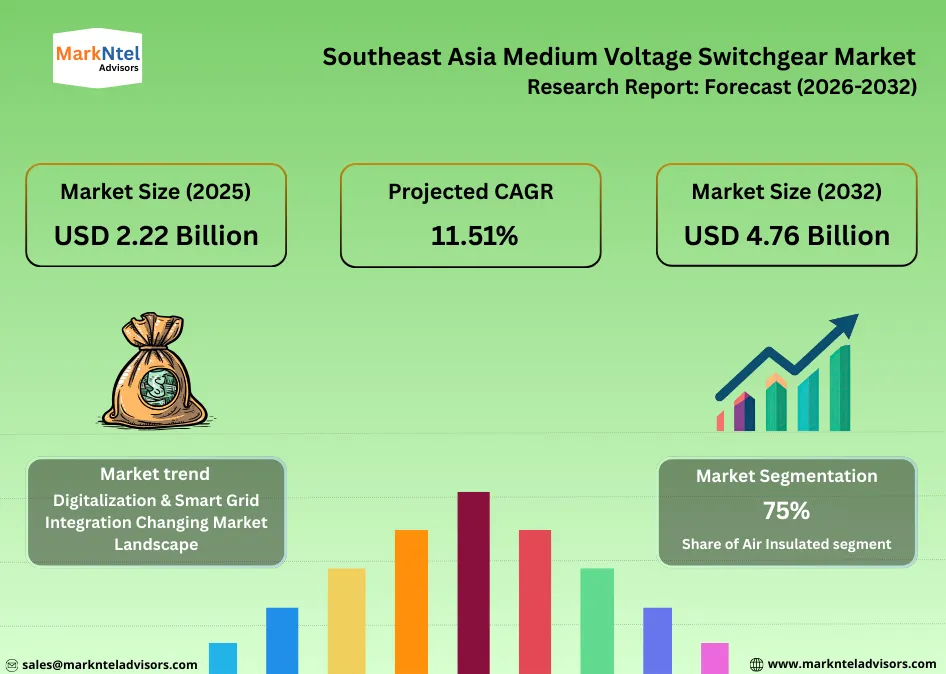
- The Southeast Asia Medium Voltage Switchgear Market size was valued at around USD 2.22 billion in 2025 and is projected to reach USD 4.76 billion by 2032. The estimated CAGR from 2026 to 2032 is around 11.51%, indicating strong growth.
- By Voltage, the 11 kV to 25 kV segment seized around 62% share of the Southeast Asia Medium Voltage Switchgear Market in 2025.
- By Insulation, the air-insulated segment holds around 75% share of the Southeast Asia Medium Voltage Switchgear Market in 2025.
- By end user, the Industrial sector represented a 35% share of the Southeast Asia Medium Voltage Switchgear Market in 2025.
- By Country, Indonesia has dominated with a market share of 22% in 2025.
- The leading voltage switchgear companies in Southeast Asia are ABB Ltd., Siemens AG, Schneider Electric SE, Hitachi Energy Ltd., Eaton Corporation Plc, Fuji Electric Co. Ltd., Mitsubishi Electric, General Electric, Hyundai Electric, and others.
Market Insights & Analysis: Southeast Asia Medium Voltage Switchgear Market (2026-2032):
The Southeast Asia Medium Voltage Switchgear Market size was valued at around USD 2.22 billion in 2025 and is projected to reach USD 4.76 billion by 2032. Along with this, the market is estimated to grow at a CAGR of around 11.51% during the forecast period, i.e., 2026-32. The Southeast Asia Medium Voltage Switchgear Market is primarily driven by rapid growth in electricity demand from urbanization and industrial expansion, along with increasing government investments in power grid modernization and renewable energy integration. Across the region, governments are responding to surging electricity needs by significantly expanding generation capacity, transmission networks, and smart grid infrastructure to ensure a reliable and sustainable power supply. For instance, Vietnam’s revised National Power Development Plan VIII (PDP8), approved in April 2025, lays out ambitious targets to grow installed capacity to between 183 GW and 236 GW by 2030, enhance transmission networks, and integrate large-scale renewable energy sources such as wind and solar underpinned by extensive grid upgrades planned through 2050. This plan requires an investment of approximately USD 134.7 billion by 2030 and up to USD 523 billion by 2050, creating substantial demand for advanced electrical infrastructure, including medium voltage switchgear.
National grid expansion is not limited to Vietnam. Across ASEAN, economies continue to increase infrastructure spending to support electricity access, industrial growth, and cross-border power integration. Renewables are expected to constitute an increasing share of the energy mix under regional action plans targeting 45 % renewable electricity by 2030, further necessitating flexible, reliable switchgear solutions for variable generation sources.
Moreover, ongoing electrification of transport and industry, coupled with smart grid technology adoption and large-scale renewable deployment, will sustain medium voltage switchgear demand. Overall, these government-led expansion plans and investments will continuously fuel market growth through enhanced grid infrastructure requirements and modernization efforts.
Southeast Asia Medium Voltage Switchgear Market Recent Developments:
- April 2025: Southeast Asia can leverage vast renewable energy resources to meet soaring demand, emphasizing wind and solar integration. This has prompted utilities to expedite grid modernization and substation upgrades, which increasingly rely on medium voltage switchgear to manage variable generation sources and improve network reliability across markets such as Vietnam, Indonesia, and Thailand.
- November 2025: Schneider Electric launched its GM AirSeT SF₆-free primary switchgear, designed to decarbonize electrical systems by eliminating sulphur hexafluoride gas. The future-ready solution targets utilities, industries, data centers, and infrastructure operators seeking resilient, sustainable, and environmentally friendly power distribution systems.
Southeast Asia Medium Voltage Switchgear Market Scope:
| Category | Segments |
|---|---|
| By Insulation | Air Insulated, Gas Insulated, Others, |
| By Installation | Indoor,Outdoor, |
| By Current | AC, DC, |
| By Voltage | 1-11 kV, 11 kV to 25 kV, 25-36 kV, Above 36 kV, |
| By End- User | Power Utilities & Transmission, Industrial, Commercial & Residential Users, Others), and others |
Southeast Asia Medium Voltage Switchgear Market Drivers:
Rapid Infrastructure Development Augmenting Market Growth
Rapid infrastructure development, particularly in power transmission and distribution, is a fundamental driver of the Southeast Asia medium voltage (MV) switchgear market. Governments across ASEAN are pursuing extensive grid modernization and integration programs to meet rising electricity demand, support renewable energy expansion, and bolster energy security. A key initiative is the ASEAN Power Grid (APG), a regional plan to interconnect national grids and promote cross-border electricity flows. Realizing the APG vision by 2045 will require approximately USD 764 billion in investments for generation and transmission infrastructure, including domestic grid upgrades that directly drive demand for MV switchgear.
Supporting this, multilateral development institutions, the World Bank, and the Asian Development Bank (ADB) have launched the ASEAN Power Grid Financing Initiative (APGF), committing an initial USD 12.5 billion to mobilize financing, technical planning, and capacity building for grid interconnection projects over the next decade.
Beyond regional integration, national grid enhancement efforts are also underway. For example, Malaysia has committed about USD 10.1 billion to upgrade its national electricity grid to support new technologies, data centers, and storage systems.
Furthermore, these long-term investments in cross-border transmission, smart substations, and renewable integration infrastructure will sustain MV switchgear demand beyond 2025, particularly as ASEAN countries work to achieve renewable targets and build resilient grids. In conclusion, robust infrastructure spending and long-range planning are set to significantly escalate MV switchgear market growth across Southeast Asia.
Southeast Asia Medium Voltage Switchgear Market Trends:
Digitalization & Smart Grid Integration Changing Market Landscape
Digitalization and smart grid integration are transforming how power systems operate in Southeast Asia, becoming a major trend in the medium voltage switchgear market. Governments in the region are actively pushing grid modernization policies that embed digital technologies such as real-time monitoring, two-way communication, and automated control systems into traditional electricity networks to improve resilience, efficiency, and renewable integration.
For example, the Philippines Department of Energy is advancing a smart grid policy framework aimed at enabling “self-healing” grids with enhanced safety, flexibility, and real-time monitoring, including wider deployment of smart meters and interactive digital technologies across distribution utilities. This initiative is part of broader grid modernization efforts to support renewable energy and empower consumers.
Singapore is another leader in grid digitalization under its Energy Market Authority’s (EMA) strategy, which incorporates digital grid tools such as virtual power plants, energy storage system integration, and digital twin technologies to manage supply efficiently and support regional low-carbon electricity imports by 2035. These systems require advanced digital infrastructure to coordinate generation, storage, and distribution intelligently.
Estimates from regional energy analyses suggest ASEAN may need USD 4–10.7 billion in smart grid investments through the late 2020s to ensure reliable and clean power as renewable penetration rises, reinforcing long-term digital grid adoption.
Overall, digitalization and smart grid integration are reshaping electrical networks across Southeast Asia, driving demand for advanced MV switchgear that supports monitoring, automation, and grid reliability in an increasingly decentralized and renewable-rich environment.
Southeast Asia Medium Voltage Switchgear Market Challenges:
High Initial Costs Impeding Market Growth & Expansion
One of the most significant challenges facing the Southeast Asia medium voltage switchgear market is the high initial cost of power system infrastructure, which affects the pace of grid modernization and related equipment procurement. According to the International Energy Agency (IEA), Southeast Asia’s electricity demand is growing rapidly, nearly 7 % in 2024, and meeting this demand while transitioning to clean energy will require a substantial increase in investment. The IEA estimates that ASEAN will need approximately USD 21 billion annually from 2026 to 2030 for grid investments alone, nearly doubling current levels to support the integration of renewables and modernize transmission and distribution networks.
Similarly, the Asian Development Bank (ADB) highlights the urgent need for comprehensive grid enhancements across Asia and the Pacific, projecting that around USD 1.7 trillion will be required by 2030 to upgrade power networks to support future demand and renewable integration. These large-scale grid upgrades inherently involve high upfront capital outlays for substation construction, MV switchgear, digital systems, and supporting infrastructure.
For developing economies in Southeast Asia, securing such capital is a persistent hurdle due to limited domestic financial resources and competing public spending priorities. Even with financing initiatives like the ASEAN Power Grid Financing Initiative, the scale of required investment underscores the cost barrier for utilities and governments, which can delay procurement cycles and slow technology adoption.
Overall, the high initial costs of modern grid infrastructure, including MV switchgear and associated systems, remain a critical challenge. Overcoming this will depend on sustained, multi-stakeholder investment and innovative financing mechanisms to unlock long-term market growth.
Southeast Asia Medium Voltage Switchgear Market (2026-32) Segmentation Analysis:
The Southeast Asia Medium Voltage Switchgear Market Report and Forecast 2026-2032 offers a detailed analysis of the market based on the following segments:
Based on Voltage:
- 1-11 kV
- 11 kV to 25 kV
- 25-36 kV
- Above 36 kV
The 11 kV to 25 kV voltage segment, holding around 62% market share, leads the Southeast Asia Medium Voltage Switchgear Market due to its widespread applicability across power distribution networks. This voltage range is the backbone of primary and secondary distribution systems, making it the most commonly deployed level for urban substations, industrial facilities, commercial complexes, and renewable energy integration points. Rapid urbanization and expansion of industrial parks across countries such as Indonesia, Vietnam, and Thailand have increased demand for reliable medium-voltage distribution at this level.
Additionally, most renewable energy projects, metro rail systems, data centers, and manufacturing units are designed to operate within the 11–25 kV range, as it balances power handling capability with cost efficiency. Utilities also prefer this segment because it allows easier grid expansion and compatibility with existing infrastructure, reducing system modification costs. As governments continue to strengthen distribution networks and integrate decentralized power sources, the 11 kV to 25 kV segment remains the preferred voltage class, sustaining its dominant position.
Based on Insulation
- Air Insulated
- Gas Insulated
- Others
The air-insulated switchgear (AIS) segment accounts for approximately 75% of the market. Market dominance is due to its cost-effectiveness, simpler design, and ease of installation and maintenance. AIS systems are widely adopted in Southeast Asia, particularly in regions where land availability is relatively higher and climatic conditions allow outdoor installations. Utilities and industries favor air-insulated solutions because they require lower upfront capital investment compared to gas-insulated alternatives and offer straightforward operation without reliance on specialized gases.
In developing and emerging economies within Southeast Asia, budget constraints and the need for scalable infrastructure make AIS the preferred choice for substations, industrial facilities, and utility distribution networks. Furthermore, AIS equipment is well-suited for rural electrification projects and grid expansion in semi-urban areas, where compactness is less critical than affordability and reliability. As a result, air-insulated switchgear continues to lead the market despite growing interest in advanced compact technologies.
Southeast Asia Medium Voltage Switchgear Market (2026-32): Regional Projection
The Southeast Asia Medium Voltage Switchgear Market is dominated by Indonesia, which accounts for nearly 22% of regional demand. Indonesia’s dominance is supported by its large population base, rapid urbanization, and sustained industrial expansion across Java, Sumatra, and Kalimantan, all of which require reliable medium voltage distribution networks. The country’s archipelagic geography further increases the need for extensive substations and feeder networks to ensure a stable electricity supply. For instance, Indonesia’s Electricity Supply Business Plan (RUPTL) 2025–2034, published by the Ministry of Energy and Mineral Resources and implemented by state utility PLN, outlines large-scale grid expansion, new substations, and transmission upgrades nationwide. These initiatives directly increase demand for medium voltage switchgear used in distribution and industrial power systems.
Continuous investments in power infrastructure, renewable integration, and industrial electrification position Indonesia as the leading contributor to regional market growth over the medium-term forecast period regionally.
Gain a Competitive Edge with Our Southeast Asia Medium Voltage Switchgear Market Report
- Southeast Asia Medium Voltage Switchgear Market Report by MarkNtel Advisors provides a detailed & thorough analysis of market size & share, growth rate, competitive landscape, and key players. This comprehensive analysis helps businesses gain a holistic understanding of the market dynamics & make informed decisions.
- This report also highlights current market trends & future projections, allowing businesses to identify emerging opportunities & potential challenges. By understanding market forecasts, companies can align their strategies & stay ahead of the competition.
- Southeast Asia Medium Voltage Switchgear Market Report aids in assessing & mitigating risks associated with entering or operating in the market. By understanding market dynamics, regulatory frameworks, and potential challenges, businesses can develop strategies to minimize risks & optimize their operations.
*Reports Delivery Format - Market research studies from MarkNtel Advisors are offered in PDF, Excel and PowerPoint formats. Within 24 hours of the payment being successfully received, the report will be sent to your email address.
Frequently Asked Questions
- Market Segmentation
- Introduction
- Product Definition
- Research Process
- Assumptions
- Executive Summary
- Southeast Asia Medium Voltage Switchgear Market Policies, Regulations, and Product Standards
- Southeast Asia Medium Voltage Switchgear Market Supply Chain Analysis
- Southeast Asia Medium Voltage Switchgear Market Trends & Developments
- Southeast Asia Medium Voltage Switchgear Market Dynamics
- Growth Drivers
- Challenges
- Southeast Asia Medium Voltage Switchgear Market Hotspot & Opportunities
- Southeast Asia Medium Voltage Switchgear Market Outlook, 2022-2032
- Market Size & Outlook
- By Revenues (USD Million)
- Market Share & Outlook
- By Insulation- Market Size & Forecast 2022-2032F, USD Million
- Air Insulated
- Gas Insulated
- Others
- By Installation- Market Size & Forecast 2022-2032F, USD Million
- Indoor
- Outdoor
- By Current- Market Size & Forecast 2022-2032F, USD Million
- AC
- DC
- By Voltage- Market Size & Forecast 2022-2032F, USD Million
- 1-11 kV
- 11 kV to 25 kV
- 25-36 kV
- Above 36 kV
- By End- User- Market Size & Forecast 2022-2032F, USD Million
- Power Utilities & Transmission
- Industrial
- Commercial & Residential Users
- Others
- By Country
- Indonesia
- Malaysia
- Singapore
- Thailand
- The Philippines
- Vietnam
- Others
- By Company
- Company Revenue Shares
- Competitor Characteristics
- By Insulation- Market Size & Forecast 2022-2032F, USD Million
- Market Size & Outlook
- Indonesia Medium Voltage Switchgear Market Outlook, 2022-2032
- Market Size & Analysis
- Market Share & Analysis
- By Insulation- Market Size & Forecast 2022-2032, USD Million
- By Installation- Market Size & Forecast 2022-2032, USD Million
- By Current- Market Size & Forecast 2022-2032, USD Million
- By Voltage- Market Size & Forecast 2022-2032, USD Million
- By End- User- Market Size & Forecast 2022-2032, USD Million
- Malaysia Medium Voltage Switchgear Outlook, 2022-2032
- Market Size & Analysis
- Market Revenues (USD Million)
- Market Share & Analysis
- By Insulation- Market Size & Forecast 2022-2032, USD Million
- By Installation- Market Size & Forecast 2022-2032, USD Million
- By Current- Market Size & Forecast 2022-2032, USD Million
- By Voltage- Market Size & Forecast 2022-2032, USD Million
- By End- User- Market Size & Forecast 2022-2032, USD Million
- Market Size & Analysis
- Singapore Medium Voltage Switchgear Outlook, 2022-2032
- Market Size & Analysis
- Market Revenues (USD Million)
- Market Share & Analysis
- By Insulation- Market Size & Forecast 2022-2032, USD Million
- By Installation- Market Size & Forecast 2022-2032, USD Million
- By Current- Market Size & Forecast 2022-2032, USD Million
- By Voltage- Market Size & Forecast 2022-2032, USD Million
- By End- User- Market Size & Forecast 2022-2032, USD Million
- Market Size & Analysis
- Thailand Medium Voltage Switchgear Market Outlook, 2022-2032
- Market Size & Analysis
- Market Revenues (USD Million)
- Market Share & Analysis
- By Insulation- Market Size & Forecast 2022-2032, USD Million
- By Installation- Market Size & Forecast 2022-2032, USD Million
- By Current- Market Size & Forecast 2022-2032, USD Million
- By Voltage- Market Size & Forecast 2022-2032, USD Million
- By End- User- Market Size & Forecast 2022-2032, USD Million
- Market Size & Analysis
- The Philippines Medium Voltage Switchgear Market Outlook, 2022-2032
- Market Size & Analysis
- Market Revenues (USD Million)
- Market Share & Analysis
- By Insulation- Market Size & Forecast 2022-2032, USD Million
- By Installation- Market Size & Forecast 2022-2032, USD Million
- By Current- Market Size & Forecast 2022-2032, USD Million
- By Voltage- Market Size & Forecast 2022-2032, USD Million
- By End- User- Market Size & Forecast 2022-2032, USD Million
- Market Size & Analysis
- Vietnam Medium Voltage Switchgear Market Outlook, 2022-2032
- Market Size & Analysis
- Market Revenues (USD Million)
- Market Share & Analysis
- By Insulation- Market Size & Forecast 2022-2032, USD Million
- By Installation- Market Size & Forecast 2022-2032, USD Million
- By Current- Market Size & Forecast 2022-2032, USD Million
- By Voltage- Market Size & Forecast 2022-2032, USD Million
- By End- User- Market Size & Forecast 2022-2032, USD Million
- Market Size & Analysis
- Southeast Asia Medium Voltage Switchgear Market Key Strategic Imperatives for Success & Growth
- Competition Outlook
- Company Profiles
- ABB Ltd.
- Business Description
- Product Portfolio
- Strategic Alliances or Partnerships
- Recent Developments
- Financial Details
- Others
- Siemens AG
- Business Description
- Product Portfolio
- Strategic Alliances or Partnerships
- Recent Developments
- Financial Details
- Others
- Schneider Electric SE
- Business Description
- Product Portfolio
- Strategic Alliances or Partnerships
- Recent Developments
- Financial Details
- Others
- Hitachi Energy Ltd.
- Business Description
- Product Portfolio
- Strategic Alliances or Partnerships
- Recent Developments
- Financial Details
- Others
- Eaton Corporation Plc
- Business Description
- Product Portfolio
- Strategic Alliances or Partnerships
- Recent Developments
- Financial Details
- Others
- Fuji Electric Co., Ltd.
- Business Description
- Product Portfolio
- Strategic Alliances or Partnerships
- Recent Developments
- Financial Details
- Others
- Mitsubishi Electric
- Business Description
- Product Portfolio
- Strategic Alliances or Partnerships
- Recent Developments
- Financial Details
- Others
- General Electric
- Business Description
- Product Portfolio
- Strategic Alliances or Partnerships
- Recent Developments
- Financial Details
- Others
- Hyundai Electric
- Business Description
- Product Portfolio
- Strategic Alliances or Partnerships
- Recent Developments
- Financial Details
- Others
- Others
- ABB Ltd.
- Company Profiles
- Disclaimer
MarkNtel Advisors follows a robust and iterative research methodology designed to ensure maximum accuracy and minimize deviation in market estimates and forecasts. Our approach combines both bottom-up and top-down techniques to effectively segment and quantify various aspects of the market. A consistent feature across all our research reports is data triangulation, which examines the market from three distinct perspectives to validate findings. Key components of our research process include:
1. Scope & Research Design At the outset, MarkNtel Advisors define the research objectives and formulate pertinent questions. This phase involves determining the type of research—qualitative or quantitative—and designing a methodology that outlines data collection methods, target demographics, and analytical tools. They also establish timelines and budgets to ensure the research aligns with client goals.
2. Sample Selection and Data Collection In this stage, the firm identifies the target audience and determines the appropriate sample size to ensure representativeness. They employ various sampling methods, such as random or stratified sampling, based on the research objectives. Data collection is carried out using tools like surveys, interviews, and observations, ensuring the gathered data is reliable and relevant.
3. Data Analysis and Validation Once data is collected, MarkNtel Advisors undertake a rigorous analysis process. This includes cleaning the data to remove inconsistencies, employing statistical software for quantitative analysis, and thematic analysis for qualitative data. Validation steps are taken to ensure the accuracy and reliability of the findings, minimizing biases and errors.

4. Data Forecast and FinalizationThe final phase involves forecasting future market trends based on the analyzed data. MarkNtel Advisors utilize predictive modeling and time series analysis to anticipate market behaviors. The insights are then compiled into comprehensive reports, featuring visual aids like charts and graphs, and include strategic recommendations to inform client decision-making
We offer flexible licensing options to cater to varying organizational needs. Choose the pricing pack that best suits your requirements:
Buy Now Inquire Before Buying
 Request Customization
 Talk to our Consultant







