Vietnam Bio-Acetic Acid Market Research Report: Forecast (2026–2032)
Vietnam Bio-Acetic Acid Market - By Production Technology (Fermentation-Based Bio-Acetic Acid, Bio-Ethanol Oxidation Route, Anaerobic Fermentation), By Feedstock (Sugarcane / Mo ... lasses, Cassava / Tapioca Starch, Corn Starch, Rice Husk Hydrolysates, Fruit Waste / Food Waste, Biomass / Cellulosic Waste, Bio-Ethanol), Others (Glycerol, Renewable Byproducts, Wastewater Organic Streams, etc.), By Grade (Food Grade, Pharmaceutical Grade, Industrial Grade, Technical Grade, Dilute Bio-Vinegar Acetic Solutions), By Distribution Channel (Direct Sales, Chemical Distributors, Industrial Retail / Specialty Chemical Retailers), By Application (Food & Beverage, Pharmaceuticals, Industrial Chemicals & Intermediates, Textiles & Dyes, Adhesives, Coatings & Packaging), By End-User (Food & Beverage Processors, Pharmaceutical & Healthcare Manufacturers, Chemical Producers & Blenders, Textile & Garment Processing Units, Paints, Coatings & Adhesive Manufacturers, Agriculture & Feed Processing), and others Read more
- Chemicals
- Dec 2025
- Pages 135
- Report Format: PDF, Excel, PPT
Vietnam Bio-Acetic Acid Market
Projected 13.02% CAGR from 2026 to 2032
Study Period
2026-2032
Market Size (2025)
USD 7.19 Million
Market Size (2032)
USD 16.94 Million
Base Year
2025
Projected CAGR
13.02%
Leading Segments
By Grade: Food Grade
Vietnam Bio-Acetic Acid Market Size: Forecast (2026-2032)
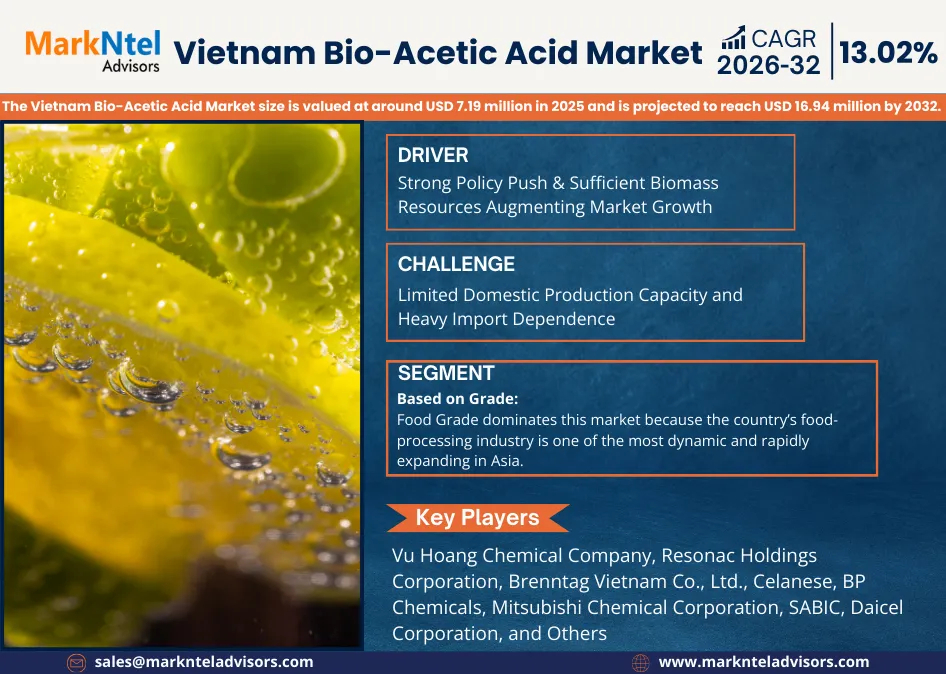
The Vietnam Bio-Acetic Acid Market size is valued at around USD 7.19 million in 2025 and is projected to reach USD 16.94 million by 2032. Along with this, the market is estimated to grow at a CAGR of around 13.02% during the forecast period, i.e., 2026-32.
Vietnam Bio-Acetic Acid Market Outlook:
Vietnam’s Bio-Acetic Acid Market stands to benefit from the scale and growth of its key industrial users, which significantly increases the market demand. For instance, in the textile and garment industry, exports reached USD44 billion in 2024. Because acetic acid is widely used for dyeing, neutralization, and finishing, the large export-oriented production directly implies high chemical demand, which is contributing to the potential growth of this market.
Meanwhile, the pharmaceutical industry in Vietnam is significantly increasing the market demand. For instance, there are about 250 manufacturing plants in the country. As the sector grows, demand increases for high-purity and regulatory-compliant chemical inputs, which favors bio- or renewable-based organic acids.
Moreover, overall, organic chemical exports to Vietnam remain large, as in 2024, total imports of goods reached about USD746 million, showing high dependence on chemical inputs and creating a supportive environment for greater adoption of bio-acetic acid. Additionally, the food-processing sector, a major acetic-acid consumer, is valued in billions annually. This large scale of production, including meat, seafood, beverage, and canned food processing, directly supports demand for acidity control, preservation, and safety-grade inputs like bio-acetic acid.
Consequently, with the large food-processing output, booming textile exports, and growing pharmaceutical demand, there is a strong structural foundation for bio-acetic acid demand in Vietnam. As industrial users adopt more sustainable, regulatory-compliant inputs, and as global supply begins shifting toward greener grades, bio-acetic acid is well-positioned to capture a growing share of the total acetic acid consumed in Vietnam.
Vietnam Bio-Acetic Acid Market Scope:
| Category | Segments |
|---|---|
| By Production Technology | Fermentation-Based Bio-Acetic Acid, Bio-Ethanol Oxidation Route, Anaerobic Fermentation), |
| By Feedstock | Sugarcane / Molasses, Cassava / Tapioca Starch, Corn Starch, Rice Husk Hydrolysates, Fruit Waste / Food Waste, Biomass / Cellulosic Waste, Bio-Ethanol), Others (Glycerol, Renewable Byproducts, Wastewater Organic Streams, etc.), |
| By Grade | Food Grade, Pharmaceutical Grade, Industrial Grade, Technical Grade, Dilute Bio-Vinegar Acetic Solutions), |
| By Distribution Channel | Direct Sales, Chemical Distributors, Industrial Retail / Specialty Chemical Retailers), |
| By Application | Food & Beverage, Pharmaceuticals, Industrial Chemicals & Intermediates, Textiles & Dyes, Adhesives, Coatings & Packaging), |
| By End-User | Food & Beverage Processors, Pharmaceutical & Healthcare Manufacturers, Chemical Producers & Blenders, Textile & Garment Processing Units, Paints, Coatings & Adhesive Manufacturers, Agriculture & Feed Processing), and others |
Vietnam Bio-Acetic Acid Market Drivers:
Strong Policy Push & Sufficient Biomass Resources Augmenting Market Growth
Vietnam’s Bio-Acetic Acid Market is being strongly driven by a national shift toward fermentation- and enzyme-based production, supported by abundant biomass resources and government-led industry reforms. For instance, the country produces about 43 million tonnes of paddy (rice) each year, generating large quantities of rice husk and straw suitable for biochemical conversion. Additionally, cassava output exceeding 10 million tonnes annually provides a starch-rich substrate for microbial and enzymatic pathways, making Vietnam naturally positioned to adopt fermentation technologies.
Supporting this, the UNDP–GEF Green Chemistry Project (2017–2021) introduced cleaner production models, demonstrated emission-reducing technologies, and strengthened industrial capacity for adopting advanced bioprocess methods. Moreover, the UNDP–GEF Green Chemistry Project allocated around USD2.4 million to cleaner chemical-production practices, capacity-building, and technology demonstrations that validate bio-based processing. Likewise, Vietnam’s Science, Technology & Innovation Strategy enhances R&D collaboration across universities, institutes, and industry, creating a strong foundation for scaling fermentation systems.
Vietnam Bio-Acetic Acid Market Trends:
Rising Utilization of Bio-Acid in Bioplastics Production
Vietnam is gradually expanding its bioplastics footprint, and this shift is helping create a favorable trend for future demand for bio-acetic acid. At the domestic level, local startup BUYO Bioplastics has already demonstrated manufacturing capability, which currently operates a pilot line producing around 10 tonnes of biodegradable material per month, with plans to scale its capacity further in the coming years. This is actively transforming the bio-acetic acid usage in the country.
At the same time, large international investors are entering the Vietnamese bioplastics landscape. For instance, in 2024, South Korea’s SKC began developing a major PBAT production complex in Vietnam with a planned output of about 70,000 tonnes of bioplastics per year. This is one of the region’s largest biodegradable-plastic investments and signals that Vietnam, contributing to the demand of this market.
Vietnam Bio-Acetic Acid Market Challenges:
Limited Domestic Production Capacity and Heavy Import Dependence
Vietnam’s bio-acetic acid market faces a major constraint due to its limited domestic production capacity, which increases reliance on imported chemical inputs. For instance, Vietnam imported around USD14 million worth of acetic acid in 2024, reflecting the country’s structural dependence on foreign supply for key intermediates. Additionally, in Vietnam, specialty chemicals used in food-processing, textiles, and pharmaceuticals are still predominantly imported, as local facilities remain small-scale and not fully integrated with bio-feedstock routes.
This production gap creates cost pressures for manufacturers. As per the Ministry of Industry and Trade (MoIT), transport-linked surcharges and currency volatility raised the landed cost of several chemical imports in recent years, making bio-derived intermediates less affordable for small and mid-sized firms. Additionally, the absence of large-scale biomass-to-acetyl infrastructure limits supply stability, affecting industries that need consistent inputs for export-oriented production.
Vietnam Bio-Acetic Acid Market (2026-32) Segmentation Analysis:
The Vietnam Bio-Acetic Acid Market Report and Forecast 2026-2032 offers a detailed analysis of the market based on the following segments:
Based on Grade
- Food Grade
- Pharmaceutical Grade
- Industrial Grade
- Technical Grade
- Dilute Bio-Vinegar Acetic Solutions
Food Grade dominates this market because the country’s food-processing industry is one of the most dynamic and rapidly expanding in Asia. According to the USDA, Vietnam’s food-processing sector reached a size of USD79.3 billion in 2024, driven by strong domestic consumption and rising demand for processed foods, beverages, sauces, and ready-to-eat products.
Additionally, Vietnam is further strengthened by its export performance. The Vietnam Association of Seafood Exporters and Producers (VASEP) recorded USD 9 billion in seafood exports in 2023, with processed seafood relying heavily on organic acids for microbial control and shelf-life extension.
Moreover, major food-processing hubs such as Ho Chi Minh City, Binh Duong, and Dong Nai use large volumes of food-grade organic acids for pickled foods, beverages, condiments, and fermented products. Because manufacturers must comply with strict Ministry of Health (MOH) food-safety regulations and export certification standards, they increasingly prefer bio-based, clean-label acetic acid. As a result, food grade is the leading and most widely used grade in Vietnam’s Bio-Acetic-Acid Market.
Based on Distribution Channel
- Direct Sales
- Chemical Distributors
- Industrial Retail / Specialty Chemical Retailers
Chemical distributors play the dominant role in Vietnam’s bio–bio-acetic-acid market because they serve as the primary link between producers and end-using industries across the country. Vietnam’s major manufacturing zones, especially in Ho Chi Minh City, Binh Duong, Dong Nai, and Long An, rely on large chemical distributors to ensure a stable, safe, and consistent supply of essential industrial inputs. These distributors maintain extensive networks of storage facilities, certified warehouses, transport fleets, and technical-support teams, allowing them to supply bio–acetic acid efficiently to food processors, pharmaceutical companies, textile factories, and chemical manufacturers.
Moreover, well-established distributors such as Brenntag Vietnam and other licensed chemical suppliers provide quality assurance, product documentation, and safety compliance, which are mandatory in Vietnam’s regulated chemical sector. Their ability to deliver chemicals in different grades, food, pharmaceutical, industrial, or technical- also makes them the preferred choice for manufacturers that require strict consistency and certification.
Leading Players of the Vietnam Bio-Acetic Acid Market:
-
Brenntag Vietnam Co., Ltd.
Brenntag Vietnam acts as a major distributor of specialty and industrial chemicals, including acetates, solvents, and bio-based ingredients. Although not a direct producer of bio-acetic acid, the company connects manufacturers with biotechnology-based chemical inputs and supports local industries in adopting greener feedstocks. Its well-developed logistics infrastructure and partnerships with global bio-chemical innovators help accelerate the penetration of bio-acetic-acid solutions across the Vietnamese food, pharma, and manufacturing sectors.
- Celanese Corporation
Celanese is one of the world’s leading producers of acetic acid, vinyl acetate monomer, and acetyl intermediates. The company has also advanced bio-based chemical technologies, including ethanol-to-acetic pathways and low-carbon acetyl production. In Vietnam, Celanese’s presence is primarily via distribution partnerships that supply high-performance acetyls to packaging, paints, adhesives, and textile industries. Its ongoing shift toward sustainable acetyl chemistry makes it a significant global influencer in the transition toward bio-acetic-acid production.
-
BP Chemicals
BP Chemicals, a segment of BP’s broader energy and petrochemical portfolio, has long-standing expertise in acetic acid production through its Cativa catalyst-based technology. While the company focuses heavily on traditional petrochemical acetyls, BP has been expanding its low-carbon ambitions through renewable feedstocks and circular chemistry initiatives. Its global leadership in acetic acid technology indirectly benefits Vietnam’s chemical sector by fostering access to advanced methodologies relevant to future bio-acetic-acid production models.
Vu Hoang Chemical Company, Resonac Holdings Corporation, Mitsubishi Chemical Corporation, SABIC, Daicel Corporation, and Others are the key players in the Vietnam Bio-Acetic Acid Market.
Vietnam Bio-Acetic Acid Market (2026-32): Regional Projection
Southern Vietnam stands out as the country’s industrial powerhouse, making it a natural hotspot for demand for chemical inputs such as bio-acetic acid. For instance, Dong Nai Province leads the nation in the number of industrial parks, hosting over 30 operational parks with around 12,000 hectares of leasable industrial land and more than 83% occupancy. Likewise, Binh Duong Province maintains roughly 30–31 industrial parks covering over 12,670 hectares.
Collectively, the southern provinces, including Binh Duong, Dong Nai, Ho Chi Minh City, and neighboring areas, form Vietnam’s most diversified and largest manufacturing cluster, spanning sectors such as chemicals, plastics, textiles, food processing, consumer-goods production, and export manufacturing. Moreover, South’s industrial zones have among the highest occupancy rates nationwide as of 2024, underlining ongoing active production activities.
Gain a Competitive Edge with Our Vietnam Bio-Acetic Acid Market Report
- Vietnam Bio-Acetic Acid Market Report by MarkNtel Advisors provides a detailed & thorough analysis of market size & share, growth rate, competitive landscape, and key players. This comprehensive analysis helps businesses gain a holistic understanding of the market dynamics & make informed decisions.
- This report also highlights current market trends & future projections, allowing businesses to identify emerging opportunities & potential challenges. By understanding market forecasts, companies can align their strategies & stay ahead of the competition.
- Vietnam Bio-Acetic Acid Market Report aids in assessing & mitigating risks associated with entering or operating in the market. By understanding market dynamics, regulatory frameworks, and potential challenges, businesses can develop strategies to minimize risks & optimize their operations.
*Reports Delivery Format - Market research studies from MarkNtel Advisors are offered in PDF, Excel and PowerPoint formats. Within 24 hours of the payment being successfully received, the report will be sent to your email address.
Frequently Asked Questions
- Market Segmentation
- Introduction
- Product Definition
- Research Process
- Assumptions
- Executive Summary
- Vietnam Bio-Acetic Acid Market Policies, Regulations, and Product Standards
- Vietnam Bio-Acetic Acid Market Supply Chain Analysis
- Vietnam Bio-Acetic Acid Market Trends & Developments
- Vietnam Bio-Acetic Acid Market Dynamics
- Growth Drivers
- Challenges
- Vietnam Bio-Acetic Acid Market Hotspot & Opportunities
- Vietnam Bio-Acetic Acid Market Outlook, 2022–2032
- Market Size & Outlook
- By Revenues (USD Million)
- By Volume (Thousand Tons)
- Market Share & Outlook
- By Production Technology– Market Size & Forecast 2022–2032, USD Million
- Fermentation-Based Bio-Acetic Acid
- Bio-Ethanol Oxidation Route
- Anaerobic Fermentation
- By Feedstock– Market Size & Forecast 2022–2032, USD Million
- Sugarcane / Molasses
- Cassava / Tapioca Starch
- Corn Starch
- Rice Husk Hydrolysates
- Fruit Waste / Food Waste
- Biomass / Cellulosic Waste
- Bio-Ethanol
- Others (Glycerol, Renewable Byproducts, Wastewater Organic Streams, etc.)
- By Grade– Market Size & Forecast 2022–2032, USD Million
- Food Grade
- Pharmaceutical Grade
- Industrial Grade
- Technical Grade
- Dilute Bio-Vinegar Acetic Solutions
- By Distribution Channel– Market Size & Forecast 2022–2032, USD Million
- Direct Sales
- Chemical Distributors
- Industrial Retail / Specialty Chemical Retailers
- By Application– Market Size & Forecast 2022–2032, USD Million
- Food & Beverage
- Pharmaceuticals
- Industrial Chemicals & Intermediates
- Textiles & Dyes
- Adhesives, Coatings & Packaging
- By End-User– Market Size & Forecast 2022–2032, USD Million
- Food & Beverage Processors
- Pharmaceutical & Healthcare Manufacturers
- Chemical Producers & Blenders
- Textile & Garment Processing Units
- Paints, Coatings & Adhesive Manufacturers
- Agriculture & Feed Processing
- By Region
- North
- Central
- South
- East
- West
- By Production Technology– Market Size & Forecast 2022–2032, USD Million
- Market Size & Outlook
- Vietnam Fermentation-Based Bio-Acetic Acid Market Outlook, 2022–2032
- Market Size & Analysis
- By Revenue (USD Million)
- By Volume (Thousand Tons)
- Market Segmentation & Analysis
- By Feedstock-Market Size & Forecast 2022–2032, USD Million
- By Food Grade-Market Size & Forecast 2022–2032, USD Million
- By Distribution Channel-Market Size & Forecast 2022–2032, USD Million
- By Application -Market Size & Forecast 2022–2032, USD Million
- By End-Users-Market Size & Forecast 2022–2032, USD Million
- Market Size & Analysis
- Vietnam Bio-Ethanol Oxidation Route Bio-Acetic Acid Market Outlook, 2022–2032
- Market Size & Analysis
- By Revenue (USD Million)
- By Volume (Thousand Tons)
- Market Segmentation & Analysis
- By Feedstock-Market Size & Forecast 2022–2032, USD Million
- By Food Grade-Market Size & Forecast 2022–2032, USD Million
- By Distribution Channel-Market Size & Forecast 2022–2032, USD Million
- By Application -Market Size & Forecast 2022–2032, USD Million
- By End-Users-Market Size & Forecast 2022–2032, USD Million
- Market Size & Analysis
- Vietnam Anaerobic Fermentation Bio-Acetic Acid Market Outlook, 2022–2032
- Market Size & Analysis
- By Revenue (USD Million)
- By Volume (Thousand Tons)
- Market Segmentation & Analysis
- By Feedstock-Market Size & Forecast 2022–2032, USD Million
- By Food Grade-Market Size & Forecast 2022–2032, USD Million
- By Distribution Channel-Market Size & Forecast 2022–2032, USD Million
- By Application -Market Size & Forecast 2022–2032, USD Million
- By End-Users-Market Size & Forecast 2022–2032, USD Million
- Market Size & Analysis
- Vietnam Bio-Acetic Acid Market Key Strategic Imperatives for Success & Growth
- Competition Outlook
- Company Revenue Shares
- Competitor Characteristics
- Company Profiles
- Vu Hoang Chemical Company
- Business Description
- Product Portfolio
- Strategic Alliances or Partnerships
- Recent Developments
- Financial Details
- Others
- Resonac Holdings Corporation
- Business Description
- Product Portfolio
- Strategic Alliances or Partnerships
- Recent Developments
- Financial Details
- Others
- Brenntag Vietnam Co., Ltd.
- Business Description
- Product Portfolio
- Strategic Alliances or Partnerships
- Recent Developments
- Financial Details
- Others
- Celanese
- Business Description
- Product Portfolio
- Strategic Alliances or Partnerships
- Recent Developments
- Financial Details
- Others
- BP Chemicals
- Business Description
- Product Portfolio
- Strategic Alliances or Partnerships
- Recent Developments
- Financial Details
- Others
- Mitsubishi Chemical Corporation
- Business Description
- Product Portfolio
- Strategic Alliances or Partnerships
- Recent Developments
- Financial Details
- Others
- SABIC
- Business Description
- Product Portfolio
- Strategic Alliances or Partnerships
- Recent Developments
- Financial Details
- Others
- Daicel Corporation
- Business Description
- Product Portfolio
- Strategic Alliances or Partnerships
- Recent Developments
- Financial Details
- Others
- Others
- Vu Hoang Chemical Company
- Company Profiles
- Disclaimer
MarkNtel Advisors follows a robust and iterative research methodology designed to ensure maximum accuracy and minimize deviation in market estimates and forecasts. Our approach combines both bottom-up and top-down techniques to effectively segment and quantify various aspects of the market. A consistent feature across all our research reports is data triangulation, which examines the market from three distinct perspectives to validate findings. Key components of our research process include:
1. Scope & Research Design At the outset, MarkNtel Advisors define the research objectives and formulate pertinent questions. This phase involves determining the type of research—qualitative or quantitative—and designing a methodology that outlines data collection methods, target demographics, and analytical tools. They also establish timelines and budgets to ensure the research aligns with client goals.
2. Sample Selection and Data Collection In this stage, the firm identifies the target audience and determines the appropriate sample size to ensure representativeness. They employ various sampling methods, such as random or stratified sampling, based on the research objectives. Data collection is carried out using tools like surveys, interviews, and observations, ensuring the gathered data is reliable and relevant.
3. Data Analysis and Validation Once data is collected, MarkNtel Advisors undertake a rigorous analysis process. This includes cleaning the data to remove inconsistencies, employing statistical software for quantitative analysis, and thematic analysis for qualitative data. Validation steps are taken to ensure the accuracy and reliability of the findings, minimizing biases and errors.

4. Data Forecast and FinalizationThe final phase involves forecasting future market trends based on the analyzed data. MarkNtel Advisors utilize predictive modeling and time series analysis to anticipate market behaviors. The insights are then compiled into comprehensive reports, featuring visual aids like charts and graphs, and include strategic recommendations to inform client decision-making
We offer flexible licensing options to cater to varying organizational needs. Choose the pricing pack that best suits your requirements:
Buy Now Inquire Before Buying
 Request Customization
 Talk to our Consultant