

APAC Automotive Radar Market Research Report: Forecast (2025-2030)
APAC Automotive Radar Market - By Range (Short Range Radar, Medium Range Radar, Long Range Radar), By Propulsion (Internal Combustion Engine (ICE), Electric), By Vehicle Type (Pa ... ssenger Vehicles, Commercial Vehicles, [Light Commercial Vehicles, Heavy Commercial Vehicles]), By Frequency (24 GHz System, 77 GHz System, 81 GHz System), By Application (Adaptive Cruise Control, Autonomous Emergency Braking, Blind Spot Detection, Forward Collision Warning System, Intelligent Parking Assistance, Cross Traffic Alerts, Lane Departure Warning Systems, Traffic Jam Assistance, Others), and others Read more
- Aerospace & Defense
- Jun 2025
- Pages 165
- Report Format: PDF, Excel, PPT
Market Definition
Automotive radars are specially designed radars for vehicles that analyze the surroundings of the vehicles. The radar converts the electrical energy into electromagnetic energy using the various components installed in the radar. These radars are installed by several vehicle manufacturers globally, including in the Asia-Pacific region.
Market Insights & Analysis: APAC Automotive Radar Market (2025-30):
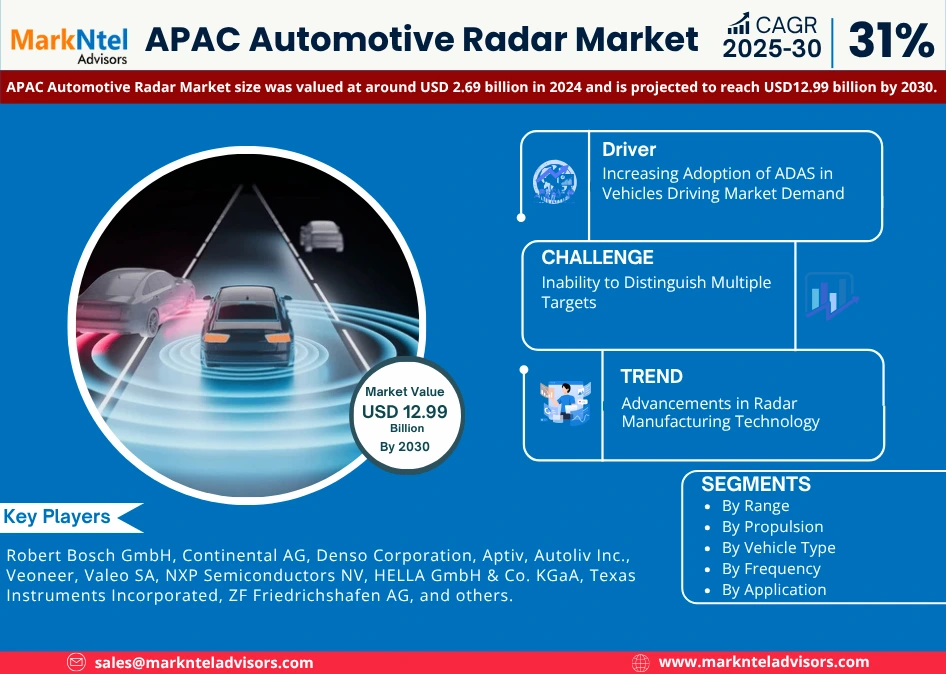
The APAC Automotive Radar Market size was valued at around USD 2.69 billion in 2024 and is projected to reach USD 12.99 billion by 2030. Along with this, the market is estimated to grow at a CAGR of around 31% during the forecast period, i.e., 2025-30. This market growth can be attributed to factors such as a rise in demand for Advanced Driving Assistance Systems (ADAS), the growing demand for autonomous vehicles, stringent safety regulations, the expansion of the automobile industry, and several others. Due to these factors, a rise in the sales of automotive radars is observed.
Moreover, the advancements in automobiles have resulted in the installation of advanced systems for autonomous driving. These systems solely rely on LiDAR, sensors, and cameras to function, which require a well-established radar technology. The sensors inspect the surroundings of the vehicles and alert the driver, hence ensuring safety. This radar technology is now coming with improved accuracy, resolution, range, and decreasing costs, and is thus extensively adopted by automobile manufacturers, specifically in the Asia-Pacific region, having a large consumer base, a favorable ecosystem for vehicle manufacturing, and supportive government policies. These are required for integrating Level-2 to Level 5 automation in automobiles. Thus, enhanced features and safety raise the demand for radar systems to be integrated in vehicles in APAC.
| Report Coverage | Details |
|---|---|
| Historical Years | 2020–23 |
| Forecast Years | 2025–30 |
| Market Value in 2024 | USD 2.69 Billion |
| Market Value by 2030 | USD 12.99 Billion |
| CAGR (2025–30) | 31% |
| Top Key Players | Robert Bosch GmbH, Continental AG, Denso Corporation, Aptiv, Autoliv Inc., Veoneer, Valeo SA, NXP Semiconductors NV, HELLA GmbH & Co. KGaA, Texas Instruments Incorporated, ZF Friedrichshafen AG, and others. |
| Segmentation | By Range (Short Range Radar, Medium Range Radar, Long Range Radar), By Propulsion (Internal Combustion Engine (ICE), Electric), By Vehicle Type (Passenger Vehicles, Commercial Vehicles, [Light Commercial Vehicles, Heavy Commercial Vehicles]), By Frequency (24 GHz System, 77 GHz System, 81 GHz System), By Application (Adaptive Cruise Control, Autonomous Emergency Braking, Blind Spot Detection, Forward Collision Warning System, Intelligent Parking Assistance, Cross Traffic Alerts, Lane Departure Warning Systems, Traffic Jam Assistance, Others), and others |
| Key Report Highlights |
|
*Boost strategic growth with in-depth market analysis - Get a free sample preview today!
According to the European Automobile Manufacturers' Association, around 57% of the global automobiles were manufactured by China, Japan, South Korea, and India in 2024. The expansion of the automotive manufacturing units in the region, beyond the major markets to Thailand, Malaysia, Indonesia, Vietnam, etc., is resulting in an increased demand for automotive radars from OEMs. Moreover, increased consumer demand for sophisticated car interiors and functionalities, supportive government policies such as tax breaks, subsidies in EV purchase, reduced registration charges, and zero emission standards, that facilitate the adoption of greener and premium automobiles in the APAC countries.
The EVs are equipped with advanced ADAS systems for better vehicle control and increased safety features. Thus, increasing manufacturing hubs in APAC countries on account of increasing vehicle demand specially hybrid and Electric, increasing adoption of ADAS system in cars and stringent safety norms by the government have all been driving the demand for radar technology in automobiles particularly in APAC region where there is high consumer demand for automobiles and favorable ecosystem for automobile manufacturers.
APAC Automotive Radar Market Driver:
Increasing Adoption of ADAS in Vehicles Driving Market Demand – Integration of technological advancements such as LiDAR, ultrasonic sensors, cameras, etc., in the automobiles has revolutionized the industry. Advanced Driving Assistance System (ADAS) operates on these advancements, primarily radar sensors, due to their accuracy. Thus providing a smooth driving experience to the drivers. ADAS automates the vehicle and prevents accidents as it has an automated braking system that operates on the radar sensors. The radar sensors analyze the surroundings of the vehicle through the Doppler effect and alert the driver, hence ensuring vehicle safety.
Additionally, advanced functionalities like blind spot detection, Autonomous Emergency Braking (AEB), collision detection, lane assist, parking assist, and traffic jam alert operations of the ADAS provide efficient driving support, specifically in semi- and fully autonomous vehicles. Thus, it increases the adoption of ADAS systems in all vehicles with the integration of radar technology from Level 2 to Level 5, which in turn increases the demand for this system in passenger cars, particularly in the Asia-Pacific region, where demand for hybrid and electric autonomous vehicles is increasing.
For instance, Tata Harrier & Mahindra XUV700 features advanced ADAS like front collision warning, lane keep assist, Automated Emergency Braking, and Automatic cruise control. Henceforth, the safety features and improved driving experience have inclined the consumer towards cars equipped with an ADAS system, and this in turn drives demand for radar systems in automobiles in the Asia-Pacific countries.
APAC Automotive Radar Market Opportunity:
Government Support to Promote Electric Vehicles – Asia-Pacific is one of the leading regions in toxic emissions; thus, to reduce them, the government is promoting the adoption of electric vehicles. Governments in this region have launched several policies and schemes, such as Malaysia’s Low Carbon Mobility 2021-30, India’s FAME II and Production Linked Incentive (PLI) scheme, etc., to promote the use of electric vehicles by reducing registration costs, offering tax rebates, and subsidies on vehicle price. The Singaporean government offers a tax exemption of nearly 45% on the registration of an electric vehicle. In India USD220 per KWh incentive is provided to four-wheelers along with exemptions in road tax and registration fees by many states. This, coupled with rapid demand for smart mobility solutions for daily commutation, is providing a growth opportunity for automotive radar manufacturers to improve safety, specifically in congested areas.
For instance, Ultraviolette Tesseract, an EV scooter, and Storm EV, a light commercial vehicle, are being launched with radar technology capabilities like blind spot alert, spatial awareness, and collision warning. Similarly, the NIO ET7 and Xpeng P7 models of Electric cars from BYD, China, have advanced ADAS based on radar technology.
APAC Automotive Radar Market Challenge:
Inability to Distinguish Multiple Targets – Radar sensors are sensitive to obstacles; this is because of their mechanism, which works on the wave signals received after striking an obstacle. The sensors examine the frequency and wavelength of the received ray and, correspondingly, detect the speed and proximity of the object. However, when these sensors receive multiple rays altogether, they stall and provide inadequate outputs. Thus, in a crowded area, the radar fails to provide precise outputs, hence negatively affecting the accuracy of the radar system.
Moreover, the camera and radar have limited range; thus, beyond that or in the blind spots of the camera, it does not function, leading to an increase in the probability of the accident, hence decreasing their reliability. As a result, the drivers cannot fully rely on the radars in the automotive industry, which hampers the functionality of the system, hence hindering the market growth.
APAC Automotive Radar Market Trend:
Advancements in Radar Manufacturing Technology – The continuous research and upgradations in technology are evolving the radar sensors. Numerous advancements, such as Radar-On-Chip (RoC), where all the components of the radar sensors are distributed on a single chip. This results in reducing the weight of the vehicle and provides more space for the interior of the vehicle. Integration of all transceiver and processing units on a chip reduces ADAS system price and, in turn, the cost of the vehicles, making autonomous vehicles more affordable to middle-income consumers.
Additionally, the implication of Complementary Metal Oxide semiconductors (CMOS) in automobile radar enhances the performance of the sensors. This is because these semiconductors are designed to operate especially on short-range waves. Thus, these integrations of technology and advancements in material science further fuel the safety of the vehicles. Thus, these new radars are in trend in the automobile sector.
APAC Automotive Radar Market (2025-30): Segmentation Analysis
The APAC Automotive Radar Market study of MarkNtel Advisors evaluates & highlights the major trends and influencing factors in each segment. It includes predictions for the period 2025-2030 at the regional level. Based on the analysis, the market has been further classified as:
Based on Vehicle Type:
- Passenger Vehicles
- Commercial Vehicles
- Light Commercial Vehicles
- Heavy Commercial Vehicles
Based on vehicle type, passenger vehicles hold the largest market share, accounting for nearly 68%. This is due to the dynamics of the vehicle, the terrain of the utility, and others. Passenger vehicles include cars and SUVs, which are mostly sold in the urban areas of APAC countries. The disposable income of the urban population is increasing, which in turn increases the purchase of luxury-based semi and fully automated vehicles such as cars and SUVs. For instance, Toyota, an automobile manufacturer, accounted for the sales of more than 4.9 million passenger vehicles in the APAC region in FY25. Additionally, the easier driving, enhanced safety features, and luxurious comfort experienced due to the integration of advanced ADAS further fuel demand for radar technology in automobiles, specifically in passenger cars of the Asia-Pacific region. With the supportive ecosystem and policies by many Asian countries, there is increasing demand for autonomous Electric passenger cars equipped with automated emergency braking, cruise control, and blind spot detection and thus determining a high market share of passenger cars for this market.
Based on Frequency:
- 24 GHz System
- 77 GHz System
- 81 GHz System
The 77 GHz System has approximately 74% share of the entire market value. This market share is due to the superior range resolution and accuracy provided by this band in comparison to the 24 GHz band. The vehicles with this system have a wider vision spectrum and can easily analyze the surroundings by improving object classification and robust ADAS algorithms. This has further aided in improving the quality of the cameras and sensors, which are the key components of the radar system in automotive. The vehicles equipped with this frequency system comparatively have more accurate and precise object detection even in climatic disruptions. Thus, decreasing the vehicle collision chances and reducing the mortality rate in the region.
The usage of this frequency radar band is also supported by the government in cars. Moreover, due to this, it is supported by the governments in the APAC region. For instance, in 2024, the Indian government removed the license requirement on the automobile manufacturers using the 77-81 GHz band for radar systems in the automobiles made in their facility. This reduces strain on automobile manufacturers and thus facilitates the adoption of this frequency band in automobiles, and hence determines the dominance of the 77 GHz band in radars used in automobiles in the Asia-Pacific region.
APAC Automotive Radar Market (2025-30): Regional Projections
- Japan
- India
- China
- South Korea
- Australia
- Thailand
- Rest of Asia-Pacific
Regionally, the automotive radar market is growing in multiple countries, however, China holds a significant share of more than 53% and is dominating the market for radar systems. This is due to increased demand for automobiles from the large population base, expansion of the automobile industry, rise in trade activities across its borders, government rules and guidelines supporting the automobile ecosystem, and others. In recent years, China has become the largest manufacturer of automobiles globally. This is due to the availability of a low-cost workforce, the availability of larger manufacturing land, and the business-friendly ecosystem. As a result, several global automobile manufacturers are enlarging and establishing their production units in China.
For instance, in February 2025, Toyota announced the establishment of a new production unit of electric vehicles in Shanghai. Similarly, other manufacturers and foreign investments are underway in the country’s automotive industry. This rise in the automotive industry directly impacts the consumption of radar systems, specifically in semi- and fully autonomous vehicles equipped with advanced ADAS systems.
Moreover, the support of the Chinese government for the adoption of electric vehicles is yet another factor facilitating the demand for EVs in the country. The government is providing incentives and tax relaxation on the registration of electric vehicles. This makes the vehicle budget-friendly for the population. Thus, it increases the sales of electric vehicles in the country. As per the China Auto Standardization Research Institute, in the first three quarters of 2024, about 9.8 million EVs were sold, depicting an increase of nearly 33.9% since the previous year. Electric vehicles are increasingly adopting Advanced Radar technology to facilitate their ADAS system with level 2& 3 radar systems, and thus, China, being the automotive hub of the world, is driving R&D activities in radar technology too. Hence, this determines the dominance of China in the automotive radar market.
APAC Automotive Radar Industry Recent Development:
- 2025: Valeno SA, in collaboration with Mobileye, to provide advanced driving assistance and safety systems in the new Modular Querbaukasten (MQB) vehicles of Volkswagen Group.
- 2024: Robert Bosch GmbH launched its new eBike system press kit MY25.1 with the enhanced sensitivity sensors.
Gain a Competitive Edge with Our APAC Automotive Radar Market Report
- APAC Automotive Radar Market by MarkNtel Advisors provides a detailed & thorough analysis of market size & share, growth rate, competitive landscape, and key players. This comprehensive analysis helps businesses gain a holistic understanding of the market dynamics & make informed decisions.
- This report also highlights current market trends & future projections, allowing businesses to identify emerging opportunities & potential challenges. By understanding market forecasts, companies can align their strategies & stay ahead of the competition.
- APAC Automotive Radar Market Report aids in assessing & mitigating risks associated with entering or operating in the market. By understanding market dynamics, regulatory frameworks, and potential challenges, businesses can develop strategies to minimize risks & optimize their operations.
*Reports Delivery Format - Market research studies from MarkNtel Advisors are offered in PDF, Excel and PowerPoint formats. Within 24 hours of the payment being successfully received, the report will be sent to your email address.
Frequently Asked Questions
- Market Segmentation
- Introduction
- Product Definition
- Research Process
- Assumptions
- Executive Summary
- APAC Automotive Radar Market Trends & Deployments
- APAC Automotive Radar Market Dynamics
- Growth Drivers
- Challenges
- APAC Automotive Radar Market Opportunities & Hotspots
- APAC Automotive Radar Market Value Chain Analysis
- APAC Automotive Radar Market Regulations and Policy
- APAC Automotive Radar Market Outlook, 2020- 2030F
- Market Size & Analysis
- By Revenues (USD Million)
- Market Share & Analysis
- By Range
- Short Range Radar- Market Size & Forecast 2020-2030, USD Billion
- Medium Range Radar- Market Size & Forecast 2020-2030, USD Billion
- Long Range Radar- Market Size & Forecast 2020-2030, USD Billion
- By Propulsion
- Internal Combustion Engine (ICE)- Market Size & Forecast 2020-2030, USD Billion
- Electric- Market Size & Forecast 2020-2030, USD Billion
- By Vehicle Type
- Passenger Vehicles- Market Size & Forecast 2020-2030, USD Billion
- Commercial Vehicles- Market Size & Forecast 2020-2030, USD Billion
- Light Commercial Vehicles- Market Size & Forecast 2020-2030, USD Billion
- Heavy Commercial Vehicles- Market Size & Forecast 2020-2030, USD Billion
- By Frequency
- 24 GHz System- Market Size & Forecast 2020-2030, USD Billion
- 77 GHz System- Market Size & Forecast 2020-2030, USD Billion
- 81 GHz System-Market Size & Forecast 2020-2030, USD Billion
- By Application
- Adaptive Cruise Control- Market Size & Forecast 2020-2030, USD Billion
- Autonomous Emergency Braking- Market Size & Forecast 2020-2030, USD Billion
- Blind Spot Detection- Market Size & Forecast 2020-2030, USD Billion
- Forward Collision Warning System- Market Size & Forecast 2020-2030, USD Billion
- Intelligent Parking Assistance- Market Size & Forecast 2020-2030, USD Billion
- Cross Traffic Alerts- Market Size & Forecast 2020-2030, USD Billion
- Lane Departure Warning Systems- Market Size & Forecast 2020-2030, USD Billion
- Traffic Jam Assistance- Market Size & Forecast 2020-2030, USD Billion
- Others- Market Size & Forecast 2020-2030, USD Billion
- By Country
- China
- Japan
- India
- South Korea
- Thailand
- Australia
- Rest of Asia-Pacific
- By Company
- Competition Characteristics
- Market Share and Analysis
- By Range
- Market Size & Analysis
- China Automotive Radar Market Outlook, 2020- 2030F
- Market Size & Analysis
- By Revenues (USD Million)
- Market Share & Analysis
- By Range- Market Size & Forecast 2020-2030, USD Million
- By Propulsion- Market Size & Forecast 2020-2030, USD Million
- By Vehicle- Market Size & Forecast 2020-2030, USD Million
- By Frequency-Market Size & Forecast 2020-2030, USD Million
- By Application--Market Size & Forecast 2020-2030, USD Million
- Market Size & Analysis
- Japan Automotive Radar Market Outlook, 2020- 2030F
- Market Size & Analysis
- By Revenues (USD Million)
- Market Share & Analysis
- By Range- Market Size & Forecast 2020-2030, USD Million
- By Propulsion- Market Size & Forecast 2020-2030, USD Million
- By Vehicle- Market Size & Forecast 2020-2030, USD Million
- By Frequency-Market Size & Forecast 2020-2030, USD Million
- By Application--Market Size & Forecast 2020-2030, USD Million
- Market Size & Analysis
- India Automotive Radar Market Outlook, 2020- 2030F
- Market Size & Analysis
- By Revenues (USD Million)
- Market Share & Analysis
- By Range- Market Size & Forecast 2020-2030, USD Million
- By Propulsion- Market Size & Forecast 2020-2030, USD Million
- By Vehicle- Market Size & Forecast 2020-2030, USD Million
- By Frequency-Market Size & Forecast 2020-2030, USD Million
- By Application--Market Size & Forecast 2020-2030, USD Million
- Market Size & Analysis
- South Korea Automotive Radar Market Outlook, 2020- 2030F
- Market Size & Analysis
- By Revenues (USD Million)
- Market Share & Analysis
- By Range- Market Size & Forecast 2020-2030, USD Million
- By Propulsion- Market Size & Forecast 2020-2030, USD Million
- By Vehicle- Market Size & Forecast 2020-2030, USD Million
- By Frequency-Market Size & Forecast 2020-2030, USD Million
- By Application--Market Size & Forecast 2020-2030, USD Million
- Market Size & Analysis
- Thailand Automotive Radar Market Outlook, 2020- 2030F
- Market Size & Analysis
- By Revenues (USD Million)
- Market Share & Analysis
- By Range- Market Size & Forecast 2020-2030, USD Million
- By Propulsion- Market Size & Forecast 2020-2030, USD Million
- By Vehicle- Market Size & Forecast 2020-2030, USD Million
- By Frequency-Market Size & Forecast 2020-2030, USD Million
- By Application--Market Size & Forecast 2020-2030, USD Million
- Market Size & Analysis
- APAC Automotive Radar Market Strategic Imperatives for Growth & Success
- Competition Outlook
- Company Profiles
- Robert Bosch GmbH
- Business Description
- Product Portfolio
- Strategic Alliances or Partnerships
- Recent Deployments
- Financial Details
- Others
- Continental AG
- Business Description
- Product Portfolio
- Strategic Alliances or Partnerships
- Recent Deployments
- Financial Details
- Others
- Denso Corporation
- Business Description
- Product Portfolio
- Strategic Alliances or Partnerships
- Recent Deployments
- Financial Details
- Others
- Aptiv
- Business Description
- Product Portfolio
- Strategic Alliances or Partnerships
- Recent Deployments
- Financial Details
- Others
- Autoliv Inc.
- Business Description
- Product Portfolio
- Strategic Alliances or Partnerships
- Recent Deployments
- Financial Details
- Others
- Veoneer
- Business Description
- Product Portfolio
- Strategic Alliances or Partnerships
- Recent Deployments
- Financial Details
- Others
- Valeo SA
- Business Description
- Product Portfolio
- Strategic Alliances or Partnerships
- Recent Deployments
- Financial Details
- Others
- NXP Semiconductors NV
- Business Description
- Product Portfolio
- Strategic Alliances or Partnerships
- Recent Deployments
- Financial Details
- Others
- HELLA GmbH & Co. KGaA
- Business Description
- Product Portfolio
- Strategic Alliances or Partnerships
- Recent Deployments
- Financial Details
- Others
- Texas Instruments Incorporated
- Business Description
- Product Portfolio
- Strategic Alliances or Partnerships
- Recent Deployments
- Financial Details
- Others
- ZF Friedrichshafen AG
- Business Description
- Product Portfolio
- Strategic Alliances or Partnerships
- Recent Deployments
- Financial Details
- Others
- Others
- Robert Bosch GmbH
- Company Profiles
- Disclaimer
MarkNtel Advisors follows a robust and iterative research methodology designed to ensure maximum accuracy and minimize deviation in market estimates and forecasts. Our approach combines both bottom-up and top-down techniques to effectively segment and quantify various aspects of the market. A consistent feature across all our research reports is data triangulation, which examines the market from three distinct perspectives to validate findings. Key components of our research process include:
1. Scope & Research Design At the outset, MarkNtel Advisors define the research objectives and formulate pertinent questions. This phase involves determining the type of research—qualitative or quantitative—and designing a methodology that outlines data collection methods, target demographics, and analytical tools. They also establish timelines and budgets to ensure the research aligns with client goals.
2. Sample Selection and Data Collection In this stage, the firm identifies the target audience and determines the appropriate sample size to ensure representativeness. They employ various sampling methods, such as random or stratified sampling, based on the research objectives. Data collection is carried out using tools like surveys, interviews, and observations, ensuring the gathered data is reliable and relevant.
3. Data Analysis and Validation Once data is collected, MarkNtel Advisors undertake a rigorous analysis process. This includes cleaning the data to remove inconsistencies, employing statistical software for quantitative analysis, and thematic analysis for qualitative data. Validation steps are taken to ensure the accuracy and reliability of the findings, minimizing biases and errors.

4. Data Forecast and FinalizationThe final phase involves forecasting future market trends based on the analyzed data. MarkNtel Advisors utilize predictive modeling and time series analysis to anticipate market behaviors. The insights are then compiled into comprehensive reports, featuring visual aids like charts and graphs, and include strategic recommendations to inform client decision-making
We offer flexible licensing options to cater to varying organizational needs. Choose the pricing pack that best suits your requirements:
Buy Now Inquire Before Buying
 Request Customization
 Talk to our Consultant







