

US GNSS Spoofing Detection & Prevention Market Research Report: Trends, Forecast & Opportunities (2026-2032)
By Component (Hardware, Software, Services), By Deployment Mode (On-Premises, Cloud-Based, Hybrid), By Solution Type (Spoofing Detection Solutions, Spoofing Prevention Solutions, I ... ntegrated Detection & Prevention Solutions), By Application (Navigation Security, Positioning Integrity, Timing & Synchronization, Autonomous Systems, Fleet Management & Asset Tracking, Surveying & Mapping, Others), By End User (Defense & Military, Government & Homeland Security, Aerospace & Aviation, Maritime, Automotive, Transportation & Logistics, Telecommunications, Energy & Utilities, Others) Read more
- Aerospace & Defense
- Jul 2026
- Pages 155
- Report Format: PDF, Excel, PPT
US GNSS Spoofing Detection & Prevention Market
Projected 6.04% CAGR from 2026 to 2032
Study Period
2026-2032
Market Size (2026)
USD 0.332 billion
Market Size (2032)
USD 0.472 billion
Base Year
2025
Projected CAGR
6.04%
Leading Segments
By Component: Hardware
US GNSS Spoofing Detection & Prevention Market Key Takeaways
- The GNSS spoofing detection & prevention market size in the United States was valued at around USD 0.310 billion in 2025 and is projected to grow from USD 0.332 billion in 2026 to USD 0.472 billion by 2032.
- The industry is projected to witness steady growth at a CAGR of 6.04 % during 2026-2032.
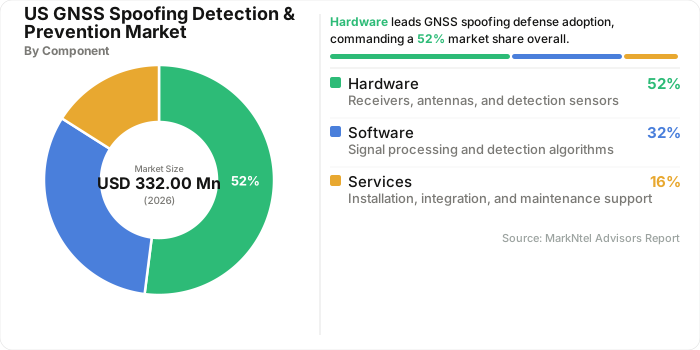
- Hardware led the market by component, accounting for approximately 52% of revenue in 2026.
- Defense & military led the market by end user, holding nearly 41% of revenue in 2026.
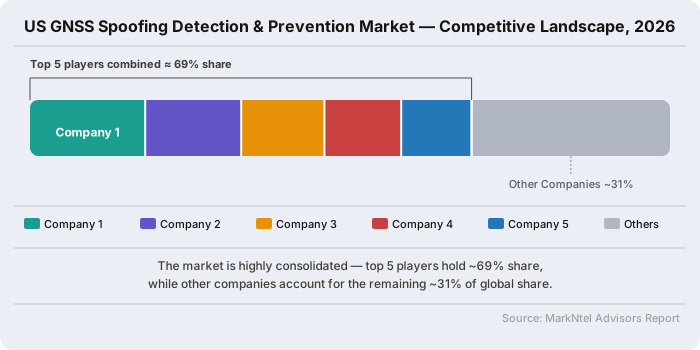
- The industry is moderately consolidated, with the top five leading players accounting for approximately 69% of the total market share.
US GNSS Spoofing Detection & Prevention Market Size and Outlook
At a CAGR of approximately 6.04% over 2026–2032, the United States GNSS spoofing detection & prevention market is expected to rise from USD 0.332 billion in 2026 to USD 0.472 billion by 2032, following a valuation of USD 0.310 billion in 2025.
The growing reliance on positioning, navigation, and timing (PNT) services across defense, aviation, transportation, telecommunications, and critical infrastructure has strengthened the foundation of the U.S. GNSS spoofing detection & prevention industry. Rising incidents of GNSS interference worldwide have accelerated investments in GNSS security solutions by government agencies and commercial organizations. In 2025, the Federal Communications Commission initiated an inquiry into complementary and alternative PNT technologies to reduce reliance on GPS, reinforcing demand for resilient navigation capabilities.
Supportive federal policies continue to enhance national navigation security and encourage broader technology adoption. During 2025–2026, the Federal Aviation Administration updated its GPS/GNSS Interference Resource Guide to help operators identify and mitigate GNSS jamming and spoofing events. At the same time, initiatives led by GPS.gov and the U.S. Department of Homeland Security are promoting backup PNT technologies and interference monitoring across critical infrastructure, supporting continued deployment by public agencies and regulated industries.
The market is also benefiting from expanding adoption across industries that depend on secure navigation and precise timing. Defense and military organizations remain the primary users, while aerospace and aviation operators continue strengthening navigation resilience. Meanwhile, telecommunications providers, utilities, transportation and logistics companies, maritime operators, and autonomous system developers are increasingly deploying anti-spoofing technologies to improve operational reliability, safety, and service continuity.
This growing demand is being reinforced by continuous advancements in resilient PNT solutions, including multi-frequency GNSS receivers, authenticated navigation signals, anti-spoofing algorithms, and interference monitoring technologies. As investments in secure navigation architectures and resilient timing systems continue alongside stronger cybersecurity initiatives, the market is expected to witness sustained technology adoption and increasing demand for advanced GNSS spoofing detection and prevention solutions across the United States.
US GNSS Spoofing Detection & Prevention Market Key Indicators
- The U.S. Department of Defense requested approximately USD 849.8 billion in discretionary funding for fiscal year 2025, supporting continued investments in resilient PNT and GPS modernization. This is driving demand for advanced GNSS spoofing detection and anti-spoofing technologies across defense applications.
- The Federal Aviation Administration (FAA) oversees more than 45,000 flights and approximately 2.9 million airline passengers each day in the United States. As commercial aviation relies extensively on GNSS for navigation and surveillance, increasing air traffic is driving investments in spoofing detection technologies and resilient navigation systems to ensure operational safety and continuity.
- The Federal Communications Commission (FCC) launched a Notice of Inquiry in 2025 to explore complementary and alternative positioning, navigation, and timing (PNT) technologies that strengthen GPS resilience. The initiative supports the development and adoption of resilient PNT and GNSS security solutions across critical infrastructure and government applications.
- The National Institute of Standards and Technology (NIST) estimated that GPS has generated nearly USD 1.4 trillion in U.S. economic benefits since the 1980s, while a complete outage could cost approximately USD 1 billion per day, highlighting the need for investment in GNSS spoofing detection and prevention technologies.
US GNSS Spoofing Detection & Prevention Market Scope
| Category | Segments |
|---|---|
| By Component | Hardware, Software, Services |
| By Deployment Mode | On-Premises, Cloud-Based, Hybrid |
| By Solution Type | Spoofing Detection Solutions, Spoofing Prevention Solutions, Integrated Detection & Prevention Solutions |
| By Application | Navigation Security, Positioning Integrity, Timing & Synchronization, Autonomous Systems, Fleet Management & Asset Tracking, Surveying & Mapping, Others |
| By End User | Defense & Military, Government & Homeland Security, Aerospace & Aviation, Maritime, Automotive, Transportation & Logistics, Telecommunications, Energy & Utilities, Others |
US GNSS Spoofing Detection & Prevention Market Growth Drivers
Rising U.S. Focus on Resilient Positioning, Navigation, and Timing (PNT) Infrastructure
Increasing reliance on satellite-based positioning, navigation, and timing (PNT) services across defense, aviation, telecommunications, financial services, transportation, and critical infrastructure is driving demand for navigation security technologies in the United States. Because GPS signals are transmitted at relatively low power levels, they remain susceptible to spoofing and interference before reaching end users. As cyber threats and electronic warfare capabilities continue to evolve, ensuring secure and resilient navigation has become a strategic priority for both government agencies and critical infrastructure operators.
Recognizing the growing importance of navigation resilience, the U.S. government has strengthened its efforts through policy initiatives and infrastructure modernization programs. National Security Memorandum-22 (NSM-22) directs federal agencies to enhance the security and resilience of U.S. critical infrastructure through coordinated risk management and public-private collaboration. At the same time, the Cybersecurity and Infrastructure Security Agency (CISA) continues to issue guidance that helps critical infrastructure operators reduce vulnerabilities associated with GPS disruption, encouraging the adoption of resilient PNT practices and interference mitigation measures.
Supporting these initiatives, continued defense modernization is accelerating investment in secure positioning, navigation, and timing (PNT) capabilities. The U.S. Army is fielding the Mounted Assured Positioning, Navigation, and Timing System (MAPS Gen II), which integrates M-Code GPS, alternative PNT sources, and anti-jam technologies to strengthen navigation resilience in contested electromagnetic environments. As secure navigation becomes increasingly important across defense and critical infrastructure, demand for advanced Assured PNT systems is expected to continue strengthening across the United States.
Recent Trends
Artificial Intelligence and Multi-Sensor Navigation Fusion Enhancing GNSS Spoofing Detection Accuracy
As GNSS spoofing techniques become increasingly sophisticated, organizations are shifting beyond conventional signal monitoring toward intelligent detection systems capable of identifying anomalies in real time. Artificial intelligence, machine learning, and sensor fusion technologies are becoming integral to next-generation navigation security platforms by combining GNSS data with inertial navigation systems, LiDAR, radar, vision sensors, and other positioning sources. These integrated approaches improve navigation signal authentication while enhancing spoofing detection accuracy and navigation reliability.
Reflecting this shift, navigation technology providers are accelerating the development of advanced multi-sensor solutions to improve positioning resilience. In 2025, Hexagon | NovAtel partnered with GPR, Inc. to integrate ground-penetrating radar into its SPAN GNSS+INS solution, strengthening positioning performance during GNSS disruptions. Similarly, SatLab introduced its HydroBoat GEN2 with multi-sensor integration and automated survey capabilities, highlighting the growing adoption of resilient navigation technologies across autonomous and geospatial applications.
As this trend continues, the expanding deployment of autonomous vehicles, unmanned systems, and critical infrastructure is expected to further increase demand for intelligent navigation technologies. AI-enabled navigation security and multi-sensor fusion are likely to become standard capabilities in future GNSS receivers, strengthening GNSS interference detection while accelerating the adoption of advanced spoofing detection solutions across defense and commercial sectors.
US GNSS Spoofing Detection & Prevention Market Opportunities and Challenges
Complexity of Integrating Legacy Systems Creating Opportunities for Modular and Interoperable Navigation Security Solutions
The widespread use of legacy GNSS receivers across defense, aviation, maritime, transportation, and critical infrastructure presents a significant challenge to deploying advanced GNSS spoofing detection and prevention technologies. Many existing navigation systems were developed before sophisticated spoofing threats emerged and lack the interfaces needed to support modern security capabilities. Replacing these systems requires substantial investment, operational downtime, and regulatory approvals, making large-scale modernization both costly and time-consuming.
This challenge is creating significant opportunities for GNSS integrity monitoring and commercial GNSS security solutions that can be integrated with existing infrastructure without requiring complete system replacement. Reflecting this shift, researchers at the U.S. Department of Energy's Oak Ridge National Laboratory (ORNL) developed a portable GPS spoofing detector that operates independently of GPS receivers, enabling real-time spoofing detection without modifying legacy navigation systems. As organizations increasingly prioritize cost-effective modernization and operational continuity, interoperable security solutions are expected to accelerate adoption across defense, transportation, and other critical infrastructure sectors.
Segmentation Insights
High Deployment of Secure Navigation Equipment Sustains Hardware Segment Leadership
The Hardware segment accounted for approximately 52% of the U.S. GNSS spoofing detection & prevention market in 2026, largely because resilient navigation systems depend on specialized equipment to detect, authenticate, and mitigate manipulated satellite signals. Anti-spoofing GNSS receivers, multi-frequency antennas, inertial measurement units (IMUs), signal monitoring devices, timing modules, and electronic warfare protection systems represent significant capital investments across defense, aerospace, transportation, and critical infrastructure. Their indispensable role in supporting resilient navigation systems continues to strengthen the hardware segment's leading revenue position.
Growing investments in defense modernization and infrastructure resilience further reinforce this leadership. Military platforms, communication networks, autonomous systems, and transportation infrastructure increasingly require advanced receiver technologies capable of integrating multiple navigation sources while identifying signal anomalies in real time. Although software and managed security services continue to expand, the high capital value and mission-critical role of secure navigation equipment are expected to reinforce hardware's contribution to overall market revenue. Based on component, the market has been segmented into:
- Hardware
- Software
- Services
Expanding Electronic Warfare Preparedness Positions Defense & Military as the Leading End User
Among all end users, defense & military emerged as the largest revenue contributor, accounting for approximately 41% of the U.S. GNSS spoofing detection & prevention market in 2026. Military aircraft, naval vessels, ground combat vehicles, unmanned aerial systems, precision-guided munitions, and battlefield communication networks rely extensively on secure positioning, navigation, and timing (PNT) services. As electronic warfare threats continue to evolve, safeguarding navigation systems against spoofing and jamming has become an operational necessity across modern defense missions.
This leadership is further reinforced by ongoing modernization initiatives across the U.S. Army. In 2025, the Army announced partnerships to accelerate the deployment of Assured Positioning, Navigation, and Timing (PNT) capabilities, including the Dismounted Assured PNT System (DAPS) and Mounted Assured PNT System (MAPS), while advancing software-defined radios, vision-aided navigation, and alternative navigation technologies. As navigation resilience remains central to military modernization, these initiatives are expected to accelerate the procurement of advanced spoofing detection solutions across U.S. defense forces. Based on end user, the market is categorized into:
- Defense & Military
- Government & Homeland Security
- Aerospace & Aviation
- Maritime
- Automotive
- Transportation & Logistics
- Telecommunications
- Energy & Utilities
- Others
US GNSS Spoofing Detection & Prevention Market Competitive Analysis
Competition within the U.S. GNSS spoofing detection & prevention industry remains moderately consolidated. Key companies, including L3Harris Technologies, Inc., RTX Corporation, Lockheed Martin Corporation, Hexagon AB, Trimble Inc., Topcon Positioning Systems, Inc., Safran S.A., BAE Systems plc, Spirent Communications plc, and Rohde & Schwarz GmbH & Co. KG, collectively account for approximately 69% of the market revenue.
Key Players of GNSS Spoofing Detection & Prevention in the US
- L3Harris Technologies, Inc.
- RTX Corporation
- Lockheed Martin Corporation
- Hexagon AB
- Trimble Inc.
- Topcon Positioning Systems, Inc.
- Safran S.A.
- BAE Systems plc
- Spirent Communications plc
- Rohde & Schwarz GmbH & Co. KG
- Others
US GNSS Spoofing Detection & Prevention Industry News and Recent Developments
January 2025: Slingshot Aerospace Selected by U.S. Space Force to Enhance GPS Jamming and Spoofing Detection
Slingshot Aerospace secured a USD 1.9 million Phase II SBIR contract from the U.S. Space Force's Space Systems Command to develop the PNT-SENTINEL platform for detecting, geolocating, and analyzing GPS jamming and spoofing threats using AI-driven analytics and multi-GNSS data processing.
Impact Analysis: The contract reinforces growing U.S. defense investment in resilient Positioning, Navigation, and Timing (PNT) capabilities, accelerating the adoption of advanced GNSS spoofing detection technologies, interference monitoring solutions, and AI-enabled navigation security systems across military and national security applications.
July 2025: HawkEye 360 Launches Enhanced GNSS Interference Detection Capabilities
HawkEye 360 introduced major enhancements to its GNSS Interference (GNSS-I) Detection suite, adding GPS spoofing detection, wider-frequency algorithms, improved emitter discrimination, and more accurate geolocation of interference sources. The upgraded platform is designed to strengthen defense, intelligence, and national security operations by delivering greater visibility into global GNSS interference threats.
Impact Analysis: The launch strengthens the adoption of advanced GNSS interference monitoring and spoofing detection technologies, enabling defense and government organizations to improve navigation resilience, situational awareness, and operational readiness against increasingly sophisticated electronic warfare threats.
Frequently Asked Questions
- Market Segmentation
- Introduction
- Product Definition
- Research Process
- Assumptions
- Executive Summary
- US GNSS Spoofing Detection & Prevention Market Policies, Regulations, and Product Standards
- US GNSS Spoofing Detection & Prevention Market Trends & Developments
- US GNSS Spoofing Detection & Prevention Market Dynamics
- Growth Factors
- Challenges
- US GNSS Spoofing Detection & Prevention Market Hotspot & Opportunities
- US GNSS Spoofing Detection & Prevention Market Outlook, 2022-2032
- Market Size & Outlook
- By Revenues (USD Million)
- Market Share & Outlook
- By Component- Market Size & Forecast 2022-2032, USD Million
- Hardware
- Software
- Services
- By Deployment Mode- Market Size & Forecast 2022-2032, USD Million
- On-Premises
- Cloud-Based
- Hybrid
- By Solution Type- Market Size & Forecast 2022-2032, USD Million
- Spoofing Detection Solutions
- Spoofing Prevention Solutions
- Integrated Detection & Prevention Solutions
- By Application- Market Size & Forecast 2022-2032, USD Million
- Navigation Security
- Positioning Integrity
- Timing & Synchronization
- Autonomous Systems
- Fleet Management & Asset Tracking
- Surveying & Mapping
- Others
- By End User- Market Size & Forecast 2022-2032, USD Million
- Defense & Military
- Government & Homeland Security
- Aerospace & Aviation
- Maritime
- Automotive
- Transportation & Logistics
- Telecommunications
- Energy & Utilities
- Others
- By Company
- Competition Characteristics
- Market Share & Analysis
- By Component- Market Size & Forecast 2022-2032, USD Million
- Market Size & Outlook
- US Hardware GNSS Spoofing Detection & Prevention Market Outlook, 2022-2032
- Market Size & Outlook
- By Revenues (USD Million)
- Market Share & Outlook
- By Deployment Mode- Market Size & Forecast 2022-2032, USD Million
- By Solution Type- Market Size & Forecast 2022-2032, USD Million
- By Application- Market Size & Forecast 2022-2032, USD Million
- By End User- Market Size & Forecast 2022-2032, USD Million
- Market Size & Outlook
- US Software GNSS Spoofing Detection & Prevention Market Outlook, 2022-2032
- Market Size & Outlook
- By Revenues (USD Million)
- Market Share & Outlook
- By Deployment Mode- Market Size & Forecast 2022-2032, USD Million
- By Solution Type- Market Size & Forecast 2022-2032, USD Million
- By Application- Market Size & Forecast 2022-2032, USD Million
- By End User- Market Size & Forecast 2022-2032, USD Million
- Market Size & Outlook
- US Services GNSS Spoofing Detection & Prevention Market Outlook, 2022-2032
- Market Size & Outlook
- By Revenues (USD Million)
- Market Share & Outlook
- By Deployment Mode- Market Size & Forecast 2022-2032, USD Million
- By Solution Type- Market Size & Forecast 2022-2032, USD Million
- By Application- Market Size & Forecast 2022-2032, USD Million
- By End User- Market Size & Forecast 2022-2032, USD Million
- Market Size & Outlook
- US GNSS Spoofing Detection & Prevention Market Key Strategic Imperatives for Success & Growth
- Competitive Outlook
- Company Profiles
- L3Harris Technologies, Inc.
- Business Description
- Product Portfolio
- Collaborations & Alliances
- Recent Developments
- Financial Details
- Others
- RTX Corporation
- Business Description
- Product Portfolio
- Collaborations & Alliances
- Recent Developments
- Financial Details
- Others
- Lockheed Martin Corporation
- Business Description
- Product Portfolio
- Collaborations & Alliances
- Recent Developments
- Financial Details
- Others
- Hexagon AB
- Business Description
- Product Portfolio
- Collaborations & Alliances
- Recent Developments
- Financial Details
- Others
- Trimble Inc.
- Business Description
- Product Portfolio
- Collaborations & Alliances
- Recent Developments
- Financial Details
- Others
- Topcon Positioning Systems, Inc.
- Business Description
- Product Portfolio
- Collaborations & Alliances
- Recent Developments
- Financial Details
- Others
- Safran S.A.
- Business Description
- Product Portfolio
- Collaborations & Alliances
- Recent Developments
- Financial Details
- Others
- BAE Systems plc
- Business Description
- Product Portfolio
- Collaborations & Alliances
- Recent Developments
- Financial Details
- Others
- Spirent Communications plc
- Business Description
- Product Portfolio
- Collaborations & Alliances
- Recent Developments
- Financial Details
- Others
- Rohde & Schwarz GmbH & Co. KG
- Business Description
- Product Portfolio
- Collaborations & Alliances
- Recent Developments
- Financial Details
- Others
- L3Harris Technologies, Inc.
- Company Profiles
- Disclaimer
MarkNtel Advisors follows a robust and iterative research methodology designed to ensure maximum accuracy and minimize deviation in market estimates and forecasts. Our approach combines both bottom-up and top-down techniques to effectively segment and quantify various aspects of the market. A consistent feature across all our research reports is data triangulation, which examines the market from three distinct perspectives to validate findings. Key components of our research process include:
1. Scope & Research Design At the outset, MarkNtel Advisors define the research objectives and formulate pertinent questions. This phase involves determining the type of research—qualitative or quantitative—and designing a methodology that outlines data collection methods, target demographics, and analytical tools. They also establish timelines and budgets to ensure the research aligns with client goals.
2. Sample Selection and Data Collection In this stage, the firm identifies the target audience and determines the appropriate sample size to ensure representativeness. They employ various sampling methods, such as random or stratified sampling, based on the research objectives. Data collection is carried out using tools like surveys, interviews, and observations, ensuring the gathered data is reliable and relevant.
3. Data Analysis and Validation Once data is collected, MarkNtel Advisors undertake a rigorous analysis process. This includes cleaning the data to remove inconsistencies, employing statistical software for quantitative analysis, and thematic analysis for qualitative data. Validation steps are taken to ensure the accuracy and reliability of the findings, minimizing biases and errors.

4. Data Forecast and FinalizationThe final phase involves forecasting future market trends based on the analyzed data. MarkNtel Advisors utilize predictive modeling and time series analysis to anticipate market behaviors. The insights are then compiled into comprehensive reports, featuring visual aids like charts and graphs, and include strategic recommendations to inform client decision-making
We offer flexible licensing options to cater to varying organizational needs. Choose the pricing pack that best suits your requirements:
Buy Now Inquire Before Buying
 Request Customization
 Talk to our Consultant







