

By Cable Power Capacity (300–499 kW, 500–900 kW, Above 900 kW), By Cable Length (Below 5 Meters, 5–8 Meters, Above 8 Meters), By Cable Diameter (Below 30 mm, 30–50 mm, Above 50 mm), By Application (Ul... ... e 50 mm), By Application (Ultrafast Charging, Megawatt Charging), By Jacket Material (Rubber, Thermoplastic Elastomer (TPE), Polyvinyl Chloride (PVC)), By Cooling Technology (Water Glycol, Others), By Vehicle Type (Passenger EVs, Commercial Vehicles, Electric Buses, Electric Trucks), and others Read more
- Automotive
- Sep 2026
- 180
- PDF, Excel, PPT
US Liquid-Cooled EV Charging Cable Market Key Takeaways
- The United States liquid-cooled EV charging cable market size was valued at USD 13.49 million in 2025 and is projected to grow from USD 17.29 million in 2026 to USD 32.12 million by 2032.
- The industry is projected to reflect growth at a steady CAGR of 10.87% during 2026-2032.
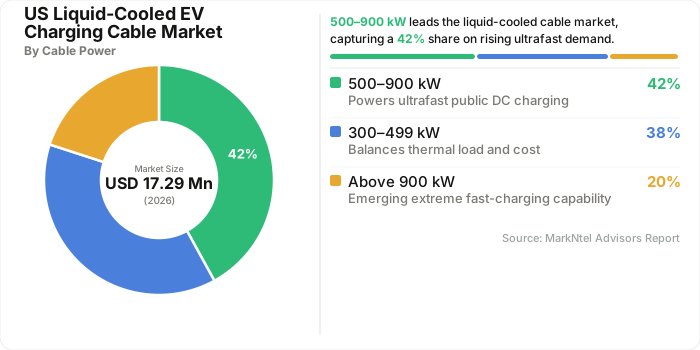
- By cable power, 500–900 kW holds a significant share of about 42% in 2026.
- By vehicle type, passenger EVs seized a significant share of about 69% in 2026.
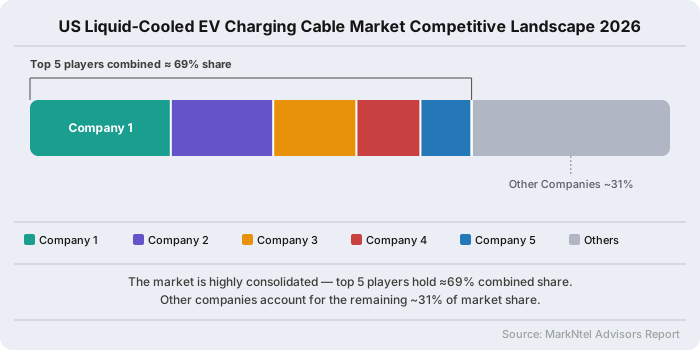
- The industry is moderately fragmented. However, the top five players collectively account for nearly 69% share.
US Liquid-Cooled EV Charging Cable Market Size and Outlook
The liquid-cooled EV charging cable market size in the US was valued at USD 13.49 million in 2025 and is projected to grow from USD 17.29 million in 2026 to USD 32.12 million by 2032. Along with this, the market is estimated to grow at a CAGR of around 10.87% during the forecast period, i.e., 2026-32.
The demand for liquid-cooled EV charging cables in the United States is gaining momentum as electric vehicle adoption and demand for high-power charging accelerate. In 2025–2026, charging infrastructure increasingly shifted toward high-power systems, including 350-kW and megawatt-class chargers, increasing the need for cables capable of managing high currents and thermal loads. Federal support for EV infrastructure and domestic clean-energy manufacturing further strengthens deployment.
Future opportunities are emerging in heavy-duty electric trucks, megawatt charging systems, fleet depots, and highway fast-charging corridors, where higher power requirements favor liquid-cooled cable technology. The market is therefore expected to maintain strong long-term growth as charging networks transition toward faster, higher-current, and more continuous-duty charging.
US Liquid-Cooled EV Charging Cable Market Key Indicators
- U.S. electric-car sales reached approximately 1.5 million units in 2025, with EVs representing around 10% of total car sales, according to the IEA. Although annual sales were slightly below 2024, battery electric vehicles increased their share of U.S. EV sales to nearly 70%. The expanding installed EV base continues to support demand for public DC fast charging and, consequently, high-current liquid-cooled charging cables.
- The U.S. had approximately 36,000 DC fast-charging ports across 9,000 stations as of the latest DOE assessment, highlighting a substantial installed base for high-power charging. DOE defines high-power charging as reaching up to 400 kW for light-duty EVs and 1+ MW for medium- and heavy-duty vehicles. Continued expansion toward higher-power infrastructure increases requirements for cables capable of carrying greater currents while managing thermal loads.
- Heavy-duty electrification is creating one of the strongest demand channels for liquid-cooled charging cables. In 2025, U.S. electric truck sales increased 25% to approximately 17,000 units, according to the IEA. Meanwhile, NREL reports that the Megawatt Charging System is being developed to provide up to 3.75 MW to electric trucks. These power levels substantially increase cable-current and thermal-management requirements, supporting liquid-cooled cable adoption.
- U.S. charging projects are moving toward multi-megawatt capacity, creating direct demand for advanced cable technologies. In January 2025, DOE awarded USD 68 million through its SuperTruck Charge initiative for medium- and heavy-duty charging projects. One USD 26 million Greenlane project will develop a publicly accessible 10+ MW charging station in Barstow, California, incorporating scalable MCS DC fast charging for Class 6–8 trucks.
- The evolution of North American charging standards is increasing current-handling requirements. DOE's January 2025 Vehicle-Grid Integration assessment lists CCS1 at up to 450 kW, 1,000 V and 500 A, while the NACS/J3400 specification was being developed around 610 A and 250 kW in the assessment. As charging systems move beyond conventional current levels toward ultra-high-power applications, liquid cooling becomes increasingly valuable for controlling cable and connector temperatures.
US Liquid-Cooled EV Charging Cable Market Scope
| Category | Segments |
|---|---|
| By Cable Power Capacity | 300–499 kW, 500–900 kW, Above 900 kW |
| By Cable Length | Below 5 Meters, 5–8 Meters, Above 8 Meters |
| By Cable Diameter | Below 30 mm, 30–50 mm, Above 50 mm |
| By Application | Ultrafast Charging, Megawatt Charging |
| By Jacket Material | Rubber, Thermoplastic Elastomer (TPE), Polyvinyl Chloride (PVC |
| By Cooling Technology | Water Glycol, Others |
| By Vehicle Type | Passenger EVs, Commercial Vehicles, Electric Buses, Electric Trucks |
US Liquid-Cooled EV Charging Cable Market Growth Drivers
Rising Demand for High-Power DC Fast Charging Drives Adoption of Liquid-Cooled EV Charging Cables
The rapid expansion of high-power DC fast-charging infrastructure is a key growth driver for the U.S. liquid-cooled EV charging cable market, as rising charger power increases the need for effective thermal management. In 2025, the U.S. continued expanding its DC fast-charging network, with the Department of Energy’s Alternative Fuels Data Center recording more than 36,000 DC fast-charging ports in the country at the end of 2025. At the same time, charging infrastructure is shifting toward higher-power systems. DOE identifies high-power charging (HPC) as reaching up to 400 kW for light-duty EVs and 1+ MW for medium- and heavy-duty vehicles, enabling faster charging and greater vehicle utilization.
Higher current levels generate greater heat within charging cables, making liquid cooling increasingly important for maintaining operating temperatures while supporting high-power delivery without excessive cable thickness or weight. This trend is reinforced by the growing deployment of 350-kW and higher chargers, particularly for highway corridors and commercial applications. Consequently, continued investment in DC fast-charging stations, combined with the transition toward 350-kW, 400-kW, and megawatt-class charging, is expected to accelerate adoption of liquid-cooled charging cables across U.S. public, fleet, and heavy-duty charging infrastructure.
Recent Trends
Increasing Development of NACS-Compatible Liquid-Cooled Charging Cables in the US
The increasing development of NACS-compatible liquid-cooled charging cables is emerging as an important product-development trend in the U.S. market. The transition toward the SAE J3400-based NACS interface is encouraging cable manufacturers to adapt high-power cable technologies to the connector standard increasingly used across North American EV charging. In February 2026, Phoenix Contact expanded its North American portfolio with NACS and CCS Type 1 charging cables, while announcing that liquid-cooled NACS cables supporting more than 600 A are expected by the end of 2026.
This development is significant because Phoenix Contact's existing liquid-cooled technology can support up to 1,000 A and 1 MW in high-power charging applications, demonstrating the technical pathway toward higher-current NACS systems. The company also states that NACS is gaining momentum across the U.S., with major automakers adopting the standard and charging networks transitioning toward it. Consequently, suppliers are increasingly developing liquid-cooled cable solutions specifically compatible with the evolving U.S. charging interface.
US Liquid-Cooled EV Charging Cable Market Opportunities and Challenges
Rising Thermal-Management Challenges at Ultra-High Charging Currents Create Opportunities for Advanced Liquid-Cooled Cables
The increasing power and current requirements of EV charging are creating a major thermal-management challenge for the U.S. liquid-cooled EV charging cable market. As charging power rises, cables must carry higher currents without excessive temperature increases, cable diameter, weight, or performance degradation. This challenge is becoming particularly important in heavy-duty and megawatt charging, where ABB’s MCS1200, introduced for e-truck charging, delivers 1.2 MW continuously at 1,500 A. Such current levels substantially increase the heat that must be dissipated from the cable and connector, making effective thermal management critical for reliable high-power charging.
This thermal challenge is creating a direct opportunity for manufacturers to develop higher-current liquid-cooled cables capable of supporting ultra-fast and megawatt charging. A recent example is ABB’s OM Duo, which offers an 800-A liquid-cooled cable and connector, compared with 600 A for its phase-cooled configuration and 375 A for its air-cooled NACS option. The liquid-cooled configuration supports 150–980 VDC, demonstrating how liquid cooling enables substantially higher current delivery while maintaining a compact charging system.
The opportunity is expanding further with ABB's OM X-Series, launched in May 2026, which uses an end-to-end liquid-cooled architecture including liquid-cooled charger cables, and scales from 800 kW to 10 MW and beyond across more than 100 charge points. This directly demonstrates the industry's movement toward liquid-cooled infrastructure for sustained, megawatt-scale charging.
Segmentation Insights
500–900 kW Segment Leads with Approximately 42% Revenue Share in 2026, Driven by High-Power Charging Adoption
The 500–900 kW segment is estimated to account for approximately 42% of U.S. liquid-cooled EV charging cable industry revenue in 2026, supported by rising demand for faster charging while avoiding the infrastructure complexity associated with full megawatt-class systems. Liquid cooling enables cables to handle higher currents without excessive size and weight, making this range suitable for high-power public and commercial charging.
For instance, Phoenix Contact’s liquid-cooled CCS Type 1 cable supports 500 kW continuously and up to 700 kW in Boost Mode at 1,000 V, directly covering the U.S. high-power charging range. Phoenix Contact also introduced second-generation cooled CCS cables in 2025 capable of 800 kW continuously and up to 1,000 kW in Boost Mode, demonstrating the industry's progression toward higher-power charging. The segment therefore represents a practical transition point between conventional fast charging and emerging megawatt-scale systems. Based on cable power, the scope has been segmented into
- 300–499 kW
- 500–900 kW
- Above 900 kW
Passenger EVs Lead with Approximately 69% Revenue Share in 2026, Driven by Growing Adoption of High-Power Fast Charging
Passenger EVs account for approximately 69% of total liquid-cooled EV charging cable revenue in 2026, making them the leading vehicle type due to the expanding deployment of high-power public charging infrastructure and rising consumer demand for shorter charging times. Passenger EVs represent the largest addressable vehicle base for fast-charging networks, particularly as newer models increasingly support higher charging rates.
For instance, Hyundai’s IONIQ 5 can charge from 10% to 80% in approximately 18 minutes using a 350-kW DC fast charger, demonstrating the growing importance of high-power charging for passenger vehicles. Similarly, Porsche’s Taycan supports charging at up to 320 kW, requiring charging equipment capable of safely managing high electrical currents. As more passenger EVs adopt high-voltage architectures and ultrafast charging capabilities, demand for liquid-cooled cables is expected to strengthen, particularly across U.S. public fast-charging networks. By vehicle type, the scope has been classified into
- Passenger EVs
- Commercial Vehicles
- Electric Buses
- Electric Trucks
US Liquid-Cooled EV Charging Cable Market Competitive Analysis
Top Five Companies Account for Approximately 69% of Market Share, Indicating a Moderately Consolidated Competitive Landscape
The U.S. liquid-cooled EV charging cable market is moderately consolidated, with leading companies such as HUBER+SUHNER AG, LEONI AG, Phoenix Contact GmbH & Co. KG, BRUGG Group AG, and SINBON Electronics Co., Ltd. collectively accounting for approximately 69% of the market share in 2026.
Key Players in US Liquid-Cooled EV Charging Cable Market
- HUBER+SUHNER AG
- HUBER+SUHNER AG
- Phoenix Contact GmbH & Co. KG
- LEONI AG
- SINBON Electronics Co., Ltd.
- BRUGG Group AG
- TE Connectivity Ltd.
- Kempower Oyj
- ABB Ltd.
- BRUGG eConnect
- LS Cable & System Ltd.
- Others
US Liquid-Cooled EV Charging Cable Industry News and Recent Developments
May 2026: ABB E-mobility Launches OM X-Series
ABB introduced the OM X-Series, an end-to-end liquid-cooled charging architecture scaling from 800 kW to 10 MW+. The system incorporates liquid-cooled power modules and liquid-cooled charger cables, targeting sustained-duty applications such as logistics hubs, transit depots, and public charging corridors.
Impact Analysis: ABB’s OM X-Series strengthens the U.S. liquid-cooled EV charging cable market by integrating liquid-cooled charger cables into an architecture scaling from 800 kW to more than 10 MW. Its first public U.S. showcase at ACT Expo in Las Vegas demonstrates growing commercial interest in continuous-duty, high-power charging. The launch supports demand for liquid-cooled cables in logistics hubs, fleet depots, and high-utilization charging corridors.
2025: Phoenix Contact Introduces Second-Generation Liquid-Cooled CCS Cable
Phoenix Contact introduced its second-generation CHARX connect professional liquid-cooled CCS charging cable, increasing charging capability to up to 1,000 kW in Boost Mode and 800 kW continuously. The new cooling concept routes coolant directly through the power wires, improving heat dissipation and enabling higher charging power. The development is particularly relevant to high-power commercial and utility-vehicle charging applications.
Impact Analysis: Phoenix Contact’s 2026 portfolio directly supports the U.S. liquid-cooled EV charging cable market through NACS liquid-cooled cables available from Q1 2026, supporting more than 600 A continuously at 1,000 V. Its cooled HPC portfolio also reaches 1,000 A in Boost Mode and 800 A continuously, enabling up to 1 MW. These capabilities strengthen demand for liquid-cooled cables as U.S. charging moves toward higher-power application.
- Market Segmentation
- Introduction
- Product Definition
- Research Process
- Assumptions
- Executive Summary
- US Liquid-Cooled EV Charging Cable Market Policies, Regulations, and Product Standards
- US Liquid-Cooled EV Charging Cable Market Trends & Developments
- US Liquid-Cooled EV Charging Cable Market Dynamics
- Growth Factors
- Challenges
- US Liquid-Cooled EV Charging Cable Market Hotspot & Opportunities
- US Liquid-Cooled EV Charging Cable Market Outlook, 2022-2032
- Market Size & Outlook
- By Revenues (USD Million)
- Market Segmentation & Outlook
- By Cable Power Capacity- Market Size & Forecast 2022-2032, USD Million
- 300–499 kW
- 500–900 kW
- Above 900 kW
- By Cable Length- Market Size & Forecast 2022-2032, USD Million
- Below 5 Meters
- 5–8 Meters
- Above 8 Meters
- By Cable Diameter- Market Size & Forecast 2022-2032, USD Million
- Below 30 mm
- 30–50 mm
- Above 50 mm
- By Application- Market Size & Forecast 2022-2032, USD Million
- Ultrafast Charging
- Megawatt Charging
- By Jacket Material- Market Size & Forecast 2022-2032, USD Million
- Rubber
- Thermoplastic Elastomer (TPE)
- Polyvinyl Chloride (PVC)
- By Cooling Technology- Market Size & Forecast 2022-2032, USD Million
- Water Glycol
- Others
- By Vehicle Type- Market Size & Forecast 2022-2032, USD Million
- Passenger EVs
- Commercial Vehicles
- Electric Buses
- Electric Trucks
- By Region- Market Size & Forecast 2022-2032, USD Million
- South
- West
- Midwest
- Northeast
- By Company
- Competition Characteristics
- Market Share & Analysis
- By Cable Power Capacity- Market Size & Forecast 2022-2032, USD Million
- Market Size & Outlook
- US Liquid-Cooled EV Ultrafast Charging Cable Market Outlook, 2022-2032
- Market Size & Outlook
- By Revenues (USD Million)
- Market Segmentation & Outlook
- By Cable Power Capacity- Market Size & Forecast 2022-2032, USD Million
- By Cable Length- Market Size & Forecast 2022-2032, USD Million
- By Cable Diameter- Market Size & Forecast 2022-2032, USD Million
- By Jacket Material- Market Size & Forecast 2022-2032, USD Million
- By Cooling Technology- Market Size & Forecast 2022-2032, USD Million
- By Vehicle Type- Market Size & Forecast 2022-2032, USD Million
- Market Size & Outlook
- US Liquid-Cooled EV Megawatt Charging Cable Market Outlook, 2022-2032
- Market Size & Outlook
- By Revenues (USD Million)
- Market Segmentation & Outlook
- By Cable Power Capacity- Market Size & Forecast 2022-2032, USD Million
- By Cable Length- Market Size & Forecast 2022-2032, USD Million
- By Cable Diameter- Market Size & Forecast 2022-2032, USD Million
- By Jacket Material- Market Size & Forecast 2022-2032, USD Million
- By Cooling Technology- Market Size & Forecast 2022-2032, USD Million
- By Vehicle Type- Market Size & Forecast 2022-2032, USD Million
- Market Size & Outlook
- US Liquid-Cooled EV Charging Cable Market Key Strategic Imperatives for Success & Growth
- Competitive Outlook
- Company Profiles
- HUBER+SUHNER AG
- Business Description
- Product Portfolio
- Collaborations & Alliances
- Recent Developments
- Financial Details
- Others
- Phoenix Contact GmbH & Co. KG
- Business Description
- Product Portfolio
- Collaborations & Alliances
- Recent Developments
- Financial Details
- Others
- LEONI AG
- Business Description
- Product Portfolio
- Collaborations & Alliances
- Recent Developments
- Financial Details
- Others
- SINBON Electronics Co., Ltd.
- Business Description
- Product Portfolio
- Collaborations & Alliances
- Recent Developments
- Financial Details
- Others
- TE Connectivity Ltd.
- Business Description
- Product Portfolio
- Collaborations & Alliances
- Recent Developments
- Financial Details
- Others
- Kempower Oyj
- Business Description
- Product Portfolio
- Collaborations & Alliances
- Recent Developments
- Financial Details
- Others
- ABB Ltd.
- Business Description
- Product Portfolio
- Collaborations & Alliances
- Recent Developments
- Financial Details
- Others
- BRUGG eConnect
- Business Description
- Product Portfolio
- Collaborations & Alliances
- Recent Developments
- Financial Details
- Others
- LS Cable & System Ltd.
- Business Description
- Product Portfolio
- Collaborations & Alliances
- Recent Developments
- Financial Details
- Others
- Coroplast
- Business Description
- Product Portfolio
- Collaborations & Alliances
- Recent Developments
- Financial Details
- Others
- Others
- HUBER+SUHNER AG
- Company Profiles
- Disclaimer

MarkNtel Advisors follows a robust and iterative research methodology designed to ensure maximum accuracy and minimize deviation in market estimates and forecasts. Our approach combines both bottom-up and top-down techniques to effectively segment and quantify various aspects of the market. A consistent feature across all our research reports is data triangulation, which examines the market from three distinct perspectives to validate findings. Key components of our research process include:
1. Scope & Research Design At the outset, MarkNtel Advisors define the research objectives and formulate pertinent questions. This phase involves determining the type of research—qualitative or quantitative—and designing a methodology that outlines data collection methods, target demographics, and analytical tools. They also establish timelines and budgets to ensure the research aligns with client goals.
2. Sample Selection and Data Collection In this stage, the firm identifies the target audience and determines the appropriate sample size to ensure representativeness. They employ various sampling methods, such as random or stratified sampling, based on the research objectives. Data collection is carried out using tools like surveys, interviews, and observations, ensuring the gathered data is reliable and relevant.
3. Data Analysis and Validation Once data is collected, MarkNtel Advisors undertake a rigorous analysis process. This includes cleaning the data to remove inconsistencies, employing statistical software for quantitative analysis, and thematic analysis for qualitative data. Validation steps are taken to ensure the accuracy and reliability of the findings, minimizing biases and errors.

4. Data Forecast and FinalizationThe final phase involves forecasting future market trends based on the analyzed data. MarkNtel Advisors utilize predictive modeling and time series analysis to anticipate market behaviors. The insights are then compiled into comprehensive reports, featuring visual aids like charts and graphs, and include strategic recommendations to inform client decision-making
We offer flexible licensing options to cater to varying organizational needs. Choose the pricing pack that best suits your requirements:
Buy Now Inquire Before Buying
 Request Customization