

By Level of Automation (Level 1 – Driver Assistance, Level 2 – Partial Automation, Level 3 – Conditional Automation, Level 4 – High Automation, Level 5 – Full Automation), By Vehicle Type (Passenger V... ... , By Vehicle Type (Passenger Vehicles, Commercial Vehicles (Light Commercial Vehicles (LCVs), Heavy Commercial Vehicles (HCVs), Buses & Shuttles)), By Propulsion Type (ICE, Electric, Hybrid), By Component (Hardware, Software), By Application (Passenger Transportation, Goods Transportation, Industrial Operations, Military & Defense), and others Read more
- Automotive
- Jul 2026
- 140
- PDF, Excel, PPT
US Autonomous Vehicle Market Key Takeaways
- The US autonomous vehicle market, valued at nearly USD 41.2 billion in 2025, is anticipated to expand steadily, reaching USD 140.22 billion by 2032 from USD 49.08 billion in 2026.
- The industry is projected to witness steady growth at a CAGR of 19.12% over 2026–2032.
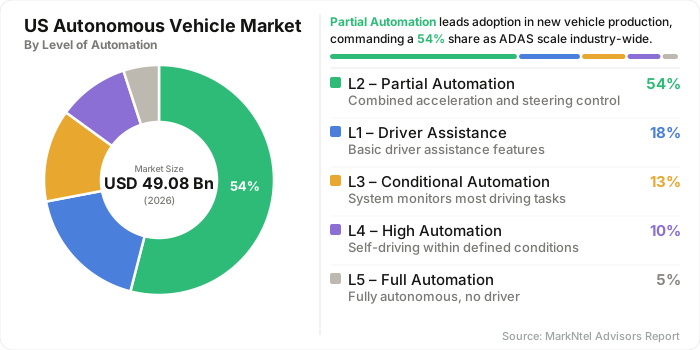
- Level 2 – Partial Automation dominated the automation-level segment with a 54% share in 2026.
- Passenger vehicles accounted for 71% of the market, forming the leading vehicle-type segment in 2026.
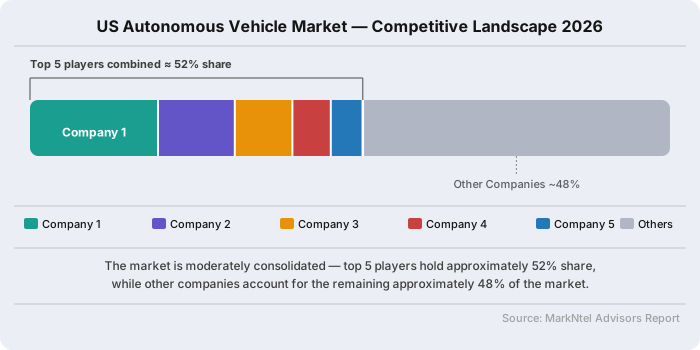
- The industry is characterized by a moderately consolidated market structure, where the top five manufacturers hold roughly 52% of the market share.
US Autonomous Vehicle Market Size and Outlook
At a CAGR of approximately 19.12% over 2026–2032, the US autonomous vehicle market is expected to rise from USD 49.08 billion in 2026 to USD 140.22 billion by 2032, following a valuation of USD 41.2 billion in 2025.
The market has progressed from pilot testing to early commercial deployment, supported by advances in artificial intelligence, connected vehicle technologies, and advanced driver assistance systems. Passenger vehicles continue to generate the highest demand, while logistics operators, public transit agencies, and industrial users increasingly adopt automated driving technologies to improve safety and operational efficiency. Supporting this transition, the US Department of Transportation introduced a new Automated Vehicle Framework in 2025 to modernize regulations and establish a more consistent national approach for automated driving systems.
These regulatory initiatives have created a more favorable environment for commercialization. During 2025 and 2026, the National Highway Traffic Safety Administration streamlined the Part 555 exemption process for vehicles without conventional controls, expanded the Automated Vehicle Exemption Program to domestically manufactured vehicles, and initiated updates to Federal Motor Vehicle Safety Standards. Together, these measures reduce development timelines while encouraging wider deployment across passenger transportation, freight operations, and autonomous mobility services.
Encouraged by this supportive policy framework, leading companies are accelerating commercial deployment and technology investments. Waymo continues expanding its driverless ride-hailing services into additional US cities, while Aurora Innovation advances autonomous trucking operations for long-haul freight. Zoox also received the first US demonstration exemption for an American-built purpose-designed autonomous vehicle, highlighting growing regulatory confidence. Meanwhile, manufacturers and fleet operators continue investing in software-defined vehicles, artificial intelligence, and high-performance computing to improve safety, scalability, and operational performance.
This combination of supportive regulations, technological innovation, and industry investment is expected to sustain long-term market growth. Commercial fleet operators are likely to remain key adopters because automated driving technologies can lower operating costs and improve productivity, while consumer demand for advanced driver assistance features continues to support passenger vehicle adoption. Ongoing regulatory refinements are also expected to strengthen public confidence and create a solid foundation for broader autonomous vehicle deployment across the United States.
US Autonomous Vehicle Market Key Indicators
- The US recorded approximately 16.2 million new light-vehicle sales in 2025, according to the National Automobile Dealers Association (NADA). Strong vehicle demand encourages automakers to integrate advanced driver assistance systems, connected technologies, and autonomous driving capabilities into new vehicle models, supporting future technology adoption.
- The US Census Bureau estimated the nation's population reached approximately 341.8 million in 2025, reflecting one of the world's largest consumer and transportation markets. A large population base supports continued demand for personal mobility, public transportation, and next-generation vehicle technologies.
- Trucks moved approximately 72.7% of the nation's freight by weight in 2024, according to the American Trucking Associations. Continued growth in freight transportation is encouraging investments in autonomous trucking technologies to improve operational efficiency, address driver shortages, and enhance supply chain productivity.
- NHTSA issued the first-ever demonstration exemption under its expanded Automated Vehicle Exemption Program (AVEP) to an American-built automated vehicle on August 6, 2025, creating a federal pathway for domestically manufactured vehicles without traditional steering wheels or pedals.
- The National Highway Traffic Safety Administration estimated 39,345 traffic fatalities in the United States during 2024, marking the first year below 40,000 since 2020. The continued focus on improving road safety is accelerating the development and deployment of advanced driver assistance and automated driving technologies.
US Autonomous Vehicle Market Scope
| Category | Segments |
|---|---|
| By Level of Automation | Level 1 – Driver Assistance, Level 2 – Partial Automation, Level 3 – Conditional Automation, Level 4 – High Automation, Level 5 – Full Automation |
| By Vehicle Type | Passenger Vehicles, Commercial Vehicles (Light Commercial Vehicles (LCVs), Heavy Commercial Vehicles (HCVs), Buses & Shuttles |
| By Propulsion Type | ICE, Electric, Hybrid |
| By Component | Hardware, Software |
| By Application | Passenger Transportation, Goods Transportation, Industrial Operations, Military & Defense |
US Autonomous Vehicle Market Growth Drivers
Growing Adoption of Autonomous Freight Transportation
The growing adoption of autonomous freight transportation is emerging as a key driver of the US autonomous vehicle industry as logistics providers seek to improve operational efficiency, reduce transportation costs, and address mounting workforce challenges. Freight transportation operates on predictable routes and high-utilization networks, making it one of the most commercially viable applications for autonomous driving technologies. Reflecting this progress, Aurora Innovation launched the first commercial driverless Class 8 trucking service in the United States in May 2025, marking an important step in the transition from pilot testing to commercial freight operations and strengthening industry confidence in autonomous trucking.
This commercial progress is further reinforced by the growing scale and operational demands of the US freight industry. According to the American Trucking Associations (ATA), trucks transported 11.27 billion tons of freight in 2024, while the industry is expected to recruit nearly 1.1 million new drivers over the next decade to meet rising freight demand and replace retiring workers. These workforce challenges, together with continuous advancements in AI-enabled driving systems and connected vehicle infrastructure, are encouraging logistics providers to expand the deployment of autonomous trucking solutions, improving fleet productivity, operational efficiency, and supply chain resilience while accelerating the modernization of commercial freight transportation.
Recent Trends
Commercial Expansion of Robotaxi Services
The commercialization of robotaxi services is accelerating in the US autonomous vehicle industry as developer transition from technology validation to real-world mobility operations. Advances in autonomous driving software, AI-powered perception, and sensor technologies are enabling safer and more reliable driverless ride-hailing services. As these capabilities mature, robotaxis are emerging as one of the earliest large-scale commercial applications of autonomous vehicles.
This transition is becoming increasingly visible through the commercial strategies adopted by leading industry participants. Tesla launched its first Robotaxi service in Austin, Texas, in June 2025, deploying autonomous Model Y vehicles within a designated service area and marking its first commercial robotaxi operation. This was followed by Waymo's expansion of its robotaxi service to select riders across four additional US cities in February 2026, demonstrating the increasing scale and commercial maturity of autonomous ride-hailing services.
The growing deployment of robotaxi fleets is also reshaping investment priorities across the autonomous mobility ecosystem. As services expand into more metropolitan areas, investments in autonomous fleet management platforms, Mobility-as-a-Service (MaaS) solutions, and autonomous ride-hailing services continue to increase, supporting the development of more connected and intelligent urban transportation networks across the US
US Autonomous Vehicle Market Opportunities and Challenges
Complex Urban Driving Conditions Driving Demand for Simulation and Digital Validation Platforms
Complex urban driving environments are emerging as a major challenge for autonomous vehicle deployment. Autonomous systems must safely navigate unpredictable pedestrian behavior, emergency vehicles, construction zones, varying road infrastructure, and changing weather conditions while meeting stringent safety and regulatory requirements. At the same time, validating autonomous driving software across millions of real-world traffic scenarios is both time-consuming and costly, increasing development complexity and slowing commercialization. These challenges are encouraging developers to adopt more efficient methods for testing and validating autonomous driving systems before public-road deployment.
This challenge is creating significant opportunities for advanced simulation and digital validation platforms that complement conventional road testing. Automotive developers are increasingly adopting high-fidelity simulation environments and digital twins capable of generating millions of virtual driving scenarios to improve software accuracy and testing efficiency. In January 2025, Applied Intuition introduced Neural Sim, an AI-powered simulation platform that enables automotive developers to transform real-world driving data into realistic virtual scenarios for large-scale software validation. As digital engineering becomes more integrated into autonomous vehicle development, simulation-based validation is expected to reduce development costs, accelerate regulatory compliance, and create new opportunities for autonomous vehicle simulation, digital twin technology, and the US autonomous vehicle market.
Segmentation Insights
Broad Consumer Adoption of Advanced Driver Assistance Systems Sustains Level 2 Automation Leadership
Level 2 – Partial Automation accounted for approximately 54% of the US autonomous vehicle market in 2026, primarily due to its widespread commercialization across passenger vehicles. Unlike higher levels of autonomy that remain confined to limited operating environments, Level 2 systems are already available across a wide range of vehicle models, offering features such as adaptive cruise control, lane centering assistance, automatic emergency braking, and hands-free highway driving. These capabilities improve safety and convenience while allowing drivers to retain control, resulting in stronger consumer acceptance.
Another important factor supporting this leadership is the growing standardization of advanced driver assistance technologies across new vehicle models. According to the Insurance Institute for Highway Safety (IIHS), automatic emergency braking and lane support technologies are increasingly offered as standard equipment in passenger vehicles sold across the United States. Their widespread adoption continues to strengthen advanced driver assistance systems (ADAS) and semi-autonomous vehicles, enabling manufacturers to enhance autonomous driving software through real-world operational data. Based on level of automation, the market has been segmented into:
- Level 1 – Driver Assistance
- Level 2 – Partial Automation
- Level 3 – Conditional Automation
- Level 4 – High Automation
- Level 5 – Full Automation
Extensive Private Vehicle Ownership Keeps Passenger Vehicles at the Forefront of Autonomous Vehicle Adoption
Passenger Vehicles accounted for approximately 71% of the US autonomous vehicle market in 2026, driven by higher production volumes, strong consumer demand, and faster integration of autonomous driving technologies than commercial vehicles. Automakers continue expanding advanced driver assistance systems and autonomous features across both premium and mass-market models, while rising consumer demand for safer and more connected driving experiences supports widespread adoption.
The scale of the US passenger vehicle fleet further reinforces this leadership. According to the US Department of Transportation, passenger vehicles account for the overwhelming majority of registered vehicles on American roads, providing the largest addressable market for autonomous technologies. The increasing adoption of software-defined vehicles and over-the-air updates is also advancing connected passenger vehicles and autonomous mobility solutions, helping passenger vehicles maintain their market leadership despite growing opportunities in commercial autonomous transport. Based on vehicle type, the market is categorized into:
- Passenger Vehicles
- Commercial Vehicles
US Autonomous Vehicle Market Competitive Analysis
The US autonomous vehicle market is moderately consolidated, with autonomous technology developers and automotive manufacturers competing across passenger vehicles, robotaxis, and autonomous freight solutions. The top five players, Tesla, Inc., Waymo LLC, General Motors Company, Ford Motor Company, and Zoox, Inc., collectively account for approximately 52% of the market, supported by advanced autonomous driving software, expanding robotaxi deployments, extensive real-world driving data, and strong vehicle manufacturing capabilities.
Key Players in US Autonomous Vehicle Market
- Tesla, Inc.
- Waymo LLC
- General Motors Company
- Ford Motor Company
- Zoox, Inc.
- Aurora Innovation, Inc.
- Motional AD LLC
- Nuro, Inc.
- Rivian Automotive, Inc.
- Mercedes-Benz Group AG
- Others
US Autonomous Vehicle Industry News and Recent Developments
June 2026: Mobileye Announces Plans for US Robotaxi Business Launch
Mobileye announced plans to establish a vertically integrated robotaxi business in a major US metropolitan area beginning in 2027. The company plans to deploy an initial fleet of approximately 100 autonomous vehicles, with expansion to nearly 17,000 vehicles over the following five years by integrating its Mobileye Drive platform with Moovit mobility services.
Impact Analysis: The initiative reinforces the commercialization of autonomous mobility, supports the expansion of large-scale robotaxi fleets, and intensifies competition among autonomous driving technology providers in the US market.
May 2025: Uber and May Mobility Partner to Expand Autonomous Ride-Hailing Services
Uber and May Mobility announced a multi-year partnership to deploy thousands of autonomous vehicles on the Uber platform across the United States. The rollout will begin with autonomous hybrid-electric Toyota Sienna vehicles in Arlington, Texas, before expanding to additional US cities, supporting the commercialization of autonomous ride-hailing services.
Impact Analysis: The partnership accelerates large-scale robotaxi deployment, expands the integration of autonomous vehicles into mainstream mobility platforms, and strengthens the commercial adoption of autonomous transportation services across the US.
- Market Segmentation
- Introduction
- Product Definition
- Research Process
- Assumptions
- Executive Summary
- US Autonomous Vehicle Market Policies, Regulations, and Product Standards
- US Autonomous Vehicle Market Trends & Developments
- US Autonomous Vehicle Market Dynamics
- Growth Factors
- Challenges
- US Autonomous Vehicle Market Hotspot & Opportunities
- US Autonomous Vehicle Market Outlook, 2022-2032F
- Market Size & Outlook
- By Revenues (USD Million)
- Market Segmentation & Outlook
- By Level of Automation- Market Size & Forecast 2022-2032, USD Million
- Level 1 – Driver Assistance
- Level 2 – Partial Automation
- Level 3 – Conditional Automation
- Level 4 – High Automation
- Level 5 – Full Automation
- By Vehicle Type- Market Size & Forecast 2022-2032, USD Million
- Passenger Vehicles
- Commercial Vehicles
- Light Commercial Vehicles (LCVs)
- Heavy Commercial Vehicles (HCVs)
- Buses & Shuttles
- By Propulsion Type- Market Size & Forecast 2022-2032, USD Million
- ICE
- Electric
- Hybrid
- By Component- Market Size & Forecast 2022-2032, USD Million
- Hardware
- Software
- By Application- Market Size & Forecast 2022-2032, USD Million
- Passenger Transportation
- Goods Transportation
- Industrial Operations
- Military & Defense
- By Company
- Competition Characteristics
- Market Share & Analysis
- By Level of Automation- Market Size & Forecast 2022-2032, USD Million
- Market Size & Outlook
- US Autonomous Passenger Vehicle Market Outlook, 2022-2032
- Market Size & Outlook
- By Revenues (USD Million)
- Market Segmentation & Outlook
- By Level of Automation - Market Size & Forecast 2022-2032, USD Million
- By Propulsion Type- Market Size & Forecast 2022-2032, USD Million
- By Component- Market Size & Forecast 2022-2032, USD Million
- By Application- Market Size & Forecast 2022-2032, USD Million
- Market Size & Outlook
- US Autonomous Commercial Vehicle Market Outlook, 2022-2032
- Market Size & Outlook
- By Revenues (USD Million)
- Market Segmentation & Outlook
- By Level of Automation- Market Size & Forecast 2022-2032, USD Million
- By Propulsion Type- Market Size & Forecast 2022-2032, USD Million
- By Component- Market Size & Forecast 2022-2032, USD Million
- By Application- Market Size & Forecast 2022-2032, USD Million
- By End User- Market Size & Forecast 2022-2032, USD Million
- Market Size & Outlook
- US Autonomous Vehicle Market Key Strategic Imperatives for Success & Growth
- Competitive Outlook
- Company Profiles
- Tesla, Inc.
- Business Description
- Product Portfolio
- Collaborations & Alliances
- Recent Developments
- Financial Details
- Others
- Waymo LLC
- Business Description
- Product Portfolio
- Collaborations & Alliances
- Recent Developments
- Financial Details
- Others
- General Motors Company
- Business Description
- Product Portfolio
- Collaborations & Alliances
- Recent Developments
- Financial Details
- Others
- Ford Motor Company
- Business Description
- Product Portfolio
- Collaborations & Alliances
- Recent Developments
- Financial Details
- Others
- Zoox, Inc.
- Business Description
- Product Portfolio
- Collaborations & Alliances
- Recent Developments
- Financial Details
- Others
- Aurora Innovation, Inc.
- Business Description
- Product Portfolio
- Collaborations & Alliances
- Recent Developments
- Financial Details
- Others
- Motional AD LLC
- Business Description
- Product Portfolio
- Collaborations & Alliances
- Recent Developments
- Financial Details
- Others
- Nuro, Inc.
- Business Description
- Product Portfolio
- Collaborations & Alliances
- Recent Developments
- Financial Details
- Others
- Rivian Automotive, Inc.
- Business Description
- Product Portfolio
- Collaborations & Alliances
- Recent Developments
- Financial Details
- Others
- Mercedes-Benz Group AG
- Business Description
- Product Portfolio
- Collaborations & Alliances
- Recent Developments
- Financial Details
- Others
- Tesla, Inc.
- Company Profiles
- Disclaimer

MarkNtel Advisors follows a robust and iterative research methodology designed to ensure maximum accuracy and minimize deviation in market estimates and forecasts. Our approach combines both bottom-up and top-down techniques to effectively segment and quantify various aspects of the market. A consistent feature across all our research reports is data triangulation, which examines the market from three distinct perspectives to validate findings. Key components of our research process include:
1. Scope & Research Design At the outset, MarkNtel Advisors define the research objectives and formulate pertinent questions. This phase involves determining the type of research—qualitative or quantitative—and designing a methodology that outlines data collection methods, target demographics, and analytical tools. They also establish timelines and budgets to ensure the research aligns with client goals.
2. Sample Selection and Data Collection In this stage, the firm identifies the target audience and determines the appropriate sample size to ensure representativeness. They employ various sampling methods, such as random or stratified sampling, based on the research objectives. Data collection is carried out using tools like surveys, interviews, and observations, ensuring the gathered data is reliable and relevant.
3. Data Analysis and Validation Once data is collected, MarkNtel Advisors undertake a rigorous analysis process. This includes cleaning the data to remove inconsistencies, employing statistical software for quantitative analysis, and thematic analysis for qualitative data. Validation steps are taken to ensure the accuracy and reliability of the findings, minimizing biases and errors.

4. Data Forecast and FinalizationThe final phase involves forecasting future market trends based on the analyzed data. MarkNtel Advisors utilize predictive modeling and time series analysis to anticipate market behaviors. The insights are then compiled into comprehensive reports, featuring visual aids like charts and graphs, and include strategic recommendations to inform client decision-making
We offer flexible licensing options to cater to varying organizational needs. Choose the pricing pack that best suits your requirements:
Buy Now Inquire Before Buying
 Request Customization