

By Production Technology (Membrane Cell Process, Diaphragm Cell Process, Mercury Cell Process), By Supply Form (Liquefied Chlorine, Gaseous Chlorine), By Distribution Mode (Pipeline Supply, Ton Contai... ... e Supply, Ton Containers, Cylinders, Bulk Tankers), By Application (Water & Wastewater Treatment, Ethylene Dichloride (EDC) Production, Organic Chemicals Manufacturing, Inorganic Chemicals Manufacturing, Pulp & Paper Bleaching, Disinfection & Sanitization, Others), By End User (Chemical Industry, Water & Wastewater Utilities, Pulp & Paper Industry, Pharmaceutical Industry, Textile Industry, Electronics & Semiconductor Industry, Metallurgical Industry, Others), and others Read more
- Chemicals
- Jul 2026
- 240
- PDF, Excel, PPT
GCC Chlorine Gas Market Key Takeaways
- The GCC chlorine gas market was valued at USD 1.11 billion in 2025 and is projected to reach USD 1.21 billion in 2026 and USD 2.98 billion by 2032, registering a 16.21% CAGR during 2026–2032.
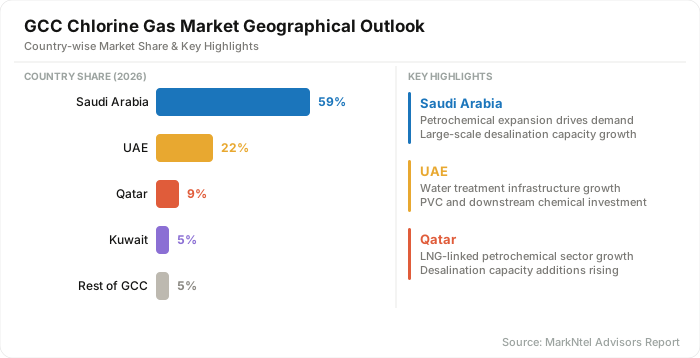
- Saudi Arabia dominates the regional market, accounting for approximately 59% of total chlorine gas demand.
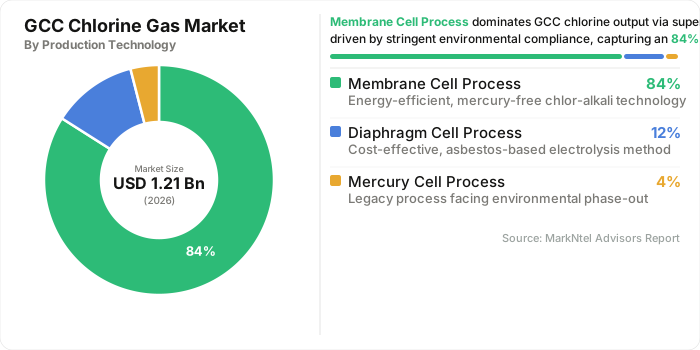
- The membrane cell process captured nearly 84% of the production technology.
- The chemical industry represented around 50% of total demand in 2026.
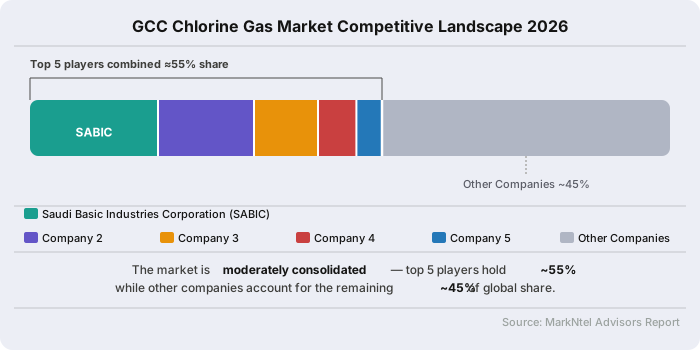
- The industry remains moderately consolidated, with the top five companies collectively accounting for nearly 55% of the regional market.
GCC Chlorine Gas Market Size and Outlook
The GCC chlorine gas market size was valued at USD 1.11 billion in 2025 and is projected to grow from USD 1.21 billion in 2026 to USD 2.98 billion by 2032, registering a CAGR of 16.21% during 2026–2032. Growth is supported by chlorine's indispensable role across the regional chlorine supply chain, serving as a critical feedstock for chlor-alkali production, vinyls manufacturing, water treatment, and numerous downstream chemical applications that continue to strengthen industrial demand across the Gulf.
According to the Gulf Petrochemicals and Chemicals Association (GPCA), GCC petrochemical production capacity reached 156.2 million tonnes in 2024, providing a robust industrial ecosystem that supports expanding chlorine consumption. Water security remains a key structural growth pillar, as chlorine and sodium hypochlorite are essential industrial disinfectants used across municipal and industrial water systems. This diversified industrial base enables chlorine demand to remain resilient while supporting integrated downstream chemical manufacturing throughout the region.
The Kingdom's desalinated water production capacity exceeded 16 million cubic meters per day by the end of 2025, representing a 247.8% increase as per the Saudi Water Authority's National Transformation Program. This rapidly expanding desalination and treated-water network generates continuous demand for chlorine through residual disinfection and biofouling control, providing a relatively stable consumption base that remains less exposed to fluctuations in industrial production and commodity price cycles.
Construction continues to represent another major growth engine because chlorine is converted into polyvinyl chloride, used in pipes, fittings, and infrastructure materials. Contract awards across Saudi Arabia's Vision 2030 giga-projects reached approximately USD 196 billion in 2025, increasing 20% year over year and supporting long-term downstream chlorine demand. Combined with continued investments in petrochemicals, manufacturing, and water infrastructure, these developments are expected to sustain healthy growth across the GCC chlorine gas industry.
GCC Chlorine Gas Market Key Indicators
- According to the GCC Statistical Center, the six Gulf states produced 7.2 billion cubic meters of desalinated water, with Qatar relying on desalination for more than 99% of its drinking water. As every desalinated and distributed stream requires chlorination for residual disinfection and biofouling control, this volume locks in baseline chlorine consumption across municipal utilities and wastewater networks.
- As per the Gulf Petrochemicals and Chemicals Association, the chemical sector contributes between 5% and 6% of GCC gross domestic product and close to 40% of regional manufacturing GDP. As chlorine is a primary input for vinyl chloride monomer and a wide range of chlorinated intermediates, this entrenched petrochemical base translates directly into sustained captive and merchant chlorine offtake.
- The Gulf Aluminium Council reports that, GCC aluminium production reached a record 6.45 million tonnes in 2024, an increase of roughly 120,000 tonnes year on year. Since molten-metal treatment uses chlorine fluxing to strip hydrogen and magnesium before casting, the Gulf's position as a leading primary-aluminium hub creates steady metallurgical demand for high-purity chlorine.
- According to Saudi Arabia's General Authority for Statistics, the national grid received more than 402 terawatt-hours of electricity in 2024, up 5.7% from previous year. As the Gulf's thermal and cogeneration plants depend on once-through seawater cooling, biofouling control through chlorine dosing of intake and cooling-water systems scales with this rising generation base, reinforcing power-sector chlorine demand.
- According to the Saudi Food and Drug Authority, more than 55 pharmaceutical manufacturing facilities are now approved and operational in the Kingdom under Vision 2030 localization targets. As chlorine underpins pharmaceutical-grade disinfection of clean rooms and process water and supplies chlorinated intermediates for active-ingredient synthesis, expanding local drug production adds incremental, quality-sensitive chlorine demand.
GCC Chlorine Gas Market Scope
| Category | Segments |
|---|---|
| By Production Technology | Membrane Cell Process, Diaphragm Cell Process, Mercury Cell Process |
| By Supply Form | Liquefied Chlorine, Gaseous Chlorine |
| By Distribution Mode | Pipeline Supply, Ton Containers, Cylinders, Bulk Tankers |
| By Application | Water & Wastewater Treatment, Ethylene Dichloride (EDC) Production, Organic Chemicals Manufacturing, Inorganic Chemicals Manufacturing, Pulp & Paper Bleaching, Disinfection & Sanitization, Others |
| By End User | Chemical Industry, Water & Wastewater Utilities, Pulp & Paper Industry, Pharmaceutical Industry, Textile Industry, Electronics & Semiconductor Industry, Metallurgical Industry, Others |
GCC Chlorine Gas Market Growth Drivers
Expanding Water Security and Wastewater Treatment Investment
Sustained government investment in water security is a principal force supporting the GCC chlorine gas market, as chlorine and its derivatives remain the preferred disinfectants for potable supply and wastewater systems and key water treatment chemicals. Under the Saudi Water Authority's Water Horizons programme, Saudi Arabia plans to install more than 10,000 kilometers of water transmission pipelines by 2030, backed by investment approaching USD 30 billion. This expansion increases mandatory chlorination points across networks.
Wastewater reuse further strengthens demand because reclaimed streams require disinfection before reuse or discharge. Saudi Arabia targets treated-wastewater reuse of 70% by 2030, while Dubai aims for complete reuse over the same period, according to the Water Horizons assessment. Every additional reuse point generates continuous chlorine consumption, helping reduce dependence on construction and petrochemical activity cycles while supporting long-term demand across the GCC chlorine gas industry.
Consequently, producers are locating chlorine and sodium hypochlorite capacity closer to municipal and utility demand centres to secure this structural consumption base. Water treatment requires chlorine regardless of oil-price fluctuations or industrial cycles, making demand relatively resilient. Expanding desalination, distribution, and reuse infrastructure therefore supports industry growth and creates opportunities for suppliers capable of providing reliable, specification-grade products to public utilities throughout the Gulf region.
Recent Trends
Renewable Electricity Integration Reshaping Energy-Intensive Chlor-Alkali Production
The GCC chlorine gas market is increasingly influenced by the transition toward low-carbon manufacturing as chlor-alkali producers integrate renewable electricity into energy-intensive operations to improve sustainability and competitiveness. According to the U.S. Environmental Protection Agency, electrolysis accounts for nearly 90% of electricity consumption in chlor-alkali production, making clean power adoption a critical lever for reducing operating costs and lowering emissions across sustainable chlorine production.
The region's accelerating renewable energy investments are strengthening this transition. The NEOM Green Hydrogen Company is investing approximately USD 8.4 billion to develop up to 4 GW of integrated solar and wind capacity capable of producing 600 tonnes of carbon-free hydrogen per day while avoiding nearly 5 million tonnes of CO₂ emissions annually. Although developed for green hydrogen production, this large-scale renewable infrastructure reinforces the low-carbon electricity ecosystem supporting energy-intensive industrial manufacturing.
The trend is further reinforced by Saudi Arabia's National Renewable Energy Program, which targets 58.7 GW of renewable generation capacity by 2030 while aiming to source 50% of national electricity from renewable energy, strengthening the GCC chlorine gas industry. As renewable electricity becomes increasingly available across the Gulf, chlor-alkali producers are expected to reduce the carbon intensity of chlorine production, improve long-term energy resilience, and enhance the competitiveness of regionally manufactured chlor-alkali products.
GCC Chlorine Gas Market Opportunities and Challenges
Fixed Chlorine–Caustic Soda Co-Production Encouraging Downstream Integration into Chlorine Derivatives
The GCC Chlorine Gas Market faces a structural challenge because chlorine and caustic soda are produced simultaneously through electrolysis, making independent output adjustments impossible. According to Euro Chlor, every tonne of chlorine generated yields about 1.1 tonnes of caustic soda and approximately 0.03 tonnes of hydrogen, collectively known as the Electrochemical Unit. This fixed production relationship exposes manufacturers to demand imbalances whenever chlorine and caustic soda markets diverge, creating persistent pressure across the chlor-alkali industry.
However, this structural limitation also creates a significant opportunity for producers to expand downstream integration. Because chlorine is hazardous and uneconomical to transport over long distances in large volumes, manufacturers increasingly convert it near production sites. Supporting this trend, Basic Chemical Industries (BCI) awarded thyssenkrupp nucera a contract in 2025 to expand its chlor-alkali plant in Jubail Industrial City using membrane-cell technology, reinforcing Saudi Arabia's integrated chlorine value chain and energy-efficient production capabilities.
Consequently, companies with integrated downstream facilities are better positioned to absorb chlorine internally while reducing exposure to fluctuations in merchant chlorine demand, strengthening the GCC chlorine gas industry. As Gulf industrial cities continue expanding chlor-vinyl and derivative manufacturing capacity, diversified local chlorine utilization is becoming a key competitive advantage, improving operational resilience, enhancing value addition, and creating higher barriers to entry for producers relying primarily on standalone chlorine sales.
Segmentation Insights
Membrane Cell Process Dominant Due to Superior Energy Efficiency and Environmental Compliance
The membrane cell process accounted for approximately 84% of the GCC chlorine gas industry in 2026, making it the region's dominant electrolysis technology. Its leadership is supported by superior energy efficiency, mercury- and asbestos-free operation, and the production of high-purity caustic soda that meets stringent industrial quality standards. These advantages have accelerated the adoption of membrane cell technology across newly commissioned and modernized chlor-alkali facilities.
The segment continues to benefit from the replacement of legacy diaphragm and mercury cell systems as producers prioritize environmental compliance, lower electricity consumption, and improved operational performance. Compared with conventional technologies, membrane cells require less energy while producing higher-purity chlorine and caustic soda, enabling manufacturers to improve production efficiency and reduce long-term operating costs in increasingly sustainability-focused industrial markets.
Furthermore, ongoing investments in modern chlor-alkali capacity across Saudi Arabia and other GCC countries are reinforcing the segment's leadership. New production facilities are increasingly designed around membrane-cell electrolysis to comply with international environmental standards and enhance process reliability. As regional producers continue expanding integrated downstream chemical manufacturing, the membrane cell process is expected to maintain its dominant position. Based on production technology, the scope has been divided into:
- Membrane Cell Process
- Diaphragm Cell Process
- Mercury Cell Process
Essential Feedstock Requirements for Chlorinated Derivatives Driving the Chemical Industry's Leadership
The chemical industry accounted for approximately 50% of the GCC chlorine gas industry in 2026, making it the largest end-user segment. Its leadership is driven by chlorine's indispensable role as a primary feedstock for producing vinyls and a broad portfolio of chlorinated derivatives used across industrial manufacturing. Growing investments in the downstream chemical industry have further strengthened chlorine consumption by supporting integrated production of higher-value chemical products.
The segment continues to benefit from expanding regional petrochemical and specialty chemical manufacturing, where chlorine is widely utilized in the production of ethylene dichloride, vinyl chloride monomer, polyvinyl chloride, hydrochloric acid, sodium hypochlorite, and other industrial intermediates. Integrated chlor-alkali and chemical complexes enable manufacturers to consume chlorine close to production sites, improving operational efficiency while minimizing transportation risks associated with handling hazardous chlorine gas.
Furthermore, government-led industrial diversification initiatives and continued investments in downstream manufacturing are reinforcing the chemical industry's dominant position. New industrial projects across Saudi Arabia and other GCC countries increasingly emphasize value-added chemical production, supporting sustained chlorine demand. As integrated chemical value chains continue expanding, the chemical industry is expected to maintain its leadership by driving consistent, large-volume chlorine consumption. The study identifies the following key end-user industries:
- Chemical Industry
- Water & Wastewater Utilities
- Pulp & Paper Industry
- Pharmaceutical Industry
- Textile Industry
- Electronics & Semiconductor Industry
- Metallurgical Industry
- Others
GCC Chlorine Gas Market Geographical Outlook
Saudi Arabia accounted for approximately 59% of the GCC chlorine gas industry, making it the largest regional consumer of chlorine gas. Its leadership is supported by extensive investments in water infrastructure, industrial development, petrochemicals, and construction, all of which generate sustained demand for PVC manufacturing and other chlorine-based products. The country's integrated chlor-alkali and downstream chemical ecosystem further strengthens domestic chlorine consumption.
Saudi Arabia's 2025 national budget allocated approximately USD 346.6 billion toward public expenditure, with significant investments directed to water infrastructure, housing, industrial development, and economic diversification initiatives, while the non-oil economy expanded by 4.3% in 2024. These investments continue to stimulate construction activity, municipal water treatment expansion, and downstream chemical manufacturing, reinforcing long-term chlorine demand across both public infrastructure and industrial applications.
Furthermore, the Kingdom's Vision 2030 industrial diversification strategy continues to encourage investments in integrated petrochemical and chlor-alkali value chains, strengthening domestic production and downstream utilization. Expanding desalination capacity, water transmission networks, and manufacturing projects are expected to sustain high chlorine consumption over the forecast period. Supported by continued infrastructure spending and industrial expansion, Saudi Arabia is expected to retain its leading position.
GCC Chlorine Gas Market Competitive Analysis
The GCC chlorine gas market is moderately consolidated, with the top five companies collectively accounting for an estimated 55% of regional capacity and consumption. Competition is primarily driven by vertically integrated chlor-alkali producers that combine chlorine manufacturing with downstream products such as caustic soda, EDC, VCM, and PVC, creating high-cost and logistics advantages. Large Saudi-based producers maintain the strongest market positions owing to extensive petrochemical integration, while regional players in Qatar, Oman, and Kuwait serve both captive and merchant markets.
Key Players in GCC Chlorine Gas Industry
- Saudi Basic Industries Corporation (SABIC)
- Saudi Industrial Investment Group (SIIG)
- Sahara International Petrochemical Company (SIPCHEM)
- National Chlorine Industries Company
- Oman Chlorine S.A.O.G.
- Gulf Chlorine W.L.L.
- Qatar Vinyl Company Ltd. (QVC)
- Qatar Petrochemical Company Q.P.J.S.C. (QAPCO)
- Al Kout Industrial Projects Company K.P.S.C.
- Union Chlorine L.L.C.
- Emirates National Chemicals Industries LLC (ENCI)
- Bahrain Chlorine W.L.L.
- Others
GCC Chlorine Gas Industry News and Recent Developments
November 2025: A'ZIZ Drives Downstream Chemical Integration Through New Chlor-Alkali Complex
TA'ZIZ awarded an engineering, procurement, and construction (EPC) contract valued at approximately USD 1.99 billion for its integrated chemicals complex in Ruwais, Abu Dhabi. The project will produce polyvinyl chloride (PVC), ethylene dichloride (EDC), vinyl chloride monomer (VCM), and caustic soda, significantly strengthening the UAE's downstream chlor-alkali value chain and expanding domestic production of key industrial chemicals.
Impact Analysis: The project marks a major step toward establishing an integrated chlorine derivatives ecosystem within the UAE, reducing reliance on imported chlorinated chemicals while supporting industrial localization. By connecting chlor-alkali production with EDC, VCM, and PVC manufacturing, the investment is expected to enhance regional value addition, improve supply chain resilience, and create sustained demand for chlorine feedstock. The complex also reinforces the GCC's position as an emerging hub for downstream petrochemical manufacturing.
June 2025: CMDC (BCI Group) Awards thyssenkrupp nucera a Chlor-Alkali Plant Expansion Contract in Jubail
Chemical Marketing and Distribution Company (CMDC), part of Basic Chemical Industries (BCI), awarded thyssenkrupp nucera a contract worth approximately USD 17.6 million (converted from approximately EUR 15 million) to expand its chlor-alkali plant in Jubail Industrial City, Saudi Arabia. The project will deploy advanced BM2.7 membrane technology to enhance production of liquid chlorine, caustic soda, sodium hypochlorite, and hydrochloric acid while improving energy efficiency.
Impact Analysis: The expansion strengthens Saudi Arabia's domestic chlor-alkali production capacity and supports growing demand from water treatment and downstream chemical industries. Deployment of advanced membrane technology is expected to improve operational efficiency, reduce electricity consumption, and enhance environmental performance, reinforcing the competitiveness of regional chlorine production. The investment also aligns with Saudi Arabia's industrial localization and manufacturing expansion objectives while supporting a more resilient supply chain for chlorine-based industrial chemicals.
- Market Segmentation
- Introduction
- Product Definition
- Research Process
- Assumptions
- Executive Summary
- GCC Chlorine Gas Market Policies, Regulations, and Product Standards
- GCC Chlorine Gas Market Trends & Developments
- GCC Chlorine Gas Market Dynamics
- Growth Factors
- Challenges
- GCC Chlorine Gas Market Value Chain Analysis
- GCC Chlorine Gas Market Production Capacity & Plant Expansion Analysis
- GCC Chlorine Gas Market Import & Export Analysis
- GCC Chlorine Gas Market Hotspot & Opportunities
- GCC Chlorine Gas Market Outlook, 2022-2032F
- Market Size & Outlook
- By Revenues (USD Million)
- By Quantity Sold (Thousand Tons)
- Market Share & Outlook
- By Production Technology- Market Size & Forecast 2022-2032, USD Million & Thousand Tons
- Membrane Cell Process
- Diaphragm Cell Process
- Mercury Cell Process
- By Supply Form- Market Size & Forecast 2022-2032, USD Million & Thousand Tons
- Liquefied Chlorine
- Gaseous Chlorine
- By Distribution Mode- Market Size & Forecast 2022-2032, USD Million & Thousand Tons
- Pipeline Supply
- Ton Containers
- Cylinders
- Bulk Tankers
- By Application- Market Size & Forecast 2022-2032, USD Million & Thousand Tons
- Water & Wastewater Treatment
- Ethylene Dichloride (EDC) Production
- Organic Chemicals Manufacturing
- Inorganic Chemicals Manufacturing
- Pulp & Paper Bleaching
- Disinfection & Sanitization
- Others
- By End User- Market Size & Forecast 2022-2032, USD Million & Thousand Tons
- Chemical Industry
- Water & Wastewater Utilities
- Pulp & Paper Industry
- Pharmaceutical Industry
- Textile Industry
- Electronics & Semiconductor Industry
- Metallurgical Industry
- Others
- By Country
- Saudi Arabia
- The UAE
- Qatar
- Kuwait
- Oman
- Bahrain
- By Company
- Competition Characteristics
- Market Share & Analysis
- By Production Technology- Market Size & Forecast 2022-2032, USD Million & Thousand Tons
- Market Size & Outlook
- Saudi Arabia Chlorine Gas Market Outlook, 2022-2032F
- Market Size & Outlook
- By Revenues (USD Million)
- By Quantity Sold (Thousand Tons)
- Market Share & Outlook
- By Production Technology- Market Size & Forecast 2022-2032, USD Million & Thousand Tons
- By Supply Form- Market Size & Forecast 2022-2032, USD Million & Thousand Tons
- By Distribution Mode- Market Size & Forecast 2022-2032, USD Million & Thousand Tons
- By Application- Market Size & Forecast 2022-2032, USD Million & Thousand Tons
- By End User- Market Size & Forecast 2022-2032, USD Million & Thousand Tons
- Market Size & Outlook
- The UAE Chlorine Gas Market Outlook, 2022-2032F
- Market Size & Outlook
- By Revenues (USD Million)
- By Quantity Sold (Thousand Tons)
- Market Share & Outlook
- By Production Technology- Market Size & Forecast 2022-2032, USD Million & Thousand Tons
- By Supply Form- Market Size & Forecast 2022-2032, USD Million & Thousand Tons
- By Distribution Mode- Market Size & Forecast 2022-2032, USD Million & Thousand Tons
- By Application- Market Size & Forecast 2022-2032, USD Million & Thousand Tons
- By End User- Market Size & Forecast 2022-2032, USD Million & Thousand Tons
- Market Size & Outlook
- Qatar Chlorine Gas Market Outlook, 2022-2032F
- Market Size & Outlook
- By Revenues (USD Million)
- By Quantity Sold (Thousand Tons)
- Market Share & Outlook
- By Production Technology- Market Size & Forecast 2022-2032, USD Million & Thousand Tons
- By Supply Form- Market Size & Forecast 2022-2032, USD Million & Thousand Tons
- By Distribution Mode- Market Size & Forecast 2022-2032, USD Million & Thousand Tons
- By Application- Market Size & Forecast 2022-2032, USD Million & Thousand Tons
- By End User- Market Size & Forecast 2022-2032, USD Million & Thousand Tons
- Market Size & Outlook
- Kuwait Chlorine Gas Market Outlook, 2022-2032F
- Market Size & Outlook
- By Revenues (USD Million)
- By Quantity Sold (Thousand Tons)
- Market Share & Outlook
- By Production Technology- Market Size & Forecast 2022-2032, USD Million & Thousand Tons
- By Supply Form- Market Size & Forecast 2022-2032, USD Million & Thousand Tons
- By Distribution Mode- Market Size & Forecast 2022-2032, USD Million & Thousand Tons
- By Application- Market Size & Forecast 2022-2032, USD Million & Thousand Tons
- By End User- Market Size & Forecast 2022-2032, USD Million & Thousand Tons
- Market Size & Outlook
- Oman Chlorine Gas Market Outlook, 2022-2032F
- Market Size & Outlook
- By Revenues (USD Million)
- By Quantity Sold (Thousand Tons)
- Market Share & Outlook
- By Production Technology- Market Size & Forecast 2022-2032, USD Million & Thousand Tons
- By Supply Form- Market Size & Forecast 2022-2032, USD Million & Thousand Tons
- By Distribution Mode- Market Size & Forecast 2022-2032, USD Million & Thousand Tons
- By Application- Market Size & Forecast 2022-2032, USD Million & Thousand Tons
- By End User- Market Size & Forecast 2022-2032, USD Million & Thousand Tons
- Market Size & Outlook
- Bahrain Chlorine Gas Market Outlook, 2022-2032F
- Market Size & Outlook
- By Revenues (USD Million)
- By Quantity Sold (Thousand Tons)
- Market Share & Outlook
- By Production Technology- Market Size & Forecast 2022-2032, USD Million & Thousand Tons
- By Supply Form- Market Size & Forecast 2022-2032, USD Million & Thousand Tons
- By Distribution Mode- Market Size & Forecast 2022-2032, USD Million & Thousand Tons
- By Application- Market Size & Forecast 2022-2032, USD Million & Thousand Tons
- By End User- Market Size & Forecast 2022-2032, USD Million & Thousand Tons
- Market Size & Outlook
- GCC Chlorine Gas Market Key Strategic Imperatives for Success & Growth
- Competitive Outlook
- Company Profiles
- Saudi Basic Industries Corporation (SABIC)
- Business Description
- Product Portfolio
- Collaborations & Alliances
- Recent Developments
- Financial Details
- Others
- Saudi Industrial Investment Group (SIIG)
- Business Description
- Product Portfolio
- Collaborations & Alliances
- Recent Developments
- Financial Details
- Others
- Sahara International Petrochemical Company (SIPCHEM)
- Business Description
- Product Portfolio
- Collaborations & Alliances
- Recent Developments
- Financial Details
- Others
- National Chlorine Industries Company
- Business Description
- Product Portfolio
- Collaborations & Alliances
- Recent Developments
- Financial Details
- Others
- Oman Chlorine S.A.O.G.
- Business Description
- Product Portfolio
- Collaborations & Alliances
- Recent Developments
- Financial Details
- Others
- Gulf Chlorine W.L.L.
- Business Description
- Product Portfolio
- Collaborations & Alliances
- Recent Developments
- Financial Details
- Others
- Qatar Vinyl Company Ltd. (QVC)
- Business Description
- Product Portfolio
- Collaborations & Alliances
- Recent Developments
- Financial Details
- Others
- Qatar Petrochemical Company Q.P.J.S.C. (QAPCO)
- Business Description
- Product Portfolio
- Collaborations & Alliances
- Recent Developments
- Financial Details
- Others
- Al Kout Industrial Projects Company K.P.S.C.
- Business Description
- Product Portfolio
- Collaborations & Alliances
- Recent Developments
- Financial Details
- Others
- Union Chlorine L.L.C.
- Business Description
- Product Portfolio
- Collaborations & Alliances
- Recent Developments
- Financial Details
- Others
- Emirates National Chemicals Industries LLC (ENCI)
- Business Description
- Product Portfolio
- Collaborations & Alliances
- Recent Developments
- Financial Details
- Others
- Bahrain Chlorine W.L.L.
- Business Description
- Product Portfolio
- Collaborations & Alliances
- Recent Developments
- Financial Details
- Others
- Others
- Saudi Basic Industries Corporation (SABIC)
- Company Profiles
- Disclaimer

MarkNtel Advisors follows a robust and iterative research methodology designed to ensure maximum accuracy and minimize deviation in market estimates and forecasts. Our approach combines both bottom-up and top-down techniques to effectively segment and quantify various aspects of the market. A consistent feature across all our research reports is data triangulation, which examines the market from three distinct perspectives to validate findings. Key components of our research process include:
1. Scope & Research Design At the outset, MarkNtel Advisors define the research objectives and formulate pertinent questions. This phase involves determining the type of research—qualitative or quantitative—and designing a methodology that outlines data collection methods, target demographics, and analytical tools. They also establish timelines and budgets to ensure the research aligns with client goals.
2. Sample Selection and Data Collection In this stage, the firm identifies the target audience and determines the appropriate sample size to ensure representativeness. They employ various sampling methods, such as random or stratified sampling, based on the research objectives. Data collection is carried out using tools like surveys, interviews, and observations, ensuring the gathered data is reliable and relevant.
3. Data Analysis and Validation Once data is collected, MarkNtel Advisors undertake a rigorous analysis process. This includes cleaning the data to remove inconsistencies, employing statistical software for quantitative analysis, and thematic analysis for qualitative data. Validation steps are taken to ensure the accuracy and reliability of the findings, minimizing biases and errors.

4. Data Forecast and FinalizationThe final phase involves forecasting future market trends based on the analyzed data. MarkNtel Advisors utilize predictive modeling and time series analysis to anticipate market behaviors. The insights are then compiled into comprehensive reports, featuring visual aids like charts and graphs, and include strategic recommendations to inform client decision-making
We offer flexible licensing options to cater to varying organizational needs. Choose the pricing pack that best suits your requirements:
Buy Now Inquire Before Buying
 Request Customization