

By Component (Software (AI Governance Software, AI Risk Management Software, AI Compliance Software, AI Audit & Reporting Software), Services (Consulting & Advisory, Integration &......Deployment, Support & Maintenance, Managed Services)), By Deployment Mode (Cloud, On-Premises), By Organization Size (Large Enterprises, Small & Medium Enterprises (SMEs)), By GRC Function (Governance (Policy & Framework Management, AI Model Inventory & Documentation, AI Lifecycle Governance & Controls), Risk Management (Model Risk Management (Validation & Performance Risk), Bias & Fairness Risk Management, Model Monitoring & Drift Risk Management), Compliance (Regulatory Compliance Management, Data Privacy & Protection Compliance, Compliance Reporting & Documentation)), By End User (BFSI, Government & Public Sector, Healthcare, IT & Telecom, Energy & Utilities, Retail & E-commerce, Manufacturing, Others), and others Read more
- ICT & Electronics
- Jun 2026
- 155
- PDF, Excel, PPT
Saudi Arabia AI Governance, Risk & Compliance Market Key Takeaways
- Saudi Arabia AI Governance, Risk & Compliance Market was valued at USD 31 million in 2025, reaching USD 38 million in 2026 and USD 77 million by 2032,
- The industry is projected to witness steady growth at a CAGR of 12.49% during the forecast period, i.e., 2026-32.
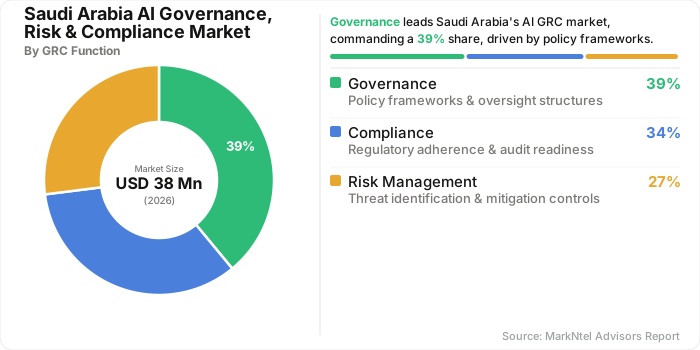
- In 2026, Governance leads GRC functions, contributing approximately a 39% share.
- Government & Public Sector dominates end-use segmentation, capturing around a 25% share in 2026.
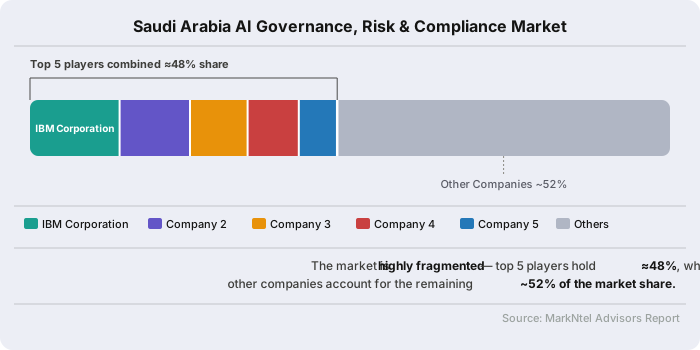
- The industry remains moderately fragmented, with the top five players collectively holding nearly a 48% share, balancing global leadership with emerging regional competition.
Saudi Arabia AI Governance, Risk & Compliance Market Size and Outlook
The AI governance, risk & compliance market size in the KSA is projected to grow from USD 31 million in 2025 to USD 38 million in 2026 and reach USD 77 million by 2032, at a CAGR of 12.49%. Growth is driven by rising AI adoption across government and enterprises. As deployments expand, organizations are adopting AI oversight tools to ensure accountability, transparency, and compliance. Increasing system complexity is further driving demand for structured governance frameworks that support efficient operations and reliable decision-making.
A key structural driver is the Kingdom’s cybersecurity ecosystem, which reached approximately USD 3.5 billion and is supported by a workforce of 19,600 professionals, including 32% women . This maturity provides a strong base for AI governance expansion, enabling organizations to extend existing security practices into intelligent systems. As AI becomes more embedded across sectors, demand for AI compliance systems is rising to standardize controls, manage risks, and ensure regulatory adherence across diverse operational environments and increasingly data-intensive digital infrastructures.
From a trend perspective, the emergence of sovereign and Arabic-first AI models is reshaping governance dynamics by embedding compliance capabilities directly into system architectures. This shift is complemented by infrastructure-scale investments, such as HUMAIN securing up to USD 1.2 billion to expand AI infrastructure, including 250 MW of data center capacity . As deployments expand, enterprises are increasingly adopting digital GRC platforms to manage decentralized AI environments, ensuring consistent governance, traceability, and policy enforcement across both centralized and distributed systems.
From an opportunity standpoint, regulatory advancements are creating a favorable environment for scalable AI governance solutions. SDAIA’s AI Adoption Framework, introduced in September 2024, formalizes lifecycle governance by translating ethical AI principles into enforceable operational standards. This creates opportunities for vendors offering sector-specific and regulator-aligned solutions that reduce compliance complexity. Collectively, the convergence of regulatory clarity, infrastructure expansion, and embedded governance trends positions the Saudi Arabia AI Governance, Risk & Compliance Industry for sustained, innovation-driven growth.
Saudi Arabia AI Governance, Risk & Compliance Market Key Indicators
- Saudi Arabia’s achievement of a perfect 100/100 score in the Global Cybersecurity Index 2024, with Tier 1 “Role-modelling” status, reflects unmatched maturity across legal, technical, organizational, capacity-building, and cooperation pillars. This elevated baseline compels enterprises to adopt advanced AI compliance tools that ensure continuous monitoring, audit readiness, and structured reporting, aligning internal governance mechanisms with globally benchmarked cybersecurity expectations.
- Ranking first globally in the cybersecurity indicator of the IMD World Competitiveness Yearbook 2025 highlights Saudi Arabia’s sustained institutional focus on governance excellence. Such leadership signals strong regulatory enforcement and funding momentum, prompting organizations to deploy AI governance framework solutions that integrate risk visibility, policy enforcement, and compliance tracking across both public institutions and highly regulated private-sector environments.
- With the AI economy projected to reach USD 135.2 billion by 2030, Saudi Arabia is rapidly embedding AI across mission-critical sectors such as finance, healthcare, and government services. This surge significantly increases the number of models requiring oversight, driving adoption of AI risk analytics platforms that enable proactive identification of model vulnerabilities, performance risks, and regulatory non-compliance in complex AI ecosystems.
- SDAIA’s strategy to achieve approximately 1.5 GW of data-center capacity by 2030 underscores a strong push toward localized digital infrastructure. This expansion heightens data residency, access governance, and audit obligations, encouraging enterprises to implement AI data governance systems that ensure in-country compliance, secure data lifecycle management, and transparent regulatory reporting aligned with national data sovereignty requirements.
Saudi Arabia AI Governance, Risk & Compliance Market Scope
| Category | Segments |
|---|---|
| By Component | Software (AI Governance Software, AI Risk Management Software, AI Compliance Software, AI Audit & Reporting Software), Services (Consulting & Advisory, Integration & Deployment, Support & Maintenance, Managed Services |
| By Deployment Mode | Cloud, On-Premises |
| By Organization Size | Large Enterprises, Small & Medium Enterprises (SMEs |
| By GRC Function | Governance (Policy & Framework Management, AI Model Inventory & Documentation, AI Lifecycle Governance & Controls), Risk Management (Model Risk Management (Validation & Performance Risk), Bias & Fairness Risk Management, Model Monitoring & Drift Risk Management), Compliance (Regulatory Compliance Management, Data Privacy & Protection Compliance, Compliance Reporting & Documentation |
| By End User | BFSI, Government & Public Sector, Healthcare, IT & Telecom, Energy & Utilities, Retail & E-commerce, Manufacturing, Others |
Saudi Arabia AI Governance, Risk & Compliance Market Growth Drivers
Government Digitization Fueling AI Compliance Infrastructure
Saudi Arabia’s public sector is the primary growth engine of the Saudi Arabia AI Governance, Risk & Compliance Market, as ministries integrate artificial intelligence into citizen services and administrative systems. The Emerging Technologies Readiness Index increased from 60.35% in 2023 to 70.70% in 2024, reflecting rapid adoption and expanding oversight requirements through structured AI policy management frameworks across government-led deployments .
Institutional advancement further strengthens this trajectory, as the Digital Transformation Measurement Index rose from 69.39% in 2021 to 87.14% in 2024 . Ministries now operate within standardized, auditable environments, increasing reliance on AI lifecycle governance systems that ensure traceability, enforce regulatory controls, and maintain transparency across interconnected platforms managing sensitive public-sector data and digital service operations at scale.
As adoption accelerates, operational complexity rises across healthcare, finance, and urban planning systems. This growth drives demand for AI monitoring tools capable of tracking model behavior, detecting anomalies, and ensuring compliance continuity. Increasing data intensity across public AI systems requires continuous validation mechanisms to mitigate risk exposure while maintaining regulatory alignment across evolving digital governance frameworks and institutional mandates.
Saudi Arabia’s institutional digitization and governance maturity are transforming compliance into a strategic capability, reinforcing sustained demand across the Saudi Arabia AI governance, risk & compliance industry through scalable oversight systems, stronger accountability frameworks, and integrated risk management approaches aligned with national digital transformation objectives.
Recent Trends
Emergence of sovereign and Arabic-first AI models
A defining trend within the Saudi Arabia AI Governance, Risk & Compliance Industry is the rise of sovereign, Arabic-first AI models designed with governance embedded at the architectural level. SDAIA’s launch of ALLaM on IBM’s watsonx platform reflects a strategic shift toward localized ecosystems where AI explainability (XAI) ensures transparency, regulatory alignment, and controlled deployment from the earliest stages of model lifecycle development.
This governance-by-design approach is expanding beyond centralized systems into edge environments. The ALLaM AI PC introduced by Qualcomm and SDAIA at LEAP 2025 demonstrates how sovereign AI execution can occur directly on devices, enabling localized processing and control. This shift strengthens reliance on AI audit systems to maintain traceability, enforce policies, and validate compliance across distributed AI environments.
Simultaneously, enterprises are prioritizing trust, performance stability, and ethical deployment as AI adoption scales. This has accelerated demand for AI validation tools that assess bias, model drift, and regulatory adherence, particularly within Arabic-language datasets where contextual accuracy and cultural alignment are critical for governance integrity across regulated sectors and public-facing digital services.
Collectively, the convergence of sovereign architectures, embedded governance, and localized execution is redefining compliance frameworks, positioning Saudi Arabia at the forefront of responsible AI innovation while enabling scalable, transparent, and regulation-ready deployment models across both centralized and decentralized artificial intelligence ecosystems.
Saudi Arabia AI Governance, Risk & Compliance Market Opportunities and Challenges
Regulatory Fragmentation Creating Demand for Specialized GRC
The Saudi Arabia AI governance, risk & compliance industry is constrained by a fragmented regulatory environment, where multiple authorities impose sector-specific mandates with distinct compliance structures. The National Cybersecurity Authority has introduced frameworks for cloud computing, critical systems, and data protection, increasing operational complexity and driving organizations toward compliance automation to manage overlapping controls, reporting requirements, and audit obligations efficiently.
This complexity is further amplified in the financial sector, where the Saudi Central Bank enforces frameworks such as Open Banking and updated 2025 banking regulations. These mandates extend governance accountability to senior management, requiring integrated risk, compliance & governance systems that align operational processes, policy enforcement, and reporting structures while reducing duplication across overlapping regulatory expectations and supervisory requirements.
However, this fragmented environment creates a clear opportunity for vendors delivering sector-specific solutions aligned with individual regulatory frameworks. Platforms leveraging RegTech AI with pre-mapped templates for NCA and SAMA requirements can reduce implementation timelines, improve compliance accuracy, and streamline audits, enabling organizations to efficiently manage regulatory obligations across BFSI, cloud, and critical infrastructure domains .
Furthermore, institutional enablers such as SAMA’s Regulatory Sandbox and Open Banking Lab provide structured pathways for testing and scaling compliance solutions . These initiatives support innovation while reducing deployment risks, allowing vendors to transform regulatory complexity into a competitive advantage through scalable, localized, and regulator-aligned AI governance platforms.
Segmentation Insights
Governance Frameworks Anchoring AI GRC Market Leadership
The Governance segment accounts for approximately 39% of total revenue within the Saudi Arabia AI Governance, Risk & Compliance Market, reflecting its foundational role in structuring enterprise-wide AI oversight. Organizations prioritize AI governance tools to establish policy frameworks, maintain model inventories, and ensure lifecycle accountability. This dominance is driven by regulatory expectations requiring clear documentation, auditability, and centralized control over AI deployments across public and private sector environments.
A key growth driver is the increasing complexity of AI systems, which necessitates structured oversight across model development and deployment stages. Capabilities such as policy and framework management, AI model documentation, and lifecycle controls enable organizations to align with evolving standards. The integration of AI control systems ensures consistency in governance practices while supporting scalability across multi-departmental AI implementations within regulated industries.
Additionally, governance functions act as the central layer connecting risk and compliance activities, reinforcing their strategic importance. By enabling traceability and standardized processes, governance platforms reduce operational silos and improve coordination between regulatory, technical, and business teams. This positioning ensures sustained demand, as enterprises seek unified frameworks to manage AI accountability and regulatory alignment effectively across expanding digital ecosystems. Based on GRC functions, the market is divided into:
- Governance
- Policy & Framework Management
- AI Model Inventory & Documentation
- AI Lifecycle Governance & Controls
- Risk Management
- Model Risk Management (Validation & Performance Risk)
- Bias & Fairness Risk Management
- Model Monitoring & Drift Risk Management
- Compliance
- Regulatory Compliance Management
- Data Privacy & Protection Compliance
- Compliance Reporting & Documentation
Government & Public Sector Emerges as Leading End-Use Vertical
The Government & Public Sector segment holds approximately 25% share, making it the leading contributor within the Saudi Arabia AI Governance, Risk & Compliance Market. This dominance is driven by the Kingdom’s extensive digital transformation initiatives, with over 3,500 government services delivered across more than 530 platforms . Such a scale necessitates robust AI governance framework adoption to ensure policy standardization, accountability, and regulatory compliance across interconnected public-sector systems.
The breadth of digital services significantly increases exposure to operational, data, and compliance risks, requiring advanced oversight mechanisms. Public entities are increasingly deploying AI monitoring tools to track system performance, detect anomalies, and maintain service reliability across high-volume citizen interactions. This need is amplified by the integration of AI into mission-critical services such as healthcare, urban planning, and financial administration.
Additionally, the public sector acts as a benchmark for other industries, setting governance standards that influence adoption across BFSI, healthcare, and energy sectors. The scale and complexity of government-led AI deployments drive demand for AI policy management solutions, ensuring consistent enforcement of regulations and alignment with national digital strategies, thereby sustaining its leadership position. The study covers the following key end-use industries:
- BFSI
- Government & Public Sector
- Healthcare
- IT & Telecom
- Energy & Utilities
- Retail & E-commerce
- Manufacturing
- Others
Saudi Arabia AI Governance, Risk & Compliance Market Competitive Analysis
The Saudi Arabia AI governance, risk & compliance industry exhibits a moderately fragmented competitive structure, with leading global technology providers including Microsoft Corporation, IBM Corporation, Oracle Corporation, SAP SE, and ServiceNow, Inc. collectively accounting for approximately 48% of total market share. Their dominance is supported by advanced AI capabilities, integrated cloud ecosystems, and established compliance platforms. Meanwhile, regional players such as Mozn, SCAI, and Bridge GRC are strengthening their presence through localized solutions and regulatory alignment.
Leading Companies in Saudi Arabia AI Governance, Risk & Compliance Industry
- IBM Corporation
- Microsoft Corporation
- Oracle Corporation
- SAP SE
- ServiceNow, Inc.
- SAS Institute Inc.
- Mozn
- Governata
- Saudi Company for Artificial Intelligence (SCAI)
- Bridge GRC
- Others
Saudi Arabia AI Governance, Risk & Compliance Industry News and Recent Developments:
October 2025: HUMAIN and Qualcomm Partner to Deploy Advanced AI Infrastructure in Saudi Arabia
HUMAIN and Qualcomm announced a strategic collaboration to deploy advanced AI infrastructure in Saudi Arabia. The initiative includes the rollout of 200 MW of Qualcomm AI200 and AI250 rack-scale solutions starting in 2026, creating one of the world's first fully optimized edge-to-cloud AI inferencing ecosystems. The partnership also integrates Saudi-developed ALLaM models with Qualcomm’s AI platforms to support enterprise and government AI applications.
Impact Analysis: This development significantly strengthens Saudi Arabia’s AI infrastructure foundation and accelerates demand for AI governance, risk, and compliance solutions. As large-scale AI inferencing environments expand, organizations will require stronger controls for model accountability, data governance, compliance monitoring, and operational oversight. The deployment is expected to increase adoption of AI governance frameworks across public-sector entities and enterprises while reinforcing Saudi Arabia’s position as a regional hub for sovereign and regulated AI ecosystems.
August 2025: HUMAIN Launches Arabic-Focused HUMAIN Chat Platform
HUMAIN introduced HUMAIN Chat, a locally developed Arabic-language AI chatbot designed to serve Arabic-speaking users with culturally relevant and linguistically optimized interactions. Built on Saudi-developed AI capabilities and aligned with national AI ambitions, the platform emphasizes localized AI experiences, data sovereignty, and greater control over AI deployment within the Kingdom’s digital ecosystem.
Impact Analysis: The launch highlights the growing importance of sovereign and Arabic-first AI systems, a trend increasing governance requirements around model transparency, content controls, bias management, and compliance monitoring. As localized AI models gain adoption across government and enterprise environments, organizations are expected to invest more heavily in governance and oversight mechanisms to ensure responsible deployment.
February 2025: Qualcomm and SDAIA Advance AI and 5G Innovation Through ALLaM AI PC
At LEAP 2025, Qualcomm and SDAIA unveiled the ALLaM AI PC, the first AI PC branded with a national large language model and capable of running ALLaM locally on-device. Qualcomm also expanded collaborations supporting AI-enabled industrial devices, AI startup development, and hybrid AI innovation, reinforcing Saudi Arabia’s broader vision of integrating AI and advanced connectivity technologies across industries.
Impact Analysis: The expansion of edge AI and on-device intelligence introduces new governance challenges related to decentralized AI deployment, model monitoring, and compliance management. As AI capabilities move beyond centralized environments into devices and industrial operations, organizations will require more sophisticated governance frameworks to maintain accountability and policy enforcement. This trend broadens the addressable market for AI governance, risk, and compliance platforms capable of managing distributed AI ecosystems at scale.
- Market Segmentation
- Introduction
- Product Definition
- Research Process
- Assumptions
- Executive Summary
- Saudi Arabia AI Governance, Risk & Compliance Market Policies, Regulations, and Product Standards
- Saudi Arabia AI Governance, Risk & Compliance Market Trends & Developments
- Saudi Arabia AI Governance, Risk & Compliance Market Dynamics
- Growth Factors
- Challenges
- Saudi Arabia AI Governance, Risk & Compliance Market Hotspot & Opportunities
- Saudi Arabia AI Governance, Risk & Compliance Market Outlook, 2022-2032F
- Market Size & Outlook
- By Revenues (USD Million)
- Market Share & Outlook
- By Component- Market Size & Forecast 2022-2032, USD Million
- Software
- AI Governance Software
- AI Risk Management Software
- AI Compliance Software
- AI Audit & Reporting Software
- Services
- Consulting & Advisory
- Integration & Deployment
- Support & Maintenance
- Managed Services
- Software
- By Deployment Mode- Market Size & Forecast 2022-2032, USD Million
- Cloud
- On-Premises
- By Organization Size- Market Size & Forecast 2022-2032, USD Million
- Large Enterprises
- Small & Medium Enterprises (SMEs)
- By GRC Function - Market Size & Forecast 2022-2032, USD Million
- Governance
- Policy & Framework Management
- AI Model Inventory & Documentation
- AI Lifecycle Governance & Controls
- Risk Management
- Model Risk Management (Validation & Performance Risk)
- Bias & Fairness Risk Management
- Model Monitoring & Drift Risk Management
- Compliance
- Regulatory Compliance Management
- Data Privacy & Protection Compliance
- Compliance Reporting & Documentation
- Governance
- By End User- Market Size & Forecast 2022-2032, USD Million
- BFSI
- Government & Public Sector
- Healthcare
- IT & Telecom
- Energy & Utilities
- Retail & E-commerce
- Manufacturing
- Others
- By Region - Market Size & Forecast 2022-2032, USD Million
- Riyadh
- Jeddah
- Damam
- Mecca & Madinah
- Others
- By Company
- Competition Characteristics
- Market Share & Analysis
- By Component- Market Size & Forecast 2022-2032, USD Million
- Market Size & Outlook
- Saudi Arabia Software Market Outlook, 2022-2032
- Market Size & Outlook
- By Revenues (USD Million)
- Market Share & Outlook
- By Deployment Mode- Market Size & Forecast 2022-2032, USD Million
- By Organization Size- Market Size & Forecast 2022-2032, USD Million
- By GRC Function - Market Size & Forecast 2022-2032, USD Million
- By End User- Market Size & Forecast 2022-2032, USD Million
- By Region - Market Size & Forecast 2022-2032, USD Million
- Market Size & Outlook
- Saudi Arabia Services Market Outlook, 2022-2032
- Market Size & Outlook
- By Revenues (USD Million)
- Market Share & Outlook
- By Deployment Mode- Market Size & Forecast 2022-2032, USD Million
- By Organization Size- Market Size & Forecast 2022-2032, USD Million
- By GRC Function - Market Size & Forecast 2022-2032, USD Million
- By End User- Market Size & Forecast 2022-2032, USD Million
- By Region - Market Size & Forecast 2022-2032, USD Million
- Market Size & Outlook
- Saudi Arabia AI Governance, Risk & Compliance Market Key Strategic Imperatives for Success & Growth
- Competitive Outlook
- Company Profiles
- IBM Corporation
- Business Description
- Product Portfolio
- Collaborations & Alliances
- Recent Developments
- Financial Details
- Others
- Microsoft Corporation
- Business Description
- Product Portfolio
- Collaborations & Alliances
- Recent Developments
- Financial Details
- Others
- Oracle Corporation
- Business Description
- Product Portfolio
- Collaborations & Alliances
- Recent Developments
- Financial Details
- Others
- SAP SE
- Business Description
- Product Portfolio
- Collaborations & Alliances
- Recent Developments
- Financial Details
- Others
- ServiceNow, Inc.
- Business Description
- Product Portfolio
- Collaborations & Alliances
- Recent Developments
- Financial Details
- Others
- SAS Institute Inc.
- Business Description
- Product Portfolio
- Collaborations & Alliances
- Recent Developments
- Financial Details
- Others
- Mozn
- Business Description
- Product Portfolio
- Collaborations & Alliances
- Recent Developments
- Financial Details
- Others
- Governata
- Business Description
- Product Portfolio
- Collaborations & Alliances
- Recent Developments
- Financial Details
- Others
- Saudi Company for Artificial Intelligence (SCAI)
- Business Description
- Product Portfolio
- Collaborations & Alliances
- Recent Developments
- Financial Details
- Others
- Bridge GRC
- Business Description
- Product Portfolio
- Collaborations & Alliances
- Recent Developments
- Financial Details
- Others
- Others
- IBM Corporation
- Company Profiles
- Disclaimer

MarkNtel Advisors follows a robust and iterative research methodology designed to ensure maximum accuracy and minimize deviation in market estimates and forecasts. Our approach combines both bottom-up and top-down techniques to effectively segment and quantify various aspects of the market. A consistent feature across all our research reports is data triangulation, which examines the market from three distinct perspectives to validate findings. Key components of our research process include:
1. Scope & Research Design At the outset, MarkNtel Advisors define the research objectives and formulate pertinent questions. This phase involves determining the type of research—qualitative or quantitative—and designing a methodology that outlines data collection methods, target demographics, and analytical tools. They also establish timelines and budgets to ensure the research aligns with client goals.
2. Sample Selection and Data Collection In this stage, the firm identifies the target audience and determines the appropriate sample size to ensure representativeness. They employ various sampling methods, such as random or stratified sampling, based on the research objectives. Data collection is carried out using tools like surveys, interviews, and observations, ensuring the gathered data is reliable and relevant.
3. Data Analysis and Validation Once data is collected, MarkNtel Advisors undertake a rigorous analysis process. This includes cleaning the data to remove inconsistencies, employing statistical software for quantitative analysis, and thematic analysis for qualitative data. Validation steps are taken to ensure the accuracy and reliability of the findings, minimizing biases and errors.

4. Data Forecast and FinalizationThe final phase involves forecasting future market trends based on the analyzed data. MarkNtel Advisors utilize predictive modeling and time series analysis to anticipate market behaviors. The insights are then compiled into comprehensive reports, featuring visual aids like charts and graphs, and include strategic recommendations to inform client decision-making
FILL THE FORM TO GET THE FREE SAMPLE PAGES
We offer flexible licensing options to cater to varying organizational needs. Choose the pricing pack that best suits your requirements:
Buy Now Inquire Before Buying
 Talk to our Consultant
 Request Customization