

By Detector Type (Hardware (Handheld Detectors, Fixed Detectors, UAV-Based Detectors), Software, Services), By Technology (Optical Gas Imaging (OGI), Acoustic Detection, Laser-Base......d Detection, IoT-Based Monitoring, AI & Predictive Analytics, Drone-Based Inspection, others), By Equipment Type (Pipelines, Valves, Pumps, Compressors, Storage Tanks, Flanges & Connectors, Pressure Relief Devices), By Leak Type (Gas Leaks, Liquid Leaks, Steam Leaks, Vacuum Leaks), By End Users (Oil & Gas Industry, Chemical Plants, Water Treatment Plants, Power Plants, Mining & Slurry, Commercial, Residential, Others), and others Read more
- Buildings, Construction, Metals & Mining
- Jun 2026
- 300
- PDF, Excel, PPT
Latin America Leak Detection and Repair Market Key Takeaways
- The Latin America LDAR market was valued at USD 578 million in 2025 and is projected to reach USD 611 million in 2026, further expanding to USD 817 million by 2032.
- The industry is projected to witness steady growth at a CAGR of 4.96% during 2026–2032.
- Hardware-based solutions dominate the market, accounting for approximately 42% of total revenue in 2026.
- By equipment type, pipelines represent the largest segment with a 34% market share in 2026.
- Brazil is the leading regional market, accounting for approximately 31% of total LDAR demand across the Latin America.
- The competitive landscape is moderately consolidated, with the top five companies collectively holding around 30% of the market share.
Latin America Leak Detection and Repair Market Size and Outlook
The Latin America Leak Detection and Repair Market size was valued at USD 578 Million in 2025, to USD 611 Million in 2026 and is projected to reach USD 817 Million by 2032, growing at a CAGR of 4.96%.
Demand for industrial leak detection systems across Latin America is structurally driven by the region's extensive and aging oil and gas asset base, which generates persistent fugitive emissions requiring continuous monitoring and repair. According to the IEA's Global Methane Tracker 2025, the fossil fuel sector in Central and South America emitted approximately 8 Mt of methane in 2024, with oil and gas facilities identified as the primary sources of emissions in Venezuela, Argentina, and Brazil.
Argentina's upstream methane intensity is roughly twice the global average, a gap that oil and gas LDAR solutions are specifically deployed to close, while Brazil's Petrobras runs the largest refining complex in Latin America, encompassing 19 refineries , each requiring pipeline leak detection and fugitive emissions monitoring infrastructure.
Regulatory compliance is converting voluntary adoption of environmental compliance solutions into mandatory procurement. Colombia's Ministry of Mines and Energy enacted MME Resolution 40066/2022, updated as MME Resolution 40317/2023, making Colombia one of the first countries to adopt a regulation specifically covering the detection and repair of fugitive methane emissions in the upstream oil and gas sector. Mexico's regulatory agency ASEA targets a 50% reduction in sector methane by 2025, and Pemex's 2024 Sustainability Plan commits to reducing methane emissions by 30% by 2030 against 2020 baseline levels.
These mandates are directly accelerating demand for VOC emissions detection systems, continuous emissions monitoring systems, and optical gas imaging cameras across Mexico and Colombia's oil and gas corridors. Moreover, large-scale infrastructure expansion across the region is enlarging the asset base subject to LDAR compliance. Brazil's Rota 3 Gas Pipeline and the Boaventura Energy Complex commenced commercial operations in late 2024, adding 21 million m³/day of gas processing capacity to the national grid. This extraterritorial compliance pressure is accelerating the adoption of advanced gas leak detection technologies and industrial asset integrity management platforms across Brazil and Argentina's export-oriented operators.
Collectively, mandatory national regulations, growing pipeline networks, and international market access requirements position the Latin America fugitive emissions management sector for sustained expansion through 2032.
Latin America Leak Detection and Repair Market Key Indicators
- According to Brazil's National Agency of Petroleum, Natural Gas, and Biofuels (ANP), Brazil's total oil and natural gas production reached a record 4.897 million barrels of oil equivalent per day (boe/d) in 2025, a 13.3% increase over 2024 output. This unprecedented production volume expands the number of active offshore platforms, subsea pipelines, and onshore processing units requiring systematic fugitive emissions monitoring and pipeline leak detection across Brazil's oil and gas sector.
- According to the U.S. Energy Information Administration (EIA), Argentina's crude oil production averaged 670,000 barrels per day (b/d) in 2024 and is forecast to reach 810,000 b/d in 2026, with Vaca Muerta unconventional output accounting for an estimated 62% of total production between January and October 2025. The rapid expansion of well pads, gathering pipelines, and compressor stations across the Vaca Muerta shale play directly enlarges the asset base, mandating continuous LDAR inspection and repair under Argentina's growing environmental compliance requirements.
- According to the IEA's Global Methane Tracker 2025, approximately 25 Mt of methane emissions from upstream oil and gas operations equivalent to 40% of all upstream oil and gas methane emissions worldwide could have been avoided at no net cost in 2024, with leak detection and repair (LDAR) identified as among the most cost-effective abatement measures available; this cost-economics gap is a direct commercial trigger for LDAR technology procurement by Latin American NOCs and independent operators seeking both compliance and financial recovery of leaked gas.
- According to ICLG's Oil and Gas Laws and Regulations Report 2026 for Brazil, the GASFOR II pipeline a midstream gas transmission project connecting northeastern Brazil, was completed by TAG in 2025, reinforcing supply security in the region and extending the natural gas transmission network; each new pipeline segment added to Brazil's transmission grid requires pre-commissioning leak testing and ongoing LDAR compliance surveys across valves, flanges, connectors, and pressure relief devices, directly generating incremental demand for pipeline leak detection technologies and services.
Latin America Leak Detection and Repair Market Scope
| Category | Segments |
|---|---|
| By Detector Type | Hardware (Handheld Detectors, Fixed Detectors, UAV-Based Detectors), Software, Services |
| By Technology | Optical Gas Imaging (OGI), Acoustic Detection, Laser-Based Detection, IoT-Based Monitoring, AI & Predictive Analytics, Drone-Based Inspection, others |
| By Equipment Type | Pipelines, Valves, Pumps, Compressors, Storage Tanks, Flanges & Connectors, Pressure Relief Devices |
| By Leak Type | Gas Leaks, Liquid Leaks, Steam Leaks, Vacuum Leaks |
| By End Users | Oil & Gas Industry, Chemical Plants, Water Treatment Plants, Power Plants, Mining & Slurry, Commercial, Residential, Others |
Latin America Leak Detection and Repair Industry Growth Drivers
Mandatory Compliance Obligations Across Expanding Latin American Hydrocarbon Production Assets
The primary driver of demand for Leak Detection and Repair (LDAR) solutions across Latin America is the rapid expansion of the region’s oil and gas infrastructure. National oil companies are drilling more wells, commissioning new pipelines, and expanding gas processing operations, resulting in a growing inventory of valves, connectors, compressors, and other equipment that must be regularly monitored for emissions and leaks.
Each new asset added to the network increases the scope of inspection and maintenance requirements under environmental regulations. As a result, investment in LDAR solutions is not discretionary but is directly tied to mandatory compliance obligations, making monitoring and repair expenditures an integral component of ongoing production growth across the region.
Ecopetrol's board-approved 2026 Annual Investment Plan, filed with the U.S. Securities and Exchange Commission, commits to drilling between 380 and 430 development wells in 2026, 95% within Colombia, targeting production of 730 to 740 thousand barrels of oil equivalent per day. Each new well pad and its associated gathering network represents a cluster of valves, flanges, and compressors that Colombia's MME Resolution 40317/2023 mandates be individually surveyed for fugitive methane emissions, making LDAR procurement an unavoidable cost of production scale-up.
The scale compounds further at the project level across the region. In Argentina, YPF and Eni signed a binding agreement in June 2025 to advance the Argentina LNG project, which is designed to develop Vaca Muerta's gas resources through floating liquefaction units targeting export capacity of up to 30 million tonnes per year by 2030.
Projects of this scale integrating upstream wells, onshore processing trains, and export pipelines require continuous methane monitoring and optical gas imaging programs at every stage of the value chain to satisfy both domestic environmental standards and the OGMP 2.0 requirements that European LNG buyers will contractually enforce from 2027. The result is a causation chain that is entirely specific to Latin America production growth that leads to new asset inventory, which further leads to mandatory inspection obligations and then sustained and growing demand for smart leak detection technologies and associated LDAR software across the region's entire oil and gas infrastructure.
Recent Trends
Rising Adoption of UAV and Vehicle-Based Sensors Over Manual Inspections Across Latin American Oil and Gas Networks
Across Latin America's oil and gas sector, a sustained directional shift is underway; operators are replacing manual handheld inspections with UAV-based detectors and autonomous mobile platforms to cover remote pipeline and production networks that ground crews cannot efficiently survey.
This transition is driven by the practical impossibility of manually inspecting assets spread across Andean terrain, Amazon basin infrastructure, and offshore platform environments where periodic foot surveys leave extended windows of undetected leakage between visits. The commercial evidence is concrete.
For instance, in 2025, SLB entered a long-term preferred partnership with ANYbotics to deploy its ANYmal autonomous inspection robot capable of delegating up to 96% of routine inspections and delivering a 70% reduction in human task involvement, with initial deployments explicitly targeting the Americas region, including active installations at Petrobras facilities in Brazil.
In June 2025, ANYbotics separately launched a dedicated Gas Leak and Presence Detection capability for ANYmal, integrating 360° acoustic imaging to detect and quantify fugitive hydrocarbon emissions in real time across compressor stations, storage tanks, and pipeline valve clusters.
As regulatory inspection frequencies tighten under Colombia's MME Resolution 40317/2023 and Brazil's emerging upstream methane framework, AI-powered leak detection and autonomous industrial emissions monitoring platforms will progressively displace periodic manual surveys as the operational standard across the region.
Latin America Leak Detection and Repair Industry Opportunities and Challenges
Acute Skilled Workforce Shortage in Latin America Creating Demand for Turnkey LDAR Service Models and Embedded Technical Training
Latin America's capacity to execute mandatory leak detection and repair compliance programs is directly constrained by a structural skilled workforce deficit. According to the OECD's Latin American Economic Outlook 2025, companies in the region are 13 times more likely to experience performance problems due to skills deficits than firms in East Asia, the worst ratio globally, and energy ranks among the most talent-constrained sectors, with 73% of employers in Mexico reporting difficulty finding qualified technical staff.
For operators across Brazil, Colombia, and Argentina, this deficit is operationally critical: mandatory VOC emissions detection and optical gas imaging surveys require certified technicians that most facilities cannot source locally, forcing reliance on outsourced full-service providers who supply equipment, trained personnel, and compliance documentation under a single contract.
This constraint simultaneously opens a measurable commercial opportunity. The Inter-American Development Bank's TVET Fund has, since 2019, financed 29 projects across 16 countries, training more than 34,000 individuals and developing 700 skill-based training modules specifically to bridge regional technical capability gaps.
As this infrastructure scales, supported by USD 2 billion in FDI directed toward vocational training centers between 2014 and 2024, LDAR service providers and environmental compliance solutions companies that embed certified technician training into long-term contracts will capture durable, compliance-driven revenue across Latin America's industrial emissions control market through 2032.
Segmentation Insights
Handheld Detectors Dominate as the Most Widely Deployed Hardware in Latin American LDAR Programs
Handheld detectors account for approximately 42% of the Latin America LDAR market by detector type, establishing them as the most widely deployed handheld gas detection instruments across the region's upstream and midstream inspection programs.
Their dominance is directly tied to the structure of regulatory compliance workflows: Colombia's MME Resolution 40317/2023 and equivalent frameworks in Brazil and Mexico mandate component-level inspections physically scanning individual valves, flanges, and connectors requiring portable, technician-operated instruments capable of real-time on-site identification.
Handheld devices fulfill this at a fraction of the capital cost of fixed sensor networks, making them the first-choice procurement category for operators managing dispersed well-pad and pipeline assets across challenging terrain.
The innovation signal from technology providers reinforces this demand trajectory; for example, in May 2025, Teledyne FLIR OEM and AerialOGI launched the AerialOGI-N, the industry's first infrared gas detection module offering two-click connection to both handheld and drone-mounted gimbals, capable of detecting more than 25 greenhouse gases in real time, directly validating that handheld form factors remain central to field inspection workflows even as aerial capabilities expand.
UAV-based detectors are the fastest-growing sub-segment within hardware, driven by the geographic scale of remote Andean and Amazon basin assets. As inspection obligations intensify and operators seek greater coverage per technician deployment, the integration of portable and aerial infrared gas detection capabilities will progressively define hardware procurement across the region's expanding compliance programs. By detector type, the market is further divided into the following sub-categories:
- Hardware
- Handheld Detectors,
- Fixed Detectors,
- UAV-Based Detectors
- Software
- Services
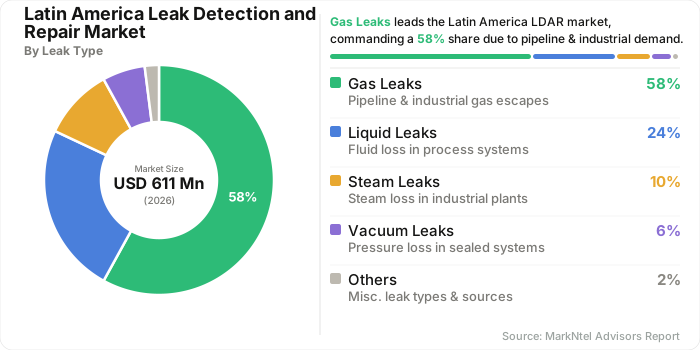
Pipelines Lead as the Dominant Equipment Type Requiring Systematic Leak Inspection Across Latin America
Pipelines account for approximately 34% of the Latin America LDAR market by equipment type, making them the dominant asset class driving pipeline integrity monitoring demand across the region. This reflects a structural reality: pressurized flow lines carry the highest concentration of regulated emission sources per asset valves, flanges, connectors, and metering points and attract the most frequent mandatory inspection intervals under Colombia's, Brazil's, and Mexico's emissions frameworks, as undetected leaks at pipeline components release methane at scale relative to other equipment categories.
The commercial expansion of this asset class directly sustains inspection demand: in March 2024, Brazil's Gasmig commenced construction of the Central-West Gas Pipeline in Minas Gerais, adding approximately 300 km of new distribution network at an investment of over USD 800 million and a gas consumption potential of 8.1 MMcf/d creating new mandatory inspection scope at every valve cluster, metering station, and flange connection across the expanded network.
Compressors and storage tanks represent the fastest-growing equipment sub-segments, driven by Argentina's active expansion and reversal of compressor stations along the North Gasduct to route Vaca Muerta gas northward. As new pipeline capacity and associated compression infrastructure comes online across Brazil, Argentina, and Colombia through 2030, acoustic leak detection and pressure relief device monitoring will account for a growing share of equipment-type inspection expenditure, broadening the addressable base for fugitive emissions detection equipment providers well beyond pipelines alone. By equipment type, the market is further segmented into the following sub-categories:
- Pipelines
- Valves
- Pumps
- Compressors
- Storage Tanks
- Flanges & Connectors
- Pressure Relief Devices
Latin America Leak Detection and Repair Industry Geographical Analysis
Brazil accounted for the largest share of the Latin America Leak Detection and Repair (LDAR) market of 31%, establishing itself as the primary demand center for emission monitoring and compliance solutions across the region.
The country's dominant position is supported by its extensive oil and gas infrastructure, stringent environmental oversight, and large base of regulated emission sources requiring continuous monitoring and maintenance. As LDAR programs become increasingly important for reducing methane emissions and ensuring regulatory compliance, Brazil's vast upstream and midstream hydrocarbon operations continue to generate substantial demand for leak detection technologies and repair services.
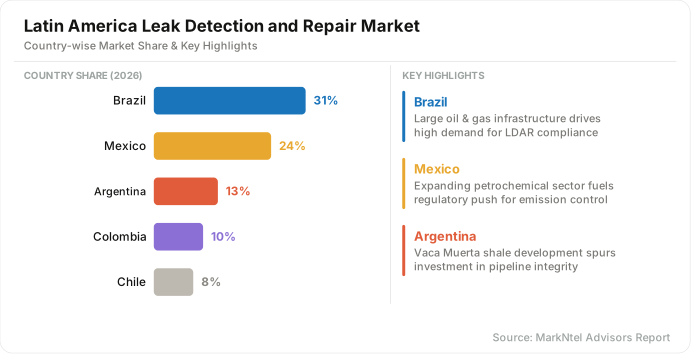
According to Brazil's ANP, oil and gas production in August 2024 originated from 6,432 active wells, 493 offshore and 5,939 onshore, each representing regulated emission sources requiring periodic fugitive emissions surveys across wellheads, pipelines, valves, and processing equipment.
No other Latin American country operates a comparable combination of deepwater offshore platforms, onshore fields, and midstream infrastructure within a single jurisdiction, making Brazil's LDAR inspection workload structurally larger than any regional place.
At the operator level, Brazil's Energy Research Company (EPE) confirmed in its July 2025 Decarbonization Scenarios report that Petrobras achieved a 32% methane emissions reduction through LDAR programs across its refining operations, with structured LDAR now being extended into the Exploration and Production segment using OGI technologies, the first formal rollout of component-level fugitive emissions detection across Brazil's upstream asset base.
Looking ahead, ANP Resolution 806/2020 mandates that offshore units commencing operations after 2025 must limit routine flaring to 2%, enforcing a Gas Utilization Index of 98%, converting every new pre-salt platform into a mandatory continuous monitoring and repair obligation , and ensuring the Brazil LDAR Market remains the primary engine of methane emissions reduction solutions demand across the region through 2032.
Latin America Leak Detection and Repair Industry Competitive Landscape
The Latin America Leak Detection and Repair market is moderately consolidated, with a mix of global industrial technology providers, gas detection specialists, inspection service companies, and emissions-monitoring firms competing across the region. The top five players in the Latin America LDAR market are Honeywell International Inc., Emerson Electric Co., Teledyne FLIR LLC, ABB Ltd., and Baker Hughes, collectively holding a share of 30%.
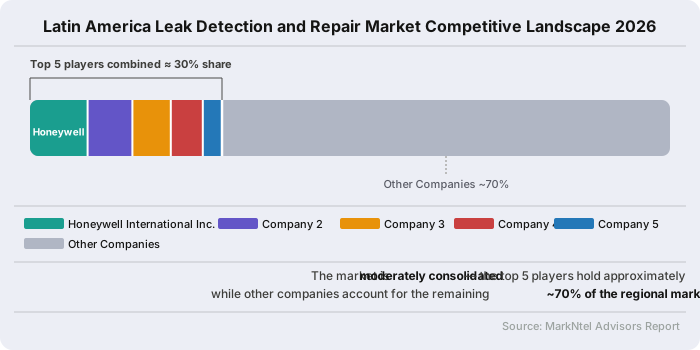
Major Companies in the Latin America Leak detection and Repair Market
- Honeywell International Inc.
- Emerson Electric Co.
- Teledyne FLIR LLC
- Dräger
- MSA Safety Incorporated
- Picarro Inc.
- ABB Ltd.
- Atmos International
- SeekOps Inc.
- Bridger Photonics, Inc.
- KLINGER Group
- Swagelok
- Baker Hughes
- SGS S.A.
- Bureau Veritas S.A.
- TEAM, Inc.
Latin America Leak Detection and Repair Industry News and Recent Developments
2026: Ecopetrol Initiates Acquisition of 51% Controlling Stake in Brava Energia to Expand Hydrocarbon Asset Base in Brazil
Ecopetrol S.A. announced in April, 2026, a Share Purchase Agreement to acquire approximately 26% of Brava Energia S.A.'s outstanding shares, with a subsequent voluntary tender offer launched on May 25, 2026, targeting a total controlling voting stake of 51%. Brava Energia, incorporated in 2024 from the merger of 3R Petroleum and Enauta Participações, holds 459 million barrels of oil equivalent in proven 1P reserves and reported production of approximately 81,000 barrels per day as of 2025, with an EBITDA of USD 806 million and an EBITDA margin of 39%. The tender offer was priced at R$23.00 per share, representing a premium of approximately 20.9% over the company's 90-day volume-weighted average price.
Impact Analysis: Ecopetrol's acquisition of Brava Energia significantly expands the combined group's onshore and offshore asset footprint across multiple Brazilian basins, adding 459 million boe of reserves subject to Brazil's evolving LDAR compliance obligations. The consolidation of two mid-size operators under a single compliance framework concentrates fugitive emissions inspection obligations and the associated procurement of detection equipment and services into one entity, increasing demand density and providing structured LDAR service providers with a larger single-customer addressable scope within Brazil's upstream sector.
2026: Baker Hughes Secures Order from San Matias Pipeline S.A. to Supply First NovaLT™ Gas Turbines in South America for Argentina's LNG Export Infrastructure
Baker Hughes announced on April 7, 2026, that it had secured a strategic order from San Matias Pipeline S.A. to supply three NovaLT™16 gas turbines equipped with three centrifugal compressors, along with commissioning services, spare parts, special tools, and remote monitoring and diagnostic capabilities. The equipment will be installed at a gas compressor station near Allen, Río Negro province, to support the transportation of natural gas from the Vaca Muerta formation through a dedicated pipeline to Southern Energy's two floating LNG vessels at the Gulf of San Matias. This marks the first deployment of Baker Hughes' NovaLT™ gas turbine technology in South America.
Impact analysis: The commissioning of three new compressor stations in Argentina's midstream LNG export corridor directly enlarges the inventory of regulated fugitive emission sources: compressors, flanges, and valve clusters requiring periodic LDAR inspection under Argentina's growing environmental compliance framework. Each compressor station added to the Vaca Muerta-to-Gulf corridor creates a defined inspection asset that operators must survey at mandated intervals, translating infrastructure investment into durable, recurring demand for detection equipment and inspection services across Argentina's expanding midstream network.
2025: Pemex and Mexican Petroleum Institute Launch National Methane-Cut Program in Collaboration with the World Bank Targeting 35 Priority LDAR Projects
In November 2025, Pemex and the Mexican Petroleum Institute (IMP) launched the development of a national methane emissions reduction program in collaboration with the World Bank under its Global Flaring and Methane Reduction (GFMR) initiative. The program was initiated at a workshop titled "Actions and Proposals to Develop a Comprehensive Methane Emissions Reduction Program," bringing together specialists from Pemex, IMP, and the World Bank to design coordinated strategies for methane detection, quantification, and mitigation. Pemex has formally identified 35 priority flaring and methane-reduction projects, with GFMR actively supporting project screening, site visits, and vent-gas assessments. A pilot vent-gas recovery program is being developed for a compressor station in Tabasco state as a concrete first deployment under the partnership.
Impact Analysis: The formalisation of a 35-project LDAR and methane abatement pipeline for Pemex Mexico's dominant upstream operator responsible for the majority of the country's oil and gas production directly translates into structured procurement demand for detection hardware, portable monitoring instruments, and site-level inspection services across Pemex's upstream, midstream, and refining asset network. For LDAR service providers operating in Latin America, the GFMR-supported programme establishes Pemex as an active, externally funded compliance buyer, reducing the financing barrier that has historically constrained Mexico's emissions monitoring market adoption.
- Market Segmentation
- Introduction
- Product Definition
- Research Process
- Assumptions
- Executive Summary
- Latin America Leak Detection and Repair Market Policies, Regulations, and Product Standards
- Latin America Leak Detection and Repair Market Trends & Developments
- Latin America Leak Detection and Repair Market Dynamics
- Growth Factors
- Challenges
- Latin America Leak Detection and Repair Market Hotspot & Opportunities
- Latin America Leak Detection and Repair Market Outlook, 2022-2032F
- Market Size & Outlook
- By Revenues (USD Million)
- Market Share & Analysis
- By Detector Type- Market Size & Forecast 2022-2032, USD Million
- Hardware
- Handheld Detectors
- Fixed Detectors
- UAV-Based Detectors
- Software
- Services
- Hardware
- By Technology- Market Size & Forecast 2022-2032, USD Million
- Optical Gas Imaging (OGI)
- Acoustic Detection
- Laser-Based Detection
- IoT-Based Monitoring
- AI & Predictive Analytics
- Drone-Based Inspection
- others
- By Equipment Type- Market Size & Forecast 2022-2032, USD Million
- Pipelines
- Valves
- Pumps
- Compressors
- Storage Tanks
- Flanges & Connectors
- Pressure Relief Devices
- By Leak Type- Market Size & Forecast 2022-2032, USD Million
- Gas Leaks
- Liquid Leaks
- Steam Leaks
- Vacuum Leaks
- By End Users- Market Size & Forecast 2022-2032, USD Million
- Oil & Gas Industry
- Chemical Plants
- Water Treatment Plants
- Power Plants
- Mining & Slurry
- Commercial
- Residential
- Others
- By Country
- Brazil
- Mexico
- Argentina
- Chile
- Colombia
- Peru
- Rest of Latin America
- By Company
- Competition Characteristics
- Market Share & Analysis
- By Detector Type- Market Size & Forecast 2022-2032, USD Million
- Market Size & Outlook
- Brazil Leak Detection and Repair Market Outlook, 2022-2032F
- Market Size & Outlook
- By Revenues (USD Million)
- Market Share & Analysis
- By Detector Type- Market Size & Forecast 2022-2032, USD Million
- By Technology- Market Size & Forecast 2022-2032, USD Million
- By Equipment Type- Market Size & Forecast 2022-2032, USD Million
- By Leak Type- Market Size & Forecast 2022-2032, USD Million
- By End Users- Market Size & Forecast 2022-2032, USD Million
- Market Size & Outlook
- Mexico Leak Detection and Repair Market Outlook, 2022-2032F
- Market Size & Outlook
- By Revenues (USD Million)
- Market Share & Analysis
- By Detector Type- Market Size & Forecast 2022-2032, USD Million
- By Technology- Market Size & Forecast 2022-2032, USD Million
- By Equipment Type- Market Size & Forecast 2022-2032, USD Million
- By Leak Type- Market Size & Forecast 2022-2032, USD Million
- By End Users- Market Size & Forecast 2022-2032, USD Million
- Market Size & Outlook
- Argentina Leak Detection and Repair Market Outlook, 2022-2032F
- Market Size & Outlook
- By Revenues (USD Million)
- Market Share & Analysis
- By Detector Type- Market Size & Forecast 2022-2032, USD Million
- By Technology- Market Size & Forecast 2022-2032, USD Million
- By Equipment Type- Market Size & Forecast 2022-2032, USD Million
- By Leak Type- Market Size & Forecast 2022-2032, USD Million
- By End Users- Market Size & Forecast 2022-2032, USD Million
- Market Size & Outlook
- Chile Leak Detection and Repair Market Outlook, 2022-2032F
- Market Size & Outlook
- By Revenues (USD Million)
- Market Share & Analysis
- By Detector Type- Market Size & Forecast 2022-2032, USD Million
- By Technology- Market Size & Forecast 2022-2032, USD Million
- By Equipment Type- Market Size & Forecast 2022-2032, USD Million
- By Leak Type- Market Size & Forecast 2022-2032, USD Million
- By End Users- Market Size & Forecast 2022-2032, USD Million
- Market Size & Outlook
- Colombia Leak Detection and Repair Market Outlook, 2022-2032F
- Market Size & Outlook
- By Revenues (USD Million)
- Market Share & Analysis
- By Detector Type- Market Size & Forecast 2022-2032, USD Million
- By Technology- Market Size & Forecast 2022-2032, USD Million
- By Equipment Type- Market Size & Forecast 2022-2032, USD Million
- By Leak Type- Market Size & Forecast 2022-2032, USD Million
- By End Users- Market Size & Forecast 2022-2032, USD Million
- Market Size & Outlook
- Peru Leak Detection and Repair Market Outlook, 2022-2032F
- Market Size & Outlook
- By Revenues (USD Million)
- Market Share & Analysis
- By Detector Type- Market Size & Forecast 2022-2032, USD Million
- By Technology- Market Size & Forecast 2022-2032, USD Million
- By Equipment Type- Market Size & Forecast 2022-2032, USD Million
- By Leak Type- Market Size & Forecast 2022-2032, USD Million
- By End Users- Market Size & Forecast 2022-2032, USD Million
- Market Size & Outlook
- Latin America Leak Detection and Repair Market Key Strategic Imperatives for Success & Growth
- Competitive Outlook
- Company Profiles
- Honeywell International Inc.
- Business Description
- Product Portfolio
- Collaborations & Alliances
- Recent Developments
- Financial Details
- Others
- Emerson Electric Co.
- Business Description
- Product Portfolio
- Collaborations & Alliances
- Recent Developments
- Financial Details
- Others
- Teledyne FLIR LLC
- Business Description
- Product Portfolio
- Collaborations & Alliances
- Recent Developments
- Financial Details
- Others
- Dräger
- Business Description
- Product Portfolio
- Collaborations & Alliances
- Recent Developments
- Financial Details
- Others
- MSA Safety Incorporated
- Business Description
- Product Portfolio
- Collaborations & Alliances
- Recent Developments
- Financial Details
- Others
- Picarro Inc.
- Business Description
- Product Portfolio
- Collaborations & Alliances
- Recent Developments
- Financial Details
- Others
- ABB Ltd.
- Business Description
- Product Portfolio
- Collaborations & Alliances
- Recent Developments
- Financial Details
- Others
- Atmos International
- Business Description
- Product Portfolio
- Collaborations & Alliances
- Recent Developments
- Financial Details
- Others
- SeekOps Inc.
- Business Description
- Product Portfolio
- Collaborations & Alliances
- Recent Developments
- Financial Details
- Others
- Bridger Photonics, Inc.
- Business Description
- Product Portfolio
- Collaborations & Alliances
- Recent Developments
- Financial Details
- Others
- KLINGER Group
- Business Description
- Product Portfolio
- Collaborations & Alliances
- Recent Developments
- Financial Details
- Others
- Swagelok
- Business Description
- Product Portfolio
- Collaborations & Alliances
- Recent Developments
- Financial Details
- Others
- Baker Hughes
- Business Description
- Product Portfolio
- Collaborations & Alliances
- Recent Developments
- Financial Details
- Others
- SGS S.A.
- Business Description
- Product Portfolio
- Collaborations & Alliances
- Recent Developments
- Financial Details
- Others
- Bureau Veritas S.A.
- Business Description
- Product Portfolio
- Collaborations & Alliances
- Recent Developments
- Financial Details
- Others
- TEAM, Inc.
- Business Description
- Product Portfolio
- Collaborations & Alliances
- Recent Developments
- Financial Details
- Others
- Honeywell International Inc.
- Company Profiles
- Disclaimer

MarkNtel Advisors follows a robust and iterative research methodology designed to ensure maximum accuracy and minimize deviation in market estimates and forecasts. Our approach combines both bottom-up and top-down techniques to effectively segment and quantify various aspects of the market. A consistent feature across all our research reports is data triangulation, which examines the market from three distinct perspectives to validate findings. Key components of our research process include:
1. Scope & Research Design At the outset, MarkNtel Advisors define the research objectives and formulate pertinent questions. This phase involves determining the type of research—qualitative or quantitative—and designing a methodology that outlines data collection methods, target demographics, and analytical tools. They also establish timelines and budgets to ensure the research aligns with client goals.
2. Sample Selection and Data Collection In this stage, the firm identifies the target audience and determines the appropriate sample size to ensure representativeness. They employ various sampling methods, such as random or stratified sampling, based on the research objectives. Data collection is carried out using tools like surveys, interviews, and observations, ensuring the gathered data is reliable and relevant.
3. Data Analysis and Validation Once data is collected, MarkNtel Advisors undertake a rigorous analysis process. This includes cleaning the data to remove inconsistencies, employing statistical software for quantitative analysis, and thematic analysis for qualitative data. Validation steps are taken to ensure the accuracy and reliability of the findings, minimizing biases and errors.

4. Data Forecast and FinalizationThe final phase involves forecasting future market trends based on the analyzed data. MarkNtel Advisors utilize predictive modeling and time series analysis to anticipate market behaviors. The insights are then compiled into comprehensive reports, featuring visual aids like charts and graphs, and include strategic recommendations to inform client decision-making
FILL THE FORM TO GET THE FREE SAMPLE PAGES
We offer flexible licensing options to cater to varying organizational needs. Choose the pricing pack that best suits your requirements:
Buy Now Inquire Before Buying
 Talk to our Consultant
 Request Customization