

Angola Compressor Market Research Report: Size, Share, Trends & Forecast (2026-2032)
By Compressor Type (Air Compressors, Gas Compressors), By Technology (Reciprocating Compressors, Rotary (screw) Compressors, Centrifugal Compressors), By Portability (Thousand Unit ... s) (Stationary, Portable), By End User (Oil & Gas, Construction, Manufacturing, Power & Utilities, Mining, Others), By Pressure Rating (Low (Upto 20 bar), Medium (21 to 100 bar), High (101 to 300 bar), Ultra-High (Above 300 bar)) Read more
- Buildings, Construction, Metals & Mining
- Mar 2026
- Pages 120
- Report Format: PDF, Excel, PPT
Angola Compressor Market
Projected 5.1% CAGR from 2026 to 2032
Study Period
2026-2032
Market Size (2026)
USD 29.43 Million
Market Size (2032)
USD 39.66 Million
Base Year
2025
Projected CAGR
5.1%
Leading Segments
By End User: Oil & Gas
Angola Compressor Market Report Key Takeaways:
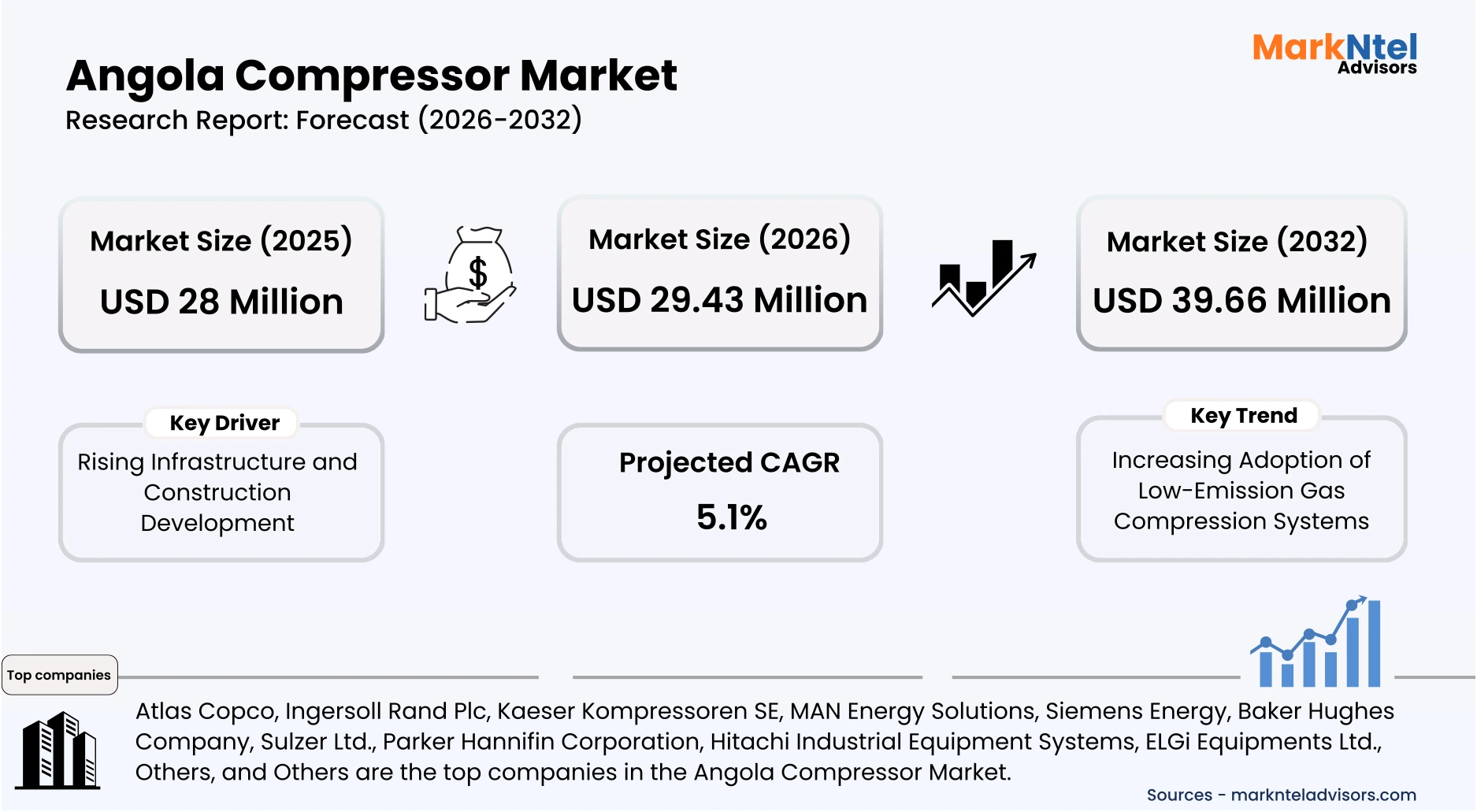
- The Angola Compressor Market size was valued at around USD 28 million in 2025 and is projected grow from USD 29.43 million in 2026 to USD 39.66 million by 2032, exhibiting a CAGR of 5.1% during the forecast period.
- By Compressor Type, the Gas Compressor segment represented a significant share of about 56% in the Angola Compressor Market in 2026.
- By End User, the Oil & Gas segment presented a significant share of about 48% in the Angola Compressor Market in 2026.
- Leading Compressor companies in the Angola market are Atlas Copco, Ingersoll Rand Plc, Kaeser Kompressoren SE, MAN Energy Solutions, Siemens Energy, Baker Hughes Company, Sulzer Ltd., Parker Hannifin Corporation, Hitachi Industrial Equipment Systems, ELGi Equipments Ltd., Others, and Others.
Market Insights & Analysis: Angola Compressor Market (2026-32):
The Angola Compressor Market size was valued at around USD 28 million in 2025 and is projected grow from USD 29.43 million in 2026 to USD 39.66 million by 2032, exhibiting a CAGR of 5.1% during the forecast period, i.e., 2026-32.
Angola’s Compressor market has evolved in line with the country’s hydrocarbon-led industrialization strategy, supported by sustained upstream investments and gas monetization policies. According to the World Bank’s Angola Economic Update, the economy recorded real GDP growth of 4.4% in 2024, driven by a revitalized oil sector and stronger non-oil activity, with higher energy export receipts reinforcing economic momentum into 2025. This macroeconomic recovery strengthened industrial capital expenditure across oil, gas, and infrastructure projects that rely heavily on compression systems. The government’s National Development Plan 2023–2027 further prioritizes energy infrastructure modernization and downstream value addition, sustaining structural demand for large-scale gas Compressor.
Current market conditions are being reinforced by offshore expansion, highlighted by Azule Energy’s commencement of production at the Ndungu field in Block 15/06, targeting peak output of approximately 60,000 barrels per day as part of the Agogo Integrated West Hub project. Such deepwater developments require extensive gas lifting, reinjection, and processing systems, directly supporting demand for high-capacity centrifugal and positive displacement Compressor. Industrial end users, particularly oil and gas operators, account for the largest share of procurement due to continuous-duty operational requirements and pressure maintenance mandates. Mining and construction activities further complement demand as infrastructure investments progress.
Regulatory and environmental frameworks are also influencing technology adoption patterns across the sector. Angola’s efforts to reduce routine gas flaring, aligned with international methane reduction initiatives and World Bank-backed zero-flaring commitments, are accelerating the deployment of vapor recovery and gas reinjection Compressor. Energy efficiency and emissions control requirements are encouraging operators to adopt advanced centrifugal and variable-speed rotary screw systems with improved fuel performance. Such compliance-driven modernization is increasing the average installed value of compressor systems across upstream and midstream facilities.
Looking forward, demographic expansion is expected to broaden commercial and light-industrial compressor demand beyond hydrocarbons. According to the United Nations Population Fund, Angola’s population is projected to reach approximately 44.9 million by 2030, growing at around 3.0% annually , supporting expansion in construction, food processing, and distributed manufacturing activities requiring reliable compressed air systems. Government diversification strategies targeting agriculture, logistics, and domestic manufacturing are likely to stimulate adoption of smaller oil-free and positive displacement units. With sustained energy investment, regulatory alignment, and industrial policy continuity, Angola’s Compressor market is positioned for steady medium-term expansion.
Angola Compressor Market Recent Developments:
- 2025 : Comptech Air Compressor expanded its industrial air compressor supply in Angola, supporting sectors such as manufacturing, automotive, construction, and food processing. The company is focusing on key industrial hubs including Luanda and Benguela, offering durable and cost-effective compressor systems designed for continuous operations and demanding working conditions across the country.
Angola Compressor Market Scope:
| Category | Segments |
|---|---|
| By Compressor Type | (Air Compressors, Gas Compressors), |
| By Technology | (Reciprocating Compressors, Rotary (screw) Compressors, Centrifugal Compressors), |
| By Portability | (Thousand Units) (Stationary, Portable), |
| By End User | (Oil & Gas, Construction, Manufacturing, Power & Utilities, Mining, Others), |
| By Pressure Rating | (Low (Upto 20 bar), Medium (21 to 100 bar), High (101 to 300 bar), Ultra-High (Above 300 bar)) |
Angola Compressor Market Driver:
Rising Infrastructure and Construction Development
Angola’s strategic infrastructure expansion has been reinforced by government and international commitments to major transport and logistics projects, which are central to national development plans. In late 2025, the Lobito Atlantic Railway secured USD 753 million in financing from the U.S. International Development Finance Corporation and the Development Bank of Southern Africa to rehabilitate the 1,300 km Benguela Railway linking mineral regions to the Port of Lobito. This project underpins Angola’s broader transport-logistics upgrade agenda, creating systemic demand for heavy industrial equipment and construction services across multiple regions .
Construction activity is expanding beyond the Lobito Corridor, evidenced by a USD 1.16 billion rail extension project connecting Luena to Saurimo, launched in early 2025 as part of the National Master Plan for Transport and Road Infrastructure . Such multi-year capital projects entail continuous use of Compressor for drilling, concrete placement, and mechanical plant support. Railway and logistics infrastructure development directly stimulates equipment procurement and deployment, significantly increasing volume demand rather than merely influencing short-term pricing or adoption patterns.
The sustained focus on infrastructure is further reflected in Angola’s role as host of the Luanda Financing Summit for Africa’s Infrastructure Development in 2025, where leaders mobilized capital to accelerate strategic projects across the continent . By anchoring long-term capital flows and regulatory support towards transport, logistics, and utilities upgrades, these developments generate structural equipment demand across construction, mining, and industrial segments. Compressor thus benefit from enduring end-user demand driven by expansive and tangible capital investments.
Angola Compressor Market Trend:
Increasing Adoption of Low-Emission Gas Compression Systems
The adoption of low-emission gas compression systems in Angola has accelerated due to intensifying global and national pressure to reduce routine gas flaring. The World Bank’s Global Gas Flaring Tracker Report 2025 highlights continued monitoring of flaring volumes among oil-producing countries, reinforcing accountability under the Zero Routine Flaring by 2030 initiative. Angola’s strategic pivot toward expanding natural gas production, as reported by Reuters in August 2025, further strengthens the need for efficient gas capture and reinjection systems. Together, these factors are driving upstream operators to prioritize advanced compression technologies in new developments.
This shift is already influencing project-level procurement decisions across offshore installations. In a confirmed development, Baker Hughes secured a contract to supply low-emission centrifugal and Integrated Compressor Line systems for TotalEnergies’ Kaminho deepwater project in Angola, specifically designed to minimize flaring and enhance gas reinjection efficiency. Such technology integration reflects a transition from conventional compression units toward emissions-optimized systems embedded with efficiency and leakage-control features. Equipment suppliers are consequently adapting engineering standards and service models to meet stricter environmental performance criteria.
The trend is structural because flaring reduction commitments are embedded in long-term energy planning and international financing conditions. As Angola targets over 20% growth in gas output by 2030, expanding processing volumes will require scalable, high-efficiency compression infrastructure. Environmental compliance is therefore becoming a baseline requirement in offshore and gas monetization projects rather than a discretionary upgrade. This alignment between regulation, investment flows, and technology deployment ensures sustained transformation of compressor demand patterns.
Angola Compressor Market Opportunity:
Expansion of Aftermarket Services & Long-Term Maintenance Contracts
The opportunity for aftermarket expansion in Angola’s compressor market is strengthening due to the commissioning of large-scale gas infrastructure in 2025. In November 2025, Eni inaugurated the New Gas Consortium (NGC) gas treatment plant in Soyo, marking Angola’s first non-associated gas development. The facility processes significant gas volumes for LNG and domestic supply, adding high-value compression assets to the installed base. As new processing capacity enters operation, structured maintenance and lifecycle support demand increases.
Simultaneously, Angola LNG continues to operate as a major gas monetization hub, designed to process associated gas that would otherwise be flared. Large-scale LNG and gas treatment facilities rely on continuous-duty centrifugal and process Compressor operating under high thermal and pressure stress. Such environments necessitate predictive maintenance, component overhauls, and periodic system optimization. This operational intensity creates recurring service demand independent of new equipment procurement cycles.
The opportunity is particularly attractive for new entrants because Angola remains heavily dependent on imported compressor systems. OEMs often lack extensive localized service networks, creating space for independent technical providers. Service-focused models require lower capital expenditure than manufacturing and allow differentiation through rapid response and technical specialization. As operators prioritize uptime and cost efficiency, long-term maintenance contracts offer scalable and defensible entry pathways.
Angola Compressor Market Challenge:
Lack of Skilled Labor and Technical Expertise for Installation and Maintenance
The shortage of specialized technical labor in Angola remains a structural constraint limiting effective deployment of advanced compressor systems. The United Nations Sustainable Development Cooperation Framework 2024–2028 confirms that Angola’s National Development Plan 2023–2027 prioritizes human capital development and vocational training, reflecting recognized skills gaps in technical sectors . Despite these policy commitments, rapid expansion of oil, gas, and industrial infrastructure has intensified demand for certified engineers and maintenance technicians. The pace of complex project execution has outstripped the availability of locally trained specialists.
This imbalance measurably affects market participants through continued reliance on foreign expertise for offshore and gas processing operations. Angola’s local content regulations (Presidential Decree 271/20), monitored through UNCTAD policy documentation, require greater national workforce participation in oil and gas activities . However, compliance often necessitates transitional external support due to limited domestic technical depth. Mobilizing expatriate service teams increases operational costs and extends commissioning timelines for compressor installations.
The constraint materially restricts market scalability because advanced compression systems require preventive diagnostics, calibration, and emissions compliance monitoring. Without sufficient in-country technical capability, operators may delay upgrades or favor simpler systems with lower service complexity. Investment decisions are therefore influenced by workforce readiness and training capacity. Until vocational and engineering programs translate into measurable industrial expertise growth, technical labor shortages will remain a barrier to sustained compressor market expansion in Angola.
Angola Compressor Market (2026-32) Segmentation Analysis:
The Angola Compressor market study of MarkNtel Advisors evaluates & highlights the major trends and influencing factors in each segment. It includes predictions for the period 2026–32 at the country level. Based on the analysis, the market has been further classified as;
Based on Compressor Type:
- Air Compressor
- Gas Compressor
The gas compressor segment dominates the Angola Compressor Market, accounting for approximately 56% of total revenue, primarily because the country’s industrial structure remains heavily centered on upstream oil and gas operations. According to Angola’s National Oil, Gas and Biofuels Agency (ANPG), crude oil production averaged roughly 1.03 million barrels per day in late 2025 . Sustained offshore production at this scale requires continuous gas lift, reinjection, and pressure maintenance systems. These core operational processes depend on high-capacity gas Compressor rather than conventional air systems.
Gas monetization strategy further reinforces this dominance. Angola continues to expand natural gas utilization to support exports and domestic energy security, increasing reliance on gas gathering, processing, and transmission infrastructure. In 2025, Chevron’s Sanha Lean Gas Connection Project marked first gas flow in Angola, signaling expanding associated gas handling capacity that directly depends on advanced gas compression systems . Gas Compressor are essential in maintaining flow assurance, stabilizing pressure across offshore FPSOs, and transporting associated gas to processing hubs. These applications demand centrifugal and process Compressor engineered for high-pressure hydrocarbon environments.
From a revenue perspective, gas Compressor command significantly higher unit values and engineering complexity compared to industrial air Compressor used in construction and workshops. Angola’s limited manufacturing base constrains broad air compressor demand, while offshore energy projects sustain capital-intensive gas compression investments. The combination of production scale, energy-sector concentration, and equipment value concentration positions gas Compressor as the leading revenue-generating segment in Angola.
Based on End User:
- Oil & Gas
- Construction
- Manufacturing
- Power & Utilities
- Mining
- Others
The Oil & Gas segment dominates the Angola Compressor Market, accounting for approximately 48% of total demand, primarily because Angola’s economy remains structurally anchored to hydrocarbon exploration, production, and LNG processing. Angola is one of Sub-Saharan Africa’s largest crude oil producers, with offshore deepwater blocks forming the backbone of national output. These upstream and midstream operations require high-capacity Compressor for gas lifting, reinjection, vapor recovery, and LNG feed gas compression making compression systems mission-critical assets across production platforms and onshore terminals.
Major offshore developments operated by global energy companies, particularly around Luanda, continue to drive sustained demand for centrifugal and rotary screw Compressor in FPSOs and gas processing units. Additionally, the Angola LNG facility in Soyo relies heavily on large-scale gas compression infrastructure to process and export liquefied natural gas, reinforcing sectoral dominance . Gas monetization initiatives and flaring reduction programs further increase the deployment of booster and reinjection Compressor.
Industrial concentration also strengthens this leadership. Unlike construction or manufacturing which remain comparatively fragmented the oil & gas sector operates capital-intensive, continuous-duty facilities requiring redundant and high-specification compression systems. These projects involve long lifecycle investments, high maintenance contracts, and strict performance standards, resulting in significantly higher compressor spending per installation. While mining and infrastructure are expanding, the scale, technical intensity, and export-driven revenue structure of oil & gas continue to position it as the leading end-user industry in Angola’s compressor market.
Gain a Competitive Edge with Our Angola Compressor Market Report:
- Angola Compressor Market Report by MarkNtel Advisors provides a detailed & thorough analysis of market size & share, growth rate, competitive landscape, and key players. This comprehensive analysis helps businesses gain a holistic understanding of the market dynamics & make informed decisions.
- This report also highlights current market trends & future projections, allowing businesses to identify emerging opportunities & potential challenges. By understanding market forecasts, companies can align their strategies & stay ahead of the competition.
- Angola Compressor Market Report aids in assessing & mitigating risks associated with entering or operating in the market. By understanding market dynamics, regulatory frameworks, and potential challenges, businesses can develop strategies to minimize risks & optimize their operations.
*Reports Delivery Format - Market research studies from MarkNtel Advisors are offered in PDF, Excel and PowerPoint formats. Within 24 hours of the payment being successfully received, the report will be sent to your email address.
Frequently Asked Questions
- Market Segmentation
- Introduction
- Product Definition
- Research Process
- Assumptions
- Executive Summary
- Angola Compressor Supply Chain Analysis
- Angola Compressor Import-Export Analysis
- Angola Compressor Market Trends & Developments
- Angola Compressor Market Dynamics
- Growth Drivers
- Challenges
- Angola Compressor Market Hotspot & Opportunities
- Angola Compressor Market Policies & Regulations
- Angola Compressor Market Outlook, 2022-32F
- Market Size & Analysis
- By Revenues (USD Million)
- By Unit Sold (Thousand)
- Market Segmentation & Analysis
- By Compressor Type- (Thousand Units)
- Air Compressors
- Gas Compressors
- By Technology- (Thousand Units)
- Reciprocating Compressors
- Rotary (screw) Compressors
- Centrifugal Compressors
- By Portability (Thousand Units)
- Stationary
- Portable
- By End User- (Thousand Units)
- Oil & Gas
- Construction
- Manufacturing
- Power & Utilities
- Mining
- Others
- By Pressure Rating- (Thousand Units)
- Low (Upto 20 bar)
- Medium (21 to 100 bar)
- High (101 to 300 bar)
- Ultra-High (Above 300 bar)
- By Competition
- Competition Characteristics
- Market Share of Top Companies
- By Compressor Type- (Thousand Units)
- Market Size & Analysis
- Angola Air Compressor Market Outlook, 2022-32F
- Market Size & Analysis
- By Revenues (USD Million)
- By Unit Sold (Thousand)
- Market Segmentation & Analysis
- By Technology- (Thousand Units)
- By Portability- (Thousand Units)
- By End User- (Thousand Units)
- By Pressure Rating- (Thousand Units)
- Market Size & Analysis
- Angola Gas Compressor Market Outlook, 2022-32F
- Market Size & Analysis
- By Revenues (USD Million)
- By Unit Sold (Thousand)
- Market Segmentation & Analysis
- By Technology- (Thousand Units)
- By Portability- (Thousand Units)
- By End User- (Thousand Units)
- By Pressure Rating- (Thousand Units)
- Market Size & Analysis
- Competitive Outlook
- Company Profiles
- Atlas Copco
- Business Description
- Product Portfolio
- Strategic Alliances or Partnerships
- Recent Developments
- Financial Details
- Others
- Ingersoll Rand Plc
- Business Description
- Product Portfolio
- Strategic Alliances or Partnerships
- Recent Developments
- Financial Details
- Others
- Kaeser Kompressoren SE
- Business Description
- Product Portfolio
- Strategic Alliances or Partnerships
- Recent Developments
- Financial Details
- Others
- MAN Energy Solutions
- Business Description
- Product Portfolio
- Strategic Alliances or Partnerships
- Recent Developments
- Financial Details
- Others
- Siemens Energy
- Business Description
- Product Portfolio
- Strategic Alliances or Partnerships
- Recent Developments
- Financial Details
- Others
- Baker Hughes Company
- Business Description
- Product Portfolio
- Strategic Alliances or Partnerships
- Recent Developments
- Financial Details
- Others
- Sulzer Ltd.
- Business Description
- Product Portfolio
- Strategic Alliances or Partnerships
- Recent Developments
- Financial Details
- Others
- Parker Hannifin Corporation
- Business Description
- Product Portfolio
- Strategic Alliances or Partnerships
- Recent Developments
- Financial Details
- Others
- Hitachi Industrial Equipment Systems
- Business Description
- Product Portfolio
- Strategic Alliances or Partnerships
- Recent Developments
- Financial Details
- Others
- ELGi Equipments Ltd.
- Business Description
- Product Portfolio
- Strategic Alliances or Partnerships
- Recent Developments
- Financial Details
- Others
- Others
- Atlas Copco
- Company Profiles
- Disclaimer
MarkNtel Advisors follows a robust and iterative research methodology designed to ensure maximum accuracy and minimize deviation in market estimates and forecasts. Our approach combines both bottom-up and top-down techniques to effectively segment and quantify various aspects of the market. A consistent feature across all our research reports is data triangulation, which examines the market from three distinct perspectives to validate findings. Key components of our research process include:
1. Scope & Research Design At the outset, MarkNtel Advisors define the research objectives and formulate pertinent questions. This phase involves determining the type of research—qualitative or quantitative—and designing a methodology that outlines data collection methods, target demographics, and analytical tools. They also establish timelines and budgets to ensure the research aligns with client goals.
2. Sample Selection and Data Collection In this stage, the firm identifies the target audience and determines the appropriate sample size to ensure representativeness. They employ various sampling methods, such as random or stratified sampling, based on the research objectives. Data collection is carried out using tools like surveys, interviews, and observations, ensuring the gathered data is reliable and relevant.
3. Data Analysis and Validation Once data is collected, MarkNtel Advisors undertake a rigorous analysis process. This includes cleaning the data to remove inconsistencies, employing statistical software for quantitative analysis, and thematic analysis for qualitative data. Validation steps are taken to ensure the accuracy and reliability of the findings, minimizing biases and errors.

4. Data Forecast and FinalizationThe final phase involves forecasting future market trends based on the analyzed data. MarkNtel Advisors utilize predictive modeling and time series analysis to anticipate market behaviors. The insights are then compiled into comprehensive reports, featuring visual aids like charts and graphs, and include strategic recommendations to inform client decision-making
We offer flexible licensing options to cater to varying organizational needs. Choose the pricing pack that best suits your requirements:
Buy Now Inquire Before Buying
 Request Customization
 Talk to our Consultant







