

By Technology (Thermal Sludge Dryers (Paddle Dryer, Disc Dryer, Belt Dryer, Drum Dryer), Solar Sludge Dryers), By Application (Municipal (Sewage Treatment Plants – STPs), Industria......ial (Pharmaceuticals, Chemicals & Petrochemicals, Food & Beverage, Textiles, Pulp & Paper)), By Capacity (Small Scale (<10 TPD), Medium Scale (10–50 TPD), Large Scale (>50 TPD)), By Heat Source (Electric, Steam, Waste Heat Recovery, Hybrid (Solar + Thermal)), By Mode of Operation (Batch, Continuous), and others Read more
- Environment
- Apr 2026
- 140
- PDF, Excel, PPT
India Sludge Dryer Market Key Takeaways
- The India sludge dryer market stood at around USD 53.2 million in 2025 and is anticipated to expand from USD 60.17 million in 2026 to USD 125.94 million by 2032, reflecting a CAGR of 13.1% over the forecast period.
- South India led the market in 2026, capturing nearly 29.73% of the overall share.
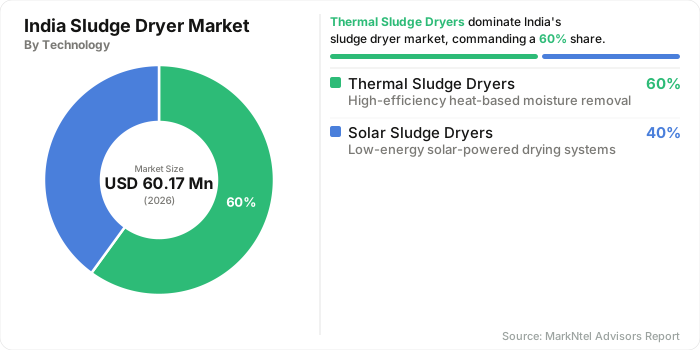
- By technology, thermal sludge dryers dominated the market, accounting for around 60% share in 2026.
- In terms of application, the municipal segment held the largest share of approximately 65% in 2026, driven by continuous sludge generation from wastewater treatment plants.
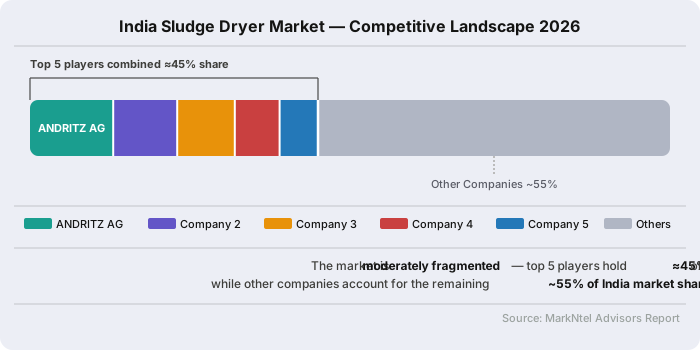
- The industry is moderately fragmented, with approximately 70–120 manufacturers and solution providers, where top players account for around 45% of the market share, and the remainder is held by regional and specialized firms.
India Sludge Dryer Market Size and Outlook
The sludge dryer market in India is poised for robust growth, growing from USD 53.2 million in 2025 to USD 60.17 million in 2026 and further to USD 125.94 million by 2032, at an estimated CAGR of 13.1% during the forecast period.
The significant growth in sludge dryer demand has been supported by the ongoing development of wastewater infrastructure and rapid urbanization. According to the Central Pollution Control Board, the country generates over 72,000 MLD of sewage, of which only about 28% is treated, creating a significant treatment gap that necessitates improved sludge management solutions . This imbalance has consistently driven demand for sludge volume reduction technologies and efficient sludge drying systems. Furthermore, wastewater generation is projected to increase by nearly 75–80% by 2050, reinforcing sustained long-term demand for sludge drying solutions .
This underlying demand is further strengthened by policy-driven infrastructure development through initiatives such as AMRUT 2.0 and Namami Gange Programme, which emphasize expansion of sewage treatment capacity and improved sludge handling practices. The Government of India has committed approximately USD 33–35 billion under AMRUT 2.0 to enhance urban water supply and sewerage systems. In parallel, regulatory oversight mandates environmentally compliant sludge disposal, prompting municipalities to increasingly integrate sludge drying technologies into sewage treatment plants.
In parallel, industrial demand is gaining momentum across sectors such as chemicals, pharmaceuticals, and textiles, supported by increasingly stringent environmental compliance requirements. The Ministry of Environment, Forest and Climate Change continues to enforce pollution control norms, including Zero Liquid Discharge requirements for high-pollution industries, thereby strengthening the need for industrial sludge treatment solutions . Consequently, industries are adopting energy-efficient sludge drying systems, while solar-based drying solutions are gaining traction in municipal projects due to their cost-effectiveness and climatic suitability.
Prospects for the market remain positive, supported by continued investments in infrastructure, evolving regulatory standards, and heightened environmental awareness. Persistent treatment gaps, along with rising landfill constraints and increasing sludge disposal costs, are expected to reinforce demand across both municipal and industrial segments. At the same time, government emphasis on water reuse and circular economy practices is likely to accelerate adoption of sludge drying technologies. Consequently, the sludge dryer market in India is projected to grow steadily, driven by technological advancements and expanding local manufacturing capabilities.
India Sludge Dryer Market Key Indicators
- In FY 2025–26, India added over 538 MLD of sewage treatment capacity through 28 newly completed sewage treatment plants (STPs) under the Namami Gange Programme, with investments of approximately USD 500 million. This expansion increases sludge generation, thereby driving demand for sludge drying systems.
- According to the Ministry of Housing and Urban Affairs, urban water supply in India is benchmarked at approximately 135 liters per capita per day (lpcd). Higher water consumption leads to increased wastewater generation, which in turn produces larger volumes of sludge, thereby driving demand for sludge drying equipment for effective treatment and disposal.
- The Government of India, under AMRUT 2.0, targets 100% coverage of sewerage and septage management in 500 cities. Expansion of sewer networks and treatment infrastructure under this initiative is expected to increase sludge generation volumes, thereby driving demand for sludge drying solutions in sewage treatment plants.
India Sludge Dryer Market Scope
| Category | Segments |
|---|---|
| By Technology | Thermal Sludge Dryers (Paddle Dryer, Disc Dryer, Belt Dryer, Drum Dryer), Solar Sludge Dryers |
| By Application | Municipal (Sewage Treatment Plants – STPs), Industrial (Pharmaceuticals, Chemicals & Petrochemicals, Food & Beverage, Textiles, Pulp & Paper, |
| By Capacity | Small Scale (<10 TPD), Medium Scale (10–50 TPD), Large Scale (>50 TPD |
| By Heat Source | Electric, Steam, Waste Heat Recovery, Hybrid (Solar + Thermal |
| By Mode of Operation | Batch, Continuous |
India Sludge Dryer Market Growth Drivers
Rising Wastewater Generation
The rapid increase in wastewater generation has emerged as a key structural driver for the India sludge dryer market, directly expanding sludge volumes requiring treatment. According to the Bhabha Atomic Research Centre, nearly 70% of sewage in India is discharged untreated, reflecting significant infrastructure gaps. This imbalance has intensified alongside urbanization and industrial activity, leading to steadily rising wastewater discharge. As treatment capacity continues to lag behind generation, sludge accumulation increases in parallel, creating sustained demand for sludge drying systems.
Moreover, this is clearly influencing demand across both municipal and industrial segments, where rising wastewater volumes are placing pressure on existing treatment systems. India generates about 72 billion liters of sewage per day, but has the capacity to treat only 37%, and actually treats around 28%, highlighting systemic inefficiencies . Consequently, higher volumes of sludge are either accumulated within facilities or inadequately managed. In addition, increasing industrial discharge further strengthens demand for industrial sludge treatment solutions across treatment plants and industrial units.
As a result, the impact of this driver extends beyond short-term adoption and directly contributes to expanding overall market volume. Sludge is an unavoidable byproduct of wastewater treatment, making its management a continuous operational requirement. With wastewater volumes rising consistently, sludge generation follows a similar trajectory, necessitating scalable solutions such as energy-efficient sludge dryers. Consequently, this structural rise in wastewater generation is expanding the addressable market and supporting long-term growth of the sludge dryer market in India.
Recent Trends
Integration of Automation and Smart Monitoring
A growing shift toward automation and smart monitoring is reshaping operational practices in the sludge dryer industry in India, driven by the need for improved efficiency, real-time control, and regulatory compliance. The Ministry of Electronics and Information Technology is promoting digital transformation through initiatives such as Digital India, while programs like SAMARTH Udyog Bharat 4.0 are accelerating adoption of Industry 4.0 technologies. As a result, wastewater treatment facilities are gradually integrating automated systems into sludge drying systems, enabling more consistent performance.
Simultaneously, this shift is transforming conventional processes into more data-driven operations across municipal and industrial segments. Smart monitoring systems enable real-time tracking of parameters such as moisture, temperature, and energy usage, improving efficiency and consistency. For instance, deployment of smart desludging trucks in Eluru and real-time monitoring in sewage treatment plants in Greater Noida highlights the transition toward mechanized and digitally managed practices. Consequently, operators are increasingly adopting integrated systems that reduce manual intervention.
As this transition continues, it is expected to influence long-term market evolution. Ongoing investments in digital infrastructure and smart utility frameworks will further support adoption of automated solutions. With wastewater systems becoming more complex, the need for scalable and remotely managed operations will continue to grow. Consequently, automation and smart monitoring will play a key role in shaping the future of sludge drying technology in India.
India Sludge Dryer Market Opportunities and Challenges
High Energy Costs and Grid Constraints Driving Adoption of Solar and Hybrid Sludge Drying Systems
Escalating energy costs, coupled with inconsistent power supply, are creating significant challenges for conventional thermal sludge drying systems. Electricity tariffs for industrial users in India increased in 2025, raising operational costs , while inconsistent power supply in several regions continues to affect process continuity. This combination of high energy expenses and unreliable supply makes conventional drying systems less economically viable, particularly for municipalities and smaller treatment facilities. As a result, operators are increasingly exploring alternatives that can reduce dependence on grid-based energy.
In this context, solar and hybrid sludge drying systems are gaining traction as energy-efficient sludge dryers, offering cost-effective and sustainable solutions. India’s high solar irradiance supports the deployment of solar-based drying technologies, while initiatives by the Ministry of New and Renewable Energy are further encouraging renewable integration across infrastructure sectors. For instance, the Greater Noida Authority initiated a solar-based sludge drying pilot at the Kasna Sewage Treatment Plant in 2025, demonstrating a practical shift toward solar sludge drying systems India and energy-efficient sludge management . Building on such developments, hybrid systems combining solar energy with auxiliary thermal inputs are increasingly being adopted to ensure operational reliability while reducing energy costs, thereby strengthening long-term sludge treatment market opportunities in India.
Segmentation Insights
Thermal Sludge Dryers Emerge as the Leading Technology
Thermal sludge dryers represent nearly 60% of the sludge dryer industry in India, making them the most widely adopted thermal sludge drying technology across municipal and industrial applications. This dominance is driven by their ability to achieve rapid and consistent moisture reduction, enabling significant sludge volume minimization and efficient handling. Technologies such as paddle, belt, and drum dryers are widely adopted due to their reliability, scalability, and suitability for large-capacity treatment plants. Their ability to handle varying sludge compositions and deliver uniform drying performance further strengthens their adoption across industries.
As wastewater treatment capacity continues to expand, demand for thermal sludge drying solutions is strengthening. The increasing treatment capacity under national programs is generating higher sludge volumes requiring efficient processing. Thermal dryers offer faster processing cycles compared to alternative methods, making them suitable for high-throughput operations. For instance, advanced thermal treatment technologies are being adopted in large-scale projects such as sludge modernization initiatives in Mumbai, improving efficiency and reducing sludge volume. Consequently, thermal sludge dryers maintain their leading position due to operational efficiency and strong alignment with large-scale requirements. Based on technology, the study is segmented into:
- Thermal Sludge Dryers
- Solar Sludge Dryers
Municipal Represents the Leading Application Category
The municipal segment captures nearly 65% of the overall market, supported by the ongoing and large-scale sludge generation from urban wastewater treatment facilities. Unlike industrial applications, where sludge generation varies with production cycles, municipal sewage treatment plants operate continuously, creating a steady and predictable demand for sludge drying solutions. The rapid growth of urban population and increasing sewage generation further intensify this requirement, making municipal facilities the most consistent end users of sludge drying systems.
In addition, large-scale investments in urban wastewater infrastructure are reinforcing this dominance. The Ministry of Jal Shakti continues to support expansion of sewage treatment capacity under national programs, leading to higher sludge output across cities. For instance, the Okhla wastewater treatment plant in Delhi, with a capacity of 564 MLD, serves around 40 lakh residents and generates substantial volumes of treated sludge, highlighting the scale and continuous nature of municipal sludge generation . As treatment capacity continues to expand, the need for efficient sludge handling and drying solutions becomes increasingly critical, ensuring that the municipal segment maintains its leading position in the sludge dryer market in India. Based on application, the market is categorized into:
- Municipal (Sewage Treatment Plants – STPs)
- Industrial
India Sludge Dryer Market Geographical Outlook
South India accounts for approximately 29.73% share of the India sludge dryer market, making it the leading regional contributor. This dominance is driven by relatively advanced wastewater infrastructure and higher urbanization levels across states such as Tamil Nadu, Karnataka, and Telangana. These states have established extensive sewage treatment networks with multiple operational plants generating continuous volumes of sludge, ensuring steady demand for sludge drying solutions across municipal systems.
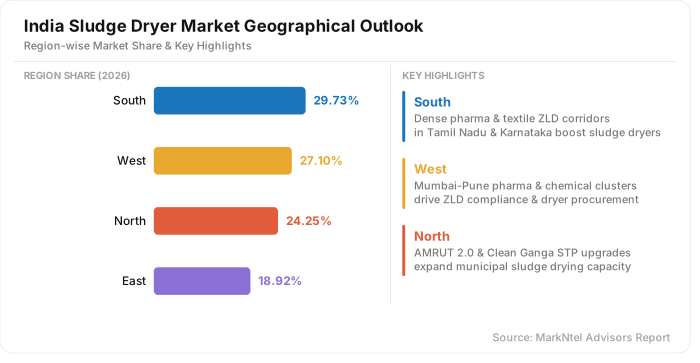
In addition, the region’s strong industrial base and focus on advanced treatment practices further reinforce its leadership. For instance, the Bangalore Water Supply and Sewerage Board (BWSSB) in Bengaluru has initiated large-scale sewage-to-biogas projects utilizing around 550 MLD of wastewater , while also implementing solar sludge drying systems at sewage treatment plants to convert sludge into reusable material and generate renewable energy . These developments highlight the scale, technological advancement, and integrated approach to sludge management in India, particularly within South India. Combined with ongoing investments in water reuse and sanitation infrastructure, this positions the region ahead of others, sustaining its dominant share in the market.
India Sludge Dryer Market Competitive Analysis
The India sludge dryer industry is characterized by a moderately fragmented competitive landscape, with nearly 70–120 manufacturers and solution providers active across municipal and industrial applications. A group of five leading companies, including ANDRITZ AG, HUBER SE, Thermax Limited, and VA Tech Wabag, together capture approximately 45% of the market share, supported by their strong project execution capabilities and advanced technologies.
Sludge Dryer Manufacturers in India
- ANDRITZ AG
- HUBER SE
- Thermax Limited
- VA Tech Wabag
- Inch Enviro Technologies Pvt Ltd
- Shachi Engineering
- Acmefil Engineering Systems Pvt Ltd
- Southern Water Tech
- AS Engineers
- Malhari Projects Pvt Ltd
- Others
India Sludge Dryer Industry News and Recent Developments
January 2026: Cambi ASA Signs Agreement for Mumbai Sludge Treatment Modernization
Cambi ASA signed an agreement to deploy thermal hydrolysis technology for sludge treatment modernization in Mumbai. The project focuses on improving sludge processing efficiency and supporting large-scale municipal wastewater infrastructure in India.
Impact Analysis: This development highlights the increasing adoption of advanced thermal sludge treatment technologies in India’s urban infrastructure. It is expected to improve sludge processing efficiency, reduce sludge volume, and strengthen demand for high-performance sludge drying and treatment solutions in large-scale municipal projects.
November 2025: CSIR-NEERI Launches India’s First MDDS-Based Sludge Drying Plant
CSIR-NEERI commissioned India’s first faecal sludge treatment plant in Chandrapur using Mechanical Dewatering & Drying System (MDDS) technology. The facility converts sludge into fertilizer-grade manure, supporting resource recovery and decentralized sludge management.
Impact Analysis: This development highlights the growing adoption of indigenous and decentralized sludge drying technologies in India. It is expected to promote cost-effective sludge treatment, enhance waste-to-resource conversion, and accelerate deployment of sustainable sludge drying solutions across municipal applications.
- Market Segmentation
- Introduction
- Product Definition
- Research Process
- Assumptions
- Executive Summary
- India Sludge Dryer Market Policies, Regulations, and Product Standards
- India Sludge Dryer Market Trends & Developments
- India Sludge Dryer Market Dynamics
- Growth Factors
- Challenges
- India Sludge Dryer Market Hotspot & Opportunities
- India Sludge Dryer Market Outlook, 2022-2032F
- Market Size & Outlook
- By Revenues (USD Million)
- Market Share & Outlook
- By Technology- Market Size & Forecast 2022-2032, USD Million
- Thermal Sludge Dryers
- Paddle Dryer
- Disc Dryer
- Belt Dryer
- Drum Dryer
- Solar Sludge Dryers
- Thermal Sludge Dryers
- By Application- Market Size & Forecast 2022-2032, USD Million
- Municipal (Sewage Treatment Plants – STPs)
- Industrial
- Pharmaceuticals
- Chemicals & Petrochemicals
- Food & Beverage
- Textiles
- Pulp & Paper
- By Capacity- Market Size & Forecast 2022-2032, USD Million
- Small Scale (<10 TPD)
- Medium Scale (10–50 TPD)
- Large Scale (>50 TPD)
- By Heat Source- Market Size & Forecast 2022-2032, USD Million
- Electric
- Steam
- Waste Heat Recovery
- Hybrid (Solar + Thermal)
- By Mode of Operation- Market Size & Forecast 2022-2032, USD Million
- Batch
- Continuous
- By Region- Market Size & Forecast 2022-2032, USD Million
- North India
- East India
- West India
- South India
- By Company
- Competition Characteristics
- Market Share & Analysis
- By Technology- Market Size & Forecast 2022-2032, USD Million
- Market Size & Outlook
- India Thermal Sludge Dryers Market Outlook, 2022-2032
- Market Size & Outlook
- By Revenues (USD Million)
- Market Share & Outlook
- By Application- Market Size & Forecast 2022-2032, USD Million
- By Capacity- Market Size & Forecast 2022-2032, USD Million
- By Heat Source- Market Size & Forecast 2022-2032, USD Million
- By Mode of Operation- Market Size & Forecast 2022-2032, USD Million
- By Region- Market Size & Forecast 2022-2032, USD Million
- Market Size & Outlook
- India Solar Sludge Dryers Market Outlook, 2022-2032
- Market Size & Outlook
- By Revenues (USD Million)
- Market Share & Outlook
- By Application- Market Size & Forecast 2022-2032, USD Million
- By Capacity- Market Size & Forecast 2022-2032, USD Million
- By Heat Source- Market Size & Forecast 2022-2032, USD Million
- By Mode of Operation- Market Size & Forecast 2022-2032, USD Million
- By Region- Market Size & Forecast 2022-2032, USD Million
- Market Size & Outlook
- India Sludge Dryer Market Key Strategic Imperatives for Success & Growth
- Competitive Outlook
- Company Profiles
- ANDRITZ AG
- Business Description
- Product Portfolio
- Collaborations & Alliances
- Recent Developments
- Financial Details
- Others
- HUBER SE
- Business Description
- Product Portfolio
- Collaborations & Alliances
- Recent Developments
- Financial Details
- Others
- Thermax Limited
- Business Description
- Product Portfolio
- Collaborations & Alliances
- Recent Developments
- Financial Details
- Others
- VA Tech Wabag
- Business Description
- Product Portfolio
- Collaborations & Alliances
- Recent Developments
- Financial Details
- Others
- Inch Enviro Technologies Pvt Ltd
- Business Description
- Product Portfolio
- Collaborations & Alliances
- Recent Developments
- Financial Details
- Others
- Shachi Engineering
- Business Description
- Product Portfolio
- Collaborations & Alliances
- Recent Developments
- Financial Details
- Others
- Acmefil Engineering Systems Pvt Ltd
- Business Description
- Product Portfolio
- Collaborations & Alliances
- Recent Developments
- Financial Details
- Others
- Southern Water Tech
- Business Description
- Product Portfolio
- Collaborations & Alliances
- Recent Developments
- Financial Details
- Others
- AS Engineers
- Business Description
- Product Portfolio
- Collaborations & Alliances
- Recent Developments
- Financial Details
- Others
- Malhari Projects Pvt Ltd
- Business Description
- Product Portfolio
- Collaborations & Alliances
- Recent Developments
- Financial Details
- Others
- Others
- Business Description
- Product Portfolio
- Collaborations & Alliances
- Recent Developments
- Financial Details
- Others
- ANDRITZ AG
- Company Profiles
- Disclaimer

MarkNtel Advisors follows a robust and iterative research methodology designed to ensure maximum accuracy and minimize deviation in market estimates and forecasts. Our approach combines both bottom-up and top-down techniques to effectively segment and quantify various aspects of the market. A consistent feature across all our research reports is data triangulation, which examines the market from three distinct perspectives to validate findings. Key components of our research process include:
1. Scope & Research Design At the outset, MarkNtel Advisors define the research objectives and formulate pertinent questions. This phase involves determining the type of research—qualitative or quantitative—and designing a methodology that outlines data collection methods, target demographics, and analytical tools. They also establish timelines and budgets to ensure the research aligns with client goals.
2. Sample Selection and Data Collection In this stage, the firm identifies the target audience and determines the appropriate sample size to ensure representativeness. They employ various sampling methods, such as random or stratified sampling, based on the research objectives. Data collection is carried out using tools like surveys, interviews, and observations, ensuring the gathered data is reliable and relevant.
3. Data Analysis and Validation Once data is collected, MarkNtel Advisors undertake a rigorous analysis process. This includes cleaning the data to remove inconsistencies, employing statistical software for quantitative analysis, and thematic analysis for qualitative data. Validation steps are taken to ensure the accuracy and reliability of the findings, minimizing biases and errors.

4. Data Forecast and FinalizationThe final phase involves forecasting future market trends based on the analyzed data. MarkNtel Advisors utilize predictive modeling and time series analysis to anticipate market behaviors. The insights are then compiled into comprehensive reports, featuring visual aids like charts and graphs, and include strategic recommendations to inform client decision-making
FILL THE FORM TO GET THE FREE SAMPLE PAGES
We offer flexible licensing options to cater to varying organizational needs. Choose the pricing pack that best suits your requirements:
Buy Now Inquire Before Buying
 Talk to our Consultant
 Request Customization