

By Type (Blended Cement (Portland Slag Cement (PSC), Portland Pozzolana Cement (PPC), Portland Composite Cement (PCC)), Ordinary Portland Cement (OPC), Others), By End User (Reside......ntial, Infrastructure, Commercial, Industrial), and others Read more
- Buildings, Construction, Metals & Mining
- Jul 2026
- 145
- PDF, Excel, PPT
India Cement Market Key Takeaways
- The India cement market was valued at USD 21.3 billion in 2025 and is projected to reach USD 36 billion by 2032 from USD 22.6 billion in 2026, growing at a CAGR of 8.07%.
- Blended cement led the market by type, accounting for approximately 68% of total market share in 2026.
- Infrastructure led the market by end user, accounting for approximately 35% of total market share in 2026.
- The industry is consolidated with the top five companies collectively accounting for 60% of market revenue.
India Cement Market Size and Outlook
The cement market size in India was valued at USD 21.3 billion in 2025 and is projected to grow from USD 22.6 billion in 2026 to USD 36 billion by 2032. Along with this, the market is estimated to grow at a CAGR of around 8.07% during the forecast period, i.e., 2026-32.
The demand for cement in India is driven by sustained double-digit production growth as the country expands its manufacturing base to keep pace with construction activity. According to the India Brand Equity Foundation, India's cement production is expected to reach about 490 million tonnes in FY26, up from 453 million tonnes in FY25, registering estimated 8-9% year-on-year growth, with cement volumes already up 9.2% year-on-year to 443.2 million tonnes in the April-February period of FY26. Because this production expansion tracks real construction demand rather than speculative capacity building, cement consumption growth of 7-8% is expected to continue into FY27.
This demand is further reinforced by record government infrastructure spending. The Union Budget 2026-27 allocated USD 138.04 billion toward capital expenditure to accelerate roads, railways, logistics, and industrial corridor development, alongside a USD 34.96 billion allocation specifically to the Ministry of Road Transport and Highways, an 8% increase over the prior budget. Consequently, the market's long-term outlook is tied to this public capex cycle, as large infrastructure projects like the Mumbai-Ahmedabad Bullet Train Corridor, which alone consumes around 20,000 cubic meters of cement daily, translate directly into sustained bulk cement demand.
Specifically, one dynamic anchors a large share of underlying demand: housing construction. Rural housing now accounts for 32-34% of total cement demand, sustained by government housing schemes, while urban housing is rebounding with support from PMAY-Urban. As a result, cement demand carries a demographic and welfare-policy floor independent of large infrastructure project cycles, since housing construction continues regardless of the pace of government capital projects.
In response, major cement producers are shifting toward sustainable, blended cement production and renewable-powered manufacturing rather than relying solely on traditional Ordinary Portland Cement. This shift reflects the industry's move toward greener production, with leading producers expanding renewable energy capacity and waste heat recovery systems, pushing India's cement industry toward higher-value, environmentally differentiated products as sustainability becomes a competitive factor alongside volume growth.
India Cement Market Key Indicators
Limestone, cement's core raw material, is produced at large scale as part of India's broader mining sector, which is expanding in step with construction demand. According to the Ministry of Mines, limestone production reached a record 450 million tonnes in FY 2023-24, up 10.7% from the prior year's record of 406.5 million tonnes, with the ministry noting that continued growth in iron ore and limestone output reflects robust demand conditions in user industries including steel and cement. As limestone output continues expanding to match rising demand, it directly determines how much raw material is available for cement manufacturing without supply constraints.
Borrowing costs directly shape how affordable home loans and construction financing are for both individual buyers and developers. The Reserve Bank of India's Monetary Policy Committee kept the policy repo rate unchanged at 5.25% in its June 2026 review, maintaining a neutral stance while revising the FY 2026-27 real GDP growth forecast to 6.6%. As the repo rate stays stable rather than rising, borrowing costs for housing loans and construction project financing remain predictable, supporting sustained residential and commercial construction activity that drives cement demand.
India's broader construction sector, the direct downstream buyer of cement, continues expanding as part of the economy's Secondary Sector. According to the Press Information Bureau (PIB), real GDP grew 7.6% in FY 2025-26 under the newly rebased GDP series, with manufacturing and construction estimated to achieve growth around 7% for the year as per the ministry's own national accounts data. As construction sector output continues scaling, cement demand grows in direct proportion to the pace of building activity across residential, commercial, and infrastructure projects.
India Cement Market Scope
| Category | Segments |
|---|---|
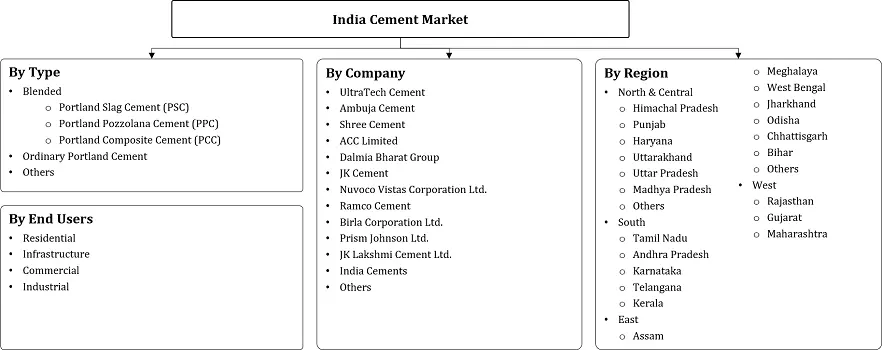
| By Type | Blended Cement (Portland Slag Cement (PSC), Portland Pozzolana Cement (PPC), Portland Composite Cement (PCC)), Ordinary Portland Cement (OPC), Others |
| By End User | Residential, Infrastructure, Commercial, Industrial |
India Cement Market Growth Drivers
GST 2.0 Reform Reducing Cement Taxation and Improving Construction Affordability
The implementation of GST 2.0 in September 2025 marked a significant policy reform for India's construction sector by reducing the Goods and Services Tax (GST) on cement from 28% to 18%, effective September 22, 2025. Announced during the 56th GST Council Meeting, the revised tax structure applies uniformly across all major cement categories, including Ordinary Portland Cement (OPC), Portland Pozzolana Cement (PPC), white cement, and other cement variants. According to the Press Information Bureau (PIB), the reform forms part of a broader initiative to simplify India's GST framework into two principal tax slabs, thereby lowering costs for businesses and consumers while improving overall economic efficiency.
The reduction in cement taxation is expected to significantly enhance construction affordability, as cement and steel collectively account for approximately 40–45% of total construction costs. Lower cement prices reduce overall project expenditures for residential, commercial, and infrastructure developments, enabling developers to improve project viability and encouraging homebuyers through reduced construction costs. As a result, a larger number of planned projects are expected to progress to the execution stage, supporting higher cement consumption across the country.
Unlike short-term fiscal incentives, the revised GST structure represents a long-term structural policy measure that permanently lowers the tax burden on one of the construction industry's most essential raw materials. This sustained improvement in project economics is expected to stimulate continuous investment in housing and infrastructure development, making the GST 2.0 reform a durable driver of growth for the India cement industry.
- Market Segmentation
- Introduction
- Product Definition
- Research Process
- Assumptions
- Executive Summary
- India Cement Market Supply Chain Analysis
- India Cement Market Import-Export Analysis
- India Cement Market Policies, Regulations, and Product Standards
- India Cement Market Trends & Developments
- India Cement Market Dynamics
- Growth Factors
- Challenges
- India Cement Market Hotspot & Opportunities
- India Cement Market Outlook, 2022-2032
- Market Size & Outlook
- By Revenues (USD Million)
- By Quantity Sold (Thousand Tons)
- Market Share & Outlook
- By Type- Market Size & Forecast 2022-2032, USD Million and Thousand Tons
- Blended Cement
- Portland Slag Cement (PSC)
- Portland Pozzolana Cement (PPC)
- Portland Composite Cement (PCC)
- Ordinary Portland Cement (OPC)
- Others
- Blended Cement
- By End User- Market Size & Forecast 2022-2032, USD Million and Thousand Tons
- Residential
- Infrastructure
- Commercial
- Industrial
- By Region- Market Size & Forecast 2022-2032, USD Million and Thousand Tons
- North
- South
- East
- West
- By Company
- Competition Characteristics
- Market Share & Analysis
- By Type- Market Size & Forecast 2022-2032, USD Million and Thousand Tons
- Market Size & Outlook
- India Blended Cement Market Outlook, 2022-2032
- Market Size & Outlook
- By Revenues (USD Million)
- By Quantity Sold (Thousand Tons)
- Market Share & Outlook
- By End User- Market Size & Forecast 2022-2032, USD Million and Thousand Tons
- By Region- Market Size & Forecast 2022-2032, USD Million and Thousand Tons
- Market Size & Outlook
- India Ordinary Portland Cement (OPC) Market Outlook, 2022-2032
- Market Size & Outlook
- By Revenues (USD Million)
- By Quantity Sold (Thousand Tons)
- Market Share & Outlook
- By End User- Market Size & Forecast 2022-2032, USD Million and Thousand Tons
- By Region- Market Size & Forecast 2022-2032, USD Million and Thousand Tons
- Market Size & Outlook
- India Cement Market Key Strategic Imperatives for Success & Growth
- Competitive Outlook
- Company Profiles
- UltraTech Cement Limited (Aditya Birla Group)
- Business Description
- Product Portfolio
- Collaborations & Alliances
- Recent Developments
- Financial Details
- Others
- Adani Group (including brands)
- Business Description
- Product Portfolio
- Collaborations & Alliances
- Recent Developments
- Financial Details
- Others
- Shree Cement Limited
- Business Description
- Product Portfolio
- Collaborations & Alliances
- Recent Developments
- Financial Details
- Others
- Dalmia Bharat Limited (Dalmia Bharat Group)
- Business Description
- Product Portfolio
- Collaborations & Alliances
- Recent Developments
- Financial Details
- Others
- Nuvoco Vistas Corporation Limited (Nirma Group)
- Business Description
- Product Portfolio
- Collaborations & Alliances
- Recent Developments
- Financial Details
- Others
- J.K. group (including brands)
- Business Description
- Product Portfolio
- Collaborations & Alliances
- Recent Developments
- Financial Details
- Others
- The Ramco Cements Limited (Ramco Group)
- Business Description
- Product Portfolio
- Collaborations & Alliances
- Recent Developments
- Financial Details
- Others
- JSW Cement Limited (JSW Group)
- Business Description
- Product Portfolio
- Collaborations & Alliances
- Recent Developments
- Financial Details
- Others
- Birla Corporation Limited (M.P. Birla Group)
- Business Description
- Product Portfolio
- Collaborations & Alliances
- Recent Developments
- Financial Details
- Others
- Star Cement Limited
- Business Description
- Product Portfolio
- Collaborations & Alliances
- Recent Developments
- Financial Details
- Others
- UltraTech Cement Limited (Aditya Birla Group)
- Company Profiles
- Disclaimer
MarkNtel Advisors follows a robust and iterative research methodology designed to ensure maximum accuracy and minimize deviation in market estimates and forecasts. Our approach combines both bottom-up and top-down techniques to effectively segment and quantify various aspects of the market. A consistent feature across all our research reports is data triangulation, which examines the market from three distinct perspectives to validate findings. Key components of our research process include:
1. Scope & Research Design At the outset, MarkNtel Advisors define the research objectives and formulate pertinent questions. This phase involves determining the type of research—qualitative or quantitative—and designing a methodology that outlines data collection methods, target demographics, and analytical tools. They also establish timelines and budgets to ensure the research aligns with client goals.
2. Sample Selection and Data Collection In this stage, the firm identifies the target audience and determines the appropriate sample size to ensure representativeness. They employ various sampling methods, such as random or stratified sampling, based on the research objectives. Data collection is carried out using tools like surveys, interviews, and observations, ensuring the gathered data is reliable and relevant.
3. Data Analysis and Validation Once data is collected, MarkNtel Advisors undertake a rigorous analysis process. This includes cleaning the data to remove inconsistencies, employing statistical software for quantitative analysis, and thematic analysis for qualitative data. Validation steps are taken to ensure the accuracy and reliability of the findings, minimizing biases and errors.

4. Data Forecast and FinalizationThe final phase involves forecasting future market trends based on the analyzed data. MarkNtel Advisors utilize predictive modeling and time series analysis to anticipate market behaviors. The insights are then compiled into comprehensive reports, featuring visual aids like charts and graphs, and include strategic recommendations to inform client decision-making
FILL THE FORM TO GET THE FREE SAMPLE PAGES
We offer flexible licensing options to cater to varying organizational needs. Choose the pricing pack that best suits your requirements:
Buy Now Inquire Before Buying
 Talk to our Consultant
 Request Customization