

By Offering (Water Treatment Chemicals (Corrosion Inhibitors, Scale Inhibitors / Antiscalants, Oxidizing Biocides, Non-Oxidizing Biocides, pH Adjusters & Alkalinity Control Chemica......ls, Dispersants & Antifoulants, Other Cooling Water Treatment Chemicals), Water Treatment Equipment (Filtrate, Chemical Dosing Systems, Disinfection Equipment, Monitoring & Control Systems, Other Equipment), Services (Operation & Maintenance (O&M), Water Testing & Monitoring, Engineering & Consulting, Cleaning & Chemical Management Services)), By Cooling System Type (Open Recirculating Cooling Systems, Closed Recirculating Cooling Systems, Once-Through Cooling Systems), By End-Use Industry (Power Generation, Oil & Gas, Chemicals & Petrochemicals, Metals & Mining, Semiconductor & Electronics, Data Centers, Food & Beverage, Pharmaceuticals, Pulp & Paper, & Manufacturing, Industries), and others Read more
- Environment
- Aug 2026
- 175
- PDF, Excel, PPT
China Cooling Water Treatment Market Key Takeaways
- The China cooling water treatment market was valued at USD 2.6 billion in 2025 and is projected to grow from USD 2.8 billion in 2026 to USD 4.1 billion by 2032.
- The industry is projected to witness steady growth at a CAGR of 6.45% during 2026–2032.
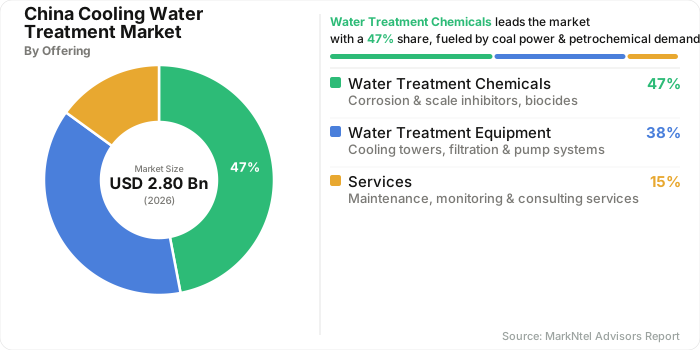
- Water treatment chemicals dominate the market by offering, accounting for a 47% share in 2026.
- Power generation remains the largest end-use industry, capturing approximately 29% of the market in 2026.
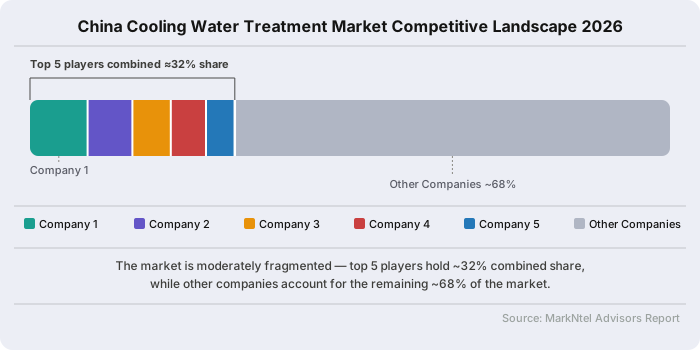
- The market is moderately fragmented, with the top five companies accounting for 32% market share in 2026.
China Cooling Water Treatment Market Size & Outlook
The cooling water treatment market in China was valued at USD 2.6 billion in 2025 and is estimated to reach USD 2.8 billion in 2026, before expanding to USD 4.1 billion by 2032, registering a CAGR of 6.45% during 2026–2032. Market growth is driven by the expansion of thermal power generation, rising industrial water reuse, and increasingly stringent environmental regulations requiring efficient cooling water management across China's industrial sectors.
Government-led water conservation initiatives continue to strengthen market demand. The National Development and Reform Commission (NDRC) implemented a nationwide water conservation regulation identifying high-efficiency industrial cooling as a strategic technology priority while targeting a 13% reduction in industrial water consumption per USD 1,380 of value-added output compared with 2020 levels. These measures are encouraging industries to upgrade recirculating cooling systems through advanced treatment chemicals, automated dosing, and digital monitoring technologies.
The market outlook is further supported by China's expanding industrial infrastructure. The China Electricity Council (CEC) and National Energy Administration (NEA) reported that the country's total installed power generation capacity reached 3,349 GW by the end of 2024, increasing 14.6% year-on-year, creating sustained demand for cooling water treatment chemicals, equipment, and lifecycle services across power and industrial facilities.
China Cooling Water Treatment Market Key Indicators
- China Electricity Council (CEC) reported that the country's thermal power generation capacity reached 1,451 GW by the end of 2025, representing the world's largest installed fleet of recirculating cooling water systems. Continuous operation of these facilities generates substantial recurring demand for cooling water treatment chemicals, corrosion inhibitors, and online monitoring solutions.
- The China Petroleum and Chemical Industry Federation (CPCIF) stated that China's petroleum and chemical industry generated operating revenue exceeding USD 2.2 trillion in 2024. Refining and petrochemical complexes rely extensively on cooling towers and heat exchangers, making industrial cooling water treatment a critical utility for maintaining process efficiency and equipment reliability.
- The China Iron and Steel Association (CISA) reported that crude steel production totalled approximately 1.01 billion tonnes in 2024, maintaining China's position as the world's largest steel producer. Steel mills consume significant volumes of recirculating cooling water throughout blast furnace, rolling, and continuous casting operations, supporting sustained demand for scale and corrosion control solutions.
- The National Development and Reform Commission (NDRC) and MIIT continue implementing the Green Development Action Plan for Data Centers, requiring the national average Power Usage Effectiveness (PUE) to remain below 1.5 by 2025 while data center electricity demand grows by approximately 15% annually. Expansion of hyperscale data centers is accelerating investments in high-efficiency cooling systems and advanced cooling water treatment technologies.
China Cooling Water Treatment Market Scope
| Category | Segments |
|---|---|
| By Offering | (Water Treatment Chemicals (Corrosion Inhibitors, Scale Inhibitors / Antiscalants, Oxidizing Biocides, Non-Oxidizing Biocides, pH Adjusters & Alkalinity Control Chemicals, Dispersants & Antifoulants, Other Cooling Water Treatment Chemicals), Water Treatment Equipment (Filtrate, Chemical Dosing Systems, Disinfection Equipment, Monitoring & Control Systems, Other Equipment), Services (Operation & Maintenance (O&M), Water Testing & Monitoring, Engineering & Consulting, Cleaning & Chemical Management Services)), |
| By Cooling System Type | (Open Recirculating Cooling Systems, Closed Recirculating Cooling Systems, Once-Through Cooling Systems), |
| By End-Use Industry | (Power Generation, Oil & Gas, Chemicals & Petrochemicals, Metals & Mining, Semiconductor & Electronics, Data Centers, Food & Beverage, Pharmaceuticals, Pulp & Paper, & Manufacturing, Industries), |
China Cooling Water Treatment Market Growth Drivers
Accelerating Growth of the Power Industry
China's expanding power sector continues to be the strongest structural driver for the cooling water treatment industry. The National Energy Administration (NEA) reported that China's cumulative wind and solar capacity reached 1.482 billion kW in the first quarter of 2025, surpassing thermal power capacity of 1.451 billion kW for the first time. Despite the growing renewable energy mix, more than 1.45 billion kW remains in operation, representing the world's largest installed fleet of recirculating and once-through cooling systems. The continuous operation of these facilities generates recurring demand for corrosion inhibitors, scale inhibitors, biocides, automated dosing systems, and online cooling water monitoring solutions to ensure reliable plant performance and regulatory compliance.
Beyond the power sector, water-intensive industries are increasingly modernizing their cooling water infrastructure to improve operational efficiency and water reuse. Veolia Water Technologies is supporting Beijing Yanshan Petro, a Sinopec subsidiary processing more than 10 million tonnes of crude oil annually, by optimizing the site's complete industrial water cycle, including cooling water, process water, and distilled water systems. The project demonstrates how large industrial facilities are transitioning from standalone water treatment equipment toward integrated, long-term cooling water treatment programs, creating sustained opportunities for chemical suppliers, digital monitoring providers, and lifecycle service companies.
Recent Trends
AI Data Centers Accelerate Cooling Water Innovation
China's rapid expansion of artificial intelligence (AI) infrastructure is reshaping cooling water management requirements across hyperscale and colocation data centers. A 2025 peer-reviewed study found that China's data centers consumed approximately 15.7 billion cubic metres of water in 2022, equivalent to around 2.7% of the country's total water consumption, while 72% of computing capacity was located in regions experiencing severe water scarcity. The increasing concentration of AI computing infrastructure is driving demand for advanced cooling water treatment solutions that improve water efficiency, minimize scaling and corrosion, and support sustainable operation of high-density liquid cooling systems.
Technology providers are responding by developing specialized water management platforms for next-generation AI cooling architectures. In May 2025, Ecolab introduced 3D TRASAR™ Technology for Direct-to-Chip Liquid Cooling, a real-time monitoring platform designed to optimize water quality while controlling corrosion, scaling, and system reliability within direct-to-chip liquid cooling loops. As AI server deployments continue to accelerate across China, the adoption of intelligent water treatment technologies is expected to increase alongside liquid and hybrid cooling systems, creating new revenue opportunities for cooling water treatment chemicals, digital monitoring solutions, and lifecycle service providers.
China Cooling Water Treatment Market Opportunities and Challenges
National Water-Use Caps Create Opportunities for High-Recovery Cooling Water Treatment Solutions
China's stringent water resource management policy is becoming a major challenge for industries that rely on large-scale cooling water systems. The Ministry of Water Resources (MWR) continues to enforce the Most Stringent Water Resources Management System, maintaining a national water-use cap of approximately 670 billion cubic metres throughout the current planning period. For power generation, petrochemical, metallurgy, and textile facilities, restricted freshwater availability requires higher cooling water recirculation rates, increasing scaling, corrosion, and biofouling risks while making conventional treatment programs less effective.
The tightening water-use limits are creating significant opportunities for advanced cooling water treatment technologies that improve water recovery and reduce chemical consumption. In July 2024, Kurita America partnered with Solugen to introduce the Tower NG series, a carbon-negative cooling water treatment chemistry developed using bio-based ingredients to replace conventional corrosion and scale inhibitors. The solution enables higher cycles of concentration and lower blowdown volumes, helping industrial operators maximize cooling system efficiency while complying with China's increasingly stringent water conservation policies.
Segmentation Insights
Operating Expenditure Model Keeps Water Treatment Chemicals in the Lead
Water treatment chemicals holds the largest share of the China cooling water treatment industry, accounting for 47.0% of market revenue in 2026. Unlike treatment equipment, which is procured during system installation or upgrades, chemicals are consumed continuously throughout the operating life of cooling systems. Shandong Taihe Water Treatment Technologies, one of China's largest water treatment chemical manufacturers, operates an annual production capacity of approximately 578,800 tonnes and has participated in developing 9 national and 18 industry standards, highlighting the scale and recurring nature of the domestic cooling water treatment chemicals market.
The segment's leadership is further reinforced by the rapid expansion of cooling-intensive infrastructure requiring long-term chemical treatment. China recently launched the world's first wind-powered underwater data center in the Lin-gang Special Area off the coast of Shanghai, representing an investment of approximately USD 228 million with a 24 MW computing capacity. Such next-generation data center projects increasingly depend on advanced cooling water treatment programs to control corrosion, scaling, and biofouling, while the shift toward higher-performance and bio-based treatment chemistries is expected to create additional premium revenue opportunities for chemical suppliers. Based on Offering, the industry is segmented into:
- Water Treatment Chemicals
- Water Treatment Equipment
- Services
Power Sector Modernization Strengthens Cooling Water Treatment Demand
Power generation represents the largest end-use segment in the China cooling water treatment industry, accounting for 29.0% of market revenue in 2026. Thermal and nuclear power plants operate China's largest installed base of recirculating and once-through cooling water systems, requiring continuous treatment to control corrosion, scaling, microbiological fouling, and heat-transfer efficiency. The China Electricity Council (CEC) projects China's electricity demand to increase by approximately 6% year-on-year to around 10,400 TWh in 2025, resulting in higher operating hours and greater cooling water treatment requirements across the country's thermal generation fleet.
The segment's leadership is further reinforced by China's continued expansion and modernization of its thermal power fleet. Under the 2024–2025 Energy Conservation and Carbon Reduction Action Plan, the State Council requires new coal-fired generating units to improve energy efficiency by 20% and existing units by 10% by the end of 2027. These efficiency upgrades require higher-performing cooling systems with improved heat-transfer performance, increasing demand for advanced corrosion inhibitors, scale control chemicals, automated dosing systems, and continuous water quality monitoring, thereby creating sustained business opportunities for cooling water treatment solution providers.>
- Semiconductor & Electronics
- Data Centers
- Food & Beverage
- Pharmaceuticals
- Pulp & Paper
- Automotive & Manufacturing
- Textiles
- Other Industries
China Cooling Water Treatment Market Competitive Analysis
The China cooling water treatment industry is moderately fragmented, with the top five companies collectively accounting for 32% of market share in 2026, while a long tail of regional Chinese chemical formulators and smaller engineering firms compete for the remaining share.
Top Companies in the China Cooling Water Treatment Industry
- Ecolab Inc. (Nalco Water)
- Veolia Water Technologies
- Kurita Water Industries Ltd.
- Solenis LLC
- SUEZ Water Technologies & Solutions
- Kemira Oyj
- DuPont Water Solutions
- Beijing Enterprises Water Group (BEWG)
- Beijing OriginWater Technology Co., Ltd.
- Xylem Inc.
China Cooling Water Treatment Market News and Recent Developments
June 2025: Solenis Enters Definitive Agreement to Acquire NCH Corporation
Solenis LLC entered into a definitive agreement to acquire NCH Corporation, a provider of maintenance chemical solutions with a significant industrial and cooling water treatment product line serving manufacturing, food processing, and commercial end-markets.
Impact Analysis: The acquisition broadens Solenis' direct-sales industrial water treatment footprint and consumable chemistry portfolio, strengthening its competitive position against Ecolab and Kurita in recurring cooling water treatment chemical contracts, including in Asia-Pacific accounts.
May 2025: Ecolab Launches 3D TRASAR™ Technology for Direct-to-Chip Liquid Cooling
Ecolab introduced 3D TRASAR™ Technology for Direct-to-Chip Liquid Cooling, a real-time digital monitoring platform designed to optimize water quality in next-generation liquid cooling systems for AI and high-performance computing (HPC) data centers. The solution continuously monitors corrosion, scaling, and coolant quality while providing predictive analytics to improve system reliability and cooling efficiency. The platform expands Ecolab's digital water management portfolio to address the growing adoption of direct-to-chip liquid cooling architectures.
Impact Analysis: The launch strengthens Ecolab's position in the emerging AI-driven cooling market while expanding the application of advanced water treatment technologies beyond conventional cooling towers. The increasing deployment of liquid-cooled data centers is expected to create new revenue opportunities for intelligent cooling water treatment solutions.
April 2024: Kurita Launches S.sensing® WEB 2.0 Remote Water Management Platform[^i3]
Kurita Water Industries launched S.sensing® WEB 2.0, an upgraded cloud-based monitoring platform that enables continuous remote monitoring of industrial water treatment systems. The platform collects real-time operational data, supports predictive maintenance, optimizes chemical dosing, and improves water treatment efficiency across cooling water and boiler water applications. The enhanced digital capabilities help industrial facilities reduce maintenance costs while improving operational performance.
Impact Analysis: The launch reinforces the industry's transition toward digital water management and intelligent cooling water treatment solutions. Increasing adoption of cloud-connected monitoring platforms is expected to strengthen recurring service revenue while improving customer retention through long-term water management contracts.
- Market Segmentation
- Introduction
- Product Definition
- Research Process
- Assumptions
- Executive Summary
- China Cooling Water Treatment Market Policies, Regulations, and Product Standards
- China Cooling Water Treatment Market Trends & Developments
- China Cooling Water Treatment Market Dynamics
- Growth Factors
- Challenges
- China Cooling Water Treatment Market Hotspot & Opportunities
- China Cooling Water Treatment Market Outlook, 2022-2032
- Market Size & Outlook
- By Revenues (USD Million)
- Market Share & Analysis
- By Offering- Market Size & Forecast 2022-2032, USD Million
- Water Treatment Chemicals
- Corrosion Inhibitors
- Scale Inhibitors / Antiscalants
- Oxidizing Biocides
- Non-Oxidizing Biocides
- pH Adjusters & Alkalinity Control Chemicals
- Dispersants & Antifoulants
- Other Cooling Water Treatment Chemicals
- Water Treatment Equipment
- Filtrate
- Chemical Dosing Systems
- Disinfection Equipment
- Monitoring & Control Systems
- Other Equipment
- Services
- Operation & Maintenance (O&M)
- Water Testing & Monitoring
- Engineering & Consulting
- Cleaning & Chemical Management Services
- Water Treatment Chemicals
- By Cooling System Type- Market Size & Forecast 2022-2032, USD Million
- Open Recirculating Cooling Systems
- Closed Recirculating Cooling Systems
- Once-Through Cooling Systems
- By End-Use Industry- Market Size & Forecast 2022-2032, USD Million
- Power Generation
- Oil & Gas
- Chemicals & Petrochemicals
- Metals & Mining
- Semiconductor & Electronics
- Data Centers
- Food & Beverage
- Pharmaceuticals
- Pulp & Paper
- Automotive & Manufacturing
- Textiles
- Other Industries
- By Region- Market Size & Forecast 2022-2032, USD Million
- East China
- North China
- South Central China
- Southwest China
- Northwest China
- Northeast China
- By Company
- Competition Characteristics
- Market Share & Analysis
- By Offering- Market Size & Forecast 2022-2032, USD Million
- Market Size & Outlook
- China Water Treatment Chemicals Market Outlook, 2022-2032
- Market Size & Outlook
- By Revenues (USD Million)
- Market Segmentation & Analysis
- By Cooling System Type- Market Size & Forecast 2022-2032, USD Million
- By End-Use Industry- Market Size & Forecast 2022-2032, USD Million
- By Region- Market Size & Forecast 2022-2032, USD Million
- Market Size & Outlook
- China Water Treatment Equipment Market Outlook, 2022-2032
- Market Size & Outlook
- By Revenues (USD Million)
- Market Segmentation & Analysis
- By Cooling System Type- Market Size & Forecast 2022-2032, USD Million
- By End-Use Industry- Market Size & Forecast 2022-2032, USD Million
- By Region- Market Size & Forecast 2022-2032, USD Million
- Market Size & Outlook
- China Water Treatment Services Market Outlook, 2022-2032
- Market Size & Outlook
- By Revenues (USD Million)
- Market Segmentation & Analysis
- By Cooling System Type- Market Size & Forecast 2022-2032, USD Million
- By End-Use Industry- Market Size & Forecast 2022-2032, USD Million
- By Region- Market Size & Forecast 2022-2032, USD Million
- Market Size & Outlook
- China Cooling Water Treatment Market Key Strategic Imperatives for Success & Growth
- Competitive Outlook
- Company Profiles
- Ecolab Inc. (Nalco Water)
- Business Description
- Product Portfolio
- Collaborations & Alliances
- Recent Developments
- Financial Details
- Others
- Veolia Water Technologies
- Business Description
- Product Portfolio
- Collaborations & Alliances
- Recent Developments
- Financial Details
- Others
- Kurita Water Industries Ltd.
- Business Description
- Product Portfolio
- Collaborations & Alliances
- Recent Developments
- Financial Details
- Others
- Solenis LLC
- Business Description
- Product Portfolio
- Collaborations & Alliances
- Recent Developments
- Financial Details
- Others
- SUEZ Water Technologies & Solutions
- Business Description
- Product Portfolio
- Collaborations & Alliances
- Recent Developments
- Financial Details
- Others
- Kemira Oyj
- Business Description
- Product Portfolio
- Collaborations & Alliances
- Recent Developments
- Financial Details
- Others
- DuPont
- Business Description
- Product Portfolio
- Collaborations & Alliances
- Recent Developments
- Financial Details
- Others
- Beijing Enterprises Water Group (BEWG)
- Business Description
- Product Portfolio
- Collaborations & Alliances
- Recent Developments
- Financial Details
- Others
- Beijing OriginWater Technology Co., Ltd.
- Business Description
- Product Portfolio
- Collaborations & Alliances
- Recent Developments
- Financial Details
- Others
- Ecolab Inc. (Nalco Water)
- Company Profiles
- Disclaimer

MarkNtel Advisors follows a robust and iterative research methodology designed to ensure maximum accuracy and minimize deviation in market estimates and forecasts. Our approach combines both bottom-up and top-down techniques to effectively segment and quantify various aspects of the market. A consistent feature across all our research reports is data triangulation, which examines the market from three distinct perspectives to validate findings. Key components of our research process include:
1. Scope & Research Design At the outset, MarkNtel Advisors define the research objectives and formulate pertinent questions. This phase involves determining the type of research—qualitative or quantitative—and designing a methodology that outlines data collection methods, target demographics, and analytical tools. They also establish timelines and budgets to ensure the research aligns with client goals.
2. Sample Selection and Data Collection In this stage, the firm identifies the target audience and determines the appropriate sample size to ensure representativeness. They employ various sampling methods, such as random or stratified sampling, based on the research objectives. Data collection is carried out using tools like surveys, interviews, and observations, ensuring the gathered data is reliable and relevant.
3. Data Analysis and Validation Once data is collected, MarkNtel Advisors undertake a rigorous analysis process. This includes cleaning the data to remove inconsistencies, employing statistical software for quantitative analysis, and thematic analysis for qualitative data. Validation steps are taken to ensure the accuracy and reliability of the findings, minimizing biases and errors.

4. Data Forecast and FinalizationThe final phase involves forecasting future market trends based on the analyzed data. MarkNtel Advisors utilize predictive modeling and time series analysis to anticipate market behaviors. The insights are then compiled into comprehensive reports, featuring visual aids like charts and graphs, and include strategic recommendations to inform client decision-making
FILL THE FORM TO GET THE FREE SAMPLE PAGES
We offer flexible licensing options to cater to varying organizational needs. Choose the pricing pack that best suits your requirements:
Buy Now Inquire Before Buying
 Talk to our Consultant
 Request Customization