

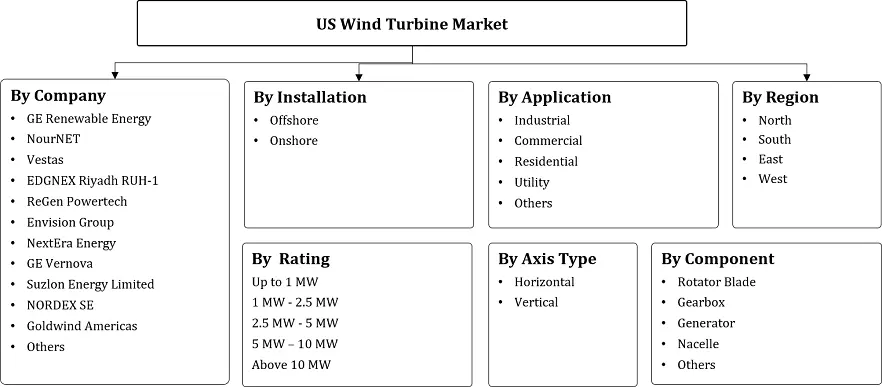
US Wind Turbine Market Report - By Axis Type (Horizontal, Vertical), By Rating (Up to 1 MW, 1 MW - 2.5 MW, 2.5 MW - 5 MW, 5 MW – 10 MW, Above 10 MW), By Installation (Offshore, Onshore), By Component... ... Onshore), By Component (Rotator Blade, Gearbox, Generator, Nacelle, Others), By Application (Industrial, Commercial, Residential, Utility, Others) and Others Read more
- Energy
- Dec 2024
- 131
- PDF, Excel, PPT
Market Definition
A turbine is a device that is essential in converting the energy from fluid or air into electricity. By utilizing a rotor system, a turbine can capture the rotational energy produced by the fluid to create various applications.
Market Insights & Analysis: US Wind Turbine Market (2025-2030):
The US Wind Turbine Market size has an installed capacity of 1,42,542 MW (with total projects of 1,699) in 2024 and is projected to reach 1,61,821 MW by 2030. Along with this, the market is estimated to grow at a CAGR of around 2.14% during the forecast period. Moreover, the new installation capacity of 2,118 MW in 2024 (across 28 projects) is projected to reach 3,213 MW by 2030 and is estimated to grow with a CAGR of around 7.19% during the forecast period, i.e. 2025-30. The wind turbine market in the US is increasing due to technological improvements, regulatory support, and increasing interest in sustainable energy, making it a key part of the renewable energy sector. Federal and state renewable energy guidelines, like the 2022 Inflation Reduction Act, are driving the market with extended tax credits for wind projects. Additionally, the growth of offshore wind power provides a major opportunity, with states such as New York and California at the leading edge of government efforts to access abundant offshore resources. Also, the emphasis on achieving energy independence and lowering dependence on foreign fossil fuels boosted the growth of the wind energy industry.
| Report Coverage | Details |
|---|---|
| Historical Years | 2020-23 |
|
Base Years
|
2024
|
|
Forecast Years
|
2025-30
|
| Market Value in 2024 | 1,42,542 MW (with total projects of 1,699) |
| Market Value in 2030 | 1,61,821 MW |
| CAGR (2025-30) | 2.14% |
| Top Key Players | GE Renewable Energy, NourNET, Vestas, EDGNEX Riyadh RUH-1, ReGen Powertech, Envision Group, NextEra Energy, GE Vernova, Suzlon Energy Limited, NORDEX SE, Goldwind Americas, and others |
| Key Report Highlights |
|
*Boost strategic growth with in-depth market analysis - Get a free sample preview today!
Moreover, it also tackles the challenge of decreasing carbon emissions in industries that are hard to decarbonize, including industrial manufacturing. The incorporation of wind electricity into the technology of green hydrogen is being seen as a potential game-changer. Promoting wind energy technology to international markets solidifies the United States’ role as a leader in renewable power innovation. Furthermore, the sector is experiencing a trend towards bigger turbine sizes, with certain offshore turbines surpassing a capacity of 12 MW such as GE Haliade-X a production of GE Vernova. This trend lowers the cost per megawatt and improves efficiency.
In addition, digital transformation is revolutionizing the industry by incorporating IoT technology in turbines for instant monitoring and maintenance forecasts. The improvements in technology like; floating wind turbines are facilitating growth in deeper waters, broadening the scope of potential offshore areas. Teamed up with federal tax benefits and strong state-level efforts, these changes could help move the US closer to achieving its net-zero emissions target, while also guaranteeing energy security and fostering job growth in the renewable energy industry.
Furthermore, hybrid projects that combine wind, solar, and battery storage are increasingly frequent, guaranteeing consistent electricity supply and enhancing the integration of renewable energy into the grid. Moreover, floating offshore wind platforms are becoming more popular, allowing for installation in deeper waters where conventional fixed platforms are impractical. Additionally, to achieve net-zero emissions by 2050, wind energy is seen as a vital part of the transition in the US. Stakeholders who take benefit of these factors, possibilities, and shifts will be in a robust role to benefit from the changing marketplace whilst addressing urgent climate and energy issues.
- Market Segmentation
- Research Methodology
- Product Definition
- Research Process
- Assumptions
- Executive Summary
- US Wind Turbine Market Trends & Development
- US Wind Turbine Market Industry Dynamics
- Drivers
- Challenges
- US Wind Turbine Market Hotspot & Opportunities
- US Wind Turbine Market Policies, Regulations, Product Standards
- US Wind Turbine Market Outlook, 2020-2030F
- Market Size & Analysis
- By Revenues (Million)
- Market Share & Analysis
- By Axis Type
- Horizontal - Market Size & Forecast 2020-2030F, USD Million
- Vertical - Market Size & Forecast 2020-2030F, USD Million
- By Rating
- Up to 1 MW - Market Size & Forecast 2020-2030F, USD Million
- 1 MW - 2.5 MW - Market Size & Forecast 2020-2030F, USD Million
- 2.5 MW - 5 MW - Market Size & Forecast 2020-2030F, USD Million
- 5 MW – 10 MW - Market Size & Forecast 2020-2030F, USD Million
- Above 10 MW - Market Size & Forecast 2020-2030F, USD Million
- By Installation
- Offshore - Market Size & Forecast 2020-2030F, USD Million
- Onshore - Market Size & Forecast 2020-2030F, USD Million
- By Component
- Rotator Blade - Market Size & Forecast 2020-2030F, USD Million
- Gearbox - Market Size & Forecast 2020-2030F, USD Million
- Generator - Market Size & Forecast 2020-2030F, USD Million
- Nacelle - Market Size & Forecast 2020-2030F, USD Million
- Others - Market Size & Forecast 2020-2030F, USD Million
- By Application
- Industrial - Market Size & Forecast 2020-2030F, USD Million
- Commercial - Market Size & Forecast 2020-2030F, USD Million
- Residential - Market Size & Forecast 2020-2030F, USD Million
- Utility - Market Size & Forecast 2020-2030F, USD Million
- Others - Market Size & Forecast 2020-2030F, USD Million
- By Region
- North
- South
- East
- West
- By Company
- Competition Characteristics
- Company Share & Analysis
- By Axis Type
- Market Size & Analysis
- US Industrial Wind Turbine Market Outlook, 2020-2030F
- Market Size & Analysis
- By Revenue (USD Million)
- Market Share & Analysis
- By Axis Type - Market Size & Forecast 2020-2030F, USD Million
- By Rating - Market Size & Forecast 2020-2030F, USD Million
- By Installation - Market Size & Forecast 2020-2030F, USD Million
- By Component - Market Size & Forecast 2020-2030F, USD Million
- Market Size & Analysis
- US Commercial Wind Turbine Market Outlook, 2020-2030F
- Market Size & Analysis
- By Revenue (USD Million)
- Market Share & Analysis
- By Axis Type - Market Size & Forecast 2020-2030F, USD Million
- By Rating - Market Size & Forecast 2020-2030F, USD Million
- By Installation - Market Size & Forecast 2020-2030F, USD Million
- By Component - Market Size & Forecast 2020-2030F, USD Million
- Market Size & Analysis
- US Residential Wind Turbine Market Outlook, 2020-2030F
- Market Size & Analysis
- By Revenue (USD Million)
- Market Share & Analysis
- By Axis Type - Market Size & Forecast 2020-2030F, USD Million
- By Rating - Market Size & Forecast 2020-2030F, USD Million
- By Installation - Market Size & Forecast 2020-2030F, USD Million
- By Component - Market Size & Forecast 2020-2030F, USD Million
- Market Size & Analysis
- US Utility Wind Turbine Market Outlook, 2020-2030F
- Market Size & Analysis
- By Revenue (USD Million)
- Market Share & Analysis
- By Axis Type - Market Size & Forecast 2020-2030F, USD Million
- By Rating - Market Size & Forecast 2020-2030F, USD Million
- By Installation - Market Size & Forecast 2020-2030F, USD Million
- By Component - Market Size & Forecast 2020-2030F, USD Million
- Market Size & Analysis
- US Wind Turbine Market Key Strategic Imperatives for Growth & Success
- Competitive Outlook
- Company Profiles
- GE Renewable Energy
- Business Description
- Type Portfolio
- Strategic Alliances or Partnerships
- Recent Developments
- Financial Details
- Others
- NourNET
- Business Description
- Type Portfolio
- Strategic Alliances or Partnerships
- Recent Developments
- Financial Details
- Others
- Vestas
- Business Description
- Type Portfolio
- Strategic Alliances or Partnerships
- Recent Developments
- Financial Details
- Others
- EDGNEX Riyadh RUH-1
- Business Description
- Type Portfolio
- Strategic Alliances or Partnerships
- Recent Developments
- Financial Details
- Others
- ReGen Powertech
- Business Description
- Type Portfolio
- Strategic Alliances or Partnerships
- Recent Developments
- Financial Details
- Others
- Envision Group
- Business Description
- Type Portfolio
- Strategic Alliances or Partnerships
- Recent Developments
- Financial Details
- Others
- NextEra Energy
- Business Description
- Type Portfolio
- Strategic Alliances or Partnerships
- Recent Developments
- Financial Details
- Others
- GE Vernova
- Business Description
- Type Portfolio
- Strategic Alliances or Partnerships
- Recent Developments
- Financial Details
- Others
- Suzlon Energy Limited
- Business Description
- Type Portfolio
- Strategic Alliances or Partnerships
- Recent Developments
- Financial Details
- Others
- NORDEX SE
- Business Description
- Type Portfolio
- Strategic Alliances or Partnerships
- Recent Developments
- Financial Details
- Others
- Goldwind Americas
- Business Description
- Type Portfolio
- Strategic Alliances or Partnerships
- Recent Developments
- Financial Details
- Others
- Others
- GE Renewable Energy
- Company Profiles
- Disclaimer
MarkNtel Advisors follows a robust and iterative research methodology designed to ensure maximum accuracy and minimize deviation in market estimates and forecasts. Our approach combines both bottom-up and top-down techniques to effectively segment and quantify various aspects of the market. A consistent feature across all our research reports is data triangulation, which examines the market from three distinct perspectives to validate findings. Key components of our research process include:
1. Scope & Research Design At the outset, MarkNtel Advisors define the research objectives and formulate pertinent questions. This phase involves determining the type of research—qualitative or quantitative—and designing a methodology that outlines data collection methods, target demographics, and analytical tools. They also establish timelines and budgets to ensure the research aligns with client goals.
2. Sample Selection and Data Collection In this stage, the firm identifies the target audience and determines the appropriate sample size to ensure representativeness. They employ various sampling methods, such as random or stratified sampling, based on the research objectives. Data collection is carried out using tools like surveys, interviews, and observations, ensuring the gathered data is reliable and relevant.
3. Data Analysis and Validation Once data is collected, MarkNtel Advisors undertake a rigorous analysis process. This includes cleaning the data to remove inconsistencies, employing statistical software for quantitative analysis, and thematic analysis for qualitative data. Validation steps are taken to ensure the accuracy and reliability of the findings, minimizing biases and errors.

4. Data Forecast and FinalizationThe final phase involves forecasting future market trends based on the analyzed data. MarkNtel Advisors utilize predictive modeling and time series analysis to anticipate market behaviors. The insights are then compiled into comprehensive reports, featuring visual aids like charts and graphs, and include strategic recommendations to inform client decision-making
We’d love to understand what matters most to you.