

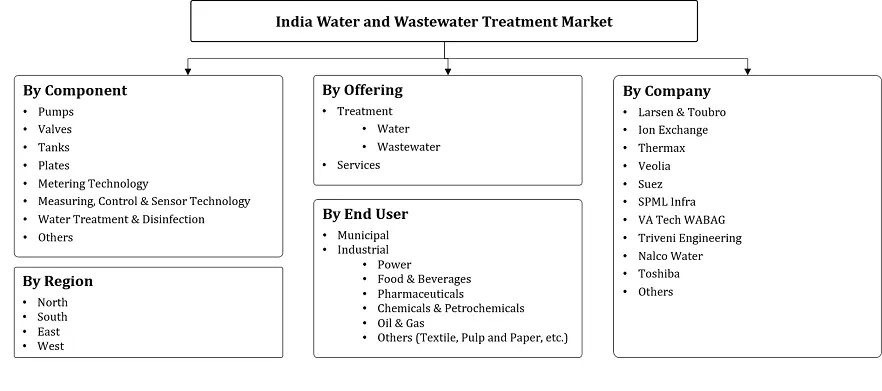
By Type (Chemicals (pH Conditioners, Coagulants & Flocculants, Disinfectants & Biocidal Products, Scale & Corrosion Inhibitors, Antifoam Chemicals, Other Chemicals), Equipment (Biological, Filtration,... ... logical, Filtration, Sludge Treatment, Disinfection, Demineralization, Other Equipment), Services (Designing & Installation, Operations, Maintenance, Others)), By Technology (Membrane filtration (UF, MF, NF), Reverse Osmosis (RO), UV disinfection, Activated sludge & nutrient removal, Advanced oxidation processes, Ion exchange & adsorption (GAC, resins)), By Application (Municipal Wastewater Treatment, Industrial Water Treatment, Municipal Wastewater Treatment, Industrial Wastewater Treatment, Agricultural Water Management, Other Applications), By End User (Municipal utilities, Power generation, Oil & gas, Food & beverage, Pharmaceuticals, Mining & metals, Chemicals, pulp & paper), and others Read more
- Environment
- Apr 2026
- 135
- PDF, Excel, PPT
India Water and Wastewater Treatment Market Key Takeaways
- India Water and Wastewater Treatment Market size was valued at USD 3.98 billion in 2025 and is projected to grow from USD 4.56 billion in 2026 to USD 9.19 billion by 2032, exhibiting a CAGR of 12.39% during 2026-2032.
- South India holds the largest share of about 38%.
- By type, the chemicals segment holds a significant share of about 43%
- By end user, the municipal utilities segment seized a significant share of about 45% in 2026.
- The industry is moderately consolidated. However, the top five players collectively account for nearly 50% share.
India Water and Wastewater Treatment Market Size and Outlook
The India Water and Wastewater Treatment Market size was valued at USD 3.98 billion in 2025 and is projected to grow from USD 4.56 billion in 2026 to USD 9.19 billion by 2032. Along with this, the market is estimated to grow at a CAGR of around 12.39% during the forecast period, i.e., 2026-32.
The market growth is expected to witness steady expansion, driven primarily by increasing freshwater stress and the growing need for water scarcity solutions in India through reuse and recycling systems. Severe depletion of freshwater resources is pushing municipalities and industries toward wastewater treatment as a reliable alternative, strengthening adoption of sustainable wastewater management practices across urban and industrial clusters.
For example, Chennai’s reuse infrastructure. The Koyambedu TTRO plant, which treats around 45 MLD of municipal wastewater into industrial-grade water, plays a key role in supplying manufacturing clusters. The ongoing upgrades such as the Kodungaiyur TTRO revamp are further expanding recycled water availability while reducing dependence on freshwater sources, reinforcing circular water economy principles in water-stressed regions.
At the policy level, India is accelerating the shift toward sustainable wastewater management through performance-based governance. The Jal Hi AMRIT Scheme under AMRUT 2.0 incentivizes cities to improve sewage treatment efficiency and promote reuse through a structured rating system, encouraging the adoption of advanced treatment technologies. Ministry of Housing and Urban Affairs
Additionally, the Press Information Bureau highlights that under AMRUT 2.0, 583 sewerage projects worth USD 7–8 billion have been approved, supporting large-scale wastewater infrastructure development and strengthening the circular water economy framework across urban India. At the state level, Uttar Pradesh’s Safe Reuse of Treated Water Policy (2026) targets 50% reuse by 2030, expanding toward full reuse across sectors such as agriculture, industry, and urban supply. This reinforces long-term solutions to water scarcity in India by reducing dependence on freshwater resources.
Moreover, the convergence of infrastructure expansion, policy enforcement, and reuse-driven frameworks is transforming India’s water sector into a resilient circular water economy, supporting long-term sustainable growth.
India Water and Wastewater Treatment Market Key Indicators
- India’s rural tap water coverage has expanded sharply, rising from around 17% in 2019 to nearly 79–80% by 2025, covering over 15 crore households. This large-scale increase in water availability is simultaneously generating higher wastewater volumes, thereby strengthening demand for sewage treatment infrastructure and driving adoption of both centralized and decentralized treatment solutions across regions.
- The Economic Survey 2025–26 highlights a critical imbalance, with India generating approximately 112 billion litres of wastewater daily, while only about 28% is treated and a mere 8% reused. This significant treatment gap is acting as a strong structural indicator, accelerating investments in sewage treatment plants, reuse systems, and advanced decentralized wastewater technologies nationwide.
- India’s heavy reliance on groundwater, particularly in rural regions where dependence reaches nearly 85%, is intensifying resource stress. Increasing scarcity is pushing municipalities and industries toward sustainable wastewater management practices, where treated wastewater is emerging as a vital alternative source. This shift is strengthening the role of reuse-oriented treatment systems in both urban and industrial applications.
- India’s water infrastructure is witnessing strong expansion under the Namami Gange Programme, which has added 538 MLD sewage treatment capacity in FY 2025–26 through multiple projects across Ganga basin states. This includes completion of 28 new STPs, reflecting large-scale investment in pollution control and wastewater treatment infrastructure. The expansion strengthens municipal wastewater management and supports rising demand for advanced treatment and reuse systems across urban regions.
India Water and Wastewater Treatment Market Scope
| Category | Segments |
|---|---|
| By Type | Chemicals (pH Conditioners, Coagulants & Flocculants, Disinfectants & Biocidal Products, Scale & Corrosion Inhibitors, Antifoam Chemicals, Other Chemicals), Equipment (Biological, Filtration, Sludge Treatment, Disinfection, Demineralization, Other Equipment), Services (Designing & Installation, Operations, Maintenance, Others |
| By Technology | Membrane filtration (UF, MF, NF), Reverse Osmosis (RO), UV disinfection, Activated sludge & nutrient removal, Advanced oxidation processes, Ion exchange & adsorption (GAC, resins |
| By Application | Municipal Wastewater Treatment, Industrial Water Treatment, Municipal Wastewater Treatment, Industrial Wastewater Treatment, Agricultural Water Management, Other Applications |
| By End User | Municipal utilities, Power generation, Oil & gas, Food & beverage, Pharmaceuticals, Mining & metals, Chemicals, pulp & paper |
India Water and Wastewater Treatment Market Growth Drivers
Structural Water Scarcity Forcing Wastewater Treatment & Reuse
India’s water and wastewater treatment market is strongly driven by widening wastewater treatment capacity gap in India, which is intensifying pressure on existing infrastructure and accelerating investment in reuse-based solutions. The country accounts for nearly 18% of the global population but only about 4% of freshwater resources, creating a persistent imbalance between demand and supply. World Bank highlights this structural constraint as a long-term challenge for the water infrastructure market India.
Government data further reinforces the severity of this gap. Per capita water availability has declined to 1,486 cubic meters in 2021 and is projected to fall further to 1,367 cubic meters by 2031, well below the water stress threshold. This long-term decline reflects growing scarcity and rising dependence on water scarcity solutions in India such as wastewater recycling and reuse systems.
In addition, climate change impact on water resources is increasing variability in rainfall, groundwater depletion, and seasonal water stress, particularly in urban and industrial clusters. This is pushing industries such as data centers, manufacturing, and power generation toward treated wastewater adoption, where a 1 MW data center consumes nearly 25.5 million liters annually for cooling.
Policy support is further accelerating adoption. Maharashtra has introduced a circular economy policy covering 424 urban local bodies with a USD 60 million investment to promote the reuse of treated wastewater. Additionally, the government has proposed mandates requiring up to 50% wastewater reuse for bulk users by 2031, reinforcing regulatory push toward circular water systems.
Furthermore, rising capacity gaps, climate-driven stress, and regulatory mandates are collectively strengthening demand for advanced wastewater treatment systems, positioning reuse infrastructure as a core growth engine for India’s water and wastewater treatment market.
- Market Segmentation
- Introduction
- Product Definition
- Research Process
- Assumptions
- Executive Summary
- India Water and Wastewater Treatment Market Policies, Regulations, and Product Standards
- India Water and Wastewater Treatment Market Trends & Developments
- India Water and Wastewater Treatment Market Dynamics
- Growth Factors
- Challenges
- India Water and Wastewater Treatment Market Hotspot & Opportunities
- India Water and Wastewater Treatment Market Outlook, 2022-2032F
- Market Size & Outlook
- By Revenues (USD Million)
- Market Share & Outlook
- By Type- Market Size & Forecast 2022-2032, USD Million
- Chemicals
- pH Conditioners
- Coagulants & Flocculants
- Disinfectants & Biocidal Products
- Scale & Corrosion Inhibitors
- Antifoam Chemicals
- Other Chemicals
- Equipment
- Biological
- Filtration
- Sludge Treatment
- Disinfection
- Demineralization
- Other Equipment
- Services
- Designing & Installation
- Operations
- Maintenance
- Others
- Chemicals
- By Technology- Market Size & Forecast 2022-2032, USD Million
- Membrane filtration (UF, MF, NF)
- Reverse Osmosis (RO)
- UV disinfection
- Activated sludge & nutrient removal
- Advanced oxidation processes
- Ion exchange & adsorption (GAC, resins)
- By Application- Market Size & Forecast 2022-2032, USD Million
- Municipal Wastewater Treatment
- Industrial Water Treatment
- Municipal Wastewater Treatment
- Industrial Wastewater Treatment
- Agricultural Water Management
- Other Applications
- By End User- Market Size & Forecast 2022-2032, USD Million
- Municipal utilities
- Power generation
- Oil & gas
- Food & beverage
- Pharmaceuticals
- Mining & metals
- Chemicals, pulp & paper
- By Region- Market Size & Forecast 2022-2032, USD Million
- South
- West
- East
- North
- By Company
- Competition Characteristics
- Market Share & Analysis
- By Type- Market Size & Forecast 2022-2032, USD Million
- Market Size & Outlook
- India Chemicals Market Outlook, 2022-2032
- Market Size & Outlook
- By Revenues (USD Million)
- Market Share & Outlook
- By Technology- Market Size & Forecast 2022-2032, USD Million
- By Application- Market Size & Forecast 2022-2032, USD Million
- By End User- Market Size & Forecast 2022-2032, USD Million
- By Region- Market Size & Forecast 2022-2032, USD Million
- Market Size & Outlook
- India Equipment Market Outlook, 2022-2032
- Market Size & Outlook
- By Revenues (USD Million)
- Market Share & Outlook
- By Technology- Market Size & Forecast 2022-2032, USD Million
- By Application- Market Size & Forecast 2022-2032, USD Million
- By End User- Market Size & Forecast 2022-2032, USD Million
- By Region- Market Size & Forecast 2022-2032, USD Million
- Market Size & Outlook
- India Services Market Outlook, 2022-2032
- Market Size & Outlook
- By Revenues (USD Million)
- Market Share & Outlook
- By Technology- Market Size & Forecast 2022-2032, USD Million
- By Application- Market Size & Forecast 2022-2032, USD Million
- By End User- Market Size & Forecast 2022-2032, USD Million
- By Region- Market Size & Forecast 2022-2032, USD Million
- Market Size & Outlook
- India Water and Wastewater Treatment Market Key Strategic Imperatives for Success & Growth
- Competitive Outlook
- Company Profiles
- Larsen & Toubro
- Business Description
- Product Portfolio
- Collaborations & Alliances
- Recent Developments
- Financial Details
- Others
- VA Tech WABAG
- Business Description
- Product Portfolio
- Collaborations & Alliances
- Recent Developments
- Financial Details
- Others
- Ion Exchange
- Business Description
- Product Portfolio
- Collaborations & Alliances
- Recent Developments
- Financial Details
- Others
- Thermax Limited
- Business Description
- Product Portfolio
- Collaborations & Alliances
- Recent Developments
- Financial Details
- Others
- SPML Infra Limited
- Business Description
- Product Portfolio
- Collaborations & Alliances
- Recent Developments
- Financial Details
- Others
- Tata Projects Limited
- Business Description
- Product Portfolio
- Collaborations & Alliances
- Recent Developments
- Financial Details
- Others
- Veolia
- Business Description
- Product Portfolio
- Collaborations & Alliances
- Recent Developments
- Financial Details
- Others
- SUEZ
- Business Description
- Product Portfolio
- Collaborations & Alliances
- Recent Developments
- Financial Details
- Others
- Nalco Water
- Business Description
- Product Portfolio
- Collaborations & Alliances
- Recent Developments
- Financial Details
- Others
- Xylem Inc.
- Business Description
- Product Portfolio
- Collaborations & Alliances
- Recent Developments
- Financial Details
- Others
- Others
- Business Description
- Product Portfolio
- Collaborations & Alliances
- Recent Developments
- Financial Details
- Others
- Larsen & Toubro
- Company Profiles
- Disclaimer
MarkNtel Advisors follows a robust and iterative research methodology designed to ensure maximum accuracy and minimize deviation in market estimates and forecasts. Our approach combines both bottom-up and top-down techniques to effectively segment and quantify various aspects of the market. A consistent feature across all our research reports is data triangulation, which examines the market from three distinct perspectives to validate findings. Key components of our research process include:
1. Scope & Research Design At the outset, MarkNtel Advisors define the research objectives and formulate pertinent questions. This phase involves determining the type of research—qualitative or quantitative—and designing a methodology that outlines data collection methods, target demographics, and analytical tools. They also establish timelines and budgets to ensure the research aligns with client goals.
2. Sample Selection and Data Collection In this stage, the firm identifies the target audience and determines the appropriate sample size to ensure representativeness. They employ various sampling methods, such as random or stratified sampling, based on the research objectives. Data collection is carried out using tools like surveys, interviews, and observations, ensuring the gathered data is reliable and relevant.
3. Data Analysis and Validation Once data is collected, MarkNtel Advisors undertake a rigorous analysis process. This includes cleaning the data to remove inconsistencies, employing statistical software for quantitative analysis, and thematic analysis for qualitative data. Validation steps are taken to ensure the accuracy and reliability of the findings, minimizing biases and errors.

4. Data Forecast and FinalizationThe final phase involves forecasting future market trends based on the analyzed data. MarkNtel Advisors utilize predictive modeling and time series analysis to anticipate market behaviors. The insights are then compiled into comprehensive reports, featuring visual aids like charts and graphs, and include strategic recommendations to inform client decision-making
We’d love to understand what matters most to you.