

By Offering Type (Water Treatment Chemicals, Water Treatment Equipment & Systems, Water Treatment Services), By Technology (Filtration & Separation, Membrane-Based Treatment, Ion Exchange & Deminerali... ... xchange & Demineralization, Disinfection & Sterilization, Chemical Treatment, Others), By Application (Boiler Feedwater Treatment, Cooling Water Treatment, Process & Utility Water Treatment, Industrial Wastewater Treatment, Water Reuse & Recycling), By End-User (Power Generation, Chemical & Petrochemical, Oil & Gas Refining, Iron & Steel / Metals & Mining, Pharmaceutical & Biotechnology, Food & Beverage, Pulp & Paper, Textile, Electronics & Semiconductor, Others), and others Read more
- Environment
- Sep 2026
- 135
- PDF, Excel, PPT
China Industrial Process Water Market Key Takeaways
- The China industrial process water market was valued at USD 7.12 billion in 2025 and is projected to grow from USD 8.98 billion in 2026 to USD 13.29 billion by 2032, registering a CAGR of 6.75% during 2026–2032.
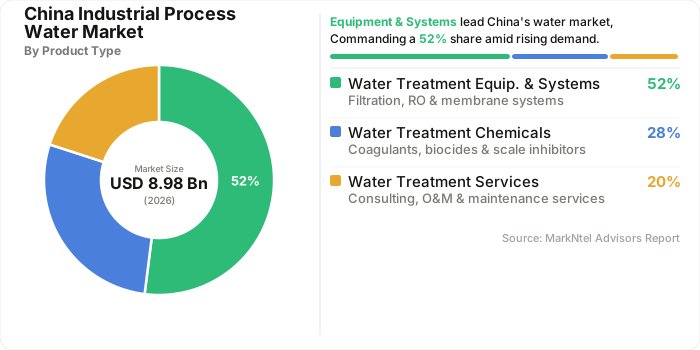
- Water treatment equipment & systems remains the dominant product type, accounting for an estimated 52% share in 2026.
- Chemical & petrochemical represents the leading end-user segment, accounting for a 26.5% share in 2026.
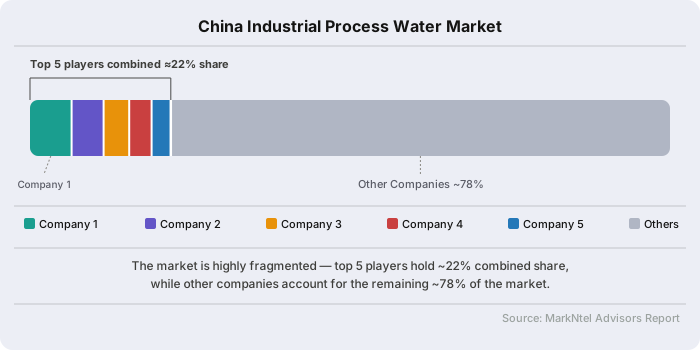
- The market is moderately fragmented, with the top five players collectively accounting for an estimated 22% share in 2026.
China Industrial Process Water Market Size and Outlook
The China Industrial Process Water Market is valued at USD 7.12 billion in 2025, expands to USD 8.98 billion in 2026, and is projected to reach USD 13.29 billion by 2032, registering a 6.75% CAGR during 2026–2032.
The market's expansion is supported by China's industrial water-efficiency targets, increasing process-water recycling requirements, and continued modernization of treatment infrastructure across water-intensive manufacturing industries.
According to the Ministry of Industry and Information Technology (MIIT), China's Industrial Water Efficiency Improvement Action Plan targets a 16% reduction in water consumption per USD 1468 of industrial value added by 2025 compared with 2020, while establishing a 94% industrial water reuse target for enterprises above a designated size. These requirements directly strengthen demand for industrial process water treatment, recycling, water-conditioning, and closed-loop systems as manufacturers improve water-use efficiency while maintaining production continuity across chemical, steel, textile, food-processing, and other water-intensive operations.
This structural demand is reinforced by the scale of industrial water consumption, with MIIT reporting industrial water use in 2024, equivalent to approximately 16% of China's total water use. The combination of a large industrial water-consumption base and tightening efficiency requirements supports recurring investment in process water treatment and reuse infrastructure.
China Industrial Process Water Market Key Indicators
- According to the Ministry of Industry and Information Technology (MIIT), China's industrial water use reaches 97.1 billion m³ in 2024, accounting for approximately 16% of national water use, while water consumption per USD 1468 of industrial value added stands at 24 m³. This large industrial water base supports recurring demand for process-water treatment, recycling, water-efficiency equipment, and lifecycle services.
- As per the National Development and Reform Commission (NDRC) and Ministry of Housing and Urban-Rural Development (MOHURD), China's 14th Five-Year Plan for Urban Wastewater Treatment and Resource Utilization targets at least 15 million m³/day of new, renovated, and expanded reclaimed-water production capacity by 2025, while reclaimed-water utilization in water-scarce cities is targeted at more than 25%. The capacity target expands the addressable market for tertiary treatment, membrane filtration, and industrial reuse infrastructure.
- According to MIIT's industrial water-efficiency guidance, benchmark water-use requirements cover major industrial processes, with the published guidance specifying 15 m³/t as the limiting value for ethylene production and differentiated water-use benchmarks across petrochemical and chemical processes. These benchmarks encourage industrial facilities to improve process-water circulation, cooling-water efficiency, and treatment performance rather than relying on higher freshwater intake.
- By the Ministry of Water Resources (MWR), China completes approximately USD 189 billion in water-conservancy construction investment in 2024, with investment increasing 12.8% year on year. The scale of water-infrastructure capital deployment strengthens the broader infrastructure ecosystem supporting industrial water supply, recycling, treatment and resource-management projects.
China Industrial Water Consumption Analysis
China's industrial process-water demand is concentrated across chemicals, steel, light manufacturing and other water-intensive production activities, creating differentiated requirements for treatment and reuse systems. According to the Ministry of Industry and Information Technology (MIIT), the petrochemical and chemical industry consumes approximately 8.31 billion m³ of water annually, representing 8.6% of industrial water use. This large consumption base across refining, synthetic ammonia, methanol, PTA and coal-to-olefins operations supports sustained demand for cooling-water treatment, process-water conditioning and industrial wastewater-recovery systems.
Water-efficiency requirements are particularly stringent in metals and manufacturing, creating demand for higher-performance recycling systems. MIIT indicates that crude-steel water withdrawal remains below 3 m³ per tonne, while a leading steel facility achieves 2.87 m³/tonne with a 98.89% water-reuse rate. Meanwhile, light industries including food, brewing, fermentation, leather and paper consume more than 5 billion tonnes of water annually, creating additional requirements for filtration, biological treatment and water recovery. These benchmarks demonstrate the increasing value of efficient closed-loop treatment infrastructure.
The demand opportunity extends beyond conventional high-volume users into industries requiring more specialized water-management solutions. MIIT's industrial water-efficiency program identifies electronics, pharmaceuticals, food, textiles, petrochemicals, steel, non-ferrous metals, coal, and power among priority sectors, while 29 industrial enterprises and 3 industrial parks are selected for wastewater recycling pilots. This broadens opportunities for RO, ultrafiltration, high-purity water, online monitoring and MLD/ZLD systems across China's industrial base.
Investment is best positioned toward high-recovery membrane systems, industrial wastewater recycling, cooling-water treatment, high-purity water systems and ZLD/MLD technologies, with chemical, steel, food, pharmaceutical, electronics and semiconductor facilities representing differentiated procurement opportunities according to water consumption, contamination characteristics and required water-quality specifications.
China Industrial Process Water Market Scope
| Category | Segments |
|---|---|
| By Offering Type | Water Treatment Chemicals, Water Treatment Equipment & Systems, Water Treatment Services |
| By Technology | Filtration & Separation, Membrane-Based Treatment, Ion Exchange & Demineralization, Disinfection & Sterilization, Chemical Treatment, Others |
| By Application | Boiler Feedwater Treatment, Cooling Water Treatment, Process & Utility Water Treatment, Industrial Wastewater Treatment, Water Reuse & Recycling |
| By End-User | Power Generation, Chemical & Petrochemical, Oil & Gas Refining, Iron & Steel / Metals & Mining, Pharmaceutical & Biotechnology, Food & Beverage, Pulp & Paper, Textile, Electronics & Semiconductor, Others |
China Industrial Process Water Market Growth Driver
Rising Industrial Production and Electricity Demand Accelerate Process-Water Treatment Investment
China's expanding industrial and electricity demand continues to strengthen the underlying requirement for industrial process water infrastructure. According to the International Energy Agency (IEA), China's electricity demand increases by 5.1% in 2024, with the industrial sector remaining a major contributor to demand growth; electricity consumption is also projected to increase by approximately 1,400 TWh through 2026. This expanding power and industrial operating base supports demand for cooling-water treatment, boiler-feed-water conditioning, filtration, and process-water management systems across energy-intensive facilities.
The manufacturing base is simultaneously shifting toward higher-value production that requires tighter process-water specifications. China's high-tech manufacturing value added increases by 8.9% year on year in 2024, according to the State Council Information Office/National Bureau of Statistics reporting. Growth across electronics, pharmaceuticals, advanced materials, and related industries increases requirements for consistent water quality, purification, and recycling, creating additional demand for high-purity process-water systems and advanced membrane-based treatment technologies.
Recent Trend
Advanced ZLD Systems Gain Traction Across Water-Stressed Coal-Chemical Clusters
China's water-stressed coal-chemical regions are increasingly adopting advanced wastewater recovery and minimum- or zero-liquid-discharge configurations to reduce freshwater dependence and manage high-salinity effluent. The National Development and Reform Commission (NDRC) identifies coal-producing areas including Longdong, Ningdong, western Inner Mongolia, northern Shaanxi and western Shanxi as regions where mine-water treatment and utilization are promoted as alternatives to conventional water sources, including for coal-chemical production. This policy direction supports continued investment in membrane concentration, water recovery and ZLD infrastructure.
Supply-side innovation is shifting these systems toward membrane-led treatment architectures that reduce the volume requiring energy-intensive thermal processing. DuPont's Fortilife MLD solution at Shaanxi Yanchang Yulin Energy & Chemical Co., Ltd. integrates ultrafiltration, nanofiltration and reverse osmosis, with the system operating at 1,300 m³/hour during Phase II and recovering RO permeate for cooling-tower makeup water. The deployment demonstrates the increasing role of high-recovery membrane systems in complex coal-chemical wastewater applications, supporting demand for MLD/ZLD retrofits and integrated process-water recovery systems.
China Industrial Process Water Market Opportunities and Challenges
High Energy Requirements of Thermal ZLD Accelerate Demand for Low-Energy Membrane Pre-Concentration
According to recent engineering research, mechanical vapor compression (MVC) systems can require approximately 15–25 kWh/m³ when treating highly concentrated industrial brines, making thermal ZLD a significant operating-cost component at high wastewater volumes. The energy burden becomes particularly material for chemical and other water-intensive facilities where hypersaline streams require evaporation and crystallization after conventional membrane treatment. This creates a clear challenge for industrial operators seeking to maintain high water recovery while controlling electricity consumption and reducing the carbon intensity of process-water treatment.
The challenge creates an opportunity for high-pressure RO, OARO, and other membrane-based brine-concentration systems that can extend membrane treatment into higher-salinity ranges before thermal polishing. Recent technical evidence indicates that HPRO can operate around 120,000 mg/L TDS, while OARO can address still higher salinity ranges under suitable process conditions. Hybrid membrane-thermal configurations therefore provide an opportunity to reduce the volume entering energy-intensive evaporation and crystallization, creating additional demand for advanced membrane systems, high-pressure equipment and integrated ZLD engineering across China's chemical, coal-chemical and heavy-industrial facilities.
Segmentation Insights
Water Treatment Equipment & Systems Capture China’s Industrial Process-Water Spending
Water treatment equipment & systems represent the largest product category, accounting for an estimated 52% of 2026 revenue. The segment leads because industrial projects require complete treatment trains, including RO skids, ultrafiltration, demineralization, evaporation-crystallization and dosing systems, creating substantially higher upfront revenue than chemicals or services. SUEZ's Jiangsu project further illustrates this capital intensity, with 50,000 m³/day industrial-water and 20,000 m³/day demineralized-water capacity.
Future equipment demand is sustained by replacement of membrane and filtration components exposed to chemically aggressive process streams, alongside new high-value manufacturing capacity and stricter water-reuse requirements. China's high-tech manufacturing value added increases 9.4% in 2025, according to the National Bureau of Statistics, strengthening requirements for reliable, higher-quality process water across electronics, advanced materials and pharmaceutical manufacturing. This expansion supports continued procurement of specialized purification, recycling and high-purity water systems, while industrial-park development creates additional large-scale equipment opportunities. Based on Product Type, the industry is segmented into:
- Water Treatment Chemicals
- Water Treatment Equipment & Systems
- Water Treatment Services
Chemical & Petrochemical Operations Drive China’s Process-Water Treatment Demand
The chemical & petrochemical segment represents the largest end-user category, accounting for 26.5% of 2026 market revenue. Its dominance is supported by China's large-scale chemical production base and high process-water intensity across cooling, steam generation, feed preparation and synthesis. According to the National Bureau of Statistics (NBS), the value added of China's chemical raw-materials and chemical-products manufacturing industry increased by 7.8% in 2025, sustaining water-treatment investment alongside production expansion.
The segment also generates higher treatment value because chemical wastewater commonly requires multiple treatment barriers and higher water-recovery performance. China's petrochemical industry produces more than 1.1 billion tonnes of wastewater annually, according to CPCIF, creating a substantial treatment and reuse requirement across refining and chemical facilities. High dissolved-solids and organic loads increase demand for pretreatment, advanced oxidation, membrane separation, and ZLD systems, while expanding refining and petrochemical capacity sustains recurring equipment, chemical, and service revenues. Based on End-Use Industry, the industry is segmented into:
- Power Generation
- Chemical & Petrochemical
- Oil & Gas Refining
- Iron & Steel / Metals & Mining
- Pharmaceutical & Biotechnology
- Food & Beverage
- Pulp & Paper
- Textile
- Electronics & Semiconductor
- Others
China Industrial Process Water Market Competitive Analysis
The China industrial process water market is moderately fragmented, with the top five companies collectively accounting for approximately 22% of 2026 market revenue. The leading competitive group includes Veolia Water Technologies (Shanghai) Co., Ltd., SUEZ Engineering (China) Co., Ltd., Ecolab Inc., Kurita Water Industries Ltd., and Xylem Inc.
Top Companies in the China Industrial Process Water industry:
- Veolia Water Technologies (Shanghai) Co., Ltd.
- SUEZ Engineering (China) Co., Ltd.
- Ecolab Inc.
- Kurita Water Industries Ltd.
- Xylem Inc.
- Beijing OriginWater Technology Co., Ltd.
- Jiangsu Jiuwu Hi-Tech Co., Ltd.
- SafBon Water Service (Holding) Inc., Shanghai
- China Everbright Water Limited
- Beijing Enterprises Water Group Limited
China Industrial Process Water Industry News and Recent Developments
April 2025: SUEZ Commissioned Large Industrial Desalination Project for Wanhua Chemical
SUEZ announced the commissioning of the Penglai industrial seawater desalination project serving Wanhua Chemical in Shandong. The project is designed to produce 300,000 m³/day of freshwater across three phases and represents a major industrial application of membrane-based seawater desalination in China. The project supplies an alternative water source for the chemical industrial complex while supporting freshwater-resource conservation.
Impact Analysis: The project strengthens SUEZ's positioning in large-scale industrial water supply and desalination. It also demonstrates the commercial shift toward alternative-water sources for water-intensive chemical complexes, expanding the addressable market for membrane desalination and integrated process-water systems.
May 2024: Veolia Opened Its First Ion-Exchange Regeneration Facility in China
Veolia Water Technologies inaugurated its first ion-exchange regeneration facility in China in Changshu, Jiangsu. The facility represents a €10 million investment, covers approximately 6,000 m², and provides 60 kL/day of mobile water services and 5 kL/day of service deionization capacity. The facility supports industries including microelectronics, pharmaceuticals, petrochemicals, power generation and food and beverage.
Impact Analysis: The facility expands localized supply and service capability for treated and ultrapure process water. Its regeneration and recycling model also strengthens the recurring-service component of the market by connecting equipment deployment with resin management, mobile-water services and lifecycle support
- Market Segmentation
- Introduction
- Product Definition
- Research Process
- Assumptions
- Executive Summary
- China Industrial Process Water Market Policies, Regulations, and Product Standards
- China Industrial Process Water Market Trends & Developments
- China Industrial Process Water Market Dynamics
- Growth Factors
- Challenges
- China Industrial Process Water Market Hotspot & Opportunities
- China Industrial Process Water Market Outlook, 2022-2032
- Market Size & Outlook
- By Revenues (USD Million)
- Market Share & Analysis
- By Offering Type - Market Size & Forecast 2022-2032, USD Million
- Water Treatment Chemicals
- Coagulants & Flocculants
- Biocides & Disinfectants
- Corrosion/Scale Inhibitors
- ph Adjusters
- Others
- Water Treatment Equipment & Systems
- Filtration Units
- Membrane Systems
- Ion Exchange Units
- Disinfection Systems
- Others
- Water Treatment Services
- EPC/System Integration
- O&M/Outsourced Water Management
- Testing & Laboratory Services
- Monitoring, Consulting & Compliance Services
- Water Treatment Chemicals
- By Technology- Market Size & Forecast 2022-2032, USD Million
- Filtration & Separation
- Membrane-Based Treatment
- Ion Exchange & Demineralization
- Disinfection & Sterilization
- Chemical Treatment
- Others
- By Application- Market Size & Forecast 2022-2032, USD Million
- Boiler Feedwater Treatment
- Cooling Water Treatment
- Process & Utility Water Treatment
- Industrial Wastewater Treatment
- Water Reuse & Recycling
- By End-User- Market Size & Forecast 2022-2032, USD Million
- Power Generation
- Chemical & Petrochemical
- Oil & Gas Refining
- Iron & Steel / Metals & Mining
- Pharmaceutical & Biotechnology
- Food & Beverage
- Pulp & Paper
- Textile
- Electronics & Semiconductor
- Others
- By Region
- East China
- North China
- South China
- Central China
- Northeast China
- Southwest China
- Northwest China
- By Company
- Competition Characteristics
- Market Share & Analysis
- By Offering Type - Market Size & Forecast 2022-2032, USD Million
- Market Size & Outlook
- China Water Treatment Chemicals Market Outlook, 2022-2032
- Market Size & Outlook
- By Revenues (USD Million)
- Market Segmentation & Analysis
- By Technology- Market Size & Forecast 2022-2032, USD Million
- By Application- Market Size & Forecast 2022-2032, USD Million
- By End-User- Market Size & Forecast 2022-2032, USD Million
- Market Size & Outlook
- China Water Treatment Equipment & Systems Market Outlook, 2022-2032
- Market Size & Outlook
- By Revenues (USD Million)
- Market Segmentation & Analysis
- By Technology- Market Size & Forecast 2022-2032, USD Million
- By Application- Market Size & Forecast 2022-2032, USD Million
- By End-User- Market Size & Forecast 2022-2032, USD Million
- Market Size & Outlook
- China Water Treatment Services Market Outlook, 2022-2032
- Market Size & Outlook
- By Revenues (USD Million)
- Market Segmentation & Analysis
- By Technology- Market Size & Forecast 2022-2032, USD Million
- By Application- Market Size & Forecast 2022-2032, USD Million
- By End-User- Market Size & Forecast 2022-2032, USD Million
- Market Size & Outlook
- China Industrial Process Water Market Key Strategic Imperatives for Success & Growth
- Competitive Outlook
- Company Profiles
- Veolia Water Technologies (Shanghai) Co., Ltd.
- Business Description
- Product Portfolio
- Collaborations & Alliances
- Recent Developments
- Financial Details
- Others
- SUEZ Engineering (China) Co., Ltd.
- Business Description
- Product Portfolio
- Collaborations & Alliances
- Recent Developments
- Financial Details
- Others
- Ecolab Inc.
- Business Description
- Product Portfolio
- Collaborations & Alliances
- Recent Developments
- Financial Details
- Others
- Kurita Water Industries Ltd.
- Business Description
- Product Portfolio
- Collaborations & Alliances
- Recent Developments
- Financial Details
- Others
- Xylem Inc.
- Business Description
- Product Portfolio
- Collaborations & Alliances
- Recent Developments
- Financial Details
- Others
- Beijing OriginWater Technology Co., Ltd.
- Business Description
- Product Portfolio
- Collaborations & Alliances
- Recent Developments
- Financial Details
- Others
- Jiangsu Jiuwu Hi-Tech Co., Ltd.
- Business Description
- Product Portfolio
- Collaborations & Alliances
- Recent Developments
- Financial Details
- Others
- SafBon Water Service (Holding) Inc., Shanghai
- Business Description
- Product Portfolio
- Collaborations & Alliances
- Recent Developments
- Financial Details
- Others
- China Everbright Water Limited
- Business Description
- Product Portfolio
- Collaborations & Alliances
- Recent Developments
- Financial Details
- Others
- Beijing Enterprises Water Group Limited
- Business Description
- Product Portfolio
- Collaborations & Alliances
- Recent Developments
- Financial Details
- Others
- Veolia Water Technologies (Shanghai) Co., Ltd.
- Company Profiles
- Disclaimer

MarkNtel Advisors follows a robust and iterative research methodology designed to ensure maximum accuracy and minimize deviation in market estimates and forecasts. Our approach combines both bottom-up and top-down techniques to effectively segment and quantify various aspects of the market. A consistent feature across all our research reports is data triangulation, which examines the market from three distinct perspectives to validate findings. Key components of our research process include:
1. Scope & Research Design At the outset, MarkNtel Advisors define the research objectives and formulate pertinent questions. This phase involves determining the type of research—qualitative or quantitative—and designing a methodology that outlines data collection methods, target demographics, and analytical tools. They also establish timelines and budgets to ensure the research aligns with client goals.
2. Sample Selection and Data Collection In this stage, the firm identifies the target audience and determines the appropriate sample size to ensure representativeness. They employ various sampling methods, such as random or stratified sampling, based on the research objectives. Data collection is carried out using tools like surveys, interviews, and observations, ensuring the gathered data is reliable and relevant.
3. Data Analysis and Validation Once data is collected, MarkNtel Advisors undertake a rigorous analysis process. This includes cleaning the data to remove inconsistencies, employing statistical software for quantitative analysis, and thematic analysis for qualitative data. Validation steps are taken to ensure the accuracy and reliability of the findings, minimizing biases and errors.

4. Data Forecast and FinalizationThe final phase involves forecasting future market trends based on the analyzed data. MarkNtel Advisors utilize predictive modeling and time series analysis to anticipate market behaviors. The insights are then compiled into comprehensive reports, featuring visual aids like charts and graphs, and include strategic recommendations to inform client decision-making
We’d love to understand what matters most to you.