Taiwan High-Purity Piping & Fluid Handling Market Research Report: Growth Drivers & Forecast (2026-2032)
By Offering (Products (Tubing & Piping, Fittings & Connectors, Valves & Regulators, Pumps, Filters & Purification Systems), Services (Installation & Fabrication, System Design & En ... gineering, Validation & Qualification, Testing & Certification, Maintenance, Repair & Retrofit)), By Material Type (Stainless Steel, Fluoropolymers, Polypropylene, Other High-Purity Polymers & Composites), By Application (Ultra-Pure Water / DI Water Distribution, Process Chemical Distribution, Specialty Gas Distribution, Process Fluid & Slurry Handling, Chemical Waste Handling & Recovery, Other High-Purity Fluid Applications), By End-User Industry (Semiconductor Manufacturing, Pharmaceutical & Biotechnology, Electronics & PCB Manufacturing, Display Manufacturing, Solar / Photovoltaic Manufacturing, Food & Beverage, Other High-Purity Industries), and pthers Read more
- Environment
- Aug 2026
- Pages 145
- Report Format: PDF, Excel, PPT
Taiwan High-Purity Piping & Fluid Handling Market
Projected 3.73% CAGR from 2026 to 2032
Study Period
2026-2032
Market Size (2026)
USD 391 Million
Market Size (2032)
USD 487 Million
Base Year
2025
Projected CAGR
3.73%
Leading Segments
By Material Type: Stainless Steel
Taiwan High-Purity Piping & Fluid Handling Market Key Takeaways
- The Taiwan high-purity piping & fluid handling market was valued at USD 382 million in 2025 and is projected to reach USD 391 million in 2026 and USD 487 million by 2032.
- The industry is projected to witness steady growth at a CAGR of 3.73% during 2026–2032.
- Semiconductor manufacturing remains the dominant end-user segment, accounting for approximately 61.2% share in 2026.
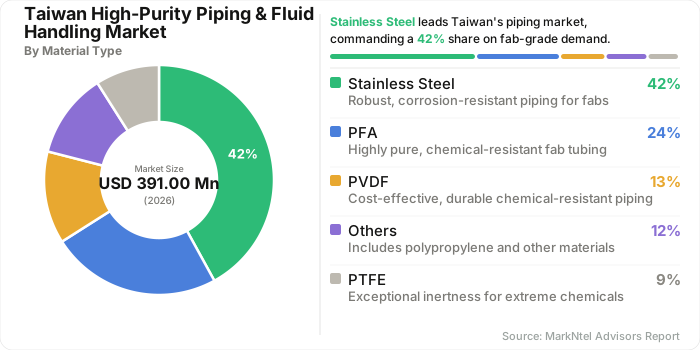
- By material type, stainless steel leads the market with an estimated 42% share in 2026.
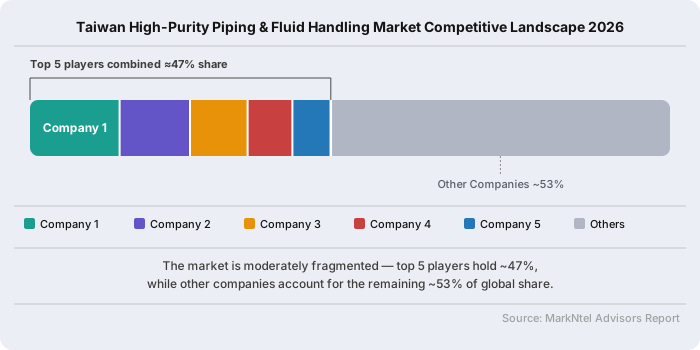
- The market is moderately fragmented, with the top five players collectively accounting for 47% of market revenue in 2026.
Taiwan High-Purity Piping & Fluid Handling Market Size and Outlook
The Taiwan high-purity piping & fluid handling market was valued at USD 382 million in 2025 and is projected to reach USD 391 million in 2026 and USD 487 million by 2032, reflecting a 3.73% CAGR during 2026–2032.
The market's structural expansion is anchored by Taiwan's advanced semiconductor fabric build-out, which requires extensive high-purity chemical, gas, ultra-pure water, and process-fluid distribution infrastructure. TSMC's current Taiwan roadmap includes multiple phases of 2nm fabs in Hsinchu and Kaohsiung Science Parks, alongside continued investment in advanced packaging facilities. This directly supports demand for contamination-controlled piping, UHP fittings, valves, polymer systems, welding, and engineered fluid-delivery assemblies.
The broader science-park ecosystem also provides a substantial foundation for demand. Taiwan's three major science parks generate USD 181.71 billion of revenue in 2025, with Southern Taiwan Science Park reaching USD 83.3 billion and growing 34.26%. Near-term demand remains supported by active capacity deployment: TSMC's 2026 capital expenditure plan indicates US$52–56 billion, primarily directed toward 2nm/3nm capacity, fab expansion, specialty technologies, and advanced packaging.
Taiwan High-Purity Piping & Fluid Handling Market Key Indicators
- According to TSMC, advanced technologies at 7nm and beyond account for 74% of total wafer revenue in 2025, reinforcing the market's structural shift toward advanced-node manufacturing, where tighter contamination control increases the requirement for high-purity chemicals, specialty gases, and ultrapure-water distribution systems.
- The Ministry of Economic Affairs (MOEA), Taiwan's 10-year national water infrastructure improvement program is valued at approximately USD 5.67 billion, covering reservoir enhancement, pipeline modernization, water-treatment facilities and network resilience, creating a distinct infrastructure-driven investment stream that complements fab-internal high-purity piping capital expenditure.
- As per SEMI's published equipment and materials standards framework, ultra-high-purity 316L stainless-steel tubing and components used in advanced semiconductor facilities are qualified under SEMI F19/F20, while polymer components for ultrapure-water and liquid chemical distribution systems are governed by SEMI F57, establishing the technical qualification benchmark that supports supplier selection and component specification across Taiwan's high-purity fluid-handling market.
Taiwan High-Purity Piping & Fluid Handling Market Scope
| Category | Segments |
|---|---|
| By Offering | Products (Tubing & Piping, Fittings & Connectors, Valves & Regulators, Pumps, Filters & Purification Systems), Services (Installation & Fabrication, System Design & Engineering, Validation & Qualification, Testing & Certification, Maintenance, Repair & Retrofit |
| By Material Type | Stainless Steel, Fluoropolymers, Polypropylene, Other High-Purity Polymers & Composites |
| By Application | Ultra-Pure Water / DI Water Distribution, Process Chemical Distribution, Specialty Gas Distribution, Process Fluid & Slurry Handling, Chemical Waste Handling & Recovery, Other High-Purity Fluid Applications |
| By End-User Industry | Semiconductor Manufacturing, Pharmaceutical & Biotechnology, Electronics & PCB Manufacturing, Display Manufacturing, Solar / Photovoltaic Manufacturing, Food & Beverage, Other High-Purity Industries |
Taiwan High-Purity Piping & Fluid Handling Market Growth Driver
Advanced-Node Fab Expansion Drives High-Purity Fluid Infrastructure Demand
Taiwan's migration toward advanced semiconductor nodes directly increases the requirement for tightly controlled chemical, gas, and ultrapure-water distribution systems. TSMC states that its 2nm N2 technology enters volume production in 4Q25, while N2P and A16 volume production is scheduled for the second half of 2026. These processes require controlled delivery environments in which particle generation, chemical compatibility, leakage, and surface contamination directly affect process stability and yield, supporting higher-value UHP piping, fittings, valves, and engineered assemblies.
The investment cycle extends beyond individual process nodes. TSMC's board approves approximately USD 44.962 billion of capital appropriations for advanced technology capacity, advanced packaging, mature/specialty capacity, and fab/facility systems. This combination of front-end and packaging investment expands the addressable installation base for fluid distribution, gas systems, chemical delivery, UPW infrastructure, and associated fabrication services.
Recent Trend
Adoption of Weld-Free, Low-Dead-Leg Valve Architectures for Slurry and Precursor Delivery
A significant technical shift in Taiwan's semiconductor fluid-handling ecosystem is the increasing use of low-dead-volume valves, PFA components, and weld-free fluid-routing architectures for high-purity chemical and slurry applications. Semiconductor suppliers participating in SEMICON Taiwan 2025 are actively presenting PFA valves, tubing, piping, and fittings for high-purity fluid management, reflecting the industry's shift toward chemically resistant, contamination-controlled flow paths. This shift addresses the need to minimize contamination, stagnation, and flow disturbances in increasingly sensitive process-fluid delivery systems.
In response, Bueno Technology introduced a high-purity PFA anti-static diaphragm valve in 2025, targeting corrosive-fluid applications requiring chemical resistance and contamination control. FITOK also introduced its DPT Series two-step pneumatic diaphragm valves, featuring a low-dead-space, internally threadless and springless architecture that reduces particle generation during flow control; the valves use 316L/316L VAR bodies with PFA or PCTFE seats and achieve helium leak rates of ≤1×10⁻⁹ std cm³/s. These launches directly support Taiwan's shift toward higher-purity fluid routing architectures.
Taiwan High-Purity Piping & Fluid Handling Market Opportunities and Challenges
Stringent Water-Reclamation Requirements Accelerate Closed-Loop UPW Piping Opportunities
Taiwan's semiconductor expansion is increasing the requirement for stable, recycled process-water infrastructure while raising the materials-performance burden on high-purity piping. According to the MOEA Water Resources Agency (WRA), the three major science parks have a combined approved water allocation of 1.312 million tonnes/day and current actual consumption of 633,000 tonnes/day, while the government is developing 16 reclaimed-water plants with planned production of 634,000 tonnes/day. The challenge is therefore not only water availability but maintaining chemical purity, corrosion resistance and low extractables as reclaimed streams are repeatedly treated and redistributed through fab piping networks.
This pressure creates an opportunity for PVDF and high-purity polypropylene (PP) piping systems designed for chemically demanding reclaimed-water loops. According to the Industrial Technology Research Institute (ITRI), next-generation IR-butt-welded PVDF piping demonstrates zero measurable surface degradation under continuous ozone exposure in its reported qualification testing. Upgrading to chemically resilient closed-loop UPW infrastructure enables fabs to meet water-reuse requirements while reducing contamination risk, supporting retrofit demand for high-purity piping integrators, PVDF/PP component suppliers and specialized polymer-system manufacturers.
Segmentation Insights
Stainless Steel Forms the Metallic Backbone of Taiwan’s High-Purity Flow Networks
Stainless steel is estimated to hold 42% of Taiwan’s high-purity piping material industry, supported by the country’s exceptionally large semiconductor manufacturing base. TSMC alone operated 6 twelve-inch GIGAFAB facilities in Taiwan, with combined capacity exceeding 13 million 12-inch-equivalent wafers in 2025. Its Taiwan fabs span processes from 0.13 μm to 2 nm, creating substantial demand for qualified metallic fluid and gas distribution infrastructure.
The segment’s dominance is reinforced by the broad qualification of 316L for high- and ultra-high-purity chemical gas/liquid systems. SEMI F20-0923 specifically defines 316L requirements for semiconductor distribution components, while SEMI F17 addresses electropolished 316L tubing and fittings. TSMC also reported that 74% of wafer revenue came from 7-nm-and-smaller technologies in 2025, increasing demand for contamination-controlled infrastructure. These factors support the segment’s continued expansion. Based on material type, the industry is segmented into:
- Stainless Steel
- Fluoropolymers
- Polypropylene
- Other High-Purity Polymers & Composites
Semiconductor Power Taiwan’s High-Purity Piping Boom as Advanced Chip Making Accelerates
Semiconductor Manufacturing is estimated to account for 61.2% of Taiwan’s high-purity piping and fluid handling industry in 2026, making it the dominant end-user segment. This position is supported by the rapid expansion and increasing technological complexity of Taiwan’s semiconductor industry. Taiwan’s three major science parks generated USD 178 billion in revenue in 2025, up 21.83% year over year, while the integrated-circuit industry within these parks grew 26.8%, driven by AI and high-performance computing demand. This expansion directly increases requirements for high-purity chemical, gas, ultrapure-water, and process-fluid distribution infrastructure.
The scale of foundry manufacturing further strengthens the segment’s revenue leadership. TSMC shipped 15.0 million 12-inch-equivalent wafers in 2025, up from 12.9 million in 2024. TSMC also achieved a 24% wafer-revenue contribution from 3nm, while 2nm entered high-volume manufacturing in 4Q25, and N2P and A16 are scheduled for volume production in 2H26. These advanced-node ramps require increasingly stringent contamination control and recurring qualification of fluid-distribution systems, supporting the share of foundries and creating sustained demand for semiconductor high-purity piping systems. Based on End-User Industry, the industry is segmented into:
- Semiconductor Manufacturing
- Pharmaceutical & Biotechnology
- Electronics & PCB Manufacturing
- Display Manufacturing
- Solar / Photovoltaic Manufacturing
- Food & Beverage
- Other High-Purity Industries
Taiwan High-Purity Piping & Fluid Handling Market Competitive Analysis
The Taiwan high-purity piping & fluid handling industry is moderately fragmented, with the top five companies estimated to account for 47% of 2026 market revenue. The competitive structure is shaped by a combination of global fluid-system specialists and Taiwan/Japan-based high-purity component manufacturers. Swagelok Fluid System Technologies, LLC, FUJIKIN TAIWAN INCORPORATED, Georg Fischer Co., Ltd., KITZ SCT CORPORATION, and Tachia Yung Ho Machine Industry Co., Ltd. (DAJA).
Top Companies in the Taiwan High-Purity Piping & Fluid Handling industry:
- Swagelok Fluid System Technologies, LLC
- Fujikin Taiwan Incorporated
- Georg Fischer Co., Ltd.
- KITZ SCT Corporation
- Tachia Yung Ho Machine Industry Co., Ltd.
- Miao Tieh Precision Industrial Co., Ltd.
- Taiwan Valve & Fitting Corp.
- Semiplastic Co., Ltd.
- Entegris Asia Pte. Ltd.
- HORIBA Taiwan, Inc.
Taiwan High-Purity Piping & Fluid Handling Industry News and Recent Developments
December 2025: GF Unveils High-Purity PEEK Piping System for Next-Generation Semiconductor Manufacturing
GF introduced SYGEF Ultra, a high-purity PEEK piping system for hot and ambient ultrapure-water applications serving next-generation semiconductor manufacturing. The company stated that the system's purity performance exceeds SEMI F57 requirements and that the material is manufactured without intentional PFAS addition. GF positioned the system around decreasing semiconductor node sizes, AI-related demand and increasing sustainability requirements.
Impact Analysis: The development increases competitive differentiation in high-purity polymer piping and expands the addressable value pool beyond conventional PVDF and PP systems. It also strengthens the opportunity for suppliers that can combine advanced materials with validated welding, installation, and UPW engineering capabilities.
May 2026: NSTC Approves USD 1.58 Billion of Science-Park Investment Projects27
Taiwan's National Science and Technology Council approved seven science-park investment projects with a combined investment value of USD 1.58 billion, alongside ten capital-increase projects worth approximately USD 68 million. The approved investments include integrated-circuit, precision-machinery, photonics and emerging-technology projects across the science-park ecosystem.
Impact Analysis: Continued science-park investment expands the installed base requiring high-purity process infrastructure, especially where projects involve semiconductor and related advanced-manufacturing facilities. This supports project-based demand for piping, valves, fittings, welding, engineering and commissioning services.
Frequently Asked Questions
- Market Segmentation
- Introduction
- Product Definition
- Research Process
- Assumptions
- Executive Summary
- Taiwan High-Purity Piping & Fluid Handling Market Policies, Regulations, and Product Standards
- Taiwan High-Purity Piping & Fluid Handling Market Trends & Developments
- Taiwan High-Purity Piping & Fluid Handling Market Dynamics
- Growth Factors
- Challenges
- Taiwan High-Purity Piping & Fluid Handling Market Hotspot & Opportunities
- Taiwan High-Purity Piping & Fluid Handling Market Outlook, 2022-2032
- Market Size & Outlook
- By Revenues (USD Million)
- Market Share & Analysis
- By Offering- Market Size & Forecast 2022-2032, USD Million
- Products
- Tubing & Piping
- Fittings & Connectors
- Valves & Regulators
- Pumps
- Filters & Purification Systems
- Services
- Installation & Fabrication
- System Design & Engineering
- Validation & Qualification
- Testing & Certification
- Maintenance, Repair & Retrofit
- Products
- By Material Type- Market Size & Forecast 2022-2032, USD Million
- Stainless Steel
- Fluoropolymers
- Polypropylene
- Other High-Purity Polymers & Composites
- By Application- Market Size & Forecast 2022-2032, USD Million
- Ultra-Pure Water / DI Water Distribution
- Process Chemical Distribution
- Specialty Gas Distribution
- Process Fluid & Slurry Handling
- Chemical Waste Handling & Recovery
- Other High-Purity Fluid Applications
- By End-User Industry- Market Size & Forecast 2022-2032, USD Million
- Semiconductor Manufacturing
- Pharmaceutical & Biotechnology
- Electronics & PCB Manufacturing
- Display Manufacturing
- Solar / Photovoltaic Manufacturing
- Food & Beverage
- Other High-Purity Industries
- By Region- Market Size & Forecast 2022-2032, USD Million
- Northern Taiwan
- Central Taiwan
- Southern Taiwan
- Eastern Taiwan
- By Company
- Competition Characteristics
- Market Share & Analysis
- By Offering- Market Size & Forecast 2022-2032, USD Million
- Market Size & Outlook
- Northern Taiwan High-Purity Piping & Fluid Market Outlook, 2022-2032
- Market Size & Outlook
- By Revenues (USD Million)
- Market Segmentation & Analysis
- By Offering- Market Size & Forecast 2022-2032, USD Million
- By Material Type- Market Size & Forecast 2022-2032, USD Million
- By Application- Market Size & Forecast 2022-2032, USD Million
- By End-User Industry- Market Size & Forecast 2022-2032, USD Million
- Market Size & Outlook
- Central Taiwan High-Purity Piping & Fluid Market Outlook, 2022-2032
- Market Size & Outlook
- By Revenues (USD Million)
- Market Segmentation & Analysis
- By Offering- Market Size & Forecast 2022-2032, USD Million
- By Material Type- Market Size & Forecast 2022-2032, USD Million
- By Application- Market Size & Forecast 2022-2032, USD Million
- By End-User Industry- Market Size & Forecast 2022-2032, USD Million
- Market Size & Outlook
- Southern Taiwan High-Purity Piping & Fluid Market Outlook, 2022-2032
- Market Size & Outlook
- By Revenues (USD Million)
- Market Segmentation & Analysis
- By Offering- Market Size & Forecast 2022-2032, USD Million
- By Material Type- Market Size & Forecast 2022-2032, USD Million
- By Application- Market Size & Forecast 2022-2032, USD Million
- By End-User Industry- Market Size & Forecast 2022-2032, USD Million
- Market Size & Outlook
- Eastern Taiwan High-Purity Piping & Fluid Market Outlook, 2022-2032
- Market Size & Outlook
- By Revenues (USD Million)
- Market Segmentation & Analysis
- By Offering- Market Size & Forecast 2022-2032, USD Million
- By Material Type- Market Size & Forecast 2022-2032, USD Million
- By Application- Market Size & Forecast 2022-2032, USD Million
- By End-User Industry- Market Size & Forecast 2022-2032, USD Million
- Market Size & Outlook
- Taiwan High-Purity Piping & Fluid Handling Market Key Strategic Imperatives for Success & Growth
- Competitive Outlook
- Company Profiles
- Swagelok Fluid System Technologies, LLC
- Business Description
- Product Portfolio
- Collaborations & Alliances
- Recent Developments
- Financial Details
- Others
- Fujikin Taiwan Incorporated
- Business Description
- Product Portfolio
- Collaborations & Alliances
- Recent Developments
- Financial Details
- Others
- Georg Fischer Co., Ltd.
- Business Description
- Product Portfolio
- Collaborations & Alliances
- Recent Developments
- Financial Details
- Others
- KITZ SCT Corporation
- Business Description
- Product Portfolio
- Collaborations & Alliances
- Recent Developments
- Financial Details
- Others
- Tachia Yung Ho Machine Industry Co., Ltd. / DAJA
- Business Description
- Product Portfolio
- Collaborations & Alliances
- Recent Developments
- Financial Details
- Others
- Miao Tieh Precision Industrial Co., Ltd.
- Business Description
- Product Portfolio
- Collaborations & Alliances
- Recent Developments
- Financial Details
- Others
- Taiwan Valve & Fitting Corp.
- Business Description
- Product Portfolio
- Collaborations & Alliances
- Recent Developments
- Financial Details
- Others
- Semiplastic Co., Ltd.
- Business Description
- Product Portfolio
- Collaborations & Alliances
- Recent Developments
- Financial Details
- Others
- Entegris Asia Pte. Ltd.
- Business Description
- Product Portfolio
- Collaborations & Alliances
- Recent Developments
- Financial Details
- Others
- HORIBA Taiwan, Inc.
- Business Description
- Product Portfolio
- Collaborations & Alliances
- Recent Developments
- Financial Details
- Others
- Swagelok Fluid System Technologies, LLC
- Company Profiles
- Disclaimer
MarkNtel Advisors follows a robust and iterative research methodology designed to ensure maximum accuracy and minimize deviation in market estimates and forecasts. Our approach combines both bottom-up and top-down techniques to effectively segment and quantify various aspects of the market. A consistent feature across all our research reports is data triangulation, which examines the market from three distinct perspectives to validate findings. Key components of our research process include:
1. Scope & Research Design At the outset, MarkNtel Advisors define the research objectives and formulate pertinent questions. This phase involves determining the type of research—qualitative or quantitative—and designing a methodology that outlines data collection methods, target demographics, and analytical tools. They also establish timelines and budgets to ensure the research aligns with client goals.
2. Sample Selection and Data Collection In this stage, the firm identifies the target audience and determines the appropriate sample size to ensure representativeness. They employ various sampling methods, such as random or stratified sampling, based on the research objectives. Data collection is carried out using tools like surveys, interviews, and observations, ensuring the gathered data is reliable and relevant.
3. Data Analysis and Validation Once data is collected, MarkNtel Advisors undertake a rigorous analysis process. This includes cleaning the data to remove inconsistencies, employing statistical software for quantitative analysis, and thematic analysis for qualitative data. Validation steps are taken to ensure the accuracy and reliability of the findings, minimizing biases and errors.

4. Data Forecast and FinalizationThe final phase involves forecasting future market trends based on the analyzed data. MarkNtel Advisors utilize predictive modeling and time series analysis to anticipate market behaviors. The insights are then compiled into comprehensive reports, featuring visual aids like charts and graphs, and include strategic recommendations to inform client decision-making
We offer flexible licensing options to cater to varying organizational needs. Choose the pricing pack that best suits your requirements:
Buy Now Inquire Before Buying
 Request Customization
 Talk to our Consultant