

By Technology Type (5G, 4G/LTE, 3G, 2G, C-V2X), By Application (Driver Assistance (ADAS), Safety & Security, Telematics & Diagnostics, Infotainment & HMI, Mobility & Fleet Manageme......nt, Over-the-Air (OTA) Updates), By Connectivity Type (Integrated, Embedded, Tethered), By Communication Type (Vehicle-to-Vehicle (V2V), Vehicle-to-Infrastructure (V2I), Vehicle-to-Pedestrian (V2P), Vehicle-to-Cloud (V2C), Vehicle-to-Grid (V2G)), By Vehicle Type (Passenger Cars, Commercial Vehicles), By Installation Type (OEM-Fitted, Aftermarket), and others Read more
- Automotive
- Aug 2026
- 295
- PDF, Excel, PPT
North America Connected Vehicles Market Key Takeaways
- North America connected vehicles market size was valued at USD 62 billion in 2025 and is projected to grow from USD 67 billion in 2026 to USD 95 billion by 2032.
- The industry is projected to sustain growth at a steady CAGR of 5.99% during 2026-2032.
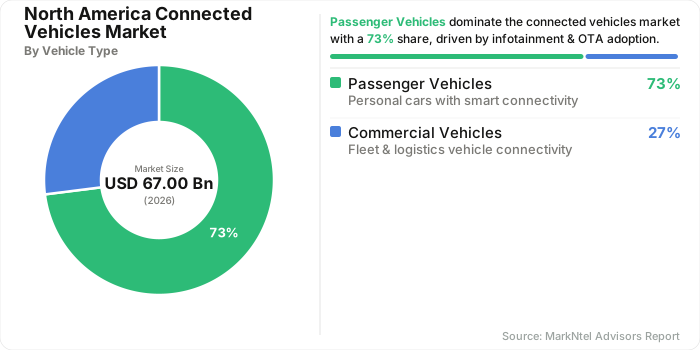
- By vehicle type, passenger vehicles hold a significant share of about 73% in 2026.
- By communication type, Vehicle-to-Vehicle (V2V) communication seized a significant share of about 40% in 2026.
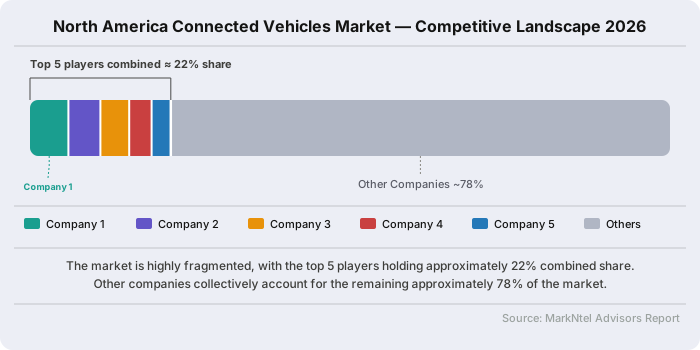
- The industry is highly fragmented. However, the top five players collectively account for nearly 22% share.
North America Connected Vehicles Market Size and Outlook
The connected vehicles market size in North America was valued at USD 62 billion in 2025 and is projected to grow from USD 67 billion in 2026 to USD 95 billion by 2032. Along with this, the market is estimated to grow at a CAGR of around 5.99% during the forecast period, i.e., 2026-32.
The demand for connected vehicles in North America is expanding as consumers increasingly demand advanced safety, real-time navigation, infotainment, remote diagnostics, telematics, and seamless digital vehicle services. North America’s connected vehicle technology reached approximately USD 14.6 billion in 2025, supported by strong automotive technology adoption and expanding 5G infrastructure. Policy initiatives are also accelerating adoption, particularly the U.S. Department of Transportation’s national V2X deployment plan and nearly USD 60 million in V2X grants. Future opportunities include 5G-V2X, software-defined vehicles, autonomous mobility, connected EVs, smart infrastructure, and fleet telematics. Overall, strong technology investment and supportive policies position the market for sustained long-term growth.
North America Connected Vehicles Market Key Indicators
- North America has one of the strongest 5G ecosystems globally, creating favorable conditions for connected vehicle adoption. Ericsson estimates that the region had approximately 370 million 5G subscriptions in 2025, representing 79% of total mobile subscriptions. The number is projected to reach around 460 million by 2031, supporting higher-speed vehicle-to-cloud communication, OTA updates, connected infotainment, telematics, and future V2X applications.
- Government investment in vehicle-to-everything infrastructure is accelerating connected mobility across the U.S. In 2024, USDOT awarded nearly USD 60 million to Arizona, Texas, and Utah for V2X deployments. Arizona alone received USD 19.6 million to deploy approximately 750 roadside units and connect an estimated 400 vehicle onboard units. Such infrastructure expansion supports vehicle-to-infrastructure communication, emergency warnings, traffic management, and connected safety applications.
- EV adoption is expanding the addressable base for connected vehicle technologies because electric vehicles depend heavily on software, battery-management systems, digital charging platforms, and cloud services. The U.S. recorded approximately 1.5 million electric-car sales in 2025, with electric vehicles accounting for around 10% of annual car sales. Despite policy changes affecting late-2025 demand, the substantial installed EV base continues to support connected charging, remote diagnostics, navigation, and energy-management services.
- Road-safety requirements are creating another measurable demand driver. NHTSA's AEB regulation is designed to save at least 360 lives and prevent 24,000 injuries annually, while requiring AEB systems to operate at speeds up to 62 mph and detect pedestrians during both daylight and darkness. These requirements encourage manufacturers to deploy increasingly sophisticated sensing, processing, communication, and software capabilities, strengthening the broader connected vehicle technology ecosystem.
North America Connected Vehicle Installed Base: 289 Million U.S. Light Vehicles and 12 Million OnStar Subscribers Expand the Software-Service Opportunity
Large addressable vehicle base: The U.S. had approximately 289 million light vehicles in operation in 2025, up by about 3 million from the previous year. The average vehicle age reached 12.8 years, indicating that the connected-vehicle opportunity extends beyond new-vehicle sales as OEMs increasingly explore connected services for existing vehicle populations.
Connected-service adoption is scaling: GM reported 12 million global OnStar subscribers at the end of 2025, while Super Cruise subscriptions exceeded 620,000, representing approximately 80% year-on-year growth. OnStar fleet subscriptions reached 2 million, demonstrating that connected services are expanding across both consumer and commercial vehicle use cases.
Real-world usage is validating software monetization: By April 2026, nearly 750,000 Super Cruise-enabled vehicles across 23 North American models had accumulated 1 billion hands-free miles. During the preceding 12 months, users generated 28.7 million Super Cruise trips and 7.1 million hours of usage, while more than 50% of users engaged with the system weekly.
OTA capability is becoming commercially relevant: NHTSA recorded 4.40 million vehicles with recalls partially or fully remedied through OTA updates in 2025, compared with 6.79 million in 2024. This demonstrates that connected-vehicle software infrastructure is increasingly being used for vehicle lifecycle management rather than only infotainment.
Overall assessment: North America's connected-vehicle opportunity is increasingly shifting from vehicle connectivity as a one-time hardware feature toward recurring software, subscription, OTA, fleet and data-enabled services. The combination of a 289-million-vehicle installed base, millions of connected-service subscribers, and measurable software usage creates a substantial monetization opportunity for OEMs, telecom operators, cloud providers and automotive technology suppliers.
North America Connected Vehicles Market Scope
| Category | Segments |
|---|---|
| By Technology Type | 5G, 4G/LTE, 3G, 2G, C-V2X |
| By Application | Driver Assistance (ADAS), Safety & Security, Telematics & Diagnostics, Infotainment & HMI, Mobility & Fleet Management, Over-the-Air (OTA) Updates |
| By Connectivity Type | Integrated, Embedded, Tethered |
| By Communication Type | Vehicle-to-Vehicle (V2V), Vehicle-to-Infrastructure (V2I), Vehicle-to-Pedestrian (V2P), Vehicle-to-Cloud (V2C), Vehicle-to-Grid (V2G |
| By Vehicle Type | Passenger Cars, Commercial Vehicles |
| By Installation Type | OEM-Fitted, Aftermarket |
North America Connected Vehicles Market Growth Drivers
Higher ADAS Penetration Supports Connected Vehicle Expansion
The increasing penetration of ADAS is accelerating demand for connected-vehicle technologies across North America because systems such as automatic emergency braking (AEB), forward-collision warning, lane-keeping assistance, adaptive cruise control, and blind-spot monitoring increasingly depend on cameras, radar, sensors, electronic control units, and real-time data connectivity. In the U.S., the Partnership for Analytics Research in Traffic Safety found that 10 of 14 ADAS features exceeded 50% penetration by the 2023 model year, while five surpassed 90%. AEB penetration increased dramatically from 4% in 2015 to 94% in 2023, demonstrating rapid integration of safety technologies into new vehicles.
This expansion directly supports connected vehicle demand because ADAS platforms increasingly exchange data with navigation systems, cloud services, roadside infrastructure, and other vehicles. Government regulation is further strengthening adoption: NHTSA finalized a rule requiring AEB and pedestrian AEB on new passenger cars and light trucks by September 2029. The agency estimates the requirement will prevent at least 24,000 injuries and save 360 lives annually. Moreover, the estimated share of registered U.S. vehicles equipped with front AEB is expected to increase from 32% in 2024 to 55% by 2029, expanding the connected technology ecosystem and supporting sustained market growth.
Recent Trends
Shift Toward 5G-Enabled Connected Vehicles
The North American connected vehicles industry is increasingly shifting toward 5G-enabled architectures as automakers seek faster data transmission, lower latency, higher network capacity, and more reliable vehicle-to-cloud communication. The trend is moving beyond in-car Wi-Fi toward telematics, real-time navigation, connected infotainment, OTA software updates, remote diagnostics, and future V2X applications.
A notable 2026 example is Verizon’s agreement with BMW Group, under which Verizon provides 5G Standalone and LTE connectivity for newly manufactured BMW, MINI, and other BMW Group vehicles in the U.S. The vehicles use Verizon’s 5G Standalone network and 3GPP Release 16 standards to support BMW ConnectedDrive, including digital infotainment, remote services, applications, and telematics.
Similarly, Toyota introduced AT&T 5G connectivity in select 2026 model-year vehicles, including the RAV4, supporting real-time navigation, Wi-Fi, remote services, entertainment, and OTA updates. In June 2026, AT&T also announced 5G connectivity for Rivian’s R2 in the U.S. and Canada, supporting faster software updates and connected services. These deployments demonstrate that 5G is becoming an integral connectivity layer for next-generation vehicles rather than simply an entertainment feature, supporting the industry's transition toward software-defined and continuously connected vehicles.
North America Connected Vehicles Market Opportunities and Challenges
Growing Cybersecurity Risks Strengthen Demand for Vehicle Security Technologies
Cybersecurity is a major challenge for the North America connected vehicles market because growing reliance on cellular networks, Wi-Fi, Bluetooth, telematics, V2X, and cloud platforms creates multiple entry points for cyberattacks. NHTSA reported in 2025 that nearly all new vehicles have wireless connectivity paths and that the increasing integration of software and safety-critical electronic controls is expanding potential attack surfaces.
A notable industry example is NHTSA’s investigation of vulnerabilities involving an aftermarket telematics device, which resulted in the recall of approximately 140,000 units after testing showed that compromised devices could potentially influence vehicle data-bus communications. These risks can undermine consumer confidence, increase development costs, and potentially delay adoption of connected features.
However, these risks are creating new growth opportunities for automotive cybersecurity and connected-vehicle security solutions. For example, GM launched Drive Block in May 2025, allowing fleet managers to remotely disable stolen GM vehicles through OnStar Vehicle Insights. The feature demonstrates how connected platforms can transform security concerns into commercially valuable services. GM also states that it invests in cybersecurity teams, tools, and industry partnerships to protect vehicles, systems, and customer data.
Consequently, demand is increasing for intrusion detection, secure gateways, authentication, encryption, vulnerability monitoring, protected OTA updates, and remote security services, making cybersecurity a challenge that simultaneously supports connected-vehicles market growth.
Segmentation Insights
Passenger Vehicles Hold Nearly 73% of Market Revenue
Passenger Vehicles hold nearly 73% of North America’s connected vehicles industry revenue, primarily because of their substantially larger installed base and faster integration of connected technologies across new models. Automakers increasingly equip passenger vehicles with embedded telematics, connected infotainment, navigation, smartphone integration, ADAS, remote diagnostics, and over-the-air (OTA) update capabilities. The growing adoption of SUVs and connected premium vehicles further increases revenue per vehicle through advanced software and subscription-based services.
In addition, rising consumer expectations for real-time traffic information, emergency assistance, remote vehicle access, and personalized digital experiences are encouraging manufacturers to make connectivity standard across broader model portfolios. Passenger vehicles therefore generate revenue across multiple connected services simultaneously, whereas commercial-vehicle connectivity is more concentrated around fleet management, tracking, diagnostics, and logistics applications. This broader monetization base supports their dominant revenue contribution in North America. Based on vehicle type, the scope has been segmented into
- Passenger Vehicles
- Commercial Vehicles
Vehicle-to-Vehicle (V2V) Leads with an Estimated 40% Revenue Share
Vehicle-to-Vehicle (V2V) communication holds the dominant position, accounting for an estimated 40% of North America’s connected vehicles market revenue, supported by its strong role in collision avoidance, road safety, and real-time vehicle awareness. V2V systems allow vehicles to continuously exchange information such as speed, position, direction, and braking status, helping drivers and ADAS systems identify hazards beyond the line of sight. USDOT has identified V2V as an important component of V2X deployment, with applications including forward-collision warnings, emergency electronic brake-light warnings, blind-spot alerts, and intersection movement assistance.
The U.S. government is also accelerating V2X adoption through deployment programs, including nearly USD 60 million in grants for V2X projects in Arizona, Texas, and Utah. Rising ADAS penetration, C-V2X deployment, and increasing emphasis on reducing roadway collisions are therefore strengthening demand for V2V communication systems across passenger and commercial vehicles. By communication type, the market is categorized into
- Vehicle-to-Vehicle (V2V)
- Vehicle-to-Infrastructure (V2I)
- Vehicle-to-Pedestrian (V2P)
- Vehicle-to-Cloud (V2C)
- Vehicle-to-Grid (V2G)
North America Connected Vehicles Market Competitive Analysis
The North America connected vehicles market is highly fragmented, with the top five companies collectively accounting for a 22% of the market by value in 2026. Key participants include General Motors Company, Ford Motor Company, Toyota Motor Corporation, Stellantis N.V., and Tesla, Inc.
Major Companies in North America Connected Vehicles Industry
- General Motors Company
- Ford Motor Company
- Toyota Motor Corporation
- Stellantis N.V.
- Tesla, Inc.
- Bosch
- Continental AG
- Aptiv PLC
- HARMAN International Industries, Inc.
- Qualcomm Incorporated
- Verizon Communications Inc.
- Geotab Inc.
- Others
North America Connected Vehicles Industry News and Recent Developments:
2026: GM Integrates Google Gemini Into Connected Vehicles
In April 2026, General Motors announced the integration of Google Gemini into vehicles equipped with Google built-in. The AI assistant uses the vehicle’s software platform and OnStar connectivity to provide conversational assistance, message summarization, translation, entertainment recommendations, and contextual information. GM stated that its connected-vehicle foundation enables the technology to scale across millions of vehicles, demonstrating the growing convergence of AI, cloud connectivity, infotainment, and vehicle software.
Impact Analysis: The integration of Google Gemini strengthens the role of AI within connected vehicles by enabling more personalized, conversational, and context-aware digital services. It increases demand for cloud connectivity, high-performance vehicle computing, data processing, and software platforms. The development also enhances the value of GM’s OnStar ecosystem and supports the broader transition toward software-defined vehicles, creating opportunities for recurring digital-service revenues.
2025: Toyota Integrates AT&T 5G Connectivity into 2026 RAV4
Toyota and AT&T announced 5G connectivity for select 2026 Toyota vehicles, enabling faster in-vehicle Wi-Fi, connected services, navigation, entertainment, and software updates. The rollout marks a move toward integrating high-speed cellular connectivity directly into vehicle platforms and strengthening Toyota’s connected mobility ecosystem in North America.
Impact Analysis: oyota's integration of AT&T 5G into the 2026 RAV4 strengthens the connectivity layer of North American vehicles by enabling higher-speed cellular data for cloud navigation, connected services, in-vehicle Wi-Fi and digital applications. The development also reinforces collaboration between automakers and telecom operators, increasing demand for embedded connectivity modules, cloud platforms and software-enabled vehicle services. Toyota's use of 5G alongside its Arene software platform further supports the industry's transition toward software-defined vehicles.
- Market Segmentation
- Introduction
- Product Definition
- Research Process
- Assumptions
- Executive Summary
- North America Connected Vehicles Market Policies, Regulations, and Product Standards
- North America Connected Vehicles Supply Chain Analysis
- North America Connected Vehicles Import/Export Analysis
- North America Connected Vehicles Market Production Trend 2022-2032
- North America Connected Vehicles Market Production Trend By Vehicle Type
- Passenger Cars
- Commercial Vehicles
- Light Commercial Vehicles
- Medium & Heavy Commercial Vehicles
- Company Wise Production Plants and Statistics
- Installed Production Capacity
- Actual Production
- Planned Production Target
- North America Connected Vehicles Market Production Trend By Vehicle Type
- North America Connected Vehicles Market Pricing Analysis 2022-2032
- North America Connected Vehicles Market Pricing Trend (USD/Units) 2022-2032
- North America Connected Vehicles Market Pricing Trend (USD/Units) By Regions 2022-2032
- United States
- Canada
- Mexico
- North America Connected Vehicles Market Pricing Trend (USD/Units) By Vehicle Type 2022-2032
- Passenger Cars
- Commercial Vehicles
- North America Connected Vehicles Market Trends & Developments
- North America Connected Vehicles Market Dynamics
- Growth Factors
- Challenges
- North America Connected Vehicles Market Hotspot & Opportunities
- North America Connected Vehicles Market Outlook, 2022-2032
- Market Size & Outlook
- By Revenues (USD Million)
- By Quantity Sold (Thousand Units)
- Market Segmentation & Outlook
- By Technology Type- Market Size & Forecast 2022-2032, USD Million & Thousand Units
- 5G
- 4G/LTE
- 3G
- 2G
- C-V2X
- By Application- Market Size & Forecast 2022-2032, USD Million & Thousand Units
- Driver Assistance (ADAS)
- Safety & Security
- Telematics & Diagnostics
- Infotainment & HMI
- Mobility & Fleet Management
- Over-the-Air (OTA) Updates
- By Connectivity Type- Market Size & Forecast 2022-2032, USD Million & Thousand Units
- Integrated
- Embedded
- Tethered
- By Communication Type- Market Size & Forecast 2022-2032, USD Million & Thousand Units
- Vehicle-to-Vehicle (V2V)
- Vehicle-to-Infrastructure (V2I)
- Vehicle-to-Pedestrian (V2P)
- Vehicle-to-Cloud (V2C)
- Vehicle-to-Grid (V2G)
- By Vehicle Type- Market Size & Forecast 2022-2032, USD Million & Thousand Units
- Passenger Cars
- Commercial Vehicles
- Light Commercial Vehicles
- Medium & Heavy Commercial Vehicles
- By Installation Type- Market Size & Forecast 2022-2032, USD Million & Thousand Units
- OEM-Fitted
- Aftermarket
- By Country
- United States
- Canada
- Mexico
- By Company
- Competition Characteristics
- Market Share & Analysis
- By Technology Type- Market Size & Forecast 2022-2032, USD Million & Thousand Units
- Market Size & Outlook
- United States Connected Vehicles Market Outlook, 2022-2032
- Market Size & Outlook
- By Revenues (USD Million)
- By Quantity Sold (Thousand Units)
- Market Segmentation & Outlook
- By Technology Type- Market Size & Forecast 2022-2032, USD Million & Thousand Units
- By Application- Market Size & Forecast 2022-2032, USD Million & Thousand Units
- By Connectivity Type- Market Size & Forecast 2022-2032, USD Million & Thousand Units
- By Communication Type- Market Size & Forecast 2022-2032, USD Million & Thousand Units
- By Vehicle Type- Market Size & Forecast 2022-2032, USD Million & Thousand Units
- By Installation Type- Market Size & Forecast 2022-2032, USD Million & Thousand Units
- Market Size & Outlook
- Canada Connected Vehicles Market Outlook, 2022-2032
- Market Size & Outlook
- By Revenues (USD Million)
- By Quantity Sold (Thousand Units)
- Market Segmentation & Outlook
- By Technology Type- Market Size & Forecast 2022-2032, USD Million & Thousand Units
- By Application- Market Size & Forecast 2022-2032, USD Million & Thousand Units
- By Connectivity Type- Market Size & Forecast 2022-2032, USD Million & Thousand Units
- By Communication Type- Market Size & Forecast 2022-2032, USD Million & Thousand Units
- By Vehicle Type- Market Size & Forecast 2022-2032, USD Million & Thousand Units
- By Installation Type- Market Size & Forecast 2022-2032, USD Million & Thousand Units
- Market Size & Outlook
- Mexico Connected Vehicles Market Outlook, 2022-2032
- Market Size & Outlook
- By Revenues (USD Million)
- By Quantity Sold (Thousand Units)
- Market Segmentation & Outlook
- By Technology Type- Market Size & Forecast 2022-2032, USD Million & Thousand Units
- By Application- Market Size & Forecast 2022-2032, USD Million & Thousand Units
- By Connectivity Type- Market Size & Forecast 2022-2032, USD Million & Thousand Units
- By Communication Type- Market Size & Forecast 2022-2032, USD Million & Thousand Units
- By Vehicle Type- Market Size & Forecast 2022-2032, USD Million & Thousand Units
- By Installation Type- Market Size & Forecast 2022-2032, USD Million & Thousand Units
- Market Size & Outlook
- North America Connected Vehicles Market Key Strategic Imperatives for Success & Growth
- Competitive Outlook
- Company Profiles
- General Motors Company
- Business Description
- Product Portfolio
- Collaborations & Alliances
- Recent Developments
- Financial Details
- Others
- Ford Motor Company
- Business Description
- Product Portfolio
- Collaborations & Alliances
- Recent Developments
- Financial Details
- Others
- Toyota Motor Corporation
- Business Description
- Product Portfolio
- Collaborations & Alliances
- Recent Developments
- Financial Details
- Others
- Stellantis N.V.
- Business Description
- Product Portfolio
- Collaborations & Alliances
- Recent Developments
- Financial Details
- Others
- Tesla, Inc.
- Business Description
- Product Portfolio
- Collaborations & Alliances
- Recent Developments
- Financial Details
- Others
- Bosch
- Business Description
- Product Portfolio
- Collaborations & Alliances
- Recent Developments
- Financial Details
- Others
- Continental AG
- Business Description
- Product Portfolio
- Collaborations & Alliances
- Recent Developments
- Financial Details
- Others
- Aptiv PLC
- Business Description
- Product Portfolio
- Collaborations & Alliances
- Recent Developments
- Financial Details
- Others
- HARMAN International Industries, Inc.
- Business Description
- Product Portfolio
- Collaborations & Alliances
- Recent Developments
- Financial Details
- Others
- Qualcomm Incorporated
- Business Description
- Product Portfolio
- Collaborations & Alliances
- Recent Developments
- Financial Details
- Others
- Verizon Communications Inc.
- Business Description
- Product Portfolio
- Collaborations & Alliances
- Recent Developments
- Financial Details
- Others
- Geotab Inc.
- Business Description
- Product Portfolio
- Collaborations & Alliances
- Recent Developments
- Financial Details
- Others
- General Motors Company
- Company Profiles
- Disclaimer

MarkNtel Advisors follows a robust and iterative research methodology designed to ensure maximum accuracy and minimize deviation in market estimates and forecasts. Our approach combines both bottom-up and top-down techniques to effectively segment and quantify various aspects of the market. A consistent feature across all our research reports is data triangulation, which examines the market from three distinct perspectives to validate findings. Key components of our research process include:
1. Scope & Research Design At the outset, MarkNtel Advisors define the research objectives and formulate pertinent questions. This phase involves determining the type of research—qualitative or quantitative—and designing a methodology that outlines data collection methods, target demographics, and analytical tools. They also establish timelines and budgets to ensure the research aligns with client goals.
2. Sample Selection and Data Collection In this stage, the firm identifies the target audience and determines the appropriate sample size to ensure representativeness. They employ various sampling methods, such as random or stratified sampling, based on the research objectives. Data collection is carried out using tools like surveys, interviews, and observations, ensuring the gathered data is reliable and relevant.
3. Data Analysis and Validation Once data is collected, MarkNtel Advisors undertake a rigorous analysis process. This includes cleaning the data to remove inconsistencies, employing statistical software for quantitative analysis, and thematic analysis for qualitative data. Validation steps are taken to ensure the accuracy and reliability of the findings, minimizing biases and errors.

4. Data Forecast and FinalizationThe final phase involves forecasting future market trends based on the analyzed data. MarkNtel Advisors utilize predictive modeling and time series analysis to anticipate market behaviors. The insights are then compiled into comprehensive reports, featuring visual aids like charts and graphs, and include strategic recommendations to inform client decision-making
FILL THE FORM TO INQUIRE BEFORE BUYING THIS REPORT
We offer flexible licensing options to cater to varying organizational needs. Choose the pricing pack that best suits your requirements:
Buy Now Talk to our Consultant
 Request Customization