

North America Tipper Truck Market Research Report: Trends, Forecast & Opportunities (2026-2032)
By Vehicle Type (Rigid, Articulated, Dump Trailer), By Axle Configuration (4×2, 4×4, 6×4, 6×6, 8×4), By Payload Capacity (Below 10 Tons, 10–25 Tons, 25–50 Tons, Above 50 Tons), By ... Powertrain (Diesel, Electric, Hybrid), By Application (Construction, Mining, Quarrying & Aggregates, Infrastructure & Road Construction, Waste Management, Agriculture, Others), By Sales Channel (OEM/Direct Sales, Dealer/Distributor, Rental & Leasing), and others Read more
- Automotive
- Aug 2026
- Pages 240
- Report Format: PDF, Excel, PPT
North America Tipper Truck Market
Projected 5.65% CAGR from 2026 to 2032
Study Period
2026-2032
Market Size (2026)
USD 8.11 Billion
Market Size (2032)
USD 11.28 Billion
Base Year
2025
Projected CAGR
5.65%
Leading Segments
By Vehicle Type: Rigid
North America Tipper Truck Market Key Takeaways
- North America tipper truck market size was valued at USD 7.27 billion in 2025 and is projected to grow from USD 8.11 billion in 2026 to USD 11.28 billion by 2032.
- The industry is projected to sustain growth at a steady CAGR of 5.65% during 2026-2032.
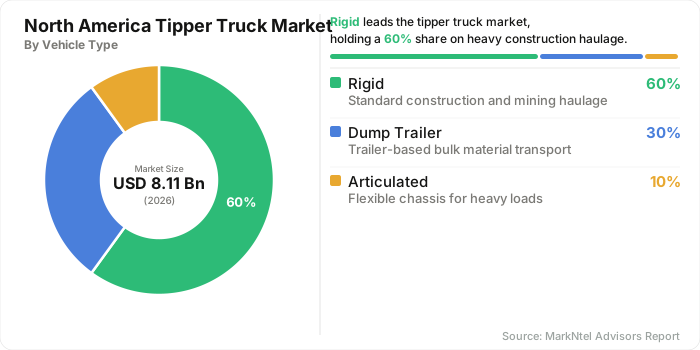
- By vehicle type, rigid tipper trucks hold a significant share of about 60% in 2026.
- By application, construction seized a significant share of about 32% in 2026.
- The industry is moderately consolidated. However, the top five players collectively account for nearly a 55% share.
North America Tipper Truck Market Size and Outlook
The tipper truck market size in North America was valued at USD 7.27 billion in 2025 and is projected to grow from USD 8.11 billion in 2026 to USD 11.28 billion by 2032. Along with this, the market is estimated to grow at a CAGR of around 5.65% during the forecast period, i.e., 2026-32.
The North America tipper truck market is supported by sustained construction, infrastructure development, quarrying, and material-handling activity, which drives demand for high-capacity vehicles for transporting aggregates, soil, asphalt, and construction debris. Policy support is also significant, with Canada’s USD-equivalent USD 37 billion Build Communities Strong Fund supporting public infrastructure over 10 years, including roads and bridges.
Future opportunities include electric and alternative-powertrain tipper trucks, connected fleet technologies, and payload-optimization systems. Increasing fleet modernization and demand for efficient vocational vehicles should further support adoption. Overall, the market is expected to maintain steady long-term growth, supported by infrastructure investment, construction activity, and technological advancement.
North America Tipper Truck Market Key Indicators
- Federal infrastructure funding provides visibility for future tipper-truck demand by supporting multi-year road and bridge projects. The U.S. Infrastructure Investment and Jobs Act provides approximately USD 350 billion for federal highway programs during FY2022–FY2026. For FY2026, federal highway infrastructure programs included USD 5.5 billion for bridge replacement and rehabilitation and USD 1.847 billion for the Bridge Investment Program. These investments support sustained material-hauling requirements.
- U.S. highway and street construction spending remained substantial in 2026. Census Bureau data show highway and street construction at a seasonally adjusted annual rate of USD 1.99 billion in May 2026, up 6.9% year over year. Road construction requires continuous transportation of aggregates, asphalt, soil, and construction debris, supporting tipper-truck utilization. Sustained public and private road investment therefore provides a measurable indication of continued demand for heavy-duty material-hauling vehicles.
- North American Class 8 vocational truck orders reached 9,710 units in June 2026, increasing 150% year over year, according to ACT Research. Total Class 8 orders reached 31,751 units, more than tripling from June 2025. Because vocational orders include trucks configured for applications such as dump, concrete, and refuse operations, the sharp increase indicates stronger fleet purchasing activity across applications relevant to the tipper truck market.
- Mining activity across North America continues to support demand for heavy-duty tipper and dump trucks used to transport ore, overburden, aggregates, and waste materials. In the U.S., the value of mineral production increased 5.6% to USD 112 billion in 2025, according to USGS data released in February 2026. In Canada, mineral exploration and deposit-appraisal expenditures reached approximately USD 3.2 billion in 2025, up from USD 3.0 billion in 2024, while 2026 spending intentions indicate further expansion. These developments support equipment utilization and fleet investment across mining and quarrying operations.
North America Tipper Truck Demand–Supply Gap: High Aggregate-Movement Requirements Contrast with Slowing New Articulated-Dump-Truck Purchases
Strong underlying hauling demand: The U.S. produced approximately 870 million tons of construction sand and gravel in 2025, while apparent consumption also reached about 870 million tons. USGS expects infrastructure funding and major investments in manufacturing, energy, and data centers to support aggregate demand in 2026. These volumes create a substantial underlying requirement for off-road material-hauling equipment, including articulated dump and tipper trucks.
Crushed stone adds another major workload: Crushed stone remains another critical source of construction aggregates, with USGS maintaining state-level production and end-use datasets covering all 50 states. Construction aggregates are widely used in infrastructure and construction, making aggregate output a useful proxy for the material-movement workload facing tipper fleets.
Equipment demand is moderating despite substantial material volumes: New financed articulated-dump-truck sales in the U.S. declined 7.4% to 1,948 units during October 2024–September 2025, while used financed ADT sales decreased 4.9% to 1,883 units. This contrasts with the substantial volume of construction materials being produced and consumed, indicating that equipment demand is not moving one-for-one with material demand.
Replacement and utilization are therefore becoming important: The earlier 2023–24 period recorded 2,074 new financed articulated trucks, meaning new financed sales fell by roughly 6% over the subsequent period. Since financed machines represent an estimated 40%–75% of total machine sales, the financing data provides a meaningful—although not complete—indicator of equipment purchasing activity.
Overall assessment: The North American tipper-truck market is characterized less by an absolute shortage of hauling equipment than by a potential replacement and utilization gap: aggregate production remains extremely large, while new ADT purchases are slowing. This creates an opportunity for OEMs and fleet operators to focus on higher payload capacity, fuel efficiency, productivity, automation, and fleet replacement, enabling existing fleets to handle rising or sustained material-movement requirements with fewer operating hours and lower cost per ton.
North America Tipper Truck Investment Landscape: US Construction Spending and OEM Technology Investments Strengthen Fleet-Modernization Potential
Strong infrastructure investment base: U.S. highway and street construction spending reached a seasonally adjusted annual rate of USD 151.7 billion in May 2026, up from USD 149.6 billion in January 2026. Actual monthly spending reached USD 13.74 billion in May, providing a substantial investment base for road construction, aggregates movement, and other applications requiring tipper and articulated-hauling equipment.
OEM investment is increasingly focused on productivity: Volvo Construction Equipment introduced the redesigned 60-ton A60 articulated dump truck for CONEXPO-CON/AGG 2026, with 15% better fuel efficiency and 5% higher productivity than its predecessor. The investment direction indicates that OEMs are competing not only through capacity but also through lower operating costs and higher material movement per hour.
Construction equipment investment is being reinforced by broader US capital spending: Caterpillar reported in August 2026 that its Q2 2026 construction segment revenue increased 35%, with North America sales rising 50%. Caterpillar's total order backlog reached USD 72.1 billion, supported by infrastructure, heavy construction and data-center investment.
Investment is also shifting toward localized equipment supply: Volvo CE announced approximately USD 260 million of investment across North America, South Korea and Sweden to expand crawler-excavator production, including a new U.S. assembly line. Although not tipper-specific, this reflects OEM efforts to localize North American construction-equipment supply chains and reduce exposure to long-distance logistics.
Overall assessment: North America's tipper-truck investment environment is being supported by USD 151.7 billion annualized highway spending, strong OEM order backlogs, and continued investment in higher-productivity equipment. The investment landscape is consequently shifting toward fleet modernization, fuel efficiency, automation, localized supply chains, and higher-capacity hauling equipment, creating opportunities for tipper-truck manufacturers and technology suppliers.
North America Tipper Truck Market Scope
| Category | Segments |
|---|---|
| By Vehicle Type | Rigid, Articulated, Dump Trailer |
| By Axle Configuration | 4×2, 4×4, 6×4, 6×6, 8×4 |
| By Payload Capacity | Below 10 Tons, 10–25 Tons, 25–50 Tons, Above 50 Tons |
| By Powertrain | Diesel, Electric, Hybrid |
| By Application | Construction, Mining, Quarrying & Aggregates, Infrastructure & Road Construction, Waste Management, Agriculture, Others |
| By Sales Channel | OEM/Direct Sales, Dealer/Distributor, Rental & Leasing |
North America Tipper Truck Market Growth Drivers
Increasing Infrastructure Development and Road Construction Driving Demand for Tipper Trucks
Rising infrastructure development and road construction is a key driver of the North America tipper truck industry, as large-scale transportation projects require substantial movement of aggregates, sand, gravel, asphalt, excavated soil, and construction debris. In the U.S., the Infrastructure Investment and Jobs Act (IIJA) provides approximately USD 350 billion for federal highway programs through FY2026, supporting road construction, rehabilitation, bridge improvements, and other transportation infrastructure projects.
Infrastructure investment is also expanding in Canada. The Build Communities Strong Fund provides USD 37 billion over 10 years starting in 2026–27, based on a representative recent exchange rate. The program supports new and renewed public infrastructure, including transportation infrastructure. These investments directly support tipper-truck demand because road and bridge projects require continuous transportation of bulk construction materials to project sites and removal of excavated and demolition materials.
The scale and multi-year nature of government-funded infrastructure programs also encourage contractors to expand and modernize their heavy-duty truck fleets. Consequently, sustained infrastructure spending across the U.S. and Canada is expected to increase tipper-truck utilization, replacement demand, and fleet purchases, making infrastructure development a major growth catalyst for the North American market.
Recent Trends
Growing Integration of Electric Power-Take-Off Systems in Tipper Trucks
Electric power-take-off (ePTO) systems are becoming an important technology trend in North American tipper trucks as manufacturers integrate electric power for auxiliary functions such as hydraulic lifting, reducing dependence on conventional engine-driven PTO systems. The development is particularly relevant to dump trucks because raising and lowering the body requires substantial hydraulic power. In May 2026, Volvo Trucks introduced a mechanical ePTO for its VNR Electric, enabling a 15-foot cargo body to operate as either a flatbed or a dump truck with hydraulic lifting capability. The system delivers 69.5 kW of continuous power and up to 90 kW of peak power, allowing the truck's battery to support auxiliary equipment while the vehicle remains stationary.
Volvo also reported more than 750 VNR Electric trucks operating across the U.S. and Canada, collectively covering more than 30 million zero-tailpipe-emission miles. These developments demonstrate that electrification is extending beyond vehicle propulsion into the equipment responsible for actual tipper-truck operations. As ePTO technology becomes more widely integrated, manufacturers can offer electric dump trucks capable of performing conventional hydraulic functions while reducing local emissions and noise during material unloading.
North America Tipper Truck Market Opportunities and Challenges
Stringent Emission Regulations Driving Demand for Electric and Low-Emission Tipper Trucks
Stringent emission regulations are a key challenge for the North American tipper truck industry because manufacturers must adopt cleaner powertrains and emission-control technologies, increasing vehicle development and compliance costs. In 2025–2026, this regulatory pressure continued to accelerate the transition toward zero-emission vocational vehicles. EPA’s heavy-duty emissions framework for MY2027 and later requires substantially lower pollutant and greenhouse-gas emissions, increasing pressure on manufacturers and fleet operators to modernize conventional diesel fleets.
However, this challenge is creating a significant opportunity for electric and low-emission tipper trucks. In April 2025, Kenworth launched the T880E, described as North America’s first Class 8 vocational battery electric truck. It offers battery configurations providing 100–250+ miles of range, with the largest configuration using a 625-kWh battery and supporting up to 82,000 lb GVWR.
Similarly, in April 2025, Peterbilt introduced the Model 567EV, an electric heavy-duty vocational truck displayed with a 15-yard dump body, specifically demonstrating its suitability for dump-truck applications. Thus, tighter emissions requirements are simultaneously constraining conventional diesel demand and creating new growth opportunities for electric, low-emission, and energy-efficient tipper trucks.
Segmentation Insights
Rigid Tippers Lead the Segment with Nearly 60% Revenue Share
Rigid tipper trucks hold nearly 60% of North America’s tipper truck industry revenue, making them the dominant truck type. Their leadership is primarily driven by their strong suitability for construction, road infrastructure, quarrying, aggregates, and general material-hauling operations, which represent major sources of tipper-truck demand across the region. The fixed-body design provides high structural strength and stability, allowing rigid trucks to carry heavy loads efficiently over paved roads and established haul routes.
They also offer relatively simpler operation and maintenance than articulated configurations, making them attractive for contractors and fleet operators seeking predictable operating costs and high utilization. In addition, rigid tippers are available in a wide range of payload capacities and axle configurations, allowing fleets to match vehicles with different project requirements. Their extensive availability through established North American manufacturers and dealer networks further supports purchasing and fleet replacement. These factors collectively enable rigid trucks to generate the largest share of regional tipper-truck revenue. Based on vehicle type, the scope has been segmented into:
- Rigid
- Articulated
- Dump Trailer
Construction Dominates with an Estimated 32% Revenue Contribution
Construction holds the dominant position, accounting for an estimated 32% of revenue, supported by the extensive use of tipper trucks for transporting sand, gravel, crushed stone, soil, demolition debris, and other bulk materials. North America’s large construction base generates continuous demand for high-payload vehicles capable of moving materials between quarries, suppliers, construction sites, and disposal locations. Tipper trucks are particularly valuable because their hydraulic unloading systems enable faster material discharge, reducing loading and unloading time and improving fleet utilization.
Demand is further supported by residential and commercial development, industrial construction, and ongoing renovation activity across the United States and Canada. Contractors also require versatile trucks that can operate across multiple project types and road conditions, favoring rigid configurations with different payload and axle options. In addition, infrastructure modernization and urban development indirectly strengthen construction-related demand by increasing requirements for aggregates and earthmoving materials. These factors collectively make construction the largest revenue-generating application segment. By application, the market is categorized into
- Construction
- Mining
- Quarrying & Aggregates
- Infrastructure & Road Construction
- Waste Management
- Agriculture
- Others
North America Tipper Truck Market Competitive Analysis
Top Five Companies Hold Around 55% of Industry Revenue in 2026
The North America tipper truck industry is moderately consolidated, with the top five manufacturers collectively accounting for approximately 55% of the market by value in 2026. Key participants include Daimler Truck Holding AG, PACCAR Inc, Volvo AB, TRATON SE, and Oshkosh Corporation.

Major Companies in North America Tipper Truck Industry
- Daimler Truck Holding AG
- PACCAR Inc
- Volvo AB
- TRATON SE
- Oshkosh Corporation
- Ford Motor Company
- Isuzu Motors Limited
- Hino Motors, Ltd.
- Autocar, LLC
- Caterpillar Inc.
- Komatsu Ltd.
- Hitachi Construction Machinery Co., Ltd.
- Others
North America Tipper Truck Industry News and Recent Developments
May 2026 | Fortescue Integrates Battery-Electric Power System into Liebherr T 264 Mining Truck in Virginia
Fortescue integrated its Fortescue Zero battery-electric power system into a Liebherr T 264 mining truck at Liebherr’s proving ground in Virginia, U.S. The T 264 is a 240-tonne-class haul truck designed for ultra-heavy mining applications. The development represents continued validation of battery-electric technology for severe-duty material hauling and supports Fortescue’s broader strategy of decarbonizing heavy-industry operations.
Impact Analysis: The development demonstrates the progression of battery-electric powertrains into ultra-heavy hauling applications relevant to North America’s mining and construction-equipment ecosystem. Applying the Fortescue Zero system to a 240-tonne-class platform provides an important technology pathway for reducing diesel dependence in high-load hauling operations. As battery-electric systems mature, similar technologies could increasingly influence the development of zero-emission articulated and off-highway tipper trucks.
March 2026 | Komatsu Introduces HM460-6 Articulated Dump Truck with 518 HP and 42-Ton Payload
Komatsu introduced the next-generation HM460-6 articulated dump truck for construction, quarrying, and other demanding material-hauling applications. The model features a new Komatsu DBA127 engine producing 518 gross horsepower, while its rated payload reaches 42 metric tons. The truck also incorporates enhanced traction and operator-assistance technologies designed to improve performance across challenging terrain.
Impact Analysis: The HM460-6 strengthens the North American articulated tipper-truck offering by combining higher power and payload capability with improved traction and operator functionality. Its 42-ton payload enables greater material movement per cycle, while the redesigned platform targets productivity and operating efficiency across demanding jobsites. The launch also indicates continued OEM investment in advanced diesel-powered articulated trucks alongside the industry's gradual transition toward alternative powertrains.
January 2026 | Volvo CE Redesigns A60 Articulated Dump Truck with 15% Higher Fuel Efficiency and 5% Greater Productivity
Volvo Construction Equipment introduced an overhauled 60-ton A60 articulated dump truck ahead of CONEXPO-CON/AGG 2026 in Las Vegas. The redesigned model delivers up to 15% better fuel efficiency and 5% higher productivity than its predecessor and incorporates technologies including Volvo Dynamic Drive, Terrain Memory, enhanced braking systems, and an updated operator environment. The A60 was made available for order and positioned for quarrying, mining, and heavy-infrastructure applications.
Impact Analysis: The A60 upgrade directly addresses two major fleet-purchasing considerations—fuel consumption and material-moving productivity. A potential 15% improvement in fuel efficiency can reduce operating expenditure, while 5% higher productivity can increase material moved per operating hour. The model’s North American debut at CONEXPO also strengthens Volvo CE’s position in the heavy articulated-hauler segment and supports replacement demand as contractors and quarry operators modernize aging fleets.
April 2025 | Caterpillar Introduces 65-Tonne Cat 775 with Future Autonomous Capability
Caterpillar showcased the new Cat 775 off-highway truck at bauma Munich 2025 as the first model in its next-generation off-highway truck design. The truck has a 65-tonne (71-ton) payload capacity, an 825-hp Cat C27 engine, and a new frame designed to reduce empty weight and potentially increase payload and lower fuel consumption. Caterpillar also engineered the platform to enable future fully autonomous operation, with planned introduction in 2026.
Impact Analysis: The Cat 775 demonstrates the increasing integration of autonomy-ready architecture into heavy-duty hauling equipment. Its 65-tonne payload and future autonomous capability position the model for high-productivity quarry and aggregate applications, while Caterpillar’s technology roadmap could accelerate adoption of automated hauling in North America. The shift toward autonomous-capable tipper platforms can improve fleet utilization, operator safety, and consistency in repetitive material-hauling operations.
Frequently Asked Questions
- Market Segmentation
- Introduction
- Product Definition
- Research Process
- Assumptions
- Executive Summary
- North America Tipper Truck Market Policies, Regulations, and Product Standards
- North America Tipper Truck Supply Chain Analysis
- North America Tipper Truck Market Production Trend 2022-2032
- North America Tipper Truck Market Production Trend By Vehicle Type
- Rigid
- Articulated
- Dump Trailer
- Company-Wise Production Plants and Statistics
- Installed Production Capacity
- Actual Production
- Planned Production Target
- North America Tipper Truck Market Production Trend By Vehicle Type
- North America Tipper Truck Market Pricing Analysis 2022-2032
- North America Tipper Truck Market Pricing Trend (USD/Units) 2022-2032
- North America Tipper Truck Market Pricing Trend (USD/Units) By Regions 2022-2032
- United States
- Canada
- Mexico
- North America Tipper Truck Market Pricing Trend (USD/Units) By Vehicle Type 2022-2032
- Rigid
- Articulated
- Dump Trailer
- North America Tipper Truck Market Trends & Developments
- North America Tipper Truck Market Dynamics
- Growth Factors
- Challenges
- North America Tipper Truck Market Hotspot & Opportunities
- North America Tipper Truck Market Outlook, 2022-2032
- Market Size & Outlook
- By Revenues (USD Million)
- By Quantity Sold (Thousand Units)
- Market Segmentation & Outlook
- By Vehicle Type- Market Size & Forecast 2022-2032, USD Million & Thousand Units
- Rigid
- Articulated
- Dump Trailer
- By Axle Configuration- Market Size & Forecast 2022-2032, USD Million & Thousand Units
- 4×2
- 4×4
- 6×4
- 6×6
- 8×4
- By Payload Capacity- Market Size & Forecast 2022-2032, USD Million & Thousand Units
- Below 10 Tons
- 10–25 Tons
- 25–50 Tons
- Above 50 Tons
- By Powertrain- Market Size & Forecast 2022-2032, USD Million & Thousand Units
- Diesel
- Electric
- Hybrid
- By Application- Market Size & Forecast 2022-2032, USD Million & Thousand Units
- Construction
- Mining
- Quarrying & Aggregates
- Infrastructure & Road Construction
- Waste Management
- Agriculture
- Others
- By Sales Channel- Market Size & Forecast 2022-2032, USD Million & Thousand Units
- OEM/Direct Sales
- Dealer/Distributor
- Rental & Leasing
- By Country
- United States
- Canada
- Mexico
- By Company
- Competition Characteristics
- Market Share & Analysis
- By Vehicle Type- Market Size & Forecast 2022-2032, USD Million & Thousand Units
- Market Size & Outlook
- United States Tipper Truck Market Outlook, 2022-2032F
- Market Size & Outlook
- By Revenues (USD Million)
- By Quantity Sold (Thousand Units)
- Market Segmentation & Outlook
- By Vehicle Type- Market Size & Forecast 2022-2032, USD Million & Thousand Units
- By Axle Configuration- Market Size & Forecast 2022-2032, USD Million & Thousand Units
- By Payload Capacity Market Size & Forecast 2022-2032, USD Million & Thousand Units
- By Powertrain- Market Size & Forecast 2022-2032, USD Million & Thousand Units
- By Application- Market Size & Forecast 2022-2032, USD Million & Thousand Units
- By Sales Channel- Market Size & Forecast 2022-2032, USD Million & Thousand Units
- Market Size & Outlook
- Canada Tipper Truck Market Outlook, 2022-2032F
- Market Size & Outlook
- By Revenues (USD Million)
- By Quantity Sold (Thousand Units)
- Market Segmentation & Outlook
- By Vehicle Type- Market Size & Forecast 2022-2032, USD Million & Thousand Units
- By Axle Configuration- Market Size & Forecast 2022-2032, USD Million & Thousand Units
- By Payload Capacity Market Size & Forecast 2022-2032, USD Million & Thousand Units
- By Powertrain- Market Size & Forecast 2022-2032, USD Million & Thousand Units
- By Application- Market Size & Forecast 2022-2032, USD Million & Thousand Units
- By Sales Channel- Market Size & Forecast 2022-2032, USD Million & Thousand Units
- Market Size & Outlook
- Mexico Tipper Truck Market Outlook, 2022-2032F
- Market Size & Outlook
- By Revenues (USD Million)
- By Quantity Sold (Thousand Units)
- Market Segmentation & Outlook
- By Vehicle Type- Market Size & Forecast 2022-2032, USD Million & Thousand Units
- By Axle Configuration- Market Size & Forecast 2022-2032, USD Million & Thousand Units
- By Payload Capacity Market Size & Forecast 2022-2032, USD Million & Thousand Units
- By Powertrain- Market Size & Forecast 2022-2032, USD Million & Thousand Units
- By Application- Market Size & Forecast 2022-2032, USD Million & Thousand Units
- By Sales Channel- Market Size & Forecast 2022-2032, USD Million & Thousand Units
- Market Size & Outlook
- North America Tipper Truck Market Key Strategic Imperatives for Success & Growth
- Competitive Outlook
- Company Profiles
- Daimler Truck Holding AG
- Business Description
- Product Portfolio
- Collaborations & Alliances
- Recent Developments
- Financial Details
- Others
- PACCAR Inc
- Business Description
- Product Portfolio
- Collaborations & Alliances
- Recent Developments
- Financial Details
- Others
- Volvo AB
- Business Description
- Product Portfolio
- Collaborations & Alliances
- Recent Developments
- Financial Details
- Others
- TRATON SE
- Business Description
- Product Portfolio
- Collaborations & Alliances
- Recent Developments
- Financial Details
- Others
- Oshkosh Corporation
- Business Description
- Product Portfolio
- Collaborations & Alliances
- Recent Developments
- Financial Details
- Others
- Ford Motor Company
- Business Description
- Product Portfolio
- Collaborations & Alliances
- Recent Developments
- Financial Details
- Others
- Isuzu Motors Limited
- Business Description
- Product Portfolio
- Collaborations & Alliances
- Recent Developments
- Financial Details
- Others
- Hino Motors, Ltd.
- Business Description
- Product Portfolio
- Collaborations & Alliances
- Recent Developments
- Financial Details
- Others
- Autocar, LLC
- Business Description
- Product Portfolio
- Collaborations & Alliances
- Recent Developments
- Financial Details
- Others
- Caterpillar Inc.
- Business Description
- Product Portfolio
- Collaborations & Alliances
- Recent Developments
- Financial Details
- Others
- Komatsu Ltd.
- Business Description
- Product Portfolio
- Collaborations & Alliances
- Recent Developments
- Financial Details
- Others
- Hitachi Construction Machinery Co., Ltd.
- Business Description
- Product Portfolio
- Collaborations & Alliances
- Recent Developments
- Financial Details
- Others
- Daimler Truck Holding AG
- Company Profiles
- Disclaimer
MarkNtel Advisors follows a robust and iterative research methodology designed to ensure maximum accuracy and minimize deviation in market estimates and forecasts. Our approach combines both bottom-up and top-down techniques to effectively segment and quantify various aspects of the market. A consistent feature across all our research reports is data triangulation, which examines the market from three distinct perspectives to validate findings. Key components of our research process include:
1. Scope & Research Design At the outset, MarkNtel Advisors define the research objectives and formulate pertinent questions. This phase involves determining the type of research—qualitative or quantitative—and designing a methodology that outlines data collection methods, target demographics, and analytical tools. They also establish timelines and budgets to ensure the research aligns with client goals.
2. Sample Selection and Data Collection In this stage, the firm identifies the target audience and determines the appropriate sample size to ensure representativeness. They employ various sampling methods, such as random or stratified sampling, based on the research objectives. Data collection is carried out using tools like surveys, interviews, and observations, ensuring the gathered data is reliable and relevant.
3. Data Analysis and Validation Once data is collected, MarkNtel Advisors undertake a rigorous analysis process. This includes cleaning the data to remove inconsistencies, employing statistical software for quantitative analysis, and thematic analysis for qualitative data. Validation steps are taken to ensure the accuracy and reliability of the findings, minimizing biases and errors.

4. Data Forecast and FinalizationThe final phase involves forecasting future market trends based on the analyzed data. MarkNtel Advisors utilize predictive modeling and time series analysis to anticipate market behaviors. The insights are then compiled into comprehensive reports, featuring visual aids like charts and graphs, and include strategic recommendations to inform client decision-making
We offer flexible licensing options to cater to varying organizational needs. Choose the pricing pack that best suits your requirements:
Buy Now Inquire Before Buying
 Request Customization
 Talk to our Consultant







