

By Product (Mineral Oils, Synthetic Fluids (Silicone Fluids, Aromatic Fluids, Synthetic Hydrocarbon Fluids, Ester-based Fluids), Glycol-based Fluids, Others), By Operating Tempera......ture Range (Low Temperature (Below 0°C), Medium Temperature (0°C – 200°C), High Temperature (Above 200°C)), By Sales Channel (Direct Sales (OEM/B2B), Distributors & Dealers, Online Retail), By End user (Chemical & Petrochemical, Oil & Gas, Concentrated Solar Power (CSP), Food & Beverages, Pharmaceuticals, Plastics & Rubber, Automotive, HVAC, Others), and others Read more
- Energy
- Jul 2026
- 140
- PDF, Excel, PPT
India Heat Transfer Fluids Market Key Takeaways
- The India Heat Transfer Fluids Market was valued at USD 589 million in 2025, reached USD 634 million in 2026, and is projected to attain USD 972 million by 2032.
- The industry is projected to witness steady growth at a CAGR of 7.38% during the forecast period i.e., 2026-32.
- Medium-temperature heat transfer fluids dominate the operating temperature range segment with approximately 52% market share.
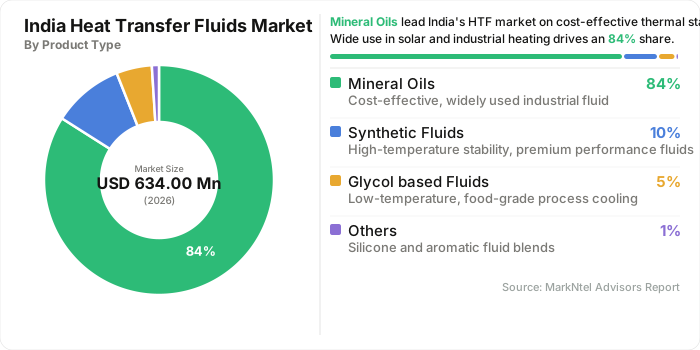
- Mineral oil-based heat transfer fluids lead the product type segment, accounting for nearly 84% of market revenue.
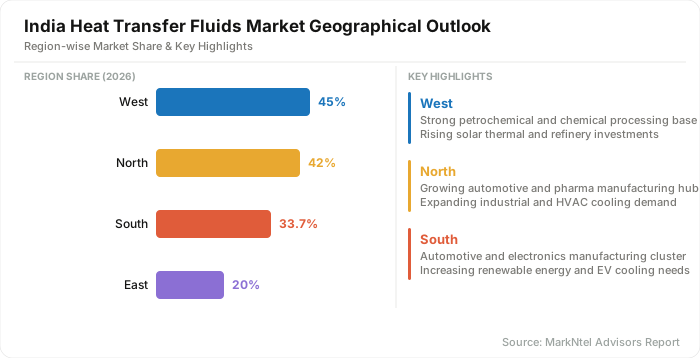
- West India remains the leading regional market with around 45% share in 2026.
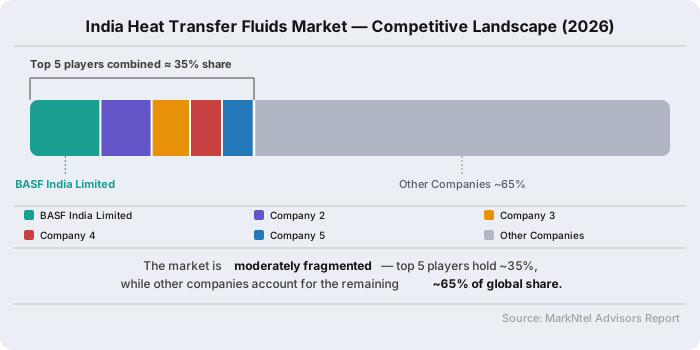
- The market exhibits a moderately consolidated structure. The top five market participants collectively account for nearly 35% of total market revenue.
India Heat Transfer Fluids Market Size and Outlook
The India Heat Transfer Fluids Market is valued at USD 589 million in 2025, USD 634 million and is projected to reach USD 972 million by 2032, expanding at a CAGR of 7.38% over the forecast period. This strong trajectory is anchored in India's concurrent expansion across petroleum refining, chemical processing, and automotive electrification all of which depend on heat transfer fluids (HTFs) for precision thermal control.
India's refining sector, which now totals 258.1 million metric tonnes per annum (MMTPA) across 23 operational refineries as of 2026, is a structural demand engine for HTFs, as thermic fluids are essential across distillation column reboilers, crude pipeline viscosity management, and gas processing stages including dehydration, sweetening, and fractionation. Public sector refiners Indian Oil Corporation Limited, Bharat Petroleum Corporation Limited, and Hindustan Petroleum Corporation Limited are collectively targeting an addition of approximately 50 MMTPA to national refining capacity by 2030, sustaining long-term procurement volumes for high-temperature thermal fluids.
The industrial and chemical processing end-user base further strengthens demand. India's National Infrastructure Pipeline (NIP), which tracks 79 sub-sectors as of March 2025, up from 57 in March 2024, concentrates approximately 85% of its investment in transport, energy, real estate, and water management, all of which require high-performance thermal systems across manufacturing and processing plants. Additionally, the chemical and pharmaceutical manufacturing segments rely on HTFs for temperature-controlled distillation and reaction management, creating a steady industrial offtake that complements the energy sector's demand base.
India's accelerating electrification of its vehicle fleet introduces a newer and fast-growing application vertical for heat transfer fluids, specifically in battery thermal management systems (BTMS). The Ministry of Heavy Industries (MHI) reported over 1 million EV sales in FY 2024–25, supported by the PM Electric Drive Revolution in Innovative Vehicle Enhancement (PM E-DRIVE) Scheme, which carries a financial outlay of USD 1.14 billion through March 2026.
As of February 2025, India has registered 5.675 million electric vehicles, generating substantial and growing demand for liquid-based thermal management fluids that prevent battery thermal runaway, extend cell lifespan, and support fast charging in extreme climatic conditions.
Across segments, these converging industrial, infrastructural, and policy-driven factors position the Indian thermal management fluids landscape for sustained and broad-based expansion through 2032.
India Heat Transfer Fluids Market Key Indicators
- According to the Ministry of Chemicals and Fertilizers (Government of India), production of major chemicals and petrochemicals reached 58,617 thousand metric tonnes in FY 2024–25, up from 45,638 thousand metric tonnes in FY 2015–16; sustained high-volume chemical processing at this scale requires continuous HTF circulation for reactor temperature control, distillation column heating, and heat exchange across large-plant operations.
- According to the Ministry of New and Renewable Energy (MNRE), India's total installed renewable energy capacity reached 220.10 GW as of March 2025, with a record 29.52 GW added in FY 2024–25 alone; solar thermal and concentrated solar applications within this expanding base rely on heat transfer fluids for energy storage and steam generation, driving procurement volumes for high-temperature synthetic and aromatic HTFs.
- According to the World Steel Association, India produced 149.4 million tonnes of crude steel in 2024, a 6.2% increase over 2023, making it the world's second-largest producer. Continuous casting, annealing, and rolling operations in steelmaking require precision thermal fluid systems for mould cooling and equipment temperature regulation, sustaining baseline HTF demand across integrated steel plants.
- According to the Ministry of Food Processing Industries (MoFPI), the food processing sector grew at an average annual rate of 6.55% over the nine years ending FY 2023–24, with processed food exports reaching 20.4% of total agri-exports in FY 2024–25. Food and beverage processing plants use HTFs in pasteurization, sterilization, and cooking systems that require fluids operating in precise temperature bands to meet FSSAI hygiene and food safety standards, directly expanding process-grade HTF consumption.
India Heat Transfer Fluids Market Scope
| Category | Segments |
|---|---|
| By Product | Mineral Oils, Synthetic Fluids (Silicone Fluids, Aromatic Fluids, Synthetic Hydrocarbon Fluids, Ester-based Fluids), Glycol-based Fluids, Others |
| By Operating Temperature Range | Low Temperature (Below 0°C), Medium Temperature (0°C – 200°C), High Temperature (Above 200°C |
| By Sales Channel | Direct Sales (OEM/B2B), Distributors & Dealers, Online Retail |
| By End user | Chemical & Petrochemical, Oil & Gas, Concentrated Solar Power (CSP), Food & Beverages, Pharmaceuticals, Plastics & Rubber, Automotive, HVAC, Others |
India Heat Transfer Fluids Market Growth Drivers
Rapid Expansion of India's Petrochemical and Specialty Chemical Manufacturing
India's accelerating build-out of petrochemical and specialty chemical production capacity is the most consequential structural driver of heat transfer fluid demand. Chemical and petrochemical processes, including cracking, distillation, polymerization, and hydrogenation, operate across temperature ranges that steam systems cannot efficiently serve, making heat transfer fluids the essential medium for sustained, precise thermal control in these plants. India's petrochemical demand reached approximately 61 million tonnes in FY 2024–25, a 7% year-on-year increase, according to data presented at the World Petrochemical Conference 2024 in Houston; each ton of throughput in downstream cracking and polymerization requires continuous HTF circulation through jacketed reactors, reboilers, and heat exchangers, directly proportioning fluid consumption to output volume.
The scale of committed new investment amplifies this demand signal. The Government of India's Petroleum, Chemicals and Petrochemicals Investment Region (PCPIR) Policy 2020–35 targets USD 213 billion in cumulative investment across integrated chemical hubs in Andhra Pradesh, Gujarat, Odisha, and Tamil Nadu by 2030, while India's petrochemical production capacity is projected to expand from 29.62 million tonnes to 46 million tonnes by 2030 — a more than 55% increase.
Every greenfield or brownfield commissioning within these clusters requires initial HTF fill volumes across heat exchangers, process reactors, and distillation systems, alongside scheduled replenishment cycles, translating each capacity addition directly into sustained fluid procurement. For suppliers, this pipeline anchored by the proposed USD 11.43 billion Andhra Pradesh greenfield refinery-petrochemical complex announced in October 2025 represents a durable, high-volume order base extending well into the forecast period.
Recent Trends
Shift Toward High-Performance Synthetic and Bio-Based Heat Transfer Fluids
Across India's industrial base, plant operators are progressively replacing conventional mineral oil-based thermic fluids with high-performance synthetic and bio-based alternatives that deliver longer service life, higher operating temperature ceilings, and lower degradation rates. This shift is being accelerated by the Bureau of Energy Efficiency's (BEE) Perform, Achieve and Trade (PAT) scheme, which has covered over 1,333 designated industrial consumers across eight energy-intensive sectors including petrochemicals, cement, iron and steel, and fertilizers through eight successive cycles, each mandating specific energy consumption reduction targets.
Upgrading from mineral oils to synthetic formulations directly supports PAT compliance by reducing heat loss and improving thermal circuit efficiency across process plants. Suppliers have responded with targeted product launches confirming the trend's commercial momentum. In January 2025, Global Heat Transfer launched Globaltherm Q, a high-performance synthetic organic heat transfer fluid for demanding industrial applications, followed in August 2025 by Globaltherm DBT, engineered for closed, forced-circulation systems in chemicals and plastics processing.
As Indian industries enter successive PAT cycles with tightening specific energy consumption norms, the transition to premium synthetic and bio-based fluids will deepen further, reshaping the India heat transfer fluids market's product mix toward higher-value formulations through 2032.
Opportunities and Challenges
Crude Oil Feedstock Price Volatility Leading to Development of Domestically Manufactured Synthetic and Bio-Based Heat Transfer Fluid Feedstocks
India's heat transfer fluid manufacturers face a structural cost constraint rooted in dependence on petrochemical-derived feedstocks — glycols, aromatics, and synthetic base oils — whose prices track crude oil markets. Crude oil derivatives constitute 60–70% of production costs for synthetic and aromatic HTF formulations, and geopolitical supply disruptions have driven 20–30% price swings in key feedstock materials, compressing manufacturer margins and creating procurement uncertainty for end-users planning thermal system upgrades.
For India's import-dependent HTF supply chain, this vulnerability is amplified domestic specialty chemical output covers only a fraction of the advanced intermediates required for high-performance formulations, leaving the market exposed to global price shocks. This pressure is simultaneously catalysing a commercial response. In August 2025, Reliance Industries Limited announced an investment of USD 7.85 billion in its Oil-to-Chemicals (O2C) business, expanding India's domestic petrochemical intermediate manufacturing base and broadening the feedstock pool available to HTF formulators.
Similarly, in September 2025, Tata Chemicals and TERI jointly launched a Centre of Excellence on Biochemicals to develop sustainable, bio-based chemicals, a direct upstream signal that domestically sourced renewable feedstocks for bio-based HTF production are entering the commercial pipeline. As India's specialty chemicals base deepens through 2026 and beyond, HTF producers with localized supply chains will gain durable cost advantages, accelerating adoption of advanced formulations across price-sensitive industrial end-users and strengthening the long-term competitiveness of the market.
Segmentation Insights
Strong Demand from Chemical, Petrochemical, and Manufacturing Sectors Sustains Mineral Oil Segment Leadership
Mineral oils account for approximately 84% of the India heat transfer fluids market, making them the leading product segment across the country's price-sensitive industrial landscape. Their market dominance is primarily driven by three key advantages: lower cost compared with synthetic alternatives, compatibility with existing heat transfer systems without requiring equipment modifications, and a dependable operating temperature range of 270°C–315°C that meets the thermal requirements of major end-use industries, including chemical processing, textile manufacturing, food & beverage processing, and metal processing.
Together, these advantages make mineral oil-based heat transfer fluids the preferred choice for industrial applications requiring reliable thermal performance and cost-effective operation. Additionally, the Indian Oil Corporation Limited reinforces segment leadership through its Servo Therm 32 and Servo Therm 46 mineral oil-based thermic fluid lines, backed by a 42% national market share in petroleum oils and lubricants and Q3 FY26 revenue of USD 24.83 billion, ensuring procurement reach unmatched by private-sector competitors.
As India's manufacturing sector expansion drives industrial capacity growth through 2032, mineral oils will retain volume dominance, even as synthetic heat transfer fluids progressively capture a larger revenue share within the overall India thermal fluids market product mix. By Product type, the market is further segmented into the following sub-categories:
- Mineral Oils
- Synthetic Fluids
- Ester-based Fluids
- Glycol-based Fluids
- Others
Medium-Temperature Heat Transfer Fluids Lead the Market Due to Their Extensive Use in Industrial Processing Applications
The medium-temperature segment (0°C–200°C) holds 52% share of the India heat transfer fluids market owing to its widespread applicability across key industrial sectors, including chemicals, petrochemicals, pharmaceuticals, food processing, textiles, and refining. A significant proportion of industrial heating operations, such as reactor temperature control, distillation, drying, storage tank heating, and heat recovery systems, are designed to operate within this temperature range, making medium-temperature fluids the most economical and technically suitable solution. The segment's leadership is further reinforced by continued growth in India's industrial base.
According to the Ministry of Petroleum and Natural Gas, India's refining capacity exceeded 258 MMTPA in 2025, while investments in petrochemical expansion projects across Gujarat, Maharashtra, and other industrial hubs continue to increase thermal fluid consumption. Additionally, the rapid expansion of specialty chemicals and pharmaceutical manufacturing facilities has generated sustained demand for reliable heat transfer systems operating within moderate temperature conditions.
As industries increasingly prioritize energy efficiency, process optimization, and operational safety, medium-temperature heat transfer fluids are expected to remain the preferred choice, thereby sustaining their dominant position in the Indian market over the coming years. By the operating temperature range the market is further segmented into the following sub-categories;
- Low Temperature (Below 0°C)
- Medium Temperature (0°C – 200°C)
- High Temperature (Above 200°C)
India Heat Transfer Fluids Geographical Analysis
West India accounts for approximately 45% of the India heat transfer fluids market, commanding the largest regional share driven by the unmatched concentration of chemical industry heat transfer fluids demand across Gujarat and Maharashtra. Gujarat's structural position as India's petrochemical thermal fluids hub is anchored by the Dahej PCPIR in Bharuch district, which hosts 180 existing and 650 under-construction industrial units requiring continuous HTF supply for reactor heating, distillation, and polymerization.
The three major PCPIRs, Dahej (Gujarat), Vizag-Kakinada, and Paradeep have collectively attracted investments of USD 35.62 billion and created over 0.37 million jobs per the Ministry of Chemicals and Fertilizers Annual Report 2025–26, with Dahej representing the most mature chemical manufacturing hub India and the single largest structural driver of Gujarat chemical industry thermal fluids demand.
Maharashtra further strengthens regional demand through its well-established pharmaceutical, automotive, and specialty chemical clusters across Mumbai, Pune, and Nashik. In 2024, BASF India expanded production capacities at its Panoli (Gujarat) and Thane (Maharashtra) facilities, while Shivtek Spechemi Industries announced the development of a new specialty chemicals manufacturing complex near Hazira, Gujarat, spanning over 1 million sq. ft. and targeting a production capacity of 250,000 MTPA by 2027–28. These investments are expected to increase demand for industrial process heating and thermal fluid systems.
As Gujarat and Maharashtra continue attracting investments in specialty chemicals, pharmaceuticals, and advanced manufacturing through 2026, West India is expected to retain its dominant position in the India heat transfer fluids market during the forecast period.
India Heat Transfer Fluids Market Competitive Landscape
The India Heat Transfer Fluids Market exhibits a moderately consolidated structure, characterized by the presence of large public-sector oil companies, global specialty chemical manufacturers, and industrial lubricant suppliers. The market is led by Indian Oil Corporation (IOCL), Hindustan Petroleum (HPCL), Bharat Petroleum (BPCL), Shell India Markets Private Limited, and Eastman Chemical (Therminol).
The top five players collectively account for 35% of the heat transfer fluids industry in India, while the remaining market share is distributed among companies such as BASF India, TotalEnergies, ExxonMobil, Savita Oil Technologies, Dow, and several regional and specialty fluid manufacturers.
Major Players in the India Heat Transfer Fluids Market
- Indian Oil Corporation (IOCL)
- Hindustan Petroleum (HPCL)
- Bharat Petroleum (BPCL)
- Shell India Markets Private Limited
- Eastman Chemical (Therminol)
- BASF India Limited
- TotalEnergies
- ExxonMobil
- Savita Oil Technologies Limited
- Dow Chemical International Private Limited
India Heat Transfer Fluids Market News and Recent Developments
2024: Castrol Launches Castrol ON Direct Liquid Cooling PG 25 Propylene Glycol-Based Heat Transfer Fluid for Direct-to-Chip Data Centre Cooling
On 13 December 2024, Castrol (a subsidiary of BP) announced the launch of Castrol ON Direct Liquid Cooling PG 25, a propylene glycol-based heat transfer fluid specifically engineered for direct-to-chip cooling applications in high-performance data centres. The ready-to-use fluid at 25% concentration requires no dilution and delivers protection against metal corrosion and bacterial growth while remaining compatible with a wide range of cooling system materials. The product targets AI, machine learning, and high-performance computing environments, where power densities of 30–100+ kW per rack make air cooling inadequate.
Impact analysis: Castrol's entry into direct-to-chip liquid cooling with a propylene glycol-based HTF signals the expanding application boundary of heat transfer fluids beyond traditional industrial process heating into high-growth digital infrastructure. As India's data center capacity accelerates driven by AI and cloud expansion this product category opens a structurally new demand vertical for glycol-based HTFs, broadening the addressable market for heat transfer fluid suppliers operating in India's rapidly industrializing economy.
2025: Nirmal Energy Limited Launches Maxothermie-660 High-Temperature Synthetic HTF in Collaboration with Capital Pure LLC, USA, Ahmedabad, India
Nirmal Energy Limited, based in Ahmedabad, Gujarat, launched Maxothermie-660, a high-performance synthetic heat transfer fluid engineered for liquid-phase, high-temperature industrial applications, in collaboration with Capital Pure LLC, USA. Formulated using an advanced modified terphenyl composition, Maxothermie-660 supports continuous bulk operating temperatures up to 350°C and is fully interchangeable with leading global products such as Dowtherm RP and Therminol-66, enabling system upgrades without equipment modifications. The fluid targets chemical processing, pharmaceuticals, plastics, and textile manufacturing — all core HTF end-use sectors in India's West region.
Impact Analysis: The launch signals growing domestic innovation capacity within India's heat transfer fluid supply chain, reducing dependence on imported high-temperature synthetic formulations. For Indian industrial operators, a locally stocked, interchangeable synthetic fluid with equivalent performance to multinational products reduces procurement lead times and strengthens supply-chain resilience, accelerating the market's ongoing transition from mineral oils to premium synthetic HTF segments.
- Market Segmentation
- Introduction
- Product Definition
- Research Process
- Assumptions
- Executive Summary
- India Heat Transfer Fluids Market Policies, Regulations, and Product Standards
- India Heat Transfer Fluids Market Trends & Developments
- India Heat Transfer Fluids Market Dynamics
- Growth Factors
- Challenges
- India Heat Transfer Fluids Market Hotspot & Opportunities
- India Heat Transfer Fluids Market Outlook, 2022-2032F
- Market Size & Outlook
- By Revenues (USD Million)
- Market Share & Outlook
- By Product - Market Size & Forecast 2022-2032, USD Million
- Mineral Oils
- Synthetic Fluids
- Silicone Fluids
- Aromatic Fluids
- Synthetic Hydrocarbon Fluids
- Ester-based Fluids
- Glycol-based Fluids
- Others
- By Operating Temperature Range- Market Size & Forecast 2022-2032, USD Million
- Low Temperature (Below 0°C)
- Medium Temperature (0°C – 200°C)
- High Temperature (Above 200°C)
- By Sales Channel- Market Size & Forecast 2022-2032, USD Million
- Direct Sales (OEM/B2B)
- Distributors & Dealers
- Online Retail
- By End user- Market Size & Forecast 2022-2032, USD Million
- Chemical & Petrochemical
- Oil & Gas
- Concentrated Solar Power (CSP)
- Food & Beverages
- Pharmaceuticals
- Plastics & Rubber
- Automotive
- HVAC
- Others
- By Region- Market Size & Forecast 2022-2032, USD Million
- North
- National Capital Region (Delhi NCR)
- Uttar Pradesh
- Punjab
- Rajasthan
- Others
- South
- Karnataka
- Tamil Nadu
- Kerala
- Others
- East
- West Bengal
- Odisha
- Others
- West
- Maharashtra
- Gujarat
- Madhya Pradesh
- Others
- North
- By Company
- Competition Characteristics
- Market Share & Analysis
- By Product - Market Size & Forecast 2022-2032, USD Million
- Market Size & Outlook
- India Mineral Oils Heat Transfer Fluids Market Outlook, 2022-2032
- Market Size & Outlook
- By Revenues (USD Million)
- Market Share & Outlook
- By Physical State- Market Size & Forecast 2022-2032, USD Million
- By Operating Temperature Range- Market Size & Forecast 2022-2032, USD Million
- By Sales Channel- Market Size & Forecast 2022-2032, USD Million
- By End user- Market Size & Forecast 2022-2032, USD Million
- By region- Market Size & Forecast 2022-2032, USD Million
- Market Size & Outlook
- India Synthetic Heat Transfer Fluids Market Outlook, 2022-2032
- Market Size & Outlook
- By Revenues (USD Million)
- Market Share & Outlook
- By Physical State- Market Size & Forecast 2022-2032, USD Million
- By Operating Temperature Range- Market Size & Forecast 2022-2032, USD Million
- By Sales Channel- Market Size & Forecast 2022-2032, USD Million
- By End user- Market Size & Forecast 2022-2032, USD Million
- By region- Market Size & Forecast 2022-2032, USD Million
- Market Size & Outlook
- India Glycol-Based Heat Transfer Fluids Market Outlook, 2022-2032
- Market Size & Outlook
- By Revenues (USD Million)
- Market Share & Outlook
- By Physical State- Market Size & Forecast 2022-2032, USD Million
- By Operating Temperature Range- Market Size & Forecast 2022-2032, USD Million
- By Sales Channel- Market Size & Forecast 2022-2032, USD Million
- By End user- Market Size & Forecast 2022-2032, USD Million
- By region- Market Size & Forecast 2022-2032, USD Million
- Market Size & Outlook
- India Heat Transfer Fluid Market Key Strategic Imperatives for Success & Growth
- Competitive Outlook
- Company Profiles
- Indian Oil Corporation (IOCL)
- Business Description
- Product Portfolio
- Collaborations & Alliances
- Recent Developments
- Financial Details
- Others
- Hindustan Petroleum (HPCL)
- Business Description
- Product Portfolio
- Collaborations & Alliances
- Recent Developments
- Financial Details
- Others
- Bharat Petroleum (BPCL)
- Business Description
- Product Portfolio
- Collaborations & Alliances
- Recent Developments
- Financial Details
- Others
- Shell India Markets Private Limited
- Business Description
- Product Portfolio
- Collaborations & Alliances
- Recent Developments
- Financial Details
- Others
- Eastman Chemical (Therminol)
- Business Description
- Product Portfolio
- Collaborations & Alliances
- Recent Developments
- Financial Details
- Others
- BASF India Limited
- Business Description
- Product Portfolio
- Collaborations & Alliances
- Recent Developments
- Financial Details
- Others
- TotalEnergies
- Business Description
- Product Portfolio
- Collaborations & Alliances
- Recent Developments
- Financial Details
- Others
- ExxonMobil
- Business Description
- Product Portfolio
- Collaborations & Alliances
- Recent Developments
- Financial Details
- Others
- Savita Oil Technologies Limited
- Business Description
- Product Portfolio
- Collaborations & Alliances
- Recent Developments
- Financial Details
- Others
- Dow Chemical International Private Limited
- Business Description
- Product Portfolio
- Collaborations & Alliances
- Recent Developments
- Financial Details
- Others
- Indian Oil Corporation (IOCL)
- Company Profiles
- Disclaimer

MarkNtel Advisors follows a robust and iterative research methodology designed to ensure maximum accuracy and minimize deviation in market estimates and forecasts. Our approach combines both bottom-up and top-down techniques to effectively segment and quantify various aspects of the market. A consistent feature across all our research reports is data triangulation, which examines the market from three distinct perspectives to validate findings. Key components of our research process include:
1. Scope & Research Design At the outset, MarkNtel Advisors define the research objectives and formulate pertinent questions. This phase involves determining the type of research—qualitative or quantitative—and designing a methodology that outlines data collection methods, target demographics, and analytical tools. They also establish timelines and budgets to ensure the research aligns with client goals.
2. Sample Selection and Data Collection In this stage, the firm identifies the target audience and determines the appropriate sample size to ensure representativeness. They employ various sampling methods, such as random or stratified sampling, based on the research objectives. Data collection is carried out using tools like surveys, interviews, and observations, ensuring the gathered data is reliable and relevant.
3. Data Analysis and Validation Once data is collected, MarkNtel Advisors undertake a rigorous analysis process. This includes cleaning the data to remove inconsistencies, employing statistical software for quantitative analysis, and thematic analysis for qualitative data. Validation steps are taken to ensure the accuracy and reliability of the findings, minimizing biases and errors.

4. Data Forecast and FinalizationThe final phase involves forecasting future market trends based on the analyzed data. MarkNtel Advisors utilize predictive modeling and time series analysis to anticipate market behaviors. The insights are then compiled into comprehensive reports, featuring visual aids like charts and graphs, and include strategic recommendations to inform client decision-making
FILL THE FORM TO INQUIRE BEFORE BUYING THIS REPORT
We offer flexible licensing options to cater to varying organizational needs. Choose the pricing pack that best suits your requirements:
Buy Now Talk to our Consultant
 Request Customization