GCC Municipal Solid Waste Management Market Research Report: Size, Share, Trends & Forecast (2026-2032)
By Waste Type (Organic/Biodegradable Waste, Paper & Paperboard, Plastic Waste, Glass Waste, Metal Waste, Others), By Service Type (Collection & Transportation, Segregation & Sortin ... g, Recycling, Biological Treatment (Composting & Bio-methanation), Disposal), By End user (Residential, Commercial, Industrial), and others Read more
- Environment
- Jul 2026
- Pages 240
- Report Format: PDF, Excel, PPT
GCC Municipal Solid Waste Management Market
Projected 11.25% CAGR from 2026 to 2032
Study Period
2026-2032
Market Size (2026)
USD 4.26 Billion
Market Size (2032)
USD 6.18 Billion
Base Year
2025
Projected CAGR
11.25%
Leading Segments
By Type Waste: Organic/Biodegradable Waste
GCC Municipal Solid Waste Management Market Key Takeaways
- The GCC municipal solid waste management market was valued at USD 3.29 billion in 2025, to 4.26 billion in 2026, and is projected to reach USD 6.18 billion by 2032.
- The industry is projected to witness steady growth at a CAGR of 11.25% during the forecast period.
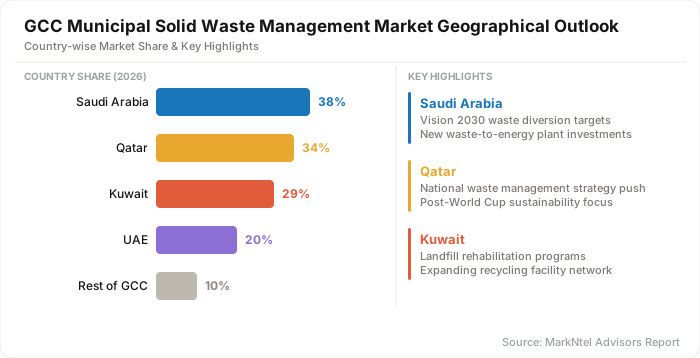
- Saudi Arabia dominated the regional market with approximately 38% share in 2026.
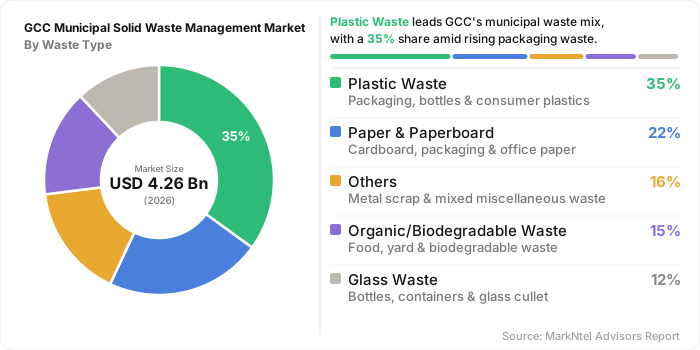
- By waste type, plastic waste accounted for the largest market share of approximately 35%.
- By service type, collection & transportation services led the market with around 52% share.
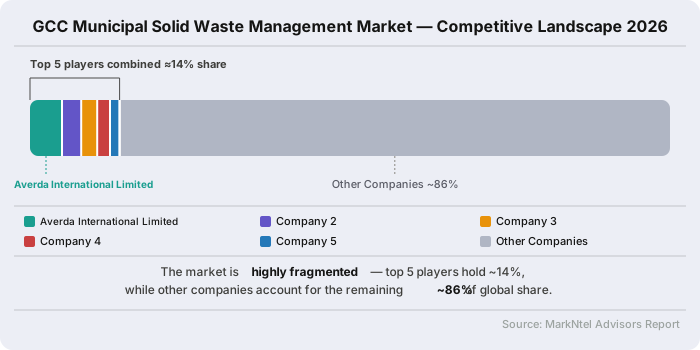
- The market is moderately fragmented, with the top five companies accounting for approximately 14% of total market revenue, while numerous regional and local operators compete across municipal waste management services.
GCC Municipal Solid Waste Management Market Size and Outlook
The GCC municipal solid waste management market was valued at USD 3.29 billion in 2025, to 4.26 billion in 2026, and is projected to reach USD 6.18 billion by 2032, expanding at a CAGR of 11.25% through the forecast period.
The market is experiencing robust growth, driven by rapid urbanization, rising municipal waste generation, and government-led transitions toward circular economy practices. With more than 80% of the GCC population residing in urban areas, the region generates over 27 million tonnes of municipal solid waste (MSW) annually, creating sustained demand for waste collection, transportation, recycling, treatment, and disposal services. Saudi Arabia, the region's largest waste producer, generates approximately 15–17 million tonnes of municipal solid waste each year, while cities such as Riyadh record per-capita waste generation exceeding 1.5 kg per day.
These expanding waste volumes are increasing the need for advanced waste management infrastructure and long-term service contracts across municipalities and industrial clusters. Additionally, the government policies are transforming these growing waste streams into structured commercial opportunities. Under Saudi Vision 2030, implemented through the Ministry of Municipalities, Rural Affairs and Housing and the National Center for Waste Management, the Kingdom aims to achieve an 82% landfill diversion rate by 2035 through greater adoption of recycling, composting, and waste-to-energy solutions.
Achieving this target requires substantial investment in material recovery facilities, transfer stations, recycling plants, and integrated waste treatment infrastructure. Similarly, the UAE Ministry of Climate Change and Environment (MOCCAE), in collaboration with Tadweer, is advancing the National Agenda for Integrated Waste Management, focusing on resource recovery and emissions reduction across the waste value chain.
Industry investments are further accelerating market expansion. In January 2025, Emirates Waste to Energy, a joint venture between BEEAH and Masdar, announced the second-phase expansion of the Sharjah Waste-to-Energy Plant, doubling annual processing capacity from 300,000 tonnes to 600,000 tonnes while increasing electricity generation from 30 MW to nearly 60 MW.
Meanwhile, Kuwait Vision 2035 and Oman Vision 2040 continue to promote recycling, landfill diversion, and smart waste management technologies. Collectively, rising waste generation, supportive regulatory frameworks, and sustained public and private investment are expected to underpin the GCC waste management market's strong growth through 2032.
GCC Municipal Solid Waste Management Market Key Indicators
- Qatar's Ministry of Municipality reported that the Domestic Solid Waste Management Centre (DSWMC) in Mesaieed received approximately 828,000 tonnes of municipal waste annually as of 2024, processing roughly 2,300 tonnes per day; this volume underscores the scale of feedstock flowing through centralized MSW treatment infrastructure across GCC cities and the sustained revenue it generates for integrated operators.
- Saudi Arabia's National Waste Management Strategy, administered by MWAN under the Ministry of Environment, Water and Agriculture, sets a target of 94% MSW landfill diversion by 2035, up from a current diversion rate of approximately 5%; the scale of this structural transition mandates investment in sorting facilities, composting plants, refuse-derived fuel lines, and waste-to-energy assets, creating a multi-decade procurement pipeline for service providers.
- Dubai Municipality, under Dubai Law No. 18 of 2024 on Regulating Waste Management, mandated routing of all construction and demolition waste to licensed recycling plants or material recovery facilities, with a 2027 deadline for landfill phase-out; with Dubai producing approximately 5,000 tonnes of C&D waste daily around 70% of its total solid waste stream this regulation translates directly into contracted volumes and processing revenues for licensed MSW and C&D facility operators.
GCC Municipal Solid Waste Management Market Scope
| Category | Segments |
|---|---|
| By Waste Type | Organic/Biodegradable Waste, Paper & Paperboard, Plastic Waste, Glass Waste, Metal Waste, Others |
| By Service Type | Collection & Transportation, Segregation & Sorting, Recycling, Biological Treatment (Composting & Bio-methanation), Disposal |
| By End user | Residential, Commercial, Industrial |
GCC Municipal Solid Waste Management Market Growth Drivers
High Per-Capita Waste Generation and Urban Population Growth Sustaining MSW Volume Expansion Across the GCC
Rapidly expanding urban populations and high per-capita consumption habits across the GCC create the foundational waste volumes that drive demand for collection, transfer, treatment, and disposal services. The GCC is among the world's most waste-intensive regions: a peer-reviewed study published in PMC found that total solid waste generated across Saudi Arabia, UAE, Qatar, Bahrain, and Kuwait reaches 95–100 million metric tonnes annually, with the UAE generating 2.1 kg per person per day, nearly three times the global average of 0.74 kg.
This elevated baseline is further reinforced by strong structural tailwinds rather than cyclical dynamics. According to the World Bank, MSW generation across the MENA region is projected to reach 754 million tonnes by 2030, driven by sustained population growth, accelerating urban in-migration, and rising household consumption intensity.
From a sector perspective, these dynamics translate into a predictable, compounding expansion in contracted waste management requirements. As volumes increase, municipalities and private operators must scale collection frequency, expand transfer station capacity, and invest in higher-throughput treatment and disposal infrastructure. This effectively anchors a structurally expanding revenue pool for waste management companies in GCC, with growth driven more by underlying demographic and consumption fundamentals than by policy cycles or short-term demand fluctuations.
Recent Trends
Shift Toward AI-Powered and IoT-Enabled Municipal Waste Collection Across GCC Urban Networks
GCC municipal waste operators are shifting from fixed-schedule, labour-intensive collection toward AI-driven and IoT-enabled service models, a structural change in how MSW is collected, routed, and monitored across urban networks. Rather than deploying trucks on predetermined circuits, operators are embedding real-time sensor data, predictive analytics, and AI-powered route optimisation into daily operations. The measurable impact is quantified: a 2025 peer-reviewed study in the International Journal of Safety and Security Engineering found that GPS-guided routing cut truck mileage by 20% and CO₂ emissions by 18% versus fixed-schedule collection, with 85% fill-level accuracy across monitored bins.
The GCC is operationalizing this shift at scale. In September 2025, Tadweer Group launched Tajmee'e, Abu Dhabi's new AI-powered waste collection company, deploying a fleet with onboard computers, AI cameras, and weight sensors that adapt routes in real time based on fill data and predictive demand modelling. Tadweer has positioned Tajmee'e as a replicable model for the wider UAE, designed to support Abu Dhabi's target of diverting 80% of waste from landfills by 2030.
As sensor costs decline and 5G connectivity expands across GCC cities, this data-driven operating model is expected to become the procurement standard for new municipal concessions across the region.
GCC Municipal Solid Waste Management Market Opportunities and Challenges
Underdeveloped Recycling Infrastructure Driving Demand for Waste-to-Energy and Resource Recovery Investment
Landfill saturation and critically low recycling rates represent the central structural constraint on the GCC municipal solid waste management market. Saudi Arabia's National Center for Waste Management (MWAN) reported that the share of waste diverted from landfills reached only 18% in 2024, against a national target of 90% by 2040, while most of the Kingdom's more than 230 landfills are approaching capacity.
The gap between generation volumes and recovery infrastructure is compounded by insufficient material recovery facilities, an underdeveloped secondary raw material market, and inadequate source-segregation systems across the region's municipalities. These gaps constrain the transition to circular economy models mandated under national visions and delay measurable progress on GHG reduction commitments.
The same infrastructure deficit, however, creates a commercially defined opening for waste-to-energy and advanced treatment investment. Abu Dhabi's Tadweer Group, in a concession agreement signed with Emirates Water and Electricity Company (EWEC) and a Japan-based consortium comprising Marubeni Corporation and Hitachi Zosen Inova, is developing a facility in Al Bihouth that will process 900,000 tonnes of municipal solid waste annually and generate 80 MW of electricity upon commissioning in 2027, directly supporting Tadweer's target of diverting 80% of Abu Dhabi's waste from landfills by 2030.
As tightening diversion mandates convert policy pressure into procurement tenders, operators capable of deploying integrated treatment capacity across multiple GCC markets will be positioned to capture first-mover advantage in one of the region's fastest-expanding infrastructure segments.
Segmentation Insights
Plastic Waste Leads the Waste Type Category with Potential Market Shares
Plastic waste accounts for 35% of the GCC municipal solid waste management market, driven by the region's exceptionally high per-capita consumption of single-use packaging, petrochemical-linked product culture, and rapid urban retail expansion. Saudi Arabia alone generates a million tonnes of plastic waste annually, of which only 10% is currently recovered, creating acute pressure on collection and treatment infrastructure.
Company-specific examples like In April 2025, SABIC's TRUCIRCLE initiative, in partnership with Napco National and FONTE, launched the Kingdom's first 100% recycled polyethylene circular bread packaging produced from pyrolysis oil, demonstrating commercial-scale closed-loop plastic recovery. Further, in July 2025, a joint venture between MVW Lechtenberg and Saudi Investment Recycling Company (SIRC) began processing 3 million tonnes of municipal solid waste annually, diverting significant plastic fractions from landfills.
As plastic-specific extended producer responsibility frameworks tighten across GCC member states, demand for advanced sorting and chemical recycling capacity will structurally accelerate. By type of waste, the market is further segmented into the following sub-categories:
- Organic/Biodegradable Waste
- Paper & Paperboard
- Plastic Waste
- Glass Waste
- Metal Waste
- Others
Collection & Transportation Drives Revenue Growth in the GCC Municipal Solid Waste Management Market
Collection and transportation services hold a 52% share of the GCC municipal solid waste management market, reflecting their position as the foundational, non-deferrable entry point of the entire waste value chain, since downstream sorting, recycling, and disposal all depend first on consistent route-based pickup across dense urban and mixed-use developments. In May 2024, Dubai Municipality launched the "Outsourcing Waste Collection, Transportation, and Recycling Services" project in Hatta in partnership with Imdad, deploying a dedicated field team of 75 cleaners and a 20-vehicle fleet to divert 20 tonnes of municipal solid waste daily from landfills.
Separately, in March 2024, Etihad Rail awarded BEEAH Tandeef a network-wide waste collection and transportation contract spanning eight designated sites across Abu Dhabi, Sharjah, and Ruwais, marking the first such agreement between the two entities. (Etihad Rail, March 2024) As landfill phase-out deadlines such as Dubai's Law No. 18 of 2024 compress disposal timelines, operators with dense, technology-enabled collection fleets will increasingly determine how efficiently downstream treatment capacity is fed. By service type, the market is further segmented into the following sub-categories:
- Collection & Transportation
- Segregation & Sorting
- Recycling
- Biological Treatment (Composting & Bio-methanation)
- Disposal
GCC Municipal Solid Waste Management Market Geographical Analysis
Saudi Arabia holds approximately 38% of the GCC municipal solid waste management market, a position underpinned by the largest population in the region, exceeding 36 million, combined with one of the world's highest per-capita waste generation rates, with Riyadh alone producing over 25.8 million tonnes of waste annually.
The Kingdom's structural dominance is further reinforced by the sheer scale of regulated waste infrastructure: MWAN has identified the need for more than 800 new treatment and resource recovery facilities to meet national targets, with investment opportunities in the sector estimated by MWAN at USD 112 billion by 2040.
Jeddah Municipality alone reported receiving nearly 5 million tonnes of waste across its landfills in the first half of 2025, illustrating the volume pressure that is accelerating procurement activity. Operationally, Saudi Arabia's waste management is organized across 25 regional clusters under MWAN's master plan, and the Kingdom hosted the inaugural IFAT Saudi Arabia summit in January 2026, convening over 450 exhibitors from 35 countries, signaling deepening international technology investment into the country's waste sector. Company-specific examples like 2025, Riyadh Municipality and SIRC RVM rollout, Riyadh Municipality deployed reverse vending machines (RVMs) across 25 newly inaugurated parks and public facilities in Riyadh in collaboration with SIRC, targeting source-level recycling and waste volume reduction aligned with the Saudi Green Initiative.
GCC Municipal Solid Waste Management Market Competitive Landscape
The GCC Municipal Solid Waste Management Market is moderately fragmented, characterized by a mix of government-owned entities, public-private partnerships (PPPs), and private waste management service providers operating across collection, recycling, treatment, energy recovery, and disposal activities. The leading players in the GCC Municipal Solid Waste Management Market are Averda International Limited, BEEAH Group PJSC, Tadweer Group PJSC, SUEZ Middle East Recycling LLC, and Veolia Middle East FZE, collectively sharing 14% of the market share.
Major Players in the GCC Municipal Solid Waste Management Market
- Averda International Limited
- BEEAH Group PJSC
- Tadweer Group PJSC
- SUEZ Middle East Recycling LLC
- Veolia Middle East FZE
- Imdaad LLC
- Dulsco Waste Management Services LLC
- EnviroServe Services LLC
- SEPCO Environment LLC
- Oman Environmental Services Holding Company
- Al Haya Enviro W.L.L.
- Envac Middle East FZ-LLC
GCC Municipal Solid Waste Management Market News and Recent Developments
2025: BEEAH Group Announces Middle East's First Commercial-Scale Waste-to-Hydrogen Plant in Sharjah
At Abu Dhabi Sustainability Week, BEEAH Group revealed plans for a waste-to-hydrogen plant in Al Sajaa, Sharjah, in collaboration with the UAE Ministry of Energy and Infrastructure, UK-based Chinook Hydrogen, and Japan's Air Water Inc. The facility will process municipal solid waste and hard-to-recycle organics using Chinook's patented RODECS gasification and pyrolysis technology, producing 7 tonnes of fuel-cell grade hydrogen daily and preventing 30,000 tonnes of GHG emissions annually, with capacity scaling to 20 tonnes per day in later phases.
Impact Analysis: The project introduces a commercially validated hydrogen-from-waste pathway into the GCC municipal solid waste stream for the first time, simultaneously increasing landfill diversion rates and generating a zero-emission fuel product — positioning waste operators as energy producers and raising the value proposition of MSW processing contracts across the region.
2025: SIRC Signs USD 625 Million MoU with EIG Management to Co-Finance Waste Infrastructure in Saudi Arabia
Saudi Investment Recycling Company (SIRC), a wholly owned subsidiary of the Public Investment Fund, signed an MoU with U.S.-based EIG Management Company to co-develop two projects: a USD 375 million refuse-derived fuel (RDF) facility in Riyadh converting municipal waste into alternative fuel for cement kilns, and a USD 250 million tire-recycling plant producing pyrolysis oil and recycled carbon black.
Impact Analysis: The combined USD 625 million commitment signals a structural shift in GCC waste infrastructure financing — from government grant-funded projects to institutional investor-backed, revenue-generating concessions — lowering entry barriers for private capital and accelerating deployment of large-scale MSW treatment capacity in Saudi Arabia's most waste-intensive urban cluster.
2026: Averda Secures Integrated Waste Management Facility Contract for The Red Sea Project
Averda signed a contract with SEPCOIII to deliver an Integrated Waste Management Facility (IWMF) for The Red Sea Project, Saudi Arabia, covering an automated Materials Recovery Facility, a state-of-the-art incinerator, a composting system, and a solar-powered electric vehicle fleet operating across land and sea. Residual ash from incineration will be reused in brick manufacturing. The facility targets zero waste to landfill across the tourism destination's operational phase. (
Impact Analysis: The contract establishes a replicable zero-landfill operating model for large-scale tourism and giga-project developments in the GCC, where waste management scope now spans MRF, energy recovery, composting, and electrified logistics under a single concession — raising the technical and capital threshold for future contract bidders in the region.
Frequently Asked Questions
- Market Segmentation
- Introduction
- Product Definition
- Research Process
- Assumptions
- Executive Summary
- GCC Municipal Solid Waste Management Market Policies, Regulations, and Product Standards
- GCC Municipal Solid Waste Management Market Trends & Developments
- GCC Municipal Solid Waste Management Market Dynamics
- Growth Factors
- Challenges
- GCC Municipal Solid Waste Management Market Hotspot & Opportunities
- GCC Municipal Solid Waste Management Market Outlook, 2022-2032F
- Market Size & Outlook
- By Revenues (USD Million)
- Market Segmentation & Outlook
- By Waste Type- Market Size & Forecast 2022-2032, USD Million
- Organic/Biodegradable Waste
- Paper & Paperboard
- Plastic Waste
- Glass Waste
- Metal Waste
- Others
- By Service Type- Market Size & Forecast 2022-2032, USD Million
- Collection & Transportation
- Segregation & Sorting
- Recycling
- Biological Treatment (Composting & Bio-methanation)
- Disposal
- By End user - Market Size & Forecast 2022-2032, USD Million
- Residential
- Commercial
- Industrial
- By Country
- Saudi Arabia
- Qatar
- Kuwait
- Oman
- Bahrain
- The UAE
- By Company
- Competition Characteristics
- Market Segmentation & Outlook
- By Waste Type- Market Size & Forecast 2022-2032, USD Million
- Market Size & Outlook
- Saudi Arabia Municipal Solid Waste Management Market Outlook, 2022-2032F
- Market Size & Outlook
- By Revenues (USD Million)
- Market Segmentation & Outlook
- By Waste Type- Market Size & Forecast 2022-2032, USD Million
- By Service Type- Market Size & Forecast 2022-2032, USD Million
- By Ownership / Operating Model- Market Size & Forecast 2022-2032, USD Million
- Market Size & Outlook
- Qatar Municipal Solid Waste Management Market Outlook, 2022-2032F
- Market Size & Outlook
- By Revenues (USD Million)
- Market Segmentation & Outlook
- By Waste Type- Market Size & Forecast 2022-2032, USD Million
- By Service Type- Market Size & Forecast 2022-2032, USD Million
- By Ownership / Operating Model- Market Size & Forecast 2022-2032, USD Million
- Market Size & Outlook
- Kuwait Municipal Solid Waste Management Market Outlook, 2022-2032F
- Market Size & Outlook
- By Revenues (USD Million)
- Market Segmentation & Outlook
- By Waste Type- Market Size & Forecast 2022-2032, USD Million
- By Service Type- Market Size & Forecast 2022-2032, USD Million
- By Ownership / Operating Model- Market Size & Forecast 2022-2032, USD Million
- Market Size & Outlook
- Oman Municipal Solid Waste Management Market Outlook, 2022-2032F
- Market Size & Outlook
- By Revenues (USD Million)
- Market Segmentation & Outlook
- By Waste Type- Market Size & Forecast 2022-2032, USD Million
- By Service Type- Market Size & Forecast 2022-2032, USD Million
- By Ownership / Operating Model- Market Size & Forecast 2022-2032, USD Million
- Market Size & Outlook
- Bahrain Municipal Solid Waste Management Market Outlook, 2022-2032F
- Market Size & Outlook
- By Revenues (USD Million)
- Market Segmentation & Outlook
- By Waste Type- Market Size & Forecast 2022-2032, USD Million
- By Service Type- Market Size & Forecast 2022-2032, USD Million
- By Ownership / Operating Model- Market Size & Forecast 2022-2032, USD Million
- Market Size & Outlook
- GCC Municipal Solid Waste Management Market Key Strategic Imperatives for Success & Growth
- Competitive Outlook
- Company Profiles
- Averda International Limited
- Business Description
- Product Portfolio
- Collaborations & Alliances
- Recent Developments
- Financial Details
- Others
- BEEAH Group PJSC
- Business Description
- Product Portfolio
- Collaborations & Alliances
- Recent Developments
- Financial Details
- Others
- Tadweer Group PJSC
- Business Description
- Product Portfolio
- Collaborations & Alliances
- Recent Developments
- Financial Details
- Others
- SUEZ Middle East Recycling LLC
- Business Description
- Product Portfolio
- Collaborations & Alliances
- Recent Developments
- Financial Details
- Others
- Veolia Middle East FZE
- Business Description
- Product Portfolio
- Collaborations & Alliances
- Recent Developments
- Financial Details
- Others
- Imdad LLC
- Business Description
- Product Portfolio
- Collaborations & Alliances
- Recent Developments
- Financial Details
- Others
- Dulsco Waste Management Services LLC
- Business Description
- Product Portfolio
- Collaborations & Alliances
- Recent Developments
- Financial Details
- Others
- EnviroServe Services LLC
- Business Description
- Product Portfolio
- Collaborations & Alliances
- Recent Developments
- Financial Details
- Others
- SEPCO Environment LLC
- Business Description
- Product Portfolio
- Collaborations & Alliances
- Recent Developments
- Financial Details
- Others
- be'ah(Oman Environmental Services Holding Company)
- Business Description
- Product Portfolio
- Collaborations & Alliances
- Recent Developments
- Financial Details
- Others
- Al Haya Enviro W.L.L.
- Business Description
- Product Portfolio
- Collaborations & Alliances
- Recent Developments
- Financial Details
- Others
- Envac Middle East FZ-LLC
- Business Description
- Product Portfolio
- Collaborations & Alliances
- Recent Developments
- Financial Details
- Others
- Averda International Limited
- Company Profiles
- Disclaimer
MarkNtel Advisors follows a robust and iterative research methodology designed to ensure maximum accuracy and minimize deviation in market estimates and forecasts. Our approach combines both bottom-up and top-down techniques to effectively segment and quantify various aspects of the market. A consistent feature across all our research reports is data triangulation, which examines the market from three distinct perspectives to validate findings. Key components of our research process include:
1. Scope & Research Design At the outset, MarkNtel Advisors define the research objectives and formulate pertinent questions. This phase involves determining the type of research—qualitative or quantitative—and designing a methodology that outlines data collection methods, target demographics, and analytical tools. They also establish timelines and budgets to ensure the research aligns with client goals.
2. Sample Selection and Data Collection In this stage, the firm identifies the target audience and determines the appropriate sample size to ensure representativeness. They employ various sampling methods, such as random or stratified sampling, based on the research objectives. Data collection is carried out using tools like surveys, interviews, and observations, ensuring the gathered data is reliable and relevant.
3. Data Analysis and Validation Once data is collected, MarkNtel Advisors undertake a rigorous analysis process. This includes cleaning the data to remove inconsistencies, employing statistical software for quantitative analysis, and thematic analysis for qualitative data. Validation steps are taken to ensure the accuracy and reliability of the findings, minimizing biases and errors.

4. Data Forecast and FinalizationThe final phase involves forecasting future market trends based on the analyzed data. MarkNtel Advisors utilize predictive modeling and time series analysis to anticipate market behaviors. The insights are then compiled into comprehensive reports, featuring visual aids like charts and graphs, and include strategic recommendations to inform client decision-making
We offer flexible licensing options to cater to varying organizational needs. Choose the pricing pack that best suits your requirements:
Buy Now Inquire Before Buying
 Request Customization
 Talk to our Consultant