

Canada Water and Waste Water Pump Market Research Report: Forecast (2026-2032)
Canada Water and Waste Water Pump Market - Pump Type: Centrifugal Pump (Overhung Pump (Vertical Inline, Horizontal End Suction), Split Case Pump (Single/Two Stage, Multistage), Ver ... tical Pump (Turbine (Solid handling, Nonsolid handling), Axial, Mixed Flow), Submersible Pump (Solid Handling, Non-solid Handling)), Positive Displacement Pump (Diaphragm Pump, Piston Pump, Gear Pump, Lobe Pump, Progressive Cavity Pump, Screw Pump, Vane Pump, Peristaltic Pump),, End User: Municipal water and wastewater, and Industrial water and wastewater Application: Water and Wastewater), and others Read more
- Environment
- Apr 2026
- Pages 135
- Report Format: PDF, Excel, PPT
Canada Water and Waste Water Pump Market
Projected 1.7% CAGR from 2026 to 2032
Study Period
2026-2032
Market Size (2026)
USD 139 Million
Market Size (2032)
USD 154 Million
Base Year
2025
Projected CAGR
1.7%
Leading Segments
By Pump Type: Centrifugal Pumps
Canada Water and Waste Water Pump Market Report Key Takeaways:
- Canada Water and Waste Water Pump Market size was valued at around USD 127 million in 2025 and is projected to grow from USD 139 million in 2026 to USD 154 million by 2032, exhibiting a CAGR of 1.7% during 2026-2032.
- Centrifugal pumps lead the Canada water and wastewater pump market in 2025, driven by their high efficiency, reliability, and suitability for large-volume flows at moderate pressures.
- In 2025, the municipal water & wastewater captured 67.8% share of the Canada water and wastewater pump market. Meanwhile, the industrial water and wastewater segment is poised to be the fastest-growing end-user category, with a projected 2.75% CAGR during 2026-32.
- Leading companies in the Canada water and wastewater industry are Flowserve, Xylem Inc., Grundfos Holding A/S, Gorman-Rupp Company, Pentair PLC, KSB SE & Co. KGaA, ITT, Sulzer Ltd., Ebara Corporation, Ingersoll Rand Inc., Other.
Market Insights & Analysis: Canada Water and Wastewater Pump Market (2026-32):
The Canada Water and Wastewater Pump Market size was valued at around USD 127 million in 2025 and is projected to grow from USD 139 million in 2026 to USD 154 million by 2032, exhibiting a CAGR of 1.7% during 2026-2032.
Government initiatives have become one of the strongest structural enablers for Canada’s water and wastewater pump market, mainly because most pump-intensive projects, such as treatment plant upgrades, lift-station rehabilitation, and stormwater capacity expansion, are embedded within publicly funded municipal and Indigenous infrastructure programs. As government spending increasingly targets system reliability, compliance, and growth-ready infrastructure, the demand for pumps rises not only in new installations but also through the replacement of aging pumping assets.
In 2024, the Government of Canada launched the USD 6 billion Canada Housing Infrastructure Fund (CHIF) under Budget 2024, explicitly supporting housing-enabling infrastructure such as drinking water, wastewater, and stormwater systems. This initiative linked housing approvals with infrastructure readiness, meaning municipalities scaling housing supply also needed to upgrade network capacity. As a result, this created direct demand for booster pumps, sewage lift-station pumps, and stormwater transfer pumping systems, particularly in urban and fast-growing suburban regions where capacity constraints are most visible.
Additionally, in 2025, CHIF started translating into tangible project-level investments. For instance, the federal government announced over USD 369.5 million for CHIF direct-delivery projects aimed at building or improving water and wastewater infrastructure to support housing growth. This conversion of policy into execution accelerated procurement of modern pumping solutions, including automation-enabled pump stations, energy-efficient pumping units, and smart monitoring systems—strengthening the replacement and upgrade cycle across municipal utilities.
Furthermore, in 2026, Canada reinforced long-term momentum through broader sustainability and Indigenous infrastructure commitments. Budget 2025 proposed USD 2.3 billion over three years starting in 2026–27 to renew the First Nations Water and Wastewater Enhanced Program, sustaining roughly 800 active projects. This will raise demand for high-durability, reliable pumping equipment suited for remote and high-risk systems. Moreover, the Draft 2026–2029 Federal Sustainable Development Strategy (FSDS) launched in January 2026 strengthened the national infrastructure resilience agenda, thereby supporting continued capital planning for water and wastewater modernization.
Collectively, these initiatives are influencing Canada’s water and wastewater pump market by creating a stable public-funded project pipeline, accelerating infrastructure expansion tied to housing development, and increasing the adoption of efficient and automated pumping technologies. Ultimately, government programs are not only expanding market volume but also upgrading the market mix toward smarter, higher-value, and more reliable pumping systems across Canada.
Canada Water and Wastewater Pump Market Scope:
| Category | Segments |
|---|---|
| By Pump Type | Centrifugal Pump (Overhung Pump (Vertical Inline, Horizontal End Suction), Split Case Pump (Single/Two Stage, Multistage), Vertical Pump (Turbine (Solid handling, Nonsolid handling), Axial, Mixed Flow), Submersible Pump (Solid Handling, Non-solid Handling)), Positive Displacement Pump (Diaphragm Pump, Piston Pump, Gear Pump, Lobe Pump, Progressive Cavity Pump, Screw Pump, Vane Pump, Peristaltic Pump), |
| By End User | Municipal water and wastewater, and Industrial water and wastewater Application: Water and Wastewater |
Canada Water and Wastewater Pump Market Driver:
Aging Municipal Infrastructure and Federal Modernization Push
Canada water and wastewater pump market is primarily driven by the urgent replacement of aging municipal pumping infrastructure, supported by federal modernization funding. To begin with, many cities, particularly across Ontario, Quebec, and Atlantic Canada, still rely on wastewater pump stations and sewer networks that are 40–60 years old. As a result, municipalities are witnessing more frequent pump failures, rising maintenance costs, and increasing incidents of overflows. Moreover, these aging systems often struggle to meet today’s performance requirements, especially under higher urban load and extreme weather-driven inflow surges.
At the same time, regulatory pressure is strengthening. Environment and Climate Change Canada, along with agencies responsible for public health and environmental compliance, has enforced stricter wastewater discharge accountability through regulations such as the Wastewater Systems Effluent Regulations (WSER). Consequently, municipalities are compelled to upgrade pumping stations and treatment systems to avoid non-compliance risks.
In response, federal programs like the Investing in Canada Infrastructure Plan and the Clean Water and Wastewater Fund have unlocked substantial co-financing, enabling faster replacement cycles. This has directly increased demand for high-reliability submersible pumps, grinder pumps, and intelligent control systems, making policy-backed infrastructure renewal the single most important driver of pump procurement across municipal Canada.
Canada Water and Wastewater Pump Market Opportunity:
Rural and Indigenous Community Infrastructure Expansion
A major upcoming opportunity lies in the expansion of water and wastewater pumping infrastructure in rural, remote, and Indigenous communities across Canada, where access to reliable, treated water remains a national priority. Thousands of smaller communities still rely on aging or undersized pump systems, septic tanks, or trucked water, which are increasingly being replaced by centralized or modular wastewater collection and treatment schemes.
Federal and provincial programs (e.g., the Canada Community‑Broadband Fund and First Nations Infrastructure Investment) are now funding new pumping stations, lift stations, and small treatment plants in these regions, creating strong demand for compact, freeze‑resistant, and low‑maintenance pumps suitable for remote operation. This is especially relevant in the Prairie provinces and Northern Ontario/QC, where expanding communities and new residential developments require new wastewater conveyance and stormwater pumping capacity. Vendors are also seeing growing interest in modular packaged pump stations and solar‑powered pump systems that can be deployed off‑grid. As this infrastructure rollout continues over the next 5–10 years, rural and Indigenous community projects will open a steady, long‑term channel for Canadian pump manufacturers and system integrators, independent of the urban renewal cycle.
Canada Water and Wastewater Pump Market Challenge:
High Capital and Energy Costs in a Constrained Budget Environment
The most significant constraint on the Canadian water and wastewater pump market is the combination of high capital/energy costs and the tight operating budgets of many municipalities and small utilities. Advanced pumps (e.g., unhoused submersibles, VFD‑driven systems, smart pumps) have high upfront costs, and installers face additional expenses for trenching, electrical tie‑ins, and corrosion protection in aggressive wastewater environments. At the same time, many Canadian municipalities, especially in smaller towns and rural areas, operate under strict fiscal constraints and rely heavily on provincial/federal grants, making large pump replacement projects difficult to finance without long payback periods. Even though energy‑efficient and smart pumps reduce OPEX over time, the high initial outlay often delays or scales down orders, especially for complete station rebuilds. This cost sensitivity is amplified in cold climates, where users must invest in more robust, cold‑resistant designs and insulation, further increasing the pump package price. As a result, many operators continue to run older pumps well beyond their intended life, opting for repairs instead of replacements, which ultimately limits market growth and slows the adoption of next‑generation pump technology.
Canada Water and Wastewater Pump Market Trend:
Rapid Adoption of Smart and IoT‑Enabled Pumping Systems
The dominant trend reshaping Canada’s water and wastewater pump market is the shift from conventional fixed‑speed pumps to smart, IoT‑integrated pump systems in municipal and industrial applications. Utilities and industries are increasingly installing pumps with built‑in sensors, variable frequency drives (VFDs), and SCADA connectivity to monitor flow, pressure, temperature, vibration, and energy use in real time. This allows for predictive maintenance, automatic load balancing, and remote control of pump stations, which is critical in Canada’s cold‑climate regions where freeze‑ups and ice blockages can cause sudden failures.
In cities like Toronto, Vancouver, and Calgary, smart pump networks are being integrated into digital water management platforms to reduce downtime and optimize energy use in gravity‑assisted and forced‑main systems. Industrial end‑users (e.g., pulp & paper, food & beverage, and mining) are also adopting smart pump packages with diagnostics and cloud dashboards to meet environmental compliance and reduce OPEX. This digitalization trend is accelerating even in smaller municipalities, owing to modular retrofit kits and vendor‑financed service models, making “smart pumping” the defining technological shift in the Canadian market over the past 3–5 years.
Canada Water and Wastewater Pump Market (2026-32): Segmentation Analysis
The Canada Water and Wastewater Pump Market study of MarkNtel Advisors evaluates & highlights the major trends and influencing factors in each segment. It includes predictions for the period 2026–2032 at the country level. Based on the analysis, the market has been further classified as:
Based on Pump Type:
- Centrifugal Pump
- Overhung Pump
- Vertical Inline
- Horizontal End Suction
- Split Case Pump
- Single/Two Stage
- Multistage
- Vertical Pump
- Turbine
- Solid Handling
- Non-Solid Handling
- Axial
- Mixed Flow
- Turbine
- Submersible Pump
- Solid Handling
- Non-solid Handling
- Overhung Pump
- Positive Displacement Pump
- Diaphragm Pump
- Piston Pump
- Gear Pump
- Lobe Pump
- Progressive Cavity Pump
- Screw Pump
- Vane Pump
- Peristaltic Pump
- Others
Centrifugal pumps dominate the Canadian water and wastewater pump industry in 2025, as they are the most suitable solution for high-flow municipal water transfer and continuous-duty operations. Their dominance is strongly supported by high energy efficiency, low lifecycle cost, and proven reliability in water treatment plants, wastewater pumping stations, stormwater drainage, and distribution networks. Additionally, Canada’s ongoing investments in utility modernization, pipeline rehabilitation, and sewage infrastructure upgrades are directly increasing demand for centrifugal models such as end-suction, split-case, and multistage pumps, since these pumps deliver stable performance at moderate pressures while ensuring smooth handling of large volumes across extensive systems.
Based on End User:
- Municipal Water and Wastewater
- Industrial Water and Wastewater
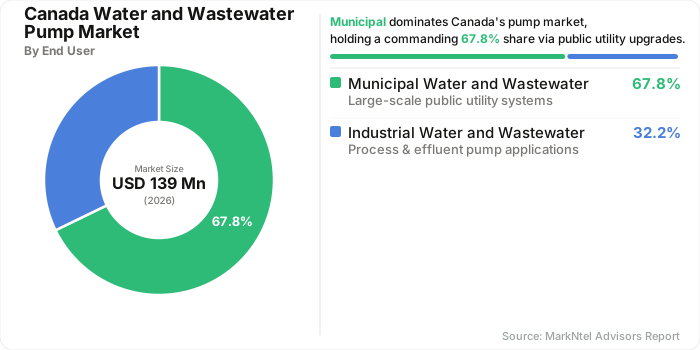
Based on end user, municipal water & wastewater leads the Canada water and wastewater pump market in 2025, accounting for 67.8% market share, as public utilities remain the largest buyers of pumps for drinking water distribution, sewage transport, wastewater treatment plants, and stormwater management systems. This dominance is supported by continuous spending on aging pipeline replacement, treatment facility modernization, and compliance-driven upgrades to maintain service reliability.
Looking ahead, the industrial water & wastewater segment is projected to dominate market growth, registering the fastest expansion at around 2.75% CAGR during 2026–2032. Growth is driven by rising industrial water demand, stricter discharge regulations, and increasing adoption of water recycling and effluent treatment systems across manufacturing and processing facilities.
Gain a Competitive Edge with Our Canada Water and Wastewater Pump Market Report:
- Canada Water and Wastewater Pump Market Report by MarkNtel Advisors provides a detailed & thorough analysis of market size & share, growth rate, competitive landscape, and key players. This comprehensive analysis helps businesses gain a holistic understanding of the market dynamics & make informed decisions.
- This report also highlights current market trends & future projections, allowing businesses to identify emerging opportunities & potential challenges. By understanding market forecasts, companies can align their strategies & stay ahead of the competition.
- Canada Water and Wastewater Pump Market Report aids in assessing & mitigating risks associated with entering or operating in the market. By understanding market dynamics, regulatory frameworks, and potential challenges, businesses can develop strategies to minimize risks & optimize their operations.
*Reports Delivery Format - Market research studies from MarkNtel Advisors are offered in PDF, Excel and PowerPoint formats. Within 24 hours of the payment being successfully received, the report will be sent to your email address.
Frequently Asked Questions
- Market Segmentation
- Introduction
- Market Definition
- Research Process
- Assumptions
- Executive Summary
- Canada Water and Wastewater Pump Market Trends & Insights
- Canada Water and Wastewater Pump Market Regulations & Policies
- Canada Water and Wastewater Pump Market Dynamics
- Growth Drivers
- Challenges
- Canada Water and Wastewater Pump Market PORTER’s Five Forces Analysis
- Canada Water and Wastewater Pump Market Hotspots & Opportunities
- Canada Water and Wastewater Pump Market Outlook, 2022-2032
- Market Size & Analysis
- By Revenues (USD Million)
- Market Segmentation & Analysis
- By Types of Pumps
- Centrifugal Pump- Market Size & Forecast 2022-2032, USD Million
- Overhung Pump- Market Size & Forecast 2022-2032, USD Million
- Vertical Inline- Market Size & Forecast 2022-2032, USD Million
- Horizontal End Suction- Market Size & Forecast 2022-2032, USD Million
- Split Case Pump- Market Size & Forecast 2022-2032, USD Million
- Single/Two Stage- Market Size & Forecast 2022-2032, USD Million
- Multistage- Market Size & Forecast 2022-2032, USD Million
- Vertical Pump- Market Size & Forecast 2022-2032, USD Million
- Turbine- Market Size & Forecast 2022-2032, USD Million
- Solid handling- Market Size & Forecast 2022-2032, USD Million
- Nonsolid handling- Market Size & Forecast 2022-2032, USD Million
- Axial- Market Size & Forecast 2022-2032, USD Million
- Mixed Flow- Market Size & Forecast 2022-2032, USD Million
- Turbine- Market Size & Forecast 2022-2032, USD Million
- Submersible Pump- Market Size & Forecast 2022-2032, USD Million
- Solid Handling- Market Size & Forecast 2022-2032, USD Million
- Non-solid Handling- Market Size & Forecast 2022-2032, USD Million
- Overhung Pump- Market Size & Forecast 2022-2032, USD Million
- Positive Displacement Pump- Market Size & Forecast 2022-2032, USD Million
- Diaphragm Pump- Market Size & Forecast 2022-2032, USD Million
- Piston Pump- Market Size & Forecast 2022-2032, USD Million
- Gear Pump- Market Size & Forecast 2022-2032, USD Million
- Lobe Pump- Market Size & Forecast 2022-2032, USD Million
- Progressive Cavity Pump- Market Size & Forecast 2022-2032, USD Million
- Screw Pump- Market Size & Forecast 2022-2032, USD Million
- Vane Pump- Market Size & Forecast 2022-2032, USD Million
- Peristaltic Pump- Market Size & Forecast 2022-2032, USD Million
- Centrifugal Pump- Market Size & Forecast 2022-2032, USD Million
- By End User
- Industrial Water & Wastewater- Market Size & Forecast 2022-2032, USD Million
- Centrifugal Pump- Market Size & Forecast 2022-2032, USD Million
- Overhung Pump- Market Size & Forecast 2022-2032, USD Million
- Vertical Inline- Market Size & Forecast 2022-2032, USD Million
- Horizontal End Suction- Market Size & Forecast 2022-2032, USD Million
- Split Case Pump- Market Size & Forecast 2022-2032, USD Million
- Single/Two Stage- Market Size & Forecast 2022-2032, USD Million
- Multistage- Market Size & Forecast 2022-2032, USD Million
- Vertical Pump- Market Size & Forecast 2022-2032, USD Million
- Turbine- Market Size & Forecast 2022-2032, USD Million
- Solid handling- Market Size & Forecast 2022-2032, USD Million
- Nonsolid handling- Market Size & Forecast 2022-2032, USD Million
- Axial- Market Size & Forecast 2022-2032, USD Million
- Mixed Flow- Market Size & Forecast 2022-2032, USD Million
- Turbine- Market Size & Forecast 2022-2032, USD Million
- Submersible Pump- Market Size & Forecast 2022-2032, USD Million
- Solid Handling- Market Size & Forecast 2022-2032, USD Million
- Non-solid Handling- Market Size & Forecast 2022-2032, USD Million
- Overhung Pump- Market Size & Forecast 2022-2032, USD Million
- Positive Displacement Pump- Market Size & Forecast 2022-2032, USD Million
- Diaphragm Pump- Market Size & Forecast 2022-2032, USD Million
- Piston Pump- Market Size & Forecast 2022-2032, USD Million
- Gear Pump- Market Size & Forecast 2022-2032, USD Million
- Lobe Pump- Market Size & Forecast 2022-2032, USD Million
- Progressive Cavity Pump- Market Size & Forecast 2022-2032, USD Million
- Screw Pump- Market Size & Forecast 2022-2032, USD Million
- Vane Pump- Market Size & Forecast 2022-2032, USD Million
- Peristaltic Pump- Market Size & Forecast 2022-2032, USD Million
- Centrifugal Pump- Market Size & Forecast 2022-2032, USD Million
- Municipal Water & Wastewater- Market Size & Forecast 2022-2032, USD Million
- Centrifugal Pump- Market Size & Forecast 2022-2032, USD Million
- Overhung Pump- Market Size & Forecast 2022-2032, USD Million
- Vertical Inline- Market Size & Forecast 2022-2032, USD Million
- Horizontal End Suction- Market Size & Forecast 2022-2032, USD Million
- Split Case Pump- Market Size & Forecast 2022-2032, USD Million
- Single/Two Stage- Market Size & Forecast 2022-2032, USD Million
- Multistage- Market Size & Forecast 2022-2032, USD Million
- Vertical Pump- Market Size & Forecast 2022-2032, USD Million
- Turbine- Market Size & Forecast 2022-2032, USD Million
- Solid handling- Market Size & Forecast 2022-2032, USD Million
- Nonsolid handling- Market Size & Forecast 2022-2032, USD Million
- Axial- Market Size & Forecast 2022-2032, USD Million
- Mixed Flow- Market Size & Forecast 2022-2032, USD Million
- Turbine- Market Size & Forecast 2022-2032, USD Million
- Submersible Pump- Market Size & Forecast 2022-2032, USD Million
- Solid Handling- Market Size & Forecast 2022-2032, USD Million
- Non-solid Handling- Market Size & Forecast 2022-2032, USD Million
- Overhung Pump- Market Size & Forecast 2022-2032, USD Million
- Positive Displacement Pump- Market Size & Forecast 2022-2032, USD Million
- Diaphragm Pump- Market Size & Forecast 2022-2032, USD Million
- Piston Pump- Market Size & Forecast 2022-2032, USD Million
- Gear Pump- Market Size & Forecast 2022-2032, USD Million
- Lobe Pump- Market Size & Forecast 2022-2032, USD Million
- Progressive Cavity Pump- Market Size & Forecast 2022-2032, USD Million
- Screw Pump- Market Size & Forecast 2022-2032, USD Million
- Vane Pump- Market Size & Forecast 2022-2032, USD Million
- Peristaltic Pump- Market Size & Forecast 2022-2032, USD Million
- Centrifugal Pump- Market Size & Forecast 2022-2032, USD Million
- Industrial Water & Wastewater- Market Size & Forecast 2022-2032, USD Million
- By Types of Pumps
- By Application
- Water- Market Size & Forecast 2022-2032, USD Million
- Wastewater- Market Size & Forecast 2022-2032, USD Million
- By Company
- Competition Characteristics
- Market Share of Leading Companies
- Market Size & Analysis
- Centrifugal Water and Wastewater Pump Market Outlook, 2022–2032
- Market Size & Outlook
- By Revenue (USD Million)
- Market Segmentation and Analysis
- By Types of Pumps- Market Size & Forecast 2022–2032, USD Million
- By End Users- Market Size & Forecast 2022-2032, USD Million
- Market Size & Outlook
- Positive Displacement Water and Wastewater Pump Market Outlook, 2022–2032
- Market Size & Outlook
- By Revenue (USD Million)
- By Segmentation and Analysis
- By Types of Pumps- Market Size & Forecast 2022–2032, USD Million
- By End Users- Market Size & Forecast 2022-2032, USD Million
- Market Size & Outlook
- Canada Water and Wastewater Pump Market Key Strategic Imperatives for Growth & Success
- Competition Outlook
- Company Profiles
- Flowserve
- Business Description
- Product Segments
- Strategic Alliances or Partnerships
- Recent Developments
- Financial Details
- Others
- Xylem Inc.
- Business Description
- Product Segments
- Strategic Alliances or Partnerships
- Recent Developments
- Financial Details
- Others
- Grundfos Holding A/S
- Business Description
- Product Segments
- Strategic Alliances or Partnerships
- Recent Developments
- Financial Details
- Others
- Gorman-Rupp Company
- Business Description
- Product Segments
- Strategic Alliances or Partnerships
- Recent Developments
- Financial Details
- Others
- Pentair PLC
- Business Description
- Product Segments
- Strategic Alliances or Partnerships
- Recent Developments
- Financial Details
- Others
- KSB SE & Co. KGaA
- Business Description
- Product Segments
- Strategic Alliances or Partnerships
- Recent Developments
- Financial Details
- Others
- ITT
- Business Description
- Product Segments
- Strategic Alliances or Partnerships
- Recent Developments
- Financial Details
- Others
- Sulzer Ltd.
- Business Description
- Product Segments
- Strategic Alliances or Partnerships
- Recent Developments
- Financial Details
- Others
- Ebara Corporation
- Business Description
- Product Segments
- Strategic Alliances or Partnerships
- Recent Developments
- Financial Details
- Others
- Ingersoll Rand Inc.
- Business Description
- Product Segments
- Strategic Alliances or Partnerships
- Recent Developments
- Financial Details
- Others
- Other
- Business Description
- Product Segments
- Strategic Alliances or Partnerships
- Recent Developments
- Financial Details
- Others
- Flowserve
- Company Profiles
- Disclaimer
MarkNtel Advisors follows a robust and iterative research methodology designed to ensure maximum accuracy and minimize deviation in market estimates and forecasts. Our approach combines both bottom-up and top-down techniques to effectively segment and quantify various aspects of the market. A consistent feature across all our research reports is data triangulation, which examines the market from three distinct perspectives to validate findings. Key components of our research process include:
1. Scope & Research Design At the outset, MarkNtel Advisors define the research objectives and formulate pertinent questions. This phase involves determining the type of research—qualitative or quantitative—and designing a methodology that outlines data collection methods, target demographics, and analytical tools. They also establish timelines and budgets to ensure the research aligns with client goals.
2. Sample Selection and Data Collection In this stage, the firm identifies the target audience and determines the appropriate sample size to ensure representativeness. They employ various sampling methods, such as random or stratified sampling, based on the research objectives. Data collection is carried out using tools like surveys, interviews, and observations, ensuring the gathered data is reliable and relevant.
3. Data Analysis and Validation Once data is collected, MarkNtel Advisors undertake a rigorous analysis process. This includes cleaning the data to remove inconsistencies, employing statistical software for quantitative analysis, and thematic analysis for qualitative data. Validation steps are taken to ensure the accuracy and reliability of the findings, minimizing biases and errors.

4. Data Forecast and FinalizationThe final phase involves forecasting future market trends based on the analyzed data. MarkNtel Advisors utilize predictive modeling and time series analysis to anticipate market behaviors. The insights are then compiled into comprehensive reports, featuring visual aids like charts and graphs, and include strategic recommendations to inform client decision-making
We offer flexible licensing options to cater to varying organizational needs. Choose the pricing pack that best suits your requirements:
Buy Now Inquire Before Buying
 Request Customization
 Talk to our Consultant







