

Brazil Water and Waste Water Pump Market Research Report: Forecast (2026-2032)
Brazil Water and Wastewater Pump Market - By Pump Type: Centrifugal Pump (Overhung Pump (Vertical Inline, Horizontal End Suction), Split Case Pump (Single/Two Stage, Multistage), V ... ertical Pump (Turbine (Solid handling, Nonsolid handling), Axial, Mixed Flow), Submersible Pump (Solid Handling, Non-solid Handling)), Positive Displacement Pump (Diaphragm Pump, Piston Pump, Gear Pump, Lobe Pump, Progressive Cavity Pump, Screw Pump, Vane Pump, Peristaltic Pump), End User: Municipal water and wastewater, and Industrial water and wastewater Application: Water and Wastewater), and others Read more
- Environment
- Apr 2026
- Pages 135
- Report Format: PDF, Excel, PPT
Brazil Water and Waste Water Pump Market
Projected 2.0% CAGR from 2026 to 2032
Study Period
2026-2032
Market Size (2026)
USD 209 Million
Market Size (2032)
USD 235 Million
Base Year
2025
Projected CAGR
2.0%
Leading Segments
By End User: Municipal Water and Wastewater
Brazil Water and Waste Water Pump Market Report Key Takeaways:
- Brazil Water and Wastewater Pump Market size was valued at around USD 194 million in 2025 and is projected to grow from USD 209 million in 2026 to USD 235 million by 2032, exhibiting a CAGR of 2.0% during 2026-2032.
- Centrifugal pumps lead the Brazil Water and Wastewater Pump Market in 2025 primarily because they efficiently handle the high-volume, moderate-head duties typical of municipal water supply, sewage lift stations, and treatment plants.
- In 2025, the municipal water & wastewater segment captured 62.3% of the Brazil water and wastewater pump market. Meanwhile, the industrial water and wastewater segment is poised to be the fastest-growing end-user category, with a projected 3.4% CAGR during 2026-32.
- Leading companies in the Brazil water and wastewater industry are Flowserve Corporation, Ebara Corporation, WILO SE, Sulzer Limited, Grundfos Holding A/S, Xylem Inc., KSB SE & Co. KGaA, Kirloskar Brothers Limited, Franklin Electric, Pentair PLC, and others.
Market Insights & Analysis: Brazil Water and Wastewater Pump Market (2026-32):
The Brazil Water and Wastewater Pump Market size was valued at around USD 194 million in 2025 and is projected to grow from USD 209 million in 2026 to USD 235 million by 2032, exhibiting a CAGR of 2.0% during 2026-2032.
Brazil’s water & wastewater pump industry is expanding steadily because Brazil’s rising water-use load and persistent infrastructure gaps are directly increasing pump demand across the entire water cycle, from abstraction to distribution and finally wastewater collection and treatment. In urban areas, utility-served water use is estimated at 155 liters per capita per day, while IBGE indicates household per-capita use of over 108.4 liters/day, confirming high and consistent daily demand. This intensifies the need for high-capacity centrifugal pumps and booster pumping stations to maintain flow rates and pressure stability across dense municipal networks, especially in high-rise and peripheral service areas.
Additionally, Brazil’s total water requirement is not limited to households; industrial and commercial activity increases freshwater withdrawal needs, which raises demand for process water pumps, transfer pumps, and high-duty pumping systems in industrial corridors. Simultaneously, higher water movement volumes ultimately translate into higher wastewater loads, expanding requirements for submersible sewage pumps, lift station pumps, and sludge-handling pumps.
Furthermore, efficiency losses strongly accelerate replacement demand: Brazil reportedly wastes 6.5 billion m³ annually in urban distribution, pushing utilities to invest in pressure management systems, efficient pump retrofits, and VFD-enabled pumping upgrades. Consequently, rising consumption, increasing withdrawals, and loss-reduction initiatives together form a strong structural engine for Brazil’s water and wastewater pump market growth.
Brazil Water and Wastewater Pump Industry Recent Development:
- 2025: WEG partnered with Kronox to advance Brazil’s sanitation pumping infrastructure through innovative sewage pumping stations integrated with digital monitoring and cloud-based diagnostics. The initiative supports predictive maintenance and improves operational uptime of pumping stations, strengthening smart sanitation systems across Brazil.
- 2025: Aegea secured USD 250 million financing to accelerate sewage infrastructure expansion in Manaus. The investment supports large-scale sewerage works, including the development of sewage pumping networks and pumping stations, directly increasing demand for wastewater pumps and pumping system installations in Brazil.
- 2024: Veolia delivered and commissioned industrial water supply and wastewater/effluent treatment facilities for Suzano’s new pulp production site in Brazil. This project reflects rising industrial investments in high-capacity water processing systems, strengthening demand for heavy-duty pumps and integrated pumping solutions in industrial wastewater applications.
Brazil Water and Wastewater Pump Market Scope:
| Category | Segments |
|---|---|
| By Pump Type | Centrifugal Pump (Overhung Pump (Vertical Inline, Horizontal End Suction), Split Case Pump (Single/Two Stage, Multistage), Vertical Pump (Turbine (Solid handling, Nonsolid handling), Axial, Mixed Flow), Submersible Pump (Solid Handling, Non-solid Handling)), Positive Displacement Pump (Diaphragm Pump, Piston Pump, Gear Pump, Lobe Pump, Progressive Cavity Pump, Screw Pump, Vane Pump, Peristaltic Pump), |
| By End User | Municipal water and wastewater, and Industrial water and wastewater Application: Water and Wastewater |
Brazil Water and Wastewater Pump Market Driver:
Government-Led Urban Sanitation & Water Infrastructure Expansion
The single most powerful driver of Brazil’s water and wastewater pump market is the government-led expansion and modernization of urban sanitation infrastructure, particularly in underserved and fast-growing municipalities. In recent years, this momentum has been reinforced by national-level initiatives such as the Sanitation Pact (Pacto pela Sanitização), along with the 2020 Sanitation Law (Lei 14.026/2020), which created a clearer regulatory mandate for universalization. Notably, the framework establishes ambitious 2033 targets, including 99% potable water coverage and 90% sewage collection and treatment, which have converted long-standing infrastructure gaps into time-bound execution priorities.
Consequently, utilities and municipalities are accelerating investments in water treatment plants, sewage pumping stations, interceptor pipelines, and wastewater treatment facilities, where pumps form the operational backbone. Additionally, major operators such as SABESP, SANEPAR, and COPASA are scaling CAPEX programs to expand service coverage and upgrade aging networks. Since each expansion project requires significant volumes of centrifugal, submersible, and sewage-handling pumps, this policy-driven infrastructure cycle directly translates into sustained multi-year demand growth for the market.
Brazil Water and Wastewater Pump Market Opportunity:
Expansion of Wastewater Treatment and Reuse in Drought‑Prone Regions
A major upcoming opportunity for Brazil’s water and wastewater pump market lies in the rapid expansion of wastewater treatment, reuse, and alternative water supply projects, particularly in drought-prone and water-stressed regions such as the Northeast and parts of the Southeast. This opportunity is becoming structurally important because Brazil’s climate variability is no longer a short-term disruption; instead, recurrent drought cycles, combined with increasing population density and industrial consumption, are turning water availability into a long-term planning constraint. Therefore, utilities and industries are progressively shifting their investment priorities from “only expanding supply networks” toward maximizing water reuse and improving treatment efficiency.
As a result, new and upcoming projects, such as SABESP’s reuse-linked initiatives, COPASA’s reuse programs in Minas Gerais, and broader Integrated Water Resources Management (IWRM) strategies, are accelerating demand for advanced treatment infrastructure. These systems require high-reliability pumping across multiple stages, including inlet transfer, aeration circulation, sludge handling, chemical dosing, and tertiary-treatment discharge. Moreover, once reuse capacity increases, additional pumping networks are required to transport treated effluent for non-potable applications such as industrial cooling, irrigation, construction, and public services, further increasing pump intensity per project.
Additionally, coastal desalination projects are emerging as a parallel growth lever, creating demand for high-pressure, corrosion-resistant pump systems. Hence, this opportunity represents a long-term market shift: from conventional conveyance pumps toward higher-value, application-specific pumps, supporting stronger margins and multi-year growth over the next 5–10 years.
Brazil Water and Wastewater Pump Market Challenge:
Limited Budgets and Funding Constraints for Municipal Projects
A major challenge restricting the growth of Brazil’s water and wastewater pump market is the persistent budget and financing constraints faced by municipal and regional sanitation operators, particularly in smaller cities and economically weaker states. Although Brazil’s sanitation universalization agenda has created ambitious investment targets, many utilities still operate under tight fiscal capacity, where revenues are constrained by delayed tariff adjustments, high operating costs, and in some cases elevated debt burdens. Consequently, utilities struggle to mobilize sufficient capital for pumping-intensive projects such as new sewage networks, pumping stations, water transmission lines, and wastewater treatment upgrades.
As a result, this funding gap frequently translates into project delays, phased execution, or reduced scope, which directly limits the volume and pace of pump procurement. Moreover, when investments are finally approved, procurement decisions often shift toward lowest-capex equipment selection, encouraging short-term buying behavior and reducing the penetration of premium solutions such as energy-efficient pumps, VFD-enabled systems, and smart monitoring technologies. This is further compounded in tier-2 and tier-3 municipalities where technical capacity and long-term planning capability are limited, leading to fragmented procurement and non-standardized specifications.
Therefore, until long-term financing availability improves, through stronger access to capital from institutions such as BNDES, deeper private-sector participation, and international funding support—along with tariff structures becoming more sustainable, municipal funding limitations will continue to cap pump market expansion, especially beyond Brazil’s major metropolitan regions.
Brazil Water and Wastewater Pump Market Trend:
Rise of Smart & Energy‑Efficient Pumping Systems
A dominant and fast-accelerating trend in Brazil’s water and wastewater pump market is the shift toward smart, variable-speed, and digitally monitored pumping systems, particularly across municipal utilities and large industrial water users. This transition has strengthened from “efficiency preference” into a digital infrastructure modernization priority, driven by electricity cost sensitivity, leakage-loss reduction goals, and the need for higher operational reliability. Consequently, utilities are increasingly replacing conventional fixed-speed pumping assets with VFD-enabled, automation-ready pump packages, where flow and pressure are dynamically controlled based on real-time conditions rather than manual operation.
Most importantly, Brazil’s sanitation ecosystem is now witnessing new smart-water technology deployments at scale, such as SABESP’s IoT-based smart metering initiative announced in 2025, which strengthens the demand-side push for connected pumping and pressure management systems across distribution and wastewater networks. In parallel, Brazil’s suppliers are also launching localized digital pumping solutions, which significantly boosting the market growth. For instance,
- WEG’s partnership with Kronox, announced in December 2025, introduced “Elevatória 4.0”, an intelligent sewage pumping station integrating WEG Smart Machine with automation, connectivity, and remote monitoring capabilities.
Moreover, leading private operators are adopting IoT platforms for real-time visibility, illustrated by Iguá Saneamento’s deployment use case for leakage and performance monitoring, reinforcing the broader shift toward sensor-driven, remotely managed water operations.
Therefore, Brazil’s procurement behavior is rapidly changing: buyers increasingly evaluate pumps not only as mechanical equipment, but as digitally optimized pumping ecosystems, which is accelerating penetration of premium smart pumps and control solutions nationwide.
Brazil Water and Wastewater Pump Market (2026-32): Segmentation Analysis
The Brazil Water and Wastewater Pump Market study of MarkNtel Advisors evaluates & highlights the major trends and influencing factors in each segment. It includes predictions for the period 2026–2032 at the country level. Based on the analysis, the market has been further classified as:
Based on Types of Pumps:
- Centrifugal Pump
- Overhung Pump
- Vertical Inline
- Horizontal End Suction
- Split Case Pump
- Single/Two Stage
- Multistage
- Vertical Pump
- Turbine
- Solid Handling
- Non-Solid Handling
- Axial
- Mixed Flow
- Turbine
- Submersible Pump
- Solid Handling
- Non-solid Handling
- Overhung Pump
- Positive Displacement Pump
- Diaphragm Pump
- Piston Pump
- Gear Pump
- Lobe Pump
- Progressive Cavity Pump
- Screw Pump
- Vane Pump
- Peristaltic Pump
- Others
In Brazil’s water & wastewater pump market, centrifugal pumps represent the leading pump type in 2025, as they are highly compatible with the country’s dominant operating needs, high-volume and moderate-head pumping in municipal water distribution, wastewater transfer lines, sewage lift stations, and treatment plants. Moreover, their simple design, operational reliability, and comparatively lower installation and maintenance costs make them the preferred choice for large-scale public infrastructure and industrial water handling. Hence, centrifugal pumps hold the largest share of industry demand.
Looking ahead, while centrifugal pumps will remain essential, submersible pumps are projected to capture a stronger incremental share and potentially dominate the fastest-growing demand portion, supported by urban sewer network expansion, higher wastewater lift-station deployment, and floodwater handling requirements. Additionally, rising emphasis on efficient wastewater solids handling and decentralized pumping solutions further strengthens the long-term outlook for submersible pumps.
Based on End User:
- Municipal Water and Wastewater
- Industrial Water and Wastewater
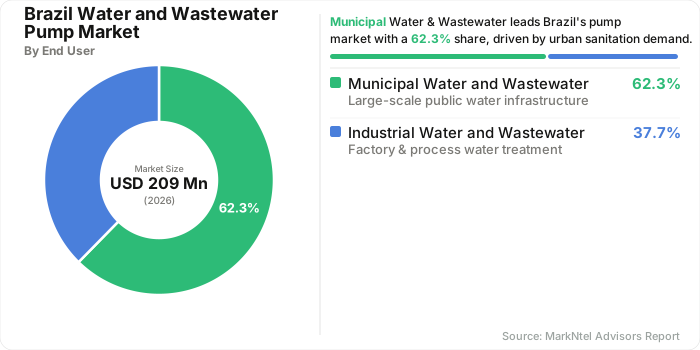
In Brazil’s water & wastewater pump market, the municipal water & wastewater segment remains the dominant end user in 2025, holding around 62.3% market share, primarily due to continuous requirements for drinking water supply, sewage collection, lift station operations, and wastewater treatment infrastructure. Moreover, rising urban population clusters and increasing investments in network rehabilitation, leakage reduction, and wastewater coverage expansion are sustaining high pump procurement volumes from municipalities.
However, in the forecast period, the industrial water & wastewater segment is expected to be the fastest-growing end-user category, advancing at 3.4% CAGR during 2026–2032. This growth is driven by stricter wastewater compliance requirements, rising adoption of process-water recycling, and higher demand from water-intensive industries such as food & beverages, chemicals, mining, pulp & paper, and power generation.
Gain a Competitive Edge with Our Brazil Water and Wastewater Pump Market Report:
- Brazil Water and Wastewater Pump Market Report by MarkNtel Advisors provides a detailed & thorough analysis of market size & share, growth rate, competitive landscape, and key players. This comprehensive analysis helps businesses gain a holistic understanding of the market dynamics & make informed decisions.
- This report also highlights current market trends & future projections, allowing businesses to identify emerging opportunities & potential challenges. By understanding market forecasts, companies can align their strategies & stay ahead of the competition.
- Brazil Water and Wastewater Pump Market Report aids in assessing & mitigating risks associated with entering or operating in the market. By understanding market dynamics, regulatory frameworks, and potential challenges, businesses can develop strategies to minimize risks & optimize their operations.
*Reports Delivery Format - Market research studies from MarkNtel Advisors are offered in PDF, Excel and PowerPoint formats. Within 24 hours of the payment being successfully received, the report will be sent to your email address.
Frequently Asked Questions
- Market Segmentation
- Introduction
- Market Definition
- Research Process
- Assumptions
- Executive Summary
- Brazil Water and Waste Water Pump Market Trends & Insights
- Brazil Water and Waste Water Pump Market Regulations & Policies
- Brazil Water and Waste Water Pump Market Dynamics
- Growth Drivers
- Challenges
- Brazil Water and Waste Water Pump Market PORTER’s Five Forces Analysis
- Brazil Water and Waste Water Pump Market Hotspots & Opportunities
- Brazil Water and Waste Water Pump Market Outlook, 2022-2032
- Market Size & Analysis
- By Revenues (USD Million)
- Market Segmentation & Analysis
- By Types of Pump
- Centrifugal Pump- Market Size & Forecast 2022-2032, USD Million
- Overhung Pump- Market Size & Forecast 2022-2032, USD Million
- Vertical Inline- Market Size & Forecast 2022-2032, USD Million
- Horizontal End Suction- Market Size & Forecast 2022-2032, USD Million
- Split Case Pump- Market Size & Forecast 2022-2032, USD Million
- Single/Two Stage- Market Size & Forecast 2022-2032, USD Million
- Multistage- Market Size & Forecast 2022-2032, USD Million
- Vertical Pump- Market Size & Forecast 2022-2032, USD Million
- Turbine- Market Size & Forecast 2022-2032, USD Million
- Solid handling- Market Size & Forecast 2022-2032, USD Million
- Nonsolid handling- Market Size & Forecast 2022-2032, USD Million
- Axial- Market Size & Forecast 2022-2032, USD Million
- Mixed Flow- Market Size & Forecast 2022-2032, USD Million
- Turbine- Market Size & Forecast 2022-2032, USD Million
- Submersible Pump- Market Size & Forecast 2022-2032, USD Million
- Solid Handling- Market Size & Forecast 2022-2032, USD Million
- Non-solid Handling- Market Size & Forecast 2022-2032, USD Million
- Overhung Pump- Market Size & Forecast 2022-2032, USD Million
- Positive Displacement Pump- Market Size & Forecast 2022-2032, USD Million
- Diaphragm Pump- Market Size & Forecast 2022-2032, USD Million
- Piston Pump- Market Size & Forecast 2022-2032, USD Million
- Gear Pump- Market Size & Forecast 2022-2032, USD Million
- Lobe Pump- Market Size & Forecast 2022-2032, USD Million
- Progressive Cavity Pump- Market Size & Forecast 2022-2032, USD Million
- Screw Pump- Market Size & Forecast 2022-2032, USD Million
- Vane Pump- Market Size & Forecast 2022-2032, USD Million
- Peristaltic Pump- Market Size & Forecast 2022-2032, USD Million
- Centrifugal Pump- Market Size & Forecast 2022-2032, USD Million
- By End User
- Industrial Water & Wastewater- Market Size & Forecast 2022-2032, USD Million
- Centrifugal Pump- Market Size & Forecast 2022-2032, USD Million
- Overhung Pump- Market Size & Forecast 2022-2032, USD Million
- Vertical Inline- Market Size & Forecast 2022-2032, USD Million
- Horizontal End Suction- Market Size & Forecast 2022-2032, USD Million
- Split Case Pump- Market Size & Forecast 2022-2032, USD Million
- Single/Two Stage- Market Size & Forecast 2022-2032, USD Million
- Multistage- Market Size & Forecast 2022-2032, USD Million
- Vertical Pump- Market Size & Forecast 2022-2032, USD Million
- Turbine- Market Size & Forecast 2022-2032, USD Million
- Solid handling- Market Size & Forecast 2022-2032, USD Million
- Nonsolid handling- Market Size & Forecast 2022-2032, USD Million
- Axial- Market Size & Forecast 2022-2032, USD Million
- Mixed Flow- Market Size & Forecast 2022-2032, USD Million
- Turbine- Market Size & Forecast 2022-2032, USD Million
- Submersible Pump- Market Size & Forecast 2022-2032, USD Million
- Solid Handling- Market Size & Forecast 2022-2032, USD Million
- Non-solid Handling- Market Size & Forecast 2022-2032, USD Million
- Overhung Pump- Market Size & Forecast 2022-2032, USD Million
- Positive Displacement Pump- Market Size & Forecast 2022-2032, USD Million
- Diaphragm Pump- Market Size & Forecast 2022-2032, USD Million
- Piston Pump- Market Size & Forecast 2022-2032, USD Million
- Gear Pump- Market Size & Forecast 2022-2032, USD Million
- Lobe Pump- Market Size & Forecast 2022-2032, USD Million
- Progressive Cavity Pump- Market Size & Forecast 2022-2032, USD Million
- Screw Pump- Market Size & Forecast 2022-2032, USD Million
- Vane Pump- Market Size & Forecast 2022-2032, USD Million
- Peristaltic Pump- Market Size & Forecast 2022-2032, USD Million
- Centrifugal Pump- Market Size & Forecast 2022-2032, USD Million
- Municipal Water & Wastewater- Market Size & Forecast 2022-2032, USD Million
- Centrifugal Pump- Market Size & Forecast 2022-2032, USD Million
- Overhung Pump- Market Size & Forecast 2022-2032, USD Million
- Vertical Inline- Market Size & Forecast 2022-2032, USD Million
- Horizontal End Suction- Market Size & Forecast 2022-2032, USD Million
- Split Case Pump- Market Size & Forecast 2022-2032, USD Million
- Single/Two Stage- Market Size & Forecast 2022-2032, USD Million
- Multistage- Market Size & Forecast 2022-2032, USD Million
- Vertical Pump- Market Size & Forecast 2022-2032, USD Million
- Turbine- Market Size & Forecast 2022-2032, USD Million
- Solid handling- Market Size & Forecast 2022-2032, USD Million
- Nonsolid handling- Market Size & Forecast 2022-2032, USD Million
- Axial- Market Size & Forecast 2022-2032, USD Million
- Mixed Flow- Market Size & Forecast 2022-2032, USD Million
- Turbine- Market Size & Forecast 2022-2032, USD Million
- Submersible Pump- Market Size & Forecast 2022-2032, USD Million
- Solid Handling- Market Size & Forecast 2022-2032, USD Million
- Non-solid Handling- Market Size & Forecast 2022-2032, USD Million
- Overhung Pump- Market Size & Forecast 2022-2032, USD Million
- Positive Displacement Pump- Market Size & Forecast 2022-2032, USD Million
- Diaphragm Pump- Market Size & Forecast 2022-2032, USD Million
- Piston Pump- Market Size & Forecast 2022-2032, USD Million
- Gear Pump- Market Size & Forecast 2022-2032, USD Million
- Lobe Pump- Market Size & Forecast 2022-2032, USD Million
- Progressive Cavity Pump- Market Size & Forecast 2022-2032, USD Million
- Screw Pump- Market Size & Forecast 2022-2032, USD Million
- Vane Pump- Market Size & Forecast 2022-2032, USD Million
- Peristaltic Pump- Market Size & Forecast 2022-2032, USD Million
- Centrifugal Pump- Market Size & Forecast 2022-2032, USD Million
- Industrial Water & Wastewater- Market Size & Forecast 2022-2032, USD Million
- By Types of Pump
- By Application
- Water- Market Size & Forecast 2022-2032, USD Million
- Waste Water- Market Size & Forecast 2022-2032, USD Million
- By Company
- Competition Characteristics
- Market Share of Leading Companies
- Market Size & Analysis
- Brazil Centrifugal Water and Waste Water Pump Market Outlook, 2022–2032
- Market Size & Outlook
- By Revenue (USD Million)
- Market Segmentation and Analysis
- By Types of Pump- Market Size & Forecast 2022–2032, USD Million
- By End Users- Market Size & Forecast 2022-2032, USD Million
- Market Size & Outlook
- Brazil Positive Displacement Water and Waste Water Pump Market Outlook, 2022–2032
- Market Size & Outlook
- By Revenue (USD Million)
- By Segmentation and Analysis
- By Types of Pump- Market Size & Forecast 2022–2032, USD Million
- By End Users- Market Size & Forecast 2022-2032, USD Million
- Market Size & Outlook
- Brazil Water and Waste Water Pump Market Key Strategic Imperatives for Growth & Success
- Competition Outlook
- Company Profiles
- Flowserve
- Business Description
- Product Segments
- Strategic Alliances or Partnerships
- Recent Developments
- Financial Details
- Others
- Xylem Inc.
- Business Description
- Product Segments
- Strategic Alliances or Partnerships
- Recent Developments
- Financial Details
- Others
- Grundfos Holding A/S
- Business Description
- Product Segments
- Strategic Alliances or Partnerships
- Recent Developments
- Financial Details
- Others
- WILO
- Business Description
- Product Segments
- Strategic Alliances or Partnerships
- Recent Developments
- Financial Details
- Others
- Pentair PLC
- Business Description
- Product Segments
- Strategic Alliances or Partnerships
- Recent Developments
- Financial Details
- Others
- KSB SE & Co. KGaA
- Business Description
- Product Segments
- Strategic Alliances or Partnerships
- Recent Developments
- Financial Details
- Others
- Franklin Electric
- Business Description
- Product Segments
- Strategic Alliances or Partnerships
- Recent Developments
- Financial Details
- Others
- Sulzer Ltd.
- Business Description
- Product Segments
- Strategic Alliances or Partnerships
- Recent Developments
- Financial Details
- Others
- Ebara Corporation
- Business Description
- Product Segments
- Strategic Alliances or Partnerships
- Recent Developments
- Financial Details
- Others
- Kirloskar Brothers Limited
- Business Description
- Product Segments
- Strategic Alliances or Partnerships
- Recent Developments
- Financial Details
- Others
- Other
- Business Description
- Product Segments
- Strategic Alliances or Partnerships
- Recent Developments
- Financial Details
- Others
- Flowserve
- Company Profiles
- Disclaimer
MarkNtel Advisors follows a robust and iterative research methodology designed to ensure maximum accuracy and minimize deviation in market estimates and forecasts. Our approach combines both bottom-up and top-down techniques to effectively segment and quantify various aspects of the market. A consistent feature across all our research reports is data triangulation, which examines the market from three distinct perspectives to validate findings. Key components of our research process include:
1. Scope & Research Design At the outset, MarkNtel Advisors define the research objectives and formulate pertinent questions. This phase involves determining the type of research—qualitative or quantitative—and designing a methodology that outlines data collection methods, target demographics, and analytical tools. They also establish timelines and budgets to ensure the research aligns with client goals.
2. Sample Selection and Data Collection In this stage, the firm identifies the target audience and determines the appropriate sample size to ensure representativeness. They employ various sampling methods, such as random or stratified sampling, based on the research objectives. Data collection is carried out using tools like surveys, interviews, and observations, ensuring the gathered data is reliable and relevant.
3. Data Analysis and Validation Once data is collected, MarkNtel Advisors undertake a rigorous analysis process. This includes cleaning the data to remove inconsistencies, employing statistical software for quantitative analysis, and thematic analysis for qualitative data. Validation steps are taken to ensure the accuracy and reliability of the findings, minimizing biases and errors.

4. Data Forecast and FinalizationThe final phase involves forecasting future market trends based on the analyzed data. MarkNtel Advisors utilize predictive modeling and time series analysis to anticipate market behaviors. The insights are then compiled into comprehensive reports, featuring visual aids like charts and graphs, and include strategic recommendations to inform client decision-making
We offer flexible licensing options to cater to varying organizational needs. Choose the pricing pack that best suits your requirements:
Buy Now Inquire Before Buying
 Request Customization
 Talk to our Consultant







