

US Space Robotics Market Research Report: Forecast (2026-2032)
US Space Robotics Market - By Product Type (Remotely Operated Vehicles (ROVs), {Rovers, Robotic Spacecraft & Servicing Vehicles, Spacecraft Landers, Others}, Remote Manipulator Sys ... tems (RMS), {Robotic arms and manipulators, Gripping & docking systems, Others} Software, {Autonomous navigation, Mission planning & control, AI and machine learning systems}, Services, {Mission operations, Maintenance & servicing support, Testing & integration services}), By Mission Type (Deep Space, {Space Transportation, Space Exploration, Others}, Near Space, {In-space 3D Printing, Space Transportation, Space Exploration, Space Operations/Scientific Experimentation, In-space Maintenance & Inspection, Others}), By Application (Satellite Servicing and Life Extension, Active Debris Removal, On-Orbit Assembly and Manufacturing, Exploration and Scientific Research, Cargo and Logistics), By End User (Government, {Space Agencies, Defense and Intelligence}, Commercial, {Commercial Satellite Operators, Research Institutes, NewSpace Start-ups}), and others Read more
- Aerospace & Defense
- Feb 2026
- Pages 135
- Report Format: PDF, Excel, PPT
US Space Robotics Market
Projected 8.69% CAGR from 2026 to 2032
Study Period
2026-2032
Market Size (2025)
USD 2.4 Billion
Market Size (2032)
USD 4.3 Billion
Base Year
2025
Projected CAGR
8.69%
Leading Segments
By Mission Type: Near-Space
US Space Robotics Market Report Key Takeaways:
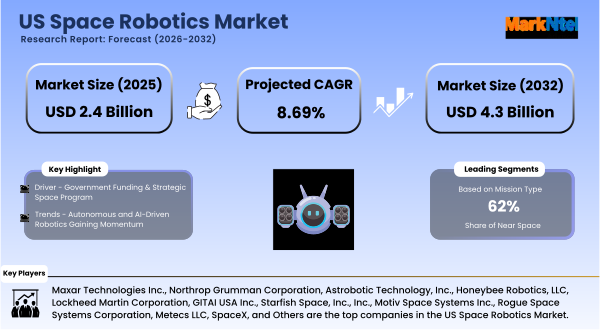
- Market size was valued at around USD 2.4 billion in 2025 and is projected to reach USD 4.3 billion by 2032. The estimated CAGR from 2026 to 2032 is around 8.69%, indicating strong growth.
- By product type, the remote manipulator systems (RMS) segment represented a significant share of about 42% in the US Space Robotics Market in 2025.
- By mission type, the near-space segment presented a significant share of about 65% in the US Space Robotics Market in 2025.
- Leading space robotics companies in the US Market are Maxar Technologies Inc., Northrop Grumman Corporation, Astrobotic Technology, Inc., Honeybee Robotics, LLC, Lockheed Martin Corporation, GITAI USA Inc., Starfish Space, Inc., Orbit Fab, Inc., Oceaneering International, Inc., Motiv Space Systems Inc., Redwire Corporation, Intuitive Machines, Inc., Altius Space Machines Inc., Rogue Space Systems Corporation, Metecs LLC, SpaceX, and Others.
Market Insights & Analysis: US Space Robotics Market (2026-32):
The US Space Robotics Market size was valued at around USD 2.4 billion in 2025 and is projected to reach USD 4.3 billion by 2032. Along with this, the market is estimated to grow at a CAGR of around 8.69% during the forecast period, i.e., 2026-32.
The US Space Robotics Market is projected to expand steadily, driven by strategic government investments in space programs and the accelerating adoption of autonomous, AI‑enabled robotic systems.
The US Space Robotics Market is anchored in mission-critical government programs and expanding institutional demand, bridging exploration and infrastructure functions. For instance, NASA’s On-Orbit Servicing, Assembly, and Manufacturing-1 (OSAM-1) mission, backed by a USD 227 million congressional appropriation in 2024, includes multiple dexterous robotic arms to assemble or repair orbital structures, underscoring federal prioritization of robotics for space infrastructure tasks .
Institutional end users such as NASA, the U.S. Space Force, and federal research laboratories are primary demand drivers. NASA’s integration of autonomous robotic systems into the International Space Station (ISS) through Astrobee free-flying robots that assist crew and researchers highlights sustained civil application . Concurrent military interest in autonomous servicing stems from advancing satellite life-extension and inspection capabilities, though specific strategy documents must be consulted directly for updated procurement details.
The current market is also shaped by regulatory and infrastructure developments that reduce integration friction for robotic systems. For example, NASA’s Fly Foundational Robots demo plans to place commercial robotic arms in low Earth orbit by 2027 to support future assembly and servicing applications, accelerating industry-wide adoption .
Looking beyond 2025, the interplay of federal roadmaps, such as NASA’s wider adoption of in-space robotics through its Space Technology Mission Directorate, points to expanding applications in deep-space logistics and long-duration habitation architectures. With civil, defense, and research users driving volume and programs institutionalizing robotics into baseline mission architectures, the market is positioned for continued systematic growth.
The upcoming Fly Foundational Robots (FFR) mission further demonstrates market momentum. Managed under NASA’s Space Technology Mission Directorate and scheduled for a late-2027 orbital demonstration, FFR will leverage a dexterous robotic arm supplied by Motiv Space Systems. This arm will perform autonomous tool handling, precision manipulation, and locomotion across spacecraft structures to validate capabilities required for future servicing, assembly, and manufacturing tasks in orbit. Performance data from FFR will critically inform how robotics can support the construction of space infrastructure and enable logistical autonomy for lunar and deep-space return missions.
Overall, anchored by federally funded missions and institutional adoption, the US Space Robotics Market is set for sustained growth, with upcoming orbital demonstrations and long-term NASA roadmaps embedding robotics into future infrastructure, logistics, and deep-space mission architectures beyond 2025.
US Space Robotics Market Recent Developments:
- 2025: Firefly Aerospace announced that Honeybee Robotics, a subsidiary of Blue Origin, has been selected to provide a lunar rover for its Blue Ghost Mission 3 under NASA’s Commercial Lunar Payload Services (CLPS) initiative. The rover will be deployed on the Gruithuisen Domes on the Moon’s near side in 2028 to carry NASA instruments and investigate the region’s geology. The mission aims to support surface operations for approximately 14 days, advancing robotic exploration capabilities.
- 2025: Researchers demonstrated reinforcement learning control for a free‑flying robotic system aboard the International Space Station, marking a breakthrough in autonomous robotic navigation and decision‑making in microgravity. This experiment, part of the APIARY project, validates adaptive artificial intelligence methods for future space robotics tasks, improving efficiency and resilience in complex orbital environments.
US Space Robotics Market Scope:
| Category | Segments |
|---|---|
| By Product Type | Remotely Operated Vehicles (ROVs), Remote Manipulator Systems (RMS), Software, Services |
| By Mission Type | Deep Space, Near Space |
| By Application | Satellite Servicing and Life Extension, Active Debris Removal, On-Orbit Assembly and Manufacturing, Exploration and Scientific Research, Cargo and Logistics), |
| By End User | Government, Commercial |
US Space Robotics Market Driver:
Government Funding & Strategic Space Program
Government funding aligned with long-term civil and defense space strategies remains the most influential driver of the US Space Robotics Market. Robotics is no longer treated as an auxiliary technology but as a core capability embedded into national mission architectures.
This shift is reflected in NASA’s FY 2025 budget request, which allocated approximately USD 1.2 billion to the Space Technology portfolio, supporting robotics, autonomy, and next-generation systems for on-orbit assembly, satellite servicing, and deep-space operations, thereby expanding demand through higher system deployment volumes per mission.
Defense-led programs further reinforce this driver by converting robotic concepts into operational requirements. The Defense Advanced Research Projects Agency (DARPA) has advanced robotic servicing through its Robotic Servicing of Geosynchronous Satellites (RSGS) program, which is designed to enable robotic inspection, relocation, and repair of high-value GEO satellites. With launch activities planned to enable servicing operations beginning in 2025, RSGS establishes robotic proximity operations as a national security capability, shifting robotics from experimental demonstrations to deployable defense assets.
Looking beyond 2025, continued federal emphasis on resilient space architectures, autonomous servicing, and life-extension of orbital assets indicates sustained investment momentum. As future exploration and defense missions increasingly mandate robotic functionality, government funding will continue to translate directly into expanded market size and long-term procurement certainty.
Sustained government funding and mission-mandated deployment of robotic systems anchor space robotics into national civil and defense strategies, ensuring durable demand expansion and accelerating market growth well beyond 2025.
US Space Robotics Market Trend:
Autonomous and AI-Driven Robotics Gaining Momentum
A dominant trend reshaping the US Space Robotics Market is the integration of autonomy and artificial intelligence (AI) to enable mission-level decision-making without continuous human oversight. As space missions extend into environments where communication latency and operational complexity limit real-time control, autonomous robotics is becoming essential rather than optional. This shift marks a structural transition from teleoperated systems to self-directed robotic platforms capable of perception, planning, and adaptive response.
Researchers achieved a significant milestone by using AI to autonomously pilot NASA’s Astrobee robot aboard the International Space Station, demonstrating up to 60% faster trajectory planning with machine-learning guidance, a critical advance for autonomous operations in cluttered, constrained space environments .
Commercial entities are actively advancing autonomous systems aligned with this trend. Starfish Space developed the Otter Pup 1, an autonomous rendezvous and docking satellite demonstration, using onboard navigation algorithms to stabilize itself and conduct proximity operations in orbit without real-time manual control.
Similarly, Astrobotic Technology focuses on autonomous lunar rovers and payload robotics under NASA’s CLPS program, equipping surface vehicles with onboard autonomy for terrain navigation and mission execution .
Government research institutions also contribute to foundational progress. The US Naval Research Laboratory’s APIARY experiment validated reinforcement-learning-based autonomous control of free-flying robots on the ISS, demonstrating the viability of modern AI methods in spaceflight conditions.
The convergence of AI and autonomy is redefining space robotics by enabling independent navigation, decision-making, and mission execution, creating a lasting shift toward self-reliant robotic systems that will shape market evolution beyond 2025.
US Space Robotics Market Opportunity
Deep-Space Resource Utilization and Infrastructure
A significant market opportunity for new entrants in the US Space Robotics Market lies in enabling deep-space resource utilization and infrastructure development, as government agencies prioritize long-duration and self-sustaining missions.
NASA’s In-Situ Resource Utilization (ISRU) initiative is a central pillar of this strategy, focusing on extracting and processing local resources such as lunar water ice, oxygen from regolith, and construction materials to reduce dependence on Earth-supplied payloads. ISRU is explicitly positioned as a requirement for sustainable lunar and Mars exploration rather than an experimental concept.
This strategic shift creates direct demand for specialized robotic systems capable of excavation, material transport, processing, and surface construction in harsh, unstructured environments. Robotics tailored for ISRU tasks must operate autonomously for extended periods, creating entry points for new players focused on niche capabilities rather than full mission integration.
As future missions emphasize sustained surface presence and infrastructure buildup, demand will increasingly favor modular, task-specific robotic systems. This environment is particularly advantageous for emerging companies that can supply focused ISRU robotics without competing directly with large aerospace primes on complete mission platforms.
The shift toward in-space resource utilization and infrastructure development creates a structurally attractive opportunity for new robotics entrants, as sustained lunar and deep-space missions generate long-term demand for autonomous excavation, transport, and construction systems.
US Space Robotics Market Challenge:
High Development and Deployment Costs
High development and integration costs remain a structural constraint for the space robotics market, particularly for complex on-orbit servicing and assembly missions. NASA’s flagship robotic servicing initiative, originally conceptualized as Restore-L and later formalized as OSAM-1 demonstrates this challenge.
Independent program reviews show that initial formulation estimates of approximately USD 626–753 million increased to well over USD 1 billion, primarily due to rising technical risks, system integration difficulties, and the complexity of developing flight-qualified robotic manipulators capable of autonomous operations in space . These cost escalations highlight how advanced robotics programs often face multi-year development cycles with significant budget exposure.
Further evidence comes from NASA satellite servicing project assessments, which indicate that robotic subsystems alone, including dexterous arms, end-effectors, sensors, and control software, can range from USD 240 million to more than USD 1.3 billion, depending on mission objectives and orbital environments. These figures exclude spacecraft platforms or crewed components, underscoring the substantial capital intensity of robotics-focused missions.
Overall, persistent cost escalation driven by technical complexity and integration risk continues to hinder scalability in space robotics, slowing commercialization and narrowing market access despite strong strategic demand.
US Space Robotics Market (2026-32) Segmentation Analysis:
The US Space Robotics Market study of MarkNtel Advisors evaluates & highlights the major trends and influencing factors in each segment. It includes predictions for the period 2026–32 at the country level. Based on the analysis, the market has been further classified as;
Based on Product Type:
- Remotely Operated Vehicles (ROVs)
- Rovers
- Robotic Spacecraft & Servicing Vehicles
- Spacecraft Landers
- Others
- Remote Manipulator Systems (RMS)
- Robotic arms and manipulators
- Gripping & docking systems
- Others
- Software
- Autonomous navigation
- Mission planning & control
- AI and machine learning systems
- Services
- Mission operations
- Maintenance & servicing support
- Testing & integration services
The remote manipulator systems (RMS) segment dominates the US Space Robotics Market, holding around 42% market share, due to their indispensable role in a wide range of space missions.
These systems, including robotic arms, end-effectors, and docking mechanisms, are core enablers for payload handling, satellite inspection, capture, repair, and on-orbit assembly, functions that cannot be reliably performed without precise manipulation capabilities.
A key factor supporting RMS dominance is its cross-mission adaptability. Unlike rovers or landers, which are designed for specific environments or objectives, RMS platforms are deployed across low Earth orbit, geostationary orbit, and planned deep-space applications. Their integration into servicing spacecraft and space stations results in repeated procurement and long operational lifetimes, strengthening cumulative market demand.
Furthermore, advances in force-torque sensing, autonomous manipulation, and AI-assisted control have expanded RMS capabilities, allowing them to operate with higher precision and reduced human intervention. These enhancements improve mission reliability while lowering operational risk, making RMS investments strategically attractive for both civil and defense space programs.
The market leadership of Remote Manipulator Systems is driven by their essential functionality, multi-mission applicability, and continuous technological evolution, establishing them as the foundational hardware segment within the global space robotics ecosystem.
Based on Mission Type:
- Deep Space
- Space Transportation
- Space Exploration
- Others
- Near Space
- In-space 3D Printing
- Space Transportation
- Space Exploration
- Space Operations/Scientific Experimentation
- In-space Maintenance & Inspection
- Others
The near-space segment dominates the US Space Robotics Market, accounting for about 62% of the total market size, driven by strong alignment with current operational priorities and sustained mission cadence.
Near-space missions primarily conducted in Low Earth Orbit (LEO) and adjacent orbital regimes support a broad range of recurring applications that require continuous robotic deployment rather than singular, long-duration exploration efforts.
A major factor underpinning this dominance is the rising demand for in-space maintenance and inspection, as satellite constellations expand and asset longevity becomes a strategic priority. Robotic systems are increasingly deployed for inspection, diagnostics, and servicing preparation, reducing reliance on premature satellite replacement.
Additionally, space operations and scientific experimentation in near-space environments depend heavily on robotics for payload manipulation, autonomous experiment handling, and station-based operational support.
The segment also benefits from advancements in in-space manufacturing, including 3D printing, where robotics enables component fabrication and assembly under microgravity conditions.
Compared to deep-space missions, near-space projects offer shorter development timelines, lower mission risk, and faster technology validation cycles, enabling higher mission frequency and more predictable investment returns.
Near space dominates the mission-type landscape by combining operational maturity, repeatable use cases, and scalable economics, making it the primary focal point for near-term investment and sustained growth in the space robotics market.
Gain a Competitive Edge with Our US Space Robotics Market Report:
- US Space Robotics Market Report by MarkNtel Advisors provides a detailed & thorough analysis of market size & share, growth rate, competitive landscape, and key players. This comprehensive analysis helps businesses gain a holistic understanding of the market dynamics & make informed decisions.
- This report also highlights current market trends & future projections, allowing businesses to identify emerging opportunities & potential challenges. By understanding market forecasts, companies can align their strategies & stay ahead of the competition.
- US Space Robotics Market Report aids in assessing & mitigating risks associated with entering or operating in the market. By understanding market dynamics, regulatory frameworks, and potential challenges, businesses can develop strategies to minimize risks & optimize their operations.
*Reports Delivery Format - Market research studies from MarkNtel Advisors are offered in PDF, Excel and PowerPoint formats. Within 24 hours of the payment being successfully received, the report will be sent to your email address.
Frequently Asked Questions
- Market Segmentation
- Introduction
- Product Definition
- Research Process
- Assumptions
- Executive Summary
- US Space Robotics Market Policies, Regulations, and Product Standards
- US Space Robotics Market Trends & Developments
- US Space Robotics Market Dynamics
- Growth Factors
- Challenges
- US Space Robotics Market Hotspot & Opportunities
- US Space Robotics Market Outlook, 2022-2032F
- Market Size & Outlook
- By Revenues (USD Million)
- Market Share & Outlook
- By Product Type- Market Size & Forecast 2022-2032, USD Million
- Remotely Operated Vehicles (ROVs)
- Rovers
- Robotic Spacecraft & Servicing Vehicles
- Spacecraft Landers
- Others
- Remote Manipulator Systems (RMS)
- Robotic arms and manipulators
- Gripping & docking systems
- Others
- Software
- Autonomous navigation
- Mission planning & control
- AI and machine learning systems
- Services
- Mission operations
- Maintenance & servicing support
- Testing & integration services
- Remotely Operated Vehicles (ROVs)
- By Mission Type - Market Size & Forecast 2022-2032, USD Million
- Deep Space
- Space Transportation
- Space Exploration
- Others
- Near Space
- In-space 3D Printing
- Space Transportation
- Space Exploration
- Space Operations/Scientific Experimentation
- In-space Maintenance & Inspection
- Others
- Deep Space
- By Application- Market Size & Forecast 2022-2032, USD Million
- Satellite Servicing and Life Extension
- Active Debris Removal
- On-Orbit Assembly and Manufacturing
- Exploration and Scientific Research
- Cargo and Logistics
- By End User - Market Size & Forecast 2022-2032, USD Million
- Government
- Space Agencies
- Defense and Intelligence
- Commercial
- Commercial Satellite Operators
- Research Institutes
- NewSpace Start-ups
- Government
- By Company
- Competition Characteristics
- Market Share & Analysis
- By Product Type- Market Size & Forecast 2022-2032, USD Million
- Market Size & Outlook
- US Remotely Operated Vehicles (ROVs) Market Outlook, 2022-2032
- Market Size & Outlook
- By Revenues (USD Million)
- Market Share & Outlook
- By Mission Type - Market Size & Forecast 2022-2032, USD Million
- By Application- Market Size & Forecast 2022-2032, USD Million
- By End User - Market Size & Forecast 2022-2032, USD Million
- Market Size & Outlook
- US Remote Manipulator Systems (RMS) Market Outlook, 2022-2032
- Market Size & Outlook
- By Revenues (USD Million)
- Market Share & Outlook
- By Mission Type - Market Size & Forecast 2022-2032, USD Million
- By Application- Market Size & Forecast 2022-2032, USD Million
- By End User - Market Size & Forecast 2022-2032, USD Million
- Market Size & Outlook
- US Software Market Outlook, 2022-2032
- Market Size & Outlook
- By Revenues (USD Million)
- Market Share & Outlook
- By Mission Type - Market Size & Forecast 2022-2032, USD Million
- By Application- Market Size & Forecast 2022-2032, USD Million
- By End User - Market Size & Forecast 2022-2032, USD Million
- Market Size & Outlook
- US Services Market Outlook, 2022-2032
- Market Size & Outlook
- By Revenues (USD Million)
- Market Share & Outlook
- By Mission Type - Market Size & Forecast 2022-2032, USD Million
- By Application- Market Size & Forecast 2022-2032, USD Million
- By End User - Market Size & Forecast 2022-2032, USD Million
- Market Size & Outlook
- US Space Robotics Market Key Strategic Imperatives for Success & Growth
- Competitive Outlook
- Company Profiles
- Maxar Technologies Inc.
- Business Description
- Product Portfolio
- Collaborations & Alliances
- Recent Developments
- Financial Details
- Others
- Northrop Grumman Corporation
- Business Description
- Product Portfolio
- Collaborations & Alliances
- Recent Developments
- Financial Details
- Others
- Astrobotic Technology, Inc.
- Business Description
- Product Portfolio
- Collaborations & Alliances
- Recent Developments
- Financial Details
- Others
- Honeybee Robotics, LLC
- Business Description
- Product Portfolio
- Collaborations & Alliances
- Recent Developments
- Financial Details
- Others
- Lockheed Martin Corporation
- Business Description
- Product Portfolio
- Collaborations & Alliances
- Recent Developments
- Financial Details
- Others
- GITAI USA Inc.
- Business Description
- Product Portfolio
- Collaborations & Alliances
- Recent Developments
- Financial Details
- Others
- Starfish Space, Inc.
- Business Description
- Product Portfolio
- Collaborations & Alliances
- Recent Developments
- Financial Details
- Others
- Orbit Fab, Inc.
- Business Description
- Product Portfolio
- Collaborations & Alliances
- Recent Developments
- Financial Details
- Others
- Oceaneering International, Inc.
- Business Description
- Product Portfolio
- Collaborations & Alliances
- Recent Developments
- Financial Details
- Others
- Motiv Space Systems Inc.
- Business Description
- Product Portfolio
- Collaborations & Alliances
- Recent Developments
- Financial Details
- Others
- Redwire Corporation
- Business Description
- Product Portfolio
- Collaborations & Alliances
- Recent Developments
- Financial Details
- Others
- Intuitive Machines, Inc.
- Business Description
- Product Portfolio
- Collaborations & Alliances
- Recent Developments
- Financial Details
- Others
- Altius Space Machines Inc.
- Business Description
- Product Portfolio
- Collaborations & Alliances
- Recent Developments
- Financial Details
- Others
- Rogue Space Systems Corporation
- Business Description
- Product Portfolio
- Collaborations & Alliances
- Recent Developments
- Financial Details
- Others
- Metecs LLC
- Business Description
- Product Portfolio
- Collaborations & Alliances
- Recent Developments
- Financial Details
- Others
- SpaceX
- Business Description
- Product Portfolio
- Collaborations & Alliances
- Recent Developments
- Financial Details
- Others
- Maxar Technologies Inc.
- Company Profiles
- Disclaimer
MarkNtel Advisors follows a robust and iterative research methodology designed to ensure maximum accuracy and minimize deviation in market estimates and forecasts. Our approach combines both bottom-up and top-down techniques to effectively segment and quantify various aspects of the market. A consistent feature across all our research reports is data triangulation, which examines the market from three distinct perspectives to validate findings. Key components of our research process include:
1. Scope & Research Design At the outset, MarkNtel Advisors define the research objectives and formulate pertinent questions. This phase involves determining the type of research—qualitative or quantitative—and designing a methodology that outlines data collection methods, target demographics, and analytical tools. They also establish timelines and budgets to ensure the research aligns with client goals.
2. Sample Selection and Data Collection In this stage, the firm identifies the target audience and determines the appropriate sample size to ensure representativeness. They employ various sampling methods, such as random or stratified sampling, based on the research objectives. Data collection is carried out using tools like surveys, interviews, and observations, ensuring the gathered data is reliable and relevant.
3. Data Analysis and Validation Once data is collected, MarkNtel Advisors undertake a rigorous analysis process. This includes cleaning the data to remove inconsistencies, employing statistical software for quantitative analysis, and thematic analysis for qualitative data. Validation steps are taken to ensure the accuracy and reliability of the findings, minimizing biases and errors.

4. Data Forecast and FinalizationThe final phase involves forecasting future market trends based on the analyzed data. MarkNtel Advisors utilize predictive modeling and time series analysis to anticipate market behaviors. The insights are then compiled into comprehensive reports, featuring visual aids like charts and graphs, and include strategic recommendations to inform client decision-making
We offer flexible licensing options to cater to varying organizational needs. Choose the pricing pack that best suits your requirements:
Buy Now Inquire Before Buying
 Request Customization
 Talk to our Consultant







