

United States Financial Services Market Research Report: Forecast (2026-2032)
By Service Type (Banking Services (Retail Banking, Commercial Banking, Investment Banking, Private Banking, Digital/Neo Banking), Insurance Services (Life Insurance, Health Insuran ... ce, Property & Casualty Insurance, Auto Insurance, Specialty Insurance), Asset & Wealth Management (Mutual Funds, Pension & Retirement Funds, Private Equity, Hedge Funds, Robo-Advisory), Payments & FinTech (Credit Cards, Debit Cards, Digital Wallets, Mobile Payments, P2P Payments, Buy Now, Pay Later (BNPL)), Lending Services (Mortgage Lending, Consumer Lending, SME Lending, Student Loans, Auto Loans), Capital Markets & Alternative Investments (Equity Markets, Fixed Income, Derivatives, Structured Products), Real Estate Finance, Crowdfunding, Crypto & Digital Assets), By Distribution Channel (Branch/Physical Offices, Online Platforms, Mobile Applications, Agents & Brokers, Third-Party Aggregators/Marketplaces, Others), By End User (Individuals/Households, Small & Medium Enterprises (SMEs), Large Enterprises, Government & Public Sector, Non-Profit Organizations-), and others Read more
- FinTech
- Jun 2026
- Pages 140
- Report Format: PDF, Excel, PPT
United States Financial Services Market
Projected 5.05% CAGR from 2026 to 2032
Study Period
2026-2032
Market Size (2026)
USD 98.21 Billion
Market Size (2032)
USD 132 Billion
Base Year
2025
Projected CAGR
5.05%
Leading Segments
By Service Types: Banking Services
The US Financial Services Market Key Takeaways
- The U.S. Financial Services Market was valued at USD 80.99 billion in 2025 and is projected to reach USD 98.21 billion in 2026 and USD 132 billion by 2032.
- The market is projected to witness steady growth at a CAGR of 5.05% during the forecast period, i.e., 2026–32.
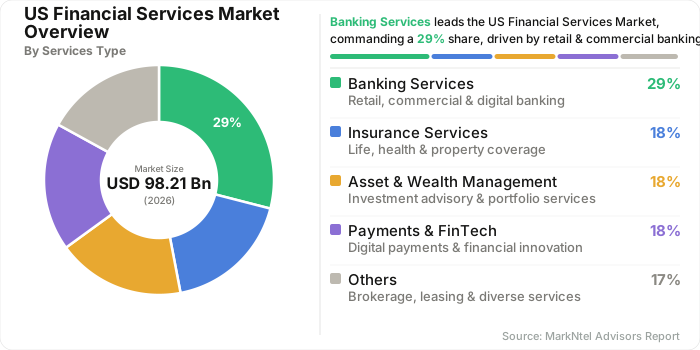
- In 2026, Banking Services dominate the service landscape, accounting for approximately 32% of total market revenue.
- Mobile applications are dominating the Financial Services Industry of the United States, accounting for more than 54% share of the total market volume.
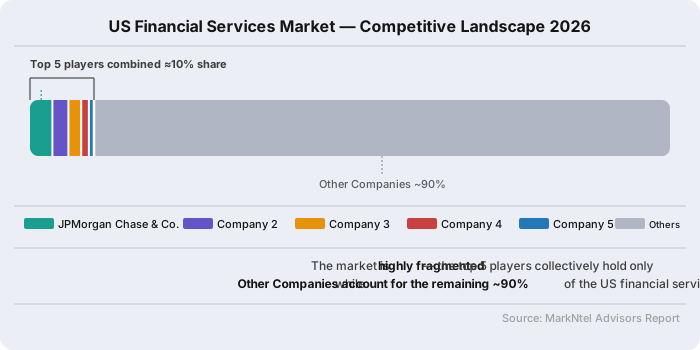
- The market remains highly fragmented, with JPMorgan Chase, Bank of America, Wells Fargo, Citigroup, and Goldman Sachs collectively accounting for approximately 10% of total market share.
The US Financial Services Market Size and Outlook
The United States Financial Services Market is valued at USD 80.99 billion in 2025 and is projected to reach USD 98.21 billion in 2026, further expanding to USD 132 billion by 2032. The market is expected to witness steady growth over the forecast period, driven by deepening digital transformation across banking, insurance, payments, wealth management, and capital market services. Increasing reliance on data-driven financial decision-making, cloud-based infrastructure, and integrated financial platforms is reshaping how services are delivered and consumed across both retail and institutional segments.
Regionally, the Northeast United States remains the core financial hub, anchored by New York’s concentration of investment banks, capital markets, and asset management firms. The West Coast, led by California, is emerging as a leading fintech innovation center, supported by venture capital inflows, digital payment startups, and technology-driven financial ecosystems. The Southern region, including Texas and Florida, is witnessing accelerated expansion in banking, insurance, and corporate financial services, driven by population migration, business relocation trends, and favorable cost structures. Meanwhile, the Midwest continues to serve as a stable base for commercial banking, lending, and industrial finance, supporting manufacturing, agriculture, and regional enterprise activity.
At a structural level, the U.S. financial ecosystem has reached a highly advanced stage of digital payment adoption. Federal Reserve insights (2025) indicate that cashless payment methods now account for over 90% of consumer transactions, while cash usage has declined to below 10% of total payment volume, reflecting a long-term shift toward digital-first financial behavior. Credit and debit cards continue to dominate consumer payment value, while mobile and digital wallet usage is expanding at a double-digit growth rate heading into 2026, particularly across e-commerce and contactless retail environments.
The convergence of these factors is expected to reinforce long-term market expansion while accelerating innovation, efficiency, and platform-based financial service delivery across the ecosystem.
The US Financial Services Market Key Indicators
- According to the Federal Reserve Diary of Consumer Payment Choice (2025), cash accounts for a single-digit share of everyday transactions in the United States, while non-cash instruments dominate consumer payments. This reflects a structurally digital payment environment where debit cards, credit cards, and electronic transfers form the core transaction mechanism, thereby increasing demand for payment processing systems, fraud management tools, and digital banking infrastructure.
- According to the Federal Reserve Payments Study (2025), the United States processes tens of billions of electronic payments annually, with ACH systems exceeding 30 billion transactions per year. This large-scale transaction throughput reflects the deep penetration of electronic clearing systems across consumer, business, and government payments, directly supporting growth in payment networks, settlement infrastructure, and financial technology platforms.
- According to the U.S. Census Bureau Retail Trade data (2025), e-commerce accounts for more than 15% of total U.S. retail sales, representing over USD 1 trillion in annual online transactions. This structural shift toward digital commerce increases reliance on card networks, digital wallets, and payment gateways, thereby accelerating demand for secure and scalable digital payment infrastructure across retail ecosystems.
- According to the U.S. Department of the Treasury (Bureau of Fiscal Service, 2025), over 95% of federal government payments are processed electronically, including tax refunds, Social Security benefits, and vendor disbursements. This near-complete digitization of government financial flows reduces dependency on paper-based instruments and strengthens the role of electronic payment rails in national financial infrastructure.
- According to the U.S. Securities and Exchange Commission (SEC, 2025 market structure data), U.S. equity markets process billions of shares traded daily, while fixed-income markets handle trillions of dollars in daily transaction value equivalents. This high-frequency capital market activity reinforces demand for brokerage services, clearing infrastructure, algorithmic trading systems, and market data platforms across institutional financial services.
- According to the Federal Reserve Financial Accounts of the United States (2025), U.S. household financial assets exceed USD 120 trillion, driven by equities, retirement accounts, and mutual funds. This large asset base strengthens demand for wealth management services, investment advisory platforms, and asset allocation systems across retail and institutional investor segments.
- According to the Federal Reserve Consumer Credit Report (2025), total U.S. consumer credit exceeds USD 5 trillion, with credit card balances surpassing USD 1 trillion. This indicates high reliance on revolving credit instruments for consumption financing, directly supporting lending institutions, credit scoring systems, and securitization markets.
- According to the FDIC (2025), the U.S. banking system comprises more than 4,000 insured institutions, collectively holding tens of trillions of dollars in assets. This institutional scale supports broad credit intermediation across mortgages, business loans, and commercial financing, reinforcing the structural depth of the banking sector.
The US Financial Services Market Scope
| Category | Segments |
|---|---|
| By Service Type | Banking Services (Retail Banking, Commercial Banking, Investment Banking, Private Banking, Digital/Neo Banking), Insurance Services (Life Insurance, Health Insurance, Property & Casualty Insurance, Auto Insurance, Specialty Insurance), Asset & Wealth Management (Mutual Funds, Pension & Retirement Funds, Private Equity, Hedge Funds, Robo-Advisory), Payments & FinTech (Credit Cards, Debit Cards, Digital Wallets, Mobile Payments, P2P Payments, Buy Now, Pay Later (BNPL)), Lending Services (Mortgage Lending, Consumer Lending, SME Lending, Student Loans, Auto Loans), Capital Markets & Alternative Investments (Equity Markets, Fixed Income, Derivatives, Structured Products), Real Estate Finance, Crowdfunding, Crypto & Digital Assets |
| By Distribution Channel | Branch/Physical Offices, Online Platforms, Mobile Applications, Agents & Brokers, Third-Party Aggregators/Marketplaces, Others |
| By End User | Individuals/Households, Small & Medium Enterprises (SMEs), Large Enterprises, Government & Public Sector, Non-Profit Organizations |
The US Financial Services Market Growth Drivers
Expansion of Real-Time Payment Infrastructure
The rapid expansion of real-time payment infrastructure is emerging as a key growth driver for the U.S. financial services market, enabling faster, more efficient, and continuously available financial transactions. According to the Federal Reserve, the FedNow® Service reached more than 1,400 participating financial institutions by July 2025, significantly expanding access to instant payment capabilities across banks and credit unions nationwide. The service allows individuals and businesses to send and receive payments within seconds, 24 hours a day, seven days a week, improving cash flow management and transaction efficiency.
The growing adoption of real-time payments is encouraging financial institutions to modernize payment systems, enhance digital banking offerings, and develop new value-added services for consumers and businesses. Faster settlement capabilities are particularly beneficial for payroll processing, bill payments, business-to-business transactions, and emergency fund transfers. In addition, real-time payment infrastructure supports broader financial inclusion by providing quicker access to funds and reducing payment delays. As participation continues to expand across the financial ecosystem, real-time payments are expected to strengthen operational efficiency, accelerate digital transformation, and create new revenue opportunities for financial service providers throughout the United States.
Recent Trends
Stablecoin Adoption and Regulatory Clarity Reshape Financial Services Infrastructure
Stablecoin adoption is emerging as one of the most significant trends in the U.S. financial services market, driven by increasing regulatory clarity and growing institutional participation. In 2025, the United States advanced a formal regulatory framework for payment stablecoins through the GENIUS Act, providing greater oversight for issuance, reserve management, and consumer protection. This regulatory progress is encouraging broader adoption of stablecoin-based payment and settlement solutions across the financial ecosystem. According to the Federal Reserve, the stablecoin market expanded by more than 50% during 2025, reaching approximately USD 317 billion by April 2026. The Federal Reserve also noted increasing integration between stablecoins, traditional payment systems, banks, and digital wallets, highlighting their growing role in financial transactions.
The trend is further supported by initiatives from major financial institutions and payment providers that are expanding stablecoin-based settlement and cross-border payment capabilities. Stablecoins offer the potential to improve transaction speed, reduce settlement costs, and enable around-the-clock payment processing. As regulatory frameworks continue to mature and institutional adoption increases, stablecoins are expected to play an increasingly important role in modernizing payment infrastructure and supporting innovation across the U.S. financial services industry.
The US Financial Services Market Opportunities and Challenges
Aging Legacy Banking Infrastructure Accelerates Cloud-Based and API-Driven Modernization
A significant portion of the U.S. financial services industry continues to rely on legacy core banking systems that struggle to support modern requirements such as real-time payments, digital banking, advanced analytics, and evolving regulatory reporting standards. As customer demand for seamless digital experiences grows, financial institutions face increasing pressure to modernize outdated technology environments. Legacy systems often create operational inefficiencies, increase maintenance costs, limit scalability, and complicate the integration of emerging technologies, reducing institutional agility and slowing innovation.
These challenges are creating substantial opportunities for cloud-based infrastructure, API-driven banking architectures, and core banking modernization initiatives. Financial institutions are increasingly investing in cloud technologies to improve operational resilience, enhance scalability, and accelerate the deployment of new products and services. Supporting this trend, several major U.S. banks expanded investments in cloud-native platforms and API-enabled solutions during 2025 to strengthen digital banking capabilities and support real-time transaction processing. As modernization efforts continue, cloud-based financial infrastructure is expected to play a critical role in improving efficiency, customer experience, and long-term competitiveness across the U.S. financial services market.
Segmentation Insights
Banking Services Lead the Industry with Potential Shares
Banking Services represent the largest segment of the U.S. financial services market, accounting for approximately 32% of total market share, supported by the scale, depth, and diversity of the country's banking system. The segment encompasses retail banking, commercial banking, investment banking, private banking, and digital banking services that collectively serve households, businesses, and institutional clients. According to the Federal Deposit Insurance Corporation, FDIC-insured institutions held more than USD 24 trillion in assets and generated hundreds of billions of dollars in annual net income, underscoring the sector's central role in the U.S. economy. The banking industry benefits from a large and stable deposit base, extensive lending activity, which supports economic growth and capital formation.
The increasing adoption of digital banking channels has further strengthened the segment's market position. According to the Federal Reserve, consumers continue to increase their use of online and mobile banking platforms for payments, account management, and financial transactions. Banks are investing significantly in artificial intelligence, cybersecurity, cloud computing, and data analytics to improve operational efficiency, enhance customer experiences, and strengthen risk management capabilities. The combination of strong financial performance, technological advancement, and broad customer reach reinforces Banking Services as the dominant segment within the U.S. financial services market. Based on service types the scope has been divided into:
- Banking Services
- Insurance Services
- Asset & Wealth Management
- Payments & FinTech
- Lending Services
- Capital Markets & Alternative Investments
Mobile Applications Lead the U.S. Financial Services Market Through Widespread Smartphone Adoption
Mobile applications dominate the United States financial services industry, accounting for more than 54% of the total market volume. This leadership is primarily driven by the widespread adoption of smartphones and the growing consumer preference for convenient, digital-first financial solutions.
As of 2025, more than 90% of Americans, approximately 240 million people, use smartphones, providing a strong foundation for mobile banking and digital financial services. The high penetration of smartphones has encouraged consumers to access financial services through mobile applications rather than visiting physical bank branches or financial institutions.
Mobile applications enable users to perform a wide range of financial activities, including checking account balances and transaction histories, transferring funds, paying bills, applying for loans, managing investments, and making digital payments, all from their smartphones. The convenience, speed, and 24/7 accessibility offered by these platforms have significantly accelerated their adoption across the country.
Furthermore, mobile-first service delivery is more cost-effective for financial institutions than maintaining extensive physical branch networks. Lower operational costs, combined with improved customer engagement and scalability, have prompted banks and fintech companies to continue investing in digital platforms. Leading providers such as PayPal, Bank of America, and Venmo have attracted millions of users by offering feature-rich mobile applications, further reinforcing the dominance of the mobile application segment in the U.S. financial services market. Based on distribution channel, the market is divided into:
- Direct (Branch/Office)
- Online/Digital Platforms
- Mobile Applications
- Agents/Brokers
- Third-Party Aggregators
- Others
The US Financial Services Market Competitive Analysis
The U.S. financial services market is highly fragmented, with the top five companies JPMorgan Chase & Co., Bank of America Corporation, Wells Fargo & Company, Citigroup Inc., and Goldman Sachs Group, Inc. accounting for approximately 10% of total market share. Competition is driven by digital innovation, product diversification, technology investments, and evolving customer expectations.
Key Companies in the US Financial Services Market
- JPMorgan Chase & Co.
- Bank of America Corporation
- Wells Fargo & Company
- Citigroup Inc.
- Goldman Sachs Group, Inc.
- Morgan Stanley
- American Express Company
- Visa Inc.
- Mastercard Incorporated
- PayPal Holdings, Inc.
The US Financial Services Industry News and Recent Developments
June 2026: Visa Inc. Launches AI-Driven Commerce Solutions and Expands Stablecoin Settlement Infrastructure
Visa announced a suite of AI-powered payment innovations, including Agent Scoring, Agentic Registry, enhanced tokenization capabilities, and expanded stablecoin settlement infrastructure. The company reported that its stablecoin settlement network achieved an annualized transaction run rate of approximately USD 7 billion as of March 2026. The new solutions are designed to facilitate autonomous AI-driven transactions, programmable payments, and more efficient cross-border settlement processes.
Impact Analysis: The launch strengthens Visa’s position at the intersection of artificial intelligence and digital payments by enabling secure machine-to-machine commerce and advanced transaction automation. Expanded stablecoin settlement capabilities improve payment efficiency and cross-border liquidity management while supporting the growing adoption of blockchain-based financial infrastructure. The development is expected to accelerate innovation across the U.S. payments ecosystem and increase competitive pressure among payment networks and fintech providers pursuing AI-enabled financial services.
June 2026: Mastercard Incorporated Expands Stablecoin-Based Settlement Capabilities Across Payment Network
Mastercard expanded its settlement infrastructure to support regulated stablecoins, including USDC, PYUSD, RLUSD, and other approved digital assets. The enhanced framework introduces intraday, weekend, and holiday settlement functionality, enabling financial institutions to process transactions beyond conventional banking hours and improve settlement flexibility across payment operations.
Impact Analysis: The expansion enhances transaction efficiency and liquidity management for banks, payment providers, and merchants by reducing settlement delays associated with traditional banking schedules. By integrating regulated stablecoins into its payment infrastructure, Mastercard strengthens its role in next-generation payment systems and supports broader institutional adoption of digital assets. The initiative further advances blockchain-enabled payment modernization and intensifies competition within the digital payments and financial infrastructure landscape.
March 2026: PayPal Holdings, Inc. Expands PYUSD Stablecoin Availability to 70 International Markets
PayPal expanded the availability of its PayPal USD (PYUSD) stablecoin to 70 international markets, allowing consumers and merchants to access a U.S. dollar-backed digital asset for cross-border payments and digital commerce. The expansion integrates PYUSD directly within PayPal’s platform, facilitating faster and lower-cost transaction capabilities for global users.
Impact Analysis: The expansion reinforces PayPal’s strategic position in digital payments and regulated digital asset adoption. By increasing access to PYUSD across international markets, the company strengthens its cross-border payment ecosystem and enhances transaction efficiency for consumers and businesses. The move supports growing mainstream acceptance of stablecoins while encouraging broader integration of blockchain-based payment solutions within the global financial services industry.
February 2026: JPMorgan Chase & Co. Announces Major U.S. Branch Expansion and Workforce Growth Initiative
JPMorgan Chase announced plans to open more than 160 new branches across over 30 U.S. states and hire approximately 1,100 employees. The initiative also includes the renovation of nearly 600 existing branch locations to enhance customer engagement and service accessibility. The expansion targets high-growth, underserved, and rural communities throughout the United States.
Impact Analysis: The investment demonstrates the continued importance of physical banking infrastructure despite increasing digital banking adoption. Expanded branch coverage improves customer access to financial services while strengthening JPMorgan’s retail banking presence in strategic markets. The initiative supports customer acquisition, deposit growth, and relationship banking while reinforcing the effectiveness of omnichannel banking models that integrate physical and digital service delivery.
June 2026: The Charles Schwab Corporation Launches Prediction Market Trading Products Through Cboe Partnership
Charles Schwab entered the prediction markets segment through a partnership with Cboe Global Markets, introducing binary options linked to the performance of the S&P 500 Index. The new offering provides investors with simplified event-based trading instruments and expands the company’s suite of alternative investment products available to retail traders.
Impact Analysis: The launch broadens Schwab’s investment product portfolio and reflects growing investor demand for innovative trading instruments beyond traditional equities and fixed-income securities. By entering the prediction markets segment, the company enhances customer engagement opportunities and diversifies revenue streams. The development may encourage broader adoption of alternative investment products within the U.S. brokerage industry and stimulate competitive innovation among wealth management and trading platforms.
Frequently Asked Questions
- Market Segmentation
- Introduction
- Product Definition
- Research Process
- Assumptions
- Executive Summary
- The US Financial Services Market Policies, Regulations, and Product Standards
- The US Financial Services Market Trends & Developments
- The US Financial Services Market Dynamics
- Growth Factors
- Challenges
- The US Financial Services Market Hotspot & Opportunities
- The US Financial Services Market Outlook, 2022-2032F
- Market Size & Outlook
- By Revenues (USD Million)
- Market Segmentation & Outlook
- By Service Type - Market Size & Forecast 2022-2032, USD Million
- Banking Services
- Retail Banking
- Commercial Banking
- Investment Banking
- Private Banking
- Digital/Neo Banking
- Insurance Services
- Life Insurance
- Health Insurance
- Property & Casualty Insurance
- Auto Insurance
- Specialty Insurance
- Asset & Wealth Management
- Mutual Funds
- Pension & Retirement Funds
- Private Equity
- Hedge Funds
- Robo-Advisory
- Payments & FinTech
- Credit Cards
- Debit Cards
- Digital Wallets
- Mobile Payments
- P2P Payments
- Buy Now, Pay Later (BNPL)
- Lending Services
- Mortgage Lending
- Consumer Lending
- SME Lending
- Student Loans
- Auto Loans
- Capital Markets & Alternative Investments
- Equity Markets
- Fixed Income
- Derivatives
- Structured Products
- Real Estate Finance
- Crowdfunding
- Crypto & Digital Assets
- Banking Services
- By Distribution Channel- Market Size & Forecast 2022-2032, USD Million
- Branch/Physical Offices
- Online Platforms
- Mobile Applications
- Agents & Brokers
- Third-Party Aggregators/Marketplaces
- Others
- By End User- Market Size & Forecast 2022-2032, USD Million
- Individuals/Households
- Small & Medium Enterprises (SMEs)
- Large Enterprises
- Government & Public Sector
- Non-Profit Organizations-
- By Region - Market Size & Forecast 2022-2032, USD Million
- Northeast
- Midwest
- South
- West
- By Company
- Competition Characteristics
- Market Share & Analysis
- By Service Type - Market Size & Forecast 2022-2032, USD Million
- Market Size & Outlook
- The US Banking Services Market Outlook, 2022-2032
- Market Size & Outlook
- By Revenues (USD Million)
- Market Segmentation & Outlook
- By Distribution Channel- Market Size & Forecast 2022-2032, USD Million
- By End User- Market Size & Forecast 2022-2032, USD Million
- By Region - Market Size & Forecast 2022-2032, USD Million
- Market Size & Outlook
- The US Insurance Services Market Outlook, 2022-2032
- Market Size & Outlook
- By Revenues (USD Million)
- Market Segmentation & Outlook
- By Distribution Channel- Market Size & Forecast 2022-2032, USD Million
- By End User- Market Size & Forecast 2022-2032, USD Million
- By Region - Market Size & Forecast 2022-2032, USD Million
- Market Size & Outlook
- The US Asset & Wealth Management Market Outlook, 2022-2032
- Market Size & Outlook
- By Revenues (USD Million)
- Market Segmentation & Outlook
- By Distribution Channel- Market Size & Forecast 2022-2032, USD Million
- By End User- Market Size & Forecast 2022-2032, USD Million
- By Region - Market Size & Forecast 2022-2032, USD Million
- Market Size & Outlook
- The US Payments & Fintech Market Outlook, 2022-2032
- Market Size & Outlook
- By Revenues (USD Million)
- Market Segmentation & Outlook
- By Distribution Channel- Market Size & Forecast 2022-2032, USD Million
- By End User- Market Size & Forecast 2022-2032, USD Million
- By Region - Market Size & Forecast 2022-2032, USD Million
- Market Size & Outlook
- The US Lending Services Market Outlook, 2022-2032
- Market Size & Outlook
- By Revenues (USD Million)
- Market Segmentation & Outlook
- By Distribution Channel- Market Size & Forecast 2022-2032, USD Million
- By End User- Market Size & Forecast 2022-2032, USD Million
- By Region - Market Size & Forecast 2022-2032, USD Million
- Market Size & Outlook
- The US Capital Markets- Market Outlook, 2022-2032
- Market Size & Outlook
- By Revenues (USD Million)
- Market Segmentation & Outlook
- By Distribution Channel- Market Size & Forecast 2022-2032, USD Million
- By End User- Market Size & Forecast 2022-2032, USD Million
- By Region - Market Size & Forecast 2022-2032, USD Million
- Market Size & Outlook
- The US Real Estate Finance Market Outlook, 2022-2032
- Market Size & Outlook
- By Revenues (USD Million)
- Market Segmentation & Outlook
- By Distribution Channel- Market Size & Forecast 2022-2032, USD Million
- By End User- Market Size & Forecast 2022-2032, USD Million
- By Region - Market Size & Forecast 2022-2032, USD Million
- Market Size & Outlook
- The US Crowdfunding Market Outlook, 2022-2032
- Market Size & Outlook
- By Revenues (USD Million)
- Market Segmentation & Outlook
- By Distribution Channel- Market Size & Forecast 2022-2032, USD Million
- By End User- Market Size & Forecast 2022-2032, USD Million
- By Region - Market Size & Forecast 2022-2032, USD Million
- Market Size & Outlook
- The US Financial Services Market Key Strategic Imperatives for Success & Growth
- Competitive Outlook
- Company Profiles
- Crypto & Digital Assets
- Business Description
- Product Portfolio
- Collaborations & Alliances
- Recent Developments
- Financial Details
- Others
- JPMorgan Chase & Co.
- Business Description
- Product Portfolio
- Collaborations & Alliances
- Recent Developments
- Financial Details
- Others
- Bank of America Corporation
- Business Description
- Product Portfolio
- Collaborations & Alliances
- Recent Developments
- Financial Details
- Others
- Wells Fargo & Company
- Business Description
- Product Portfolio
- Collaborations & Alliances
- Recent Developments
- Financial Details
- Others
- Citigroup Inc.
- Business Description
- Product Portfolio
- Collaborations & Alliances
- Recent Developments
- Financial Details
- Others
- Goldman Sachs Group, Inc.
- Business Description
- Product Portfolio
- Collaborations & Alliances
- Recent Developments
- Financial Details
- Others
- Morgan Stanley
- Business Description
- Product Portfolio
- Collaborations & Alliances
- Recent Developments
- Financial Details
- Others
- American Express Company
- Business Description
- Product Portfolio
- Collaborations & Alliances
- Recent Developments
- Financial Details
- Others
- Visa Inc.
- Business Description
- Product Portfolio
- Collaborations & Alliances
- Recent Developments
- Financial Details
- Others
- Mastercard Incorporated
- Business Description
- Product Portfolio
- Collaborations & Alliances
- Recent Developments
- Financial Details
- Others
- Crypto & Digital Assets
- Company Profiles
- Disclaimer
MarkNtel Advisors follows a robust and iterative research methodology designed to ensure maximum accuracy and minimize deviation in market estimates and forecasts. Our approach combines both bottom-up and top-down techniques to effectively segment and quantify various aspects of the market. A consistent feature across all our research reports is data triangulation, which examines the market from three distinct perspectives to validate findings. Key components of our research process include:
1. Scope & Research Design At the outset, MarkNtel Advisors define the research objectives and formulate pertinent questions. This phase involves determining the type of research—qualitative or quantitative—and designing a methodology that outlines data collection methods, target demographics, and analytical tools. They also establish timelines and budgets to ensure the research aligns with client goals.
2. Sample Selection and Data Collection In this stage, the firm identifies the target audience and determines the appropriate sample size to ensure representativeness. They employ various sampling methods, such as random or stratified sampling, based on the research objectives. Data collection is carried out using tools like surveys, interviews, and observations, ensuring the gathered data is reliable and relevant.
3. Data Analysis and Validation Once data is collected, MarkNtel Advisors undertake a rigorous analysis process. This includes cleaning the data to remove inconsistencies, employing statistical software for quantitative analysis, and thematic analysis for qualitative data. Validation steps are taken to ensure the accuracy and reliability of the findings, minimizing biases and errors.

4. Data Forecast and FinalizationThe final phase involves forecasting future market trends based on the analyzed data. MarkNtel Advisors utilize predictive modeling and time series analysis to anticipate market behaviors. The insights are then compiled into comprehensive reports, featuring visual aids like charts and graphs, and include strategic recommendations to inform client decision-making
We offer flexible licensing options to cater to varying organizational needs. Choose the pricing pack that best suits your requirements:
Buy Now Inquire Before Buying
 Request Customization
 Talk to our Consultant







