

US Circuit Breaker Market Research Report: Trends & Forecast (2026-2032)
By Type (Mechanical Circuit Breakers, Solid-State Circuit Breakers, Hybrid Circuit Breakers), By Mounting (Fixed, Withdrawable), By Design (Live Tank Circuit Breakers, Dead Tank Ci ... rcuit Breakers), By Voltage (Low Voltage (Up to 1 kV), Medium Voltage (1 kV –69 kV), High (69kV to 230 kV), Extra/Ultra-High (Above 230 kV)), By Rated Voltage (Up to 500V, 500V – 1 kV, 1 kV – 15 kV, 15 kV –38 kV, 121 kV –245 kV, 245 kV – 500 kV, Above 600 kV), By Rated Current (Up to 500 A, 500 to 1,500 A, 1,500 to 2,500 A, 2,500 to 4,500 A, Above 4,500 A), By Insulation (Vacuum Circuit Breakers, Gas Circuit Breakers, Air Circuit Breakers, Oil Circuit Breakers), By Installation (Outdoor Circuit Breakers, Indoor Circuit Breakers), By Application (Power Generation, Transmission & Distribution, Renewable Energy, Infrastructure (Railways, Metro, Smart Cities), Industrial Automation & Manufacturing, Data Centers & Smart Buildings), By End-User (Utilities, Industrial, Commercial, Residential), and others Read more
- Energy
- Mar 2026
- Pages 150
- Report Format: PDF, Excel, PPT
US Circuit Breaker Market
Projected 4.94% CAGR from 2026 to 2032
Study Period
2026-2032
Market Size (2026)
USD 2.71 Billion
Market Size (2032)
USD 3.62 Billion
Base Year
2025
Projected CAGR
4.94%
Leading Segments
By End User: Utilities
US Circuit Breaker Market Report Key Takeaways:
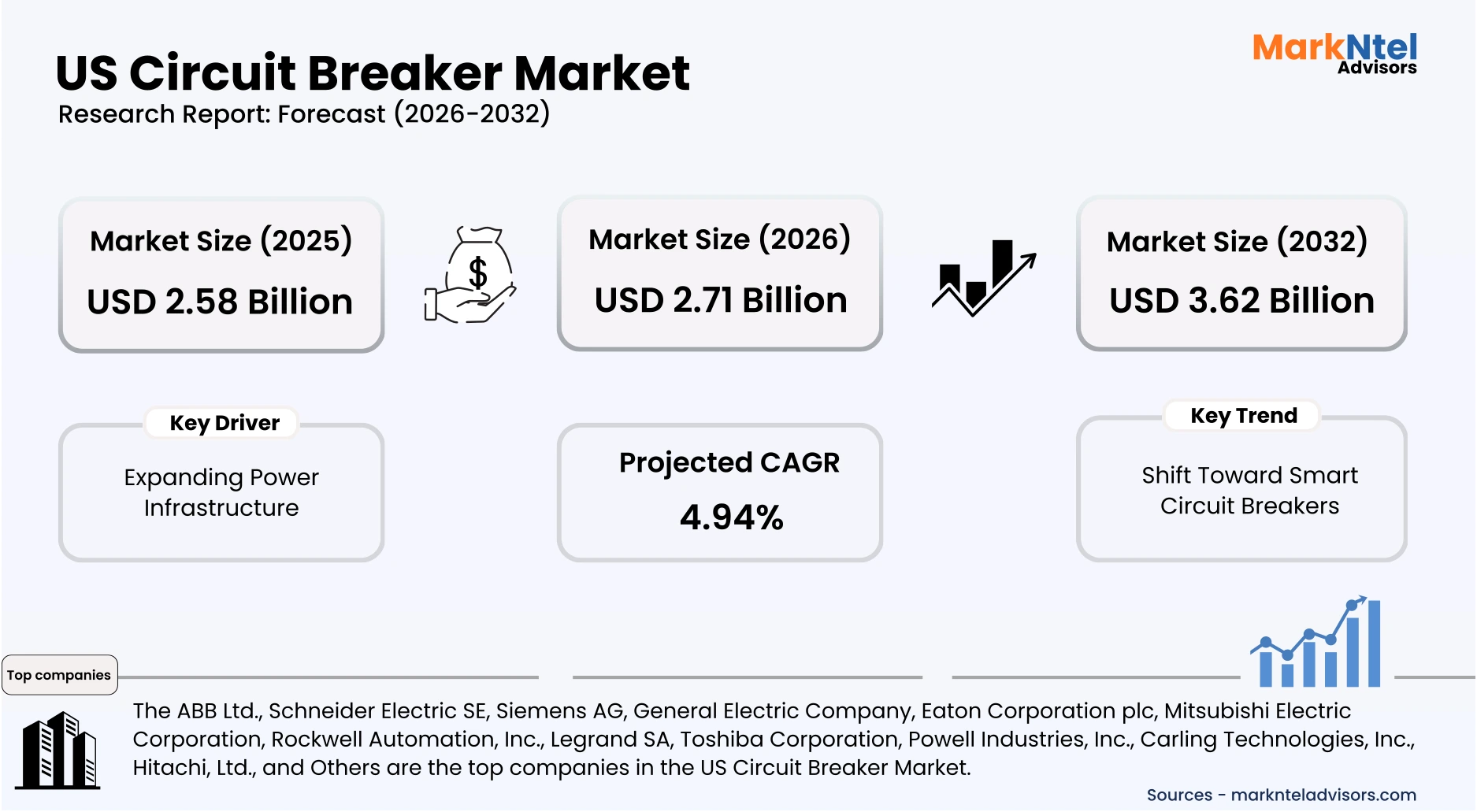
- The US Circuit Breaker market size was valued at USD 2.58 billion in 2025 and is projected to grow from USD 2.71 billion in 2026 to USD 3.62 billion by 2032, exhibiting a CAGR of 4.94% during the forecast period.
- By type, the mechanical circuit breakers segment represented a significant share of about 88% in the US Circuit Breaker Market in 2026.
- By end user, the utilities segment seized a significant share of about 45% in the US Circuit Breaker Market in 2026.
- Leading circuit breaker companies in the US are ABB Ltd., Schneider Electric SE, Siemens AG, General Electric Company, Eaton Corporation plc, Mitsubishi Electric Corporation, Rockwell Automation, Inc., Legrand SA, Toshiba Corporation, Powell Industries, Inc., Carling Technologies, Inc., Hitachi, Ltd., and Others.
Market Insights & Analysis: US Circuit Breaker Market (2026-32):
The US Circuit Breaker Market size was valued at around USD 2.58 billion in 2025 and is projected to grow from USD 2.71 billion in 2026 to USD 3.62 billion by 2032. Along with this, the market is estimated to grow at a CAGR of around 4.94% during the forecast period, i.e., 2026-32.
The US Circuit Breaker Market is projected to expand steadily, driven by ongoing power infrastructure expansion and increasing adoption of smart circuit breakers, driven by grid modernization initiatives, rising electrification, and the growing need for advanced, reliable electrical protection systems.
The expansion of transmission and distribution infrastructure, supported by federal funding and utility spending, is significantly driving demand for circuit breakers across substations and power networks.
A key growth enabler is the strong policy support for grid resilience. For instance, in 2024, the U.S. Department of Energy announced USD 14.5 billion in funding to strengthen grid infrastructure and improve reliability nationwide. This initiative reflects a broader effort to upgrade aging systems and integrate renewable energy sources.
Complementing this, a USD 1.5 billion federal investment in four multi-state transmission projects is expected to add nearly 1,000 miles of new transmission lines, enhancing grid stability and interconnectivity . Earlier, in 2023, the U.S. government allocated USD 3.5 billion across 58 grid resilience projects, further accelerating infrastructure upgrades.
At the regional level, large-scale projects are reinforcing market momentum. The Southern Spirit Transmission project (2025) will introduce a 320-mile high-voltage direct current (HVDC) line with 3,000 MW capacity, strengthening connectivity between Texas and southeastern states .
Additionally, the planned expansion of the Southwest Power Pool (SPP) in 2026 across 17 states is expected to improve transmission efficiency and grid coordination in the western region . These developments highlight a robust pipeline of projects requiring reliable circuit protection systems.
In parallel, technological advancements are reshaping the market landscape. The transition toward smart circuit breakers is gaining traction, supported by digital grid initiatives. For instance, Schneider Electric introduced its GM AirSeT platform, which incorporates digitally connected circuit protection systems and eliminates SF₆ gas . Such innovations enable real-time monitoring, enhance operational efficiency, and align with sustainability objectives, reinforcing the shift toward intelligent grid infrastructure.
Looking ahead, long-term infrastructure requirements will further accelerate market expansion. The DOE estimates that the U.S. must develop approximately 5,000 miles of new transmission lines annually between 2025 and 2035, compared to only 888 miles added in 2024, underscoring a significant capacity gap . Moreover, federal plans target the deployment of 7,500 miles of new transmission lines by 2030 to meet rising electricity demand.
Robust federal investments, expanding transmission networks, and increasing adoption of smart technologies are collectively driving demand for circuit breakers. As infrastructure development accelerates and grid systems become more intelligent, the U.S. circuit breaker market is expected to witness consistent and long-term growth.
US Circuit Breaker Market Recent Developments:
- 2025: At CES 2025, Savant Systems introduced its Smart Budget feature within the Smart Power system, enabling app-based control of individual circuits in existing breaker panels. The solution allows automated energy distribution, such as scheduling EV charging during off-peak hours, improving home energy efficiency.
- 2025: ABB introduced a new switchgear solution featuring the 7200A Emax 2 air circuit breaker to support next-generation wind turbines. The system delivers high power capacity, improved reliability, and efficient switching, enabling larger turbines and enhanced energy output for renewable projects.
US Circuit Breaker Market Scope:
| Category | Segments |
|---|---|
| By Type | (Mechanical Circuit Breakers, Solid-State Circuit Breakers, Hybrid Circuit Breakers), |
| By Mounting | (Fixed, Withdrawable), |
| By Design | (Live Tank Circuit Breakers, Dead Tank Circuit Breakers), |
| By Voltage | (Low Voltage (Up to 1 kV), Medium Voltage (1 kV –69 kV), High (69kV to 230 kV), Extra/Ultra-High (Above 230 kV)), |
| By Rated Voltage | (Up to 500V, 500V – 1 kV, 1 kV – 15 kV, 15 kV –38 kV, 121 kV –245 kV, 245 kV – 500 kV, Above 600 kV), |
| By Rated Current | (Up to 500 A, 500 to 1,500 A, 1,500 to 2,500 A, 2,500 to 4,500 A, Above 4,500 A), |
| By Insulation | (Vacuum Circuit Breakers, Gas Circuit Breakers, Air Circuit Breakers, Oil Circuit Breakers), |
| By Installation | (Outdoor Circuit Breakers, Indoor Circuit Breakers), |
| By Application | (Power Generation, Transmission & Distribution, Renewable Energy, Infrastructure (Railways, Metro, Smart Cities), Industrial Automation & Manufacturing, Data Centers & Smart Buildings), |
| By End-User | (Utilities, Industrial, Commercial, Residential), |
US Circuit Breaker Market Driver:
Expanding Power Infrastructure
The expansion of regional transmission infrastructure across the United States is a key driver of circuit breaker demand, particularly as utilities focus on improving grid reliability and integrating renewable energy sources.
In the Northeast, infrastructure development is being accelerated by the need to enhance transmission capacity and stabilize power supply. A notable example is the USD 425 million federally supported transmission project in Maine (2024–2025), which includes the development of a 111-mile transmission line capable of delivering approximately 1,200 MW to the New England grid. Such large-scale projects require extensive deployment of circuit breakers across substations and transmission nodes to ensure system protection and operational safety.
Similarly, the Midwest is emerging as a major hub for grid expansion, driven by rising electricity demand and renewable energy integration. In 2025, the Midcontinent Independent System Operator (MISO) announced a USD 22 billion transmission expansion plan, aimed at deploying high-voltage lines across multiple states . This initiative represents one of the largest regional grid investments in the U.S., necessitating advanced circuit protection systems to manage increased load capacity and ensure grid stability.
The surge in regional transmission investments across the Northeast and Midwest is significantly increasing the need for circuit breakers. As large-scale grid projects continue to expand, demand for reliable circuit protection systems will rise, driving sustained market growth.
US Circuit Breaker Market Trend:
Shift Toward Smart Circuit Breakers
The U.S. circuit breaker market is increasingly transitioning toward smart, digitally integrated circuit protection systems, supported by large-scale grid modernization and digitalization initiatives.
The U.S. Department of Energy continues to promote the deployment of advanced grid infrastructure incorporating automation, real-time monitoring, and secure communication technologies. This shift is driving the need for circuit breakers capable of intelligent fault detection, remote operation, and data-driven performance optimization.
A notable example of this trend is the innovation by ABB Ltd., which launched the SACE Emax 3 advanced air circuit breaker. This next-generation system is specifically designed for AI-driven data centers and industrial environments, both of which are rapidly expanding across the United States. T he product integrates advanced sensing capabilities, digital connectivity, and cybersecurity features, enabling real-time monitoring, predictive maintenance, and improved operational efficiency in critical infrastructure.
Such advancements highlight the broader industry shift from conventional mechanical protection devices to intelligent, connected systems capable of interacting with smart grids and complex energy networks. As U.S. infrastructure increasingly adopts automation and digital technologies, the role of smart circuit breakers becomes essential in ensuring reliability and optimizing energy usage.
The convergence of federal digitalization efforts and advanced product innovations is accelerating the adoption of smart circuit breakers in the U.S. As infrastructure becomes more intelligent and interconnected, this trend will significantly drive market expansion in the coming years.
US Circuit Breaker Market Opportunity:
Rapid Expansion of EV Charging Infrastructure
The accelerating deployment of electric vehicle (EV) charging infrastructure across the United States is creating a substantial opportunity for the circuit breaker market. The country surpassed 200,000 public EV charging ports in 2024, according to the Joint Office of Energy and Transportation. This rapid scale-up reflects strong federal support for transportation electrification and increased pressure on electrical networks, requiring advanced circuit protection systems.
Significant public investments are further strengthening this opportunity. In 2024, the U.S. Department of Transportation announced USD 521 million in grants to deploy more than 9,200 additional EV charging ports across multiple states. These installations, particularly high-capacity charging stations, require reliable circuit breakers to ensure operational safety and prevent overload risks.
In parallel, the U.S. Department of Energy provided a USD 1.25 billion loan to expand nationwide fast-charging infrastructure, supporting the rollout of approximately 7,500 high-power chargers. Such chargers operate at elevated voltage levels, significantly increasing the demand for robust and intelligent circuit protection devices.
The rapid growth of EV charging infrastructure, backed by large-scale federal funding, is directly driving the need for advanced circuit breakers. As deployment intensifies, this opportunity will play a critical role in accelerating the growth of the U.S. circuit breaker market.
US Circuit Breaker Market Challenge:
Supply Chain Bottlenecks in Grid Equipment
Supply chain disruptions across the U.S. power equipment ecosystem are significantly constraining the deployment of circuit breakers, particularly due to shortages in critical grid components.
A major bottleneck lies in transformer availability, which directly impacts substation and transmission infrastructure. The U.S. Department of Energy reported that transformer lead times surged from 2–4 months to 22–33 months in 2023, thereby limiting utilities’ ability to expand or maintain grid systems efficiently .
This challenge is further reinforced by findings from the Federal Energy Regulatory Commission, which indicate that large transformer delivery timelines range between 38 weeks and 38 months, causing substantial delays in transmission and distribution project execution . Since circuit breakers are installed alongside such equipment, these delays directly postpone their deployment.
Moreover, broader supply chain assessments highlight that grid component lead times averaged approximately 38 weeks in 2023, nearly doubling year-over-year due to rising electrification demand and constrained domestic manufacturing capacity . These systemic delays are slowing the pace of infrastructure upgrades across the country.
Overall, persistent supply chain bottlenecks are restricting timely grid expansion and equipment installation. As a result, circuit breaker deployment is being delayed, posing a significant challenge to market growth despite strong underlying demand.
US Circuit Breaker Market (2026-32) Segmentation Analysis:
The US Circuit Breaker Market study of MarkNtel Advisors evaluates & highlights the major trends and influencing factors in each segment. It includes predictions for the period 2026–32 at the country level. Based on the analysis, the market has been further classified as;
Based on Type:
- Mechanical Circuit Breakers
- Solid-State Circuit Breakers
- Hybrid Circuit Breakers
The mechanical circuit breakers dominate the US Circuit Breaker market, accounting for approximately 88% of the market size, primarily due to their established reliability, economic viability, and extensive integration across existing power infrastructure. These systems remain the preferred choice for utilities and industrial operators, particularly in transmission and distribution networks where consistent and proven fault interruption performance is essential.
A key factor supporting their dominance is the large installed base of conventional electrical infrastructure across the United States. Mechanical breakers are highly compatible with legacy grid systems, making them the most practical option for refurbishment, replacement, and incremental upgrades. Their lower capital cost compared to solid-state and hybrid alternatives further strengthens their adoption, especially in large-scale projects where cost efficiency is critical.
In addition, mechanical circuit breakers demonstrate strong performance in medium- and high-voltage applications, ensuring operational stability under demanding grid conditions. Their mature manufacturing ecosystem and established supply chains enable reliable availability and relatively shorter deployment timelines. Furthermore, these breakers offer durability and predictable maintenance requirements, which are important for long-term utility planning.
The continued reliance on cost-efficient, compatible, and field-proven technologies ensures that mechanical circuit breakers maintain their dominant position in the U.S. market, particularly amid ongoing grid modernization efforts.
Based on End User:
- Utilities
- Industrial
- Commercial
- Residential
The utilities segment dominates the US Circuit Breaker market, accounting for about 45% of total market value, supported by its critical responsibility in electricity transmission, distribution, and grid reliability management. Utilities operate extensive and complex power networks that require continuous deployment of circuit breakers to ensure system protection, fault isolation, and uninterrupted power delivery.
A major factor underpinning this dominance is the consistent capital investment in grid infrastructure upgrades and modernization initiatives. According to the U.S. Energy Information Administration, utilities invested USD 6.1 billion in substation equipment in 2023, reflecting a 15% year-over-year increase driven by reliability enhancement efforts and the growing integration of renewable energy sources. These investments directly elevate the demand for circuit breakers, which are fundamental to substation operations and network protection.
Furthermore, utilities are leading the transition toward renewable energy integration, electrification of end-use sectors, and expansion of transmission capacity. These developments require advanced circuit protection systems capable of handling higher loads, variable generation, and increased grid complexity. The scale of utility operations, combined with regulatory requirements for safety and reliability, reinforces their dependence on robust circuit breaker solutions.
Sustained infrastructure investments and the expanding scope of grid operations firmly position utilities as the dominant end-user segment, ensuring continued demand for circuit breakers across the U.S. power sector.
Gain a Competitive Edge with Our US Circuit Breaker Market Report:
- The US Circuit Breaker Market Report by MarkNtel Advisors provides a detailed & thorough analysis of market size & share, growth rate, competitive landscape, and key players. This comprehensive analysis helps businesses gain a holistic understanding of the market dynamics & make informed decisions.
- This report also highlights current market trends & future projections, allowing businesses to identify emerging opportunities & potential challenges. By understanding market forecasts, companies can align their strategies & stay ahead of the competition.
- The US Circuit Breaker Market Report aids in assessing & mitigating risks associated with entering or operating in the market. By understanding market dynamics, regulatory frameworks, and potential challenges, businesses can develop strategies to minimize risks & optimize their operations.
*Reports Delivery Format - Market research studies from MarkNtel Advisors are offered in PDF, Excel and PowerPoint formats. Within 24 hours of the payment being successfully received, the report will be sent to your email address.
Frequently Asked Questions
- Market Segmentation
- Introduction
- Product Definition
- Research Process
- Assumptions
- Executive Summary
- US Circuit Breaker Market Policies, Regulations, and Product Standards
- US Circuit Breaker Market Trends & Developments
- US Circuit Breaker Market Dynamics
- Growth Factors
- Challenges
- US Circuit Breaker Market Hotspot & Opportunities
- US Circuit Breaker Market Outlook, 2022-2032F
- Market Size & Outlook
- By Revenues (USD Million)
- Market Share & Outlook
- By Type - Market Size & Forecast 2022-2032, USD Million
- Mechanical Circuit Breakers
- Solid-State Circuit Breakers
- Hybrid Circuit Breakers
- By Mounting- Market Size & Forecast 2022-2032, USD Million
- Fixed
- Withdrawable
- By Design- Market Size & Forecast 2022-2032, USD Million
- Live Tank Circuit Breakers
- Dead Tank Circuit Breakers
- By Voltage- Market Size & Forecast 2022-2032, USD Million
- Low Voltage (Up to 1 kV)
- Medium Voltage (1 kV –69 kV)
- High (69kV to 230 kV)
- Extra/Ultra-High (Above 230 kV)
- By Rated Voltage- Market Size & Forecast 2022-2032, USD Million
- Up to 500V
- 500V – 1 kV
- 1 kV – 15 kV
- 15 kV –38 kV
- 38 kV – 72.5 kV
- 72.5 kV – 121 kV
- 121 kV –245 kV
- 245 kV – 500 kV
- Above 600 kV
- By Rated Current- Market Size & Forecast 2022-2032, USD Million
- Up to 500 A
- 500 to 1,500 A
- 1,500 to 2,500 A
- 2,500 to 4,500 A
- Above 4,500 A
- By Insulation - Market Size & Forecast 2022-2032, USD Million
- Vacuum Circuit Breakers
- Gas Circuit Breakers
- Air Circuit Breakers
- Oil Circuit Breakers
- By Installation- Market Size & Forecast 2022-2032, USD Million
- Outdoor Circuit Breakers
- Indoor Circuit Breakers
- By Application- Market Size & Forecast 2022-2032, USD Million
- Power Generation
- Transmission & Distribution
- Renewable Energy
- Infrastructure (Railways, Metro, Smart Cities)
- Industrial Automation & Manufacturing
- Data Centers & Smart Buildings
- By End-User- Market Size & Forecast 2022-2032, USD Million
- Utilities
- Industrial
- Commercial
- Residential
- By Region- Market Size & Forecast 2022-2032, USD Million
- Northeast
- Midwest
- South
- West
- By Company
- Competition Characteristics
- Market Share & Analysis
- By Type - Market Size & Forecast 2022-2032, USD Million
- Market Size & Outlook
- US Mechanical Circuit Breakers Market Outlook, 2022-2032
- Market Size & Outlook
- By Revenues (USD Million)
- Market Share & Outlook
- By Mounting- Market Size & Forecast 2022-2032, USD Million
- By Design- Market Size & Forecast 2022-2032, USD Million
- By Voltage- Market Size & Forecast 2022-2032, USD Million
- By Rated Voltage- Market Size & Forecast 2022-2032, USD Million
- By Rated Current- Market Size & Forecast 2022-2032, USD Million
- By Insulation - Market Size & Forecast 2022-2032, USD Million
- By Installation- Market Size & Forecast 2022-2032, USD Million
- By Application- Market Size & Forecast 2022-2032, USD Million
- By End-User- Market Size & Forecast 2022-2032, USD Million
- By Region- Market Size & Forecast 2022-2032, USD Million
- Market Size & Outlook
- US Solid-State Circuit Breakers Market Outlook, 2022-2032
- Market Size & Outlook
- By Revenues (USD Million)
- Market Share & Outlook
- By Mounting- Market Size & Forecast 2022-2032, USD Million
- By Design- Market Size & Forecast 2022-2032, USD Million
- By Voltage- Market Size & Forecast 2022-2032, USD Million
- By Rated Voltage- Market Size & Forecast 2022-2032, USD Million
- By Rated Current- Market Size & Forecast 2022-2032, USD Million
- By Insulation - Market Size & Forecast 2022-2032, USD Million
- By Installation- Market Size & Forecast 2022-2032, USD Million
- By Application- Market Size & Forecast 2022-2032, USD Million
- By End-User- Market Size & Forecast 2022-2032, USD Million
- By Region- Market Size & Forecast 2022-2032, USD Million
- Market Size & Outlook
- US Hybrid Circuit Breakers Market Outlook, 2022-2032
- Market Size & Outlook
- By Revenues (USD Million)
- Market Share & Outlook
- By Mounting- Market Size & Forecast 2022-2032, USD Million
- By Design- Market Size & Forecast 2022-2032, USD Million
- By Voltage- Market Size & Forecast 2022-2032, USD Million
- By Rated Voltage- Market Size & Forecast 2022-2032, USD Million
- By Rated Current- Market Size & Forecast 2022-2032, USD Million
- By Insulation - Market Size & Forecast 2022-2032, USD Million
- By Installation- Market Size & Forecast 2022-2032, USD Million
- By Application- Market Size & Forecast 2022-2032, USD Million
- By End-User- Market Size & Forecast 2022-2032, USD Million
- By Region- Market Size & Forecast 2022-2032, USD Million
- Market Size & Outlook
- US Circuit Breaker Market Key Strategic Imperatives for Success & Growth
- Competitive Outlook
- Company Profiles
- ABB Ltd.
- Business Description
- Product Portfolio
- Collaborations & Alliances
- Recent Developments
- Financial Details
- Others
- Schneider Electric SE
- Business Description
- Product Portfolio
- Collaborations & Alliances
- Recent Developments
- Financial Details
- Others
- Siemens AG
- Business Description
- Product Portfolio
- Collaborations & Alliances
- Recent Developments
- Financial Details
- Others
- General Electric Company
- Business Description
- Product Portfolio
- Collaborations & Alliances
- Recent Developments
- Financial Details
- Others
- Eaton Corporation plc
- Business Description
- Product Portfolio
- Collaborations & Alliances
- Recent Developments
- Financial Details
- Others
- Mitsubishi Electric Corporation
- Business Description
- Product Portfolio
- Collaborations & Alliances
- Recent Developments
- Financial Details
- Others
- Rockwell Automation, Inc.
- Business Description
- Product Portfolio
- Collaborations & Alliances
- Recent Developments
- Financial Details
- Others
- Legrand SA
- Business Description
- Product Portfolio
- Collaborations & Alliances
- Recent Developments
- Financial Details
- Others
- Toshiba Corporation
- Business Description
- Product Portfolio
- Collaborations & Alliances
- Recent Developments
- Financial Details
- Others
- Powell Industries, Inc.
- Business Description
- Product Portfolio
- Collaborations & Alliances
- Recent Developments
- Financial Details
- Others
- Carling Technologies, Inc.
- Business Description
- Product Portfolio
- Collaborations & Alliances
- Recent Developments
- Financial Details
- Others
- Hitachi, Ltd.
- Business Description
- Product Portfolio
- Collaborations & Alliances
- Recent Developments
- Financial Details
- Others
- ABB Ltd.
- Company Profiles
- Disclaimer
MarkNtel Advisors follows a robust and iterative research methodology designed to ensure maximum accuracy and minimize deviation in market estimates and forecasts. Our approach combines both bottom-up and top-down techniques to effectively segment and quantify various aspects of the market. A consistent feature across all our research reports is data triangulation, which examines the market from three distinct perspectives to validate findings. Key components of our research process include:
1. Scope & Research Design At the outset, MarkNtel Advisors define the research objectives and formulate pertinent questions. This phase involves determining the type of research—qualitative or quantitative—and designing a methodology that outlines data collection methods, target demographics, and analytical tools. They also establish timelines and budgets to ensure the research aligns with client goals.
2. Sample Selection and Data Collection In this stage, the firm identifies the target audience and determines the appropriate sample size to ensure representativeness. They employ various sampling methods, such as random or stratified sampling, based on the research objectives. Data collection is carried out using tools like surveys, interviews, and observations, ensuring the gathered data is reliable and relevant.
3. Data Analysis and Validation Once data is collected, MarkNtel Advisors undertake a rigorous analysis process. This includes cleaning the data to remove inconsistencies, employing statistical software for quantitative analysis, and thematic analysis for qualitative data. Validation steps are taken to ensure the accuracy and reliability of the findings, minimizing biases and errors.

4. Data Forecast and FinalizationThe final phase involves forecasting future market trends based on the analyzed data. MarkNtel Advisors utilize predictive modeling and time series analysis to anticipate market behaviors. The insights are then compiled into comprehensive reports, featuring visual aids like charts and graphs, and include strategic recommendations to inform client decision-making
We offer flexible licensing options to cater to varying organizational needs. Choose the pricing pack that best suits your requirements:
Buy Now Inquire Before Buying
 Request Customization
 Talk to our Consultant







