

UAE Hybrid Power Generation Systems Market Research Report: Size, Share, Trends & Forecast (2026-2032)
By Technology (Solar–Diesel Hybrid Systems, Wind–Diesel Hybrid Systems, Solar–Wind Hybrid Systems, Solar–Wind–Diesel Hybrid Systems, Others), By Deployment Type (On-Grid Hybrid Sys ... tems, Off-Grid Hybrid Systems, Microgrid Hybrid Systems), By Power Rating (Up to 10 kW, 11 kW – 100 kW, Above 100 kW), By Capacity (Less than 100 kWh, 100 kWh to 1 MWh, More than 1 MWh), By End-User (Commercial, Industrial, Residential), and others Read more
- Energy
- Mar 2026
- Pages 155
- Report Format: PDF, Excel, PPT
UAE Hybrid Power Generation Systems Market
Projected 3.36% CAGR from 2026 to 2032
Study Period
2026-2032
Market Size (2026)
USD 0.82 Billion
Market Size (2032)
USD 1.0 Billion
Base Year
2025
Projected CAGR
3.36%
Leading Segments
By Technology: Solar–diesel hybrid systems
UAE Hybrid Power Generation Systems Market Report Key Takeaways:
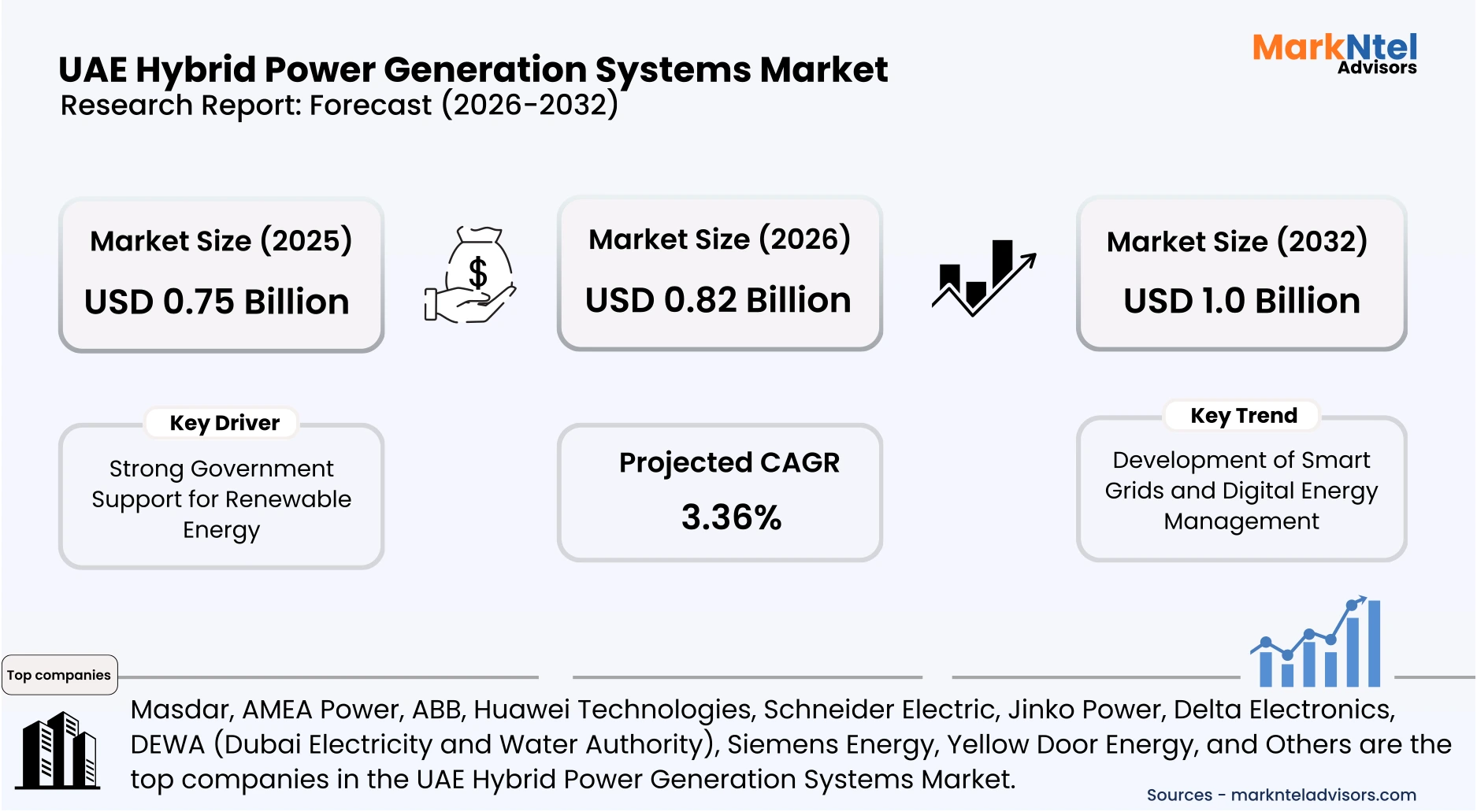
- The UAE Hybrid Power Generation Systems Market size was valued at USD 0.75 billion in 2025 and is projected to grow from USD 0.82 billion in 2026 to USD 1.0 billion by 2032, exhibiting a CAGR of 3.36% during the forecast period.
- Abu Dhabi & Al Ain hold the largest market share of about 45% in the UAE Hybrid Power Generation Systems Market in 2026.
- By technology, the solar–diesel hybrid systems captured a significant share of about 54% in the UAE Hybrid Power Generation Systems Market in 2026.
- By deployment type, the on-grid hybrid systems segment seized a significant share of about 74% in the UAE Hybrid Power Generation Systems Market in 2026.
- Leading hybrid power generation systems companies in the UAE are Masdar, AMEA Power, ABB, Huawei Technologies, Schneider Electric, Jinko Power, Delta Electronics, DEWA (Dubai Electricity and Water Authority), Siemens Energy, Yellow Door Energy, and Others.
Market Insights & Analysis: UAE Hybrid Power Generation Systems Market (2026-32):
The UAE Hybrid Power Generation Systems Market size was valued at USD 0.75 billion in 2025 and is projected to grow from USD 0.82 billion in 2026 to USD 1.0 billion by 2032. Along with this, the market is estimated to grow at a CAGR of around 3.36% during the forecast period, i.e., 2026-32.
The UAE hybrid power generation systems market is experiencing steady expansion as the country accelerates its transition toward a diversified and low-carbon energy mix. Hybrid power systems combining renewable sources such as solar with storage technologies or conventional generation are becoming increasingly important for ensuring a reliable electricity supply while supporting national sustainability targets.
One of the major growth drivers is strong government support for renewable energy deployment. The UAE government continues to invest heavily in large-scale renewable infrastructure as part of long-term energy transition strategies. National initiatives aimed at expanding clean energy capacity are encouraging utilities and private sector stakeholders to adopt hybrid energy solutions that integrate renewable generation with energy storage or backup power systems. These systems help maintain grid stability while reducing dependence on fossil fuels.
Recent developments also highlight the growing importance of hybrid power solutions in the country’s energy sector. During Abu Dhabi Sustainability Week 2025, the UAE announced the development of a large-scale renewable power station combining solar generation with battery storage technology. The hybrid facility is designed to deliver stable, clean electricity and support the country’s long-term objective of providing round-the-clock renewable power . Such initiatives demonstrate how hybrid energy systems are becoming a key component of the UAE’s future electricity infrastructure.
The market is also benefiting from the rapid adoption of smart grids and digital energy management technologies. Utilities across the UAE are implementing advanced metering systems, automated grid control, and real-time monitoring platforms to improve electricity efficiency and reliability. These digital technologies make it easier to integrate renewable energy sources into the grid and optimize hybrid power generation systems across commercial, industrial, and utility-scale applications.
Regional energy development further supports market expansion. While Abu Dhabi and Dubai remain the primary hubs for renewable power projects, other regions such as Sharjah and the Northern Emirates are gradually strengthening their renewable infrastructure through federal and local initiatives. Under the UAE Energy Strategy 2050, the government plans to significantly expand renewable capacity and invest between USD 40 billion and USD 54 billion in energy infrastructure by 2030 to meet growing electricity demand and improve energy security .
Looking ahead, future investment plans are expected to further accelerate the adoption of hybrid power technologies. The Emirates Water and Electricity Company (EWEC) aims to increase Abu Dhabi’s solar generation capacity to around 18 GW by 2035, reflecting the country’s commitment to expanding renewable energy capacity. As solar installations increase, hybrid systems integrating renewable generation with storage will play a critical role in balancing power supply and ensuring reliable electricity delivery .
Overall, strong government policies, rising renewable investments, and ongoing grid modernization efforts are expected to drive the UAE hybrid power generation systems market in the coming years. As the country continues expanding its renewable energy capacity, hybrid power solutions will remain essential for maintaining grid stability, improving energy efficiency, and supporting long-term sustainable energy development.
UAE Hybrid Power Generation Systems Market Recent Developments:
- 2025: Masdar unveiled a large renewable hybrid facility in Abu Dhabi integrating 5.2 GW solar PV with 19 GWh battery storage, with an investment of around USD 6 billion. The project is designed to provide 1 GW of continuous clean electricity, enabling round-the-clock renewable power generation.
- 2025: DEWA added 800 MW of new clean energy capacity through the Mohammed bin Rashid Al Maktoum Solar Park. The project integrates photovoltaic solar and energy-storage technologies to support hybrid power generation and strengthen Dubai’s clean-energy grid infrastructure.
UAE Hybrid Power Generation Systems Market Scope:
| Category | Segments |
|---|---|
| By Technology | (Solar–Diesel Hybrid Systems, Wind–Diesel Hybrid Systems, Solar–Wind Hybrid Systems, Solar–Wind–Diesel Hybrid Systems, Others), |
| By Deployment Type | (On-Grid Hybrid Systems, Off-Grid Hybrid Systems, Microgrid Hybrid Systems), |
| By Power Rating | (Up to 10 kW, 11 kW – 100 kW, Above 100 kW), |
| By Capacity | (Less than 100 kWh, 100 kWh to 1 MWh, More than 1 MWh), |
| By End-User | (Commercial, Industrial, Residential), |
UAE Hybrid Power Generation Systems Market Driver:
Strong Government Support for Renewable Energy
Government policy and large-scale public investment in clean energy are major forces accelerating the UAE hybrid power generation systems market. The UAE government has implemented long-term strategies such as the UAE Energy Strategy 2050, which aims to diversify the national energy mix while reducing carbon emissions. As part of this strategy, the government plans to invest more than USD 163 billion in renewable and clean energy projects by 2050 to meet rising electricity demand and ensure sustainable economic growth .
In addition, the UAE is rapidly expanding renewable capacity through large solar infrastructure programs led by government utilities. The Mohammed bin Rashid Al Maktoum Solar Park in Dubai, developed by Dubai Electricity and Water Authority, is one of the world’s largest solar projects, with installed capacity already reaching 3,860 MW and plans to expand to over 8,000 MW by 2030 . The UAE has also set national targets to achieve 14.2 GW of renewable energy capacity by 2030, reflecting the country’s long-term commitment to clean energy expansion .
Government programs are also strengthening grid modernization and encouraging private investment through independent power producer (IPP) models and public-private partnerships. These initiatives support large renewable installations while ensuring a stable power supply through hybrid solutions that combine solar, storage, and conventional generation.
Looking beyond 2025, the UAE plans to significantly increase solar capacity and continue expanding renewable projects through 2030 and beyond. Such large-scale renewable deployment will require hybrid power systems to manage intermittency, improve reliability, and stabilize the electricity grid.
Strong policy backing, large public investments, and ambitious renewable capacity targets are creating a favorable environment for hybrid energy solutions. As renewable installations expand, hybrid power systems will play a critical role in balancing energy supply, thereby driving sustained market growth in the UAE.
UAE Hybrid Power Generation Systems Market Trend:
Development of Smart Grids and Digital Energy Management
The UAE energy sector is increasingly adopting smart grids and digital energy management systems, which are emerging as a key trend supporting the growth of hybrid power generation systems. Smart grids enable real-time monitoring, automated power management, and efficient integration of renewable energy sources such as solar and wind into national electricity networks. These digital systems are essential for managing fluctuating renewable power generation and ensuring a stable electricity supply.
Government-led utilities are heavily investing in advanced grid infrastructure. For example, the Dubai Electricity and Water Authority (DEWA) is implementing a large-scale smart grid program with total investments of approximately USD 1.9 billion extending to 2035. The program integrates technologies such as artificial intelligence, big data analytics, and automated grid restoration systems to enhance operational efficiency and reliability .
Digital transformation is already visible in grid operations. By 2024, Dubai achieved 100% smart meter coverage, deploying more than 1.2 million smart electricity meters and over 1.1 million smart water meters, enabling real-time monitoring and energy management across the network. These systems process over 15 million data points daily, improving predictive maintenance and system performance .
Looking ahead, smart grid expansion aligned with the Dubai Clean Energy Strategy 2050 will support large-scale renewable integration and distributed energy resources. Hybrid power systems combined with digital grid technologies will therefore play a crucial role in ensuring reliable and efficient electricity supply across the UAE.
The rapid deployment of smart grids and digital energy platforms is transforming the UAE’s power infrastructure. As renewable generation increases, these digital systems will accelerate the adoption of hybrid power solutions, supporting long-term market growth.
UAE Hybrid Power Generation Systems Market Opportunity:
Rising Demand for Sustainable Power Solutions in Commercial Facilities
The increasing demand for sustainable energy solutions in commercial and industrial facilities is creating significant opportunities for the UAE's hybrid power generation systems industry. Businesses across the UAE are adopting renewable energy technologies to reduce electricity costs, lower carbon emissions, and meet national sustainability targets aligned with the country’s Net Zero by 2050 strategy.
Government programs are actively encouraging commercial buildings to install renewable power systems. For example, the Dubai Electricity and Water Authority (DEWA) launched the Shams Dubai initiative, which allows commercial and residential building owners to install rooftop solar systems and connect them to the grid. By 2025, more than 8,430 buildings in Dubai had installed rooftop solar systems with a combined capacity exceeding 725 MW .
The program has also stimulated participation from the private sector ecosystem, with over 111 certified companies authorized to design and install solar systems under the initiative. This expanding market indicates strong interest from commercial property owners such as shopping malls, logistics warehouses, and office buildings seeking cleaner and more cost-efficient electricity.
As commercial facilities integrate rooftop solar and distributed renewable systems, hybrid power generation combining solar, storage, and backup generation becomes essential to maintain a stable electricity supply. These systems allow businesses to store excess solar energy and ensure uninterrupted power during peak demand or low solar generation.
UAE Hybrid Power Generation Systems Market Challenge:
High Initial Capital Investment
High upfront capital investment remains a major challenge for the UAE hybrid power generation systems market. Hybrid power systems combine multiple technologies such as solar photovoltaic panels, battery storage, control systems, and backup generators, which significantly increases the initial installation cost compared with conventional single-source power systems. These investments can create financial barriers for small businesses and independent power producers despite long-term operational savings.
Large renewable projects in the UAE illustrate the scale of capital required for such integrated energy systems. For example, the Noor Abu Dhabi solar power plant, one of the largest solar installations in the region, required an investment of approximately USD 870 million to build a 1.17 GW solar facility using over 3.2 million solar panels . While the project provides electricity to tens of thousands of consumers, the high construction cost highlights the significant capital requirements associated with large-scale renewable infrastructure.
Similarly, the Al Dhafra Solar PV project in Abu Dhabi, with a capacity of 2 GW, required around USD 1 billion in project investment, involving multiple international partners and financial institutions . Hybrid power systems often require additional investments in battery storage and advanced energy management systems, which can further increase overall project costs.
Such high capital requirements may slow adoption among smaller industrial facilities or off-grid commercial users that lack access to large financing mechanisms. Although government support and declining technology costs are gradually improving project economics, the substantial upfront investment remains a key barrier to widespread hybrid power system deployment.
High capital expenditure continues to be a major constraint for hybrid energy projects in the UAE. However, as financing models, public-private partnerships, and technology costs improve, the market is expected to gradually overcome this barrier and expand in the coming
UAE Hybrid Power Generation Systems Market (2026-32) Segmentation Analysis:
The UAE Hybrid Power Generation Systems Market study of MarkNtel Advisors evaluates & highlights the major trends and influencing factors in each segment. It includes predictions for the period 2026–32 at the country level. Based on the analysis, the market has been further classified as;
Based on Technology:
- Solar–Diesel Hybrid Systems
- Wind–Diesel Hybrid Systems
- Solar–Wind Hybrid Systems
- Solar–Wind–Diesel Hybrid Systems
- Others
Solar–diesel hybrid systems dominate the UAE hybrid power generation systems market, accounting for around 54% of the total market value. This leadership is mainly driven by the country’s high solar irradiation levels and the continued need for reliable backup power in remote or energy-intensive applications. Many industrial facilities, construction sites, oil and gas operations, and off-grid infrastructure still rely on diesel generators for a consistent power supply. By integrating solar photovoltaic panels with diesel generators, companies can significantly reduce fuel consumption, operating costs, and carbon emissions while maintaining power reliability. The hybrid configuration allows solar energy to supply electricity during daylight hours, while diesel generators operate when solar output declines.
Additionally, government initiatives promoting renewable energy adoption and sustainability are encouraging businesses to adopt solar-diesel hybrid solutions. These systems are also relatively easier to install compared with more complex hybrid combinations, which further supports their widespread adoption across commercial and industrial sectors in the UAE.
Based on Deployment Type:
-
- On-Grid Hybrid Systems
- Off-Grid Hybrid Systems
- Microgrid Hybrid Systems
On-grid hybrid systems hold the largest share in the UAE hybrid power generation systems market, with about 74% market share. Their dominance is largely attributed to the country’s well-developed power grid infrastructure and strong policy support for grid-connected renewable energy projects. On-grid hybrid systems combine renewable energy sources such as solar or wind with conventional power sources while remaining connected to the national electricity grid. This configuration allows users to draw electricity from the grid whenever renewable generation is insufficient and export excess renewable power back to the grid when production is high.
In the UAE, utilities and government entities are actively investing in large-scale solar projects and hybrid energy installations to improve energy efficiency and grid stability. Commercial buildings, industrial facilities, and public infrastructure increasingly adopt on-grid hybrid systems to reduce electricity costs and meet sustainability targets. As renewable capacity continues to expand across the country, grid-connected hybrid solutions are expected to remain the preferred deployment model.
UAE Hybrid Power Generation Systems Market (2026-32): Regional Projection
The UAE Hybrid Power Generation Systems Market is primarily dominated by Abu Dhabi & Al Ain, accounting for approximately 45% of the total market size. The region’s leadership is driven by its large-scale renewable energy investments, strong government policies, and the presence of major energy authorities and utility companies. Abu Dhabi hosts several large solar and hybrid power projects, including utility-scale renewable developments led by organizations such as Masdar and the Emirates Water and Electricity Company (EWEC). These projects integrate solar energy with advanced storage and backup generation systems to ensure a reliable electricity supply.
Additionally, Abu Dhabi and Al Ain have extensive industrial zones, oil and gas operations, and infrastructure developments that require stable and continuous power, which increases the demand for hybrid power generation systems. The government’s long-term clean energy strategy and ongoing investments in renewable capacity expansion further support the region’s dominance, making Abu Dhabi & Al Ain the central hub for hybrid power deployment in the UAE.
Gain a Competitive Edge with Our UAE Hybrid Power Generation Systems Market Report:
- UAE Hybrid Power Generation Systems Market Report by MarkNtel Advisors provides a detailed & thorough analysis of market size & share, growth rate, competitive landscape, and key players. This comprehensive analysis helps businesses gain a holistic understanding of the market dynamics & make informed decisions.
- This report also highlights current market trends & future projections, allowing businesses to identify emerging opportunities & potential challenges. By understanding market forecasts, companies can align their strategies & stay ahead of the competition.
- UAE Hybrid Power Generation Systems Market Report aids in assessing & mitigating risks associated with entering or operating in the market. By understanding market dynamics, regulatory frameworks, and potential challenges, businesses can develop strategies to minimize risks & optimize their operations.
*Reports Delivery Format - Market research studies from MarkNtel Advisors are offered in PDF, Excel and PowerPoint formats. Within 24 hours of the payment being successfully received, the report will be sent to your email address.
Frequently Asked Questions
- Market Segmentation
- Introduction
- Product Definition
- Research Process
- Assumptions
- Executive Summary
- UAE Hybrid Power Generation Systems Market Policies, Regulations, and Product Standards
- UAE Hybrid Power Generation Systems Market Trends & Developments
- UAE Hybrid Power Generation Systems Market Dynamics
- Growth Factors
- Challenges
- UAE Hybrid Power Generation Systems Market Hotspot & Opportunities
- UAE Hybrid Power Generation Systems Market Outlook, 2022-2032F
- Market Size & Outlook
- By Revenues (USD Million)
- Market Share & Outlook
- By Technology- Market Size & Forecast 2022-2032, USD Million
- Solar–Diesel Hybrid Systems
- Wind–Diesel Hybrid Systems
- Solar–Wind Hybrid Systems
- Solar–Wind–Diesel Hybrid Systems
- Others
- By Deployment Type- Market Size & Forecast 2022-2032, USD Million
- On-Grid Hybrid Systems
- Off-Grid Hybrid Systems
- Microgrid Hybrid Systems
- By Power Rating- Market Size & Forecast 2022-2032, USD Million
- Up to 10 kW
- 11 kW – 100 kW
- Above 100 kW
- By Capacity- Market Size & Forecast 2022-2032, USD Million
- Less than 100 kWh
- 100 kWh to 1 MWh
- More than 1 MWh
- By End-User- Market Size & Forecast 2022-2032, USD Million
- Commercial
- Industrial
- Residential
- By Region- Market Size & Forecast 2022-2032, USD Million
- Abu Dhabi & Al Ain
- Dubai
- Sharjah & Northern Emirates
- By Company
- Competition Characteristics
- Market Share & Analysis
- By Technology- Market Size & Forecast 2022-2032, USD Million
- Market Size & Outlook
- UAE Solar–Diesel Hybrid Systems Market Outlook, 2022-2032
- Market Size & Outlook
- By Revenues (USD Million)
- Market Share & Outlook
- By Deployment Type- Market Size & Forecast 2022-2032, USD Million
- By Power Rating- Market Size & Forecast 2022-2032, USD Million
- By Capacity- Market Size & Forecast 2022-2032, USD Million
- By End-User- Market Size & Forecast 2022-2032, USD Million
- By Region- Market Size & Forecast 2022-2032, USD Million
- Market Size & Outlook
- UAE Wind–Diesel Hybrid Systems Market Outlook, 2022-2032
- Market Size & Outlook
- By Revenues (USD Million)
- Market Share & Outlook
- By Deployment Type- Market Size & Forecast 2022-2032, USD Million
- By Power Rating- Market Size & Forecast 2022-2032, USD Million
- By Capacity- Market Size & Forecast 2022-2032, USD Million
- By End-User- Market Size & Forecast 2022-2032, USD Million
- By Region- Market Size & Forecast 2022-2032, USD Million
- Market Size & Outlook
- UAE Solar–Wind Hybrid Systems Market Outlook, 2022-2032
- Market Size & Outlook
- By Revenues (USD Million)
- Market Share & Outlook
- By Deployment Type- Market Size & Forecast 2022-2032, USD Million
- By Power Rating- Market Size & Forecast 2022-2032, USD Million
- By Capacity- Market Size & Forecast 2022-2032, USD Million
- By End-User- Market Size & Forecast 2022-2032, USD Million
- By Region- Market Size & Forecast 2022-2032, USD Million
- Market Size & Outlook
- UAE Solar–Wind–Diesel Hybrid Systems Market Outlook, 2022-2032
- Market Size & Outlook
- By Revenues (USD Million)
- Market Share & Outlook
- By Deployment Type- Market Size & Forecast 2022-2032, USD Million
- By Power Rating- Market Size & Forecast 2022-2032, USD Million
- By Capacity- Market Size & Forecast 2022-2032, USD Million
- By End-User- Market Size & Forecast 2022-2032, USD Million
- By Region- Market Size & Forecast 2022-2032, USD Million
- Market Size & Outlook
- UAE Hybrid Power Generation Systems Market Key Strategic Imperatives for Success & Growth
- Competitive Outlook
- Company Profiles
- Masdar
- Business Description
- Product Portfolio
- Collaborations & Alliances
- Recent Developments
- Financial Details
- Others
- AMEA Power
- Business Description
- Product Portfolio
- Collaborations & Alliances
- Recent Developments
- Financial Details
- Others
- ABB
- Business Description
- Product Portfolio
- Collaborations & Alliances
- Recent Developments
- Financial Details
- Others
- Huawei Technologies
- Business Description
- Product Portfolio
- Collaborations & Alliances
- Recent Developments
- Financial Details
- Others
- Schneider Electric
- Business Description
- Product Portfolio
- Collaborations & Alliances
- Recent Developments
- Financial Details
- Others
- Jinko Power
- Business Description
- Product Portfolio
- Collaborations & Alliances
- Recent Developments
- Financial Details
- Others
- Delta Electronics
- Business Description
- Product Portfolio
- Collaborations & Alliances
- Recent Developments
- Financial Details
- Others
- DEWA (Dubai Electricity and Water Authority)
- Business Description
- Product Portfolio
- Collaborations & Alliances
- Recent Developments
- Financial Details
- Others
- Siemens Energy
- Business Description
- Product Portfolio
- Collaborations & Alliances
- Recent Developments
- Financial Details
- Others
- Yellow Door Energy
- Business Description
- Product Portfolio
- Collaborations & Alliances
- Recent Developments
- Financial Details
- Others
- Masdar
- Company Profiles
- Disclaimer
MarkNtel Advisors follows a robust and iterative research methodology designed to ensure maximum accuracy and minimize deviation in market estimates and forecasts. Our approach combines both bottom-up and top-down techniques to effectively segment and quantify various aspects of the market. A consistent feature across all our research reports is data triangulation, which examines the market from three distinct perspectives to validate findings. Key components of our research process include:
1. Scope & Research Design At the outset, MarkNtel Advisors define the research objectives and formulate pertinent questions. This phase involves determining the type of research—qualitative or quantitative—and designing a methodology that outlines data collection methods, target demographics, and analytical tools. They also establish timelines and budgets to ensure the research aligns with client goals.
2. Sample Selection and Data Collection In this stage, the firm identifies the target audience and determines the appropriate sample size to ensure representativeness. They employ various sampling methods, such as random or stratified sampling, based on the research objectives. Data collection is carried out using tools like surveys, interviews, and observations, ensuring the gathered data is reliable and relevant.
3. Data Analysis and Validation Once data is collected, MarkNtel Advisors undertake a rigorous analysis process. This includes cleaning the data to remove inconsistencies, employing statistical software for quantitative analysis, and thematic analysis for qualitative data. Validation steps are taken to ensure the accuracy and reliability of the findings, minimizing biases and errors.

4. Data Forecast and FinalizationThe final phase involves forecasting future market trends based on the analyzed data. MarkNtel Advisors utilize predictive modeling and time series analysis to anticipate market behaviors. The insights are then compiled into comprehensive reports, featuring visual aids like charts and graphs, and include strategic recommendations to inform client decision-making
We offer flexible licensing options to cater to varying organizational needs. Choose the pricing pack that best suits your requirements:
Buy Now Inquire Before Buying
 Request Customization
 Talk to our Consultant







