

UAE Fluid & Lubricants for Electric Vehicles Market Research Report: Size, Share, Trends & Forecast (2026-2032)
By Product Type (Engine Oil, Greases, Heat Transfer Fluids, Coolants, Other Fluids), By Demand Type (OEM, Aftermarket), By Vehicle Type (Passenger EVs, Commercial EVs, Two/Three-Wh ... eelers), By Propulsion Type (Battery Electric Vehicles (BEVs), Hybrid Electric Vehicles (HEVs), Plug-in Hybrid Electric Vehicles (PHEVs)), and others Read more
- Automotive
- Mar 2026
- Pages 170
- Report Format: PDF, Excel, PPT
UAE Fluid & Lubricants for Electric Vehicles Market
Projected 30.46% CAGR from 2026 to 2032
Study Period
2026-2032
Market Size (2026)
USD 6.11 Million
Market Size (2032)
USD 30.12 Million
Base Year
2025
Projected CAGR
30.46%
Leading Segments
By Product Type: Heat Transfer Fluids
UAE Fluid & Lubricants for Electric Vehicles Market Report Key Takeaways:
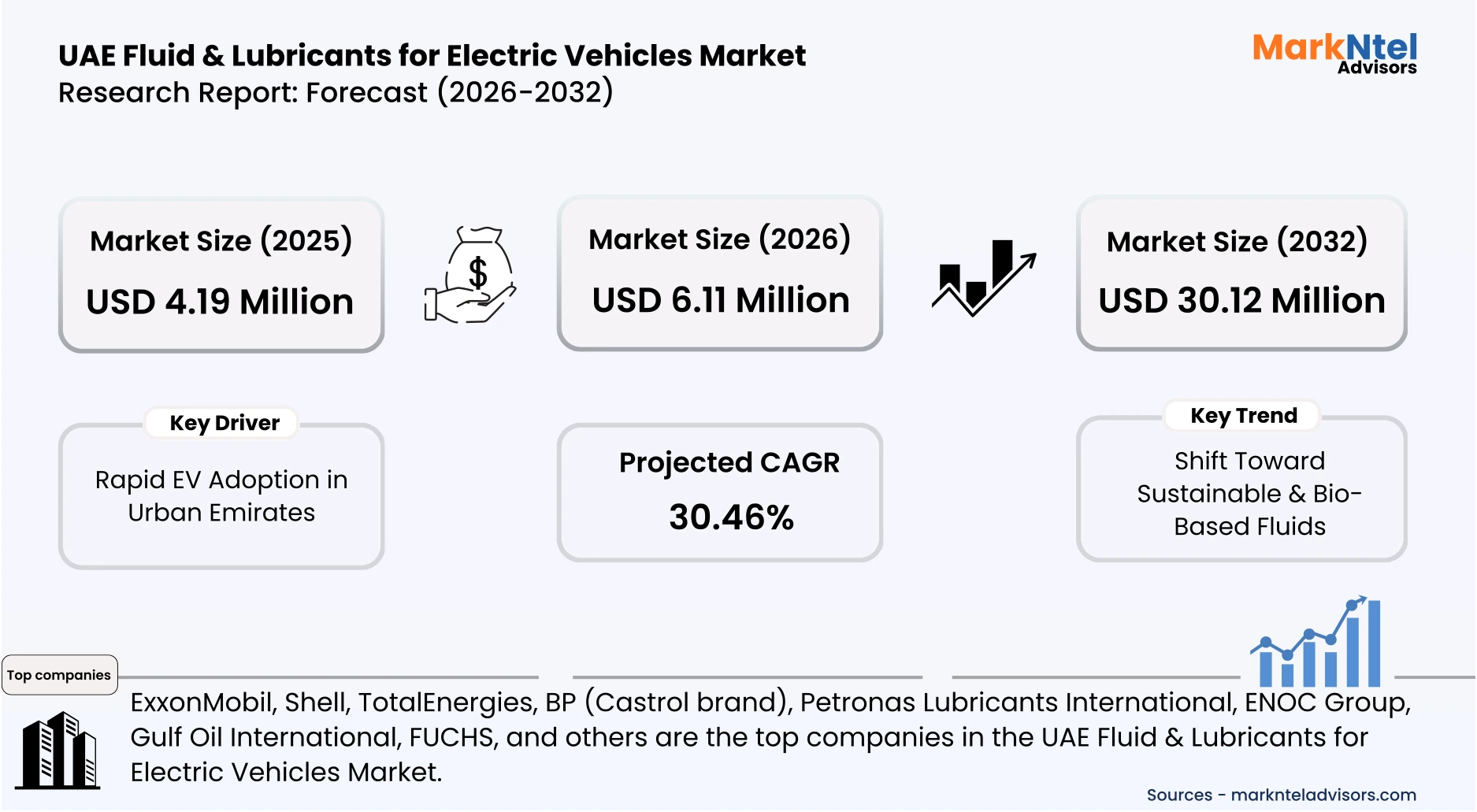
- The UAE Fluid & Lubricants for Electric Vehicles Market size was valued at around USD 4.19 million in 2025 and is projected grow from USD 6.11 million in 2026 to USD 30.12 million by 2032, exhibiting a CAGR of 30.46% during the forecast period.
- Dubai holds the largest market share of about 45% in the UAE Fluid & Lubricants for Electric Vehicles Market in 2026.
- By Product Type, the Heat Transfer Fluids segment represented a significant share of about 35% in the UAE Fluid & Lubricants for Electric Vehicles Market in 2026.
- By Propulsion Type, the Battery Electric Vehicles (BEVs) segment presented a significant share of about 68% in the UAE Fluid & Lubricants for Electric Vehicles Market in 2026.
- Leading Fluid & Lubricants for Electric Vehicles companies in the UAE are ExxonMobil, Shell, TotalEnergies, BP (Castrol brand), Petronas Lubricants International, ENOC Group, Gulf Oil International, FUCHS, and Others.
Market Insights & Analysis: UAE Fluid & Lubricants for Electric Vehicles Market (2026-32):
The UAE Fluid & Lubricants for Electric Vehicles Market size was valued at around USD 4.19 million in 2025 and is projected grow from USD 6.11 million in 2026 to USD 30.12 million by 2032, exhibiting a CAGR of 30.46% during the forecast period, i.e., 2026-32.
The UAE Fluid & Lubricants for Electric Vehicles Market has expanded in tandem with the country’s accelerating transition toward clean mobility and economic diversification. National electrification priorities under the Net Zero 2050 framework, reinforced in 2025 by the Ministry of Energy and Infrastructure, have strengthened regulatory certainty for EV deployment. Dubai’s EV Green Charger network now exceeds 1,270 charging points serving more than 40,600 vehicles, reflecting sustained infrastructure scaling. Notably, charging point usage increased by 23.6% compared to the same period in 2024, indicating rising utilization intensity and deepening EV penetration.
Current market dynamics are supported by active participation across residential, commercial, and institutional end-user segments. Residential consumers continue adopting EVs as primary vehicles, while commercial operators, including taxi fleets and logistics providers, integrate BEVs into high-mileage daily operations. ADNOC Distribution’s 2025 launch of a 60-point ultra-fast charging hub along the E11 corridor strengthens intercity fleet mobility. Concurrently, ION’s partnership with the Sharjah Roads and Transport Authority to deploy more than 100 ultra-fast chargers enhances regional charging accessibility and supports institutional electrification strategies.
Industry-led initiatives further reinforce market maturity. In 2025, Petronas Lubricants International established a dedicated NEV Fluids Business Unit to develop and commercialize EV-specific lubricants across the UAE and EMEA markets . ENOC Group simultaneously expanded its EV-focused Elektra range and strengthened its distributor network to address growing hybrid and electric vehicle lubricant demand . These strategic actions signal long-term capital commitment and localized supply chain enhancement aligned with evolving battery and drivetrain technologies.
Looking ahead, continued charging network densification, corporate sustainability mandates, and policy-driven electrification programs are expected to sustain demand growth. Increasing battery capacities and higher fast-charging adoption will elevate technical requirements for advanced thermal management and e-drive fluids. Collaboration between regulators, mobility providers, and lubricant manufacturers strengthens ecosystem integration. Consequently, the UAE EV fluids market is positioned for steady, structurally supported expansion in the coming years.
UAE Fluid & Lubricants for Electric Vehicles Market Recent Developments:
- 2025 : ENOC Group introduced Elektra, a dedicated portfolio of electric and hybrid vehicle fluids at its global distributors meet. This expanded lineup targets EV thermal and drivetrain needs and was showcased after being launched at Automechanika Dubai, reinforcing ENOC’s commitment to EV fluid solutions.
- 2025 : Shell announced its EV-Plus Thermal Fluid with PurePlus Technology can manage all BEV powertrain cooling through a single-fluid system, enhancing efficiency and reducing component complexity significant for hot-climate markets like the UAE.
UAE Fluid & Lubricants for Electric Vehicles Market Scope:
| Category | Segments |
|---|---|
| By Product Type | (Engine Oil, Greases, Heat Transfer Fluids, Coolants, Other Fluids), |
| By Demand Type | (OEM, Aftermarket), |
| By Vehicle Type | (Passenger EVs, Commercial EVs, Two/Three-Wheelers), |
| By Propulsion Type | (Battery Electric Vehicles (BEVs), Hybrid Electric Vehicles (HEVs), Plug-in Hybrid Electric Vehicles (PHEVs)), |
UAE Fluid & Lubricants for Electric Vehicles Market Driver:
Rapid EV Adoption in Urban Emirates
A structurally transformative force shaping the UAE EV fluids and lubricants market is the sustained expansion of electric vehicle adoption across key urban emirates. According to the International Energy Agency (IEA) Global EV Outlook 2025, EV sales in the Middle East maintained double-digit growth during 2024–2025, with the UAE emerging as a regional leader. Supporting this trajectory, Dubai’s Roads and Transport Authority reported that EV registrations increased from 37,486 in 2024 to 47,944 by the end of 2025, representing a 27.9% year-on-year rise . Concurrently, public charging infrastructure surpassed 700 charging points, reinforcing long-term fleet expansion.
This acceleration has been reinforced through structured policy implementation in 2025–2026. The UAE Ministry of Energy and Infrastructure reaffirmed the Net Zero 2050 strategy and strengthened national green mobility frameworks, while Dubai Electricity and Water Authority (DEWA) expanded its Green Charger initiative . Public-sector fleet electrification mandates and procurement reforms in Abu Dhabi and Dubai further institutionalized EV uptake. These measurable increases in registered EV units directly translate into higher demand for battery heat-transfer fluids, advanced coolants, and specialized e-drive lubricants.
The impact of this driver is fundamentally volumetric rather than price-based. Each additional BEV entering operation generates incremental and recurring requirements for thermal management and drivetrain fluids, particularly in extreme climatic conditions exceeding 45°C. As the cumulative EV fleet expands annually, total fluid consumption scales proportionally with vehicle stock growth. Therefore, urban EV adoption structurally enlarges market size and demand volume instead of merely influencing pricing dynamics or temporary purchasing behavior.
UAE Fluid & Lubricants for Electric Vehicles Market Trend:
Shift Toward Sustainable & Bio-Based Fluids
A sustained transition toward sustainable and bio-based lubricants is reshaping the UAE EV fluids market as part of broader national decarbonization efforts. The UAE reaffirmed its Net Zero 2050 Strategy during COP28 follow-up implementation phases in 2025, strengthening industrial sustainability mandates. The Ministry of Climate Change and Environment has expanded green procurement guidelines for public-sector entities. These policy actions are encouraging suppliers to reduce lifecycle emissions associated with automotive fluids.
This shift has accelerated as global OEMs adopt environmental, social, and governance (ESG) targets requiring lower carbon intensity across supply chains. Major energy companies operating in the UAE, including Shell and TotalEnergies, publicly expanded bio-based and low-carbon lubricant portfolios in 2025. In 2025, TotalEnergies Lubrifiants launched its Quartz EV3R and Rubia EV3R lubricant ranges formulated using high-quality regenerated base oils under its “3R” (Reduce, Reuse, Regenerate) eco-design approach, with bottles made from 50% recycled plastic . Such product reformulations alter sourcing models, increasing demand for renewable base oils and advanced additive chemistry. Consequently, distributors and blenders are restructuring procurement strategies toward certified sustainable inputs.
The trend is structural because it aligns with regulatory commitments, corporate ESG compliance, and long-term climate policy enforcement. Government-backed sustainable finance frameworks in 2025 have increased green investment flows, supporting cleaner industrial inputs. As EV adoption grows, environmental scrutiny of supporting materials intensifies, reinforcing demand for low-emission fluid alternatives. Therefore, bio-based and sustainable formulations are positioned to materially influence long-term value chain configuration rather than represent a temporary market preference.
UAE Fluid & Lubricants for Electric Vehicles Market Opportunity:
Creation of Advanced Thermal Management Solutions
The development of advanced thermal management solutions represents a compelling structural opportunity in the UAE EV fluids market. The International Energy Agency’s Global EV Outlook 2025 confirms sustained EV growth across emerging economies, including the Middle East. Simultaneously, the UAE Ministry of Energy and Infrastructure reaffirmed transport electrification measures under the Net Zero 2050 strategy in 2025. High ambient temperatures frequently exceeding 45°C intensify battery cooling requirements, creating urgent demand for high-performance dielectric and immersion-based thermal fluids.
This opportunity exists because battery efficiency, safety, and lifespan are directly linked to effective temperature control, particularly in extreme climates. The UAE’s expansion of public charging networks through DEWA in 2025 increases fast-charging usage, which elevates battery heat loads. In 2025, Shell demonstrated its EV-Plus Thermal Fluid capable of enabling 10%–80% battery charging in under 10 minutes using non-conductive GTL-based technology that significantly reduces thermal stress while maintaining battery safety and lifespan . As charging intensity rises, OEMs and fleet operators require specialized cooling formulations to prevent thermal degradation. Consequently, measurable growth in EV stock and charging density translates into scalable, recurring demand for advanced heat-transfer technologies.
The segment is advantageous for new entrants because it remains innovation-driven rather than commoditized. Established lubricant majors maintain diversified portfolios, while niche players can specialize in climate-optimized dielectric chemistries. Smaller firms can collaborate with local universities and technology hubs to develop tailored solutions suited to Gulf operating conditions. As EV penetration structurally expands, thermal management innovation will remain central to long-term market evolution rather than a short-term niche.
UAE Fluid & Lubricants for Electric Vehicles Market Challenge:
Lower Fluid Replacement Frequency in EVs
A critical structural challenge constraining the UAE EV fluids market is the sharp reduction in recurring lubricant replacement cycles associated with battery electric vehicles. The International Energy Agency’s Global EV Outlook 2025 reports that EV adoption displaced over 1.3 million barrels per day of oil globally in 2024, reflecting a systemic shift away from combustion-based mobility . This displacement signals declining reliance on engine-related petroleum products. As the UAE accelerates electrification under its Net Zero 2050 strategy, traditional lubricant intensity per vehicle structurally declines.
This challenge disproportionately affects the aftermarket segment, where engine oil changes historically generated stable, repeat revenues for distributors and service workshops. Unlike internal combustion vehicles, BEVs eliminate combustion-engine lubrication systems, removing one of the highest-frequency service interventions. Consequently, rising EV registrations do not proportionally increase aftermarket lubricant turnover. While fleet numbers expand, the elimination of routine oil-change cycles compresses recurring revenue streams across independent garages and regional blending operations.
The constraint materially restricts long-term scalability and investment confidence. Reduced service frequency lengthens revenue cycles and intensifies competition for a smaller pool of recurring demand. Smaller lubricant brands and aftermarket-focused distributors face structural revenue pressure as fleet electrification progresses. Therefore, lower fluid replacement frequency represents a systemic growth barrier rather than a temporary market adjustment.
UAE Fluid & Lubricants for Electric Vehicles Market (2026-32) Segmentation Analysis:
The UAE Fluid & Lubricants for Electric Vehicles Market study of MarkNtel Advisors evaluates and highlights the major trends and influencing factors in each segment. It includes predictions for the period 2026–32 at the country level. Based on the analysis, the market has been further classified as;
Based on Product Type:
- Engine Oil
- Greases
- Heat Transfer Fluids
- Coolants
- Other Fluids
The Heat Transfer Fluids segment dominates the UAE Fluid & Lubricants for Electric Vehicles Market, accounting for approximately 35% of total demand, primarily because battery systems represent the most performance-critical component within electric vehicles. Unlike greases or auxiliary lubricants that serve localized mechanical functions, thermal fluids regulate battery temperature, power electronics stability, and charging efficiency. As BEVs form the majority of the UAE’s EV mix, battery-centric fluid demand structurally outweighs other product categories. This functional centrality positions heat transfer fluids as indispensable to vehicle reliability and efficiency.
Technological evolution further reinforces this leadership. In 2025, Castrol partnered with Lion Smart to develop a high-performance battery module utilizing direct immersion cooling with dielectric thermal fluids, enabling faster charging, improved heat dissipation, enhanced power density, and greater operational safety . Direct battery cooling increases fluid dependency by submerging cells within specialized non-conductive fluids, expanding both volume intensity and technical value per vehicle. Such integration embeds thermal fluids directly into battery architecture rather than treating them as peripheral consumables.
Additionally, premium passenger EVs and electrified commercial fleets in the UAE increasingly deploy larger battery capacities, raising thermal management complexity. Larger packs generate greater heat during operation and high-power charging cycles, requiring advanced fluid formulations with strong dielectric stability and oxidation resistance. Compared to transmission fluids or greases, heat transfer solutions carry higher system dependency and performance influence. Consequently, structural reliance on battery cooling technology sustains heat transfer fluids as the dominant product segment.
Based on Propulsion Type:
- Battery Electric Vehicles (BEVs)
- Hybrid Electric Vehicles (HEVs)
- Plug-in Hybrid Electric Vehicles (PHEVs)
The Battery Electric Vehicles (BEVs) segment dominates the UAE Fluid & Lubricants for Electric Vehicles Market, accounting for approximately 68% of total demand, primarily due to policy-backed infrastructure expansion and regulatory prioritization of fully electric mobility. The International Energy Agency’s Global EV Outlook 2025 highlights accelerating BEV adoption across emerging markets. In 2025, Dubai Electricity and Water Authority (DEWA) signed agreements with Dubai Taxi Company to deploy 208 ultra-fast chargers and with Parkin to install 100 public chargers, while also partnering with ENOC to integrate EV charging into fuel stations. This infrastructure investment structurally favors BEVs over HEVs and PHEVs .
Infrastructure scale-up directly strengthens BEV economics in both private and commercial segments. Ultra-fast charging deployment at taxi sites enhances fleet electrification viability, while expansion across public parking and service stations improves consumer accessibility. As charging convenience increases, reliance on fully electric drivetrains becomes more practical than hybrid alternatives. This accelerates BEV penetration within the overall EV mix.
From a fluids perspective, BEVs generate higher demand for advanced dielectric coolants and dedicated e-drive lubricants compared to hybrid systems. Full electrification requires continuous battery and power electronics thermal regulation, increasing value contribution per vehicle. Consequently, infrastructure-led adoption and higher per-unit fluid intensity collectively reinforce BEVs as the leading propulsion segment in the UAE EV fluids market.
UAE Fluid & Lubricants for Electric Vehicles Market (2026-32): Regional Projection
Dubai dominates the UAE Fluid & Lubricants for Electric Vehicles Market, accounting for approximately 45% of total demand, primarily because it represents the country’s largest concentration of EV ownership and automotive economic activity. As the UAE’s primary commercial and financial center, Dubai hosts the highest density of private vehicle registrations, luxury automotive sales, and corporate fleet operators. Higher vehicle ownership rates translate directly into a larger installed EV base, which proportionally increases demand for EV-specific thermal fluids and drivetrain lubricants. In 2025, SERES inaugurated its first luxury EV showroom in Dubai in partnership with Green Motors, further reinforcing the emirate’s position as a focal point for premium electric vehicle expansion and sales concentration .
Dubai’s infrastructure leadership further strengthens this dominance. The emirate now operates more than 1,270 EV charging points serving approximately 40,600 vehicles under the EV Green Charger initiative, the region’s first public charging network launched in 2014. This extensive charging footprint enhances accessibility and accelerates daily EV utilization across private and commercial segments. The government’s long-term objective to raise the share of electric and hybrid vehicles to 50% of total vehicles by 2050 aligns infrastructure expansion with national clean energy and carbon neutrality strategies .
The emirate’s broader economic ecosystem amplifies its market share. Dubai’s logistics, tourism, and ride-hailing sectors generate higher vehicle utilization compared to other emirates, increasing system wear and fluid intensity over time. Additionally, Dubai serves as the UAE’s primary automotive distribution and aftermarket services hub, concentrating dealerships, service centers, and lubricant suppliers. This combination of fleet density, infrastructure maturity, and commercial centrality structurally positions Dubai ahead of other regions in EV fluid demand.
Gain a Competitive Edge with Our UAE Fluid & Lubricants for Electric Vehicles Market Report:
- UAE Fluid & Lubricants for Electric Vehicles Market Report by MarkNtel Advisors provides a detailed & thorough analysis of market size & share, growth rate, competitive landscape, and key players. This comprehensive analysis helps businesses gain a holistic understanding of the market dynamics & make informed decisions.
- This report also highlights current market trends & future projections, allowing businesses to identify emerging opportunities & potential challenges. By understanding market forecasts, companies can align their strategies & stay ahead of the competition.
- UAE Fluid & Lubricants for Electric Vehicles Market Report aids in assessing & mitigating risks associated with entering or operating in the market. By understanding market dynamics, regulatory frameworks, and potential challenges, businesses can develop strategies to minimize risks & optimize their operations.
*Reports Delivery Format - Market research studies from MarkNtel Advisors are offered in PDF, Excel and PowerPoint formats. Within 24 hours of the payment being successfully received, the report will be sent to your email address.
Frequently Asked Questions
- Market Segmentation
- Introduction
- Product Definition
- Research Process
- Assumptions
- Executive Summary
- UAE Fluid & Lubricants for Electric Vehicles Market Policies, Regulations, and Product Standards
- UAE Fluid & Lubricants for Electric Vehicles Market Trends & Developments
- UAE Fluid & Lubricants for Electric Vehicles Market Dynamics
- Growth Factors
- Challenges
- UAE Fluid & Lubricants for Electric Vehicles Market Hotspot & Opportunities
- UAE Fluid & Lubricants for Electric Vehicles Market Outlook, 2022-2032F
- Market Size & Outlook
- By Revenues (USD Million)
- By Volume (Thousand Tons)
- Market Share & Outlook
- By Product Type- Market Size & Forecast 2022-2032, USD Million & Thousand Tons
- Engine Oil
- Greases
- Heat Transfer Fluids
- Coolants
- Other Fluids
- By Demand Type- Market Size & Forecast 2022-2032, USD Million & Thousand Tons
- OEM
- Aftermarket
- By Vehicle Type- Market Size & Forecast 2022-2032, USD Million & Thousand Tons
- Passenger EVs
- Commercial EVs
- Two/Three-Wheelers
- By Propulsion Type- Market Size & Forecast 2022-2032, USD Million & Thousand Tons
- Battery Electric Vehicles (BEVs)
- Hybrid Electric Vehicles (HEVs)
- Plug-in Hybrid Electric Vehicles (PHEVs)
- By Region - Market Size & Forecast 2022-2032, USD Million & Thousand Tons
- Dubai
- Abu Dhabi
- Sharjah
- Northern Emirates
- By Company
- Competition Characteristics
- Market Share & Analysis
- By Product Type- Market Size & Forecast 2022-2032, USD Million & Thousand Tons
- Market Size & Outlook
- UAE Engine Oil Market Outlook, 2022-2032
- Market Size & Outlook
- By Revenues (USD Million)
- By Volume (Thousand Tons)
- Market Share & Outlook
- By Demand Type- Market Size & Forecast 2022-2032, USD Million & Thousand Tons
- By Vehicle Type- Market Size & Forecast 2022-2032, USD Million & Thousand Tons
- By Propulsion Type- Market Size & Forecast 2022-2032, USD Million & Thousand Tons
- By Region - Market Size & Forecast 2022-2032, USD Million & Thousand Tons
- Market Size & Outlook
- UAE Greases Market Outlook, 2022-2032
- Market Size & Outlook
- By Revenues (USD Million)
- By Volume (Thousand Tons)
- Market Share & Outlook
- By Demand Type- Market Size & Forecast 2022-2032, USD Million & Thousand Tons
- By Vehicle Type- Market Size & Forecast 2022-2032, USD Million & Thousand Tons
- By Propulsion Type- Market Size & Forecast 2022-2032, USD Million & Thousand Tons
- By Region - Market Size & Forecast 2022-2032, USD Million & Thousand Tons
- Market Size & Outlook
- UAE Heat Transfer Fluids Market Outlook, 2022-2032
- Market Size & Outlook
- By Revenues (USD Million)
- By Volume (Thousand Tons)
- Market Share & Outlook
- By Demand Type- Market Size & Forecast 2022-2032, USD Million & Thousand Tons
- By Vehicle Type- Market Size & Forecast 2022-2032, USD Million & Thousand Tons
- By Propulsion Type- Market Size & Forecast 2022-2032, USD Million & Thousand Tons
- By Region - Market Size & Forecast 2022-2032, USD Million & Thousand Tons
- Market Size & Outlook
- UAE Coolants Market Outlook, 2022-2032
- Market Size & Outlook
- By Revenues (USD Million)
- By Volume (Thousand Tons)
- Market Share & Outlook
- By Demand Type- Market Size & Forecast 2022-2032, USD Million & Thousand Tons
- By Vehicle Type- Market Size & Forecast 2022-2032, USD Million & Thousand Tons
- By Propulsion Type- Market Size & Forecast 2022-2032, USD Million & Thousand Tons
- By Region - Market Size & Forecast 2022-2032, USD Million & Thousand Tons
- Market Size & Outlook
- UAE Fluid & Lubricants for Electric Vehicles Market Key Strategic Imperatives for Success & Growth
- Competitive Outlook
- Company Profiles
- ExxonMobil
- Business Description
- Product Portfolio
- Collaborations & Alliances
- Recent Developments
- Financial Details
- Others
- Shell
- Business Description
- Product Portfolio
- Collaborations & Alliances
- Recent Developments
- Financial Details
- Others
- TotalEnergies
- Business Description
- Product Portfolio
- Collaborations & Alliances
- Recent Developments
- Financial Details
- Others
- BP (Castrol brand)
- Business Description
- Product Portfolio
- Collaborations & Alliances
- Recent Developments
- Financial Details
- Others
- Petronas Lubricants International
- Business Description
- Product Portfolio
- Collaborations & Alliances
- Recent Developments
- Financial Details
- Others
- ENOC Group
- Business Description
- Product Portfolio
- Collaborations & Alliances
- Recent Developments
- Financial Details
- Others
- Gulf Oil International
- Business Description
- Product Portfolio
- Collaborations & Alliances
- Recent Developments
- Financial Details
- Others
- FUCHS
- Business Description
- Product Portfolio
- Collaborations & Alliances
- Recent Developments
- Financial Details
- Others
- Others
- Business Description
- Product Portfolio
- Collaborations & Alliances
- Recent Developments
- Financial Details
- Others
- ExxonMobil
- Company Profiles
- Disclaimer
MarkNtel Advisors follows a robust and iterative research methodology designed to ensure maximum accuracy and minimize deviation in market estimates and forecasts. Our approach combines both bottom-up and top-down techniques to effectively segment and quantify various aspects of the market. A consistent feature across all our research reports is data triangulation, which examines the market from three distinct perspectives to validate findings. Key components of our research process include:
1. Scope & Research Design At the outset, MarkNtel Advisors define the research objectives and formulate pertinent questions. This phase involves determining the type of research—qualitative or quantitative—and designing a methodology that outlines data collection methods, target demographics, and analytical tools. They also establish timelines and budgets to ensure the research aligns with client goals.
2. Sample Selection and Data Collection In this stage, the firm identifies the target audience and determines the appropriate sample size to ensure representativeness. They employ various sampling methods, such as random or stratified sampling, based on the research objectives. Data collection is carried out using tools like surveys, interviews, and observations, ensuring the gathered data is reliable and relevant.
3. Data Analysis and Validation Once data is collected, MarkNtel Advisors undertake a rigorous analysis process. This includes cleaning the data to remove inconsistencies, employing statistical software for quantitative analysis, and thematic analysis for qualitative data. Validation steps are taken to ensure the accuracy and reliability of the findings, minimizing biases and errors.

4. Data Forecast and FinalizationThe final phase involves forecasting future market trends based on the analyzed data. MarkNtel Advisors utilize predictive modeling and time series analysis to anticipate market behaviors. The insights are then compiled into comprehensive reports, featuring visual aids like charts and graphs, and include strategic recommendations to inform client decision-making
We offer flexible licensing options to cater to varying organizational needs. Choose the pricing pack that best suits your requirements:
Buy Now Inquire Before Buying
 Request Customization
 Talk to our Consultant







