Latin America Two-Wheeler Market Research Report: Forecast (2026-2032)
Latin America Two-Wheeler Market - By Type (Motorcycles, Scooters, Mopeds), By Capacity (Less Than 100cc, 100-125cc, 126-250cc, 250-500cc, More Than 500cc), By Fuel Type (Gasoline, ... Electric), By Sales Channel (OEM, Aftermarket), By Technology (Manual, Automatic), By End User (Individual Consumers, Commercial Fleets, Institutional/Governmental Fleets), and others Read more
- Automotive
- Dec 2025
- Pages 168
- Report Format: PDF, Excel, PPT
Latin America Two-Wheeler Market
Projected 11.53% CAGR from 2026 to 2032
Study Period
2026-2032
Market Size (2025)
USD 6.19 Billion
Market Size (2032)
USD 13.29 Billion
Base Year
2025
Projected CAGR
11.53%
Leading Segments
By Type: Motorcycles
Latin America Two-Wheeler Market Report Key Takeaways:
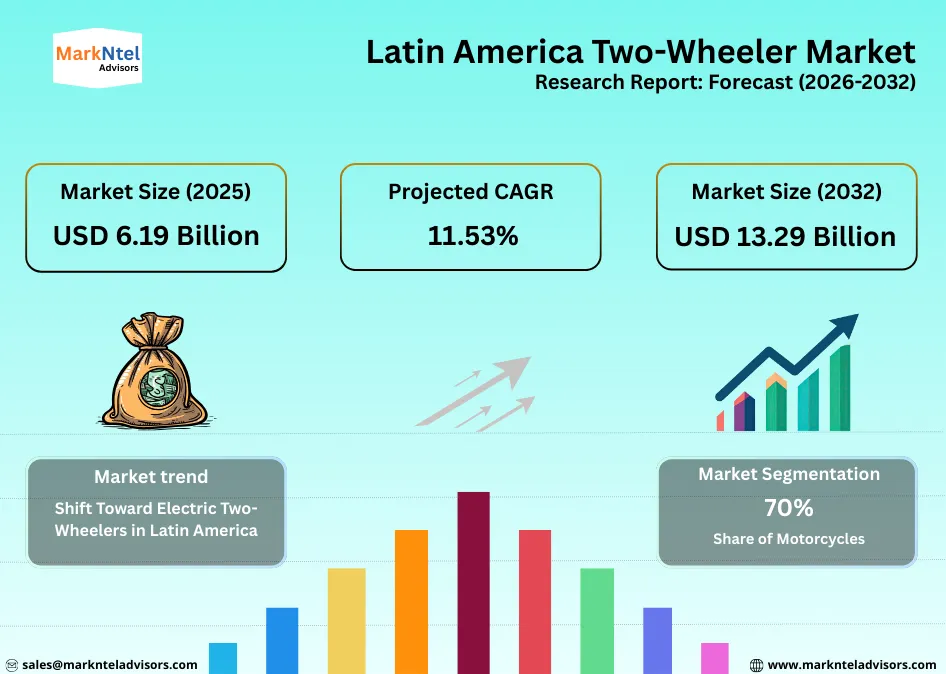
- Market size is valued at around USD6.19 billion in 2025 and is projected to reach USD13.29 billion by 2032. The estimated CAGR from 2026 to 2032 is around 11.53%, indicating strong growth.
- Brazil is dominating this market by accounting for 34% market share in 2025.
- By Capacity, 126-250cc represented a significant share of about 57% in the Latin America Two-Wheeler Market in 2025.
- By Type, Motorcycles represented a significant share of about 70% in the Latin America Two-Wheeler Market in 2025.
- By Fuel Type, the Gasoline (ICE) segment holds a major share of nearly 96% in 2025.
- Leading Two-Wheeler in Latin America are Honda Motor Co. Ltd., Yamaha Motor Co. Ltd., Suzuki Motor Corporation, Dafra Motos, BMW Motorrad, Italika, Bajaj Auto Ltd, TVS Motor Company Ltd, Lifan Ltd., and Others.
Market Insights & Analysis: Latin America Two-Wheeler Market (2026-32):
The Latin America Two-Wheeler Market size is valued at around USD6.19 billion in 2025 and is projected to reach USD13.29 billion by 2032. Along with this, the market is estimated to grow at a CAGR of around 11.53% during the forecast period, i.e., 2026-32.
The Latin America Two-Wheeler Market is gaining momentum as motorcycles become essential for daily mobility, to avoid traffic congestion, and urban efficiency. For instance, the United Nations reports that over 80% of Latin America’s population lives in urban areas, intensifying congestion and strengthening demand for compact, flexible transport solutions such as motorcycles. Additionally, motorcycles are increasingly used for commuting and short-distance travel where public transport coverage is limited.
Additionally, production activity is also strengthening across the region. For reference, Honda’s motorcycle plant in Argentina surpassed 1.5 million units in cumulative production by 2025, reflecting sustained regional demand and long-term manufacturing confidence. Similarly, Brazil continues to serve as the region’s largest two-wheeler manufacturing hub, supported by ongoing capacity investments and supplier activity.
Moreover, commercial usage is another strong pillar of growth. For instance, the rapid expansion of food delivery and e-commerce services across Brazil, Mexico, and Colombia has increased demand for durable, fuel-efficient motorcycles used by couriers and fleet operators. Additionally, motorcycles remain a preferred choice for informal transport services such as moto-taxis in urban and semi-urban areas.
Moreover, the market outlook is shaped by cost sensitivity. For reference, heavy reliance on imported components exposes manufacturers to currency fluctuations and logistics costs, influencing pricing strategies. Likewise, while electric two-wheelers are emerging in large cities, adoption remains gradual due to limited charging infrastructure.
Overall, the Latin American two-wheeler market is expected to grow steadily, supported by urbanization, commercial demand, and selective manufacturing investments, while long-term competitiveness will depend on deeper localization and infrastructure development.
Latin America Two-Wheeler Market Recent Developments:
- 2024: Bajaj Auto opened its new motorcycle manufacturing plant in Manaus, Brazil, in June 2024, becoming the first Indian two-wheeler company to set up a factory in Latin America. For instance, the plant has an initial capacity of about 20,000 units per year, with expansion plans to around 50,000 units annually, and will locally produce Dominar motorcycles for regional markets.
- 2025: Honda announced a new investment of about USD320 million to expand its motorcycle production capacity at the Manaus plant in Brazil between 2026 and 2029 to meet rising demand in the region.
Latin America Two-Wheeler Market Scope:
| Category | Segments |
|---|---|
| By Type | Motorcycles, Scooters, Mopeds), |
| By Capacity | Less Than 100cc, 100-125cc, 126-250cc, 250-500cc, More Than 500cc), |
| By Fuel Type | Gasoline, Electric), |
| By Sales Channel | OEM,Aftermarket), |
| By Technology | Manual, Automatic), |
| By End User | Individual Consumers, Commercial Fleets, Institutional/Governmental Fleets), and others |
Latin America Two-Wheeler Market Driver:
Increasing Traffic Congestion Driving Market Demand
Traffic congestion in Latin America’s cities has become a quantifiable factor driving the adoption of two-wheelers. According to the TomTom Traffic Index, several Latin American cities rank among the most congested in the world. For instance, Lima, Peru, regularly exceeds 30 minutes’ average travel time for a 10 km trip, indicating heavy urban traffic delays.
Urbanization levels in the region are also high, which strains transport systems and leads to frequent traffic bottlenecks. In cities like Mexico City, average commute times exceed 60 minutes. Consequently, Mexico City’s commuters lost about 96 hours in traffic in the most recent INRIX scorecard, one of the highest totals worldwide. Hence, residents increasingly choose two-wheelers to cut travel time, reflecting slow-moving rush-hour conditions that make motorcycles more attractive compared with cars or overloaded buses.
Latin America Two-Wheeler Market Trend:
Shift Toward Electric Two-Wheelers in Latin America
A growing trend in the Latin America two-wheeler market is the gradual rise in interest in electric scooters and motorcycles, reflecting early shifts toward cleaner and more efficient urban mobility. While internal combustion engine (ICE) motorcycles still dominate sales volumes, electric two-wheelers are gaining attention due to urban congestion, fuel-cost volatility, and sustainability goals in major cities.
For instance, Brazil has emerged as an early production hub for electric two-wheelers. Voltz Motors, a domestic electric motorcycle manufacturer, established its manufacturing facility in Manaus to locally produce electric scooters and motorcycles, signaling a long-term commitment to regional electrification. Company disclosures and Brazilian industry reporting confirm that the plant was designed for an initial output of around 5,000 units per year, with scalability to about 15,000 units, supporting domestic demand growth.
Similarly, in Mexico, Italika, the country’s largest motorcycle producer, has begun integrating electric models into its product portfolio alongside its large ICE base. Italika operates one of the region’s largest motorcycle manufacturing ecosystems and has publicly highlighted electric mobility as a future growth area. Additionally, electrification momentum is reinforced through partnerships; Italika, Citio, and Rappi collaborated to deploy electric motorcycles for last-mile delivery services, according to LATAM Mobility industry reporting, demonstrating real-world commercial use cases.
Latin America Two-Wheeler Market Challenges:
High Import Dependence Impeding Market Expansion
High import dependence remains a critical challenge for the Latin America two-wheeler market because most manufacturers rely heavily on imported components, engines, and CKD/SKD kits. For instance, Brazil imported over USD740 million worth of motorcycle parts in 2023, highlighting the region’s exposure to global supply chains. Additionally, these imports are making production costs highly sensitive to exchange-rate movements.
For reference, currencies such as the Brazilian real and Mexican peso recorded double-digit depreciation during 2024, which immediately increased the local cost of imported parts. Likewise, higher logistics costs, port delays, and import duties further inflate manufacturing expenses. This cost pressure is often passed on to consumers, reducing affordability in a market where motorcycles are primarily used as low-cost daily transport.
Moreover, heavy import reliance limits the development of local supplier ecosystems, restricting job creation and long-term industrial resilience. As a result, import dependence weakens competitiveness and increases vulnerability across most Latin American countries.
Latin America Two-Wheeler Market (2026-32) Segmentation Analysis:
The Latin America Two-Wheeler Market Report and Forecast 2026-2032 offers a detailed analysis of the market based on the following segments:
Based on Type
- Motorcycles
- Scooters
- Mopeds
Motorcycles dominate the Latin America two-wheeler industry by holding about 70% market share because they closely match the region’s mobility needs, income levels, and usage patterns across both cities and smaller towns. Unlike scooters, motorcycles offer higher durability, better load capacity, and longer travel range, which are critical in Latin American conditions.
Additionally, in Brazil, motorcycles are widely used beyond major cities, especially in semi-urban and rural areas where public transport is limited. Additionally, motorcycles are central to delivery services, commuting, and informal transport, making them the preferred two-wheeler type. Local manufacturing in Brazil also focuses mainly on commuter motorcycles, reinforcing their dominance.
Similarly, in Mexico, motorcycles are favored due to longer commuting distances and mixed road quality. Manufacturers such as Italika, which produces motorcycles at a very large scale, primarily target entry-level and mid-range motorcycle buyers, reflecting strong domestic demand. This production focus further strengthens motorcycle penetration over scooters.
Likewise, Peru relies heavily on motorcycles for daily mobility in semi-urban and rural regions, where road infrastructure is uneven, and affordability is critical. Motorcycles support livelihoods through small businesses, transport services, and agriculture-linked travel.
Based on Fuel Type
- Gasoline (ICE)
- Electric
Gasoline (internal-combustion) models still dominate Latin American two-wheelers, with about 96% market share, because electric alternatives remain very small and adoption is concentrated in a few cities. For instance, electric two-wheelers account for only about 3–4% of the region’s motorcycles and scooters, so the vast majority are fuel-powered.
Additionally, motorcycles make up a very large share of the vehicle fleets in some countries. For reference, in Colombia, over 60% of the national vehicle park is motorcycles, and these are overwhelmingly petrol-powered, which keeps gasoline demand high.
For instance, national and regional energy reviews show that motor gasoline remains one of the largest oil products used in road transport. Similarly, the IEA notes that electric two-wheelers are still a small share globally, and Latin America lags behind Asia in EV two-wheeler uptake, reinforcing ICE dominance.
Latin America Two-Wheeler Market (2026-32): Regional Projection
Brazil dominates the Latin America two-wheeler market, accounting for about one-third (around 34%) of regional volumes, mainly because it has the largest motorcycle fleet, production base, and domestic demand in the region. For instance, Brazil produced more than 1.6 million motorcycles in 2023, according to ABRACICLO, the official Brazilian Motorcycle Manufacturers Association, making it by far the largest producer in Latin America. Additionally, Brazil consistently registers over 1.4 million new motorcycle sales annually, far exceeding Mexico, Colombia, or Peru, which individually sell only a few hundred thousand units per year, as reported by national transport authorities and trade associations.
Moreover, Brazil has over 32 million motorcycles in circulation, based on data from the Brazilian National Traffic Department (DENATRAN), representing the single largest two-wheeler fleet in the region. Similarly, motorcycles play a critical economic role in Brazil’s logistics and urban mobility sectors, particularly in food delivery, e-commerce, and informal transport, which expanded sharply after 2020, according to government labor and transport reports.
Gain a Competitive Edge with Our Latin America Two-Wheeler Market Report
- Latin America Two-Wheeler Market Report by MarkNtel Advisors provides a detailed & thorough analysis of market size & share, growth rate, competitive landscape, and key players. This comprehensive analysis helps businesses gain a holistic understanding of the market dynamics & make informed decisions.
- This report also highlights current market trends & future projections, allowing businesses to identify emerging opportunities & potential challenges. By understanding market forecasts, companies can align their strategies & stay ahead of the competition.
- Latin America Two-Wheeler Market Report aids in assessing & mitigating risks associated with entering or operating in the market. By understanding market dynamics, regulatory frameworks, and potential challenges, businesses can develop strategies to minimize risks & optimize their operations.
*Reports Delivery Format - Market research studies from MarkNtel Advisors are offered in PDF, Excel and PowerPoint formats. Within 24 hours of the payment being successfully received, the report will be sent to your email address.
Frequently Asked Questions
- Market Segmentation
- Introduction
- Product Definition
- Research Process
- Assumptions
- Executive Summary
- Latin America Two-Wheeler Market Regulations, Policies & Standards
- Latin America Two-Wheeler Market Trends & Developments
- Latin America Two-Wheeler Market Supply Chain Analysis
- Latin America Two-Wheeler Market Imports/Exports
- Latin America Two-Wheeler Market Dynamics
- Growth Drivers
- Challenges
- Latin America Two-Wheeler Market Hotspots & Opportunities
- Latin America Two-Wheeler Market Pricing Analysis
- Latin America Two-Wheeler Market Outlook, 2022-2032F
- Market Size & Analysis
- By Revenue (USD Million)
- By Quantity Sold (Thousand Units)
- Market Share & Analysis
- By Type- (Thousand Units)
- Motorcycles
- Scooters
- Mopeds
- By Capacity- (Thousand Units)
- Less Than 100cc
- 100-125cc
- 126-250cc
- 250-500cc
- More Than 500cc
- By Fuel Type- (Thousand Units)
- Gasoline
- Electric
- By Sales Channel- (Thousand Units)
- OEM
- Aftermarket
- By Technology- (Thousand Units)
- Manual
- Automatic
- By End User- (Thousand Units)
- Individual Consumers
- Commercial Fleets
- Institutional/Governmental Fleets
- By Country
- Brazil
- Mexico
- Argentina
- Columbia
- Peru
- Chile
- Ecuador
- Rest of Latin America
- By Competitors
- Competition Characteristics
- Market Share & Analysis
- By Type- (Thousand Units)
- Market Size & Analysis
- Brazil Two-Wheeler Market Outlook, 2022-2032F
- Market Size & Analysis
- By Revenue (USD Million)
- By Quantity Sold (Thousand Units)
- Market Share & Analysis
- By Type- (Thousand Units)
- By Capacity- (Thousand Units)
- By Fuel Type- (Thousand Units)
- By Sales Channel- (Thousand Units)
- By Technology- (Thousand Units)
- By End User- (Thousand Units)
- Market Size & Analysis
- Mexico Two-Wheeler Market Outlook, 2022-2032F
- Market Size & Analysis
- By Revenue (USD Million)
- By Quantity Sold (Thousand Units)
- Market Share & Analysis
- By Type- (Thousand Units)
- By Capacity- (Thousand Units)
- By Fuel Type- (Thousand Units)
- By Sales Channel- (Thousand Units)
- By Technology- (Thousand Units)
- By End User- (Thousand Units)
- Market Size & Analysis
- Argentina Two-Wheeler Market Outlook, 2022-2032F
- Market Size & Analysis
- By Revenue (USD Million)
- By Quantity Sold (Thousand Units)
- Market Share & Analysis
- By Type- (Thousand Units)
- By Capacity- (Thousand Units)
- By Fuel Type- (Thousand Units)
- By Sales Channel- (Thousand Units)
- By Technology- (Thousand Units)
- By End User- (Thousand Units)
- Market Size & Analysis
- Columbia Two-Wheeler Market Outlook, 2022-2032F
- Market Size & Analysis
- By Revenue (USD Million)
- By Quantity Sold (Thousand Units)
- Market Share & Analysis
- By Type- (Thousand Units)
- By Capacity- (Thousand Units)
- By Fuel Type- (Thousand Units)
- By Sales Channel- (Thousand Units)
- By Technology- (Thousand Units)
- By End User- (Thousand Units)
- Market Size & Analysis
- Peru Two-Wheeler Market Outlook, 2022-2032F
- Market Size & Analysis
- By Revenue (USD Million)
- By Quantity Sold (Thousand Units)
- Market Size & Analysis
- Market Share & Analysis
- By Type- (Thousand Units)
- By Capacity- (Thousand Units)
- By Fuel Type- (Thousand Units)
- By Sales Channel- (Thousand Units)
- By Technology- (Thousand Units)
- By End User- (Thousand Units)
- Chile Two-Wheeler Market Outlook, 2022-2032F
- Market Size & Analysis
- By Revenue (USD Million)
- By Quantity Sold (Thousand Units)
- Market Size & Analysis
- Market Share & Analysis
- By Type- (Thousand Units)
- By Capacity- (Thousand Units)
- By Fuel Type- (Thousand Units)
- By Sales Channel- (Thousand Units)
- By Technology- (Thousand Units)
- By End User- (Thousand Units)
- Ecuador Two-Wheeler Market Outlook, 2022-2032F
- Market Size & Analysis
- By Revenue (USD Million)
- By Quantity Sold (Thousand Units)
- Market Size & Analysis
- Market Share & Analysis
- By Type- (Thousand Units)
- By Capacity- (Thousand Units)
- By Fuel Type- (Thousand Units)
- By Sales Channel- (Thousand Units)
- By Technology- (Thousand Units)
- By End User- (Thousand Units)
- Latin America Two-Wheeler Market Key Strategic Imperatives for Growth & Success
- Competitive Outlook
- Company Profiles
- Honda Motor Co. Ltd.
- Business Description
- Product Portfolio
- Strategic Alliances or Partnerships
- Recent Developments
- Financial Details
- Others
- Yamaha Motor Co. Ltd.
- Business Description
- Product Portfolio
- Strategic Alliances or Partnerships
- Recent Developments
- Financial Details
- Others
- Suzuki Motor Corporation
- Business Description
- Product Portfolio
- Strategic Alliances or Partnerships
- Recent Developments
- Financial Details
- Others
- Dafra Motos
- Business Description
- Product Portfolio
- Strategic Alliances or Partnerships
- Recent Developments
- Financial Details
- Others
- BMW Motorrad
- Business Description
- Product Portfolio
- Strategic Alliances or Partnerships
- Recent Developments
- Financial Details
- Others
- Italika
- Business Description
- Product Portfolio
- Strategic Alliances or Partnerships
- Recent Developments
- Financial Details
- Others
- Bajaj Auto Ltd
- Business Description
- Product Portfolio
- Strategic Alliances or Partnerships
- Recent Developments
- Financial Details
- Others
- TVS Motor Company Ltd
- Business Description
- Product Portfolio
- Strategic Alliances or Partnerships
- Recent Developments
- Financial Details
- Others
- Lifan Ltd
- Business Description
- Product Portfolio
- Strategic Alliances or Partnerships
- Recent Developments
- Financial Details
- Others
- Others
- Honda Motor Co. Ltd.
- Company Profiles
- Disclaimer
MarkNtel Advisors follows a robust and iterative research methodology designed to ensure maximum accuracy and minimize deviation in market estimates and forecasts. Our approach combines both bottom-up and top-down techniques to effectively segment and quantify various aspects of the market. A consistent feature across all our research reports is data triangulation, which examines the market from three distinct perspectives to validate findings. Key components of our research process include:
1. Scope & Research Design At the outset, MarkNtel Advisors define the research objectives and formulate pertinent questions. This phase involves determining the type of research—qualitative or quantitative—and designing a methodology that outlines data collection methods, target demographics, and analytical tools. They also establish timelines and budgets to ensure the research aligns with client goals.
2. Sample Selection and Data Collection In this stage, the firm identifies the target audience and determines the appropriate sample size to ensure representativeness. They employ various sampling methods, such as random or stratified sampling, based on the research objectives. Data collection is carried out using tools like surveys, interviews, and observations, ensuring the gathered data is reliable and relevant.
3. Data Analysis and Validation Once data is collected, MarkNtel Advisors undertake a rigorous analysis process. This includes cleaning the data to remove inconsistencies, employing statistical software for quantitative analysis, and thematic analysis for qualitative data. Validation steps are taken to ensure the accuracy and reliability of the findings, minimizing biases and errors.

4. Data Forecast and FinalizationThe final phase involves forecasting future market trends based on the analyzed data. MarkNtel Advisors utilize predictive modeling and time series analysis to anticipate market behaviors. The insights are then compiled into comprehensive reports, featuring visual aids like charts and graphs, and include strategic recommendations to inform client decision-making
We offer flexible licensing options to cater to varying organizational needs. Choose the pricing pack that best suits your requirements:
Buy Now Inquire Before Buying
 Request Customization
 Talk to our Consultant