

Argentina Specialty Fertilizer Market Research Report: Forecast (2026-2032)
Argentina Specialty Fertilizer Market - By Nutrient Type (Primary Nutrients, Nitrogen, Phosphorus, Potassium, Secondary Nutrients, Calcium, Magnesium, Sulfur, Micronutrients, Boron ... , Copper, Others (Manganese, Iron, Zinc, etc.), By Crop Type (Cereals & Grains, Wheat, Rice, Corn, Others (Sugarcane, Cotton, etc.), Fruits & Vegetables, Leafy Vegetables, Roots & Tuber Vegetables, Citrus Fruits, Others (Pome Fruits, Stone Fruits, Grapes, etc.), Oilseed & Pulses, Soybean, Sunflower, Others (Rapeseed, Niger, etc.), By Form (Controlled Release Fertilizers, Polymer Coated, Sulfur Coated, Polymer-Sulfur Coated, Slow Release Fertilizers, Urea-Formaldehyde (UF), NitroForm (UF Derivative), Others (Methylene Urea, Isobutylidendiurea, etc.), Water Soluble Fertilizers, Potassium Nitrate, Potassium Sulfate, Calcium Nitrate, Others (NPK Fertilizers, Potassium Chloride, etc.), Liquid Fertilizers, Organic, Mineral, Others (Micronutrients, Granular, etc.), By Application Methods (Soil, Foliar, Fertigation), and others Read more
- Environment
- Nov 2025
- Pages 138
- Report Format: PDF, Excel, PPT
Argentina Specialty Fertilizer Market
Projected 13.1% CAGR from 2026 to 2032
Study Period
2026-2032
Market Size (2025)
USD 1.11 Billion
Market Size (2032)
USD 2.33 Billion
Base Year
2025
Projected CAGR
13.1%
Leading Segments
By Nutrient Type: Primary Nutrients
Argentina Specialty Fertilizer Market Report Key Takeaways:
- Market size is valued at around USD 1.1 billion in 2025 and is projected to reach USD 2.33 billion by 2032. The estimated CAGR from 2026 to 2032 is around 13.1%, indicating strong market growth.
- By Nutrient type, the Primary Segment led with 79.40% market share in 2025, whereas the secondary segment is advancing at a 5.69% CAGR through 2032.
- By crop type, fruits and vegetables represented 50.66% of the Argentina specialty fertilizer market size in 2025. Out of which, Leafy Vegetable shows the fastest growth at 7.54% CAGR to 2032.
- By application, fertigation represented 58.24% of the Argentina specialty fertilizer market size in 2025, whereas foliar is projected to expand at a 6.74% CAGR during the forecast period.
Market Insights & Analysis: Argentina Specialty Fertilizer Market (2026-32):
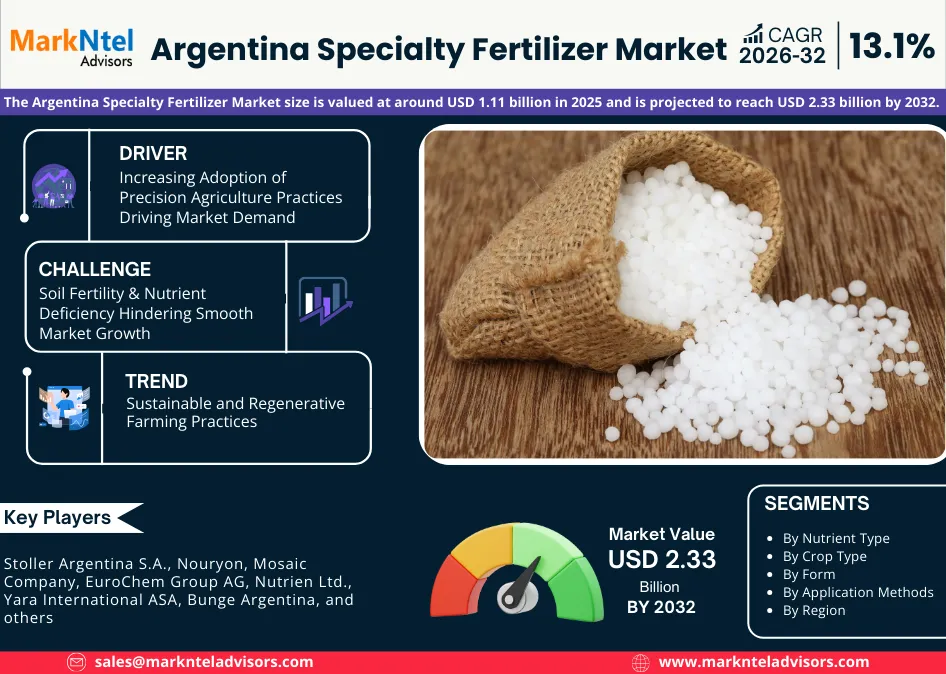
The Argentina Specialty Fertilizer Market size is valued at around USD 1.11 billion in 2025 and is projected to reach USD 2.33 billion by 2032. Along with this, the market is estimated to grow at a CAGR of around 13.1% during the forecast period, i.e., 2026-32.
Argentina’s specialty fertilizer market is set for substantial revenue growth, driven by agriculture’s critical economic role and evolving nutrient management needs. Agriculture contributes about 6% to Argentina’s GDP and constitutes a major pillar of export revenue and rural employment. The country utilizes over 35 million hectares for agriculture, cultivating staples such as soybeans, maize, and wheat, alongside expanding high-value fruits and vegetables. Intensive cropping and year-round farming cycles escalate the pressure on soil nutrient reserves, necessitating optimized fertilizer applications to sustain yields and soil health.
Fertilizer use averages 63 kg of nutrients per hectare in Argentina, which falls short of ideal nutrient replacement, especially for potassium and essential micronutrients. This shortfall highlights the growing importance of specialty fertilizers, such as controlled-release, water-soluble, foliar, and micronutrient-enriched formulations, that improve nutrient use efficiency, reduce environmental losses, and enhance crop productivity. The sector also benefits from increased adoption of fertigation and precision agriculture technologies, which rely heavily on specialty inputs for targeted and efficient nutrient delivery.
Government initiatives, including the 2025 SENASA fertilizer regulation that streamlines fertilizer import and registration processes, are strengthening quality standards and facilitating specialty fertilizer adoption. Additionally, the Argentine Ministry of Agriculture has launched various financing and incentive programs focused on sustainable agriculture, precision irrigation, and improved nutrient management, significantly supporting the market growth of specialty fertilizers. These initiatives align with broader national strategies to enhance agricultural productivity and environmental sustainability.
Argentina Specialty Fertilizer Industry Recent Developments:
- 2025: PepsiCo and Yara have partnered to enhance crop nutrition in Latin America, focusing on reducing the carbon footprint of agriculture. Yara will supply PepsiCo’s farmers with innovative, low-carbon fertilizers, such as Yara Climate Choice™, which reduce emissions in potato farming by 20% to 40%. The partnership will initially support potato farmers in Mexico, Colombia, Chile, and Argentina.
Argentina Specialty Fertilizer Market Scope:
| Category | Segments |
|---|---|
| By Nutrient Type | Primary Nutrients, Nitrogen, Phosphorus, Potassium, Secondary Nutrients, Calcium, Magnesium, Sulfur, Micronutrients, Boron, Copper, Others (Manganese, Iron, Zinc, etc.), |
| By Crop Type | Cereals & Grains, Wheat, Rice, Corn, Others (Sugarcane, Cotton, etc.), Fruits & Vegetables, Leafy Vegetables, Roots & Tuber Vegetables, Citrus Fruits, Others (Pome Fruits, Stone Fruits, Grapes, etc.), Oilseed & Pulses, Soybean, Sunflower, Others (Rapeseed, Niger, etc.), |
| By Form | Controlled Release Fertilizers, Polymer Coated, Sulfur Coated, Polymer-Sulfur Coated, Slow Release Fertilizers, Urea-Formaldehyde (UF), NitroForm (UF Derivative), Others (Methylene Urea, Isobutylidendiurea, etc.), Water Soluble Fertilizers, Potassium Nitrate, Potassium Sulfate, Calcium Nitrate, Others (NPK Fertilizers, Potassium Chloride, etc.), Liquid Fertilizers, Organic, Mineral, Others (Micronutrients, Granular, etc.), |
| By Application Methods | Soil, Foliar, Fertigation), and others |
Argentina Specialty Fertilizer Market Driver:
Increasing Adoption of Precision Agriculture Practices Driving Market Demand – The widespread adoption of precision agriculture is the primary driver propelling the Argentina specialty fertilizer market. By 2025, over 60% of Argentine farms are projected to utilize precision agriculture technologies, including satellite-based monitoring, soil sensors, drones, and AI-powered advisory systems. These technologies enable farmers to optimize fertilizer application, reduce input costs, and enhance crop yields while minimizing environmental impact. According to the Argentine civil association Fertilizer, precision agriculture has led to a 10–18% increase in productivity and a significant reduction in fertilizer and water usage.
The integration of digital platforms and AI-driven advisory systems has further empowered farmers to make data-driven decisions, improving resource efficiency and sustainability. For instance, Farmonaut introduced its AI-driven advisory system, Jeevn AI, to provide Argentine farmers with real-time crop health insights, pest risk alerts, and optimal resource management strategies. The system leverages satellite imagery and field data to enhance farm productivity and sustainability, helping farmers optimize fertilizer application and reduce input costs. The expected outcome is improved yields and reduced environmental impact, supporting the adoption of specialty fertilizers in precision agriculture. Therefore, the technological shift is not only boosting the demand for specialty fertilizers but also fostering innovation in product development and application methods.
Argentina Specialty Fertilizer Market Opportunity:
Expansion in High-Value Crop Cultivation – A significant opportunity for the Argentina specialty fertilizer industry arises from the expansion of high-value crop cultivation, especially fruits and vegetables. These crops represented a major share of the specialty fertilizer market as of 2025, with leafy vegetables demonstrating notably rapid growth. The rising consumer demand for premium-quality produce, both within Argentina and in export markets, is encouraging farmers to adopt advanced nutrient management practices that improve crop quality and maximize yields. The Argentine Ministry of Agriculture actively supports this transition through initiatives aimed at promoting the use of specialty fertilizers in high-value horticultural crops, emphasizing soil health restoration and reduced environmental footprint. Government programs focused on sustainable agriculture and biotechnology innovations are facilitating wider adoption of such fertilizers.
For instance, in 2025, the Argentine Ministry of Agriculture and Livestock launched a major crop-support and sustainability financing plan, mobilizing approximately USD 66.4 billion to promote sustainable intensification, precision irrigation, and adoption of advanced fertilizers, including specialty types for high-value crops and export-oriented systems. These efforts are aligned with national strategies to enhance agricultural sustainability and productivity, creating promising avenues for specialty fertilizer manufacturers and distributors, particularly within the fruits and vegetables sector. This alignment with official policy frameworks ensures a robust foundation for market expansion.
Argentina Specialty Fertilizer Market Challenge:
Soil Fertility & Nutrient Deficiency Hindering Smooth Market Growth – A significant challenge facing the specialty fertilizer market is the widespread issue of soil fertility and nutrient deficiency. According to Fertilizar (A Non-profit Civil Association), 60–65% of fields in the central Pampas region suffer from medium to severe phosphorus deficiency, necessitating higher doses of phosphorus or the incorporation of specialty fertilizers. The over-cultivation of the Pampas and deforestation in northern provinces have led to intensive soil erosion and fertility loss, directly threatening the sustainability of agricultural production. While specialty fertilizers offer a solution to these challenges, their adoption is hindered by producers’ cost reductions and a lack of conviction regarding the use of fertilizers as an investment. Addressing these issues requires continued government support, education, and the promotion of sustainable farming practices to ensure long-term soil health and productivity.
Argentina Specialty Fertilizer Market Trend:
Sustainable and Regenerative Farming Practices – A leading trend in the Argentina specialty fertilizer industry is the shift towards sustainable and regenerative farming practices. Techniques such as no-till farming, cover cropping, and agroforestry are gaining momentum among both large commercial operations and smallholders, helping to restore soil health, promote biodiversity, and increase carbon sequestration. The Argentine government is actively participating in international climate agreements and rolling out incentives for sustainable production and eco-friendly certification schemes. The expected outcome results in reduced environmental impact, driving the growth of the specialty fertilizer market.
Blockchain-based solutions are also emerging to improve traceability and transparency in commodity production chains, vital for meeting the increasing demands from international buyers. This trend is not only enhancing the environmental sustainability of agriculture but also driving the demand for specialty fertilizers that support regenerative practices.
Argentina Specialty Fertilizer Market (2026-32): Segmentation Analysis
The Argentina Specialty Fertilizer Market study of MarkNtel Advisors evaluates & highlights the major trends and influencing factors in each segment. It includes predictions for the period 2026–2032 at the country level. Based on the analysis, the market has been further classified as:
Based on Nutrient Type:
- Primary Nutrients
- Nitrogen
- Phosphorus
- Potassium
- Secondary Nutrients
- Calcium
- Magnesium
- Sulfur
- Micronutrients
- Boron
- Copper
- Others (Manganese, Iron, Zinc, etc.)
The primary nutrients segment leads Argentina's specialty fertilizer market with a commanding 79.40% share in 2025, underscoring its critical role in the country’s agriculture. This dominance stems mainly from the high demand for nitrogen (N), phosphorus (P), and potassium (K) fertilizers, often referred to as NPK, as these primary nutrients are essential for staple crops like soybeans, corn, and wheat, which constitute roughly 98% of Argentina’s total cultivated land for field crops.
Meanwhile, the secondary segment, consisting of nutrients like calcium, magnesium, and sulfur, is gaining traction with a projected 5.69% CAGR through 2032, propelled by increasing awareness of micronutrient importance for disease resistance and overall crop vigor, particularly in high-value horticultural crops and regions with specific soil imbalances.
Based on Application Methods:
- Soil
- Foliar
- Fertigation
Amongst all, Fertigation dominates the industry, representing 58.24% of the Argentina specialty fertilizer industry size in 2025. Its leadership is largely due to its superior efficiency in delivering nutrients directly to the root zone through irrigation systems, minimizing nutrient losses via leaching or volatilization. This targeted nutrient delivery greatly enhances nutrient-use efficiency, leading to improved crop yields and better resource use, which is critical in Argentina’s intensive agricultural systems that demand sustainable input management. While foliar application is projected to grow at a 6.74% CAGR due to its quick corrective nutrient supply and stress mitigation benefits.
Gain a Competitive Edge with Our Argentina Specialty Fertilizer Market Report
- Argentina Specialty Fertilizer Market Report by MarkNtel Advisors provides a detailed & thorough analysis of market size & share, growth rate, competitive landscape, and key players. This comprehensive analysis helps businesses gain a holistic understanding of the market dynamics & make informed decisions.
- This report also highlights current market trends & future projections, allowing businesses to identify emerging opportunities & potential challenges. By understanding market forecasts, companies can align their strategies & stay ahead of the competition.
- Argentina Specialty Fertilizer Market Report aids in assessing & mitigating risks associated with entering or operating in the market. By understanding market dynamics, regulatory frameworks, and potential challenges, businesses can develop strategies to minimize risks & optimize their operations.
*Reports Delivery Format - Market research studies from MarkNtel Advisors are offered in PDF, Excel and PowerPoint formats. Within 24 hours of the payment being successfully received, the report will be sent to your email address.
Frequently Asked Questions
- Market Segmentation
- Introduction
- Product Definition
- Research Process
- Assumptions
- Executive Summary
- Argentina Specialty Fertilizer Supply Chain Analysis
- Argentina Specialty Fertilizer Import-Export Analysis
- Argentina Specialty Fertilizer Market Trends & Insights
- Argentina Specialty Fertilizer Market Dynamics
- Drivers
- Challenges
- Argentina Specialty Fertilizer Market Hotspot & Opportunities
- Argentina Specialty Fertilizer Market Policies & Regulations
- Argentina Specialty Fertilizer Market Outlook, 2022-32F
- Market Size & Analysis
- By Revenues (USD Million)
- By Quantity Sold (Thousand Tons)
- Market Size & Analysis
- By Nutrient Type
- Primary Nutrients- Market Size & Forecast 2022-32, USD Million
- Nitrogen- Market Size & Forecast 2022-32, USD Million
- Phosphorus- Market Size & Forecast 2022-32, USD Million
- Potassium - Market Size & Forecast 2022-32, USD Million
- Secondary Nutrients- Market Size & Forecast 2022-32, USD Million
- Calcium- Market Size & Forecast 2022-32, USD Million
- Magnesium- Market Size & Forecast 2022-32, USD Million
- Sulfur- Market Size & Forecast 2022-32, USD Million
- Micronutrients- Market Size & Forecast 2022-32, USD Million
- Boron- Market Size & Forecast 2022-32, USD Million
- Copper- Market Size & Forecast 2022-32, USD Million
- Others (Manganese, Iron, Zinc, etc.- Market Size & Forecast 2022-32, USD Million)
- Primary Nutrients- Market Size & Forecast 2022-32, USD Million
- By Crop Type
- Cereals & Grains- Market Size & Forecast 2022-32, USD Million
- Wheat- Market Size & Forecast 2022-32, USD Million
- Rice- Market Size & Forecast 2022-32, USD Million
- Corn- Market Size & Forecast 2022-32, USD Million
- Others (Sugarcane, Cotton, etc.)- Market Size & Forecast 2022-32, USD Million
- Fruits & Vegetables- Market Size & Forecast 2022-32, USD Million
- Leafy Vegetables- Market Size & Forecast 2022-32, USD Million
- Roots & Tuber Vegetables- Market Size & Forecast 2022-32, USD Million
- Citrus Fruits- Market Size & Forecast 2022-32, USD Million
- Others (Pome Fruits, Stone Fruits, Grapes, etc.)- Market Size & Forecast 2022-32, USD Million
- Oilseed & Pulses- Market Size & Forecast 2022-32, USD Million
- Soybean- Market Size & Forecast 2022-32, USD Million
- Sunflower- Market Size & Forecast 2022-32, USD Million
- Others (Rapeseed, Niger, etc.)- Market Size & Forecast 2022-32, USD Million
- Cereals & Grains- Market Size & Forecast 2022-32, USD Million
- By Form
- Controlled Release Fertilizers- Market Size & Forecast 2022-32, USD Million
- Polymer Coated- Market Size & Forecast 2022-32, USD Million
- Sulfur Coated- Market Size & Forecast 2022-32, USD Million
- Polymer-Sulfur Coated- Market Size & Forecast 2022-32, USD Million
- Slow Release Fertilizers- Market Size & Forecast 2022-32, USD Million
- Urea-Formaldehyde (UF) - Market Size & Forecast 2022-32, USD Million
- NitroForm (UF Derivative) - Market Size & Forecast 2022-32, USD Million
- Others (Methylene Urea, Isobutylidendiurea, etc.) - Market Size & Forecast 2022-32, USD Million
- Water Soluble Fertilizers- Market Size & Forecast 2022-32, USD Million
- Potassium Nitrate- Market Size & Forecast 2022-32, USD Million
- Potassium Sulfate- Market Size & Forecast 2022-32, USD Million
- Calcium Nitrate- Market Size & Forecast 2022-32, USD Million
- Others (NPK Fertilizers, Potassium Chloride, etc.) - Market Size & Forecast 2022-32, USD Million
- Liquid Fertilizers- Market Size & Forecast 2022-32, USD Million
- Organic - Market Size & Forecast 2022-32, USD Million
- Mineral- Market Size & Forecast 2022-32, USD Million
- Others (Micronutrients, Granular, etc.)- Market Size & Forecast 2022-32, USD Million- Market Size & Forecast 2022-32, USD Million
- Controlled Release Fertilizers- Market Size & Forecast 2022-32, USD Million
- By Application Methods
- Soil- Market Size & Forecast 2022-32, USD Million
- Foliar- Market Size & Forecast 2022-32, USD Million
- Fertigation- Market Size & Forecast 2022-32, USD Million
- By Region
- Buenos Aires Region
- Litoral Region
- Northern Region
- Cordoba Region
- Cuyo Region
- Patagonia Region
- By Competition
- Competition Characteristics
- Market Share of Top Companies
- By Nutrient Type
- Market Size & Analysis
- Argentina Primary Nutrients America Specialty Fertilizer Market Outlook, 2022-32F
- Market Size & Analysis
- By Revenues (USD Million)
- By Quantity Sold (Thousand Tons)
- Market Share & Analysis
- By Nutrient Type- Market Size & Forecast 2022-32, USD Million
- By Crop Type- Market Size & Forecast 2022-32, USD Million
- By Forms- Market Size & Forecast 2022-32, USD Million
- By Application Method- Market Size & Forecast 2022-32, USD Million
- Market Size & Analysis
- Argentina Secondary Nutrients Specialty Fertilizer Market Outlook, 2022-32F
- Market Size & Analysis
- By Revenues (USD Million)
- By Quantity Sold (Thousand Tons)
- Market Share & Analysis
- By Nutrient Type- Market Size & Forecast 2022-32, USD Million
- By Crop Type- Market Size & Forecast 2022-32, USD Million
- By Forms- Market Size & Forecast 2022-32, USD Million
- By Application Method- Market Size & Forecast 2022-32, USD Million
- Market Size & Analysis
- Argentina Micronutrients Specialty Fertilizer Market Outlook, 2022-32F
- Market Size & Analysis
- By Revenues (USD Million)
- By Quantity Sold (Thousand Tons)
- Market Share & Analysis
- By Nutrient Type- Market Size & Forecast 2022-32, USD Million
- By Crop Type- Market Size & Forecast 2022-32, USD Million
- By Forms- Market Size & Forecast 2022-32, USD Million
- By Application Method- Market Size & Forecast 2022-32, USD Million
- Market Size & Analysis
- Competitive Outlook
- Company Profiles
- Bunge Argentina
- Business Description
- Product Portfolio
- Strategic Alliances or Partnerships
- Recent Developments
- Financial Details
- Others
- Yara International ASA
- Business Description
- Product Portfolio
- Strategic Alliances or Partnerships
- Recent Developments
- Financial Details
- Others
- Nutrien Ltd.
- Business Description
- Product Portfolio
- Strategic Alliances or Partnerships
- Recent Developments
- Financial Details
- Others
- EuroChem Group AG
- Business Description
- Product Portfolio
- Strategic Alliances or Partnerships
- Recent Developments
- Financial Details
- Others
- The Mosaic Company
- Business Description
- Product Portfolio
- Strategic Alliances or Partnerships
- Recent Developments
- Financial Details
- Others
- Nouryon
- Business Description
- Product Portfolio
- Strategic Alliances or Partnerships
- Recent Developments
- Financial Details
- Others
- Stoller Argentina S.A.
- Business Description
- Product Portfolio
- Strategic Alliances or Partnerships
- Recent Developments
- Financial Details
- Others
- Others
- Business Description
- Product Portfolio
- Strategic Alliances or Partnerships
- Recent Developments
- Financial Details
- Bunge Argentina
- Company Profiles
- Disclaimer
MarkNtel Advisors follows a robust and iterative research methodology designed to ensure maximum accuracy and minimize deviation in market estimates and forecasts. Our approach combines both bottom-up and top-down techniques to effectively segment and quantify various aspects of the market. A consistent feature across all our research reports is data triangulation, which examines the market from three distinct perspectives to validate findings. Key components of our research process include:
1. Scope & Research Design At the outset, MarkNtel Advisors define the research objectives and formulate pertinent questions. This phase involves determining the type of research—qualitative or quantitative—and designing a methodology that outlines data collection methods, target demographics, and analytical tools. They also establish timelines and budgets to ensure the research aligns with client goals.
2. Sample Selection and Data Collection In this stage, the firm identifies the target audience and determines the appropriate sample size to ensure representativeness. They employ various sampling methods, such as random or stratified sampling, based on the research objectives. Data collection is carried out using tools like surveys, interviews, and observations, ensuring the gathered data is reliable and relevant.
3. Data Analysis and Validation Once data is collected, MarkNtel Advisors undertake a rigorous analysis process. This includes cleaning the data to remove inconsistencies, employing statistical software for quantitative analysis, and thematic analysis for qualitative data. Validation steps are taken to ensure the accuracy and reliability of the findings, minimizing biases and errors.

4. Data Forecast and FinalizationThe final phase involves forecasting future market trends based on the analyzed data. MarkNtel Advisors utilize predictive modeling and time series analysis to anticipate market behaviors. The insights are then compiled into comprehensive reports, featuring visual aids like charts and graphs, and include strategic recommendations to inform client decision-making
We offer flexible licensing options to cater to varying organizational needs. Choose the pricing pack that best suits your requirements:
Buy Now Inquire Before Buying
 Request Customization
 Talk to our Consultant







