China Membrane Bioreactor Market Research Report: Trends & Forecast (2026-2032)
By System Configuration (Submerged MBR Systems (SMBR), Side-stream / External MBR Systems), By Flow Rate Capacity (Less than 50,000 GPD, 50,000 - 250,000 GPD, 250,000 - 1,000,000 G ... PD, Over 1,000,000 GPD), By Membrane Type (Hollow Fiber Membranes, Flat Sheet Membranes, Multi-tubular Membranes), By Application (Municipal Wastewater Treatment, Industrial Wastewater Treatment), By End-Use Industry (Municipalities, Pharmaceuticals, Food & Beverage, Chemical & Petrochemical, Textile Industry, Power & Energy, Oil & Gas, Pulp & Paper), By Technology Integration (Microfiltration (MF) based MBR, Ultrafiltration (UF) based MBR, Hybrid systems (advanced combinations with NF/RO in reuse plants)), By Module Configuration (Spiral wound systems, Hollow fiber modules (dominant), Tubular modules, Plate & frame modules, Ceramic-based systems (premium industrial use)), and others Read more
- Environment
- May 2026
- Pages 145
- Report Format: PDF, Excel, PPT
China Membrane Bioreactor Market
Projected 7.32% CAGR from 2026 to 2032
Study Period
2026-2032
Market Size (2026)
USD 573.8 Million
Market Size (2032)
USD 876.5 Million
Base Year
2025
Projected CAGR
7.32%
Leading Segments
By System Configuration: Submerged MBR Systems (SMBR)
China Membrane Bioreactor Market Report Key Takeaways
- China membrane bioreactor market reached USD 528 million in 2025 and is projected to grow to USD 876.5 million by 2032 from USD 573.8 million in 2026, at 7.32% CAGR.
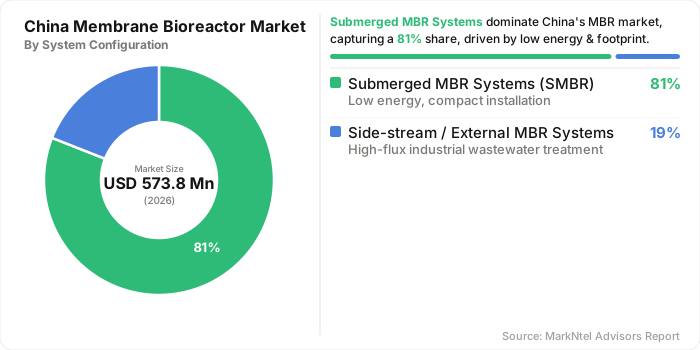
- Submerged MBR systems dominated China’s market with 81% share due to compact design, lower operational costs, and widespread municipal wastewater infrastructure deployment.
- Municipal wastewater treatment accounted for 69% market share, supported by stricter discharge regulations, urban sewage treatment expansion, and rising reclaimed water reuse investments.
- East China led the market with 45% share, driven by dense industrialization, advanced municipal infrastructure, and large-scale wastewater treatment modernization projects across coastal provinces.
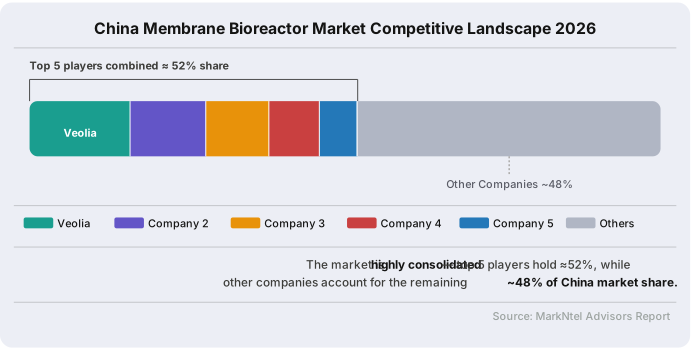
- China’s membrane bioreactor market remains highly consolidated, with top five companies controlling approximately 52% revenue through technology leadership, localized manufacturing, and municipal project expertise.
China Membrane Bioreactor Market Size and Outlook
The China membrane bioreactor market is projected to grow at a CAGR of 7.32% from 2026–2032. China represents one of the most active deployment environments for membrane bioreactor (MBR) technology globally, driven by the country's acute freshwater scarcity it holds approximately 6% of global freshwater reserves while supporting over 18% of the world's population, and by a national regulatory framework that mandates advanced effluent standards across both municipal and industrial facilities.
The primary macro demand force is the Chinese government's sustained investment mandate under the 14th Five-Year Plan for Urban Wastewater Treatment and Resource Utilization (2021–2025), jointly issued by the Ministry of Housing and Urban-Rural Development (MOHURD) and the National Development and Reform Commission (NDRC). The plan mandates a sewage treatment rate in county-level cities by 2025 and a recycled water utilisation rate above 25% in water-deficient cities with the Beijing-Tianjin-Hebei region required to exceed 35%.
Furthermore, the Ministry of Water Resources confirmed that China invested a record (1.35 trillion yuan) USD 187.8 billion in water conservancy facility construction in 2024 alone the third consecutive record-breaking year as part of a total 14th Five-Year Plan commitment exceeding USD 759.6 billion. These mandates directly incentivise the deployment of MBR systems, which are the primary technology capable of consistently achieving the Class 1A effluent standard required for reclaimed water reuse. A secondary demand force comes from China's industrial sector, where tightening zero-liquid-discharge and near-zero-effluent regulations compel chemical, pharmaceutical, and textile operators to adopt advanced biological-membrane treatment.
The NDRC and four partner ministries jointly released the 14th Five-Year Plan Water Conservation Promotion Plan, which identifies petrochemical, chemical, non-ferrous metals, and textile printing as priority industries for industrial wastewater recycling, mandating near-zero effluent pilot programmes in national-level industrial development zones.
Moreover, according to the Ministry of Ecology and Environment, as of 2024, China's annual sludge production from wastewater treatment had exceeded 70 million tonnes, with the NDRC mandating an additional 20,000 tonnes per day of sludge treatment capacity a pressure that reinforces demand for MBR technology, which produces significantly lower sludge volumes than conventional activated sludge processes.
Key market participants are actively commissioning and expanding capacity to capture this demand. SUEZ Environnement delivered the Huaifang Water Reclamation Plant in Beijing the largest underground MBR-based wastewater treatment facility in Asia, with a recycling capacity of 200 million cubic metres of wastewater per year.
Collectively, these dynamics, including binding policy targets, record public investment, and active private-sector commitment, are positioning the China membrane bioreactor market for sustained and measurable expansion from USD 573.8 million in 2026 to USD 876.5 million by 2032.
China Membrane Bioreactor Market Key Indicators
- According to the National Bureau of Statistics of China, China's urbanization rate reached 67% in 2024, representing an urban population of 943.5 million, an increase of 3.11 percentage points over 2020. Each additional percentage point of urbanization generates new municipal wastewater volumes that legacy activated sludge plants cannot process to the Class 1A standard required for reuse, directly expanding the addressable installation base for MBR systems in newly urbanized municipalities.
- According to the National Development and Reform Commission (NDRC) and MOHURD, China's 14th Five-Year Plan for Urban Wastewater Treatment and Resource Utilization targets the addition of 15 million cubic metres per day of reclaimed water capacity by 2025, with the NDRC mandating a recycled water utilization rate above 25% in water-scarce cities. MBR technology is the principal treatment process capable of consistently producing effluent at the quality level required to meet these reuse standards, positioning the market as a direct beneficiary of this binding national target.
China Membrane Bioreactor Market Scope
| Category | Segments |
|---|---|
| By System Configuration | Submerged MBR Systems (SMBR), Side-stream / External MBR Systems |
| By Flow Rate Capacity | Less than 50,000 GPD, 50,000 - 250,000 GPD, 250,000 - 1,000,000 GPD, Over 1,000,000 GPD |
| By Membrane Type | Hollow Fiber Membranes, Flat Sheet Membranes, Multi-tubular Membranes |
| By Application | Municipal Wastewater Treatment, Industrial Wastewater Treatment |
| By End-Use Industry | Municipalities, Pharmaceuticals, Food & Beverage, Chemical & Petrochemical, Textile Industry, Power & Energy, Oil & Gas, Pulp & Paper |
| By Technology Integration | Microfiltration (MF) based MBR, Ultrafiltration (UF) based MBR, Hybrid systems (advanced combinations with NF/RO in reuse plants |
| By Module Configuration | Spiral wound systems, Hollow fiber modules (dominant), Tubular modules, Plate & frame modules, Ceramic-based systems (premium industrial use |
China Membrane Bioreactor Market Growth Drivers
Stringent Municipal Discharge Standards Mandating MBR Adoption Across China's Wastewater Infrastructure
China's mandatory upgrade of municipal wastewater treatment plants from the Class 1B to the stricter Class 1A effluent discharge standard is the single most direct driver of membrane bioreactor market growth. Conventional activated sludge processes cannot consistently achieve Class 1A thresholds for suspended solids, biological oxygen demand, and nitrogen making MBR systems the primary retrofit and new-build technology of choice for municipal operators facing enforcement deadlines.
According to data from the China Urban Construction Statistical Yearbook, China's urban wastewater treatment rate reached 98.69% in 2023, with 97.31% processed through centralized facilities a scale that amplifies the financial and operational impact of each incremental standard upgrade across thousands of plants simultaneously.
Furthermore, in 2024, the Chinese government allocated more than USD 3.6 billion specifically to water pollution control, with revised pollutant discharge standards explicitly pushing adoption of advanced membrane-based technologies. As enforcement intensifies and upgrade mandates extend to Tier 2 and Tier 3 municipalities through 2032, this regulatory pressure will remain the most consistent and measurable demand catalyst for the membrane bioreactors in China.
Recent Trends
Integration of Water Reuse-Focused Advanced MBR Systems Across Industrial Clusters in China
China's industrial clusters are undergoing a measurable structural shift toward closed-loop water management, and advanced MBR systems are emerging as the core biological treatment stage in multi-technology industrial reuse trains driving this transition. The policy foundation compelling this shift is binding, the Ministry of Industry and Information Technology (MIIT), jointly with five government departments, mandated raising the industrial water recycling rate for enterprises above designated size to 94% by 2025. This is up from 92.9% in 2021 requiring chemical, petrochemical, textile, and non-ferrous metal industrial parks to invest in MBR-anchored treatment infrastructure capable of producing effluent quality suitable for direct process water reuse.
Reinforcing this industrial reuse mandate, the MIIT and NDRC's zero-carbon industrial park programme with 31 provinces setting key priorities in 2025 separately requires industrial wastewater reuse rates above 80% within certified park boundaries, creating an additional procurement layer for high-performance MBR systems across China's designated industrial zones.
These converging mandates are prompting global membrane technology suppliers to localise capacity in direct response, in Q4 2025, DuPont agreed to acquire a reverse osmosis membrane manufacturing facility in China to localise FilmTec membrane supply for Asia -Pacific strengthening the downstream polishing capacity that pairs with MBR pre-treatment in industrial reuse trains across Chinese industrial clusters.
As zero-carbon park certification expands and industrial reuse targets tighten across additional sectors, this trend is positioned to structurally deepen demand within the China membrane bioreactor market through 2032.
China Membrane Bioreactor Market Opportunities and Challenges
High Energy Consumption of MBR Systems Creating Opportunity for Low-Carbon Next-Generation MBR Technology in China
MBR systems require approximately 0.5 kWh of electricity per cubic metre of treated wastewater nearly double the 0.3 kWh average of conventional treatment technologies operating in China creating a direct conflict with the country's binding dual-carbon policy framework that mandates carbon peak by 2030 and neutrality by 2060. This energy burden is amplified by the finding that indirect emissions from electricity and chemical consumption account for 59.9% of total greenhouse gas emissions across China's wastewater treatment sector, placing MBR's above-average electricity demand directly within the scope of carbon audit obligations now imposed on plant operators.
The same pressure, however, creates a precisely defined commercial opportunity. The NDRC and MOHURD jointly issued the Notice on Launching the Selection of Green and Low-Carbon Benchmark Sewage Treatment Plants (NDRC and ERPC [2024] No. 531) in 2024 establishing a national certification Programme that directly incentivizes procurement of energy-optimized MBR configurations. Research published in ACS ES&T Water in 2025 confirmed that optimizing aeration parameters in large-scale MBR facilities can reduce N₂O emissions by up to 77% while cutting aeration power consumption by 20%, demonstrating that low-carbon MBR configurations are technically achievable at full scale.
China's dual-carbon certification framework is tightening, and low-carbon benchmark standards become mandatory evaluation criteria alongside effluent quality. Suppliers of energy-optimised MBR systems are positioned to capture disproportionate procurement share within the China membrane bioreactor market through 2032.
Segmentation Analysis
Submerged MBR Systems Lead as the Dominant System Configuration in China
Submerged membrane bioreactor (SMBR) systems account for 81% of the China membrane bioreactor market, making them the overwhelmingly preferred configuration across both municipal and industrial applications. Their dominance is structurally grounded in three measurable advantages over external systems: membranes placed directly inside the bioreactor tank eliminate high-pressure pumps, reducing energy demands.
China-based players are actively innovating within this segment. CITIC Envirotech's subsidiary Memstar has pioneered the proprietary Thermally Induced Phase Separation (TIPS) PVDF hollow fibre membrane combined with its Energy Saving Air Scouring (ESAS) technology a submerged-configuration innovation that minimizes aeration energy and chemical cleaning frequency across both municipal and industrial installations.
Beijing OriginWater Technology Co., Ltd which accounts for approximately 70% of China's municipal membrane wastewater treatment market share developed its independently patented hollow fibre MBRU submerged MBR technology through Asia's largest membrane R&D centre in Beijing's Huairou District, achieving an annual PVDF membrane production capacity exceeding 8 million m². The company deployed this submerged configuration at China's largest MBR facility the Beijing Kunyu River Wastewater Treatment and Reclamation Plant with a daily treatment and reuse capacity of 100,000 m³, as well as at the Xiaohongmen reclaimed water plant treating 45,000 m³ per day to surface water Grade IV standard.
As underground plant construction accelerates and China's domestic PVDF manufacturing base continues scaling through 2032, submerged MBR systems are positioned to consolidate their dominant share within membrane bioreactors. By system configuration, the market is further segmented into the following sub -categories:
- Submerged MBR Systems (SMBR)
- Side-stream / External MBR Systems
Municipal Wastewater Treatment Leads as the Dominant Application
Municipal wastewater treatment accounts for 69% of the China membrane bioreactor market, establishing it as the single largest application segment by a decisive margin. Membrane bioreactors are the only treatment technology capable of consistently achieving China's Class 1A effluent discharge standard the mandatory threshold under the Discharge Standard of Pollutants for Municipal Wastewater Treatment Plant (GB 18918-2002) without secondary add-on filtration systems.
Additionally, the sustained scale of government capital deployment directly sustains municipal procurement volume, in 2025, the Chinese central government allocated over USD 13.8 billion in ultra-long-term special treasury bonds specifically to support the Yangtze River protection initiative, focusing on urban sewage pipeline networks.
At the investment level, the Asian Development Bank (ADB) signed a USD 150 million financing package in December 2025 with China Water Affairs Group Limited (CWA) to support the construction of a new 100,000 m³ per day smart wastewater treatment plant in Ningxiang City, Hunan Province, one of China's Tier 3 municipal centres, where MBR-based advanced treatment infrastructure is now entering its first procurement cycle.
As China's 15th Five-Year Plan (2026–2030) prioritises "major new progress in building a Beautiful China" and the Ministry of Ecology and Environment expands its surface water monitoring network to include over 200 additional tributaries, municipal discharge compliance pressure will intensify further, positioning municipal wastewater treatment to consolidate its 69% dominant share within the China membrane bioreactor market through 2032. By application segment, the market is further divided into the following sub- categories
- Municipal Wastewater Treatment
- Industrial Wastewater Treatment
China Membrane Bioreactor Market Geographical Analysis
East China accounts for 45% of the China membrane bioreactor market, commanding the largest regional share driven by three structural factors unique to the region. First, East China's provinces Jiangsu, Zhejiang, Shandong, Shanghai, Anhui, and Fujian host the highest concentration of wastewater treatment infrastructure in China.
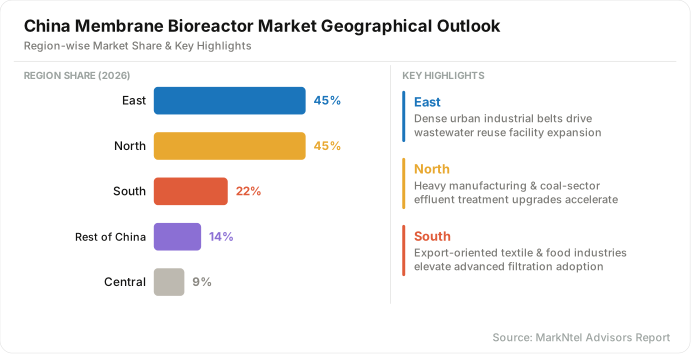
The region's industrial innovation activity directly reinforces its membrane bioreactors market leadership. Zhejiang's textile hub the largest contributor to China's textile exports, China's total textiles and apparel exports has established an integrated governance framework combining industrial clustering, MBR-anchored wastewater treatment, and reclaimed water reuse, with a printing and dyeing district in Zhejiang achieving a reclaimed water utilization rate of 40.1% in 2025 through water-saving technological upgrades mandated under the 14th Five-Year Plan. Furthermore, projects in Shanghai and the Greater Bay Area corridor specifically priorities nutrient removal, MBR integration, and smart pipeline management a technology combination that positions East China's treatment operators at the frontier of China's low-carbon benchmark plant certification programme.
Additionally, in December 2025, SUEZ Environnement formalised a USD 60.5 million industrial water treatment plant partnership with the Lianyun Economic Development Zone in Jiangsu a facility hosting over 1,000 companies in new materials and advanced manufacturing designing a 50,000 m³ per day industrial water supply and 20,000 m³ per day demineralised water system, signalling continued large-scale private investment in East China's advanced water treatment infrastructure.
These dynamics position East China to consolidate and extend its dominant share of the membrane bioreactor technology in China through 2032, making it the single most strategically significant geography for suppliers of submerged MBR systems, PVDF membrane modules, and advanced water reuse infrastructure operating.
China Membrane Bioreactors Industry Competitive Landscape
The Chinese market is highly consolidated and competitive, with the top five companies accounting for an estimated 52% of total market revenue in 2025. Major participants include CITIC Envirotech, Aquatech International Corp., Aquatech BM, Kubota Corp, and Kemira Oyj, supported by strong municipal wastewater treatment project pipelines and localized membrane manufacturing capabilities.
Major Players in China Membrane bioreactors technology:
- CITIC Envirotech
- Aquatech International Corp.
- Aquatech BM
- Kubota Corp
- Kemira Oyj
- Calgon Carbon
- Buckman
- SUEZ Environnement
- Toray Industries Inc
- Portland General Electric Co
- Veolia Environnement SA
- Danaher Corp
- Mitsubishi Electric Corp
China Membrane Bioreactors Industry News and Recent Developments
May 2024: Veolia Water Technologies Inaugurates First Ion Exchange Regeneration Facility in China, Expanding Advanced Water Purification Infrastructure in Jiangsu
Veolia Water Technologies inaugurated its first ion exchange regeneration facility in China on 15 May 2024, located in the Changshu Economic and Technological Development Zone (CEDZ) in Jiangsu province. The facility represents a EUR 10 million investment, spanning 6,000 square metres with a production capacity of 60 kL per day for mobile water services and 5 kL per day for service deionisation. Designed under Veolia's GreenUp strategic programme for 2024–2027, the plant integrates water recycling systems that reduce city water consumption by up to 60%, directly supporting China's 14th Five-Year Plan circular economy objectives. The facility serves semiconductor, pharmaceutical, and advanced manufacturing clients in Jiangsu's densely industrialised eastern coastal zone, where ultrapure and treated water demand is expanding rapidly alongside EV battery and microelectronics production.
Impact Analysis: The inauguration of Veolia's first China regeneration facility strengthens the treated and ultrapure water service infrastructure that feeds directly into industrial MBR pre-treatment and post-treatment chains across East China's high-demand manufacturing zones. By anchoring a resin regeneration and mobile water fleet in Jiangsu — a province subject to mandatory 85% water reuse rates for textile industrial clusters — Veolia expands the service ecosystem supporting MBR-anchored water reuse trains, increasing competitive pressure on domestic and international MBR system suppliers to offer integrated technology and service models.
September 2024: Pentair X-Flow Establishes Strategic Distributor Partnership with Beijing Kelin Zhixing Environmental Technology Co. to Expand MBR Membrane Access Across China
Pentair X-Flow, a global leader in membrane filtration technology , announced a strategic distribution partnership with Beijing Kelin Zhixing Environmental Technology Co., effective September 2024. Under the agreement, Beijing Kelin Zhixing was appointed as the sole distributor of X-Flow membrane elements for wastewater applications in China, and as the sole partner for integrating Pentair's tubular fibres into Kelin's proprietary Kelin Star membrane elements for the Chinese market. The partnership combines Pentair's internationally proven tubular ultrafiltration membrane technology designed for high-strength industrial wastewater including MBR applications with Beijing Kelin Zhixing's established domestic market reach, procurement relationships, and local technical support capability across China's municipal and industrial wastewater treatment sectors.
Impact Analysis: The Pentair–Beijing Kelin Zhixing partnership directly expands the distribution reach of advanced tubular MBR membrane elements within China's wastewater treatment market, reducing procurement lead times and technical access barriers for municipal operators and industrial park operators considering MBR system upgrades. The integration of Pentair's fibres into domestically branded Kelin Star membrane elements reflects a broader competitive trend — international membrane technology suppliers entering China through localised product and distribution structures to compete with fully domestic suppliers such as OriginWater and Memstar on cost, service response, and supply chain proximity.
2026: China Develops AI-Powered Technology That Converts Dirty Wastewater into Valuable Fertiliser
Chinese researchers developed an AI-assisted dual-atom catalyst technology that converts nitrate-rich wastewater into ammonia-based fertilizer with nearly three times higher efficiency than conventional methods. The innovation supports low-energy wastewater resource recovery and circular water treatment applications.
Market impact analysis: The development is highly relevant to the China membrane bioreactor (MBR) market because advanced MBR systems are increasingly integrated with nutrient recovery and water reuse technologies in municipal and industrial treatment plants. This innovation strengthens China’s shift toward resource-recovery wastewater infrastructure rather than conventional disposal-focused treatment systems.It can accelerate investments in smart wastewater treatment facilities combining AI, membrane filtration, and nutrient recovery modules across urban utilities and industrial parks. The breakthrough also supports higher-value adoption of advanced biological treatment technologies, benefiting MBR suppliers involved in water reuse and sustainable wastewater management projects.
2026: Intelligent Fouling Monitoring Technology Advances China’s Membrane Wastewater Treatment Sector
Researchers from CITIC Envirotech and Tsinghua University developed an intelligent fouling monitoring system for membrane-based wastewater treatment plants using advanced sensing and predictive analytics. The system improves membrane performance stability and operational efficiency in large-scale wastewater facilities.
Market Impact Analysis: The innovation is directly relevant to China’s membrane bioreactor (MBR) market because membrane fouling remains one of the largest operational challenges in municipal and industrial MBR plants. AI-enabled predictive monitoring can reduce maintenance costs, energy consumption, and membrane replacement frequency across China’s wastewater infrastructure.
The technology supports wider adoption of smart MBR systems in urban sewage treatment and reclaimed water reuse projects under China’s digital environmental management initiatives.
It also strengthens the competitiveness of Chinese and Asia-based membrane technology suppliers in high-capacity wastewater treatment deployments.
Frequently Asked Questions
- Market Segmentation
- Introduction
- Product Definition
- Research Process
- Assumptions
- Executive Summary
- China Membrane Bioreactor Market Policies, Regulations, and Product Standards
- China Membrane Bioreactor Market Trends & Developments
- China Membrane Bioreactor Market Dynamics
- Growth Factors
- Challenges
- China Membrane Bioreactor Market Hotspot & Opportunities
- China Membrane Bioreactor Market Outlook, 2022-2032F
- Market Size & Outlook
- By Revenues (USD Million)
- Market Share & Outlook
- By System Configuration- Market Size & Forecast 2022-2032, USD Million
- Submerged MBR Systems (SMBR)
- Side-stream / External MBR Systems
- By Flow Rate Capacity - Market Size & Forecast 2022-2032, USD Million
- Less than 50,000 GPD
- 50,000 - 250,000 GPD
- 250,000 - 1,000,000 GPD
- Over 1,000,000 GPD
- By Membrane Type- Market Size & Forecast 2022-2032, USD Million
- Hollow Fiber Membranes
- Flat Sheet Membranes
- Multi-tubular Membranes
- By Application- Market Size & Forecast 2022-2032, USD Million
- Municipal Wastewater Treatment
- Industrial Wastewater Treatment
- By End-Use Industry- Market Size & Forecast 2022-2032, USD Million
- Municipalities
- Pharmaceuticals
- Food & Beverage
- Chemical & Petrochemical
- Textile Industry
- Power & Energy
- Oil & Gas
- Pulp & Paper
- By Technology Integration- Market Size & Forecast 2022-2032, USD Million
- Microfiltration (MF) based MBR
- Ultrafiltration (UF) based MBR
- Hybrid systems (advanced combinations with NF/RO in reuse plants)
- By Module Configuration- Market Size & Forecast 2022-2032, USD Million
- Spiral wound systems
- Hollow fiber modules (dominant)
- Tubular modules
- Plate & frame modules
- Ceramic-based systems (premium industrial use)
- By region- Market Size & Forecast 2022-2032, USD Million
- North
- North West
- North East
- South
- South West
- East
- Central
- By Company
- Competition Characteristics
- Market Share & Analysis
- By System Configuration- Market Size & Forecast 2022-2032, USD Million
- Market Size & Outlook
- China Hollow Fiber Membranes Market Outlook, 2022-2032
- Market Size & Outlook
- By Revenues (USD Million)
- Market Share & Outlook
- By Flow Rate Capacity - Market Size & Forecast 2022-2032, USD Million
- By Membrane Type- Market Size & Forecast 2022-2032, USD Million
- By Application- Market Size & Forecast 2022-2032, USD Million
- By End-Use Industry- Market Size & Forecast 2022-2032, USD Million
- By Technology Integration- Market Size & Forecast 2022-2032, USD Million
- By Module Configuration- Market Size & Forecast 2022-2032, USD Million
- By region- Market Size & Forecast 2022-2032, USD Million
- Market Size & Outlook
- China Flat Sheet Membranes Market Outlook, 2022-2032
- Market Size & Outlook
- By Revenues (USD Million)
- Market Share & Outlook
- By Flow Rate Capacity - Market Size & Forecast 2022-2032, USD Million
- By Membrane Type- Market Size & Forecast 2022-2032, USD Million
- By Application- Market Size & Forecast 2022-2032, USD Million
- By End-Use Industry- Market Size & Forecast 2022-2032, USD Million
- By Technology Integration- Market Size & Forecast 2022-2032, USD Million
- By Module Configuration- Market Size & Forecast 2022-2032, USD Million
- By region- Market Size & Forecast 2022-2032, USD Million
- Market Size & Outlook
- China Multi-Tubular Membranes Market Outlook, 2022-2032
- Market Size & Outlook
- By Revenues (USD Million)
- Market Share & Outlook
- By Flow Rate Capacity - Market Size & Forecast 2022-2032, USD Million
- By Membrane Type- Market Size & Forecast 2022-2032, USD Million
- By Application- Market Size & Forecast 2022-2032, USD Million
- By End-Use Industry- Market Size & Forecast 2022-2032, USD Million
- By Technology Integration- Market Size & Forecast 2022-2032, USD Million
- By Module Configuration- Market Size & Forecast 2022-2032, USD Million
- By region- Market Size & Forecast 2022-2032, USD Million
- Market Size & Outlook
- China CITIC Envirotech Market Outlook, 2022-2032
- Market Size & Outlook
- By Revenues (USD Million)
- Market Share & Outlook
- By Flow Rate Capacity - Market Size & Forecast 2022-2032, USD Million
- By Membrane Type- Market Size & Forecast 2022-2032, USD Million
- By Application- Market Size & Forecast 2022-2032, USD Million
- By End-Use Industry- Market Size & Forecast 2022-2032, USD Million
- By Technology Integration- Market Size & Forecast 2022-2032, USD Million
- By Module Configuration- Market Size & Forecast 2022-2032, USD Million
- By region- Market Size & Forecast 2022-2032, USD Million
- Market Size & Outlook
- China Aquatech International Corp. Market Outlook, 2022-2032
- Market Size & Outlook
- By Revenues (USD Million)
- Market Share & Outlook
- By Flow Rate Capacity - Market Size & Forecast 2022-2032, USD Million
- By Membrane Type- Market Size & Forecast 2022-2032, USD Million
- By Application- Market Size & Forecast 2022-2032, USD Million
- By End-Use Industry- Market Size & Forecast 2022-2032, USD Million
- By Technology Integration- Market Size & Forecast 2022-2032, USD Million
- By Module Configuration- Market Size & Forecast 2022-2032, USD Million
- By region- Market Size & Forecast 2022-2032, USD Million
- Market Size & Outlook
- China Aquatech BM Market Outlook, 2022-2032
- Market Size & Outlook
- By Revenues (USD Million)
- Market Share & Outlook
- By Flow Rate Capacity - Market Size & Forecast 2022-2032, USD Million
- By Membrane Type- Market Size & Forecast 2022-2032, USD Million
- By Application- Market Size & Forecast 2022-2032, USD Million
- By End-Use Industry- Market Size & Forecast 2022-2032, USD Million
- By Technology Integration- Market Size & Forecast 2022-2032, USD Million
- By Module Configuration- Market Size & Forecast 2022-2032, USD Million
- By region- Market Size & Forecast 2022-2032, USD Million
- Market Size & Outlook
- China Membrane Bioreactor Market Key Strategic Imperatives for Success & Growth
- Competitive Outlook
- Company Profiles
- CITIC Envirotech
- Business Description
- Product Portfolio
- Collaborations & Alliances
- Recent Developments
- Financial Details
- Others
- Aquatech International Corp.
- Business Description
- Product Portfolio
- Collaborations & Alliances
- Recent Developments
- Financial Details
- Others
- Aquatech BM
- Business Description
- Product Portfolio
- Collaborations & Alliances
- Recent Developments
- Financial Details
- Others
- Kubota Corp
- Business Description
- Product Portfolio
- Collaborations & Alliances
- Recent Developments
- Financial Details
- Others
- Kemira Oyj
- Business Description
- Product Portfolio
- Collaborations & Alliances
- Recent Developments
- Financial Details
- Others
- Calgon Carbon
- Business Description
- Product Portfolio
- Collaborations & Alliances
- Recent Developments
- Financial Details
- Others
- Buckman
- Business Description
- Product Portfolio
- Collaborations & Alliances
- Recent Developments
- Financial Details
- Others
- SUEZ Environnement
- Business Description
- Product Portfolio
- Collaborations & Alliances
- Recent Developments
- Financial Details
- Others
- Toray Industries Inc
- Business Description
- Product Portfolio
- Collaborations & Alliances
- Recent Developments
- Financial Details
- Others
- Portland General Electric Co
- Business Description
- Product Portfolio
- Collaborations & Alliances
- Recent Developments
- Financial Details
- Others
- Veolia Environnement SA
- Business Description
- Product Portfolio
- Collaborations & Alliances
- Recent Developments
- Financial Details
- Others
- Danaher Corp
- Business Description
- Product Portfolio
- Collaborations & Alliances
- Recent Developments
- Financial Details
- Others
- Mitsubishi Electric Corp
- Business Description
- Product Portfolio
- Collaborations & Alliances
- Recent Developments
- Financial Details
- Others
- Others
- CITIC Envirotech
- Company Profiles
- Disclaimer
MarkNtel Advisors follows a robust and iterative research methodology designed to ensure maximum accuracy and minimize deviation in market estimates and forecasts. Our approach combines both bottom-up and top-down techniques to effectively segment and quantify various aspects of the market. A consistent feature across all our research reports is data triangulation, which examines the market from three distinct perspectives to validate findings. Key components of our research process include:
1. Scope & Research Design At the outset, MarkNtel Advisors define the research objectives and formulate pertinent questions. This phase involves determining the type of research—qualitative or quantitative—and designing a methodology that outlines data collection methods, target demographics, and analytical tools. They also establish timelines and budgets to ensure the research aligns with client goals.
2. Sample Selection and Data Collection In this stage, the firm identifies the target audience and determines the appropriate sample size to ensure representativeness. They employ various sampling methods, such as random or stratified sampling, based on the research objectives. Data collection is carried out using tools like surveys, interviews, and observations, ensuring the gathered data is reliable and relevant.
3. Data Analysis and Validation Once data is collected, MarkNtel Advisors undertake a rigorous analysis process. This includes cleaning the data to remove inconsistencies, employing statistical software for quantitative analysis, and thematic analysis for qualitative data. Validation steps are taken to ensure the accuracy and reliability of the findings, minimizing biases and errors.

4. Data Forecast and FinalizationThe final phase involves forecasting future market trends based on the analyzed data. MarkNtel Advisors utilize predictive modeling and time series analysis to anticipate market behaviors. The insights are then compiled into comprehensive reports, featuring visual aids like charts and graphs, and include strategic recommendations to inform client decision-making
We offer flexible licensing options to cater to varying organizational needs. Choose the pricing pack that best suits your requirements:
Buy Now Inquire Before Buying
 Request Customization
 Talk to our Consultant