

Global Space-Based Missile Warning and Defense System Market Research Report Forecast: (2026-2032)
By Component (Weapon Systems, Radar Systems, Command & Control Systems, Early Warning Systems), By Platform (Airborne, Land, Naval), By Range (Short Range, Medium Range, Long Range ... ), By Threat Type (Subsonic Missiles, Supersonic Missiles, Hypersonic Missiles), and others Read more
- Aerospace & Defense
- Jun 2026
- Pages 340
- Report Format: PDF, Excel, PPT
Global Space-Based Missile Warning and Defense System Market
Projected 5.65% CAGR from 2026 to 2032
Study Period
2026-2032
Market Size (2026)
USD 50.13 Billion
Market Size (2032)
USD 69.67 Billion
Largest Region
North America
Projected CAGR
5.65%
Leading Segments
By Component: Weapon Systems
Space-Based Missile Warning and Defense System Market Key Takeaways
- The Space-Based Missile Warning and Defense System Market was valued at approximately USD 50.13 billion in 2026 and is projected to reach nearly USD 69.67 billion by 2032.
- The industry is projected to witness steady growth at a CAGR of around 5.65% during 2026-2032.
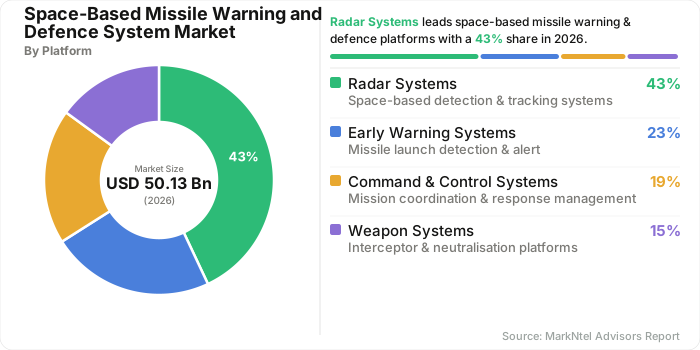
- By component, Radar Systems account for approximately 43% of the total market share.
- By platform, Airborne systems lead with approximately 50% market share in 2026.
- North America lead the industry with 35% of total market shares.
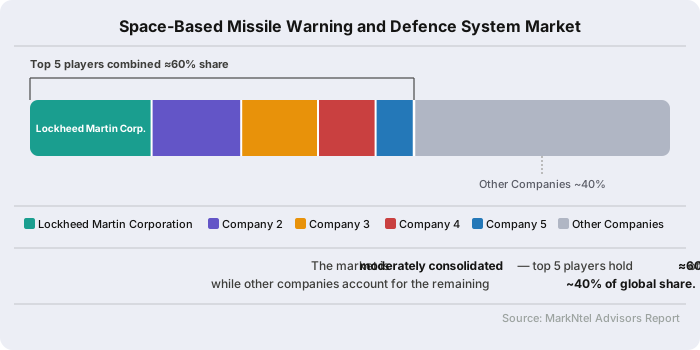
- The industry is moderately consolidated, with the top five players collectively accounting for a 60% of the global market share.
Space-Based Missile Warning and Defense System Market Size & Outlook
The Space-Based Missile Warning and Defense System Industry was valued at USD 47.23 billion in 2025 and is projected to grow from USD 50.13 billion in 2026 to USD 69.67 billion by 2032, expanding at a CAGR of around 5.65% during 2026–2032.
Market growth is being driven by escalating geopolitical tensions, the rapid proliferation of hypersonic weapons, and the increasing deployment of manoeuvrable missile systems capable of evading conventional Defense networks. Traditional ground-based radar infrastructure faces inherent limitations in detecting and continuously tracking high-speed, trajectory-changing threats, prompting governments to strengthen space-based missile warning and Defense capabilities. As a result, Defense agencies worldwide are increasingly investing in satellite-based surveillance, tracking, and early-warning architectures to enhance strategic deterrence and improve response effectiveness.
This shift is most evident in the United States, where space-based missile Defense has become a central pillar of national security strategy. In 2025, the Space Development Agency awarded contracts worth approximately USD 3.5 billion for the deployment of 72 missile-tracking satellites under the Proliferated Warfighter Space Architecture (PWSA). Complementing these efforts, the government's broader Golden Dome initiative has allocated nearly USD 25 billion toward integrated missile warning, tracking, and interception infrastructure, underscoring a long-term commitment to next-generation Defense capabilities.
Similar investment momentum is emerging across the Asia-Pacific region, where evolving security challenges are accelerating the modernization of space-based Defense systems. India approved its Space-Based Surveillance (SBS-3) programme, valued at approximately USD 3.2 billion, to deploy 52 surveillance satellites by 2027–28 and strengthen its missile detection and monitoring capabilities. Likewise, Japan is expanding investments in hypersonic missile Defense and advanced early-warning systems in response to the changing threat landscape in Northeast Asia, further reinforcing regional demand for space-based Defense infrastructure.
Europe is also advancing sovereign space Defense capabilities as part of broader collective security initiatives. The European Union's IRIS² programme, which aims to deploy nearly 290 satellites by 2030, reflects growing efforts to reduce dependence on external infrastructure for critical Defense and communication functions while strengthening regional resilience against emerging missile threats.
Collectively, these large-scale investment programs across North America, Asia-Pacific, and Europe demonstrate that demand for space-based missile warning and Defense systems is being driven by long-term strategic requirements rather than short-term procurement cycles. Looking ahead, the integration of artificial intelligence-enabled threat assessment, advanced sensor fusion technologies, and multi-orbit satellite constellations is expected to significantly enhance detection accuracy, tracking capabilities, and response times. These technological advancements are anticipated to create substantial growth opportunities for both prime contractors and subsystem suppliers throughout the forecast period.
Space-Based Missile Warning and Defense System Market Key Indicators
- According to the Stockholm International Peace Research Institute, global military expenditure reached USD 2.718 trillion in 2024, representing a 9.4% year-over-year increase and the highest level ever recorded. Rising defense budgets are enabling greater investments in missile warning, missile tracking, and space-based surveillance architectures worldwide.
- In December 2025, the Space Development Agency awarded L3Harris a contract to develop 18 infrared Tranche 3 tracking satellites designed to detect hypersonic and ballistic missile threats, highlighting continued investment in space-based missile-tracking infrastructure.
- The number of active satellites orbiting Earth reached approximately 11,700 satellites by May 2025, compared with fewer than 4,000 in 2020. The rapid expansion of orbital infrastructure is increasing demand for space domain awareness, missile tracking, and resilient space-based sensing networks.
- NATO members collectively accounted for more than USD 1 trillion in annual defense spending, with a growing number of allies meeting the alliance's 2% of GDP defense spending target. Rising defense allocations are supporting modernization of integrated missile defense and space surveillance systems.
- The European Defense Fund allocated approximately USD 183 million under its 2026 work programme for hypersonic countermeasure and interception research, supporting the development of next-generation missile warning and Defense technologies.
- The U.S. Space Force awarded 20 OTA contracts valued at up to USD 3.2 billion to 12 companies for prototyping space-based interceptor constellations capable of engaging missile threats during boost, midcourse, and glide phases.
- BAE Systems' Epoch 2 medium-earth-orbit missile-warning satellites completed preliminary design review in March 2026, incorporating advanced sensors, optical crosslinks, AI-enabled data fusion, and mission management capabilities to enhance hypersonic threat detection.
- France committed approximately USD 4.85 billion in military space funding through 2030, including investments in early-warning satellite development under the Franco-German JEWEL initiative aimed at strengthening NATO missile Defense capabilities.
Space-Based Missile Warning and Defense System Market Scope
| Category | Segments |
|---|---|
| By Component | Weapon Systems, Radar Systems, Command & Control Systems , Early Warning Systems |
| By Platform | Airborne, Land, Naval |
| By Range | Short Range, Medium Range, Long Range |
| By Threat Type | Subsonic Missiles, Supersonic Missiles, Hypersonic Missiles |
Space-Based Missile Warning and Defense System Market Growth Drivers
Hypersonic Missile Proliferation Driving Space-Based Defense Demand
The accelerating proliferation of hypersonic missile systems among major military powers is creating a structural and sustained demand shift toward space-based missile warning and Defense architectures globally. Russia's deployment of the avangard glide vehicle and its active combat use of the Oreshnik hypersonic ballistic missile, including a january 2026 strike near Lviv, just 60 kilometres from NATO's eastern border has compelled European governments to urgently address critical gaps in sovereign early-warning capability. North Korea conducted multiple ballistic and hypersonic missile launches throughout 2025 into early 2026, intensifying demand for persistent space-based detection architectures across Japan, South Korea, and U.S. Indo-Pacific commands.
These threat realities have a direct and measurable consequence: ground-based radar networks cannot track manoeuvrable hypersonic threats throughout all phases of flight, making orbital sensor constellations the only viable solution. Governments across multiple regions have responded with concrete programmes. Europe launched the Franco-German JEWEL initiative and the EU-backed ODIN'S EYE and TWISTER programmes specifically to develop indigenous space-based hypersonic detection capability, reducing reliance on U.S. assets. The United States accelerated the HBTSS programme and the SDA's multi-orbit tracking layer constellation, while China's ongoing DF-17 deployments are driving parallel investment across Indo-Pacific allies. The cumulative effect is a multi-regional procurement cycle anchored in an irreversible strategic reality, hypersonic threats cannot be managed from the ground alone.
Recent Trends
AI-Driven Infrared Sensing and Multi-Layer Sensor Fusion Redefining Architecture Globally
The integration of artificial intelligence, advanced infrared payloads, and multi-layer sensor fusion is rapidly redefining how space-based missile warning and Defense systems are designed, built, and operated across major Defense economies.
Industry leaders at the Satellite 2026 conference highlighted that on board AI processing is enabling satellites to automatically identify hypersonic threats in real time. These tasks were previously handled by human operators reviewing thermal signatures manually and fundamentally compressing the detection-to-response cycle. This shift from human-in-the-loop to machine-speed threat discrimination is no longer aspirational; it is actively embedded in current procurement programmes.
The trend is increasingly pronounced across the Indo-Pacific region. Japan’s ministry of Defense confirmed in its May 2026 space build-up briefing that IHI aerospace and JAXA are developing infrared sensors aboard the HTV-X platform specifically engineered to detect and track hypersonic glide vehicles, while Japan’s space Defense budget increased substantially from USD 492 million in fiscal 2022 to USD 3.36 billion in fiscal 2025. Furthermore, Japan and the United States confirmed during their March 2025 Defense ministerial meeting a joint programme to develop a dedicated low Earth orbit constellation focused on hypersonic glide vehicle detection and tracking capabilities.
This transition is further reinforcing global investments in AI-enabled command-and-control (C2) infrastructure, autonomous decision-support systems, and multi-sensor battlefield analytics platforms capable of processing large-scale real-time threat intelligence across domains. Programs such as the United States’ joint all-domain command and control (JADC2) initiative are accelerating the integration of space, air, naval, land, and cyber Defense networks into interoperable combat ecosystems. The increasing adoption of AI-enabled sensor fusion and real-time battlefield coordination technologies is expected to significantly enhance missile warning responsiveness, targeting precision, and integrated Defense coordination capabilities globally.
Space-Based Missile Warning and Defense System Market Opportunities & Challenges
Rising Satellite Development Costs Accelerating Adoption of Proliferated LEO Architectures
The most operationally significant challenge confronting the global space-based missile warning and Defense system market is the substantial and increasingly uncontrollable cost of developing, deploying, and sustaining advanced satellite architectures. A burden that is straining Defense budgets across every major region simultaneously.
The consequences of this cost pressure are concrete and recent. The U.S. next-generation overhead persistent infrared polar programme, initiated in 2018, accumulated USD 2.1 billion in expenditure before its cancellation in April 2026, terminating the effort with a total projected cost of USD 3.4 billion and zero satellites launched.
The problem is equally acute beyond U.S. borders. A 2026 IISS study found that European nations are collectively committed to investing at least EUR 95 billion in space capabilities by 2030, yet full strategic autonomy in space-based missile warning would require an additional USD 10 billion at a minimum, excluding ground infrastructure, personnel, and cyber resilience costs and which may not be achievable before the late 2030s.
In the Indo-Pacific, Japanese Defense analysts have noted that a constellation fully capable of tracking hypersonic glide vehicles would require thousands of satellites, each demanding costly infrared sensors engineered for hypersonic-speed object capture, a scale that far exceeds current national budgets without commercial and allied co-investment.
This shared pressure is generating a clearly defined and durable market opportunity. Governments are responding through competitive, multi-vendor contracting, commercial partnerships, and proliferated LEO architectures that distribute cost across broader industrial bases. India's Digantara secured USD 50 million in December 2025 to expand from space domain awareness into missile tracking, illustrating how cost-driven demand is pulling commercial and start-up capital into a segment historically dominated by government prime contractors.
The shift is also driving procurement restructuring across major Defense economies. The U.S. Space Development Agency’s decision to distribute Tranche 3 satellite production across multiple contractors reflects the growing emphasis on competitive pricing, industrial scalability, and accelerated constellation deployment timelines. For firms capable of delivering modular, cost-competitive satellite systems at production scale, this structural reorientation creates an expanding procurement pipeline across the 2026–2032 forecast period.
Segmentation Insights
Advanced Radar Systems Drive Component Segment Dominance
Radar Systems represent the dominant segment within the global space-based missile warning and Defense system market by component, commanding approximately 43% of total market value in 2026. Their market leadership is rooted in their irreplaceable function as the primary detection mechanism within any comprehensive missile Defense architecture. Space-based radar systems provide continuous, wide-area surveillance capable of identifying missile launches and tracking flight trajectories in real time, data that feeds directly into command, control, and intercept decision chains.
The segment's dominance is further reinforced by the technological sophistication of modern space-based radar, including active electronically scanned array (AESA) configurations and multi-spectral sensing capabilities. These advancements enhance discrimination performance, enabling systems to differentiate between actual missile threats and decoys or debris, a capability increasingly critical given the growing complexity of adversarial missile payloads. Sustained government investment in next-generation radar platforms, including those integrated within the golden dome architecture and the SDA's tracking layer, ensures the segment will maintain its leadership position through the forecast period. Based on component, the market is segmented into:
- Weapon Systems
- Radar Systems
- Command & Control Systems
- Early Warning System
Airborne Platforms Maintain Dominance Through Advanced Missile Tracking Capabilities
The Airborne segment leads the space-based missile warning and Defense system market by platform, accounting for approximately 50% of market share in 2026. This dominance reflects the operational superiority of airborne and satellite-based platforms in delivering persistent, globally scalable missile surveillance coverage without the geographic constraints inherent in land or naval systems. Deployed on both aircraft and satellites, airborne platforms integrate advanced infrared, radar, and signals intelligence sensors to achieve early detection and continuous tracking of ballistic, hypersonic, and cruise missile threats across all flight phases.
The segment benefits from active and large-scale procurement across the U.S. Defense establishment. The space development agency's proliferated war fighter space architecture, anchored by successive tranches of LEO missile tracking satellites, is fundamentally an airborne-layer build-out. Lockheed Martin's ongoing production of Next Gen OPIR satellites for both GEO and MEO applications further reflects the centrality of airborne platforms in multi-orbit Defense architectures. Expanding allied investment in satellite-based missile warning capabilities, particularly across NATO and Indo-Pacific partnership frameworks, is anticipated to sustain the segment's dominant share through 2032. Based on platform, the market is bifurcated into:
- Airborne
- Land
- Naval
Space-Based Missile Warning and Defense System Market Geographical Outlook
North America leads the global space-based missile warning and Defense system market, retaining approximately 35% of total market share in 2026. The region's dominance is underpinned by the concentration of the world's foremost Defense prime contractors, including Lockheed Martin, Northrop Grumman, Raytheon Technologies, L3Harris, and Boeing, all of which maintain deep institutional relationships with the U.S. Department of Defense and Space Force.
The U.S. continues to operate the most sophisticated and extensive space-based missile warning architecture globally, encompassing the SBIRS constellation, Next Gen OPIR satellites, and the rapidly scaling SDA Tracking Layer. These programs represent multi-decade procurement and sustainment commitments that anchor regional market dominance through the forecast period. The Golden Dome initiative, backed by approximately USD 25 billion in approved congressional funding and a revised program estimate of USD 185 billion, further cements the U.S. as the primary demand generator for the global industry.
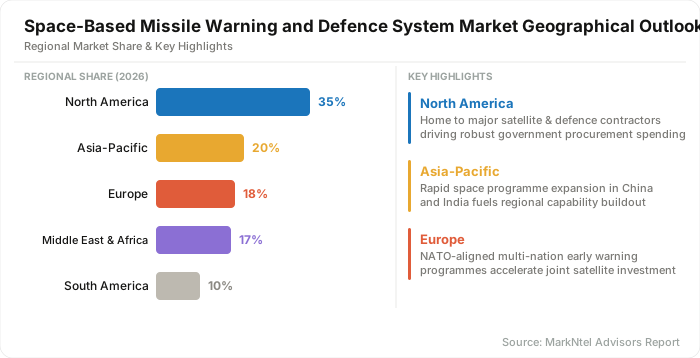
The Asia-Pacific region represents the most dynamic growth frontier for the market during 2026-2032. Escalating tensions across the Korean Peninsula, the Taiwan Strait, and the broader Indo-Pacific theatre are compelling governments in India, Japan, South Korea, and Australia to substantially increase space Defense spending. India has been expanding its space-based ISR and missile warning capabilities, while Japan and Australia are deepening space Defense cooperation with the United States under bilateral and multilateral frameworks.
Space-Based Missile Warning and Defense System Market Competitive Analysis
The global space-based missile warning and Defense system market is moderately consolidated, with a small number of large-scale Defense prime contractors commanding the majority of program awards, development contracts, and long-term sustainment revenue. Major market participants include Lockheed Martin, Northrop Grumman, RTX, L3Harris Technologies, and Boeing. These companies collectively account for approximately 60% of the global space-based missile warning and Defense system market in 2026.
Key Companies in the Space-Based Missile Warning and Defense System Market
- Lockheed Martin Corporation
- Northrop Grumman Corporation
- RTX Corporation (Raytheon Technologies)
- L3Harris Technologies
- The Boeing Company
- BAE Systems plc
- MBDA S.A.S.
- Airbus SE
- General Dynamics Corporation
- Rafael Advanced Defense Systems
- Leonardo S.P.A.
- Thales S.A.
- Hanwha Corporation
- Saab AB
- Rheinmetall AG
- ASELSAN Elektronik Sanayi ve Ticaret A.Ş.
Space-Based Missile Warning and Defense System Market News & Recent Developments
L3Harris Secures USD 843 Million Contract for SDA Tranche 3 Missile-Tracking Satellites
The U.S. Space Development Agency awarded L3Harris Technologies a contract valued at up to USD 843 million to develop 18 infrared Tracking Layer satellites under Tranche 3 of the Proliferated Warfighter Space Architecture (PWSA). The satellites are designed to enhance missile warning and missile tracking capabilities against advanced threats, including hypersonic missiles, through improved infrared sensing, onboard data processing, and real-time threat detection. The award forms part of SDA's broader USD 3.5 billion Tranche 3 program, under which 72 missile-tracking satellites will be deployed in low Earth orbit.
Impact Analysis: This development underscores the accelerating global investment in proliferated low-Earth-orbit missile warning and tracking constellations. The contract is expected to drive demand for advanced infrared sensors, satellite manufacturing, onboard processing technologies, and space-based command-and-control systems. Furthermore, the large-scale deployment of Tracking Layer satellites demonstrates the growing strategic importance of space-based missile Defense architectures for countering hypersonic and ballistic missile threats. The program is also likely to create long-term opportunities for satellite integrators, component suppliers, launch service providers, and Defense-space technology companies throughout the forecast period.
Frequently Asked Questions
- Market Segmentation
- Introduction
- Product Definition
- Research Process
- Assumptions
- Executive Summary
- Global Space-Based Missile Warning and Defense System Market Policies, Regulations, and Product Standards
- Global Space-Based Missile Warning and Defense System Production Trend 2022-2032
- Global Space-Based Missile Warning and Defense System Production Trend by Type of Component
- Weapon Systems
- Radar Systems
- Command & Control Systems
- Early Warning Systems
- Global Space-Based Missile Warning and Defense System Production Trend by Type of Component
- Global Space-Based Missile Warning and Defense System Pricing Analysis 2022-2032
- Global Space-Based Missile Warning and Defense System Pricing Trend 2022-2032
- Global Space-Based Missile Warning and Defense System Pricing Trend by Regions 2022-2032
- North America
- South America
- Europe
- The Middle East & Africa
- Asia-Pacific
- Global Space-Based Missile Warning and Defense System Market Trends & Developments
- Global Space-Based Missile Warning and Defense System Market Dynamics
- Growth Factors
- Challenges
- Global Space-Based Missile Warning and Defense System Market Hotspot & Opportunities
- Global Space-Based Missile Warning and Defense System Market Outlook, 2022-2032F
- Market Size & Outlook
- By Revenues (USD Million)
- Market Share & Analysis
- By Component- Market Size & Forecast 2022-2032, USD Million
- Weapon Systems
- Radar Systems
- Command & Control Systems
- Early Warning Systems
- By Platform- Market Size & Forecast 2022-2032, USD Million
- Airborne
- Land
- Naval
- By Range- Market Size & Forecast 2022-2032, USD Million
- Short Range
- Medium Range
- Long Range
- By Threat Type- Market Size & Forecast 2022-2032, USD Million
- Subsonic Missiles
- Supersonic Missiles
- Hypersonic Missiles
- By Region
- North America
- South America
- Europe
- The Middle East & Africa
- Asia-Pacific
- By Company
- Competition Characteristics
- Market Share & Analysis
- By Component- Market Size & Forecast 2022-2032, USD Million
- Market Size & Outlook
- North America Space-Based Missile Warning and Defense System Market Outlook, 2022-2032F
- Market Size & Outlook
- By Revenues (USD Million)
- Market Share & Analysis
- By Component- Market Size & Forecast 2022-2032, USD Million
- By Platform- Market Size & Forecast 2022-2032, USD Million
- By Range- Market Size & Forecast 2022-2032, USD Million
- By Threat Type- Market Size & Forecast 2022-2032, USD Million
- By Country
- The US
- Canada
- Mexico
- The US Space-Based Missile Warning and Defense System Market Outlook, 2022-2032F
- Market Size & Outlook
- By Revenues (USD Million)
- Market Share & Analysis
- By Component- Market Size & Forecast 2022-2032, USD Million
- By Platform- Market Size & Forecast 2022-2032, USD Million
- By Range- Market Size & Forecast 2022-2032, USD Million
- By Threat Type- Market Size & Forecast 2022-2032, USD Million
- Market Size & Outlook
- Canada Space-Based Missile Warning and Defense System Market Outlook, 2022-2032F
- Market Size & Outlook
- By Revenues (USD Million)
- Market Share & Analysis
- By Component- Market Size & Forecast 2022-2032, USD Million
- By Platform- Market Size & Forecast 2022-2032, USD Million
- By Range- Market Size & Forecast 2022-2032, USD Million
- By Threat Type- Market Size & Forecast 2022-2032, USD Million
- Market Size & Outlook
- Mexico Space-Based Missile Warning and Defense System Market Outlook, 2022-2032F
- Market Size & Outlook
- By Revenues (USD Million)
- Market Share & Analysis
- By Component- Market Size & Forecast 2022-2032, USD Million
- By Platform- Market Size & Forecast 2022-2032, USD Million
- By Range- Market Size & Forecast 2022-2032, USD Million
- By Threat Type- Market Size & Forecast 2022-2032, USD Million
- Market Size & Outlook
- Market Size & Outlook
- South America Space-Based Missile Warning and Defense System Market Outlook, 2022-2032F
- Market Size & Outlook
- By Revenues (USD Million)
- Market Share & Analysis
- By Component- Market Size & Forecast 2022-2032, USD Million
- By Platform- Market Size & Forecast 2022-2032, USD Million
- By Range- Market Size & Forecast 2022-2032, USD Million
- By Threat Type- Market Size & Forecast 2022-2032, USD Million
- By Country
- Brazil
- Argentina
- Rest of South America
- Brazil Space-Based Missile Warning and Defense System Market Outlook, 2022-2032F
- Market Size & Outlook
- By Revenues (USD Million)
- Market Share & Analysis
- By Component- Market Size & Forecast 2022-2032, USD Million
- By Platform- Market Size & Forecast 2022-2032, USD Million
- By Range- Market Size & Forecast 2022-2032, USD Million
- By Threat Type- Market Size & Forecast 2022-2032, USD Million
- Market Size & Outlook
- Argentina Space-Based Missile Warning and Defense System Market Outlook, 2022-2032F
- Market Size & Outlook
- By Revenues (USD Million)
- Market Share & Analysis
- By Component- Market Size & Forecast 2022-2032, USD Million
- By Platform- Market Size & Forecast 2022-2032, USD Million
- By Range- Market Size & Forecast 2022-2032, USD Million
- By Threat Type- Market Size & Forecast 2022-2032, USD Million
- Market Size & Outlook
- Market Size & Outlook
- Europe Space-Based Missile Warning and Defense System Market Outlook, 2022-2032F
- Market Size & Outlook
- By Revenues (USD Million)
- Market Share & Analysis
- By Component- Market Size & Forecast 2022-2032, USD Million
- By Platform- Market Size & Forecast 2022-2032, USD Million
- By Range- Market Size & Forecast 2022-2032, USD Million
- By Threat Type- Market Size & Forecast 2022-2032, USD Million
- By Country
- The UK
- Germany
- France
- Italy
- Spain
- Scandinavia
- Rest of Europe
- The UK Space-Based Missile Warning and Defense System Market Outlook, 2022-2032F
- Market Size & Outlook
- By Revenues (USD Million)
- Market Share & Analysis
- By Component- Market Size & Forecast 2022-2032, USD Million
- By Platform- Market Size & Forecast 2022-2032, USD Million
- By Range- Market Size & Forecast 2022-2032, USD Million
- By Threat Type- Market Size & Forecast 2022-2032, USD Million
- Market Size & Outlook
- Germany Space-Based Missile Warning and Defense System Market Outlook, 2022-2032F
- Market Size & Outlook
- By Revenues (USD Million)
- Market Share & Analysis
- By Component- Market Size & Forecast 2022-2032, USD Million
- By Platform- Market Size & Forecast 2022-2032, USD Million
- By Range- Market Size & Forecast 2022-2032, USD Million
- By Threat Type- Market Size & Forecast 2022-2032, USD Million
- Market Size & Outlook
- France Space-Based Missile Warning and Defense System Market Outlook, 2022-2032F
- Market Size & Outlook
- By Revenues (USD Million)
- Market Share & Analysis
- By Component- Market Size & Forecast 2022-2032, USD Million
- By Platform- Market Size & Forecast 2022-2032, USD Million
- By Range- Market Size & Forecast 2022-2032, USD Million
- By Threat Type- Market Size & Forecast 2022-2032, USD Million
- Market Size & Outlook
- Italy Space-Based Missile Warning and Defense System Market Outlook, 2022-2032F
- Market Size & Outlook
- By Revenues (USD Million)
- Market Share & Analysis
- By Component- Market Size & Forecast 2022-2032, USD Million
- By Platform- Market Size & Forecast 2022-2032, USD Million
- By Range- Market Size & Forecast 2022-2032, USD Million
- By Threat Type- Market Size & Forecast 2022-2032, USD Million
- Market Size & Outlook
- Spain Space-Based Missile Warning and Defense System Market Outlook, 2022-2032F
- Market Size & Outlook
- By Revenues (USD Million)
- Market Share & Analysis
- By Component- Market Size & Forecast 2022-2032, USD Million
- By Platform- Market Size & Forecast 2022-2032, USD Million
- By Range- Market Size & Forecast 2022-2032, USD Million
- By Threat Type- Market Size & Forecast 2022-2032, USD Million
- Market Size & Outlook
- Scandinavia Space-Based Missile Warning and Defense System Market Outlook, 2022-2032F
- Market Size & Outlook
- By Revenues (USD Million)
- Market Share & Analysis
- By Component- Market Size & Forecast 2022-2032, USD Million
- By Platform- Market Size & Forecast 2022-2032, USD Million
- By Range- Market Size & Forecast 2022-2032, USD Million
- By Threat Type- Market Size & Forecast 2022-2032, USD Million
- Market Size & Outlook
- Market Size & Outlook
- The Middle East & Africa Space-Based Missile Warning and Defense System Market Outlook, 2022-2032F
- Market Size & Outlook
- By Revenues (USD Million)
- Market Share & Analysis
- By Component- Market Size & Forecast 2022-2032, USD Million
- By Platform- Market Size & Forecast 2022-2032, USD Million
- By Range- Market Size & Forecast 2022-2032, USD Million
- By Threat Type- Market Size & Forecast 2022-2032, USD Million
- By Country
- Saudi Arabia
- The UAE
- South Africa
- Rest of Middle East & Africa
- Saudi Arabia Space-Based Missile Warning and Defense System Market Outlook, 2022-2032F
- Market Size & Outlook
- By Revenues (USD Million)
- Market Share & Analysis
- By Component- Market Size & Forecast 2022-2032, USD Million
- By Platform- Market Size & Forecast 2022-2032, USD Million
- By Range- Market Size & Forecast 2022-2032, USD Million
- By Threat Type- Market Size & Forecast 2022-2032, USD Million
- Market Size & Outlook
- The UAE Space-Based Missile Warning and Defense System Market Outlook, 2022-2032F
- Market Size & Outlook
- By Revenues (USD Million)
- Market Share & Analysis
- By Component- Market Size & Forecast 2022-2032, USD Million
- By Platform- Market Size & Forecast 2022-2032, USD Million
- By Range- Market Size & Forecast 2022-2032, USD Million
- By Threat Type- Market Size & Forecast 2022-2032, USD Million
- Market Size & Outlook
- South Africa Space-Based Missile Warning and Defense System Market Outlook, 2022-2032F
- Market Size & Outlook
- By Revenues (USD Million)
- Market Share & Analysis
- By Component- Market Size & Forecast 2022-2032, USD Million
- By Platform- Market Size & Forecast 2022-2032, USD Million
- By Range- Market Size & Forecast 2022-2032, USD Million
- By Threat Type- Market Size & Forecast 2022-2032, USD Million
- Market Size & Outlook
- Market Size & Outlook
- Asia-Pacific Space-Based Missile Warning and Defense System Market Outlook, 2022-2032F
- Market Size & Outlook
- By Revenues (USD Million)
- Market Share & Analysis
- By Component- Market Size & Forecast 2022-2032, USD Million
- By Platform- Market Size & Forecast 2022-2032, USD Million
- By Range- Market Size & Forecast 2022-2032, USD Million
- By Threat Type- Market Size & Forecast 2022-2032, USD Million
- By Country
- China
- Japan
- India
- South Korea
- Australia
- Rest of Asia-Pacific
- China Space-Based Missile Warning and Defense System Market Outlook, 2022-2032F
- Market Size & Outlook
- By Revenues (USD Million)
- Market Share & Analysis
- By Component- Market Size & Forecast 2022-2032, USD Million
- By Platform- Market Size & Forecast 2022-2032, USD Million
- By Range- Market Size & Forecast 2022-2032, USD Million
- By Threat Type- Market Size & Forecast 2022-2032, USD Million
- Market Size & Outlook
- Japan Space-Based Missile Warning and Defense System Market Outlook, 2022-2032F
- Market Size & Outlook
- By Revenues (USD Million)
- Market Share & Analysis
- By Component- Market Size & Forecast 2022-2032, USD Million
- By Platform- Market Size & Forecast 2022-2032, USD Million
- By Range- Market Size & Forecast 2022-2032, USD Million
- By Threat Type- Market Size & Forecast 2022-2032, USD Million
- Market Size & Outlook
- India Space-Based Missile Warning and Defense System Market Outlook, 2022-2032F
- Market Size & Outlook
- By Revenues (USD Million)
- Market Share & Analysis
- By Component- Market Size & Forecast 2022-2032, USD Million
- By Platform- Market Size & Forecast 2022-2032, USD Million
- By Range- Market Size & Forecast 2022-2032, USD Million
- By Threat Type- Market Size & Forecast 2022-2032, USD Million
- Market Size & Outlook
- South Korea Space-Based Missile Warning and Defense System Market Outlook, 2022-2032F
- Market Size & Outlook
- By Revenues (USD Million)
- Market Share & Analysis
- By Component- Market Size & Forecast 2022-2032, USD Million
- By Platform- Market Size & Forecast 2022-2032, USD Million
- By Range- Market Size & Forecast 2022-2032, USD Million
- By Threat Type- Market Size & Forecast 2022-2032, USD Million
- Market Size & Outlook
- Australia Space-Based Missile Warning and Defense System Market Outlook, 2022-2032F
- Market Size & Outlook
- By Revenues (USD Million)
- Market Share & Analysis
- By Component- Market Size & Forecast 2022-2032, USD Million
- By Platform- Market Size & Forecast 2022-2032, USD Million
- By Range- Market Size & Forecast 2022-2032, USD Million
- By Threat Type- Market Size & Forecast 2022-2032, USD Million
- Market Size & Outlook
- Market Size & Outlook
- Global Space-Based Missile Warning and Defense System Market Key Strategic Imperatives for Success & Growth
- Competitive Outlook
- Company Profiles
- Lockheed Martin Corporation
- Business Description
- Product Portfolio
- Collaborations & Alliances
- Recent Developments
- Financial Details
- Others
- Northrop Grumman Corporation
- Business Description
- Product Portfolio
- Collaborations & Alliances
- Recent Developments
- Financial Details
- Others
- RTX Corporation (Raytheon Technologies)
- Business Description
- Product Portfolio
- Collaborations & Alliances
- Recent Developments
- Financial Details
- Others
- BAE Systems PLC
- Business Description
- Product Portfolio
- Collaborations & Alliances
- Recent Developments
- Financial Details
- Others
- The Boeing Company
- Business Description
- Product Portfolio
- Collaborations & Alliances
- Recent Developments
- Financial Details
- Others
- MBDA S.A.S.
- Business Description
- Product Portfolio
- Collaborations & Alliances
- Recent Developments
- Financial Details
- Others
- Airbus SE
- Business Description
- Product Portfolio
- Collaborations & Alliances
- Recent Developments
- Financial Details
- Others
- General Dynamics Corporation
- Business Description
- Product Portfolio
- Collaborations & Alliances
- Recent Developments
- Financial Details
- Others
- Rafael Advanced Defense Systems
- Business Description
- Product Portfolio
- Collaborations & Alliances
- Recent Developments
- Financial Details
- Others
- Leonardo S.p.A.
- Business Description
- Product Portfolio
- Collaborations & Alliances
- Recent Developments
- Financial Details
- Others
- Thales S.A.
- Business Description
- Product Portfolio
- Collaborations & Alliances
- Recent Developments
- Financial Details
- Others
- Hanwha Corporation
- Business Description
- Product Portfolio
- Collaborations & Alliances
- Recent Developments
- Financial Details
- Others
- Saab AB
- Business Description
- Product Portfolio
- Collaborations & Alliances
- Recent Developments
- Financial Details
- Others
- Rheinmetall AG
- Business Description
- Product Portfolio
- Collaborations & Alliances
- Recent Developments
- Financial Details
- Others
- L3Harris Technologies Inc.
- Business Description
- Product Portfolio
- Collaborations & Alliances
- Recent Developments
- Financial Details
- Others
- ASELSAN Elektronik Sanayi ve Ticaret A.Ş.
- Business Description
- Product Portfolio
- Collaborations & Alliances
- Recent Developments
- Financial Details
- Others
- Lockheed Martin Corporation
- Company Profiles
- Disclaimer
MarkNtel Advisors follows a robust and iterative research methodology designed to ensure maximum accuracy and minimize deviation in market estimates and forecasts. Our approach combines both bottom-up and top-down techniques to effectively segment and quantify various aspects of the market. A consistent feature across all our research reports is data triangulation, which examines the market from three distinct perspectives to validate findings. Key components of our research process include:
1. Scope & Research Design At the outset, MarkNtel Advisors define the research objectives and formulate pertinent questions. This phase involves determining the type of research—qualitative or quantitative—and designing a methodology that outlines data collection methods, target demographics, and analytical tools. They also establish timelines and budgets to ensure the research aligns with client goals.
2. Sample Selection and Data Collection In this stage, the firm identifies the target audience and determines the appropriate sample size to ensure representativeness. They employ various sampling methods, such as random or stratified sampling, based on the research objectives. Data collection is carried out using tools like surveys, interviews, and observations, ensuring the gathered data is reliable and relevant.
3. Data Analysis and Validation Once data is collected, MarkNtel Advisors undertake a rigorous analysis process. This includes cleaning the data to remove inconsistencies, employing statistical software for quantitative analysis, and thematic analysis for qualitative data. Validation steps are taken to ensure the accuracy and reliability of the findings, minimizing biases and errors.

4. Data Forecast and FinalizationThe final phase involves forecasting future market trends based on the analyzed data. MarkNtel Advisors utilize predictive modeling and time series analysis to anticipate market behaviors. The insights are then compiled into comprehensive reports, featuring visual aids like charts and graphs, and include strategic recommendations to inform client decision-making
We offer flexible licensing options to cater to varying organizational needs. Choose the pricing pack that best suits your requirements:
Buy Now Inquire Before Buying
 Request Customization
 Talk to our Consultant







