

In-Orbit Satellite Services Market Research Report: Forecast (2026-2032)
By Type of Service (Life Extension, Refueling, Repair & Maintenance, Relocation & Orbit Adjustment, Debris Removal / Salvage Operations, Inspection & Diagnostics), By By Orbit (Lo ... w Earth Orbit (LEO), Medium Earth Orbit (MEO), Geostationary Earth Orbit (GEO)), By End User (Commercial, Government & Defense), and others Read more
- Aerospace & Defense
- Aug 2026
- Pages 340
- Report Format: PDF, Excel, PPT
In-Orbit Satellite Services Market
Projected 20.59% CAGR from 2026 to 2032
Study Period
2026-2032
Market Size (2026)
USD 2.27 Billion
Market Size (2032)
USD 6.98 Billion
Largest Region
2025
Projected CAGR
20.59%
Leading Segments
By Type Services: Life Extension
In-Orbit Satellite Services Market Key Takeaways
- The in-orbit satellite services market was valued at USD 2.11 billion in 2025 and is projected to grow from USD 2.27 billion in 2026 to USD 6.98 billion by 2032.
- The industry is projected to expand at a 20.59% CAGR during 2026–2032.
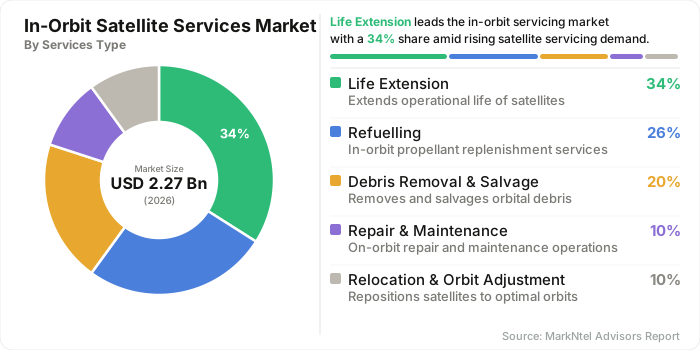
- By type of service, life extension is estimated to hold the leading position, accounting for approximately 34% of the market in 2026.
- By orbit, geostationary earth orbit (GEO) is estimated to represent approximately 58% of the market in 2026.
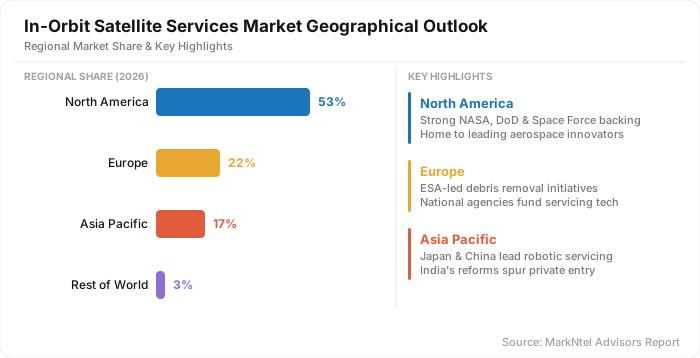
- North America leads the global market with approximately a 53% share in 2026.
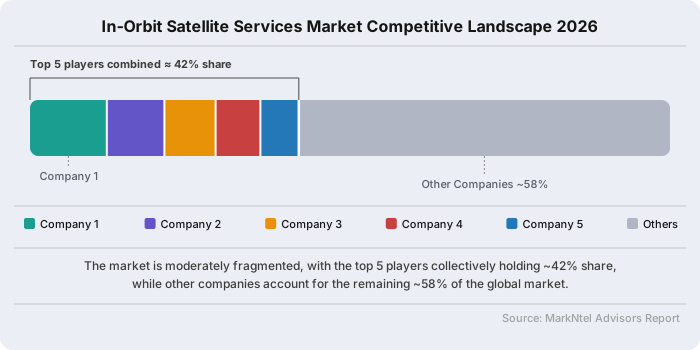
- The market is moderately consolidated, with the top five companies collectively accounting for approximately 42% share in 2026.
In-Orbit Satellite Services Market Size and Outlook
The in-orbit satellite services market was valued at USD 2.11 billion in 2025 and is projected to reach USD 2.27 billion in 2026 and USD 6.98 billion by 2032, expanding at a 20.59% CAGR during 2026–2032. Market growth is being supported by increasing commercialization of satellite servicing, rising demand for spacecraft mobility and orbital repositioning, greater utilization of robotic servicing platforms, and growing adoption of satellite refurbishment and upgrading solutions. The shift from one-time spacecraft replacement toward service-based orbital asset management is also strengthening recurring revenue potential, while expanding government procurement is helping validate emerging servicing business models and accelerate market commercialization.
In-Orbit Satellite Services Market Key Indicators
- The global active satellite base has expanded from around 1,400 satellites in 2015 to more than 11,000 in 2025, representing nearly an eightfold increase in a decade. The U.S. Government Accountability Office also indicates that 18,000 or more additional satellites could be launched by 2030. A larger and increasingly valuable on-orbit asset base expands the addressable pool for satellite life extension, inspection, relocation, refueling, repair, and other in-orbit services, directly supporting market growth.
- Commercial satellite constellations are accelerating the requirement for orbital maintenance services. SpaceX launched 3,174 Starlink satellites during 2025, representing 78.6% of all commercial spacecraft launched that year, while Starlink surpassed 10,000 operational satellites. Amazon Leo had deployed more than 300 satellites by mid-2026 and plans a constellation exceeding 3,000 satellites by 2029. Such high-volume deployments increase the number of assets requiring orbit management, collision avoidance, inspection, servicing, and eventual deorbiting, creating sustained demand for in-orbit satellite services.
- Orbital congestion is simultaneously creating a measurable need for satellite inspection and debris-removal services. As of July 2026, approximately 46,210 space objects were regularly tracked, including around 18,840 satellites still in space and 16,000 functioning satellites. The scale of the orbital population increases the frequency and complexity of conjunction management and creates a larger operational requirement for spacecraft capable of inspection, maneuvering, and debris mitigation.
- Space debris is becoming a direct demand catalyst for remediation-oriented in-orbit services. ESA estimates more than 1.2 million debris objects larger than 1 cm and more than 50,000 objects larger than 10 cm, while over 3,000 tracked objects were added during 2024 alone following fragmentation events. The resulting collision risk strengthens demand for active debris removal, life-extension missions, inspection, and controlled deorbiting capabilities, expanding the scope of the in-orbit services ecosystem.
- The increasing mass and frequency of spacecraft deployments also enlarge the value at risk in orbit. In 2024, 259 orbital launch attempts were recorded, while total spacecraft mass delivered to orbit increased 40% to 1.9 million kg, despite spacecraft deployments declining 3% to 2,802. Heavier and more sophisticated spacecraft represent higher replacement costs, strengthening the economic case for extending satellite operating lives through in-orbit servicing rather than prematurely replacing assets.
- The development of space-based infrastructure is also increasing the strategic importance of satellite longevity. More than 11,000 active satellites were providing critical services in 2025, spanning communications, navigation, Earth observation, and other applications. As satellite services become increasingly embedded in terrestrial infrastructure, minimizing service interruptions becomes more commercially important, supporting demand for in-orbit repair, repositioning, inspection, and life-extension services.
- ESA's orbital sustainability data further indicates that about 80% of rocket bodies in low-Earth orbit comply with the newer five-year orbit-clearance standard, while approximately 90% comply with the previous 25-year standard. Increasing emphasis on shorter post-mission disposal periods is encouraging operators to incorporate controlled deorbiting and end-of-life management into mission planning, thereby creating additional opportunities for in-orbit servicing and active debris-removal providers.
In-Orbit Satellite Services Industry Demand–Supply Gap Analysis
The in-orbit satellite services market faces a developing demand–supply gap as satellite fleets expand and reach recurring replacement and end-of-life cycles, while commercial servicing capacity remains limited. According to the U.S. Government Accountability Office (GAO), the U.S. Space Development Agency’s Proliferated Warfighter Space Architecture (PWSA) is planned to include at least 300–500 LEO satellites, with each satellite having an operational life of approximately 5 years. This implies a potential lifecycle replacement requirement of around 60–100 satellites annually once the constellation reaches steady-state operations.
However, dedicated commercial servicing capacity remains at an early deployment stage. In January 2026, Starfish Space received a USD 52.5 million U.S. Space Force contract for Deorbit-as-a-Service for PWSA satellites, but the contracted mission initially includes one deorbit, with additional disposals available as options. This compares with the potential 60–100 annual satellite replacement cycle for the same constellation, highlighting the limited initial availability of dedicated end-of-life servicing.
Similarly, Northrop Grumman’s Mission Robotic Vehicle launched in July 2026 with three Mission Extension Pods, providing an initial capacity for three GEO life-extension interventions. The company identifies the MRV as a multi-mission servicing platform for life extension, inspection, repair, upgrades, disposal, and assembly.
The disparity between recurring satellite lifecycle requirements and currently deployed servicing capacity creates a measurable opportunity for deorbiting, life extension, inspection, maneuvering, and repair services, encouraging additional servicing vehicles and commercial capacity.
In-Orbit Satellite Services Market Scope
| Category | Segments |
|---|---|
| By Type of Service | Life Extension, Refueling, Repair & Maintenance, Relocation & Orbit Adjustment, Debris Removal / Salvage Operations, Inspection & Diagnostics |
| By Orbit | Low Earth Orbit (LEO), Medium Earth Orbit (MEO), Geostationary Earth Orbit (GEO |
| By End User | Commercial, Government & Defense |
In-Orbit Satellite Services Market Growth Drivers
Rapid Expansion of Satellite Constellations and Orbital Assets
The rapid expansion of satellite constellations is a significant growth driver for the in-orbit satellite services industry, as the increasing number of operational spacecraft expands the potential customer base for inspection, life extension, relocation, repair, refueling, and end-of-life services. NASA reports that 4,577 spacecraft were launched in 2025, with Starlink constellation launches accounting for approximately 70% of all spacecraft launched during the year. NASA's latest Small Spacecraft Technology assessment also identifies a continuing influx of mini-class constellations and larger next-generation constellation platforms, alongside increasing demand for orbital maneuvering and transport capabilities.
Separately, ESA recorded approximately 27,490 satellites placed into Earth orbit, with around 18,840 remaining in space and approximately 16,000 still functioning as of July 31, 2026. The expanding operational satellite population is increasing the need to maintain spacecraft availability and manage assets throughout their orbital lifecycles. Consequently, constellation growth is creating a broader addressable customer base for commercial servicing providers and strengthening demand for satellite maintenance, mobility, life extension, and disposal solutions.
Recent Trends
Autonomous Rendezvous, Proximity Operations and Docking (RPOD)
Autonomous rendezvous, proximity operations and docking is emerging as one of the most commercially relevant technologies in the in-orbit satellite services industry because it provides the core operational capability required for servicing spacecraft to safely approach, inspect, capture, and interact with target satellites. NASA identifies RPOD as a key capability for future space operations, including inspection, refueling, repair, and debris remediation. Recent NASA technology updates also highlight autonomous docking and AI-based planning as areas of growing development. In Europe, ESA’s RISE mission is being developed to demonstrate autonomous rendezvous and docking with a GEO satellite, followed by commercial life-extension services.
The mission incorporates robotics, proximity sensors, and autonomous control technologies for close-range satellite operations. As satellite fleets expand and operators increasingly seek life extension, relocation, repair, refueling, and end-of-life disposal, RPOD capabilities are becoming essential to executing these services. Consequently, advances in autonomous navigation, relative sensing, guidance and control, and precision docking are expected to strengthen the scalability and commercial viability of in-orbit satellite servicing.
In-Orbit Satellite Services Market Opportunities and Challenges
Regulatory, Liability and Insurance Complexity Leading to Specialized In-Orbit Servicing Compliance Solutions
Regulatory and insurance complexity remains a challenge for in-orbit satellite servicing providers because missions involving rendezvous, docking, inspection, or spacecraft control can introduce additional licensing, liability, insurance, safety, and sustainability requirements. The UK government’s RPO regulatory sandbox identified regulatory gaps associated with novel servicing missions and worked toward developing a minimum viable licensing framework for new RPO mission types. This indicates that regulatory uncertainty can increase the time and resources required to bring emerging servicing missions from technical development to commercial operation.
These requirements are simultaneously creating an opportunity for standardized licensing, compliance, risk-assessment, and regulatory-support services tailored to satellite-servicing operators. The UK government supported a USD 2.72 million. RPO regulatory sandbox, equivalent to approximately USD 2.7 million, involving companies including Astroscale, ClearSpace, and D-Orbit. The initiative aims to provide greater regulatory clarity and confidence for businesses and investors while establishing pathways for novel servicing missions. The UK government estimates that clearer regulation could help capture a USD 18.2 billion cumulative revenue opportunity over the next decade for the UK's in-orbit servicing market, demonstrating the commercial value of reducing regulatory barriers.
Segmentation Insights
Life Extension is estimated to account for approximately 34% of the in-orbit satellite services market in 2026
Life extension is the leading service segment. Its leadership is primarily driven by the economic value of extending the productive life of high-value satellites, avoiding premature replacement, and maximizing revenue from existing orbital assets. The service is particularly relevant for spacecraft approaching propulsion depletion while remaining technically capable of continuing their missions. A strong 2025 industry development came in April, when Northrop Grumman’s Mission Extension Vehicle-1 (MEV-1) completed five years of life-extension services for Intelsat IS-901, enabling the satellite to operate beyond its original design life. MEV-1 subsequently docked with another client satellite in May 2025, demonstrating the reusable, multi-client servicing model.
A further factor supporting the segment is the development of lower-cost, modular life-extension solutions. Northrop Grumman's Mission Extension Pods are designed to augment the propulsion systems of aging satellites and provide approximately six additional years of operational life. The pods can be installed by its mission robotic vehicle on existing commercial and government spacecraft. This model expands life-extension services beyond traditional dedicated servicing vehicles and supports broader commercial adoption. Based on the type of services, the market is further bifurcated into:
- Life Extension
- Refueling
- Repair & Maintenance
- Relocation & Orbit Adjustment
- Debris Removal / Salvage Operations
- Inspection & Diagnostics
Geostationary Earth Orbit (GEO) is Estimated to Account for Approximately 58% of In-Orbit Satellite Services Market in 2026
Geostationary earth orbit is leading the orbit segment. Its position is supported by the high value of GEO communication assets and the increasing need to maintain, relocate, and safely dispose of spacecraft operating in this strategically important orbital regime. ESA's latest space-environment statistics identify approximately 951 objects currently associated with GEO, including 804 payloads, highlighting the substantial installed asset base that can potentially require servicing throughout its operational lifecycle.
The servicing requirement is reinforced by the operational complexity of the GEO environment. ESA's 2025 assessment identified 1,057 objects near the geosynchronous ring as drifting, representing 56.6% of the classified population, while only 357 objects, or 19.1%, were under both east-west and north-south control. This creates requirements for orbit management, relocation, inspection, life extension, and end-of-life intervention. Furthermore, ESA notes that GEO satellites are particularly suited to telecommunications because they remain fixed relative to ground antennas, supporting continuous communication coverage. Together, the sizable GEO asset population and orbital-management requirements strengthen the commercial case for in-orbit servicing. Based on the orbit type, the market is further segmented into:
- Low Earth Orbit (LEO)
- Medium Earth Orbit (MEO)
- Geostationary Earth Orbit (GEO)
North America Leads with 53% Market Share in 2026
North America remains the leading region in the global in-orbit satellite services market, accounting for approximately 53% of the market share in 2026. The region’s dominance is driven by substantial government funding for space infrastructure, advanced rendezvous and proximity operations (RPO) capabilities, and the presence of major satellite-servicing companies, including Northrop Grumman, Astroscale U.S., and Starfish Space. Increasing U.S. government adoption of commercial satellite-servicing technologies for life extension, inspection, orbital maneuvering, and end-of-life disposal is further strengthening demand.
In July 2026, DARPA and Northrop Grumman’s SpaceLogistics launched the Mission Robotic Vehicle carrying the Robotic Servicing of Geosynchronous Satellites (RSGS) system, representing a significant step toward operational geostationary-orbit servicing. Meanwhile, NASA is advancing commercial-first approaches for satellite servicing, on-orbit repair, maneuvering, and debris removal. These investments are accelerating technology commercialization, expanding the regional servicing ecosystem, and reinforcing North America’s leadership across government, defense, and commercial applications.
In-Orbit Satellite Services Market Competitive Analysis
The in-orbit satellite services market is moderately consolidated, with the top five players accounting for approximately 42% of market share in 2026. Northrop Grumman, Astroscale, Airbus, Lockheed Martin, and Thales Alenia Space maintain strong positions through satellite life extension, inspection, repair, debris removal, and robotic servicing capabilities.
Key Companies in the In-Orbit Satellite Services Market
- Northrop Grumman Corporation
- Astroscale Holdings Inc.
- Airbus SE
- Lockheed Martin Corporation
- Thales Alenia Space
- Infinite Orbits SAS
- ATOMOS SPACE
- Firefly Aerospace
- Orbit Fab
- Starfish Space
- ClearSpace SA
- D-Orbit
- Redwire Corporation
- Blue Origin
- Intelsat/SES
- Others
In-Orbit Satellite Services Industry News and Recent Developments
January 2026: Astroscale Secures ESA Contract for In-Orbit Refurbishment and Upgrading Service
Astroscale UK was awarded a USD 0.46 million contract, approximately USD 463,000, by the European Space Agency to lead the Phase A design of the In-Orbit Refurbishment and Upgrading Service (IRUS). The proposed service is designed to enable satellites to be upgraded, repaired, and extended while remaining in orbit, with BAE Systems participating as a prospective servicing client.
Impact Analysis: The development strengthens the commercial case for extending satellite lifecycles through in-orbit intervention rather than replacement, supporting the emergence of refurbishment and upgrade services as a distinct segment of the market.
January 2026: Starfish Space Wins USD 52.5 Million U.S. Space Force Deorbiting Contract
Starfish Space secured a USD 52.5 million contract from the U.S. Space Force's Space Development Agency to provide Deorbit-as-a-Service for satellites within the Proliferated Warfighter Space Architecture. The company will build, launch, and operate an Otter servicing spacecraft in LEO, initially targeting one deorbit with options for additional satellite disposals.
Impact Analysis: The contract represents a significant commercialization milestone for end-of-life satellite servicing. It also demonstrates growing government demand for dedicated disposal services as satellite constellations expand and operators face increasing orbital sustainability requirements.
February 2026: Starfish Space Receives USD54.5 Million Contract for Dedicated Satellite Servicing Vehicle
Starfish Space was awarded a USD 54.5 million U.S. Space Force contract to deliver a second Otter satellite servicing vehicle under the Pentagon's APFIT program. The spacecraft is designed for dynamic operations in geosynchronous orbit, including autonomous docking and maneuvering of national-security satellites that were not originally designed for servicing. Delivery is scheduled for 2028.
Impact Analysis: The award reinforces government adoption of autonomous rendezvous, proximity operations and docking technologies. It also supports the shift toward smaller, dedicated servicing spacecraft capable of providing maneuver and sustainment capabilities to existing satellite fleets.
Frequently Asked Questions
- Market Segmentation
- Introduction
- Product Definition
- Research Process
- Assumptions
- Executive Summary
- In-Orbit Satellite Services Market Policies, Regulations, and Product Standards
- In-Orbit Satellite Services Market Trends & Developments
- In-Orbit Satellite Services Market Dynamics
- Growth Factors
- Challenges
- In-Orbit Satellite Services Market Hotspot & Opportunities
- In-Orbit Satellite Services Market Outlook, 2022-2032
- Market Size & Outlook
- By Revenues (USD Million)
- Market Segmentation & Outlook
- By Type of Service- Market Size & Forecast 2022-2032, USD Million
- Life Extension
- Refueling
- Repair & Maintenance
- Relocation & Orbit Adjustment
- Debris Removal / Salvage Operations
- Inspection & Diagnostics
- By Orbit- Market Size & Forecast 2022-2032, USD Million
- Low Earth Orbit (LEO)
- Medium Earth Orbit (MEO)
- Geostationary Earth Orbit (GEO)
- By End User- Market Size & Forecast 2022-2032, USD Million
- Commercial
- Government & Defense
- By Region
- North America
- Europe
- Asia-Pacific
- Rest of World
- By Company
- Competition Characteristics
- Market Share & Analysis
- By Type of Service- Market Size & Forecast 2022-2032, USD Million
- Market Size & Outlook
- North America In-Orbit Satellite Services Market Outlook, 2022-2032
- Market Size & Outlook
- By Revenues (USD Million)
- Market Segmentation & Outlook
- By Type of Service- Market Size & Forecast 2022-2032, USD Million
- By Orbit- Market Size & Forecast 2022-2032, USD Million
- By End User- Market Size & Forecast 2022-2032, USD Million
- By Country
- The US
- The US In-Orbit Satellite Services Market Outlook, 2022-2032
- Market Size & Outlook
- By Revenues (USD Million)
- Market Segmentation & Outlook
- By Type of Service- Market Size & Forecast 2022-2032, USD Million
- By Orbit- Market Size & Forecast 2022-2032, USD Million
- By End User- Market Size & Forecast 2022-2032, USD Million
- Market Size & Outlook
- Market Size & Outlook
- Europe In-Orbit Satellite Services Market Outlook, 2022-2032
- Market Size & Outlook
- By Revenues (USD Million)
- Market Segmentation & Outlook
- By Type of Service- Market Size & Forecast 2022-2032, USD Million
- By Orbit- Market Size & Forecast 2022-2032, USD Million
- By End User- Market Size & Forecast 2022-2032, USD Million
- By Country
- The UK
- Germany
- France
- Russia
- Rest of Europe
- The UK In-Orbit Satellite Services Market Outlook, 2022-2032
- Market Size & Outlook
- By Revenues (USD Million)
- Market Segmentation & Outlook
- By Type of Service- Market Size & Forecast 2022-2032, USD Million
- By Orbit- Market Size & Forecast 2022-2032, USD Million
- By End User- Market Size & Forecast 2022-2032, USD Million
- Market Size & Outlook
- Germany In-Orbit Satellite Services Market Outlook, 2022-2032
- Market Size & Outlook
- By Revenues (USD Million)
- Market Segmentation & Outlook
- By Type of Service- Market Size & Forecast 2022-2032, USD Million
- By Orbit- Market Size & Forecast 2022-2032, USD Million
- By End User- Market Size & Forecast 2022-2032, USD Million
- Market Size & Outlook
- France In-Orbit Satellite Services Market Outlook, 2022-2032
- Market Size & Outlook
- By Revenues (USD Million)
- Market Segmentation & Outlook
- By Type of Service- Market Size & Forecast 2022-2032, USD Million
- By Orbit- Market Size & Forecast 2022-2032, USD Million
- By End User- Market Size & Forecast 2022-2032, USD Million
- Market Size & Outlook
- Russia In-Orbit Satellite Services Market Outlook, 2022-2032
- Market Size & Outlook
- By Revenues (USD Million)
- Market Segmentation & Outlook
- By Type of Service- Market Size & Forecast 2022-2032, USD Million
- By Orbit- Market Size & Forecast 2022-2032, USD Million
- By End User- Market Size & Forecast 2022-2032, USD Million
- Market Size & Outlook
- Market Size & Outlook
- Asia- Pacific In-Orbit Satellite Services Market Outlook, 2022-2032
- Market Size & Outlook
- By Revenues (USD Million)
- Market Segmentation & Outlook
- By Type of Services - Market Size & Forecast 2022-2032, USD Million
- By Orbit - Market Size & Forecast 2022-2032, USD Million
- By end user - Market Size & Forecast 2022-2032, USD Million
- By Country
- China
- Japan
- India
- South Korea
- Rest of Asia-Pacific
- China In-Orbit Satellite Services Market Outlook, 2022-2032
- Market Size & Outlook
- By Revenues (USD Million)
- Market Segmentation & Outlook
- By Type of Services - Market Size & Forecast 2022-2032, USD Million
- By Orbit - Market Size & Forecast 2022-2032, USD Million
- By end user - Market Size & Forecast 2022-2032, USD Million
- Market Size & Outlook
- Japan In-Orbit Satellite Services Market Outlook, 2022-2032
- Market Size & Outlook
- By Revenues (USD Million)
- Market Segmentation & Outlook
- By Type of Services - Market Size & Forecast 2022-2032, USD Million
- By Orbit - Market Size & Forecast 2022-2032, USD Million
- By end user - Market Size & Forecast 2022-2032, USD Million
- Market Size & Outlook
- India In-Orbit Satellite Services Market Outlook, 2022-2032
- Market Size & Outlook
- By Revenues (USD Million)
- Market Segmentation & Outlook
- By Type of Services - Market Size & Forecast 2022-2032, USD Million
- By Orbit - Market Size & Forecast 2022-2032, USD Million
- By end user - Market Size & Forecast 2022-2032, USD Million
- Market Size & Outlook
- South Korea In-Orbit Satellite Services Market Outlook, 2022-2032
- Market Size & Outlook
- By Revenues (USD Million)
- Market Segmentation & Outlook
- By Type of Services - Market Size & Forecast 2022-2032, USD Million
- By Orbit - Market Size & Forecast 2022-2032, USD Million
- By end user - Market Size & Forecast 2022-2032, USD Million
- Market Size & Outlook
- Market Size & Outlook
- In-Orbit Satellite Services Market Key Strategic Imperatives for Success & Growth
- Competitive Outlook
- Company Profiles
- Northrop Grumman
- Business Description
- Product Portfolio
- Collaborations & Alliances
- Recent Developments
- Financial Details
- Others
- Astroscale
- Business Description
- Product Portfolio
- Collaborations & Alliances
- Recent Developments
- Financial Details
- Others
- Airbus
- Business Description
- Product Portfolio
- Collaborations & Alliances
- Recent Developments
- Financial Details
- Others
- Lockheed Martin
- Business Description
- Product Portfolio
- Collaborations & Alliances
- Recent Developments
- Financial Details
- Others
- Thales Alenia Space
- Business Description
- Product Portfolio
- Collaborations & Alliances
- Recent Developments
- Financial Details
- Others
- ClearSpace
- Business Description
- Product Portfolio
- Collaborations & Alliances
- Recent Developments
- Financial Details
- Others
- Starfish Space
- Business Description
- Product Portfolio
- Collaborations & Alliances
- Recent Developments
- Financial Details
- Others
- D-Orbit
- Business Description
- Product Portfolio
- Collaborations & Alliances
- Recent Developments
- Financial Details
- Others
- Orbit Fab
- Business Description
- Product Portfolio
- Collaborations & Alliances
- Recent Developments
- Financial Details
- Others
- Infinite Orbits
- Business Description
- Product Portfolio
- Collaborations & Alliances
- Recent Developments
- Financial Details
- Others
- Redwire Corporation
- Business Description
- Product Portfolio
- Collaborations & Alliances
- Recent Developments
- Financial Details
- Others
- Blue Origin
- Business Description
- Product Portfolio
- Collaborations & Alliances
- Recent Developments
- Financial Details
- Others
- Katalyst Space Technologies
- Business Description
- Product Portfolio
- Collaborations & Alliances
- Recent Developments
- Financial Details
- Others
- Firefly Aerospace
- Business Description
- Product Portfolio
- Collaborations & Alliances
- Recent Developments
- Financial Details
- Others
- Rocket Lab
- Business Description
- Product Portfolio
- Collaborations & Alliances
- Recent Developments
- Financial Details
- Others
- Others
- Northrop Grumman
- Company Profiles
- Disclaimer
MarkNtel Advisors follows a robust and iterative research methodology designed to ensure maximum accuracy and minimize deviation in market estimates and forecasts. Our approach combines both bottom-up and top-down techniques to effectively segment and quantify various aspects of the market. A consistent feature across all our research reports is data triangulation, which examines the market from three distinct perspectives to validate findings. Key components of our research process include:
1. Scope & Research Design At the outset, MarkNtel Advisors define the research objectives and formulate pertinent questions. This phase involves determining the type of research—qualitative or quantitative—and designing a methodology that outlines data collection methods, target demographics, and analytical tools. They also establish timelines and budgets to ensure the research aligns with client goals.
2. Sample Selection and Data Collection In this stage, the firm identifies the target audience and determines the appropriate sample size to ensure representativeness. They employ various sampling methods, such as random or stratified sampling, based on the research objectives. Data collection is carried out using tools like surveys, interviews, and observations, ensuring the gathered data is reliable and relevant.
3. Data Analysis and Validation Once data is collected, MarkNtel Advisors undertake a rigorous analysis process. This includes cleaning the data to remove inconsistencies, employing statistical software for quantitative analysis, and thematic analysis for qualitative data. Validation steps are taken to ensure the accuracy and reliability of the findings, minimizing biases and errors.

4. Data Forecast and FinalizationThe final phase involves forecasting future market trends based on the analyzed data. MarkNtel Advisors utilize predictive modeling and time series analysis to anticipate market behaviors. The insights are then compiled into comprehensive reports, featuring visual aids like charts and graphs, and include strategic recommendations to inform client decision-making
We offer flexible licensing options to cater to varying organizational needs. Choose the pricing pack that best suits your requirements:
Buy Now Inquire Before Buying
 Request Customization
 Talk to our Consultant







