

Global Hypersonic Weapons, Missiles, and Glide Vehicles Market Research Report: Trends, Forecast & Opportunities (2026-2032)
By Weapon Type (Hypersonic Glide Vehicles (HGVs), Hypersonic Cruise Missiles (HCMs), Hypersonic Ballistic Missiles (HBMs / Maneuverable Re-entry Vehicles), Hypersonic Air-Launched ... Strike Weapons), By Launch Platform (Land-Based Systems, Air-Launched Systems, Sea-Launched Systems), By Range Category (Short Range (<1,000 km), Medium Range (1,000–3,000 km), Intermediate Range (3,000–5,500 km), Intercontinental Range (>5,500 km)), By Propulsion Technology (Boost-Glide (Rocket Boost + Glide Vehicle), Scramjet / Air-Breathing Propulsion, Advanced Rocket Propulsion (for MaRV systems)), By Warhead Type (Conventional Warheads, Nuclear-Capable Warheads, Kinetic Energy Penetrators (Hit-to-Kill)), By Mission Type (Nuclear & Strategic Deterrence, Precision Long-Range Strike, Anti-Ship / Maritime Strike, Anti-Access / Area Denial (A2/AD)), By End User (Army / Land Forces, Air Force, Navy, Strategic Command & Joint Forces), and others Read more
- Aerospace & Defense
- Mar 2026
- Pages 350
- Report Format: PDF, Excel, PPT
Global Hypersonic Weapons, Missiles, and Glide Vehicles Market
Projected 12.89% CAGR from 2026 to 2032
Study Period
2026-2032
Market Size (2026)
USD 9.23 Billion
Market Size (2032)
USD 19.1 Bllion
Largest Region
Asia-Pacific
Projected CAGR
12.89%
Leading Segments
By Mission Type: Nuclear & Strategic Deterrence
Global Hypersonic Weapons, Missiles, and Glide Vehicles Market Report Key Takeaways:
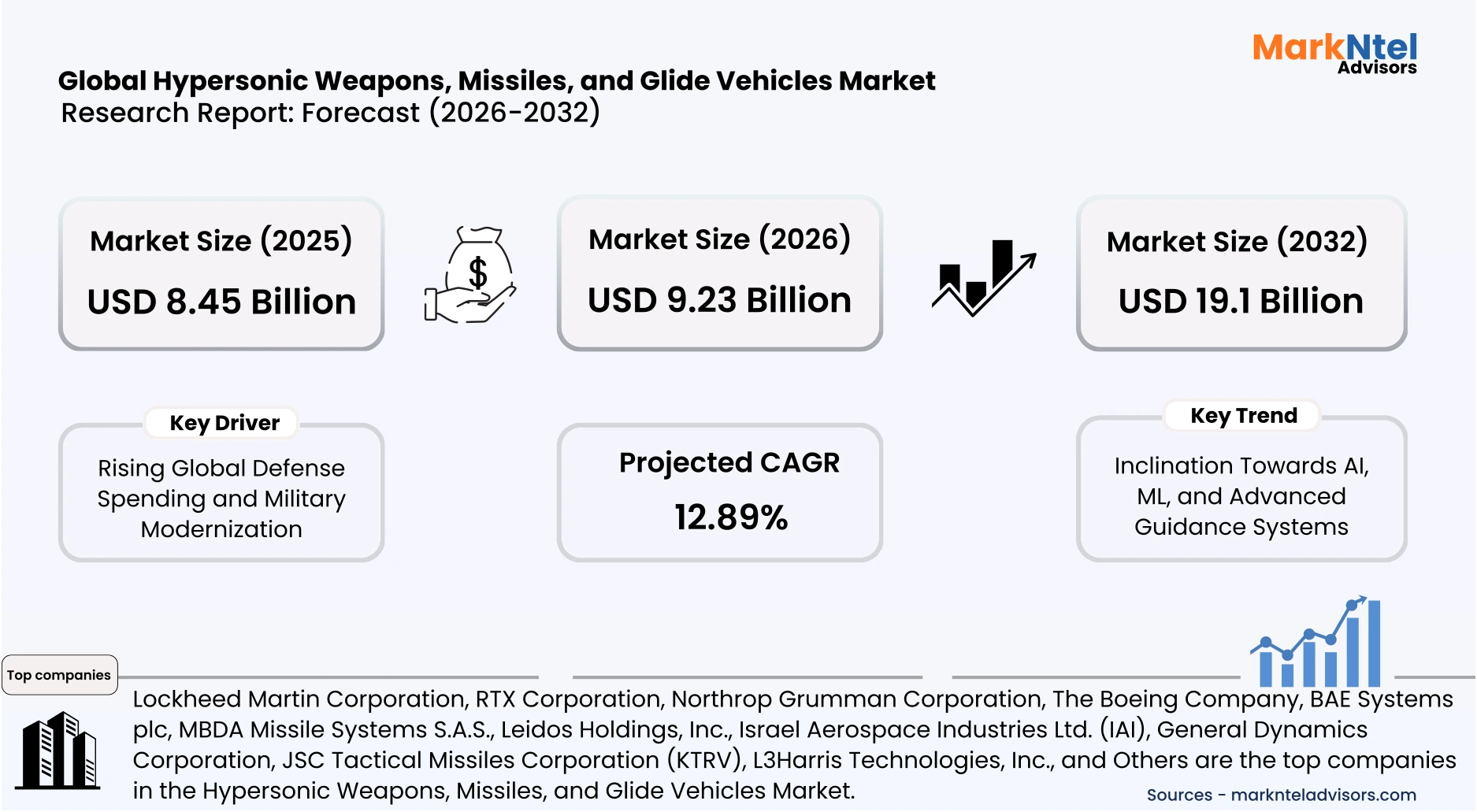
- Market size was valued at USD 8.45 billion in 2025 and is projected to grow from USD 9.23 billion in 2026 to USD 19.1 billion by 2032, exhibiting a CAGR of 12.89% during the forecast period.
- Asia-Pacific holds the largest market share of about 40% in the Global Hypersonic Weapons, Missiles, and Glide Vehicles Market in 2026.
- By weapon type, the hypersonic glide vehicles (HGVs) segment holds the largest market share, about 45% in 2026.
- By mission type, the nuclear & strategic deterrence segment seized a significant share of about 47% in the Global Hypersonic Weapons, Missiles, and Glide Vehicles Market.
- Leading green companies in the global Market are Lockheed Martin Corporation, RTX Corporation, Northrop Grumman Corporation, The Boeing Company, BAE Systems plc, MBDA Missile Systems S.A.S., Leidos Holdings, Inc., Israel Aerospace Industries Ltd. (IAI), General Dynamics Corporation, JSC Tactical Missiles Corporation (KTRV), China Aerospace Science and Industry Corporation Limited (CASIC), Mitsubishi Heavy Industries, Ltd., Rafael Advanced Defense Systems Ltd., L3Harris Technologies, Inc., and Others.
Market Insights & Analysis: Global Hypersonic Weapons, Missiles, and Glide Vehicles Market (2026-32):
The Global Hypersonic Weapons, Missiles, and Glide Vehicles Market size was valued at USD 8.45 billion in 2025 and is projected to grow from USD 9.23 billion in 2026 to USD 19.1 billion by 2032. Along with this, the market is estimated to grow at a CAGR of around 12.89% during the forecast period, i.e., 2026-32.
The Global Hypersonic Weapons, Missiles, and Glide Vehicles Market is projected to expand steadily, driven by increasing defense budgets, ongoing military modernization programs, and the expanding adoption of AI-enabled guidance and advanced autonomous technologies.
The United States continues to dominate global military investment, providing a strong financial foundation for hypersonic research, procurement, and deployment. For instance, global military spending reached USD 2.7 trillion in 2024, with the United States accounting for approximately USD 997 billion, equal to 37% of worldwide military expenditure and 66% of NATO spending. This level of investment highlights the scale at which advanced missile technologies, including hypersonic weapons, are being prioritized.
U.S. budget allocations show a clear acceleration in hypersonic procurement and development. The 2025 defense budget includes USD 744 million in procurement funding for the Long-Range Hypersonic Weapon (LRHW), more than four times the previous year’s procurement level, alongside USD 538 million requested for research, development, testing, and evaluation.
In parallel, the U.S. Air Force has allocated USD 517 million in FY2025 to continue development of the Hypersonic Attack Cruise Missile (HACM), demonstrating a transition from early testing toward operational capability.
Defense spending is increasingly concentrated among major military powers. The United States, China, Russia, Germany, and India collectively account for about 60% of global military expenditure, reflecting the concentration of funding in technologically advanced weapons and aerospace programs.
In parallel, national roadmaps are prioritizing artificial intelligence and advanced guidance systems. For example, India’s Ministry of Defence has outlined a 15-year technology roadmap covering more than 200 future weapon systems, explicitly highlighting AI-enabled weapons and hypersonic missiles as strategic priorities for domestic capability development.
Looking beyond 2025, long-term modernization strategies continue to reinforce market expansion. For instance, China has recorded 30 consecutive years of defense spending growth, driven by its objective to modernize the armed forces by 2035, ensuring sustained investment in advanced missile and aerospace technologies.
Collectively, rising defense budgets, expanding procurement pipelines, and long-term modernization plans across major military powers strongly indicate sustained growth and large-scale deployment of hypersonic weapon systems over the coming decades.
Global Hypersonic Weapons, Missiles, and Glide Vehicles Market Recent Developments:
- 2025: Russia conducted a test of the Zircon hypersonic missile during the joint Russia-Belarus Zapad-2025 military drills, highlighting its extreme speed, submarine-launch capability, and difficulty of interception. Analysts noted the missile can travel at around Mach 10 with a range of approximately 2,000 km, reinforcing Russia’s advanced hypersonic strike capabilities.
- 2025: China showcased several new hypersonic anti-ship missiles during a major Beijing military parade, including the YJ-17 boost-glide weapon, the scramjet-powered YJ-19 cruise missile, and the YJ-20 hypersonic glide missile designed for highly manoeuvrable, high-speed strikes against naval targets, highlighting rapid advances shaping the global hypersonic weapons market.
Global Hypersonic Weapons, Missiles, and Glide Vehicles Market Scope:
| Category | Segments |
|---|---|
| By Weapon Type | (Hypersonic Glide Vehicles (HGVs), Hypersonic Cruise Missiles (HCMs), Hypersonic Ballistic Missiles (HBMs / Maneuverable Re-entry Vehicles), Hypersonic Air-Launched Strike Weapons), |
| By Launch Platform | (Land-Based Systems, Air-Launched Systems, Sea-Launched Systems), |
| By Range Category | (Short Range (<1,000 km), Medium Range (1,000–3,000 km), Intermediate Range (3,000–5,500 km), Intercontinental Range (>5,500 km)), |
| By Propulsion Technology | (Boost-Glide (Rocket Boost + Glide Vehicle), Scramjet / Air-Breathing Propulsion, Advanced Rocket Propulsion (for MaRV systems)), |
| By Warhead Type | (Conventional Warheads, Nuclear-Capable Warheads, Kinetic Energy Penetrators (Hit-to-Kill)), |
| By Mission Type | (Nuclear & Strategic Deterrence, Precision Long-Range Strike, Anti-Ship / Maritime Strike, Anti-Access / Area Denial (A2/AD)), |
| By End User | (Army / Land Forces, Air Force, Navy, Strategic Command & Joint Forces), |
Global Hypersonic Weapons, Missiles, and Glide Vehicles Market Driver:
Rising Global Defense Spending and Military Modernization
The acceleration of global defense budgets is a fundamental driver of demand for hypersonic weapons, missiles, and glide vehicles. According to the Stockholm International Peace Research Institute (SIPRI), global military expenditure reached USD 2.718 trillion in 2024, rising 9.4% year-on-year, marking the largest annual increase since the Cold War. Military spending has increased continuously for ten consecutive years, highlighting sustained modernization priorities across major economies .
The United States remains the largest defense investor, allocating USD 997 billion in 2024, representing 37% of global military expenditure and reinforcing funding for advanced strike systems and missile technologies. Meanwhile, China ranked second with USD 314 billion, while Russia’s spending grew 38% in 2024 to USD 149 billion, reflecting an intensified focus on high-end warfare capabilities.
Europe is also accelerating defense modernization. Military expenditure across Europe rose 17% in 2024, driven largely by the Russia-Ukraine war and NATO’s renewed commitment to collective defense.
SIPRI highlights that all NATO members increased military spending in 2024, with many moving toward the 2% of GDP defense target, strengthening long-term investment in advanced missile and deterrence technologies .
Overall, Sustained increases in global defense spending and long-term modernization plans are accelerating investment in advanced strike capabilities, positioning hypersonic weapons as a strategic priority and driving strong future market growth.
Global Hypersonic Weapons, Missiles, and Glide Vehicles Market Trend:
Inclination Towards AI, ML, and Advanced Guidance Systems
Artificial intelligence (AI), machine learning, and autonomous guidance technologies are becoming a defining trend in the evolution of hypersonic weapons and advanced missile systems. Governments are increasingly integrating AI into targeting, navigation, and mission planning to improve precision, survivability, and real-time decision-making.
The U.S. Department of Defense has formally elevated AI as a core operational capability across air, land, sea, cyber, and space domains, highlighting its role in next-generation warfare. The Pentagon has allocated more than USD 2.2 billion for AI and machine learning initiatives in the FY2026 defense budget, reinforcing the growing importance of AI-enabled systems across modern military platforms .
AI is also reshaping combat aviation and missile guidance ecosystems. The U.S. Air Force is investing heavily in AI-enabled collaborative combat aircraft, committing approximately USD 6 billion over five years to develop autonomous aircraft designed to operate alongside crewed fighters and advanced weapons.
The program aims to deploy a fleet of around 1,000 autonomous fighter jets, demonstrating the scale of future integration between AI systems and advanced strike technologies. Such initiatives highlight how AI-powered decision support, predictive analytics, and autonomous mission execution are becoming foundational for next-generation strike and interception capabilities.
Looking beyond 2025, continued investment in autonomous aircraft, AI-driven battlefield networks, and intelligent weapons will significantly accelerate demand for hypersonic platforms equipped with advanced guidance systems.
The growing adoption of AI-enabled targeting, autonomy, and decision-making will enhance weapon accuracy and operational efficiency, accelerating procurement of hypersonic systems and strengthening long-term market expansion.
Global Hypersonic Weapons, Missiles, and Glide Vehicles Market Opportunity
Defense Partnerships & Joint Ventures Opening New Doors
Strengthening defense cooperation among allied nations is creating a significant opportunity for advanced defense technologies, joint production, and long-term procurement programs. Governments are increasingly formalizing long-duration military support agreements, ensuring predictable funding pipelines that encourage cross-border industrial collaboration and co-development initiatives.
A major example is the United Kingdom’s commitment to provide approximately USD 3.8 billion per year in military assistance to Ukraine until at least 2030, demonstrating a long-term funding framework that supports sustained defense manufacturing and multinational supply chains.
Similarly, France signed a 2024 agreement to deliver up to USD 3.0 billion in military assistance within the same year, highlighting Europe’s expanding coordinated defense support mechanisms.
Germany’s USD 105 billion special defense fund further reinforces this collaborative environment by accelerating procurement of advanced weapons, modernization programs, and joint defense R&D projects with allied partners. This fund has become a cornerstone of Europe’s defense industrial expansion and cross-border capability development.
In parallel, Sweden introduced a USD 2.4 billion military support fund for 2024–2026, strengthening regional security cooperation and enabling shared defense technology investments across Europe .
Long-term military aid commitments and defense modernization funds are reinforcing multinational collaboration. These partnerships will expand joint development, procurement, and technology transfer, significantly accelerating future market growth.
Global Hypersonic Weapons, Missiles, and Glide Vehicles Market Challenge:
High Development and Testing Costs
The cost intensity of hypersonic weapon development remains a major barrier to large-scale deployment. Advanced propulsion, extreme-temperature materials, and specialized testing infrastructure significantly increase program budgets compared with conventional missile systems.
For example, the U.S. Air Force’s Air-Launched Rapid Response Weapon (ARRW) program has reached an estimated USD 1.7 billion total cost, while the Hypersonic Attack Cruise Missile (HACM) is projected to exceed USD 2.4 billion in development spending . These figures highlight the large upfront investment required even before production begins.
Naval hypersonic programs further demonstrate the scale of expenditure. A U.S. Navy hypersonic cruise missile is estimated to cost USD 1.9 billion, and the Navy’s Conventional Prompt Strike (CPS) initiative is assessed as a USD 30 billion effort, underscoring the financial complexity of operationalizing hypersonic strike capabilities across multiple platforms .
Long-term procurement expenses add further pressure. According to the U.S. Congressional Budget Office, hypersonic missiles could be one-third more expensive than ballistic missiles, with 300 missiles projected to cost USD 17.9 billion over 20 years.
The enormous financial burden of development, procurement, and lifecycle costs limits rapid adoption and slows program scalability, posing a significant constraint on the growth of the hypersonic weapons market.
Global Hypersonic Weapons, Missiles, and Glide Vehicles Market (2026-32) Segmentation Analysis:
The Global Hypersonic Weapons, Missiles, and Glide Vehicles Market study of MarkNtel Advisors evaluates & highlights the major trends and influencing factors in each segment. It includes predictions for the period 2026–32 at the global level. Based on the analysis, the market has been further classified as;
Based on Weapon Type:
- Hypersonic Glide Vehicles (HGVs)
- Hypersonic Cruise Missiles (HCMs)
- Hypersonic Ballistic Missiles (HBMs / Maneuverable Re-entry Vehicles)
- Hypersonic Air-Launched Strike Weapons
The hypersonic glide vehicles (HGVs) segment dominates the Global Hypersonic Weapons, Missiles, and Glide Vehicles Market, accounting for around 45% market share, due to their advanced operational capabilities and strategic importance in modern defense planning.
Unlike conventional ballistic missiles that travel along predictable trajectories, HGVs are boosted to high altitudes and then glide at hypersonic speeds within the atmosphere, allowing them to maneuver unpredictably throughout their flight path. This combination of speed, altitude flexibility, and maneuverability significantly reduces interception probability by existing missile defense systems.
Defense agencies are increasingly prioritizing HGVs because they offer a credible solution for penetrating sophisticated air and missile defense networks. Their ability to deliver payloads with high precision across intercontinental distances within minutes enhances deterrence and rapid-response strike capabilities. As a result, HGV development has become a central component of long-range strike modernization programs across major military powers.
Furthermore, HGV technology has progressed closer to operational deployment compared with several other hypersonic weapon categories, supported by sustained government funding and extensive testing programs.
This growing maturity, combined with strong strategic demand, positions HGVs as the dominant weapon type within the global hypersonic weapons, missiles, and glide vehicles market.
Based on Mission Type:
- Nuclear & Strategic Deterrence
- Precision Long-Range Strike
- Anti-Ship / Maritime Strike
- Anti-Access / Area Denial (A2/AD)
The nuclear & strategic deterrence segment dominates the Global Hypersonic Weapons, Missiles, and Glide Vehicles Market, with a market share of around 47%, primarily due to its critical importance in national security strategies and global power balance.
Hypersonic systems significantly enhance deterrence credibility by enabling rapid, long-range strike capabilities that can evade existing missile defense architectures through extreme speed, maneuverability, and unpredictable flight trajectories. These attributes strengthen second-strike capability and reinforce the reliability of strategic arsenals.
Major defense powers are prioritizing hypersonic technologies to modernize their nuclear deterrence frameworks and ensure survivable and responsive strike options. Hypersonic glide vehicles and long-range missiles offer improved flexibility across land, sea, and air launch platforms, allowing nations to maintain strategic readiness against evolving threats. As missile defense systems continue to advance, hypersonic weapons provide a means to preserve deterrence effectiveness and strategic stability.
Rising geopolitical tensions and ongoing nuclear modernization programs are further accelerating investments in long-range strategic strike capabilities. As a result, nuclear and strategic deterrence is expected to remain the dominant mission focus, shaping procurement priorities and driving sustained demand for hypersonic weapon systems.
Global Hypersonic Weapons, Missiles, and Glide Vehicles Market (2026-32): Regional Projection
Asia-Pacific dominates the Global Hypersonic Weapons, Missiles, and Glide Vehicles market with an estimated 40% share, due to sustained defense budget expansion, evolving regional security dynamics, and accelerated investments in advanced strike capabilities. Governments across the region are prioritizing long-range precision weapons and next-generation missile systems to strengthen deterrence and enhance rapid response capabilities.
Japan is a prominent contributor to this regional leadership through significant policy and budgetary shifts. The country has committed to increasing defense spending to 2% of GDP by 2027, representing a historic transformation in its security strategy .
Supporting this objective, Japan’s Ministry of Defense requested a record 2026 defense budget of approximately USD 59.9 billion. A considerable share of this funding is earmarked for the development of long-range missiles and advanced hypersonic technologies, including the Hyper Velocity Glide Projectile (HVGP), aimed at reinforcing island defense and improving long-distance strike capability.
More broadly, Asia Pacific nations are accelerating modernization programs to address growing security challenges and technological competition. Rising geopolitical tensions, maritime disputes, and the need for advanced deterrence systems are driving investments in high-speed strike and missile defense technologies. Governments are also strengthening domestic aerospace and defense manufacturing capabilities, fostering innovation and long-term procurement pipelines.
Collectively, strong fiscal commitment, modernization priorities, and the rapid adoption of advanced missile technologies position the Asia Pacific as the dominant regional market for hypersonic weapons and glide vehicles.
Gain a Competitive Edge with Our Global Hypersonic Weapons, Missiles, and Glide Vehicles Market Report:
- Global Hypersonic Weapons, Missiles, and Glide Vehicles Market Report by MarkNtel Advisors provides a detailed & thorough analysis of market size & share, growth rate, competitive landscape, and key players. This comprehensive analysis helps businesses gain a holistic understanding of the market dynamics & make informed decisions.
- This report also highlights current market trends & future projections, allowing businesses to identify emerging opportunities & potential challenges. By understanding market forecasts, companies can align their strategies & stay ahead of the competition.
- Global Hypersonic Weapons, Missiles, and Glide Vehicles Market Report aids in assessing & mitigating risks associated with entering or operating in the market. By understanding market dynamics, regulatory frameworks, and potential challenges, businesses can develop strategies to minimize risks & optimize their operations.
*Reports Delivery Format - Market research studies from MarkNtel Advisors are offered in PDF, Excel and PowerPoint formats. Within 24 hours of the payment being successfully received, the report will be sent to your email address.
Frequently Asked Questions
- Market Segmentation
- Introduction
- Product Definition
- Research Process
- Assumptions
- Executive Summary
- Global Hypersonic Weapons, Missiles, and Glide Vehicles Market Policies, Regulations, and Product Standards
- Global Hypersonic Weapons, Missiles, and Glide Vehicles Market Trends & Developments
- Global Hypersonic Weapons, Missiles, and Glide Vehicles Market Dynamics
- Growth Factors
- Challenges
- Global Hypersonic Weapons, Missiles, and Glide Vehicles Market Hotspot & Opportunities
- Global Hypersonic Weapons, Missiles, and Glide Vehicles Market Outlook, 2022-2032F
- Market Size & Outlook
- By Revenues (USD Million)
- Market Share & Analysis
- By Weapon Type- Market Size & Forecast 2022-2032, USD Million
- Hypersonic Glide Vehicles (HGVs)
- Hypersonic Cruise Missiles (HCMs)
- Hypersonic Ballistic Missiles (HBMs / Maneuverable Re-entry Vehicles)
- Hypersonic Air-Launched Strike Weapons
- By Launch Platform- Market Size & Forecast 2022-2032, USD Million
- Land-Based Systems
- Air-Launched Systems
- Sea-Launched Systems
- By Range Category- Market Size & Forecast 2022-2032, USD Million
- Short Range (<1,000 km)
- Medium Range (1,000–3,000 km)
- Intermediate Range (3,000–5,500 km)
- Intercontinental Range (>5,500 km)
- By Propulsion Technology- Market Size & Forecast 2022-2032, USD Million
- Boost-Glide (Rocket Boost + Glide Vehicle)
- Scramjet / Air-Breathing Propulsion
- Advanced Rocket Propulsion (for MaRV systems)
- By Warhead Type- Market Size & Forecast 2022-2032, USD Million
- Conventional Warheads
- Nuclear-Capable Warheads
- Kinetic Energy Penetrators (Hit-to-Kill)
- By Mission Type- Market Size & Forecast 2022-2032, USD Million
- Nuclear & Strategic Deterrence
- Precision Long-Range Strike
- Anti-Ship / Maritime Strike
- Anti-Access / Area Denial (A2/AD)
- By End User- Market Size & Forecast 2022-2032, USD Million
- Army / Land Forces
- Air Force
- Navy
- Strategic Command & Joint Forces
- By Region
- North America
- Europe
- Asia-Pacific
- By Company
- Competition Characteristics
- Market Share & Analysis
- By Weapon Type- Market Size & Forecast 2022-2032, USD Million
- Market Size & Outlook
- North America Hypersonic Weapons, Missiles, and Glide Vehicles Market Outlook, 2022-2032F
- Market Size & Outlook
- By Revenues (USD Million)
- Market Share & Analysis
- By Weapon Type- Market Size & Forecast 2022-2032, USD Million
- By Launch Platform- Market Size & Forecast 2022-2032, USD Million
- By Range Category- Market Size & Forecast 2022-2032, USD Million
- By Propulsion Technology- Market Size & Forecast 2022-2032, USD Million
- By Warhead Type- Market Size & Forecast 2022-2032, USD Million
- By Mission Type- Market Size & Forecast 2022-2032, USD Million
- By End User- Market Size & Forecast 2022-2032, USD Million
- By Country
- The US
- Rest of North America
- The US Hypersonic Weapons, Missiles, and Glide Vehicles Market Outlook, 2022-2032F
- Market Size & Outlook
- By Revenues (USD Million)
- Market Share & Analysis
- By Weapon Type- Market Size & Forecast 2022-2032, USD Million
- By Launch Platform- Market Size & Forecast 2022-2032, USD Million
- By Range Category- Market Size & Forecast 2022-2032, USD Million
- By Propulsion Technology- Market Size & Forecast 2022-2032, USD Million
- By Warhead Type- Market Size & Forecast 2022-2032, USD Million
- By Mission Type- Market Size & Forecast 2022-2032, USD Million
- By End User- Market Size & Forecast 2022-2032, USD Million
- Market Size & Outlook
- Market Size & Outlook
- Europe Hypersonic Weapons, Missiles, and Glide Vehicles Market Outlook, 2022-2032F
- Market Size & Outlook
- By Revenues (USD Million)
- Market Share & Analysis
- By Weapon Type- Market Size & Forecast 2022-2032, USD Million
- By Launch Platform- Market Size & Forecast 2022-2032, USD Million
- By Range Category- Market Size & Forecast 2022-2032, USD Million
- By Propulsion Technology- Market Size & Forecast 2022-2032, USD Million
- By Warhead Type- Market Size & Forecast 2022-2032, USD Million
- By Mission Type- Market Size & Forecast 2022-2032, USD Million
- By End User- Market Size & Forecast 2022-2032, USD Million
- By Country
- The UK
- Germany
- France
- Russia
- Rest of Europe
- The UK Hypersonic Weapons, Missiles, and Glide Vehicles Market Outlook, 2022-2032F
- Market Size & Outlook
- By Revenues (USD Million)
- Market Share & Analysis
- By Weapon Type- Market Size & Forecast 2022-2032, USD Million
- By Launch Platform- Market Size & Forecast 2022-2032, USD Million
- By Range Category- Market Size & Forecast 2022-2032, USD Million
- By Propulsion Technology- Market Size & Forecast 2022-2032, USD Million
- By Warhead Type- Market Size & Forecast 2022-2032, USD Million
- By Mission Type- Market Size & Forecast 2022-2032, USD Million
- By End User- Market Size & Forecast 2022-2032, USD Million
- Market Size & Outlook
- Germany Hypersonic Weapons, Missiles, and Glide Vehicles Market Outlook, 2022-2032F
- Market Size & Outlook
- By Revenues (USD Million)
- Market Share & Analysis
- By Weapon Type- Market Size & Forecast 2022-2032, USD Million
- By Launch Platform- Market Size & Forecast 2022-2032, USD Million
- By Range Category- Market Size & Forecast 2022-2032, USD Million
- By Propulsion Technology- Market Size & Forecast 2022-2032, USD Million
- By Warhead Type- Market Size & Forecast 2022-2032, USD Million
- By Mission Type- Market Size & Forecast 2022-2032, USD Million
- By End User- Market Size & Forecast 2022-2032, USD Million
- Market Size & Outlook
- France Hypersonic Weapons, Missiles, and Glide Vehicles Market Outlook, 2022-2032F
- Market Size & Outlook
- By Revenues (USD Million)
- Market Share & Analysis
- By Weapon Type- Market Size & Forecast 2022-2032, USD Million
- By Launch Platform- Market Size & Forecast 2022-2032, USD Million
- By Range Category- Market Size & Forecast 2022-2032, USD Million
- By Propulsion Technology- Market Size & Forecast 2022-2032, USD Million
- By Warhead Type- Market Size & Forecast 2022-2032, USD Million
- By Mission Type- Market Size & Forecast 2022-2032, USD Million
- By End User- Market Size & Forecast 2022-2032, USD Million
- Market Size & Outlook
- Russia Hypersonic Weapons, Missiles, and Glide Vehicles Market Outlook, 2022-2032F
- Market Size & Outlook
- By Revenues (USD Million)
- Market Share & Analysis
- By Weapon Type- Market Size & Forecast 2022-2032, USD Million
- By Launch Platform- Market Size & Forecast 2022-2032, USD Million
- By Range Category- Market Size & Forecast 2022-2032, USD Million
- By Propulsion Technology- Market Size & Forecast 2022-2032, USD Million
- By Warhead Type- Market Size & Forecast 2022-2032, USD Million
- By Mission Type- Market Size & Forecast 2022-2032, USD Million
- By End User- Market Size & Forecast 2022-2032, USD Million
- Market Size & Outlook
- Market Size & Outlook
- Asia-Pacific Hypersonic Weapons, Missiles, and Glide Vehicles Market Outlook, 2022-2032F
- Market Size & Outlook
- By Revenues (USD Million)
- Market Share & Analysis
- By Weapon Type- Market Size & Forecast 2022-2032, USD Million
- By Launch Platform- Market Size & Forecast 2022-2032, USD Million
- By Range Category- Market Size & Forecast 2022-2032, USD Million
- By Propulsion Technology- Market Size & Forecast 2022-2032, USD Million
- By Warhead Type- Market Size & Forecast 2022-2032, USD Million
- By Mission Type- Market Size & Forecast 2022-2032, USD Million
- By End User- Market Size & Forecast 2022-2032, USD Million
- By Country
- China
- India
- Japan
- South Korea Rest of Asia-Pacific
- China Hypersonic Weapons, Missiles, and Glide Vehicles Market Outlook, 2022-2032F
- Market Size & Outlook
- By Revenues (USD Million)
- Market Share & Analysis
- By Weapon Type- Market Size & Forecast 2022-2032, USD Million
- By Launch Platform- Market Size & Forecast 2022-2032, USD Million
- By Range Category- Market Size & Forecast 2022-2032, USD Million
- By Propulsion Technology- Market Size & Forecast 2022-2032, USD Million
- By Warhead Type- Market Size & Forecast 2022-2032, USD Million
- By Mission Type- Market Size & Forecast 2022-2032, USD Million
- By End User- Market Size & Forecast 2022-2032, USD Million
- Market Size & Outlook
- India Hypersonic Weapons, Missiles, and Glide Vehicles Market Outlook, 2022-2032F
- Market Size & Outlook
- By Revenues (USD Million)
- Market Share & Analysis
- By Weapon Type- Market Size & Forecast 2022-2032, USD Million
- By Launch Platform- Market Size & Forecast 2022-2032, USD Million
- By Range Category- Market Size & Forecast 2022-2032, USD Million
- By Propulsion Technology- Market Size & Forecast 2022-2032, USD Million
- By Warhead Type- Market Size & Forecast 2022-2032, USD Million
- By Mission Type- Market Size & Forecast 2022-2032, USD Million
- By End User- Market Size & Forecast 2022-2032, USD Million
- Market Size & Outlook
- Japan Hypersonic Weapons, Missiles, and Glide Vehicles Market Outlook, 2022-2032F
- Market Size & Outlook
- By Revenues (USD Million)
- Market Share & Analysis
- By Weapon Type- Market Size & Forecast 2022-2032, USD Million
- By Launch Platform- Market Size & Forecast 2022-2032, USD Million
- By Range Category- Market Size & Forecast 2022-2032, USD Million
- By Propulsion Technology- Market Size & Forecast 2022-2032, USD Million
- By Warhead Type- Market Size & Forecast 2022-2032, USD Million
- By Mission Type- Market Size & Forecast 2022-2032, USD Million
- By End User- Market Size & Forecast 2022-2032, USD Million
- Market Size & Outlook
- Market Size & Outlook
- Global Hypersonic Weapons, Missiles, and Glide Vehicles Market Key Strategic Imperatives for Success & Growth
- Competitive Outlook
- Company Profiles
- Lockheed Martin Corporation
- Business Description
- Product Portfolio
- Collaborations & Alliances
- Recent Developments
- Financial Details
- Others
- RTX Corporation
- Business Description
- Product Portfolio
- Collaborations & Alliances
- Recent Developments
- Financial Details
- Others
- Northrop Grumman Corporation
- Business Description
- Product Portfolio
- Collaborations & Alliances
- Recent Developments
- Financial Details
- Others
- The Boeing Company
- Business Description
- Product Portfolio
- Collaborations & Alliances
- Recent Developments
- Financial Details
- Others
- BAE Systems plc
- Business Description
- Product Portfolio
- Collaborations & Alliances
- Recent Developments
- Financial Details
- Others
- MBDA Missile Systems S.A.S.
- Business Description
- Product Portfolio
- Collaborations & Alliances
- Recent Developments
- Financial Details
- Others
- Leidos Holdings, Inc.
- Business Description
- Product Portfolio
- Collaborations & Alliances
- Recent Developments
- Financial Details
- Others
- Israel Aerospace Industries Ltd. (IAI)
- Business Description
- Product Portfolio
- Collaborations & Alliances
- Recent Developments
- Financial Details
- Others
- General Dynamics Corporation
- Business Description
- Product Portfolio
- Collaborations & Alliances
- Recent Developments
- Financial Details
- Others
- JSC Tactical Missiles Corporation (KTRV)
- Business Description
- Product Portfolio
- Collaborations & Alliances
- Recent Developments
- Financial Details
- Others
- China Aerospace Science and Industry Corporation Limited (CASIC)
- Business Description
- Product Portfolio
- Collaborations & Alliances
- Recent Developments
- Financial Details
- Others
- Mitsubishi Heavy Industries, Ltd.
- Business Description
- Product Portfolio
- Collaborations & Alliances
- Recent Developments
- Financial Details
- Others
- Rafael Advanced Defense Systems Ltd.
- Business Description
- Product Portfolio
- Collaborations & Alliances
- Recent Developments
- Financial Details
- Others
- L3Harris Technologies, Inc.
- Business Description
- Product Portfolio
- Collaborations & Alliances
- Recent Developments
- Financial Details
- Others
- Others
- Business Description
- Product Portfolio
- Collaborations & Alliances
- Recent Developments
- Financial Details
- Others
- Lockheed Martin Corporation
- Company Profiles
- Disclaimer
MarkNtel Advisors follows a robust and iterative research methodology designed to ensure maximum accuracy and minimize deviation in market estimates and forecasts. Our approach combines both bottom-up and top-down techniques to effectively segment and quantify various aspects of the market. A consistent feature across all our research reports is data triangulation, which examines the market from three distinct perspectives to validate findings. Key components of our research process include:
1. Scope & Research Design At the outset, MarkNtel Advisors define the research objectives and formulate pertinent questions. This phase involves determining the type of research—qualitative or quantitative—and designing a methodology that outlines data collection methods, target demographics, and analytical tools. They also establish timelines and budgets to ensure the research aligns with client goals.
2. Sample Selection and Data Collection In this stage, the firm identifies the target audience and determines the appropriate sample size to ensure representativeness. They employ various sampling methods, such as random or stratified sampling, based on the research objectives. Data collection is carried out using tools like surveys, interviews, and observations, ensuring the gathered data is reliable and relevant.
3. Data Analysis and Validation Once data is collected, MarkNtel Advisors undertake a rigorous analysis process. This includes cleaning the data to remove inconsistencies, employing statistical software for quantitative analysis, and thematic analysis for qualitative data. Validation steps are taken to ensure the accuracy and reliability of the findings, minimizing biases and errors.

4. Data Forecast and FinalizationThe final phase involves forecasting future market trends based on the analyzed data. MarkNtel Advisors utilize predictive modeling and time series analysis to anticipate market behaviors. The insights are then compiled into comprehensive reports, featuring visual aids like charts and graphs, and include strategic recommendations to inform client decision-making
We offer flexible licensing options to cater to varying organizational needs. Choose the pricing pack that best suits your requirements:
Buy Now Inquire Before Buying
 Request Customization
 Talk to our Consultant







