

India Drone Detection Radar Market Research Report: Size, Share, Trends & Forecast (2026-2032)
By Radar Type (Short-Range Radar (<5 km), Medium-Range Radar (5–10 km), Long-Range Radar (>10 km), AI-enabled / Cognitive Radar), By Frequency Band (X-Band Radar, Ku-Band Radar, Ka ... -Band Radar, L-Band / S-Band Radar, Multi-band Radar), By Platform (Ground-based Radar, Naval Radar, Airborne Radar, Vehicle-mounted / Portable Radar), By Detection Range (Very Short Range (<2 km), Short Range (2–5 km, Medium Range (5–10 km), Long Range (>10 km)), By End User (Military & Defense, Homeland Security / Border Protection, Airports & Aviation Security, Critical Infrastructure, Government & Public Safety, Commercial & Industrial Facilities, Event & Stadium Security) Read more
- Aerospace & Defense
- Mar 2026
- Pages 130
- Report Format: PDF, Excel, PPT
India Drone Detection Radar Market
Projected 27.7% CAGR from 2026 to 2032
Study Period
2026-2032
Market Size (2026)
USD 127 Million
Market Size (2032)
USD 552 Million
Base Year
2025
Projected CAGR
27.7%
Leading Segments
By Radar Type: Medium-Range Radar (5–10 km)
India Drone Detection Radar Market Report Key Takeaways:
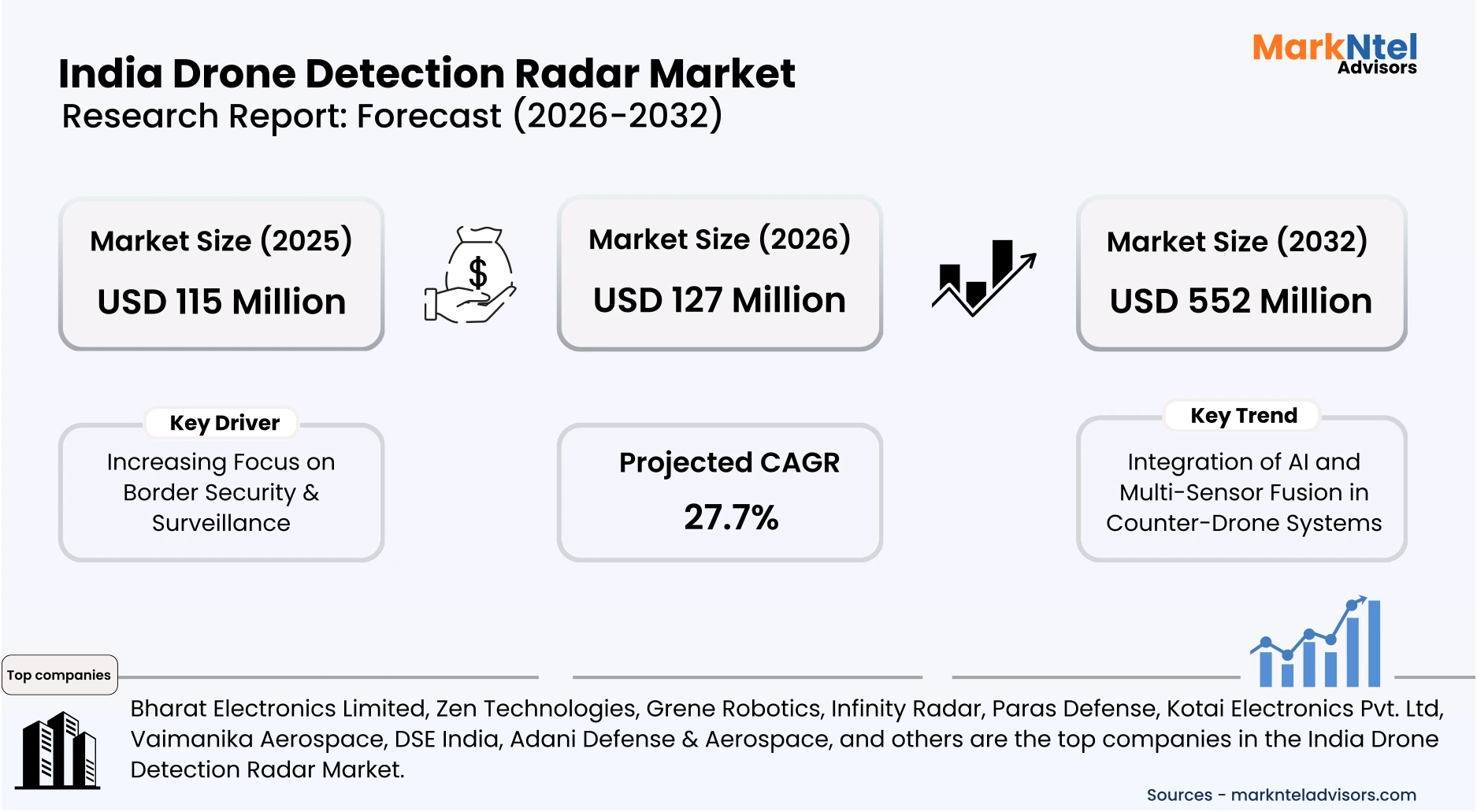
- Market size was valued at around USD 115 million in 2025 and is projected to grow from USD 127 million in 2026 to USD 552 million by 2032. The estimated CAGR from 2026 to 2032 is around 27.7%, indicating strong growth.
- By radar type, the medium-range radar (5–10 km) segment represented a significant share of about 30% in the India Drone Detection Radar Market in 2026.
- By end user, the military & defense sector seized a significant share of about 40% in the India Drone Detection Radar Market in 2026.
- Leading drone detection radar companies in India are Bharat Electronics Limited, Zen Technologies, Grene Robotics, Infinity Radar, Paras Defense, Kotai Electronics Pvt. Ltd, Vaimanika Aerospace, DSE India, Adani Defense & Aerospace, and others.
Market Insights & Analysis: India Drone Detection Radar Market (2026-32):
The India Drone Detection Radar Market size was valued at around USD 115 million in 2025 and is projected to grow from USD 127 million in 2026 to USD 552 million by 2032. Along with this, the market is estimated to grow at a CAGR of around 27.7% during the forecast period, i.e., 2026-32.
The India Drone Detection Radar Market is projected to expand steadily, driven by escalating cross-border security concerns, which drive demand, accelerating integration of AI-powered multi-sensor systems enhances detection capabilities, and expanding commercial and critical-infrastructure security applications further amplify nationwide adoption.
Security agencies have reported a consistent rise in hostile drone activity along sensitive frontiers, underlining the need for specialized surveillance and interception infrastructure. In 2025, the Border Security Force recorded the seizure of 272 drones between January and November, averaging 24 interceptions per month. The same operations led to the recovery of 200 weapons, 3,625 rounds of ammunition, 10.2 kg of RDX/IED material, and large volumes of narcotics, demonstrating the operational shift toward UAV-enabled cross-border activities.
Government spending patterns are increasingly aligned with this evolving threat environment. In 2024, the Punjab government approved the procurement of nine anti-drone systems valued at approximately USD 6.2 million to strengthen protection along the 532-km international border. This investment reflects the transition from reactive measures toward structured and institutionalized counter-drone deployment.
Technological innovation is further accelerating demand as India advances toward AI-enabled, multi-sensor counter-drone architectures. For instance, Paras Defence is developing layered solutions combining RF sensing, radar, and EO/IR payloads to detect autonomous and radio-silent drones, while AI-based threat correlation reduces false alarms and improves detection of low-altitude, low-radar-cross-section targets in complex environments .
Adoption is also expanding across civil security and public-safety environments, demonstrating broader market diversification. For instance, in 2025, Odisha Police announced plans to procure anti-drone technologies equipped with radar, RF analysis, optical sensors, and jamming capabilities to protect VIP events, sensitive government facilities, and urban security zones. This shift reflects the integration of drone detection systems into routine policing and public-safety operations, demonstrating the growing relevance of counter-drone infrastructure across civilian environments.
Looking ahead, long-term national defense planning will further sustain market growth. For example, India’s Sudarshan Chakra air defense initiative aims to establish a nationwide layered air-defense network by 2035, explicitly incorporating counter-drone technologies as a core component of future aerial threat management. This multi-decade modernization program signals enduring government commitment and continuous procurement pipelines for advanced detection technologies.
Rising drone threats, expanding public-safety deployments, technological innovation, and long-term air-defense modernization collectively position India’s Drone Detection Radar Market for sustained and strategic growth over the coming decade.
India Drone Detection Radar Market Recent Developments:
- 2025: India’s Defence Acquisition Council approved weapons procurement worth USD 9.5 billion, prioritizing indigenous long-range weapons and counter-drone systems. The package includes the Integrated Drone Detection and Interdiction System Mk-II and low-level radars to strengthen the protection of critical assets and enhance surveillance capabilities.
- 2025: India successfully test-fired the indigenous Bhargavastra counter-swarm drone system in 2025, marking a major step toward strengthening protection against coordinated UAV attacks. The system is designed to neutralize drone swarms using layered interception technologies and represents growing domestic innovation in counter-drone defense.
India Drone Detection Radar Market Scope:
| Category | Segments |
|---|---|
| By Radar Type | (Short-Range Radar (<5 km), Medium-Range Radar (5–10 km), Long-Range Radar (>10 km), AI-enabled / Cognitive Radar), |
| By Frequency Band | (X-Band Radar, Ku-Band Radar, Ka-Band Radar, L-Band / S-Band Radar, Multi-band Radar), |
| By Platform | (Ground-based Radar, Naval Radar, Airborne Radar, Vehicle-mounted / Portable Radar), |
| By Detection Range | (Very Short Range (<2 km), Short Range (2–5 km, Medium Range (5–10 km), Long Range (>10 km)), |
| By End User | (Military & Defense, Homeland Security / Border Protection, Airports & Aviation Security, Critical Infrastructure, Government & Public Safety, Commercial & Industrial Facilities, Event & Stadium Security) |
India Drone Detection Radar Market Driver:
Increasing Focus on Border Security & Surveillance
The growing use of unmanned aerial vehicles for cross-border smuggling and infiltration has become a critical national security concern, significantly accelerating the need for advanced drone detection radar systems in India.
In 2024, the Border Security Force confirmed that more than 250 drones were shot down or seized along the Indo-Pakistan border, highlighting the scale and persistence of UAV-enabled cross-border operations and the increasing sophistication of hostile tactics .
Government disclosures in 2025 reinforced the urgency of strengthening counter-drone infrastructure. The Union Ministry of Home Affairs informed the Lok Sabha that the Border Security Force seized 294 drones along the Punjab border during 2024 alone. Authorities further stated that dedicated anti-drone systems have already been deployed across the region to mitigate these threats. Enhanced intelligence sharing among the Border Security Force, the Indian Air Force, and state police agencies has also been institutionalized to enable coordinated real-time monitoring and interception of hostile UAVs.
This transition reflects a broader shift from conventional border surveillance toward technology-driven, networked security architecture. Persistent drone incursions are driving sustained investments in radar-based monitoring, electronic warfare, and integrated airspace awareness systems capable of continuous and wide-area coverage.
Escalating UAV-enabled cross-border threats are reshaping India’s surveillance priorities, driving continuous government investment and establishing a strong, long-term demand foundation for drone detection radar systems.
India Drone Detection Radar Market Trend:
Integration of AI and Multi-Sensor Fusion in Counter-Drone Systems
India’s drone detection radar landscape is shifting toward AI-enabled, multi-sensor fusion as low-altitude and autonomous UAV threats expose the limits of single-sensor systems. Integrated platforms combining radar, RF sensing, and electro-optical technologies are becoming essential for reliable airspace monitoring across defense and civilian environments.
The DRDO Integrated Drone Detection and Interdiction System Mark-2 represents a major milestone in this transition toward intelligent and layered air-defense capability. The platform integrates radar, electro-optical/infrared sensors, and radio-frequency detectors supported by AI-based algorithms for real-time drone detection, tracking, and classification. The system also incorporates soft-kill capabilities such as RF jamming and GNSS spoofing alongside hard-kill laser engagement with ranges of up to 2 km. This multi-layered architecture highlights India’s commitment to advanced and indigenous counter-drone technologies designed for complex operational environments.
Parallel advancements are emerging within the domestic private sector, accelerating the commercialization of AI-driven counter-UAS solutions. For example, Hyderabad-based Indrajaal has developed a mobile anti-drone patrol vehicle capable of autonomously detecting and hijacking hostile UAVs. By fusing data from multiple sensors through an autonomy engine, the system can create protective “security domes” for airports, refineries, ports, and major urban centers. Such developments demonstrate the growing integration of intelligent automation into India’s broader security ecosystem.
The adoption of AI and multi-sensor fusion is redefining counter-drone capabilities in India, strengthening indigenous innovation and driving long-term demand for advanced drone detection radar systems.
India Drone Detection Radar Market Opportunity:
Expansion of Commercial Security Applications
India’s rapidly expanding civil aviation and public-safety landscape is creating a significant opportunity for drone detection radar deployment beyond military applications. For instance, in November 2025, the Ministry of Home Affairs and the Bureau of Civil Aviation Security approved the phased deployment of anti-drone systems at major civil airports, including Delhi, Mumbai, Srinagar, and Jammu . The initiative reflects rising concerns over drone misuse and the need for continuous surveillance of civilian airspace surrounding high-value infrastructure and densely populated regions.
The scale of legitimate drone adoption is further reinforcing the need for monitoring and traffic-management infrastructure. According to the Ministry of Civil Aviation, India had registered 10,208 commercial drones on the Digital Sky platform by September 2024, and approximately 86% of the national airspace has been opened for regulated drone operations. The rapid growth of UAV applications across logistics, agriculture, infrastructure inspection, and geospatial surveying is significantly increasing low-altitude air traffic and the complexity of airspace management.
As commercial drone usage expands, industries such as energy, transportation, ports, and urban infrastructure are expected to adopt detection and monitoring systems to ensure operational safety and regulatory compliance.
Expanding civil drone operations and nationwide airport protection initiatives are creating a strong and long-term growth opportunity for drone detection radar deployment across India’s civilian security landscape.
India Drone Detection Radar Market Challenge:
Complex Procurement and Certification Procedures
India’s Drone Detection Radar Market continues to face structural delays caused by multi-layered certification and procurement frameworks that directly slow technology deployment. A 2024 analysis by the Institute for Defence Studies and Analyses highlighted that the Directorate General of Civil Aviation does not permit simultaneous type-certification applications for multiple UAV models. Manufacturers must therefore submit approvals sequentially, which extends certification timelines from several months to multiple years and slows the commercialization of surveillance platforms and radar-integrated drone systems.
Procurement bottlenecks within the defense acquisition process further compound deployment challenges. A Comptroller and Auditor General audit presented in Parliament reported that only 28% of examined defense contracts were completed within one year, while 72% experienced delays. Many deliveries were postponed by 1–18 months or longer, and the delayed contracts included radars, UAVs, communication systems, and counter-drone technologies critical to airspace security modernization.
Overall, administrative and procurement delays create uncertainty, slow deployments, raise project costs, and complicate investment planning. Prolonged certification timelines ultimately restrict rapid modernization and delay large-scale adoption of advanced drone detection radar systems across India.
India Drone Detection Radar Market (2026-32) Segmentation Analysis:
The India Drone Detection Radar Market study of MarkNtel Advisors evaluates & highlights the major trends and influencing factors in each segment. It includes predictions for the period 2026–32 at the country level. Based on the analysis, the market has been further classified as;
Based on Radar Type:
- Short-Range Radar (<5 km)
- Medium-Range Radar (5–10 km)
- Long-Range Radar (>10 km)
- AI-enabled / Cognitive Radar
The medium-range radar (5–10 km) segment dominates the India Drone Detection Radar market, accounting for around 30% market share, reflecting due to their ability to deliver balanced coverage and operational efficiency.
Security agencies require solutions capable of monitoring wide perimeters while remaining financially viable for large-scale deployment. A detection range of 5–10 km closely matches the operational envelope of the smallest and medium UAVs, making these systems highly effective for detecting low-altitude threats in both border and urban environments.
The segment’s leadership is further supported by its deployment flexibility across multiple use cases. Medium-range radar can be integrated into mobile units, fixed installations, and vehicle-mounted platforms, enabling rapid deployment across diverse terrains. This adaptability is particularly valuable for protecting airports, energy facilities, transportation corridors, and public-event venues where persistent yet cost-efficient monitoring is essential.
Additionally, medium-range radar plays a critical role in layered airspace security frameworks by bridging the capability gap between short-range tactical sensors and high-cost long-range surveillance networks. Their interoperability with electro-optical, RF, and AI-based analytics systems enhances situational awareness while optimizing resource allocation.
Overall, the combination of practical detection range, scalability, and cost efficiency firmly establishes medium-range radar as the most widely adopted solution in India’s evolving drone detection radar ecosystem.
Based on End User:
- Military & Defense
- Homeland Security / Border Protection
- Airports & Aviation Security
- Critical Infrastructure
- Government & Public Safety
- Commercial & Industrial Facilities
- Event & Stadium Security
The military & defense segment dominates the India Drone Detection Radar market, with 40% market share, due to the country’s continued focus on strengthening national airspace security and modernizing surveillance capabilities.
Defense authorities require persistent, high-reliability monitoring systems to detect and track low-altitude and autonomous aerial threats across complex terrains, including border regions, coastal zones, and high-value military installations. These operational requirements have significantly accelerated the adoption of advanced radar-based drone detection technologies.
Armed forces rely on layered air defense architectures that integrate radar, radio-frequency sensing, and electro-optical surveillance to support real-time threat assessment and rapid response. Protection of airbases, naval facilities, ammunition depots, and forward operating locations necessitates wide-area monitoring solutions capable of operating continuously under challenging environmental conditions. Regular modernization programs and technology upgrades further reinforce the procurement of advanced detection systems tailored for defense applications.
Additionally, defense procurement typically involves large-scale deployment, long operational lifecycles, and sustained maintenance contracts, resulting in higher investment volumes compared with civilian segments.
The need for nationwide coverage, interoperability across armed services, and long-term capability development ensures that Military & Defense remains the most influential end-user segment driving adoption of drone detection radar technologies in India.
Gain a Competitive Edge with Our India Drone Detection Radar Market Report:
- India Drone Detection Radar Market Report by MarkNtel Advisors provides a detailed & thorough analysis of market size & share, growth rate, competitive landscape, and key players. This comprehensive analysis helps businesses gain a holistic understanding of the market dynamics & make informed decisions.
- This report also highlights current market trends & future projections, allowing businesses to identify emerging opportunities & potential challenges. By understanding market forecasts, companies can align their strategies & stay ahead of the competition.
- India Drone Detection Radar Market Report aids in assessing & mitigating risks associated with entering or operating in the market. By understanding market dynamics, regulatory frameworks, and potential challenges, businesses can develop strategies to minimize risks & optimize their operations.
*Reports Delivery Format - Market research studies from MarkNtel Advisors are offered in PDF, Excel and PowerPoint formats. Within 24 hours of the payment being successfully received, the report will be sent to your email address.
Frequently Asked Questions
- Market Segmentation
- Introduction
- Product Definition
- Research Process
- Assumptions
- Executive Summary
- India Drone Detection Radar Market Policies, Regulations, and Product Standards
- India Drone Detection Radar Market Trends & Developments
- India Drone Detection Radar Market Dynamics
- Growth Factors
- Challenges
- India Drone Detection Radar Market Hotspot & Opportunities
- India Drone Detection Radar Market Outlook, 2022-2032F
- Market Size & Outlook
- By Revenues (USD Million)
- Market Share & Outlook
- By Radar Type - Market Size & Forecast 2022-2032, USD Million
- Short-Range Radar (<5 km)
- Medium-Range Radar (5–10 km)
- Long-Range Radar (>10 km)
- AI-enabled / Cognitive Radar
- By Frequency Band- Market Size & Forecast 2022-2032, USD Million
- X-Band Radar
- Ku-Band Radar
- Ka-Band Radar
- L-Band / S-Band Radar
- Multi-band Radar
- By Platform - Market Size & Forecast 2022-2032, USD Million
- Ground-based Radar
- Naval Radar
- Airborne Radar
- Vehicle-mounted / Portable Radar
- By Detection Range- Market Size & Forecast 2022-2032, USD Million
- Very Short Range (<2 km)
- Short Range (2–5 km
- Medium Range (5–10 km)
- Long Range (>10 km)
- By End User - Market Size & Forecast 2022-2032, USD Million
- Military & Defense
- Homeland Security / Border Protection
- Airports & Aviation Security
- Critical Infrastructure
- Government & Public Safety
- Commercial & Industrial Facilities
- Event & Stadium Security
- By Company
- Competition Characteristics
- Market Share & Analysis
- By Radar Type - Market Size & Forecast 2022-2032, USD Million
- Market Size & Outlook
- India Short-Range Radar (<5 km) Market Outlook, 2022-2032
- Market Size & Outlook
- By Revenues (USD Million)
- Market Share & Outlook
- By Frequency Band- Market Size & Forecast 2022-2032, USD Million
- By Platform - Market Size & Forecast 2022-2032, USD Million
- By Detection Range- Market Size & Forecast 2022-2032, USD Million
- By End User - Market Size & Forecast 2022-2032, USD Million
- Market Size & Outlook
- India Medium-Range Radar (5–10 km) Market Outlook, 2022-2032
- Market Size & Outlook
- By Revenues (USD Million)
- Market Share & Outlook
- By Frequency Band- Market Size & Forecast 2022-2032, USD Million
- By Platform - Market Size & Forecast 2022-2032, USD Million
- By Detection Range- Market Size & Forecast 2022-2032, USD Million
- By End User - Market Size & Forecast 2022-2032, USD Million
- Market Size & Outlook
- India Long-Range Radar (>10 km) Market Outlook, 2022-2032
- Market Size & Outlook
- By Revenues (USD Million)
- Market Share & Outlook
- By Frequency Band- Market Size & Forecast 2022-2032, USD Million
- By Platform - Market Size & Forecast 2022-2032, USD Million
- By Detection Range- Market Size & Forecast 2022-2032, USD Million
- By End User - Market Size & Forecast 2022-2032, USD Million
- Market Size & Outlook
- India AI-enabled / Cognitive Radar Market Outlook, 2022-2032
- Market Size & Outlook
- By Revenues (USD Million)
- Market Share & Outlook
- By Frequency Band- Market Size & Forecast 2022-2032, USD Million
- By Platform - Market Size & Forecast 2022-2032, USD Million
- By Detection Range- Market Size & Forecast 2022-2032, USD Million
- By End User - Market Size & Forecast 2022-2032, USD Million
- Market Size & Outlook
- India Drone Detection Radar Market Key Strategic Imperatives for Success & Growth
- Competitive Outlook
- Company Profiles
- Bharat Electronics Limited
- Business Description
- Product Portfolio
- Collaborations & Alliances
- Recent Developments
- Financial Details
- Others
- Zen Technologies
- Business Description
- Product Portfolio
- Collaborations & Alliances
- Recent Developments
- Financial Details
- Others
- Grene Robotics
- Business Description
- Product Portfolio
- Collaborations & Alliances
- Recent Developments
- Financial Details
- Others
- Infinity Radar
- Business Description
- Product Portfolio
- Collaborations & Alliances
- Recent Developments
- Financial Details
- Others
- Paras Defense
- Business Description
- Product Portfolio
- Collaborations & Alliances
- Recent Developments
- Financial Details
- Others
- Kotai Electronics Pvt. Ltd
- Business Description
- Product Portfolio
- Collaborations & Alliances
- Recent Developments
- Financial Details
- Others
- Vaimanika Aerospace
- Business Description
- Product Portfolio
- Collaborations & Alliances
- Recent Developments
- Financial Details
- Others
- DSE India
- Business Description
- Product Portfolio
- Collaborations & Alliances
- Recent Developments
- Financial Details
- Others
- Adani Defense & Aerospace
- Business Description
- Product Portfolio
- Collaborations & Alliances
- Recent Developments
- Financial Details
- Others
- Others
- Business Description
- Product Portfolio
- Collaborations & Alliances
- Recent Developments
- Financial Details
- Others
- Bharat Electronics Limited
- Company Profiles
- Disclaimer
MarkNtel Advisors follows a robust and iterative research methodology designed to ensure maximum accuracy and minimize deviation in market estimates and forecasts. Our approach combines both bottom-up and top-down techniques to effectively segment and quantify various aspects of the market. A consistent feature across all our research reports is data triangulation, which examines the market from three distinct perspectives to validate findings. Key components of our research process include:
1. Scope & Research Design At the outset, MarkNtel Advisors define the research objectives and formulate pertinent questions. This phase involves determining the type of research—qualitative or quantitative—and designing a methodology that outlines data collection methods, target demographics, and analytical tools. They also establish timelines and budgets to ensure the research aligns with client goals.
2. Sample Selection and Data Collection In this stage, the firm identifies the target audience and determines the appropriate sample size to ensure representativeness. They employ various sampling methods, such as random or stratified sampling, based on the research objectives. Data collection is carried out using tools like surveys, interviews, and observations, ensuring the gathered data is reliable and relevant.
3. Data Analysis and Validation Once data is collected, MarkNtel Advisors undertake a rigorous analysis process. This includes cleaning the data to remove inconsistencies, employing statistical software for quantitative analysis, and thematic analysis for qualitative data. Validation steps are taken to ensure the accuracy and reliability of the findings, minimizing biases and errors.

4. Data Forecast and FinalizationThe final phase involves forecasting future market trends based on the analyzed data. MarkNtel Advisors utilize predictive modeling and time series analysis to anticipate market behaviors. The insights are then compiled into comprehensive reports, featuring visual aids like charts and graphs, and include strategic recommendations to inform client decision-making
We offer flexible licensing options to cater to varying organizational needs. Choose the pricing pack that best suits your requirements:
Buy Now Inquire Before Buying
 Request Customization
 Talk to our Consultant







