

Southeast Asia Heat Transfer Fluids Market Research Report: Trends, Forecast & Opportunities (2026-2032)
By Product (Mineral Oils, Synthetic Fluids (Silicone Fluids, Aromatic Fluids, Synthetic Hydrocarbon Fluids, Ester-based Fluids), Glycol-based Fluids, Others), By Operating Tempera ... ture Range (Low Temperature (Below 0°C), Medium Temperature (0°C – 200°C), High Temperature (Above 200°C)), By Sales Channel (Direct Sales (OEM/B2B), Distributors & Dealers, Online Retail), By End user (Chemical & Petrochemical, Oil & Gas, Concentrated Solar Power (CSP), Food & Beverages, Pharmaceuticals, Plastics & Rubber, Automotive, HVAC, Others), and others Read more
- Energy
- Jul 2026
- Pages 240
- Report Format: PDF, Excel, PPT
Southeast Asia Heat Transfer Fluids Market
Projected 7.86% CAGR from 2026 to 2032
Study Period
2026-2032
Market Size (2026)
USD 336 Million
Market Size (2032)
USD 529 Million
Base Year
2025
Projected CAGR
7.86%
Leading Segments
By Product Type: Mineral Oils
Southeast Asia Heat Transfer Fluids Market Key Takeaways
- The Southeast Asia Heat Transfer Fluids Market is valued at USD 307 million in 2025 and is projected to grow to USD 336 million in 2026, reaching USD 529 million by 2032.
- The market is expected to expand at a CAGR of 7.86% during the forecast period (2026–2032).
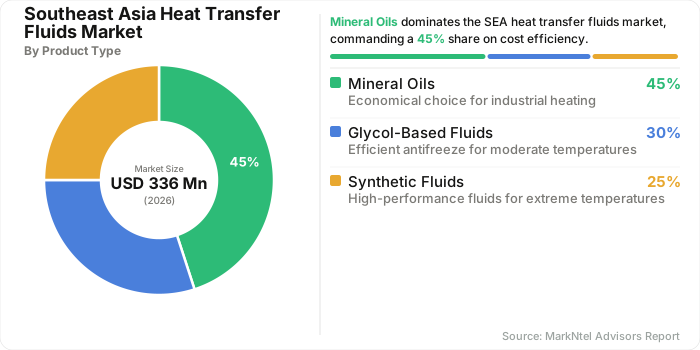
- Mineral oils represent the largest product segment, accounting for approximately 45% of the total market share.
- Medium-temperature fluids (0°C–200°C) dominate the temperature range segment, capturing an estimated 52% market share in 2026.
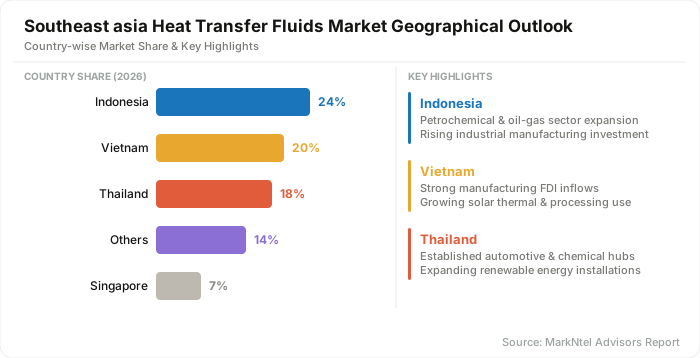
- Indonesia is the leading country in the region, contributing approximately 24% of the Southeast Asia market share in 2026.
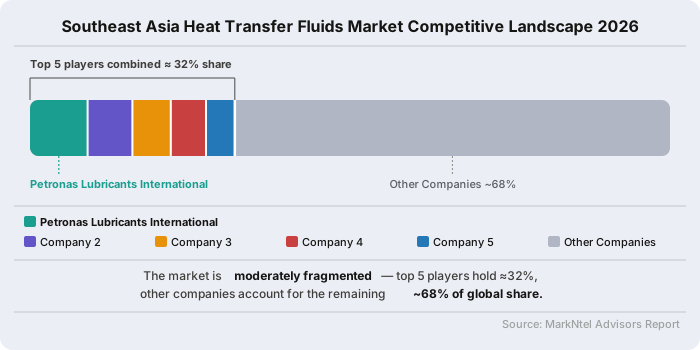
- The market is moderately fragmented, with the top five companies collectively accounting for around 32% of the total market share, reflecting the presence of a diverse regional supplier base.
Southeast Asia Heat Transfer Fluids Market Size and Outlook
The Southeast Asia heat transfer fluids market is valued at USD 307 million in 2025 and is projected to reach USD 336 million in 2026, advancing to USD 529 million by 2032 at a CAGR of 7.86%, supported by expanding petrochemical capacity, refinery upgrades, and rising industrial process-heating requirements across the region. Indonesia, the leading regional contributor at 24% share, anchors this growth through sustained chemical sector investment: Chandra Asri's Chlor Alkali–Ethylene Dichloride plant in Cilegon, Banten, was 33% complete as of 2025 and is designed to produce 400,000 tons of caustic soda and 500,000 tons of Ethylene Dichloride annually, feeding water treatment, alumina, and nickel-processing operations that rely on continuous thermal regulation.
Vietnam reinforces demand through refinery modernization, with Binh Son Refining and Petrochemical's USD 1.2 billion upgrade of the Dung Quat Oil Refinery raising processing capacity from 6.5 million to 7.5 million tonnes per year, targeted for commercial operation in early 2026. Additionally, ExxonMobil's exploration of a refinery project in Khanh Hoa province, supported by Van Phong Economic Zone investment incentives, signals further downstream expansion that will require process-heating and cooling infrastructure.
Thailand, the largest ASEAN petrochemical producer at 34.6 million tonnes per annum capacity in 2022, sustains regional demand through its Eastern Economic Corridor, which offers fifteen-year corporate income tax waivers to attract petrochemical and specialty chemical investment requiring precision thermal management. With the top five companies collectively holding 32% share in a moderately fragmented competitive landscape, continued refinery expansion, petrochemical diversification, and regulatory support for industrial decarbonization across Indonesia, Vietnam, and Thailand are expected to sustain demand through 2032.
Southeast Asia Heat Transfer Fluids Market Key Indicators
- According to Indonesia's Ministry of Industry, the country's combined chemical, pharmaceutical, and textile manufacturing sector grew by 6.5% in 2025, up from 5.8% in 2024. This steady industrial expansion is increasing the installation of reactors, distillation columns, and other process equipment that require continuous and reliable thermal regulation, thereby driving demand for heat transfer fluids.
- The Philippines' Department of Energy awarded 30.9 MW of new geothermal power capacity under its third Green Energy Auction in 2025. Binary-cycle geothermal power plants rely on closed-loop heat transfer fluid systems to transfer heat from lower-temperature geothermal resources, enabling efficient electricity generation and supporting the growing demand for heat transfer fluids.
- According to Vietnam's Ministry of Industry and Trade, domestic petroleum demand is projected to reach nearly 12 million tonnes in 2025, while existing refining capacity is expected to meet only around 70% of this demand. This widening supply gap is driving investments in new refinery projects, increasing the need for fluid-based thermal management systems and, consequently, boosting demand for heat transfer fluids.
- Malaysia's National Energy Transition Roadmap (NETR) aims to attract USD 143 billion in renewable energy investments to achieve a 70% share of installed renewable energy capacity by 2050, according to the U.S. Energy Information Administration (EIA). This transition is accelerating the development of solar thermal and biomass energy projects, both of which rely on dedicated heat transfer fluid systems for efficient thermal storage, heat transfer, and energy conversion.
Southeast Asia Heat Transfer Fluids Market Scope
| Category | Segments |
|---|---|
| By Product | Mineral Oils, Synthetic Fluids (Silicone Fluids, Aromatic Fluids, Synthetic Hydrocarbon Fluids, Ester-based Fluids), Glycol-based Fluids, Others |
| By Operating Temperature Range | Low Temperature (Below 0°C), Medium Temperature (0°C – 200°C), High Temperature (Above 200°C |
| By Sales Channel | Direct Sales (OEM/B2B), Distributors & Dealers, Online Retail |
| By End user | Chemical & Petrochemical, Oil & Gas, Concentrated Solar Power (CSP), Food & Beverages, Pharmaceuticals, Plastics & Rubber, Automotive, HVAC, Others |
Southeast Asia Heat Transfer Fluids Market Growth Drivers
Expanding Integrated Refining and Petrochemical Capacity Across Southeast Asia
Large-scale integrated refining and petrochemical complexes are driving sustained heat transfer fluid demand across Southeast Asia, since cracking, distillation, and polymerization processes within these facilities require continuous, precisely controlled thermal regulation. A key example is PETRONAS' Pengerang Integrated Complex in Johor, Malaysia, a joint venture with Saudi Aramco, processes up to 300,000 barrels per day of crude and houses the region's largest steam cracker, producing over 3 million tonnes annually of ethylene, propylene, and other olefin derivatives.
This capacity expansion extends across multiple Southeast Asian economies. Vietnam's Long Son Petrochemicals Complex, developed by Thailand's Siam Cement Group at an investment of USD 5.4 billion, integrates a 1 million-ton-per-annum ethylene cracker feeding more than 2 million tonnes of combined polyethylene and polypropylene production capacity. Such cross-border investment by regional petrochemical groups signals that capacity build-out is structural rather than country-specific.
For market participants, integrated cracker-to-downstream operators represent the highest-intensity demand centers, since cracking and polymerization stages consume disproportionately larger volumes of circulating thermal fluids than standalone refining units. Suppliers capable of servicing multi-train, high-throughput complexes across Malaysia, Vietnam, and neighboring economies are best positioned to capture recurring fluid replacement and maintenance contracts as these facilities reach full commercial operation.
Recent Trends
Rising Geothermal and Solar Capacity Build-Out Creating New Heat Transfer Fluid Applications in Southeast Asia
A sustained shift toward geothermal and solar-linked power generation is broadening the application base for heat transfer fluids beyond traditional petrochemical processing, as these renewable technologies depend on fluid-based thermal transfer for steam conversion and energy storage. The Asian Development Bank reports that renewable capacity across Southeast Asia stood at 120 GW in 2024 and is projected to nearly triple by 2035 under current policy settings.
This shift is visible in project-level investment. In January 2025, the Asian Development Bank signed a USD 92.6 million financing agreement with PT Supreme Energy Muara Laboh to expand a geothermal facility in West Sumatra, Indonesia, adding an 83 MW power plant that relies on closed-loop thermal fluid systems for steam-to-electricity conversion.
As renewable financing accelerates and multilateral lenders de-risk early-stage geothermal projects, fluid suppliers positioned to serve binary-cycle and solar thermal installations are likely to capture a growing share of demand that was historically concentrated in conventional industrial processing.
Southeast Asia Heat Transfer Fluids Market Opportunities and Challenges
Intensifying Captive Coal-Fired Operations in Indonesia's Nickel Sector Driving Demand for Condition-Based Fluid Maintenance Services
Indonesia's captive coal-fired power capacity dedicated to nickel smelting nearly tripled from 5.7 GW in 2019 to 15.2 GW in 2024, with more than 40 operational smelters recorded across the country by 2025, according to a December 2025 Climate works Centre report. The continuous, high-utilization operation of these captive facilities subjects circulating fluids to sustained oxidative and thermal stress, increasing the frequency of contamination-driven fluid replacement and raising maintenance costs across this rapidly expanding industrial base.
This recurring degradation cycle is driving regional suppliers toward condition-based maintenance and extended-life fluid technologies. Malaysia's PETRONAS Lubricants International launched its flagship PETRONAS Pro Series on 23 April 2026, a range of industrial fluids including PETRONAS ProHyd hydraulic fluids and PETRONAS ProGear transmission lubricants engineered specifically for maximum uptime and extended equipment longevity. The range is supported by PETRONAS Industrial Solutions' existing Diagnostics service, which uses oil condition monitoring to help customers optimize fluid drain intervals and prevent equipment failure. Suppliers replicating this condition-monitoring-plus-extended-life model are well positioned to capture recurring maintenance contracts as Southeast Asia's continuous-operation industrial base scales further.
Segmentation Insights
Cost Advantage and Regional Refining Capacity Keep Mineral Oils at the Forefront
Mineral oils hold approximately 45% of the Southeast Asia heat transfer fluids market, primarily owing to their cost competitiveness, extensive regional availability, and established refining infrastructure. Unlike synthetic alternatives, mineral oil-based heat transfer fluids benefit from integrated crude-to-base oil value chains across the region, enabling manufacturers to offer competitively priced products while ensuring a stable feedstock supply.
This cost advantage makes mineral oils the preferred choice for industries such as chemicals, petrochemicals, food processing, and general manufacturing, where thermal performance must be balanced with operating costs. The regional supply position has been further strengthened by recent refining investments.
In September 2025, ExxonMobil commenced commercial shipments from its Singapore Resid Upgrade Project (SURP), increasing Group II base oil production by 20,000 barrels per day, including the introduction of the EHC 340 MAX™ extra-heavy neutral grade. Additionally, Thai Lube Base, a subsidiary of Thai Oil, reported an annual base oil production capacity of 267,015 tonnes in its September 2025 investor presentation.
The expansion of regional base oil production enhances feedstock security, reduces import dependence, and is expected to sustain the dominance of mineral oil-based heat transfer fluids throughout the forecast period. By product type, the market is further segmented into the following segments:
- Mineral Oils
- Synthetic Fluids
- Glycol-based Fluids
- Others
Medium-Temperature Applications Drive the Largest Share of Heat Transfer Fluid Demand
The medium temperature range accounts for approximately 52% of the Southeast Asia heat transfer fluids market, reflecting the region's industrial structure, which is heavily concentrated in sectors such as food processing, textiles, plastics, rubber, and polymer manufacturing. These industries rely on continuous process heating but typically operate below the high-temperature thresholds required in heavy petrochemical and refining applications. According to the International Energy Agency (IEA), nearly 75% of heat demand in less energy-intensive industries worldwide is generated at temperatures below 200°C, highlighting the importance of medium-temperature thermal applications across manufacturing operations.
This trend is also evident in Southeast Asia's industrial sector. For example, Indonesia's polyester processing industry utilizes thermal fluid heating systems rated at 8 million kcal/h to support continuous polymer production within the medium-temperature operating range. The widespread use of such systems across manufacturing facilities creates substantial demand for heat transfer fluids designed for long-term thermal stability, operational efficiency, and cost-effective performance within the 0°C–200°C range, reinforcing the segment's dominant position in the regional market. By operating temperature range the market is further segmented into the following sub-categories:
- Low Temperature (Below 0°C)
- Medium Temperature (0°C – 200°C)
- High Temperature (Above 200°C)
Southeast Asia Heat Transfer Fluids Market Geographical Analysis
Indonesia accounts for approximately 24% of the Southeast Asia heat transfer fluids market, the largest single-country share in the region, underpinned by its position as the world's dominant nickel-processing hub.
According to Indonesia's Minister of Energy and Mineral Resources, the country's exports of nickel derivative products reached USD 38–40 billion in 2024, up from USD 11.9 billion in 2020, with the number of operating nickel smelters rising from two in 2016 to more than 60 by 2025, as the country's nickel ore export ban redirected investment into domestic smelting and high-pressure acid leach processing capacity. This concentration of continuous, high-temperature pyrometallurgical and hydrometallurgical processing lines sustains structurally higher per-facility fluid consumption than other Southeast Asian economies, where industrial activity remains more fragmented across lighter manufacturing.
Indonesia's Ministry of Energy and Mineral Resources tightened the 2026 nickel ore mining quota (RKAB) to 260–270 million wet metric tonnes, down from 379 million tonnes in 2025, signaling a shift toward prioritizing integrated, higher-value-added smelting projects over raw ore output . This regulatory recalibration favors fewer, larger-scale processing facilities, reinforcing demand concentration around continuous-operation thermal systems in the country's industrial parks.
Southeast Asia Heat Transfer Fluids Market Competitive Landscape
The Southeast Asia Heat Transfer Fluids Market is moderately fragmented, with the top five players collectively accounting for approximately 32% of the market share, reflecting the presence of numerous regional manufacturers and specialty fluid suppliers. Petronas Lubricants International, PT Pertamina Lubricants, IRPC Public Company Limited, Bangchak Corporation Public Company Limited, and Thai Lube Base Public Company Limited are the leading participants, supported by their integrated refining capabilities, established distribution networks, and strong presence across key industrial sectors. The remaining market is shared among several regional suppliers serving diverse end-use industries across Southeast Asia.
Major Players in the Southeast Asia Heat Transfer Fluids Market
- Petronas Lubricants International
- PT Pertamina Lubricants
- Thai Lube Base Public Company Limited
- IRPC Public Company Limited
- Bangchak Corporation Public Company Limited
- PTAK Trading Sdn. Bhd.
- Unimech Group Berhad
- Chemie Asia Pacific
- Hi-Tech Interchem (Thailand) Co., Ltd.
- Petrochem Safety Pte. Ltd.
- United Oil Company Pte. Ltd.
- AP Oil International Limited
Southeast Asia Heat Transfer Fluids Market News and Recent Developments
2025: Lubrizol Appoints IMCD Group as Vietnam Channel Partner for Lubricant Additives
Lubrizol named IMCD Group, which operates distribution networks across more than 50 countries, as its new channel partner for lubricant and fuel additive distribution in Vietnam, a market currently dominated by motorcycle oil alongside a sizeable heavy-duty engine oil segment
Impact Analysis: The partnership strengthens Lubrizol's local supply chain reach and technical service capacity in Vietnam, accelerating domestic blenders' access to ultra-low viscosity additive technologies and reinforcing competitive positioning against established regional fluid suppliers.
2025: ExxonMobil Explores USD 10 Billion Low-Emission Refinery in Vietnam's Van Phong Economic Zone
ExxonMobil conducted feasibility surveys at Van Phong Economic Zone, Khanh Hoa province, for what would be its first near-zero-emission refinery in the Asia-Pacific region, expected to generate approximately 10,000 construction jobs and 1,500 long-term roles
Impact Analysis: A facility of this scale would significantly expand Vietnam's domestic refining and petrochemical base, create substantial new fluid demand and strengthen ExxonMobil's downstream supply position across Southeast Asia, while raising entry barriers for competitors lacking comparable port and feedstock access.
2025: PT Pertamina Lubricants Partners with PLN to Develop Transformer Cooling Fluids
PT Pertamina Lubricants, Indonesia's state-affiliated lubricants producer, entered a partnership with PT PLN (Persero), the national power utility, to jointly develop transformer oils and electrical cooling fluids for Indonesia's power transmission network
Impact Analysis: The collaboration positions Pertamina Lubricants to supply specialized dielectric and transformer cooling fluids directly into PLN's expanding grid infrastructure, securing long-term institutional demand and strengthening domestic substitution against imported transformer fluid brands as Indonesia continues to scale its power transmission capacity.
2025: Pertamina Geothermal Energy and PLN Indonesia Power Partner to Develop 530 MW of Geothermal Capacity
In August 2025, PT Pertamina Geothermal Energy (PGE) and PT PLN Indonesia Power signed a Head of Agreement (HoA) and consortium agreement to jointly develop 19 geothermal projects with a combined capacity of 530 MW. The collaboration includes 30 MW Ulubelu Binary Unit and 15 MW Lahendong Binary Unit projects, supporting PGE's target of achieving 1 GW of installed geothermal capacity within the next two to three years.
Impact Analysis: The agreement is expected to expand Indonesia's geothermal generation capacity while creating new opportunities for high-performance heat transfer fluids used in binary-cycle geothermal plants. Unlike conventional flash steam facilities, binary-cycle systems rely on closed-loop organic heat transfer fluids to transfer geothermal heat to the turbine through a secondary working fluid. As more binary geothermal projects are commissioned, demand for thermally stable and long-life heat transfer fluids is expected to increase, creating a new application segment beyond traditional industrial process heating.
Frequently Asked Questions
- Market Segmentation
- Introduction
- Product Definition
- Research Process
- Assumptions
- Executive Summary
- Southeast Asia Heat Transfer Fluids Market Policies, Regulations, and Product Standards
- Southeast Asia Heat Transfer Fluids Market Trends & Developments
- Southeast Asia Heat Transfer Fluids Market Dynamics
- Growth Factors
- Challenges
- Southeast Asia Heat Transfer Fluids Market Hotspot & Opportunities
- Southeast Asia Heat Transfer Fluids Market Outlook, 2022-2032F
- Market Size & Outlook
- By Revenues (USD Million)
- By Quantity Sold (thousand tons)
- Market Segmentation & Outlook
- By Product- Market Size & Forecast 2022-2032, USD Million & thousand tons
- Mineral Oils
- Synthetic Fluids
- Silicone Fluids
- Aromatic Fluids
- Synthetic Hydrocarbon Fluids
- Ester-based Fluids
- Glycol-based Fluids
- Others
- By Operating Temperature Range- Market Size & Forecast 2022-2032, USD Million & thousand tons
- Low Temperature (Below 0°C)
- Medium Temperature (0°C – 200°C)
- High Temperature (Above 200°C)
- By Sales Channel- Market Size & Forecast 2022-2032, USD Million & thousand tons
- Direct Sales (OEM/B2B)
- Distributors & Dealers
- Online Retail
- By End user- Market Size & Forecast 2022-2032, USD Million & thousand tons
- Chemical & Petrochemical
- Oil & Gas
- Concentrated Solar Power (CSP)
- Food & Beverages
- Pharmaceuticals
- Plastics & Rubber
- Automotive
- HVAC
- Others
- By Country
- Vietnam
- Thailand
- Indonesia
- Singapore
- Malaysia
- Cambodia
- Philippines
- Rest of Southeast Asia
- By Company
- Competition Characteristics
- Market Share & Outlook
- By Product- Market Size & Forecast 2022-2032, USD Million & thousand tons
- Market Size & Outlook
- Vietnam Heat Transfer Fluids Market Outlook, 2022-2032F
- Market Size & Outlook
- By Revenues (USD Million)
- By Quantity sold (thousand tons)
- Market Segmentation & Outlook
- By Product- Market Size & Forecast 2022-2032, USD Million & thousand tons
- By Physical State- Market Size & Forecast 2022-2032, USD Million & thousand tons
- By Operating Temperature Range- Market Size & Forecast 2022-2032, USD Million & thousand tons
- By Sales Channel- Market Size & Forecast 2022-2032, USD Million & thousand tons
- By End user- Market Size & Forecast 2022-2032, USD Million & thousand tons
- Market Size & Outlook
- Thailand Heat Transfer Fluids Market Outlook, 2022-2032F
- Market Size & Outlook
- By Revenues (USD Million)
- By Quantity Sold (thousand tons)
- Market Segmentation & Outlook
- By Product- Market Size & Forecast 2022-2032, USD Million & thousand tons
- By Physical State- Market Size & Forecast 2022-2032, USD Million & thousand tons
- By Operating Temperature Range- Market Size & Forecast 2022-2032, USD Million & thousand tons
- By Sales Channel- Market Size & Forecast 2022-2032, USD Million & thousand tons
- By End user- Market Size & Forecast 2022-2032, USD Million & thousand tons
- Market Size & Outlook
- Indonesia Heat Transfer Fluids Market Outlook, 2022-2032F
- Market Size & Outlook
- By Revenues (USD Million)
- By Quantity sold (thousand tons)
- Market Segmentation & Outlook
- By Product- Market Size & Forecast 2022-2032, USD Million & thousand tons
- By Physical State- Market Size & Forecast 2022-2032, USD Million & thousand tons
- By Operating Temperature Range- Market Size & Forecast 2022-2032, USD Million & thousand tons
- By Sales Channel- Market Size & Forecast 2022-2032, USD Million & thousand tons
- By End user- Market Size & Forecast 2022-2032, USD Million & thousand tons
- Market Size & Outlook
- Singapore Heat Transfer Fluids Market Outlook, 2022-2032F
- Market Size & Outlook
- By Revenues (USD Million)
- By Quantity Sold (thousand tons)
- Market Segmentation & Outlook
- By Product- Market Size & Forecast 2022-2032, USD Million & thousand tons
- By Physical State- Market Size & Forecast 2022-2032, USD Million & thousand tons
- By Operating Temperature Range- Market Size & Forecast 2022-2032, USD Million & thousand tons
- By Sales Channel- Market Size & Forecast 2022-2032, USD Million & thousand tons
- By End user- Market Size & Forecast 2022-2032, USD Million & thousand tons
- Market Size & Outlook
- Malaysia Heat Transfer Fluids Market Outlook, 2022-2032F
- Market Size & Outlook
- By Revenues (USD Million)
- By Quantity Sold (thousand tons)
- Market Segmentation & Outlook
- By Product- Market Size & Forecast 2022-2032, USD Million & thousand tons
- By Physical State- Market Size & Forecast 2022-2032, USD Million & thousand tons
- By Operating Temperature Range- Market Size & Forecast 2022-2032, USD Million & thousand tons
- By Sales Channel- Market Size & Forecast 2022-2032, USD Million & thousand tons
- By End user- Market Size & Forecast 2022-2032, USD Million & thousand tons
- Market Size & Outlook
- Cambodia Heat Transfer Fluids Market Outlook, 2022-2032F
- Market Size & Outlook
- By Revenues (USD Million)
- By Quantity sold (thousand tons)
- Market Segmentation & Outlook
- By Product- Market Size & Forecast 2022-2032, USD Million & thousand tons
- By Physical State- Market Size & Forecast 2022-2032, USD Million & thousand tons
- By Operating Temperature Range- Market Size & Forecast 2022-2032, USD Million & thousand tons
- By Sales Channel- Market Size & Forecast 2022-2032, USD Million & thousand tons
- By End user- Market Size & Forecast 2022-2032, USD Million & thousand tons
- Market Size & Outlook
- Philippines Heat Transfer Fluids Market Outlook, 2022-2032F
- Market Size & Outlook
- By Revenues (USD Million)
- By Quantity Sold (thousand tons)
- Market Segmentation & Outlook
- By Product- Market Size & Forecast 2022-2032, USD Million & thousand tons
- By Physical State- Market Size & Forecast 2022-2032, USD Million & thousand tons
- By Operating Temperature Range- Market Size & Forecast 2022-2032, USD Million & thousand tons
- By Sales Channel- Market Size & Forecast 2022-2032, USD Million & thousand tons
- By End user- Market Size & Forecast 2022-2032, USD Million & thousand tons
- Market Size & Outlook
- Southeast Asia Heat Transfer Fluids Market Key Strategic Imperatives for Success & Growth
- Competitive Outlook
- Company Profiles
- Petronas Lubricants International
- Business Description
- Product Portfolio
- Collaborations & Alliances
- Recent Developments
- Financial Details
- Others
- PT Pertamina Lubricants
- Business Description
- Product Portfolio
- Collaborations & Alliances
- Recent Developments
- Financial Details
- Others
- Thai Lube Base Public Company Limited
- Business Description
- Product Portfolio
- Collaborations & Alliances
- Recent Developments
- Financial Details
- Others
- IRPC Public Company Limited
- Business Description
- Product Portfolio
- Collaborations & Alliances
- Recent Developments
- Financial Details
- Others
- Bangchak Corporation Public Company Limited
- Business Description
- Product Portfolio
- Collaborations & Alliances
- Recent Developments
- Financial Details
- Others
- PTAK Trading Sdn. Bhd.
- Business Description
- Product Portfolio
- Collaborations & Alliances
- Recent Developments
- Financial Details
- Others
- Unimech Group Berhad
- Business Description
- Product Portfolio
- Collaborations & Alliances
- Recent Developments
- Financial Details
- Others
- Chemie Asia Pacific
- Business Description
- Product Portfolio
- Collaborations & Alliances
- Recent Developments
- Financial Details
- Others
- Hi-Tech Interchem (Thailand) Co., Ltd.
- Business Description
- Product Portfolio
- Collaborations & Alliances
- Recent Developments
- Financial Details
- Others
- Petrochem Safety Pte. Ltd.
- Business Description
- Product Portfolio
- Collaborations & Alliances
- Recent Developments
- Financial Details
- Others
- United Oil Company Pte. Ltd.
- Business Description
- Product Portfolio
- Collaborations & Alliances
- Recent Developments
- Financial Details
- Others
- AP Oil International Limited
- Business Description
- Product Portfolio
- Collaborations & Alliances
- Recent Developments
- Financial Details
- Others
- Petronas Lubricants International
- Company Profiles
- Disclaimer
MarkNtel Advisors follows a robust and iterative research methodology designed to ensure maximum accuracy and minimize deviation in market estimates and forecasts. Our approach combines both bottom-up and top-down techniques to effectively segment and quantify various aspects of the market. A consistent feature across all our research reports is data triangulation, which examines the market from three distinct perspectives to validate findings. Key components of our research process include:
1. Scope & Research Design At the outset, MarkNtel Advisors define the research objectives and formulate pertinent questions. This phase involves determining the type of research—qualitative or quantitative—and designing a methodology that outlines data collection methods, target demographics, and analytical tools. They also establish timelines and budgets to ensure the research aligns with client goals.
2. Sample Selection and Data Collection In this stage, the firm identifies the target audience and determines the appropriate sample size to ensure representativeness. They employ various sampling methods, such as random or stratified sampling, based on the research objectives. Data collection is carried out using tools like surveys, interviews, and observations, ensuring the gathered data is reliable and relevant.
3. Data Analysis and Validation Once data is collected, MarkNtel Advisors undertake a rigorous analysis process. This includes cleaning the data to remove inconsistencies, employing statistical software for quantitative analysis, and thematic analysis for qualitative data. Validation steps are taken to ensure the accuracy and reliability of the findings, minimizing biases and errors.

4. Data Forecast and FinalizationThe final phase involves forecasting future market trends based on the analyzed data. MarkNtel Advisors utilize predictive modeling and time series analysis to anticipate market behaviors. The insights are then compiled into comprehensive reports, featuring visual aids like charts and graphs, and include strategic recommendations to inform client decision-making
We offer flexible licensing options to cater to varying organizational needs. Choose the pricing pack that best suits your requirements:
Buy Now Inquire Before Buying
 Request Customization
 Talk to our Consultant







