

Southeast Asia Antiscalant Market Research Report: Trends & Forecast (2026-2032)
By Type (Phosphonates, Carboxylate-based Polymers, Sulfonates, Others (including bio-based/green antiscalants)), By Application (Reverse Osmosis (RO) Systems, Cooling Water Systems ... , Boilers & Steam Systems, Desalination, Others (process water, wastewater reuse)), By End-Use Industry (Power Generation, Oil & Gas, Chemicals & Petrochemicals, Food & Beverage, Municipal Water & Wastewater, Others (pulp & paper, mining, pharmaceuticals)), By Technology (Reverse Osmosis (RO), Nanofiltration (NF), Ultrafiltration (UF), Thermal Desalination (MSF/MED), Conventional Water Treatment Systems), By Feed Water (Seawater, Brackish Water, Surface Water, Groundwater, Wastewater / Recycled Water), and others Read more
- Chemicals
- Aug 2026
- Pages 290
- Report Format: PDF, Excel, PPT
Southeast Asia Antiscalant Market
Projected 3.77% CAGR from 2026 to 2032
Study Period
2026-2032
Market Size (2026)
USD 197 Billion
Market Size (2032)
USD 246 Billion
Base Year
2025
Projected CAGR
3.77%
Leading Segments
By Type: Phosphonates
Southeast Asia Antiscalant Market Key Takeaways
- The Southeast Asia antiscalant market size was valued at USD 187 billion in 2025 and is projected to grow from USD 197 billion in 2026 to USD 246 billion by 2032.
- The industry is projected to reflect sustained growth at a steady CAGR of 3.77% during 2026-2032.
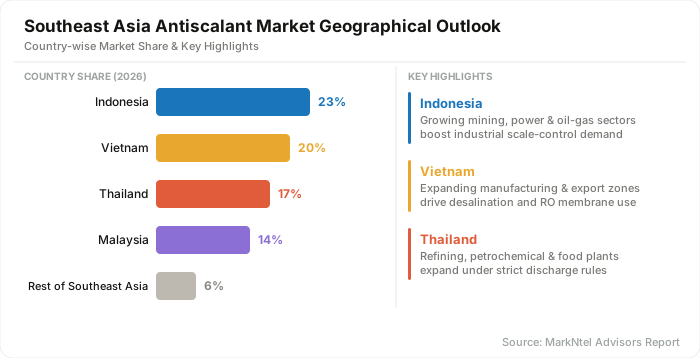
- Indonesia holds the largest share of about 23% in 2026.
- By type, phosphonates hold a significant share of about 48% in 2026.
- By application, reverse osmosis (RO) systems seized a significant share of about 40% in 2026.
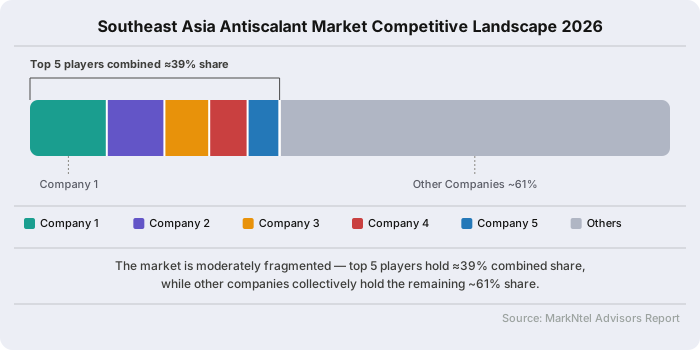
- The industry is moderately fragmented. However, the top five players collectively account for nearly 39% share.
Southeast Asia Antiscalant Market Size and Outlook
The antiscalant market size in Southeast Asia was valued at USD 187 billion in 2025 and is projected to grow from USD 197 billion in 2026 to USD 246 billion by 2032. Along with this, the market is estimated to grow at a CAGR of around 3.77% during the forecast period, i.e., 2026-32.
The demand for antiscalant across the region is supported by rising demand for efficient water treatment, driven by rapid urbanization, industrialization, water scarcity, and expanding wastewater reuse. Growing investment in desalination, municipal water infrastructure, and industrial water recycling is increasing the deployment of membrane-based treatment systems that require antiscalants to control mineral scaling. Policy initiatives promoting water security, sanitation, climate resilience, and sustainable water management are further supporting demand.
For instance, ADB-backed projects are expanding water-treatment capacity in Vietnam, including a 100 million-liter-per-day expansion in Binh Duong. Singapore's emphasis on desalination and water reuse provides another important demand center. Future opportunities lie in advanced RO systems, industrial wastewater reuse, desalination, and high-performance, environmentally compatible formulations. The market is expected to maintain a positive long-term outlook as Southeast Asian economies prioritize water security and infrastructure modernization.
Southeast Asia Antiscalant Market Key Indicators
- According to the Asian Development Bank’s Asian Water Development Outlook 2025, Asia and the Pacific require an estimated USD 4 trillion in WASH investment through 2040, while current public spending covers only 40% of the requirement, leaving an annual shortfall of around USD 150 billion. This infrastructure deficit is expected to sustain investment in water treatment, reuse, and desalination across Southeast Asia, supporting long-term demand for antiscalants.
- Singapore’s desalination infrastructure provides a measurable demand indicator for antiscalants. According to PUB, the country operates five desalination plants, and on 26 December 2025, it announced a feasibility study for a potential sixth plant. The study will assess multiple designs, including a dual-mode facility capable of treating seawater or freshwater, similar to Marina East. As desalination relies on membrane-based treatment, continued capacity expansion creates recurring requirements for antiscalants to control membrane scaling and maintain RO performance.
- Indonesia’s RUPTL 2025–2034 targets 69.5 GW of new generation capacity and approximately USD 190 billion in investment, with around 73% expected through independent power producers. Although 76% of planned capacity is renewable, 16.6 GW will come from gas and coal, creating demand for boiler feedwater and cooling-water treatment. The plan also projects electricity demand rising from 306 TWh in 2024 to 511 TWh by 2034, supporting sustained industrial water-treatment requirements and antiscalant consumption.
- Pertamina’s Balikpapan Refinery Development Master Plan (RDMP) represents a significant industrial water-treatment demand indicator. The USD 7.4 billion project increased refinery processing capacity from 260,000 to 360,000 barrels per day and was inaugurated on 12 January 2026. The expanded refinery’s cooling-water and process-water systems create recurring requirements for scale control, making the project a direct, named capacity addition supporting antiscalant demand in Indonesia’s industrial sector.
Southeast Asia Antiscalant Market Scope
| Category | Segments |
|---|---|
| By Type | (Phosphonates, Carboxylate-based Polymers, Sulfonates, Others (including bio-based/green antiscalants)), |
| By Application | (Reverse Osmosis (RO) Systems, Cooling Water Systems, Boilers & Steam Systems, Desalination, Others (process water, wastewater reuse)), |
| By End-Use Industry | (Power Generation, Oil & Gas, Chemicals & Petrochemicals, Food & Beverage, Municipal Water & Wastewater, Others (pulp & paper, mining, pharmaceuticals)), |
| By Technology | (Reverse Osmosis (RO), Nanofiltration (NF), Ultrafiltration (UF), Thermal Desalination (MSF/MED), Conventional Water Treatment Systems), |
| By Feed Water | (Seawater, Brackish Water, Surface Water, Groundwater, Wastewater / Recycled Water), |
Southeast Asia Antiscalant Market Growth Drivers
Expansion of Seawater Reverse Osmosis (SWRO) Desalination Capacity Driving Antiscalant Demand
Increasing water stress and limited freshwater availability are accelerating the adoption of seawater reverse osmosis (SWRO) desalination projects across Southeast Asia, directly supporting demand for antiscalants. Seawater reverse osmosis systems require continuous antiscalant dosing because seawater contains high concentrations of dissolved salts, including calcium, magnesium, and silica, which can form mineral deposits on RO membranes, reducing water recovery rates and increasing maintenance costs.
Singapore represents the strongest regional example, where desalination has become one of the country’s four national water sources. The country currently operates five desalination plants, including the SingSpring, Tuas South, Tuas, Marina East, and Jurong Island desalination facilities. Singapore’s first large-scale seawater desalination plant, SingSpring, has a capacity of 136,380 cubic metres per day (30 million gallons per day) and uses reverse osmosis technology to supply around 7% of national water demand. The Keppel Marina East Desalination Plant, operational since 2020, adds another 137,000 cubic metres per day (approximately 30 million gallons per day) of freshwater production capacity through a dual-mode desalination system integrating membrane-based treatment.
Beyond Singapore, other Southeast Asian countries are expanding desalination capacity to address regional water shortages. In the Philippines, construction began in 2025 on the Metro Iloilo seawater reverse osmosis desalination plant, described as the country’s largest SWRO facility, developed to improve water security amid declining reliability of traditional freshwater sources. These investments increase the installed base of RO membranes, creating recurring demand for antiscalant chemicals required for membrane protection, higher operational efficiency, and longer equipment lifespan.
Recent Trends
Shift Toward Integrated and High-Performance Membrane Treatment Solutions
Development of integrated and high-performance membrane treatment solutions has emerged as the most influential trend shaping the Southeast Asia antiscalant industry during 2025–2026, as end users increasingly seek complete membrane performance solutions rather than standalone antiscalant products. Industrial water users are adopting integrated programmes that combine advanced antiscalants, membrane cleaners, digital monitoring, diagnostics, and technical services to improve membrane recovery, reduce cleaning frequency, and lower operating costs.
This shift is accelerating technology innovation and moving competition from commodity chemicals toward value-added performance solutions. Supporting this trend, Veolia announced more than USD 750 million in global water technology contracts in 2025, including a USD 550 million ultrapure water and wastewater treatment facility for a semiconductor plant that will recycle approximately 8,000 m³ of water per day using advanced membrane technologies.
The trend is further reinforced by Kurita's Avista® platform, which integrates Vitec™ antiscalants, membrane cleaners, digital monitoring (AdvisorCi™), membrane autopsy, and restoration services into a comprehensive membrane management solution. Likewise, Solenis continues expanding its reverse osmosis portfolio by combining antiscalants, pretreatment chemicals, automated dosing systems, and digital performance management into unified treatment programmes. These developments are changing purchasing behavior, with customers increasingly selecting suppliers capable of delivering lifecycle membrane optimization instead of individual chemicals.
Moreover, continued investment in digital diagnostics, predictive monitoring, and integrated membrane performance platforms is expected to accelerate the transition toward intelligent water treatment ecosystems, supporting premium antiscalant formulations and long-term service-based business models.
Southeast Asia Antiscalant Market Opportunities and Challenges
High Costs Restrain Membrane Adoption, Creating Modular System Opportunities
High capital cost and slow deployment of membrane-based water treatment systems remain a major restraint on the Southeast Asia antiscalant industry because antiscalants are primarily used in reverse osmosis (RO), nanofiltration (NF), desalination, and advanced wastewater treatment facilities. Large membrane projects require substantial upfront investment, lengthy approval processes, and complex engineering, delaying plant commissioning and recurring antiscalant consumption.
A notable example is the Kochi Integrated Urban Regeneration and Water Transport System (IURWTS), where project costs increased from approximately USD 152 million to USD 199 million, delaying government approval and tendering despite retaining the planned treatment capacity. Likewise, the Asian Development Bank (ADB) estimates that Asia and the Pacific require nearly USD 4 trillion in water, sanitation, and hygiene (WASH) investments through 2040, underscoring the financing gap that continues to slow advanced water infrastructure deployment.
The strongest long-term opportunity lies in the adoption of modular and decentralized membrane water treatment systems, which reduce upfront capital requirements, shorten construction timelines, and enable phased capacity expansion. To support this transition, the ADB is implementing a January 2025–December 2026 demonstration programme in Malaysia and the Philippines to evaluate modular smart water treatment systems integrating membrane capacitive deionization (MCDI) with RO for scalable, cost-effective deployment.
In parallel, Veolia Water Technologies has expanded its portfolio of modular RO-based treatment solutions across Asia, offering pre-engineered systems that lower engineering costs and accelerate installation. As commercialization of modular membrane technologies expands beyond 2026, faster RO deployment is expected to enlarge the installed membrane base, generating sustained recurring demand for antiscalants throughout system operation.
Segmentation Insights
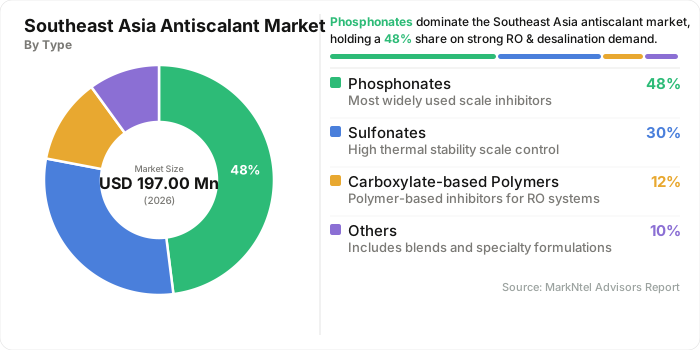
Phosphonates Lead the Southeast Asia Antiscalant Demand with Nearly 48% Share
Phosphonates is estimated to account for nearly 48% of Southeast Asia’s antiscalant market, making it the largest product category. Its leading position is supported by widespread use in residential, commercial, and infrastructure construction, particularly for roofs, foundations, basements, underground structures, bridges, and roads. Bitumen membranes and coatings are valued for their strong water resistance, durability, and relatively cost-effective application, making them suitable for price-sensitive construction markets across the region.
The product is also compatible with large-scale infrastructure projects, where extensive surface areas require reliable moisture protection. In countries such as Indonesia, Vietnam, Thailand, Malaysia, and the Philippines, continued urbanization, housing construction, transport infrastructure development, and tropical rainfall exposure are sustaining demand for bitumen-based systems. Furthermore, the availability of modified formulations, including polymer-enhanced bitumen membranes, is improving flexibility, crack resistance, and service life.
Consequently, the combination of established contractor familiarity, broad application coverage, cost competitiveness, and strong demand from new construction and infrastructure projects supports bitumen-based waterproofing as the largest product segment in Southeast Asia. Based on type, the scope has been segmented into
- Phosphonates
- Carboxylate-based Polymers
- Sulfonates
- Others
Reverse Osmosis Systems Lead with a 40% Share, Supported by Growing Water Treatment Requirements
Reverse Osmosis Systems is estimated to account for approximately 40% of the Southeast Asia antiscalant industry. The segment leads because RO is widely deployed for municipal, industrial, wastewater-reuse, and desalination applications, where antiscalants are essential for preventing mineral deposits on membranes and maintaining treatment efficiency. For instance, Singapore relies extensively on RO for both desalination and NEWater production.
The country currently operates five desalination plants, while its NEWater facilities use membrane-based treatment including RO to produce high-grade reclaimed water. Similarly, the Changi NEWater Phase 2 project uses microfiltration followed by RO to treat secondary sewage effluent, achieving more than 99% desalination. RO is also identified as the most commonly used desalination technology in Southeast Asia, reinforcing its broad application base and consequently its high demand for antiscalants. Based on application, the market is categorized into
- Reverse Osmosis (RO) Systems
- Cooling Water Systems
- Boilers & Steam Systems
- Desalination
- Others
Southeast Asia Antiscalant Market Geographical Outlook
Indonesia accounts for approximately 23% of the Southeast Asia antiscalant market, making it the region’s leading country-level market. This position is supported by the country’s large population, rapid urbanization, extensive residential construction, and broad infrastructure development. Construction contributed 10.43% of Indonesia’s GDP in the fourth quarter of 2024, highlighting the sector’s significant economic contribution and the scale of building activity generating demand for construction chemicals.
A major example is Nusantara, Indonesia’s planned new capital, where the continued development of residential areas, government facilities, roads, utilities, and supporting infrastructure is expanding the country’s construction pipeline. These projects require waterproofing solutions for foundations, roofs, basements, bathrooms, wet areas, underground utilities, tunnels, and other concrete structures exposed to moisture. In parallel, Indonesia’s industrial expansion, transportation infrastructure, commercial construction, and urban redevelopment are creating demand across both new-build and renovation applications.
The country’s tropical climate, high humidity, heavy rainfall, and exposure to flooding further increase the importance of moisture protection and durable waterproofing systems. Consequently, Indonesia’s large construction base, continued urban expansion, Nusantara development, and diverse application opportunities support its leading share of the regional antiscalant market.
Southeast Asia Antiscalant Market Competitive Analysis
The Southeast Asia antiscalant market is moderately fragmented, with the top five players Solenis LLC, Ecolab Inc., Kurita Water Industries Ltd., Veolia Water Technologies SA, and Dow Inc. collectively accounting for an estimated approximately 39% share of the regional market.
Major Companies in Southeast Asia Antiscalant Industry
- Solenis LLC
- Ecolab Inc.
- Kurita Water Industries Ltd.
- Veolia Water Technologies SA
- Dow Inc.
- BASF SE
- Avista Technologies, Inc.
- Kemira Oyj
- Italmatch Chemicals S.p.A.
- Clariant AG
- BWA Water Additives UK Ltd.
- Genesys International Ltd.
- Others
Southeast Asia Antiscalant Industry News and Recent Developments
2026: Kurita Introduces Enhanced Avista® S.sensing™ RO-AS Antiscalant Performance Validation Technology
Kurita introduced enhanced S.sensing™ RO-AS technology under its Avista® membrane treatment solutions platform in 2026. The technology validates antiscalant performance using actual feedwater conditions, enabling more accurate dosing decisions and improved reverse osmosis (RO) system optimization. The development reflects the industry shift toward data-driven antiscalant management and integrated membrane performance solutions.
Impact Analysis: Kurita’s enhanced S.sensing™ RO-AS technology could improve antiscalant dosing accuracy by enabling performance validation under actual feedwater conditions. This supports more efficient chemical consumption, reduces scaling-related membrane performance losses, and helps optimize RO operating costs. The technology may also strengthen demand for advanced antiscalant solutions as Southeast Asian water-treatment operators increasingly prioritize data-driven monitoring, membrane efficiency, and predictive treatment management.
Frequently Asked Questions
- Market Segmentation
- Introduction
- Product Definition
- Research Process
- Assumptions
- Executive Summary
- Southeast Asia Antiscalant Market Policies, Regulations, and Product Standards
- Southeast Asia Antiscalant Market Trends & Developments
- Southeast Asia Antiscalant Market Dynamics
- Growth Factors
- Challenges
- Southeast Asia Antiscalant Market Hotspot & Opportunities
- Southeast Asia Antiscalant Market Outlook, 2022-2032
- Market Size & Outlook
- By Revenues (USD Million)
- By Quantity Sold (Thousand Tons)
- Market Segmentation & Outlook
- By Type- Market Size & Forecast 2022-2032, USD Million & Thousand Tons
- Phosphonates
- Carboxylate-based Polymers
- Sulfonates
- Others (including bio-based/green antiscalants)
- By Application- Market Size & Forecast 2022-2032, USD Million & Thousand Tons
- Reverse Osmosis (RO) Systems
- Cooling Water Systems
- Boilers & Steam Systems
- Desalination
- Others (process water, wastewater reuse)
- By End-Use Industry- Market Size & Forecast 2022-2032, USD Million & Thousand Tons
- Power Generation
- Oil & Gas
- Chemicals & Petrochemicals
- Food & Beverage
- Municipal Water & Wastewater
- Others (pulp & paper, mining, pharmaceuticals)
- By Technology- Market Size & Forecast 2022-2032, USD Million & Thousand Tons
- Reverse Osmosis (RO)
- Nanofiltration (NF)
- Ultrafiltration (UF)
- Thermal Desalination (MSF/MED)
- Conventional Water Treatment Systems
- By Feed Water- Market Size & Forecast 2022-2032, USD Million & Thousand Tons
- Seawater
- Brackish Water
- Surface Water
- Groundwater
- Wastewater / Recycled Water
- By Country
- Indonesia
- Vietnam
- Thailand
- Malaysia
- Singapore
- Philippines
- Cambodia
- Rest of Southeast Asia
- By Company
- Competition Characteristics
- Market Share & Analysis
- By Type- Market Size & Forecast 2022-2032, USD Million & Thousand Tons
- Market Size & Outlook
- Indonesia Antiscalant Market Outlook, 2022-2032
- Market Size & Outlook
- By Revenues (USD Million)
- By Quantity sold (Tons)
- Market Segmentation & Outlook
- By Type- Market Size & Forecast 2022-2032, USD Million & Thousand Tons
- By Application- Market Size & Forecast 2022-2032, USD Million & Thousand Tons
- By End-Use Industry- Market Size & Forecast 2022-2032, USD Million & Thousand Tons
- By Technology- Market Size & Forecast 2022-2032, USD Million & Thousand Tons
- By Feed Water- Market Size & Forecast 2022-2032, USD Million & Thousand Tons
- Market Size & Outlook
- Vietnam Antiscalant Market Outlook, 2022-2032
- Market Size & Outlook
- By Revenues (USD Million)
- By Quantity sold (Tons)
- Market Segmentation & Outlook
- By Type- Market Size & Forecast 2022-2032, USD Million & Thousand Tons
- By Application- Market Size & Forecast 2022-2032, USD Million & Thousand Tons
- By End-Use Industry- Market Size & Forecast 2022-2032, USD Million & Thousand Tons
- By Technology- Market Size & Forecast 2022-2032, USD Million & Thousand Tons
- By Feed Water- Market Size & Forecast 2022-2032, USD Million & Thousand Tons
- Market Size & Outlook
- Thailand Antiscalant Market Outlook, 2022-2032
- Market Size & Outlook
- By Revenues (USD Million)
- By Quantity sold (Tons)
- Market Segmentation & Outlook
- By Type- Market Size & Forecast 2022-2032, USD Million & Thousand Tons
- By Application- Market Size & Forecast 2022-2032, USD Million & Thousand Tons
- By End-Use Industry- Market Size & Forecast 2022-2032, USD Million & Thousand Tons
- By Technology- Market Size & Forecast 2022-2032, USD Million & Thousand Tons
- By Feed Water- Market Size & Forecast 2022-2032, USD Million & Thousand Tons
- Market Size & Outlook
- Malaysia Antiscalant Market Outlook, 2022-2032
- Market Size & Outlook
- By Revenues (USD Million)
- By Quantity sold (Tons)
- Market Segmentation & Outlook
- By Type- Market Size & Forecast 2022-2032, USD Million & Thousand Tons
- By Application- Market Size & Forecast 2022-2032, USD Million & Thousand Tons
- By End-Use Industry- Market Size & Forecast 2022-2032, USD Million & Thousand Tons
- By Technology- Market Size & Forecast 2022-2032, USD Million & Thousand Tons
- By Feed Water- Market Size & Forecast 2022-2032, USD Million & Thousand Tons
- Market Size & Outlook
- Singapore Antiscalant Market Outlook, 2022-2032
- Market Size & Outlook
- By Revenues (USD Million)
- By Quantity sold (Tons)
- Market Segmentation & Outlook
- By Type- Market Size & Forecast 2022-2032, USD Million & Thousand Tons
- By Application- Market Size & Forecast 2022-2032, USD Million & Thousand Tons
- By End-Use Industry- Market Size & Forecast 2022-2032, USD Million & Thousand Tons
- By Technology- Market Size & Forecast 2022-2032, USD Million & Thousand Tons
- By Feed Water- Market Size & Forecast 2022-2032, USD Million & Thousand Tons
- Market Size & Outlook
- Philippines Antiscalant Market Outlook, 2022-2032
- Market Size & Outlook
- By Revenues (USD Million)
- By Quantity sold (Tons)
- Market Segmentation & Outlook
- By Type- Market Size & Forecast 2022-2032, USD Million & Thousand Tons
- By Application- Market Size & Forecast 2022-2032, USD Million & Thousand Tons
- By End-Use Industry- Market Size & Forecast 2022-2032, USD Million & Thousand Tons
- By Technology- Market Size & Forecast 2022-2032, USD Million & Thousand Tons
- By Feed Water- Market Size & Forecast 2022-2032, USD Million & Thousand Tons
- Market Size & Outlook
- Cambodia Antiscalant Market Outlook, 2022-2032
- Market Size & Outlook
- By Revenues (USD Million)
- By Quantity sold (Tons)
- Market Segmentation & Outlook
- By Type- Market Size & Forecast 2022-2032, USD Million & Thousand Tons
- By Application- Market Size & Forecast 2022-2032, USD Million & Thousand Tons
- By End-Use Industry- Market Size & Forecast 2022-2032, USD Million & Thousand Tons
- By Technology- Market Size & Forecast 2022-2032, USD Million & Thousand Tons
- By Feed Water- Market Size & Forecast 2022-2032, USD Million & Thousand Tons
- Market Size & Outlook
- Southeast Asia Antiscalant Market Key Strategic Imperatives for Success & Growth
- Competitive Outlook
- Company Profiles
- Solenis LLC
- Business Description
- Product Portfolio
- Collaborations & Alliances
- Recent Developments
- Financial Details
- Others
- Ecolab Inc.
- Business Description
- Product Portfolio
- Collaborations & Alliances
- Recent Developments
- Financial Details
- Others
- Kurita Water Industries Ltd.
- Business Description
- Product Portfolio
- Collaborations & Alliances
- Recent Developments
- Financial Details
- Others
- Veolia Water Technologies SA
- Business Description
- Product Portfolio
- Collaborations & Alliances
- Recent Developments
- Financial Details
- Others
- Dow Inc.
- Business Description
- Product Portfolio
- Collaborations & Alliances
- Recent Developments
- Financial Details
- Others
- BASF SE
- Business Description
- Product Portfolio
- Collaborations & Alliances
- Recent Developments
- Financial Details
- Others
- Avista Technologies, Inc.
- Business Description
- Product Portfolio
- Collaborations & Alliances
- Recent Developments
- Financial Details
- Others
- Kemira Ovi
- Business Description
- Product Portfolio
- Collaborations & Alliances
- Recent Developments
- Financial Details
- Others
- Italmatch Chemicals S.p.A.
- Business Description
- Product Portfolio
- Collaborations & Alliances
- Recent Developments
- Financial Details
- Others
- Clariant AG
- Business Description
- Product Portfolio
- Collaborations & Alliances
- Recent Developments
- Financial Details
- Others
- BWA Water Additives UK Ltd.
- Business Description
- Product Portfolio
- Collaborations & Alliances
- Recent Developments
- Financial Details
- Others
- Genesys International Ltd.
- Business Description
- Product Portfolio
- Collaborations & Alliances
- Recent Developments
- Financial Details
- Others
- Others
- Solenis LLC
- Company Profiles
- Disclaimer
MarkNtel Advisors follows a robust and iterative research methodology designed to ensure maximum accuracy and minimize deviation in market estimates and forecasts. Our approach combines both bottom-up and top-down techniques to effectively segment and quantify various aspects of the market. A consistent feature across all our research reports is data triangulation, which examines the market from three distinct perspectives to validate findings. Key components of our research process include:
1. Scope & Research Design At the outset, MarkNtel Advisors define the research objectives and formulate pertinent questions. This phase involves determining the type of research—qualitative or quantitative—and designing a methodology that outlines data collection methods, target demographics, and analytical tools. They also establish timelines and budgets to ensure the research aligns with client goals.
2. Sample Selection and Data Collection In this stage, the firm identifies the target audience and determines the appropriate sample size to ensure representativeness. They employ various sampling methods, such as random or stratified sampling, based on the research objectives. Data collection is carried out using tools like surveys, interviews, and observations, ensuring the gathered data is reliable and relevant.
3. Data Analysis and Validation Once data is collected, MarkNtel Advisors undertake a rigorous analysis process. This includes cleaning the data to remove inconsistencies, employing statistical software for quantitative analysis, and thematic analysis for qualitative data. Validation steps are taken to ensure the accuracy and reliability of the findings, minimizing biases and errors.

4. Data Forecast and FinalizationThe final phase involves forecasting future market trends based on the analyzed data. MarkNtel Advisors utilize predictive modeling and time series analysis to anticipate market behaviors. The insights are then compiled into comprehensive reports, featuring visual aids like charts and graphs, and include strategic recommendations to inform client decision-making
We offer flexible licensing options to cater to varying organizational needs. Choose the pricing pack that best suits your requirements:
Buy Now Inquire Before Buying
 Request Customization
 Talk to our Consultant







